Buyer Fit Snapshot
| Best fit | Custom Triangle Box Packaging projects where brand print, material claims, artwork control, MOQ, and repeat-order consistency need to be specified before quoting. |
|---|---|
| Quote inputs | Share finished size, material target, print colors, finish, packing count, annual reorder estimate, ship-to region, and any compliance wording. |
| Proofing check | Approve dieline scale, logo placement, barcode or warning zones, color tolerance, closure strength, and carton packing before bulk production. |
| Main risk | Vague material claims, crowded artwork, missing packing details, or unclear freight terms can make a low unit price expensive after revisions. |
Fast answer: Custom Triangle Box Packaging: Design, Cost, Timeline should be specified like a repeatable production item. The safest quote records material, print method, finish, artwork proof, packing count, and reorder notes in one written spec.
Production checks before approval
Compare the actual filled-product size with the drawing, then confirm tolerance on folds, seals, hang holes, label areas, and retail display edges. Reserve space for logos, QR codes, warning copy, and material claims before decorative graphics fill the panel.
Quote comparison points
Review material grade, print process, finish, sampling route, tooling charges, carton quantity, and freight assumptions side by side. A quote is only useful when the supplier can repeat the same color, closure quality, and packing count on the next order.
Custom triangle box packaging gets attention quickly because every angled face becomes a branding surface, and that shifts the job from plain containment to package branding with real shelf presence. A triangle carton can feel premium, clever, and a little unexpected, but only when the structure, board, and print spec are all pulling in the same direction.
From a packaging buyer's point of view, the appeal is easy to understand: custom triangle box packaging can make a small product look intentional instead of generic. The tradeoff shows up just as fast. A sloppy dieline can make the box hard to fold, waste material, or create awkward fill and shipping issues that eat into margin. People often discover that after the approval rush, which is usually too late and too expensive.
If you are comparing custom printed boxes, a triangle format sits in a different lane from a standard tuck box or sleeve. It is not just a shape. It is a decision about how the product opens, how it sits on shelf, how it moves through a fulfillment line, and how much of your branding lives on the carton itself. That is why custom triangle box packaging deserves more planning than a quick reorder from a template.
What Is Custom Triangle Box Packaging?
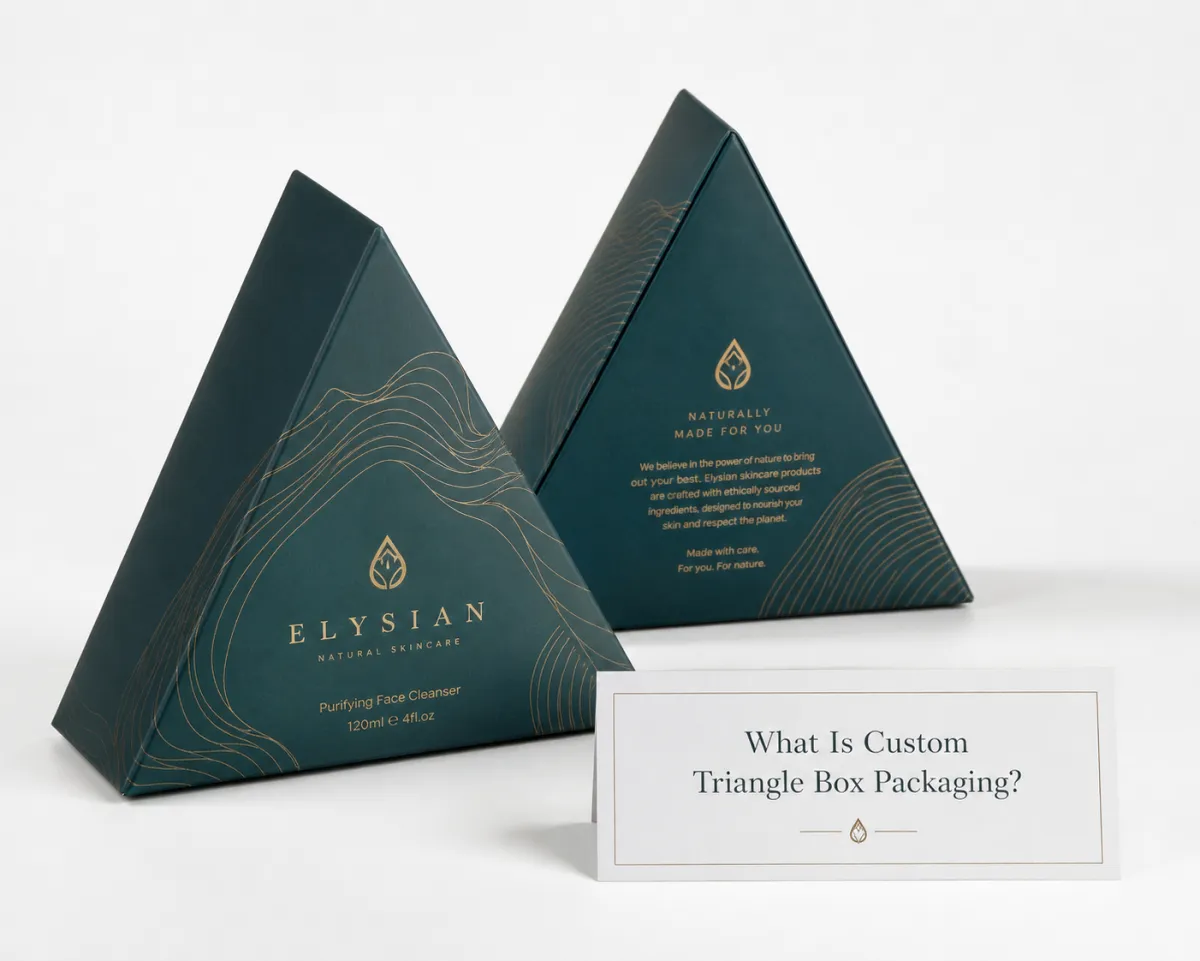
Custom triangle box packaging is a carton or folding box built around a triangular profile instead of the usual rectangle. The idea sounds simple until you start mapping the folds. Each face becomes a visible panel, each score line affects how the box stands, and each closure has to work harder because the geometry gives you less forgiveness than a basic square box. In practice, custom triangle box packaging often gets chosen because the format creates instant visual interest before the shopper even touches the product.
It shows up in retail packaging, gifting, promo kits, subscription inserts, and display-ready product launches. Candles are a common fit. So are small apparel items, cosmetics, snack packs, tea tubes, and compact branded gift sets. The shape also works well when a brand wants a cleaner premium look without moving into rigid boxes. A triangle carton can do a lot with a little, which is one reason custom triangle box packaging has become a favorite for brands trying to stand out without building an entire luxury unboxing system from scratch.
Buyers should keep the practical side in mind. A triangle box draws the eye because the shape is unusual, but the same shape affects stacking, filling, and material use. If the structure is too loose, the carton can buckle at the edges. If the board is too light, the box may look clever on screen and flimsy in person. If the panel sizes are off, the artwork will feel cramped. That is where custom triangle box packaging goes from smart to annoying.
I like a simple rule here: if the product needs the carton to help sell it, the packaging design has to be cleaner than average. If the product is already strong and the box only needs to support the brand story, the structure can stay simpler and the money can go into better board, cleaner print, and less decorative noise. Straightforward choices win more often than people think.
Another useful way to think about custom triangle box packaging is as a branding tool that also behaves like packaging. Plenty of teams reverse that order. They start with a dramatic mockup and only later ask whether the box can be folded, filled, or shipped at scale. The better triangle cartons balance shape, strength, and usability so the packaging works in the warehouse as well as it does in a product photo.
For brands building a new line, custom triangle box packaging can also support a stronger family look across multiple SKUs. A single structural system with different colors, finishes, or window placements can create continuity without making every item look identical. That helps with branded packaging because the product range feels related while each SKU still keeps a clear role.
How Custom Triangle Box Packaging Works
Custom triangle box packaging starts as a flat dieline, not a finished carton. That dieline maps the folds, glue areas, closure tabs, and cut lines that create the triangular shape once the sheet is scored and folded. Anyone used to rectangular folding cartons will notice the difference right away: the geometry does more work, so the structure has to hold its shape while still staying simple enough for production crews to assemble without fighting it.
Most triangle cartons include a base panel, two side panels that form the angled faces, glue tabs, and a top or bottom closure that may tuck in, lock, or seal with adhesive. Some styles use a side seam like a standard carton. Others use a wraparound format with more visible edges. Either way, custom triangle box packaging lives or dies by the accuracy of the dieline. If the angles are off by even a little, the finished box will show it immediately.
The production flow usually looks like this: design, die-cutting, scoring, folding, gluing, printing, coating, and final assembly. For custom triangle box packaging, the print step matters more than people expect because the triangular faces are highly visible. Weak layout makes the carton look lopsided. Strong layout makes the box feel more expensive than it probably is. That is not magic. It is disciplined packaging design.
Depending on the product, the box may open from the top, the end, or one angled face. Product insertion can happen by hand or by machine, though hand packout is more common for shorter runs. If the item is fragile or narrow, custom triangle box packaging may need an insert, cradle, or liner to stop the product from shifting. I would rather spec a simple paperboard insert than let a nice box fail because the contents move around like loose hardware in a drawer.
Finishing is where brands tend to spend or over-spend. Custom triangle box packaging can be fully printed, spot UV coated, foil stamped, embossed, debossed, windowed, or kept minimal with a clean matte look. None of those choices is wrong. The wrong move is treating finish selection as decoration only. A glossy surface can improve scuff resistance. A matte coating can hide handling marks. A window can sell the product, but it also adds another production step. Every finish needs a reason.
If the box is going into ecommerce or parcel distribution, ask whether the design needs to pass handling checks similar to ISTA testing guidance. That does not mean every small launch needs a formal lab program, but it does mean you should respect drop, vibration, and compression risk. Triangle shapes can look stable on a table and behave differently in transit. Packaging does not care about your mood board.
One more production reality: custom triangle box packaging can be made from lightweight folding carton board, heavier paperboard, or laminated corrugated stock depending on the application. A premium retail carton might use 350gsm to 400gsm SBS or C1S board. A mailer-oriented version might use E-flute or B-flute corrugated for more crush resistance. The board choice changes both the feel and the cost, which is why structure and material should be decided together.
If recycled content or chain-of-custody certification matters to the brand, ask about FSC-certified stock and look at the general standard reference at FSC. That matters more than some teams admit, especially in retail packaging where buyers and retailers care about sourcing claims.
Custom Triangle Box Packaging Costs and Pricing Factors
Pricing for custom triangle box packaging is not random, but it can feel that way if you only ask for one quote at one quantity. The real unit cost depends on board stock, size, print coverage, finishing, closure style, and whether the shape requires special tooling or extra handwork. Small differences in structure can move the price more than a prettier artwork file ever will.
The short version is simple. Smaller runs cost more per unit. That is true for almost every custom packaging job, and custom triangle box packaging is no exception. Setup costs for die-cutting, proofing, and press preparation get spread across fewer boxes on low-volume orders, so a 100-piece run will almost always look expensive next to a 5,000-piece run. Not because suppliers are being dramatic. Because math exists.
For simple custom triangle box packaging, a rough range for small runs of 100 to 250 units might land around $1.60 to $3.20 per unit, depending on size and finishing. At 500 units, that may drop closer to $0.90 to $1.80. At 1,000 to 2,500 units, a common range is $0.55 to $1.20. Larger runs can move into the $0.22 to $0.55 range, again depending on how detailed the spec gets. Those numbers are directional, not a promise, but they are useful for planning.
| Order Quantity | Typical Unit Cost | Best Fit | Cost Notes |
|---|---|---|---|
| 100-250 | $1.60-$3.20 | Testing a concept or a small launch | Setup costs dominate the price |
| 500 | $0.90-$1.80 | Short retail runs and seasonal items | Better spread of tooling and proofing |
| 1,000-2,500 | $0.55-$1.20 | Established SKUs and repeat orders | Usually the sweet spot for many brands |
| 5,000+ | $0.22-$0.55 | Higher-volume retail or subscription programs | Most efficient pricing if the spec stays simple |
A few cost drivers deserve special attention. Print coverage matters because full-bleed artwork uses more ink and usually more setup care than a one-color design. Finishing matters because foil stamping, embossing, soft-touch lamination, and spot UV all add steps. Closures matter because a self-locking structure is not always cheaper than a glued one once you factor in assembly. And special tooling matters because a custom window, unusual flap, or insert can add a separate process or die.
There are also hidden costs that show up after the first quote. Artwork revisions can burn time and sometimes money if they require new proofs. Prototypes can cost extra, especially if you want more than one sample. Window patches, internal inserts, and rush production are all common add-ons. A rush order can raise the total by 15% to 30% depending on the schedule and the supplier. That is why custom triangle box packaging should be quoted at multiple quantities before anyone starts celebrating a supposed deal.
My practical buying advice is simple: request quotes at 100, 500, 1,000, and 5,000 units if your forecast might grow. That shows you the break point where the unit price drops enough to justify a bigger order. It also tells you whether a more expensive finish still makes sense at scale. Sometimes the answer is yes. Sometimes the answer is, "We paid extra to make the box shinier, and nobody cared." That happens more often than teams admit.
If your product line includes several package sizes, compare custom triangle box packaging against other Custom Packaging Products before you lock the structure. A slightly different carton style can sometimes save enough on board or assembly to fund a stronger print treatment elsewhere.
Custom Triangle Box Packaging Process and Timeline
Custom triangle box packaging should be treated like a multi-step production job, not a quick print order you can fake at the last minute. The workflow usually starts with a brief, then a dieline, then design, sampling, approval, production, finishing, packing, and shipping. If one step slips, the whole schedule slips. Packaging is rude like that.
A typical timeline for straightforward custom triangle box packaging might look like this: 1 to 3 business days for brief review and dieline setup, 2 to 4 business days for initial artwork proofing, 5 to 10 business days for a sample or prototype, and 10 to 20 business days for production after final approval. Add shipping time on top. If the job includes foil, embossing, window patches, or a custom insert, give yourself more breathing room.
The longest delays usually come from avoidable mistakes. Artwork may not match the dieline. Bleeds may be missing. A logo might land too close to a fold. Someone decides the size needs to change after the sample is already built. Or the approval chain drags because five people want one more look. That is how a neat production plan turns into a schedule fire.
Sampling deserves more respect than it gets. A simple triangle carton can sample quickly, but a more complex custom triangle box packaging project may need a second round if the closure is tight or the print has to align across multiple faces. If the product is expensive, fragile, or tightly fitted, a prototype is cheaper than a mistake in mass production. No one loves paying for a sample twice. They love paying for a failed 5,000-piece run even less.
For shipping-based programs, I would also ask whether the box needs to survive parcel handling or only shelf display. That question changes everything. A retail-first carton can use lighter board and a thinner coat. A shipping-first version may need stronger board, better compression resistance, or an outer mailer. The difference is not theoretical. It shows up in crushed edges and customer complaints.
One useful planning habit is to write the timeline backward from the launch date. Start with the store opening, campaign mail date, or fulfillment deadline. Then subtract shipping time, production time, sample time, and a buffer for revisions. For custom triangle box packaging, that buffer should be real, not imaginary. If the schedule only works when every approval happens instantly, the schedule is fake.
Many brands also forget to reserve time for a final packout test. That matters because the finished product may behave differently from the dummy sample. A real bottle, candle, or cosmetic jar can change how the carton closes or how much pressure the face panels take. That is why custom triangle box packaging should always be tested with the actual product, not just a foam placeholder and optimism.
Step-by-Step Guide to Planning the Box
Good custom triangle box packaging starts with product data, not artwork. Measure the product itself, not the marketing label. Record length, width, height, weight, and any fragile points. If the product has a cap, pump, handle, or irregular edge, note that too. Then decide whether it needs an insert, liner, or protective fold. A box that looks perfect around a photo mockup can fail badly once the real item arrives.
Next, choose the structure with a purpose. Ask whether the carton is primarily display-first, shipping-first, or gift-first. That decision affects the board grade, closure style, and even the print approach. Display-first custom triangle box packaging can use cleaner surfaces and lighter board. Shipping-first packaging may need more structure and a more conservative finish. Gift-first cartons can justify decorative treatments, but only if the product price supports them.
After that, confirm the branding plan. Which faces need the logo? Where should the product name sit? Is one triangle face reserved for regulatory copy or ingredients? Is there enough room for barcode placement? In custom triangle box packaging, face size matters because each side is visible from a different angle. A design that works on a flat rectangle may feel crowded on a triangle if the copy is not edited down properly.
I like to see a one-page spec sheet before quotes go out. It should include dimensions, target quantity, board preference, finish preference, shipping method, and whether a prototype is required. That keeps quotes comparable. It also helps suppliers avoid guessing, which is a nice change of pace in packaging procurement.
- Product dimensions: finished size plus clearance for fit
- Weight and fragility: helps determine board grade and insert need
- Artwork requirements: logo files, copy, barcode, and legal text
- Finish choices: matte, gloss, soft-touch, foil, emboss, or none
- Shipping method: retail carton, pallet, parcel, or ecommerce
Once the artwork is in motion, check printable areas, safe zones, and bleed on the dieline. Confirm whether the triangle faces align well with the core message. If the design needs repetition, make sure the layout does not create awkward seams or dead zones. Custom triangle box packaging can be elegant, but only if the graphic rhythm matches the structure. Otherwise the box looks like it was designed by committee, which is usually true, and usually not a compliment.
Then approve a prototype before mass production. Test the opening behavior. Test the shelf presence. Test the closure strength. Test the box with the actual product inside. If the item slides, rattles, or presses too hard on the panel edge, change the spec before the run starts. That is the cheapest moment to catch a problem in custom triangle box packaging, which is why it should never be skipped for a tight-fit or premium launch.
For companies building a broader line of product packaging, it can help to review the rest of the Custom Packaging Products catalog during planning. Sometimes the best answer is still a triangle carton. Sometimes it is a triangle carton paired with a sleeve, insert, or outer shipper. That combination can work better than forcing one box to do everything.
Common Mistakes With Triangle Box Packaging
The most common mistake in custom triangle box packaging is sizing to the label instead of the product. Labels are flat. Products are not. That simple disconnect leads to crushed corners, loose fit, or a box that has to be forced closed. A triangle carton looks crisp only when the internal dimensions actually match the object it carries.
Another mistake is assuming good graphics can rescue a weak structure. They cannot. Beautiful artwork does not fix a closure that pops open or a board that buckles under light pressure. I have seen brands spend heavily on foil, embossing, and rich color only to lose the effect because the carton felt flimsy in the hand. If the box is supposed to feel premium, custom triangle box packaging needs a structural spec that supports that feeling.
Shipping errors are also common. Triangle cartons can ship well, but only if the secondary packaging and carton orientation are planned with the final route in mind. If the box is going into a master carton, orient it so the faces are not taking the full load on one seam. If the product is fragile, add an insert or outer shipper. If the retail unit is being mailed directly, test it under parcel conditions, not just on a clean table in a bright room.
Budget creep is another trap. Special finishes look tempting because they show well in mockups. But every extra process adds cost and failure points. A window cutout, soft-touch lamination, foil stamp, and embossed logo can make custom triangle box packaging expensive without improving sales. That does not mean premium finishes are bad. It means they need a commercial reason. If the finish does not support brand positioning, stop paying for it.
"A triangle box is only premium if the structure behaves." That is the part most mockups skip. A clean box that closes correctly beats a flashy carton that fights the customer every time.
There is also a classic approval mistake: teams review artwork on a flat screen and ignore the folds. On a triangle, those fold lines can cut through copy, interrupt patterns, or make logos sit at strange angles. Custom triangle box packaging needs a layout review that treats the carton as a 3D object, not a poster. That means checking side-by-side faces, closure alignment, and what shows first when the box is picked up.
Finally, do not assume the cheapest quote is the best one. A low bid can be perfectly fine, or it can be missing something important like a tighter tolerance, better board, or proper finishing allowance. Ask what is included. Ask how many revisions are covered. Ask whether a sample is part of the quote. The gap between "cheap" and "good value" is where many packaging surprises live.
Expert Tips and Next Steps Before You Order
If you want custom triangle box packaging to work on the first serious run, keep the spec clean. I mean really clean. Use one-page requirements, not a ten-page wish list with half the team's opinions attached. Decide the target quantity, finish level, and shipping method before you ask for pricing. That makes comparisons easier and stops quote drift before it starts.
Ask for at least three supplier quotes on the same specification. Otherwise you are not comparing prices. You are comparing different assumptions. One quote might include a better board grade, another might skip a finish, and a third might quietly leave out the insert you actually need. Comparing apples-to-apples saves time and reduces the odds of a budget surprise later.
For sustainable or compliance-sensitive projects, ask for FSC-certified stock if the supply chain supports it. That does not automatically make the box perfect, but it is a sensible starting point for responsible sourcing. Pair that with realistic waste planning. Custom triangle box packaging can look premium and still be practical if the board choice and finish are intentional, not decorative by default.
- Confirm the structure: lock the dieline before polishing the artwork
- Test with the real product: not a dummy shape, not a guess
- Review the closure: make sure it opens cleanly and stays shut
- Verify the finish: choose it for function as well as appearance
- Keep a backup plan: have a simpler version ready if the premium spec runs hot on cost
That last point matters more than people want to admit. Sometimes custom triangle box packaging is the right fit only if the job is scaled correctly. A smaller run with a premium finish can be perfect for launch. A larger run may need a simpler build to protect margin. The right answer depends on sales velocity, channel, and how much of the package is doing real work versus just looking expensive.
Before you place the order, ask for a physical sample, check the fit, approve the print, and only then move into production. If the plan is for the box to support branded packaging across a broader range, make sure the structure can be repeated cleanly across future SKUs. Good systems scale. Messy ones become expensive habits.
The smart move is plain: lock the structure, confirm the materials, approve a sample, and then move custom triangle box packaging into production with your eyes open. That is how you get a carton that looks distinctive without turning the project into a guessing contest.
How much does custom triangle box packaging usually cost?
Pricing depends on size, board grade, print coverage, and finishing. Small runs usually cost more per unit because setup fees are spread across fewer boxes. For planning, ask for quotes at 100, 500, and 1,000 units so you can see where the break point actually sits.
What products work best in triangle box packaging?
Small, premium, or giftable products usually fit best. Candles, cosmetics, specialty food items, and promo kits are common matches. If the item is heavy or fragile, plan for inserts or a reinforced board so the carton does not become the weak link.
Can custom triangle box packaging be shipped flat?
Yes, many triangle cartons are designed to ship flat before assembly. Flat shipping saves space and often lowers freight cost. Confirm whether the box is self-locking or needs glue at packout so the assembly plan matches your labor budget.
How long does custom triangle box packaging take to produce?
Simple projects can move quickly if the dieline is ready and approvals are fast. Sampling, revisions, and special finishes add time. Build extra time into the schedule if you need a prototype or a custom insert, because that is where the calendar usually starts to stretch.
Do I need a prototype for custom triangle box packaging?
Yes, if the product is tight-fitting, fragile, or premium enough that fit matters. A prototype helps catch sizing, closure, and print alignment issues early. Skipping the sample is how people end up paying twice, which is a very expensive way to learn a basic lesson.
Custom triangle box packaging works best when the design, cost, and timeline are treated as one job instead of three separate arguments. Get the structure right, keep the artwork disciplined, and respect the sample stage, and the box will do its job instead of fighting the brand. The practical takeaway is simple: lock the dieline first, test with the real product, and only then commit to production so the carton performs the way it looks on paper.

