Custom USPS boxes look straightforward until the first cartons leave your packing table and start taking real abuse. A box that photographs well can still fail under stacking pressure, friction from conveyor systems, rough handoffs, or a route that includes a few extra drops than anyone planned for. That is the split buyers have to manage: presentation on one side, survival on the other.
The difference between a clean delivery and a claim is often smaller than it should be. A few millimeters of extra space can let a product rattle. A tight fit can crush corners or force the closure tabs to deform. A good box is not just branded packaging with a shipping label on it. It is a structure tuned to the weight, fragility, and packing process of the item inside.
If you are ordering custom usps boxes, think like a production buyer. Ask what happens when the box is stacked, dropped, stored, and packed by humans who repeat the same motion hundreds of times a day. That is where a packaging spec proves itself or falls apart.
Why custom USPS boxes look simple until one shipment gets crushed
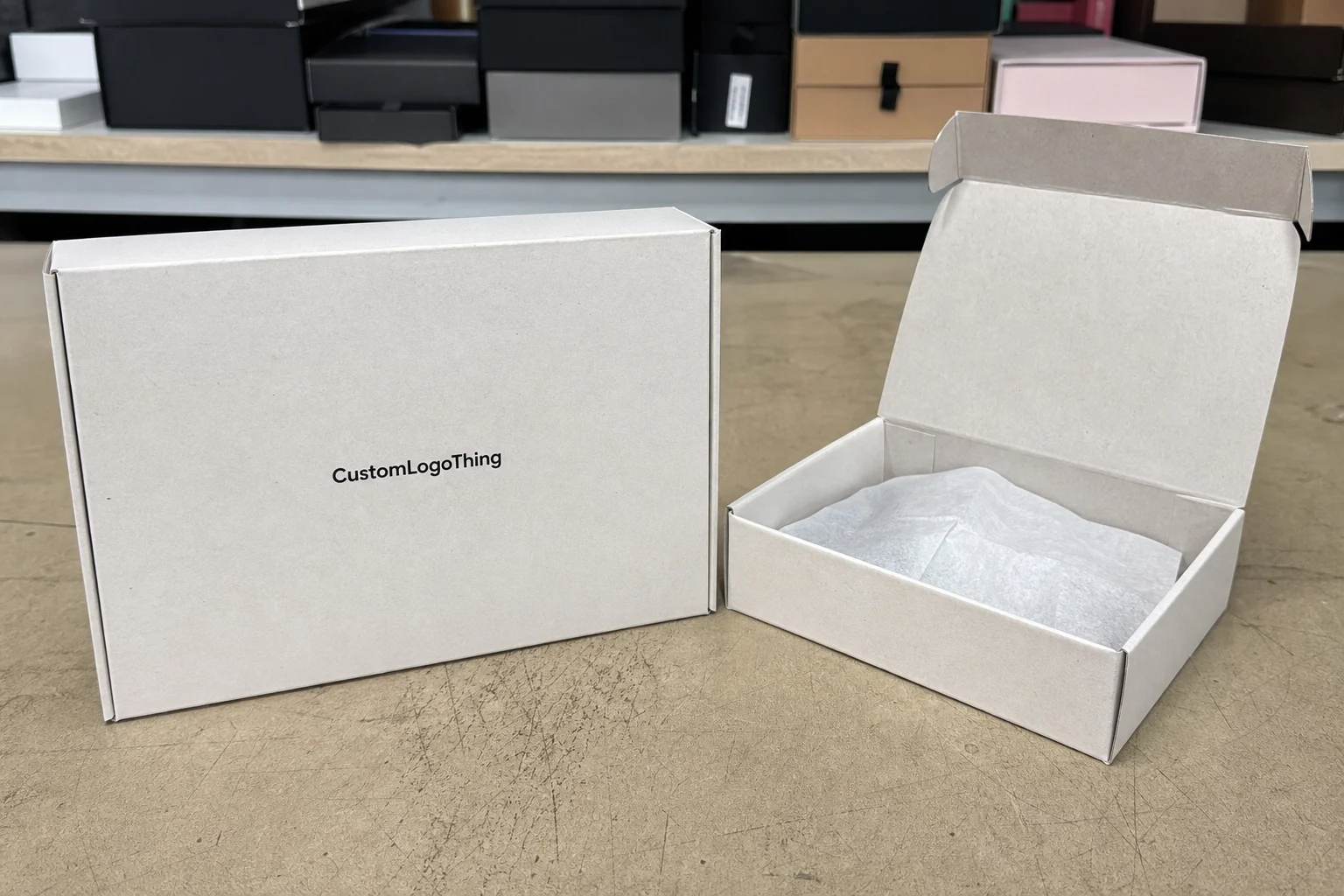
Most packaging mistakes begin with the assumption that outside dimensions are the whole story. They are not. The outside size helps with shipping estimates and storage planning, but the interior space decides whether the product moves, compresses, or sits securely. If the internal fit is wrong, the whole package becomes unstable before it ever reaches a carrier.
That problem gets worse when the contents are dense, fragile, or irregular. Cosmetics, electronics, glass bottles, and boxed sets all behave differently in transit. One SKU may need only a light corrugated mailer and paper filler. Another may need a stronger board, an insert, and a tighter closure system. A one-size approach rarely survives real shipping conditions for long.
There is also a mismatch between what looks premium and what actually protects the contents. Heavy print coverage, special finishes, and crisp graphics can improve shelf appeal and unboxing quality, but they do not compensate for weak seams or thin board. If the structure fails, the customer notices the failure before they notice the branding.
That is why buyers should treat custom packaging as a performance item, not a decorative one. The brand story matters, but the box has to earn the right to tell it.
“A box that looks expensive but arrives damaged is not premium. It is just expensive.”
One practical caveat: if your artwork includes USPS marks, service language, or postal references, the design still has to fit the service rules you are actually using. Custom printing does not override mail-class requirements. And if you are using official USPS-provided packaging, that is a separate matter entirely, because those cartons are not meant to be rebranded as though they were a private-label format.
How custom USPS boxes work in transit
Once a box leaves the pack station, the details become mechanical. Board grade, flute structure, closure style, seam placement, and adhesive performance matter more than a rendering ever will. A 32 ECT single-wall mailer behaves differently from a heavier double-wall structure. A tuck-top style behaves differently from a glued mailer with a stronger front panel. The box either supports the contents or it does not.
Internal dimensions are the number that should drive the order. If the product is 7.2 by 4.8 by 2.1 inches and the insert requires another 0.1 to 0.2 inch of clearance, that margin has to be built into the spec from the start. Small differences matter. Two or three millimeters can change whether the packout feels snug, forced, or loose.
Print placement also matters more than most first-time buyers expect. Artwork too close to folds can distort. Small text near seam areas can disappear once the board is folded. Barcodes, regulatory marks, and shipping identifiers should sit in stable zones where die-cutting and overlap will not interfere. What looks clean in a flat proof can shift once the carton is assembled.
For fragile shipments, the protective system matters as much as the exterior shell. That may mean an insert, a paper wrap, corner protection, or a stronger flute. In some cases, the cheapest improvement is a simple one: eliminate excess void space so the item does not move. In others, a stronger board grade is the only reasonable fix. The box has to fit the product and the route, not just the budget.
Testing is the closest thing to a reality check. ISTA test methods are widely used as a reference for simulated shipping stress, and they are useful because they reveal failures before a customer does. For brands that want a responsible fiber story, FSC documentation is also worth requesting so material claims can be supported cleanly rather than guessed later.
The right box is rarely the fanciest one. It is the one that stays square, packs quickly, and protects the contents without adding avoidable weight or labor. That is what good product packaging is supposed to do.
Cost, pricing, and MOQ: what changes the quote
Pricing for custom USPS boxes usually comes down to five variables: quantity, board grade, print coverage, finishing, and whether inserts or special construction are involved. Quantity carries the most weight because setup costs do not disappear; they simply get spread across more or fewer units. That is why a small run can look expensive per box even when the material itself is not.
MOQ means minimum order quantity, the smallest production run a supplier will take on without making the economics ugly. Lower quantities usually carry higher unit costs because tooling, setup, proofing, and labor are distributed over fewer cartons. That is not a markup trick. It is the cost structure of short-run manufacturing.
For planning purposes, broad pricing ranges are more useful than fake precision. Exact costs depend on the dimensions, board, and coverage, but these ranges are realistic enough to frame a budget conversation:
| Option | Typical Use | Approx. Unit Cost at Medium Volume | Notes |
|---|---|---|---|
| Single-wall mailer | Light products with moderate shipping stress | $0.42-$0.78 | Useful when presentation matters but the contents are not especially heavy |
| Heavier mailer or double-wall style | Fragile items or denser contents | $0.68-$1.20 | More board, more protection, and usually more freight weight |
| Insert kit | Precision fit for product packaging | +$0.06-$0.22 | Common for cosmetics, electronics, and mixed-item retail packaging |
| Special finish | Premium presentation and visual impact | +$0.10-$0.30 | Soft-touch, foil, spot UV, and heavy coating all add cost and process time |
What should a quote actually include? Unit price, tooling or die charges, proof charges, sample charges, freight assumptions, and whether inserts are included. If any of those are missing, you are not comparing equivalent quotes. You are comparing one supplier’s full landed price against another supplier’s partial number.
If the goal is to reduce cost without damaging performance, cut complexity before you cut quality. Standardize a size where possible. Reduce the number of print colors. Simplify the finish. Reuse one insert style across multiple SKUs if the product family allows it. If you need a starting point for standard formats and related custom packaging products, Custom Packaging Products is the logical place to sort the structure before tooling begins.
Freight should not be treated as an afterthought. A low unit cost can become the wrong decision once shipping, storage, and repacking labor are added. The number that matters is landed cost, because that is what hits the margin.
Process and timeline: from dieline approval to delivery
A clean order starts with measurement. Not estimates. Measure the product, any insert, the closure method, and the clearance needed for a comfortable packout. Then decide whether the contents need a simple mailer, a heavier corrugated structure, or a more controlled insert system. The best format depends on weight, fragility, and how the item will be handled after it leaves your hands.
After the dimensions are set, the dieline comes next. The dieline is the flat template that shows folds, cuts, glue areas, and safe zones. If artwork ignores the dieline, the final carton can look misaligned even when the file looked perfect on a monitor. This is one of those problems that is predictable if the spec is checked early and annoying if it is checked late.
Proof review is where a lot of time gets lost, because buyers often look at color first and structure second. The correct order is the reverse. Confirm panel orientation, fold lines, barcode placement, margins, and shipping marks before worrying about subtle color shifts. A beautiful proof with the wrong dimensions is still wrong.
A realistic timeline often looks like this:
- Artwork and spec confirmation: 1-3 business days
- Dieline or proof review: 2-5 business days
- Production: 7-15 business days, depending on complexity
- Finishing and packing: 1-3 business days
- Freight transit: 2-7 business days, depending on destination
That puts many orders in the 12-25 business day range from approval to delivery. Rush jobs can be faster, but they leave less room for revisions and usually cost more. Once a proof is approved, the ability to correct artwork or structural mistakes narrows fast. Manufacturing is not forgiving in that way.
If the project is new, break the schedule into phases instead of treating it as one deadline. Proof time is not production time. Production time is not freight time. Keeping those separate makes the process easier to manage and exposes delays before they become expensive.
Step-by-step setup for a clean first order
Start with the actual product, not the concept of the product. Measure width, depth, and height, then account for the insert, wrap, or padding that will be used in the real packout. If the item ships as a set, measure it assembled. A surprising number of box problems begin with someone measuring components separately and assuming the finished bundle will behave the same way. It will not.
Choose the structure based on the contents and the route. A folding mailer works well for moderate protection and a cleaner presentation. A stronger corrugated style is better for denser items or products likely to experience rough handling. If your orders go through both direct-to-consumer and wholesale channels, the same carton may not serve both environments equally well. That is a design constraint, not a fault in the product.
Artwork should be built against the real panel sizes. Keep critical text away from seams and folds. Keep the logo large enough to survive handling and minor scuffs. Leave room for shipping labels and operational marks if they need to sit on the same carton. Good packaging design usually looks simple because the crowded parts were handled before print, not after.
Then request a proof or sample and pack a real product into it. Not a placeholder. Not foam cut to approximate size. Use the real item, close the box, shake it, stack a few units, and inspect the corners and closure tabs. A sample that fails under those conditions is useful because it exposed the weakness before a full run of custom usps boxes was produced.
- Write a one-page spec with product dimensions, target quantity, print requirements, insert details, and shipping method.
- Ask for pricing at two or three quantity breaks so you can see where the unit economics actually improve.
- Review the proof carefully and correct it before tooling starts.
- Run a pilot shipment and inspect the carton after it moves through an actual carrier network.
If the pilot performs well, freeze the spec and reuse it. Stable packaging programs are built on repetition, not improvisation. Reusing the same board grade, dieline, and approval notes also makes the reorder cycle faster and less error-prone.
Common mistakes that cause damage, reprints, and wasted budget
The first mistake is sizing from the outside only. Exterior dimensions help with storage and shipping estimates, but they do not show how much usable space is inside the carton. Internal fit controls movement, pressure, and the final feel of the package. Ignore that and the first damage claim becomes a packaging issue, not a logistics mystery.
The second mistake is placing key artwork too close to folds, seams, and tuck areas. That is how logos get split and small text disappears after assembly. In custom printed boxes, the flat file is only a promise. The folded box is the real product.
The third mistake is skipping the test ship. A carton can look flawless in hand and still fail after vibration, stacking, or temperature changes. ISTA methods are useful precisely because they simulate those conditions instead of trusting appearance. If the box has not been challenged, it has not been validated.
The fourth mistake is ignoring the full landed cost. Unit price matters, but so do freight, storage, packing labor, and reprints. A cheap carton that damages product or arrives too late is not cheap. It is an avoided cost that was never actually avoided.
There is also a branding error that shows up more often than it should: the design team focuses on finish and color while the operations team quietly inherits a box that is slow to pack or too fragile for transit. That is a bad trade. Retail packaging still has to move through a shipping lane. If it only works as a photo prop, the customer sees the flaw before they see the brand story.
“If the box only works when it is empty, it is not a shipping box. It is a display prop.”
One way to reduce risk is to keep a standard structure available while the custom version is being refined. If the dimensions are still being tested, start with a known carton format from Custom Packaging Products, then move to the custom spec once the fit and protection level are confirmed.
Actionable next steps for a cleaner reorder
Put the full spec in one place. Product size, quantity, print colors, finish, insert, shipping method, and intended use case should all live on the same page. When those details are spread across a trail of emails, reorders get messy fast. When they are consolidated, the quote is more accurate and the approval process is easier.
Ask for two or three quantity breaks. That shows where the unit price actually changes and helps separate real savings from wishful thinking. Sometimes the difference between 1,000 and 2,500 pieces is modest. Sometimes the price drop is meaningful enough to justify the larger run. Without the breakpoints, you are guessing.
Request a proof, then order a pilot quantity if the program is new. Use the pilot to check registration, fit, shipping strength, and visual consistency. If the carton survives that stage and the print holds up, the spec is probably ready for repeat production. Consistency matters more than novelty in packaging operations.
Before the reorder is locked, check three things again:
- Inside dimensions match the actual product plus the needed clearance
- Artwork stays inside safe zones and away from folds or seams
- The shipping method and carton strength match the product weight
After that, reuse the same die, the same structure, and the same approval notes. It cuts errors, shortens the reorder cycle, and keeps custom usps boxes consistent from one run to the next. That consistency is what makes the packaging program feel controlled instead of improvised.
Are custom USPS boxes allowed for Priority Mail shipments?
Yes, provided the carton is your own packaging and the service rules are followed. The box still needs to fit the mail class, size limits, and labeling requirements you are using. If the artwork includes USPS marks or service language, confirm that the layout is appropriate before production. If you are using USPS-provided free packaging, do not treat it as a custom-branded carton.
How much do custom USPS boxes usually cost per unit?
Unit cost depends most on quantity, board grade, print coverage, and whether inserts or finishes are added. Smaller runs cost more per box because setup is spread across fewer pieces, while larger runs usually lower the price. For planning, quantity breaks are more useful than a single quote.
What is a normal turnaround for custom USPS boxes?
Turnaround includes proof approval, production, finishing, and freight, so do not judge it by print time alone. A straightforward run may finish in a couple of weeks, while more complex orders take longer. Rush timelines are possible, but they reduce room for corrections and usually cost more.
What files do I need to start a custom USPS box order?
At minimum, provide product dimensions, target quantity, print requirements, and a clean artwork file or logo source. If you already have a dieline, send it. If not, the supplier should build one from the box style and dimensions so the layout matches the final structure.
What should I check before approving custom USPS boxes?
Confirm the inside dimensions, print placement, safe zones, and any service marks or shipping information that need to stay visible. Test-pack one real product and, if possible, send a pilot shipment before approving the full production run. That one test can save you from a costly reprint or a damaged first order.