Custom vinyl labels do more than carry a logo. They sit in the same system as garment packaging, hang tags, inserts, and shipper boxes, and they have to survive handling without looking tired before the customer even opens the bag. If the label peels, cracks, or fades, the rest of the presentation starts working against you.
That is why buyers should treat the label as a production spec, not a decorative extra. A clean proof is nice. A label that stays attached, stays legible, and still looks intentional after folding, packing, and transit is the part that matters.
There is also a practical side people skip over. The same design can behave very differently on cotton, polyester, fleece, coated fabric, or a stretch blend. One material choice can make a label feel premium. Another can turn it into a liability. Funny how that works.
What custom vinyl labels are and why apparel brands use them
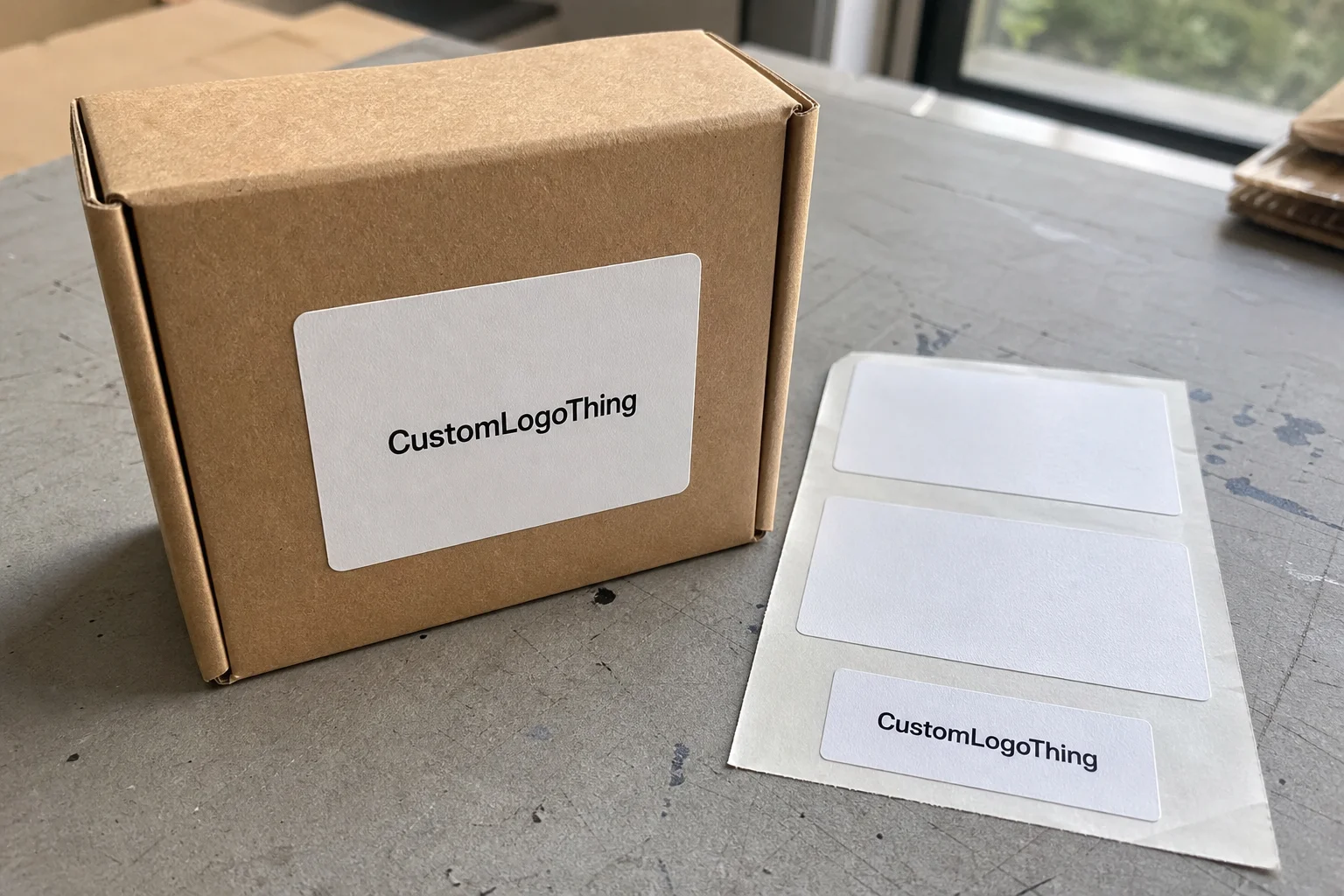
Custom vinyl labels are flexible labels made from a vinyl face stock that is printed, cut, or both, then finished for use on apparel or related packaging. Depending on the use case, they may be pressure-sensitive, heat-applied, or sewn in. The appeal is straightforward: they can hold sharp graphics, bold color, and small details without the texture of a woven label or the fragility of a paper sticker.
Apparel brands use them in a few recurring ways. Neck labels need clear typography and fast readability. Hem and sleeve marks need a low-profile look that does not fight the garment shape. Care information and size identifiers need clarity first and style second. Temporary promo labels are a separate category because residue, removability, and shelf presentation matter more than permanence.
Placement changes the spec more than most first-time buyers expect. A label on a heavy hoodie can tolerate a different build than one on a soft tee or a coated performance layer. The same is true for retail kits and folded garments. What works on a flat sample can fail once the product is compressed, stretched, or stored in a carton.
- Neck labels: brand identity, size, and origin information.
- Hem or sleeve tags: secondary branding and retail visibility.
- Care or size markers: clear, standardized, and easy to reproduce.
- Promo or seal labels: short-term use on packaging or kitting.
For brands building a broader packaging system, the label should support the whole presentation instead of sitting apart from it. That means it needs to align with insert cards, hang tags, and the outer carton or mailer. If you need a broader sourcing reference, see Custom Labels & Tags and Custom Packaging Products.
How the label structure and application method work
The graphic is only one layer of the decision. The build underneath is what determines whether the label behaves well in production and after sale. A typical construction includes a face stock, an adhesive or transfer layer, a liner, and sometimes a protective laminate or overcoat. Each layer affects print quality, die cutting, handling, and durability.
There are three common constructions. Pressure-sensitive labels adhere directly to the garment or insert using a formulated adhesive. Heat-applied labels bond under pressure and temperature, which can give a cleaner finish on certain fabrics. Sewn-in vinyl labels are less common than sewn woven labels, but they still show up when a brand wants a very specific look or a more permanent attachment.
The right choice depends on fabric behavior, wash exposure, and whether the label is supposed to stay put for good or come off later. That last point sounds obvious. It is not obvious to everyone placing the order.
Artwork becomes a production file quickly. A designer may send a logo, but production needs a die line, cut path, safe margins, color builds, and clear type hierarchy. Tiny reversed text can fill in. Fine lines can vanish. Sharp internal corners can lift sooner than rounded ones. The file may look polished and still be unbuildable.
A sample that looks fine on a desk but lifts after one warm wash is not ready for production.
Proofing should cover more than the visible design. Look for gloss versus matte, opacity on dark fabric, edge fidelity, and registration accuracy. Those details tell you more about the final result than a clean mockup ever will.
Key specs that change durability, finish, and hand feel
Material thickness is one of the first Specs to Check. A thinner, more flexible face stock usually conforms better to soft garments and lowers the chance of curling. A heavier build can feel sturdier, but too much thickness creates a stiff edge that people notice immediately. For apparel, that tradeoff matters.
Adhesive strength comes next. Cotton behaves differently from polyester. Blends behave differently from coated performance fabrics. A label that bonds well to one surface may start lifting at the edges on another, especially after compression in a polybag or repeated motion in transit. Heat-activated systems need the right temperature and dwell time. Pressure-sensitive systems need a clean surface and enough cure time before the product is handled heavily.
Finish is not just about appearance. Gloss reads brighter and more retail-forward, but it can show scratches and handling marks. Matte hides wear better and usually feels more restrained on minimalist branding. Transparent faces let the garment color show through, while opaque faces give stronger contrast on darker fabrics. Soft-touch coatings can make a label feel less plastic, though they often add cost and may narrow the adhesive options.
Size and line weight also affect performance. Large shapes and bold typography survive production more reliably than tiny type and delicate outlines. That does not mean the design has to be bland. It means the medium has limits. A label that looks elegant in a mockup may become fragile once it is cut, applied, folded, and washed. The cleanest custom vinyl labels are rarely the most ornamental ones.
Color management deserves real attention. If the artwork depends on a specific PMS match, ask how close the supplier can get on the chosen stock and finish. Bright colors shift differently on matte film than on gloss. Dark garments reduce contrast. If the label has to sit beside other branded packaging, check the color in context rather than treating it like a standalone swatch.
For brands with sustainability targets, the label should also fit the rest of the packaging program. If the label lives inside a carton or kit, the surrounding materials may need to align with FSC-certified paper or similar sourcing goals. For shipping and distribution, it is smart to borrow the discipline of ISTA test methods so the system is evaluated under realistic handling instead of ideal conditions. For paper-based components, FSC is the clean reference point.
Production steps, process, and timeline for a first order
The ordering process should feel predictable. A good supplier moves from inquiry to artwork review, then proof approval, sampling, production, finishing, and shipment. If any of those steps is vague, the schedule gets fragile fast. That matters even more when the label sits inside a launch with packaging, kitting, and retail receiving deadlines.
For a standard run, a realistic timeline is often 12-15 business days from proof approval to shipment. A simple sample can arrive in 3-5 business days, while physical proofs and Custom Die Cutting can add time. Rush programs can shorten the calendar, but they do not erase setup work, and they do not fix incomplete artwork. If the brief changes midstream, the clock moves.
These are the delays that show up most often:
- Missing vector artwork or blurry source files.
- Unclear dimensions, especially on curved or irregular shapes.
- Slow proof approval from multiple stakeholders.
- Last-minute quantity changes after production is queued.
- Changes to finish, adhesive, or placement after sampling.
Launch timing matters more than teams like to admit. If the label needs to be applied, packed, or inserted before retail ship dates, build a buffer. A one-week cushion can absorb a proof revision or a small freight delay. A zero-buffer schedule turns a minor issue into a missed drop.
Cost, pricing, MOQ, and unit cost: what changes the quote
Pricing for custom vinyl labels usually breaks into setup, materials, printing, finishing, cutting, and packing. Two quotes can look similar and still be very different once the line items are unpacked. Comparing only the unit price is how buyers end up surprised by the final invoice.
MOQ becomes more important as the label becomes more custom. Standard shapes and simpler finishes can support lower quantities, while Custom Die Cuts, specialty films, and premium adhesive systems usually need larger runs to make economic sense. The reason is simple: setup cost gets spread over more pieces as the quantity rises.
For context, a small test order may land around 250-500 pieces at a higher per-unit price, while a production run of 5,000 pieces can lower the unit cost noticeably. In apparel, that difference matters less than people think if the cheaper option fails early. Replacements, rework, and returns erase savings quickly.
| Label Type | Best Use | Typical Setup | Typical Unit Cost at Scale | Practical Notes |
|---|---|---|---|---|
| Pressure-sensitive vinyl | Neck labels, size marks, promo seals | $40-$120 | $0.08-$0.22 | Fast to produce, but fabric and adhesive compatibility matter. |
| Heat-applied vinyl | Brand marks on apparel surfaces | $60-$150 | $0.12-$0.30 | Cleaner finish on garments, but press settings must be controlled. |
| Sewn-in vinyl patch | Heritage branding, durable trim detail | $75-$180 | $0.18-$0.42 | More labor-heavy and less common, but stable for certain styles. |
Hidden costs show up more often than they should. Art cleanup may be billed separately if the file needs rebuilds. A second proof can add time and sometimes money. Expedited freight changes the total quickly, especially on smaller orders. Split shipments for multiple warehouses can also push the final number higher than expected.
The better way to judge pricing is total value. If a better adhesive prevents edge lift, you avoid replacements. If a cleaner finish supports the perceived value of the garment, the label helps the sale instead of undermining it. That is where the right spec earns its keep.
Common mistakes brands make when ordering vinyl labels
The first mistake is sending artwork that is too small, too thin, or too low-resolution. A file can look fine on a laptop and still fall apart once it is separated into cut paths and print layers. If the type is tiny or the lines are delicate, ask for a production review before final approval. That is cheaper than discovering the issue after the run is finished.
The second mistake is choosing a finish before testing it on the actual garment. A matte label that looks understated on a sample card may disappear on textured fabric. A glossy label that pops in a mockup may show scuffs after handling. The sample needs to live on the real material, not just on a white sheet in good light.
Third, some buyers assume the sample condition is the production condition. It is not. Heat, moisture, stacking pressure, and time all affect adhesion and appearance. A label that behaves in a clean sample room may behave differently after it sits in a warm carton for a week. That is especially true in retail packaging where garments are folded tightly or packed with inserts.
Another common miss is ordering for appearance only. A label can look excellent and still be wrong if it cannot survive the care routine, if it lifts on a seam line, or if it disappears under a fold once the garment is packed. The final check should always include placement visibility on the finished product, not just the label graphic itself.
Finally, brands sometimes ignore how the label interacts with the rest of the product. Folds, seams, hang tags, stickers, and outer packaging all create friction. If the label lands where the garment bends most often, wear shows up faster. If it conflicts with other branded packaging elements, the presentation gets cluttered. Small details, yes. Still the details customers notice.
Expert tips for cleaner artwork, stronger adhesion, and fewer reorders
Use bolder shapes than you think you need. Fine detail is expensive to protect and hard to keep consistent across batches. Strong contrast, simple geometry, and clear typography usually travel better from proof to finished label. That is true whether the label sits in the neck, on the sleeve, or as a secondary mark on the hem.
Ask for a physical sample when the garment fabric is stretchy, slippery, brushed, or coated. A sample on the exact substrate can reveal edge lift, surface incompatibility, and finish issues that digital proofs hide. If the supplier cannot test on the exact fabric, ask for the closest equivalent and be honest about the gap. Uncertainty handled early is cheaper than a reorder.
Standardize sizes across product families where possible. A common label format lowers setup complexity, shortens approval cycles, and makes reorders easier to manage. It also creates consistency across package branding, which matters when the apparel line sits next to other branded packaging or retail packaging systems.
Keep a spec sheet for each approved label. Include size, finish, color references, placement, fabric type, application method, and any approved sample notes. That document becomes the source of truth for future runs and keeps the project from drifting into “we thought it was the same as last time.”
Build a launch buffer into the calendar. Even a well-run order can be slowed by a proof revision, material substitution, or shipping congestion. A buffer gives the team room to protect the launch instead of forcing the supplier into an impossible schedule. That is not overplanning. That is basic risk control.
The cheapest label is the one you do not have to replace.
What to prepare before you request quotes and place the first order
Start with the basics: artwork, dimensions, target quantity, fabric type, application method, and delivery date. Include where the label will sit on the garment and how it will be handled after application if you can. Quotes get much more accurate when the use case is specific instead of broad.
Ask for a quote that separates setup, unit pricing, sampling, and freight. That makes supplier comparison fairer. A low unit price with a heavy setup fee is not always the best value, especially on smaller launches. A higher quote can still be the better move if it includes stronger proofing or a more suitable adhesive.
Before approving production, request proof images or a sample and test it on the actual garment. Check adhesion, edge lift, color clarity, and feel after handling. If the label will sit inside a broader packaging system, verify that it does not conflict with hang tags, cartons, inserts, or retail packaging placement. The goal is consistency, not isolated perfection.
- Confirm the use case: neck label, decoration, care panel, or seal.
- Lock the application method: pressure-sensitive, heat-applied, or sewn-in.
- Document the fabric: cotton, polyester, blend, coated, or stretch.
- Approve the exact spec: size, finish, color, and placement.
Once the sample is approved, do not keep revisiting the spec unless there is a real production reason. That is where projects slip. A locked spec keeps the order moving and keeps the launch team focused on the actual launch.
Custom vinyl labels work best when they are treated like a controlled component of the full product packaging system. Done well, they strengthen the garment, the shelf presence, and the unboxing moment at the same time. Done poorly, they become a reminder that the spec never got finished.
How long do custom vinyl labels last on clothing?
Lifespan depends on adhesive, fabric type, wash frequency, and whether the label is heat-applied, pressure-sensitive, or sewn in. For repeat-wash apparel, test the label on the exact garment and care routine before approving production.
Can custom vinyl labels be used on stretchy or coated fabrics?
Yes, but the adhesive and face stock need to match the fabric movement and surface finish. Stretchy, coated, or slippery fabrics usually need a sample test to confirm bond strength and edge lift resistance.
What files do I need for custom vinyl label production?
Send vector artwork when possible, along with dimensions, color references, and any die-line or shape requirements. If the design includes small type or fine lines, ask for a production review before final proof approval.
What affects the price of custom vinyl labels the most?
Quantity, setup complexity, material choice, finish type, and whether the order needs custom cutting or special adhesive. Rush production, physical samples, art cleanup, and shipping method can also change the total cost.
How do I test a vinyl label before placing a full order?
Apply the sample to the exact garment, then check adhesion, edge lift, visual clarity, and feel after handling. Run the sample through the intended wash or wear cycle before approving the final run.


