Buyer Fit Snapshot
| Best fit | Custom Warning Labels Wholesale projects where brand print, material claims, artwork control, MOQ, and repeat-order consistency need to be specified before quoting. |
|---|---|
| Quote inputs | Share finished size, material target, print colors, finish, packing count, annual reorder estimate, ship-to region, and any compliance wording. |
| Proofing check | Approve dieline scale, logo placement, barcode or warning zones, color tolerance, closure strength, and carton packing before bulk production. |
| Main risk | Vague material claims, crowded artwork, missing packing details, or unclear freight terms can make a low unit price expensive after revisions. |
Fast answer: Custom Warning Labels Wholesale: Specs, Pricing, Lead Times should be specified like a repeatable production item. The safest quote records material, print method, finish, artwork proof, packing count, and reorder notes in one written spec.
Production checks before approval
Compare the actual filled-product size with the drawing, then confirm tolerance on folds, seals, hang holes, label areas, and retail display edges. Reserve space for logos, QR codes, warning copy, and material claims before decorative graphics fill the panel.
Quote comparison points
Review material grade, print process, finish, sampling route, tooling charges, carton quantity, and freight assumptions side by side. A quote is only useful when the supplier can repeat the same color, closure quality, and packing count on the next order.
Custom warning labels wholesale looks small on a purchase order and very large on the damage report. I have seen a perfectly built carton get rejected at receiving because the warning was too tiny to read, or the adhesive started lifting before the pallet even cleared the dock. That kind of failure is not mysterious. It is usually just a skipped packaging decision.
From a buyer's perspective, custom warning labels wholesale pays back quickly because it reduces avoidable claims, repacks, and those awkward calls from the warehouse that begin with, "this needed to be marked." Clear handling instructions change behavior. People stop, notice, and move the shipment differently. The idea is simple, and simple ideas are often the ones that save the most money.
The best buyers treat custom warning labels wholesale as part of branded packaging and product packaging, not as a loose sticker added at the end. A warning label can carry a logo, color coding, multilingual text, batch numbers, or a barcode tied to warehouse routing. It can sit beside custom printed boxes without wrecking the presentation. Done well, it supports package branding and still does the one job that matters: telling people how to handle the shipment without damaging it.
A label that costs a few cents can save many times that amount if it prevents broken cartons, rejected pallets, or spoiled temperature-sensitive goods. The math is not glamorous. It is just practical. For fragile goods, orientation-sensitive products, chilled shipments, hazardous materials, or cartons that need special handling, custom warning labels wholesale is a working tool, not a decorative one.
The promise here is straightforward: no filler, no packaging talk that drifts off into poetry, just the Specs, Pricing, Lead Times, and buying questions that matter before you place an order for custom warning labels wholesale.
Custom Warning Labels Wholesale: Why They Pay Off Fast
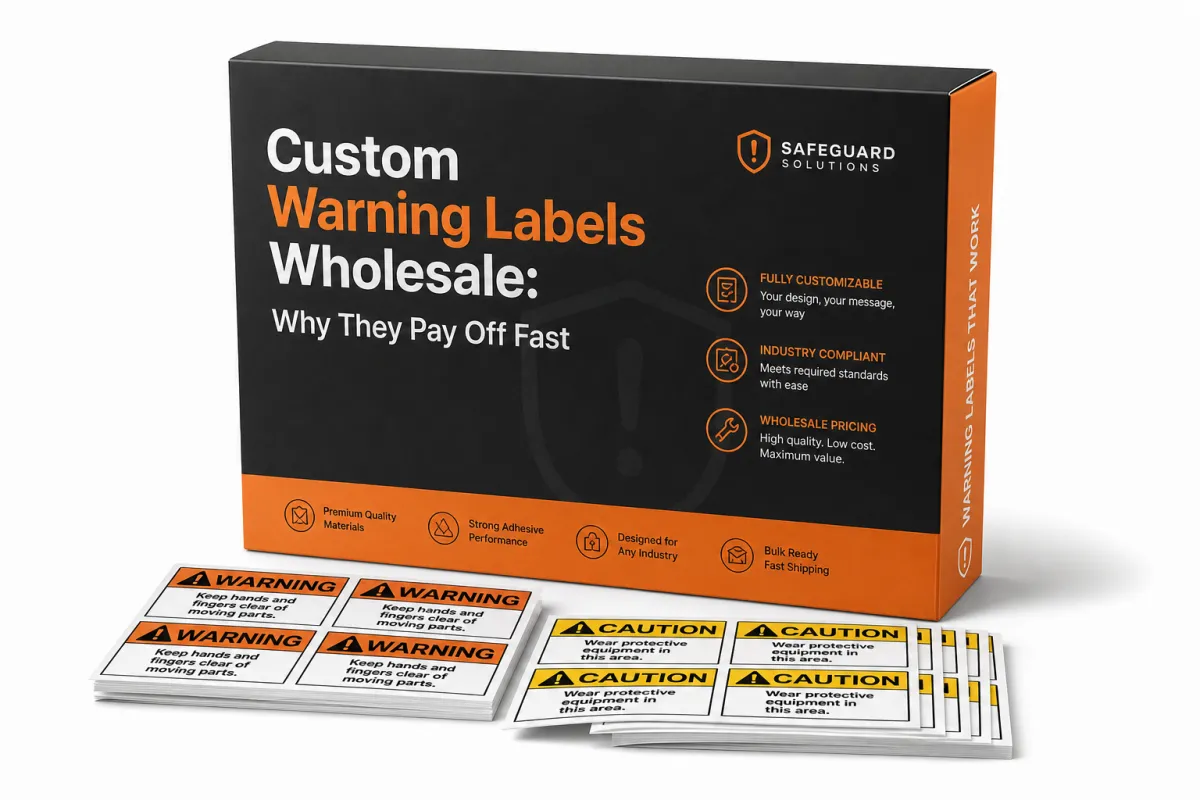
The blunt truth is that a lot of shipping teams lose more money from bad handling than from bad cartons. A box can be engineered correctly and still fail if nobody knows which side stays up, whether it can be stacked, or whether moisture is going to ruin the contents. Custom warning labels wholesale closes that gap by putting the instruction right where the handling decision happens.
Warehouse crews rarely have time to inspect every line of print on every carton. They scan, stack, move, and keep the freight flowing. A warning label has to work fast. Bright, legible, and placed in the right spot, it turns a vague request into a clear direction. That matters for glass, electronics, cosmetics, medical supplies, temperature-controlled products, and any shipment where one mistake becomes a claim.
In daily operations, custom warning labels wholesale helps in four clear ways:
- It reduces damage claims by making handling instructions obvious.
- It cuts repacks and relabeling because the message is already on the package.
- It keeps labeling consistent across facilities, which matters if you ship from more than one warehouse.
- It supports compliance and internal handling rules without forcing a redesign of the whole package.
A label will not rescue a weak carton, sloppy pallet build, or careless freight handling. It does remove one easy-to-fix failure point. That is worth paying attention to. A low-cost production run of custom warning labels wholesale can save far more than it costs if it prevents even a few damaged cartons or one rejected pallet.
A label that peels off at the dock is decoration, not instruction.
That is why serious buyers look past the artwork file. They ask where the carton travels, how long it sits in storage, whether the surface is dusty or chilled, and who needs to read the message from three feet away versus ten. The answers shape the face stock, adhesive, size, and layout for custom warning labels wholesale.
I've also watched a polished label fail for a very ordinary reason: dock lights hit the glossy face at the wrong angle and the warning became a mirror. It looked great in proofing. It was useless in the building. That kind of mistake is why real-world testing matters more than pretty mockups.
Teams that also source Custom Labels & Tags and broader Custom Packaging Products usually find that warning labels fit naturally into the same production plan. They support the packaging system instead of fighting it, which is how they should behave.
Custom Warning Labels Wholesale: Product Details That Matter
At the most basic level, custom warning labels wholesale means adhesive labels printed with handling, safety, or shipping instructions. They stick to cartons, drums, pallets, mailers, and industrial packaging. The message might say fragile, this side up, keep dry, do not stack, temperature sensitive, tamper alert, or something tied to your own shipping flow.
Some buyers need stock-style warning labels. Others need a fully custom build. Stock formats make sense when the message is standard and the operation only needs a familiar icon or phrase. Fully custom custom warning labels wholesale makes more sense when the brand colors matter, the copy needs to be multilingual, the label must carry numbered batches, or barcode and QR integration have to tie into warehouse scanning.
The design choices are not cosmetic. They decide whether the label gets noticed. A label that is too small disappears on a corrugated carton. Weak contrast fades into a dim warehouse. Tiny text and crowded graphics may look tidy on a screen and fail on the dock. Strong packaging design keeps the message direct, bold, and readable in the real world.
That is why many buyers treat custom warning labels wholesale as part of the larger retail packaging and logistics system. The label should fit the way the box is handled, not just the way it looks in a mockup. If the box also supports a branded unboxing experience, the warning still needs to be easy to read without looking like a last-minute patch.
Common use cases include:
- Fragile labels for glass, ceramics, electronics, and similar breakable goods.
- This side up labels for products that shift, leak, or lose integrity when inverted.
- Keep dry labels for cartons vulnerable to moisture during storage or transit.
- Do not stack labels for lightweight cartons, odd-shaped boxes, or pressure-sensitive contents.
- Temperature warning labels for chilled, frozen, or heat-sensitive products.
- Tamper alert labels for sealed kits, regulated goods, or higher-risk retail packaging.
One mistake shows up again and again: buyers focus on the wording before they think about the reading distance. A warning meant for dock staff needs to be larger and louder than one meant for final receiving inspection. Custom warning labels wholesale works best when the message matches the environment and the person who needs to act on it.
For brands that also use custom printed boxes, the warning label can be designed to sit cleanly within the package graphics. That keeps the shipping face readable without making the carton look chaotic. It is a small detail, and small details tend to separate a tidy operation from a sloppy one.
Print method matters too. Digital printing is usually the easiest path for shorter runs or frequent copy changes. Flexographic printing becomes attractive when the art stays stable and volume climbs. Thermal transfer is useful when the label needs variable data applied on demand rather than preprinted in bulk. None of those choices are glamorous, but they absolutely change cost, speed, and consistency.
Custom Warning Labels Wholesale Specifications
Specification choices decide whether a label works or fails. For custom warning labels wholesale, the important details are size, shape, material, adhesive strength, print method, and format. Those are the pieces that determine whether the label survives the route or curls, smears, or peels off halfway there.
Size is usually the first real decision. A small label can work for close-up inspection, but it disappears on a large carton or pallet wrap. A larger label costs a little more, yet if the instruction has to be visible from across a dock, that is money well spent. Typical sizes often range from 2 x 3 inches for compact warnings to 4 x 6 inches or larger for warehouse-visible handling instructions.
Shape matters less than most people assume, though it still changes how the label feels in use. Squares and rectangles are efficient. Rounded corners help reduce edge lift. Die-cut shapes can support branding, but they also add tooling complexity. If the goal is logistics first, standard shapes usually make the most sense for custom warning labels wholesale.
Material should match the environment. Paper labels work for dry indoor cartons and short transit cycles. Synthetic film holds up better against moisture, abrasion, and repeated handling. For cold storage, rough cartons, or long-haul movement, a stronger build with a dependable adhesive is usually the safer choice. Dusty, textured, or chilled surfaces are where cheap paper labels tend to show their limits fast.
Finish affects more than appearance. Gloss can increase contrast and make colors pop, but it can also throw glare under warehouse lighting. Matte softens that glare and often improves readability. Coated or laminated faces add scuff resistance when the label rubs against pallets, straps, or neighboring cartons. For that reason, custom warning labels wholesale should be specified by use case rather than by whatever mockup looks prettiest.
Adhesive is where a lot of labels fall apart in practice. A strong face stock with weak adhesive still peels. A label that performs well on clean corrugated board may fail on dusty recycled cartons, frozen pack-outs, or plastic drums. Match the adhesive to the application surface first, then select the face material. That order avoids a lot of expensive irritation later.
A buyer who works through a proper spec sheet usually ends up with fewer surprises. I have seen teams try to save time by writing "use heavy adhesive" in an email, then wonder why the label still failed on a refrigerated pallet. That is not a spec. That is a wish.
For buyers who need to reference industry standards, groups like the International Safe Transit Association are useful for understanding package testing expectations. If your warning labels are part of a system that must survive vibration, drop testing, or rough transit, the label should be designed with those conditions in mind.
Compliance can matter as well. Some products require standardized symbols, specific wording, multilingual instructions, or hazard language. If that applies to your line, confirm the wording before print starts. A label that worked on one product may be wrong on the next. Custom warning labels wholesale should never rely on guesswork.
Here is a practical way to compare the common label directions.
| Option | Best For | Typical Wholesale Cost | Tradeoff |
|---|---|---|---|
| Paper warning labels | Dry cartons, short transit, light warehouse handling | $0.03-$0.08 per unit at higher volumes | Lowest cost, but weaker against moisture and abrasion |
| Synthetic film labels | Moisture, long transit, abrasion, cold storage | $0.06-$0.14 per unit | Higher material cost, better durability |
| Heavy-duty adhesive builds | Rough cartons, drums, chilled pallets, difficult surfaces | $0.08-$0.18 per unit | Best hold, but not always needed for standard shipping |
| Custom die-cut shapes | Branded packaging, special visibility, unique labeling systems | Varies with tooling and quantity | More setup cost and usually a higher minimum order |
That table is not a quote. It gives the kind of range most buyers should expect for custom warning labels wholesale based on material, complexity, and quantity. A simple run with one-color printing and a standard stock size can land much lower than a custom, multi-color, specialty-adhesive build. The expensive part is usually not the ink.
For businesses aligning warning labels with broader Wholesale Programs, the spec sheet should function like a control document. Reorder consistency matters. If the next production run changes even slightly, warehouse staff notice immediately. They may not complain, but they notice.
One more technical point: if your label is going onto corrugated board that has a recycled face, test on that exact board grade. "Corrugate" is too broad to be useful. Board coatings, dust, temperature, and compression all affect how a label behaves, and that is the kind of detail that separates a workable program from a messy one.
Custom Warning Labels Wholesale Pricing, MOQ, and Savings
Pricing for custom warning labels wholesale depends on the usual factors: size, material, finish, quantity, number of colors, adhesive type, and artwork complexity. If a quote looks suspiciously cheap, something is probably smaller, lighter, slower, or less durable than you actually need.
The real pattern is simple: unit price usually falls as quantity rises, while setup complexity and specialty materials keep some quotes higher than buyers expect. A repeat order with stable artwork can be efficient. A custom die, custom wording, or multi-version label family will usually cost more at the start, even if the per-unit rate improves later.
Most buyers do best by thinking in tiers. For custom warning labels wholesale, a 500-piece test run works well if you are checking size or adhesive. A 1,000 to 5,000 piece order often gives better economics for regular shipping. Larger runs can improve again once the artwork is locked and the material stays standard.
MOQ changes with the build. Standard shapes and common materials often begin around the 500 to 1,000 label range per design. Fully custom sizes, specialty films, unusual adhesives, or multiple versions can push the minimum higher. That is not a trick. It is how setup, changeovers, and waste work.
There are three direct ways buyers usually lower costs:
- Standardize label sizes across product lines so you are not paying for multiple die sizes.
- Combine warning messages into one production run when the material and size are the same.
- Order in bundles so the setup cost is spread over more units.
One quiet savings move gets missed a lot: make the warning label do more than one job. A label can carry the handling message, a barcode, a product code, and a brand cue. That cuts clutter on the carton and simplifies the workflow. Warehouses usually run better when the package face is easier to read.
Another practical savings point is proof discipline. Every extra round of artwork changes adds cost somewhere, even if the supplier does not itemize it separately. The cleaner the copy, the fewer corrections you will pay for. That is especially true on custom warning labels wholesale, where the same format may be used for multiple SKUs over a long stretch.
Here is a practical pricing framework for custom warning labels wholesale. The figures are broad because artwork, materials, and volume change the final number, but they are useful for planning.
| Order Type | Typical MOQ | Typical Unit Price | Notes |
|---|---|---|---|
| Simple stock-style warning, one color | 500-1,000 | $0.03-$0.07 | Fastest and cheapest, usually paper-based |
| Custom message with logo | 1,000-2,500 | $0.05-$0.12 | Good middle ground for branded packaging |
| Film label with stronger adhesive | 1,000-5,000 | $0.08-$0.16 | Better for moisture, transit wear, and rough handling |
| Special size or die-cut label | Usually higher | Quote-based | Tooling and setup drive the cost |
Quote transparency matters. A solid custom warning labels wholesale quote should spell out print setup, proofing, packaging, freight, and any revision or reprint fees. If those items are missing, ask before approving the order. Surprise charges never feel smaller after the invoice arrives.
Buyers also save money by keeping the design realistic. If you need six versions of almost the same warning, ask whether one base format can handle the variations through a text swap or color change. Small layout decisions can save real money across repeated runs, especially when multiple SKUs and facilities are involved.
For operations that also source product packaging and other branded materials, combining orders can help. A warning label run alongside cartons, inserts, or seals may reduce freight and admin overhead. The goal is not to cram every item into one spec. It is to align production where the materials and schedules actually fit.
Custom Warning Labels Wholesale Process and Timeline
The order process for custom warning labels wholesale is easy on paper and only gets messy when the buyer leaves out details. The path is familiar: request a quote, confirm specs, review artwork, approve proof, produce, inspect, and ship. Delays usually come from vague wording, missing files, or a late proof change that sends the project back into another approval round.
That is why the fastest orders are not always the smallest ones. They are the ones that arrive with clean artwork and final copy. If the warning text is already locked, the label size is known, and the shipping surface is clear, production can move quickly. If the team is still deciding between fragile, handle with care, or both, the clock starts later than expected.
Simple repeat runs for custom warning labels wholesale usually move faster once the artwork is already approved. More custom jobs need more time. A new die-cut shape, specialty film, or unusual adhesive may require setup and testing. That is not a delay in the frustrating sense. It is the work that keeps the label from failing later.
Typical lead times often look like this:
- Repeat runs: often 5-10 business days after approval, depending on stock and volume.
- Standard custom runs: often 10-15 business days after proof approval.
- Special material or new die orders: often 15-20 business days or more.
Rush orders help, but they do not bend physics. A supplier may be able to move printing or shipping faster, yet a custom die, specialty film, or proof correction still takes time. If the deadline is tight, say it early. That gives everyone room to tell the truth before speed becomes a promise nobody can keep.
Quality control matters more than most teams admit. For custom warning labels wholesale, the checks that matter are adhesion, legibility, roll orientation, count verification, and print consistency. If labels are wound the wrong way on the roll, application slows down. If the contrast is weak, the warning becomes ornamental. If the count is off, the order becomes a headache.
I always tell buyers to ask one simple question before approval: "How will this label behave after a week in the real environment?" That question catches more problems than a glossy proof ever will. It also keeps the conversation grounded in the actual use case instead of the mockup.
For teams that need the warning labels to fit into a larger shipping test or compliance workflow, packaging organizations like ISTA help with broader transit-testing context, and FSC matters if you are sourcing certified paper-based materials. The label is one part of a larger system, and buyers who see the whole system make better decisions.
If your operation mixes warning labels with other branded materials, keep the schedule aligned with your Custom Labels & Tags and packaging calendar. Nothing slows a launch like cartons, inserts, and warnings arriving out of sync by a week.
Why Choose Us for Custom Warning Labels Wholesale
What matters in a good label supplier is not fancy language. It is clean specs, fast answers, and production decisions that match how real shipping teams work. That is the point of custom warning labels wholesale. A label should do its job and arrive on time.
Consistency matters a great deal. If you reorder the same label next month or next quarter, it should look and perform the same. Multi-warehouse teams cannot afford a warning label that shifts in shade, size, or adhesive behavior from one run to the next. Reorder stability is part of the value in custom warning labels wholesale, even if it is the least glamorous part of the job.
Not every buyer needs a large run on day one. Some want a test batch first. Some need a wholesale volume with the same layout across different SKUs. Some need a warning label that works on corrugated cartons now and on a plastic tote next month. Flexibility matters, especially when the shipping schedule is real and the docks are not waiting for anyone.
That is why straightforward artwork support and proofing matter more than polished sales language. If a label is going to sit on a cold carton, a rough shipping drum, or a high-value retail package, it should be built for that use. Good custom warning labels wholesale is not about the loudest design. It is about the right material and the right message.
For buyers building broader package systems, the label can sit alongside package branding, shipping cartons, inserts, and seals without creating visual noise. Used well, it supports the whole presentation. Used badly, it looks like a last-minute repair. Receiving teams can spot the difference quickly.
We also keep an eye on the invoice. No one appreciates surprise charges after proof approval. If a project needs a revised size, a different adhesive, or a shipping adjustment, that should be clear before the order moves. That is especially true on custom warning labels wholesale, where buyers usually care more about repeatability and unit economics than sales theatrics.
If you are already sourcing through Wholesale Programs, it makes sense to ask how warning labels fit into the broader production plan. A good supplier should help line up order timing, spec stability, and shipping expectations without turning every request into a special project.
Next Steps for Ordering Custom Warning Labels Wholesale
Before you request custom warning labels wholesale, get the essentials locked in. Decide the exact warning message, the surface it will stick to, the approximate size, the quantity, and whether you need a logo or barcode. If you already have artwork files, send them. If not, a plain-text brief is enough to start a solid quote.
The most useful question is not "How cheap can this be?" It is "What environment does this label need to survive?" Indoor cartons, cold-chain pallets, and rough industrial handling all point to different material and adhesive choices. That one answer usually clears up half the spec conversation.
If the shipment is expensive, regulated, or likely to be handled badly, ask for a sample or proof. Skipping that step because the art looks good on screen is a mistake. Screens do not show how a 4 x 6 warning behaves on a dusty carton under warehouse lights. Real life always gets the final say.
A practical ordering checklist for custom warning labels wholesale:
- Write the warning text exactly as it should appear.
- Choose the application surface: carton, drum, pallet, or mailer.
- Confirm the environment: dry, cold, damp, rough, or long-haul.
- Set the size and quantity range.
- Send logo or artwork files if branding is part of the label.
- Ask for proofing, freight, and lead time before approval.
Compare price against performance, not just the sticker rate. A cheap label that peels off is not cheap. It is expensive in a quiet, annoying way. One lost shipment can wipe out the savings from an entire run of low-grade labels. For that reason, the best buyers treat custom warning labels wholesale as a risk-control decision, not only a line item.
If you are ready to move, request a quote with the warning text, size, quantity, and shipping environment spelled out. The clearer the brief, the cleaner the result. If you are building a full packaging system, keep your warning labels aligned with your cartons, inserts, and branded materials so the whole program works like one unit rather than four unrelated orders. That is how custom warning labels wholesale actually saves money.
The most practical takeaway is simple: write the spec before you write the purchase order. A one-page brief with the message, surface, environment, read distance, and quantity will usually point you to the right material the first time, and that saves far more than arguing over pennies after the fact.
What is the usual MOQ for custom warning labels wholesale?
For many standard custom runs, MOQ often starts in the 500 to 1,000 label range per design. Fully custom sizes, specialty materials, or multiple versions can push the minimum higher. If you need several warning messages, ask whether they can be grouped into one production order.
Which material is best for custom warning labels wholesale in shipping?
Paper works well for dry cartons and short transit cycles. Synthetic film is better for moisture, abrasion, and long-haul handling. For cold storage or rough surfaces, match the adhesive to the environment first, then pick the face material.
How long does production take after proof approval?
Simple repeat orders can move quickly once artwork is locked. Custom sizes, special finishes, or new dies usually add setup time. The fastest path is clean artwork, final wording, and no proof revisions.
Can I order multiple warning types in one wholesale run?
Yes, but pricing depends on whether the designs share the same size, material, and print setup. A grouped order is often more efficient than separate small runs. Ask for a quote that shows the cost difference between one design and multiple versions.
What do you need from me to quote custom warning labels wholesale?
Send the warning text, preferred size, quantity, application surface, and any artwork or logo files. Include environment details such as indoor, outdoor, refrigerated, or rough-handling use. If you are unsure, give the product and shipping scenario first and let the supplier recommend the spec.
If you want a label program that actually reduces damage instead of just looking neat on a proof, start with custom warning labels wholesale. Put the use case, quantity, surface, and environment in writing first, then match the material to that job. That is the fastest path to a label that survives the trip and does not turn into a costly do-over.

