Buyer Fit Snapshot
| Best fit | Custom Window Patching Boxes Wholesale projects where brand print, material claims, artwork control, MOQ, and repeat-order consistency need to be specified before quoting. |
|---|---|
| Quote inputs | Share finished size, material target, print colors, finish, packing count, annual reorder estimate, ship-to region, and any compliance wording. |
| Proofing check | Approve dieline scale, logo placement, barcode or warning zones, color tolerance, closure strength, and carton packing before bulk production. |
| Main risk | Vague material claims, crowded artwork, missing packing details, or unclear freight terms can make a low unit price expensive after revisions. |
Fast answer: Custom Window Patching Boxes Wholesale: Specs, Pricing, MOQ should be specified like a repeatable production item. The safest quote records material, print method, finish, artwork proof, packing count, and reorder notes in one written spec.
Production checks before approval
Compare the actual filled-product size with the drawing, then confirm tolerance on folds, seals, hang holes, label areas, and retail display edges. Reserve space for logos, QR codes, warning copy, and material claims before decorative graphics fill the panel.
Quote comparison points
Review material grade, print process, finish, sampling route, tooling charges, carton quantity, and freight assumptions side by side. A quote is only useful when the supplier can repeat the same color, closure quality, and packing count on the next order.
People buy what they can see, and packaging that shows the product usually earns attention faster than a carton covered in long copy and decorative noise. That is why Custom Window Patching boxes wholesale tend to move products quicker than text-heavy retail packaging in busy stores, on crowded shelves, and during unboxing moments where the first glance does most of the selling. A clear window gives the shopper immediate proof, which matters more than a paragraph of claims once the box reaches the shelf.
From a packaging buyer’s point of view, custom window patching boxes wholesale is not a decorative extra. It is a practical sales tool for bakery items, cosmetics, candles, apparel accessories, and small electronics, especially when the item has color, texture, or shape worth showing openly. The design still needs discipline, because every inch of window area takes away from print space, branding room, and compliance copy. The best carton does both jobs at once: it presents the product honestly and still looks like deliberate packaging, not a cutout with a logo taped onto it.
Wholesale buying matters because the unit cost drops once the structure is planned with the box, the print, and the window in mind from the start. A simple carton with a smart window layout usually outperforms a complicated build that spends money on extras nobody asked for. That is the real equation behind branded packaging That Feels Premium, keeps the product visible, and still makes sense on a spreadsheet. I have seen plenty of launches where the packaging looked nice on a mockup and then fell flat in a store because the shopper could not tell what was inside. That is a pricey mistake, and it is one you can avoid.
A window should help the product sell. The moment it starts competing with the product, the design has gone in the wrong direction.
Why Custom Window Patching Boxes Wholesale Sell Faster
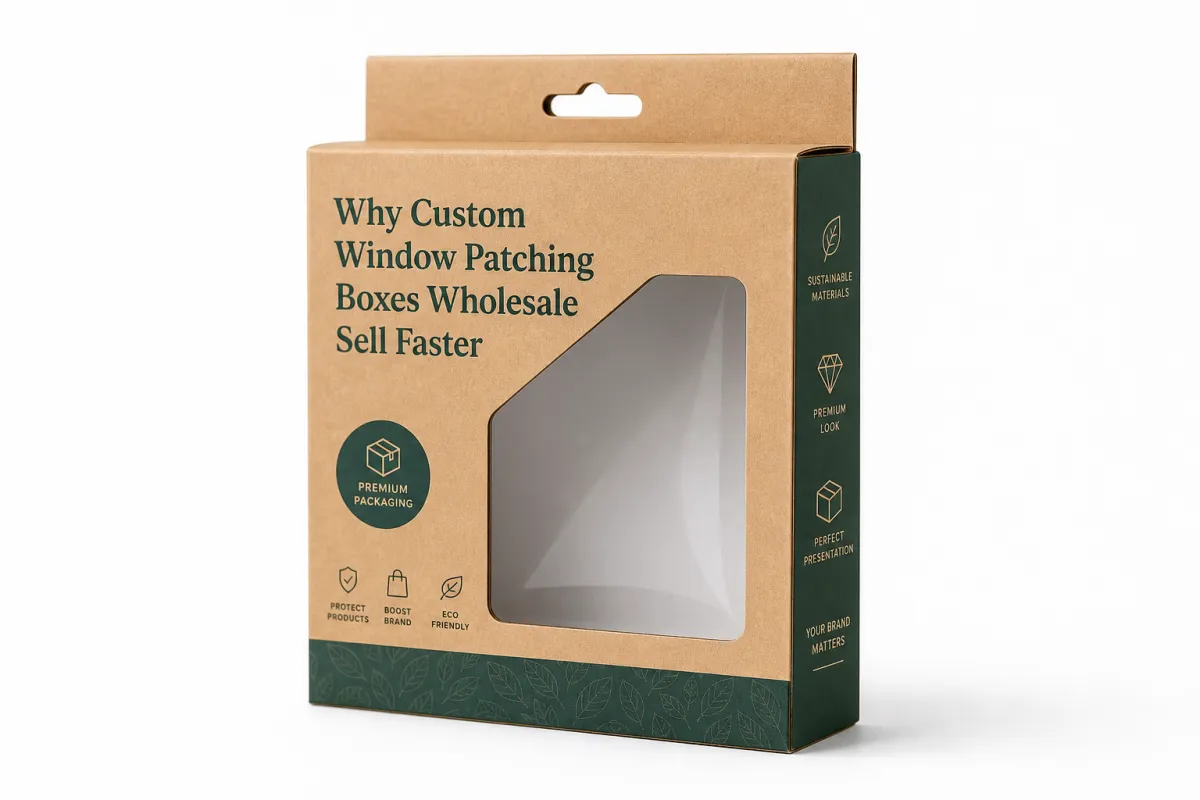
Custom window patching boxes wholesale sells faster because the shopper does not have to guess. They can see the frosting on a cupcake box, the gloss on a cosmetic bottle, the tone of a candle jar, the fold of a scarf, or the shape of a small electronics accessory before they ever touch the package. That reduces hesitation at shelf level, and retail lives or dies by how quickly a customer can decide. A box that answers the obvious question right away is already doing part of the selling.
Bakery brands use a window to show icing, garnish, and portion size. Cosmetic brands use it to show container color, label finish, or the exact silhouette of a compact. Candle brands use it to show wax tone, jar shape, and the look of the closure. Apparel accessory brands use it to show ties, socks, scarves, and leather details without asking the buyer to open the box. Small electronics benefit too, since a visible device or accessory reassures the customer that the product looks clean and complete before purchase. That little bit of certainty matters more than people think.
There is always a tradeoff. A bigger window gives more product visibility, yet it removes printable space for graphics, ingredients, warnings, or brand story. The box has to work from both sides. It needs to show the item clearly, then still carry the identity of the brand with enough confidence that it feels finished rather than borrowed from a generic carton.
For many retail products, a window that covers roughly 20% to 40% of the front panel gives a strong balance. Smaller windows can work better for heavy copy or stricter compliance needs. Larger windows make sense for products where the item itself is the main visual hook. For custom window patching boxes wholesale, that range is a useful starting point, especially for buyers who want fewer revisions and less back-and-forth during proofing. It is not a hard rule, just a solid place to start before the layout gets more specific.
Wholesale also helps maintain consistency across multiple SKUs. A holiday set, a launch series, or a store brand with several variations benefits from the same visual language across all cartons. Custom window patching boxes wholesale gives that repeatable look without forcing each box to become a one-off project. The shelf reads as organized, which is exactly what retail teams want, and customers notice that order even when they do not say it out loud.
Retail reality: the decision often happens before the box leaves the shelf. A clean window patch can do more than a page of claims, because the product is already speaking for itself.
Custom Window Patching Boxes Wholesale Product Details
Custom window patching boxes wholesale usually starts with a folding carton and then gets adjusted for the product’s weight, shape, and display needs. The build can stay simple or become more engineered, but the aim does not change: hold the product securely, show it clearly, and make the box easy to stack and ship.
Common box structures
Straight tuck is a familiar choice for light retail items and gives the front panel a neat face for the window. Reverse tuck follows a similar structure while changing the way the flaps close, which can help with machine efficiency in some runs. Auto-lock bottom gives better support for heavier items or cartons that need extra stability at the base. Sleeve-style packaging creates a more premium feel and can be paired with an inner tray. Rigid-style variations suit higher-end gift sets or display packaging where presentation matters more than shipping economy.
For custom window patching boxes wholesale, the structure should fit the product first. A glass jar in a flimsy tuck carton is a mistake waiting to happen. A light accessory in a rigid box may look impressive, yet it can waste money where it does not add real value. The strongest packaging decisions usually come from buyers who know the unit economics and understand where the box helps the sale versus where it simply adds cost.
Window shapes and placement
Window patch options go further than most buyers expect. A front panel window remains the most common because it provides direct visibility. Side windows can show texture or bundled contents. Full-face cutouts create strong shelf presence, especially for bakery or gift items. Custom die-cut forms fit products with a distinct silhouette, like a candle jar, an ornament, or a small electronics accessory that deserves a precise frame.
Placement matters as much as the shape. A window set too high can hide the base of the product. Set too low, and the top edge may disappear beneath the graphic layout. For custom window patching boxes wholesale, the most effective placement usually reveals the product’s most recognizable feature while still leaving enough room for the brand name, key selling point, and any required legal copy. That balance is where the layout starts feeling intentional instead of crowded.
Inserts, trays, and product restraint
Window boxes are not only about visibility. They also need restraint. A product that slides around behind the film looks careless, and that can undermine the sale by making the item seem smaller, damaged, or poorly packed. Inserts, inner trays, molded pulp supports, paperboard cradles, and simple folding tabs all help keep the product centered behind the window.
That detail matters in custom window patching boxes wholesale for categories like cosmetics, candles, and electronics, where alignment affects the entire display. If the label on a jar is supposed to face forward, the insert has to hold it there. If a bakery item needs a specific orientation, the tray must lock it in place without compressing the product. The part that looks minor on a CAD drawing can decide whether the box feels polished or rushed.
Finishes that change shelf impact
Matte lamination gives the package a softer, more restrained tone. Gloss makes color stronger and can help food or gift packaging stand out under store lighting. Soft-touch finishes bring a velvety feel that often suits premium retail. Spot UV can pull focus to a logo or a pattern. Foil adds sharp contrast, although it needs a careful hand because too much foil can push the box toward flashy instead of refined.
Uncoated natural finishes still have a place, particularly for kraft-based branded packaging or packaging aimed at an earthier market position. If the goal is a calm, organic look, a rawer surface may fit better than a glossy one. For custom window patching boxes wholesale, the finish should support the product and the shelf story rather than fight both of them. That sounds simple, but it is exactly where a lot of packaging goes sideways.
In practical terms, custom window patching boxes wholesale can cover a low-cost retail SKU or a higher-end presentation box. The structure, the window, and the finish do the heavy lifting; the rest is refinement.
Materials, Window Patch Options, and Print Specs
The board choice tells a buyer a great deal before the shopper even notices the product. SBS board gives a crisp retail face and works well for full-color custom printed boxes. Kraft board brings a more natural tone and suits artisan or earth-forward positioning. Corrugated board makes sense for heavier items, shipping-intensive programs, or products that need extra crush resistance during transport and handling.
For custom window patching boxes wholesale, the material needs to match product weight and the expected life of the package, not only the brand mood board. A 16pt to 18pt SBS folding carton is common for lighter retail goods. Heavier products may call for thicker paperboard or a corrugated build, especially if the package will move through rough distribution channels before it reaches the shelf.
Window patch film is one of the places where buyers become selective for good reason. PET film is the standard choice because it stays clear and handles stress well during production and transit. It tends to resist tearing better than many lower-grade options and gives reliable shelf presentation. A film thickness around 0.15 mm to 0.25 mm is common on many folding cartons, though larger windows or more demanding handling may justify a heavier spec.
The sustainability discussion deserves practical treatment. If a buyer wants recyclable or certified paperboard, the sourcing option should be verified instead of assumed. For fiber sourcing and chain-of-custody needs, FSC is the reference point for certification. If transit performance matters, many teams turn to ISTA test protocols to judge whether the package can handle realistic shipping conditions rather than idealized ones.
Print specs matter more than many people expect. For custom window patching boxes wholesale, the artwork should be built on the dieline from the beginning, not placed onto a random flat mockup and treated as finished. A proper setup should include:
- Dieline approved before artwork moves into production.
- Bleed of about 3 mm so trimming does not expose white edges.
- Safe area of roughly 2 to 3 mm inside the cut line so critical text does not get clipped.
- Resolution at 300 dpi for raster artwork.
- Color format in CMYK, with Pantone references if spot colors are required.
Tolerances are normal in folding carton production. They are also where buyers sometimes get nervous over minor movement that falls within standard manufacturing limits. Depending on size and structure, trim and score variation around 1 to 2 mm is common. That is part of the process. What should never happen is a window that sits obviously off-center, glue bleed that shows through the film, or a carton that no longer frames the product properly once assembled.
The window patch itself needs its own assembly standard. Adhesion should stay clean, the film needs to sit flat, and the patch must not bubble when pressure is applied lightly. If the package is meant to represent a premium product, cloudy glue lines or a crooked window will pull the entire presentation down. That is the difference between decent product packaging and packaging that feels hurried.
For buyers comparing options, custom window patching boxes wholesale works best with a spec sheet that stays focused and specific: board grade, film type, window dimensions, print coverage, finish, and target quantity. Clear direction reduces surprises and keeps the run moving in the right direction.
Custom Window Patching Boxes Wholesale Pricing & MOQ
Price depends on more than box size, although size is usually the first thing that changes the math. Board grade, window shape, film type, print coverage, coating, inserts, and finishing details all affect the final number. Custom window patching boxes wholesale does not become expensive because it is custom. It becomes expensive when the spec keeps adding features that do not improve the sale or the shipping experience.
The cleanest way to think about pricing is to compare the same structure across different quantities. A standard folding carton with a PET window and full-color print sits in one range, while specialty finishes sit in another. If the quote changes from one supplier to the next, the structure should stay identical or the comparison loses meaning.
| Quantity Band | Typical Unit Price | Best For | Notes |
|---|---|---|---|
| 500-999 | $0.60-$1.40 | Testing a new SKU or smaller launch | Setup cost is spread across fewer units, so the unit price stays high |
| 1,000-2,499 | $0.38-$0.92 | Early wholesale orders and seasonal runs | Good balance if you want custom window patching boxes wholesale without overcommitting |
| 3,000-4,999 | $0.24-$0.58 | Growing retail programs | More efficient on press, die-cutting, and window patching |
| 5,000-9,999 | $0.16-$0.42 | Established SKUs and repeat retail packaging | Usually where pricing starts feeling like true wholesale |
| 10,000+ | $0.12-$0.34 | High-volume programs | Best pricing, especially with standard structures and limited finishing |
Those ranges assume a common folding carton, a PET window, and standard print coverage. Add foil, soft-touch lamination, heavy ink coverage, specialty die-cuts, or a custom insert, and the unit price climbs. Swap SBS for thicker stock or corrugated and the math shifts again. That is normal. Packaging pricing behaves like production should behave: the spec changes, the cost follows.
MOQ logic is simple: lower quantities cost more per unit because setup stays nearly the same. For custom window patching boxes wholesale, many suppliers start around 500 to 1,000 units, though certain structures or premium builds may need 1,500 or even 2,000 units to make sense. Once the order moves into the several-thousand range, the pricing usually bends in the buyer’s favor.
If budget is tight, keep the structure standard and put money where shoppers will notice it. A smart window shape matters more than a stack of extra inks. A single spot UV treatment can do more than a carton full of decorative clutter. For custom window patching boxes wholesale, the practical rule is straightforward: make the structure clean, then invest in the face of the box.
Here is the buying approach I would use. For a new product, choose the lowest structure risk and accept a higher per-unit cost on the first run. For a product that already has traction, raise the quantity and negotiate the print and finishing details. That is how custom window patching boxes wholesale shifts from a design expense into a useful packaging purchase. No magic there, just the plain math of setup, yield, and shelf impact.
Production Process and Timeline for Custom Window Patching Boxes Wholesale
The production flow stays manageable when the buyer is organized. It becomes difficult when artwork is unfinished, dimensions are guessed, or several people keep changing the brief after the quote has already been built. Custom window patching boxes wholesale follows a predictable path once the basics are settled.
- Quote request. Send the product size, box style, quantity, board preference, window shape, and finish. A complete brief usually gets a cleaner quote faster.
- Dieline confirmation. The packaging team confirms the structure and the cut path before artwork is locked.
- Artwork setup. The design is placed on the dieline, checked for bleed, and prepared for proofing.
- Sample approval. A sample checks fit, window position, visibility, and the overall structure.
- Mass production. The approved spec moves through print, die-cutting, window patching, finishing, and assembly.
- Packing and shipping. Cartons are counted, boxed, and prepared for freight or parcel shipment.
Timing depends on complexity, but realistic planning beats hopeful planning every time. A clean quote can often come back in 24 to 48 hours. Dieline confirmation may take 1 to 2 business days if the structure is standard. Sample production often takes 5 to 8 business days, sometimes a little longer if the box has a tricky window shape or a special insert.
Mass production for custom window patching boxes wholesale often runs about 12 to 18 business days after sample approval for standard folding cartons. Large orders, heavily finished packaging, and busy production schedules can extend that window. Shipping is its own variable, and freight should never be treated as a fixed number unless the route is already booked and confirmed.
The sample and the full run serve different purposes. The sample proves structure and fit. The production run proves repeatability. A sample can look right in hand and still reveal a problem once the box is packed tightly, the window sits slightly high, or the product moves during transit. That is why custom window patching boxes wholesale should never be approved from mockups alone. A render can be helpful, sure, but it is not a substitute for a physical check.
What speeds the process up? Final dimensions, print-ready files, a single decision-maker, and a clear window spec. If the buyer is still debating between two finishes, the schedule slows. If the box needs a special insert, the schedule slows again. If the product has not been measured correctly, the project can stall before production even starts.
For buyers who want fewer delays, the order package should include product photos, a rough sketch, the target quantity, and the preferred board. That gives the factory enough information to begin without a week of clarification. Custom window patching boxes wholesale rewards clarity. Confusion costs time, and time always shows up somewhere on the schedule.
Why Choose Us for Custom Window Patching Boxes Wholesale
Manufacturing control is the real value behind the order. A dependable supplier keeps cutting consistent, patch adhesion stable, and machine setup repeatable as the order scales. That matters more than polished promises. Custom window patching boxes wholesale only works if the first carton and the last carton look like they came from the same line with the same care.
Quality checks should stay practical. We look at window alignment, glue clarity, edge strength, and how the carton stacks after packing. If the carton bows, the film wrinkles, or the product shifts enough to spoil the display, the box has missed the point. A buyer does not need a speech. They need packaging that lands ready for retail.
Support is another place where a real packaging partner earns the order. Dieline guidance saves time. Material recommendations save money. Honest advice about what not to add saves even more. If a customer wants a premium presentation, it is better to guide them toward the right finish or a better board than to stack on random extras that only raise the invoice without improving the box.
Custom window patching boxes wholesale also depends on logistics discipline. Carton counts need to be accurate. Packing standards need to be consistent. Freight planning has to match the quantity, the carton dimensions, and the receiving method. A beautiful box that sits at the dock because nobody planned the pallet count is not a success story.
If you are comparing structures across SKUs, start with our Custom Packaging Products and compare them against the broader Wholesale Programs. That gives a clearer view of what is available, what scales well, and where the cost usually lands for custom printed boxes in actual production.
For buyers who care about transit and sourcing standards, the references are straightforward. ISTA is where shipping-test thinking lives, and FSC matters when paper sourcing needs to be documented. That kind of due diligence keeps product packaging from turning into an expensive guessing game.
Custom window patching boxes wholesale should give you a box that looks good, runs well in production, and holds together through real distribution. If a supplier can deliver that consistently, the relationship is worth more than a low quote that falls apart during the approval stage.
Next Steps to Order Custom Window Patching Boxes Wholesale
If you want a clean quote, send the basics first. Product dimensions. Target quantity. Preferred board. Window shape. Print finish. That is enough to start a serious conversation about custom window patching boxes wholesale without wasting time on guesses.
The fastest path usually includes a product photo, a rough size, and one example of a box style you already like. If you have a competitor package or a reference carton, share that as well. It helps narrow the structure and gives the production team a stronger base for estimating cost and lead time.
If you are comparing two or three options, run a pilot order before committing to the full launch. A 500 to 1,000 unit test is often enough to prove fit, shelf appeal, and shipping behavior. After that, scale once the structure, price, and freight method are confirmed. That is the sensible way to buy custom window patching boxes wholesale, not the glamorous way, but the one that keeps mistakes small.
For most buyers, the smartest move is simple: choose a standard structure, keep the material honest, and spend the budget on the visual elements shoppers actually see. That is how custom window patching boxes wholesale stays efficient while still looking like a premium retail package.
The takeaway is pretty straightforward: measure the product first, lock the window size around the selling feature, and approve a sample before you place the full run. If those three steps are in order, the rest usually falls into place without drama.
If you are ready to move, send the dimensions, quantity, board preference, window shape, and finish choice now. Custom window patching boxes wholesale works best when the first brief is clear, the spec is realistic, and the goal is a box that sells the product instead of decorating the shelf.
What is the usual MOQ for custom window patching boxes wholesale?
MOQ depends on size, print coverage, and whether the box uses a standard or fully custom structure. Many custom window patching boxes wholesale runs start in the 500 to 1,000 unit range, with better pricing at higher quantities. If you need a lower MOQ, keep the structure simple and use standard materials so setup costs stay under control.
Which window film is best for custom window patching boxes wholesale?
PET is usually the safest default because it gives clear visibility and solid strength in transit. The right choice still depends on product weight, shipping conditions, and the look you want on shelf. If sustainability is a priority, ask for the available material options before you lock the spec for custom window patching boxes wholesale.
How much do custom window patching boxes wholesale cost per unit?
Unit price changes with size, board grade, window size, print coverage, and finishing complexity. Smaller runs and heavily finished boxes cost more per piece; larger orders usually cut the price fast. The cleanest way to budget custom window patching boxes wholesale is to compare the same design at different quantities and material levels.
Can I get a sample before placing a wholesale order?
Yes, and you should if the box has a custom window shape or an important fit requirement. A sample lets you check window alignment, product visibility, strength, and how the box feels in hand. Use the sample to approve dimensions and artwork before committing to the full custom window patching boxes wholesale run.
How long does production take for custom window patching boxes wholesale?
Lead time depends on artwork approval, sample approval, order size, and the current production queue. Sample creation usually takes less time than full production, but approval delays can stretch the schedule. If you want a faster run, send final specs and print files up front so the custom window patching boxes wholesale order can move without backtracking.

