Buyer Fit Snapshot
| Best fit | Custom Windowed Cereal Box Printing projects where brand print, material claims, artwork control, MOQ, and repeat-order consistency need to be specified before quoting. |
|---|---|
| Quote inputs | Share finished size, material target, print colors, finish, packing count, annual reorder estimate, ship-to region, and any compliance wording. |
| Proofing check | Approve dieline scale, logo placement, barcode or warning zones, color tolerance, closure strength, and carton packing before bulk production. |
| Main risk | Vague material claims, crowded artwork, missing packing details, or unclear freight terms can make a low unit price expensive after revisions. |
Fast answer: Custom Windowed Cereal Box Printing: Structure, Print Proof, Packing, and Reorder Risk should be specified like a repeatable production item. The safest quote records material, print method, finish, artwork proof, packing count, and reorder notes in one written spec.
Production checks before approval
Compare the actual filled-product size with the drawing, then confirm tolerance on folds, seals, hang holes, label areas, and retail display edges. Reserve space for logos, QR codes, warning copy, and material claims before decorative graphics fill the panel.
Quote comparison points
Review material grade, print process, finish, sampling route, tooling charges, carton quantity, and freight assumptions side by side. A quote is only useful when the supplier can repeat the same color, closure quality, and packing count on the next order.
Custom Windowed Cereal Box Printing: Design, Cost, Tips
custom windowed Cereal Box Printing changes the shelf conversation fast. A carton that relies only on graphics has to sell an idea; a window lets the product do some of the talking, and that matters in an aisle where shoppers often decide in a few seconds. I have sat through enough packaging reviews to know the pattern: the box with the clearest product cue usually wins the first glance, even when the competitor has louder artwork. That is the quiet advantage here.
The format does more than look nice. It sits at the intersection of retail packaging, product protection, and compliance. One panel has to carry branding, legal copy, and shelf appeal, while the cutout or film opening reveals enough of the cereal to build confidence. That is a lot for one piece of board to handle, so Custom Windowed Cereal Box Printing is usually a packaging decision, not just a design decision.
Cereal, granola, muesli, clusters, and snack mixes all benefit from the same basic behavior: people trust what they can see. Texture, color balance, fill level, and freshness cues are easier to judge through a window than through a full-bleed illustration. Copy can promise crunch. The window can show it. For brands already spending money on branded packaging, custom windowed cereal box printing turns that spend into evidence instead of suggestion.
There is a tradeoff, of course. A window can alter carton strength, add conversion steps, and sometimes call for a film insert depending on the product and the retail channel. It also changes the visual layout of the front panel, which means the legal copy, claims, and branding have less room to breathe. So yes, custom windowed cereal box printing is a visual upgrade. It is also a structural and operational choice, and the best teams treat it that way from the start.
In my experience, the strongest specs are the ones that respect the box as a working object. A window that is too small tells shoppers very little. One that is too large can weaken the panel or make the carton scuff before it ever reaches the shelf. The sweet spot sits where the box still stacks cleanly, prints sharply, and shows enough of the product to earn attention without begging for it. That balance is the whole game.
What Custom Windowed Cereal Box Printing Is and Why It Stands Out
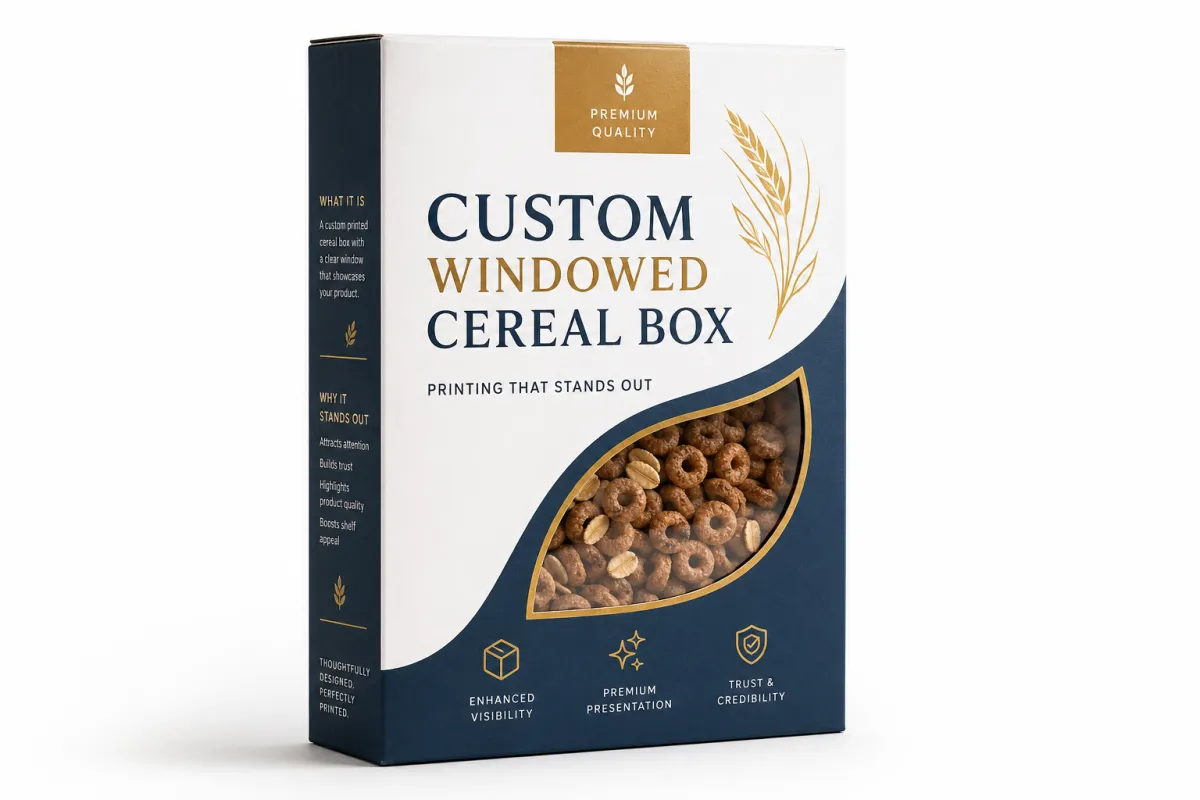
At its core, custom windowed cereal box printing means a paperboard cereal carton with a cutout or clear window that exposes part of the contents. The outer surface still carries the brand mark, nutrition facts, ingredient statement, barcode, and required claims. The window turns the front panel from a flat printed field into a viewing surface, and that small shift changes how shoppers read the box.
The format works because cereal is easy to evaluate visually. Clusters, flakes, fruit pieces, nut content, color consistency, and fill level can all be judged in a glance. A shopper does not need a long paragraph to decide whether a product looks fresh. In practical terms, custom windowed cereal box printing reduces uncertainty, and uncertainty is the kind of friction that quietly kills impulse buys.
Premium granola and snack mixes often benefit even more. Golden clusters, visible almonds, freeze-dried fruit, and layered textures tend to look convincing when they are actually on display. That is one reason custom windowed cereal box printing can outperform a full-panel illustration for higher-end lines. The box still looks finished, but the window adds proof. In retail packaging, proof tends to travel farther than hype.
The merchandising effect matters too. A front window can make a carton feel more candid, and candor has real value in package branding. A brand that uses custom windowed cereal box printing is basically saying, "We are comfortable showing the product." Parents notice that. Health-focused shoppers notice it. Private-label buyers notice it too, especially when they compare cartons side by side. It is a small signal, but a useful one.
"A window should reveal the product, not apologize for the structure." That is the practical test I use for custom windowed cereal box printing: if the opening improves trust, it earns space; if it only adds decoration, it needs to justify the extra die-cut and barrier work.
The window also changes how value is perceived. A carton with a clean opening often feels more premium than the same carton without one, even before the logo registers. That is not a trick. It is visual evidence. If the cereal looks fresh and consistent, custom windowed cereal box printing can raise shelf confidence in a way that static artwork rarely matches. Sometimes the buyer is not comparing brands line by line. They are just scanning for the carton that feels less like a guess.
Brands building a new line often pair the format with other Custom Packaging Products so the cereal carton fits the rest of the shelf set. If the same brand also uses stand-up pouches, tray packs, or club-store cartons, the windowed box has to feel like part of the same family, not a one-off experiment. That is where broader package branding starts to matter, because packaging rarely wins in isolation.
How Custom Windowed Cereal Box Printing Works
Custom windowed cereal box printing begins with structure, not artwork. The carton usually uses paperboard in the 300-400 gsm range, though the exact caliper depends on box size, fill weight, shipping path, and store expectations. The outer wrap is printed, then die-cut, folded, glued, and converted into finished cartons. If the spec includes a film window, the clear material is added during conversion so the contents stay visible while remaining protected.
Print method matters more than many buyers expect. Digital printing is usually a better fit for short runs, pilot launches, seasonal SKUs, and artwork testing. Offset printing generally suits larger quantities because it brings better cost efficiency at volume and tighter control over color consistency. In custom windowed cereal box printing, the print choice affects more than image quality. It also changes lead time, setup cost, and the room available for finishing options such as matte varnish, gloss varnish, soft-touch coating, or spot accents.
The dieline carries the real decisions. Window size, panel placement, fold lines, glue zones, and shelf-facing hierarchy all shape whether the carton looks sharp or awkward. A well-built dieline keeps the opening away from structural weak points and leaves enough room for the brand mark, product name, and required copy to breathe. A poor dieline forces typography to crowd the cutout, and that is how otherwise strong custom windowed cereal box printing projects end up looking busy. Busy boxes usually lose the premium feel they were trying to earn.
Many cereal products still use an inner pouch or liner even when the outer carton has a window. That pouch protects freshness, helps manage grease or moisture, and keeps the visible product from rubbing against the board. The setup matters even more if the product includes oily nuts or fragile pieces that shed crumbs during transit. The carton is the retail face; the inner pouch handles food protection. That division of labor is one of the things packaging does well when it is designed properly.
Before production starts, proofing should cover three layers: structure, color, and fit. Structural mockups show whether the window survives folding. Color proofs show whether the branding reads correctly under the chosen print method. Fit tests show whether the cereal or granola sits properly in the box without buckling the panel or blocking the viewing area. If the carton will move through e-commerce, ask whether samples were tested against ISTA methods published by the International Safe Transit Association. If paper sourcing matters to your procurement policy, FSC certification is worth asking about early, not after the order has already been locked.
That is the working model for custom windowed cereal box printing: build the structure first, print the story second, and verify the finished package against the product and the channel before the full run begins. If a vendor cannot speak clearly about dielines, print methods, and sample approval, that is usually a sign to slow down. A good supplier should be able to explain what the box is doing, not just what it will look like.
The strongest suppliers can also explain how the same carton architecture changes across different Manufacturing Capabilities. That matters because a box that works at 2,000 units on digital printing may need a different board or window spec once it moves to offset printing and a larger production run. In other words, the right spec at sample stage is not always the right spec at scale. That is normal, and honestly, it is part of the job.
Key Factors That Influence Custom Windowed Cereal Box Printing
Board grade is the first cost and performance lever in custom windowed cereal box printing. Lightweight stock can lower unit price, but a carton that feels soft in the hand or crushes in a case pack hurts perceived value. Premium cereal and granola often benefit from firmer board, especially if the box is tall, the fill is dense, or the retailer expects strong stackability on shelf. A carton that still looks crisp after shipping is worth more than one that arrives slightly bent.
Window shape and size matter just as much. A broad rectangle or large oval reveals more product, but it also removes more structural area from the front panel. That can weaken the carton if the opening sits too close to a fold line or panel edge. In custom windowed cereal box printing, shape has to work with the mechanics of the box. The prettiest opening in the world is useless if the carton bows when filled.
The film question comes next. Some projects use a clear film insert, often PET, to protect the product while preserving the viewing effect. Others leave a plain cutout and depend on the inner pouch for barrier performance. Film usually improves presentation and reduces exposure, but it adds a conversion step and more material cost. In custom windowed cereal box printing, that choice often comes down to channel, product texture, and how much risk the buyer can tolerate in exchange for a cleaner look. That is a real business choice, not a design flourish.
Artwork placement is another detail that gets underestimated. A window changes the balance of the panel. Headlines, flavor callouts, icons, certification marks, and regulatory copy all have to sit around the opening without fighting it. Too much content and the box feels crowded. Too little and it can drift toward generic. Good packaging design solves both problems at once. It leaves room for the product to show through while still making the brand unmistakable.
Finishes and embellishments can raise the perceived quality of the carton, but they also add process steps. Foil catches the eye. Embossing gives the logo more presence. Spot varnish can sharpen a phrase or image. Soft-touch coating can make a premium cereal line feel more deliberate. The question is not whether those effects look good on their own. The question is whether they support the story told by custom windowed cereal box printing or simply pad the spec. Some boxes need more sparkle; many do not.
Quantity changes the economics almost immediately. At low volumes, setup charges weigh heavily. At higher volumes, print efficiency and conversion speed matter more than the marginal cost of a better finish. A spec that looks expensive on paper may be the better retail packaging choice once sell-through and shelf impression are folded into the math. A three-cent difference can disappear quickly if one box looks stronger, stacks better, or gets picked up more often.
One simple rule helps: custom windowed cereal box printing rewards clear priorities. If the product is the star, choose a window spec that shows it. If the brand needs stronger premium signaling, spend on finish instead of oversized graphics. If the unit economics are tight, simplify the window and keep the structure strong. The rest is secondary. This is where a lot of teams get kinda tangled, because they try to optimize every variable at once and end up dulling the package.
How Much Does Custom Windowed Cereal Box Printing Cost?
Pricing for Custom windowed cereal box printing is shaped by six main variables: carton size, board type, print method, window style, quantity, and finishing. Add a film insert and the spec moves. Add a custom die and setup cost changes again. That is why line-item quotes matter. A single headline number hides too much. It can make a fair quote look expensive or an underbuilt quote look attractive.
The math shifts quickly with volume. A low-volume run often looks expensive per box because setup costs are spread across fewer units. At larger quantities, unit pricing typically drops because press time, die use, and conversion efficiency improve. That means custom windowed cereal box printing can be economical at 10,000 units and still feel pricey at 1,000. The printer is not inventing the difference. Fixed costs are simply being divided across different batch sizes.
| Option | Typical Unit Price at 5,000 Units | What Drives the Price | Best For |
|---|---|---|---|
| Standard cutout, no film | $0.18-$0.28 | Board grade, die-cut complexity, offset printing setup | Simple cereal or granola cartons with an inner pouch |
| Clear film window | $0.24-$0.38 | Film material, placement accuracy, extra conversion step | Products that need more protection or a cleaner display |
| Premium finish with spot UV or foil | $0.32-$0.55 | Specialty coating, embellishment passes, tighter registration | Premium branded packaging and higher-margin SKUs |
| Short-run digital prototype | $0.45-$1.10 | Lower volume, faster setup, sample or launch testing | New product trials and design validation |
Those figures are estimates, not promises. A compact carton with minimal coverage can sit below the range; a tall, heavily printed box with a specialty finish can land above it. The point is to compare comparable specs. If one quote includes a film window, an FSC board upgrade, and a proofing stage while another leaves those items out, the lower number is only lower on paper. That is the kind of comparison that leads buyers astray.
Hidden costs catch many buyers. Structural samples can add time and expense. Plates or dies may be one-time charges. Freight is often forgotten until the final stage. Storage can matter if a launch slips. Artwork revisions can get costly if they arrive after the dieline is already approved. In custom windowed cereal box printing, the safest budget is the one that accounts for all of those pieces before the order is released. I have seen too many teams discover the real cost after they have already promised a retail date. That is a bad afternoon.
A low-cost carton can also create a downstream loss if it feels flimsy or the window sits poorly. I have seen packaging specs where saving three cents a unit made the box look cheap enough to hurt sell-through. That is not a small error. In retail, perception often moves faster than a spreadsheet. The better question is not "What is the cheapest carton?" It is "What spec produces the best return once shelf presence, damage rate, and brand impression are counted together?" Those are not the same question at all.
If a vendor will not break down the quote, treat that as information. Good custom windowed cereal box printing should be quoted like a real manufacturing job, not a mystery number.
When you request pricing, ask for separate lines for board, print, window treatment, finish, sampling, and freight. That makes it easier to compare true apples to apples and easier to decide whether a more premium spec is worth it. If you are choosing between two carton families, ask how each one would behave in Custom Packaging Products used for shelf display and secondary pack-out. The comparison often shows where the extra money actually goes. It also shows whether the lower quote is actually the better option or just the thinner one.
Step-by-Step Process and Timeline for Custom Windowed Cereal Box Printing
The workflow usually starts with the brief. Before artwork begins, define the product dimensions, fill weight, target quantity, shelf channel, and any required labeling copy. That sounds basic, yet it is where many custom windowed cereal box printing projects begin to drift. If the product dimensions are off by even a few millimeters, the inner pouch, carton depth, or window alignment can all suffer later. Small errors love to compound.
Next comes the dieline review. This is the point where the structural engineer, designer, and buyer should all look at the same file. The dieline determines fold lines, glue zones, panel hierarchy, and where the window can safely land. If you want the front panel to carry the brand story while the side panel carries claims or flavor copy, the dieline has to support that layout. Custom windowed cereal box printing is a structural job as much as it is a print job.
Then come proofs. A structural mockup catches fit issues. A color proof catches tone, contrast, and saturation problems. A folded sample catches real-world issues that a flat PDF cannot reveal. For custom windowed cereal box printing, this step is not optional unless the job is a simple repeat order. It is cheaper to catch an awkward window placement on one sample than to discover it after thousands of cartons are already on the floor. That is one of those unglamorous truths the packaging calendar keeps teaching.
Timeline depends on complexity. A simple digital run with finalized artwork may move in a few business days once proofs are approved. An offset run with a custom die, film insert, or specialty finish usually needs more time. If the job includes structural sampling, expect the schedule to stretch. In practical terms, many custom windowed cereal box printing jobs land in the 12-15 business day range after approval, while more elaborate specs can run longer. Late artwork changes, especially late legal changes, are the quickest way to derail the schedule.
Planning works best backward from the launch date, not forward from the quote date. If retail resets, seasonal promotions, or distributor deadlines are fixed, the packaging schedule has to protect those dates. That means room for proof review, revision, and shipping. A box that arrives after the promotion starts is just inventory. It is not a launch asset, and it will not be forgiven for that.
If you need help matching the schedule to your broader production line, our Manufacturing Capabilities page is a practical place to check which formats can be turned quickly and which ones need more lead time. That matters because custom windowed cereal box printing does not live in a vacuum. It has to fit the wider manufacturing calendar, the pack-out team, and the freight plan. A good schedule feels boring because all the hard decisions were made early.
The cleanest projects usually follow the same sequence:
- Lock the product spec and carton dimensions.
- Approve the dieline and window placement.
- Finalize the artwork and legal copy.
- Review a structural or print sample.
- Confirm production quantities and delivery timing.
- Release the order only after everything above is signed off.
That rhythm keeps custom windowed cereal box printing manageable. It sounds plain, and that is exactly why it works. Every delayed decision becomes a later production issue. Every early decision saves time, money, or both. Simple does not mean easy, but it does mean repeatable.
Common Mistakes to Avoid in Custom Windowed Cereal Box Printing
The first mistake is an oversized window. It is tempting to cut away as much board as possible because the product seems more visible in a bigger opening. Larger windows can weaken the front panel, make the carton easier to dent, and expose too much of the contents to handling damage. In custom windowed cereal box printing, the visual gain is not always worth the structural loss. Bigger is not automatically better, and packaging punishes that assumption quickly.
The second mistake is crowding the panel with branding. Too many icons, too many claims, too many effects, and the window stops feeling premium. It starts feeling busy. Good package branding is selective. It gives the eye one or two points of interest, not eight. If the opening is doing its job, the rest of the graphics should support it rather than compete with it. The box should breathe a little.
The third mistake is ignoring the physical fold. A design can look polished on screen and fail once it is folded, glued, and packed. Window placement that sits too close to a fold line can wrinkle or distort. Text placed too near the cutout can feel cramped. These are basic structural issues, yet they show up often enough to deserve a reminder. That is why custom windowed cereal box printing should always be reviewed against the actual dieline, not just the mockup.
The fourth mistake is compliance drift. Nutrition panels, ingredient statements, allergen declarations, and other legal copy need to remain clear and legible. A beautiful front panel does not excuse a confusing side panel. The carton still has to function like real retail packaging. That means the design must protect the label hierarchy while making room for the window. If the claims are hard to find, the box is not doing its job, no matter how nice the front looks.
The fifth mistake is choosing the cheapest quote without checking the board, registration, or closure performance. A weak carton can create problems all the way downstream: crushed corners, loose tuck flaps, poor alignment, and extra shrink or overwrap on the line. Those issues cost more than the pennies saved at purchase. In custom windowed cereal box printing, the lowest sticker price is often the highest total cost.
There is another mistake buyers make with samples. They approve an empty mockup and assume the filled carton will behave the same way. It will not. Once product weight, bag volume, and case packing are introduced, the box behaves differently. That is why filled samples matter. They show how the window reads with actual cereal inside, not just paperboard in a sample room. The difference is often more dramatic than people expect.
If you want a cleaner result, keep the spec disciplined. Use the window to reveal one meaningful advantage. Keep the graphics legible. Review the dieline with the printer. Test the sample with real product. Those steps sound unglamorous, but they are what make custom windowed cereal box printing look polished in the aisle rather than merely attractive in a file. There is a reason the best cartons look easy. They were usually hard work.
Expert Tips and Next Steps for Better Ordering
The strongest windowed carton specs use the opening to prove a single benefit. Maybe the cereal is visibly layered. Maybe the granola has large fruit pieces. Maybe the cluster size is unusually consistent. Maybe ingredient quality is the headline. Pick one story and let custom windowed cereal box printing support that story clearly. If the window is trying to prove everything, it usually proves nothing. Focus helps the product look more convincing.
Test two or three window sizes before you lock the final layout. A slightly wider opening may improve visibility, while a slightly smaller one may improve strength and stacking. That comparison is worth doing because the differences are not abstract. On shelf, a carton that stands straighter and resists scuffing can outsell a prettier carton that arrives looking tired. Custom windowed cereal box printing rewards that kind of practical testing, and the results tend to show up in the first few feet of shelf space.
Request samples with real product fill, not just blank mockups. The visual effect changes once the cereal is inside the box, and the weight distribution changes too. A filled sample is the closest thing to truth you can get before production. It is also the best way to judge whether the window feels like a display feature or a distraction. In most cases, that one test improves the final spec more than another round of cosmetic edits. I have watched teams change their mind in under two minutes once the actual fill goes in.
Build a quote checklist before you speak to vendors. Include dimensions, target quantity, board preference, window size, finish preference, labeling copy status, and timeline. If you are aligning a broader line of retail packaging, pull in the product family early so the cereal carton matches the rest of the shelf set. That is where Custom Packaging Products can help you compare format options without starting from scratch each time. It saves a few false starts, which is usually where time disappears.
Here is the practical sequence I would use. Gather specs. Compare quotes line by line. Review the dieline. Approve a filled sample. Then release production. That order keeps custom windowed cereal box printing focused on the real business outcome: a carton that looks strong, protects the product, and earns its place in the aisle. It sounds almost too plain, but packaging often rewards the plainest discipline.
Good custom windowed cereal box printing is a balancing act, not a checkbox. The best cartons reveal just enough product to build trust, hold their shape in transit, and leave room for the brand to speak clearly. If you manage the spec with that mindset, custom windowed cereal box printing can do what retailers want and what buyers need: turn a cereal box into a visible reason to choose one brand over another. That is the takeaway, and it is the one worth acting on first.
What materials work best for custom windowed cereal box printing?
Rigid paperboard is the standard choice because it prints cleanly, stacks well, and holds its shape on shelf. For custom windowed cereal box printing, many brands pair that carton with an inner food pouch so freshness stays protected while the outer box handles branding and display. If the product is fragile or oily, board strength and pouch quality matter even more.
How much does custom windowed cereal box printing usually cost?
Pricing depends on quantity, board grade, print method, window style, and finishing choices. Small runs usually cost more per unit because setup and tooling are spread across fewer cartons, while larger orders often bring the unit price down. That is why custom windowed cereal box printing quotes should always be compared line by line, not by the bottom-line number alone.
How long does custom windowed cereal box printing take?
Standard timelines depend on artwork readiness, proof approvals, and whether structural samples are needed. Simple digital jobs can move quickly once files are approved, while custom tooling, specialty finishes, or late design changes can add days or weeks. For custom windowed cereal box printing, the safest schedule is the one built backward from the launch date, with room for one or two revision rounds.
Is custom windowed cereal box printing food-safe?
The carton itself is typically an outer package, so food-contact protection usually comes from an inner pouch or liner. Ask for materials that are appropriate for food packaging, and confirm how the window is built so it does not create contamination risks. In custom windowed cereal box printing, the safest spec is the one that separates display from direct product protection clearly.
What files do I need for custom windowed cereal box printing?
You usually need print-ready artwork, an approved dieline, logo files, and finalized regulatory copy. Vector files and clearly labeled layers help the printer place graphics accurately around the window and fold lines. That is especially important in custom windowed cereal box printing, where one misplaced element can crowd the opening or disrupt the panel hierarchy.

