Buyer Fit Snapshot
| Best fit | Pricing for Custom Printed Sleeves projects where brand print, material claims, artwork control, MOQ, and repeat-order consistency need to be specified before quoting. |
|---|---|
| Quote inputs | Share finished size, material target, print colors, finish, packing count, annual reorder estimate, ship-to region, and any compliance wording. |
| Proofing check | Approve dieline scale, logo placement, barcode or warning zones, color tolerance, closure strength, and carton packing before bulk production. |
| Main risk | Vague material claims, crowded artwork, missing packing details, or unclear freight terms can make a low unit price expensive after revisions. |
Fast answer: Pricing for Custom Printed Sleeves: What Drives Cost should be specified like a repeatable production item. The safest quote records material, print method, finish, artwork proof, packing count, and reorder notes in one written spec.
Production checks before approval
Compare the actual filled-product size with the drawing, then confirm tolerance on folds, seals, hang holes, label areas, and retail display edges. Reserve space for logos, QR codes, warning copy, and material claims before decorative graphics fill the panel.
Quote comparison points
Review material grade, print process, finish, sampling route, tooling charges, carton quantity, and freight assumptions side by side. A quote is only useful when the supplier can repeat the same color, closure quality, and packing count on the next order.
Pricing for custom printed sleeves looks simple until three quotes arrive with three different assumptions, and the numbers suddenly live in different zip codes. I remember standing over a sample table in Grand Rapids, Michigan, with a buyer holding two sleeve mockups that looked nearly identical under fluorescent lights, only to learn that one quote assumed 14 pt C1S board with a four-color build and the other called for 350gsm C1S artboard, hot foil on the logo, and spot UV across the product name, which pushed the price close to triple. That kind of spread is exactly why pricing for custom printed sleeves deserves a real breakdown instead of a quick guess.
The sleeve is a small surface with an outsized job to do, and on a 120 mm by 45 mm carton face it can carry more retail pressure than the box beneath it. It wraps, slips, or bands around a carton, tray, tube, or pouch and gives the brand one more place to speak clearly, whether that means shelf messaging, batch code placement, or a burst of visual energy that catches a buyer from six feet away. Good package branding often depends on the sleeve because it gives the designer a fresh printable face without forcing a redesign of the primary package beneath it. A sleeve on a cosmetics carton or a tea tin can make the product feel newly dressed without sending the whole package back through structural engineering.
That also places pricing for custom printed sleeves in a very specific part of the packaging budget, usually separate from the inner carton and separate from the full cost of product packaging. It is the cost of the printed outer layer, the die that shapes it, the finish that changes its feel, and the handling that keeps it looking the way the brand expects. If the sleeve needs to hug odd dimensions, sit cleanly around a display carton, or hold sharp registration around a window, the quote can shift fast. I have watched a 1 mm change in fit turn a clean estimate into a new dieline, a fresh proof, and an extra 5 to 7 business days on the calendar. Packaging math has a way of being very calm right up until it is absolutely not.
That matters to anyone building retail packaging, especially a launch scheduled for a ship date in late September or before a trade show in Las Vegas, Nevada. It matters even more to a team refreshing branded packaging on a timeline that already feels too tight. The best results usually come from treating pricing for custom printed sleeves as a design decision, a production decision, and a logistics decision all at once. If any one of those gets ignored, the budget starts acting surprised, and the freight quote from Ohio to California usually arrives with the bad news.
What pricing for custom printed sleeves really covers
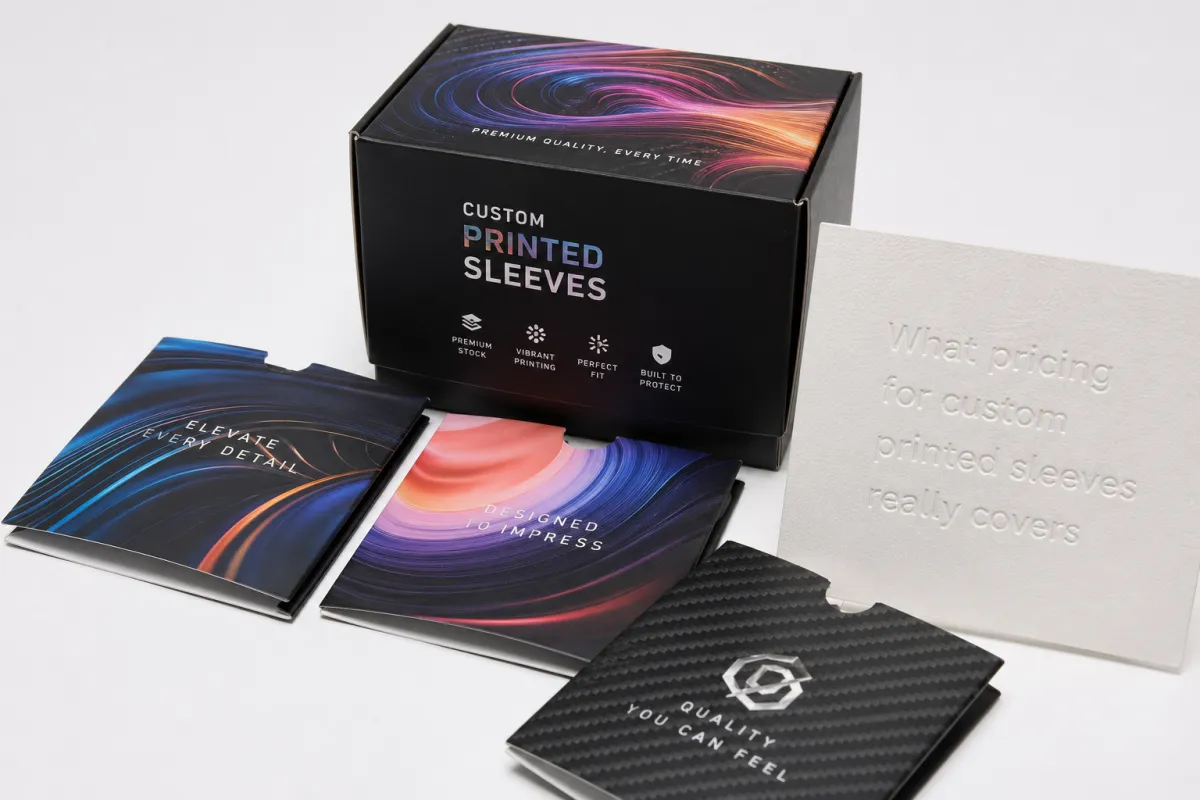
When people ask what pricing for custom printed sleeves really covers, I usually start with a cosmetics run that stayed with me because the gap between appearance and process was so wide. Two sleeve samples sat side by side on a pressroom table in Columbus, Ohio, and from a distance they looked nearly the same. One used a plain 16 pt stock board with standard four-color printing; the other used white SBS, a metallic foil accent on the logo, and spot UV on the product name. On screen, the difference barely showed. In the plant, it meant three finishing steps, a more expensive substrate, and a more careful approval path. That is how pricing for custom printed sleeves grows quietly, piece by piece.
At the core, the sleeve is a printed wrap or slip-on component that adds branding, instructions, or shelf presence without replacing the primary package. Many buyers compare it to a label, though that comparison only goes so far. A label is often adhesive and fairly straightforward; a sleeve usually needs die-cutting, scoring, folding, and sometimes glue or tab construction. If the sleeve has to sit over an inner carton or tray, the tolerances matter in a way that a simple sticker never has to think about. That is where pricing for custom printed sleeves starts reflecting actual factory work instead of just artwork on a screen.
It also helps to separate the sleeve from the rest of the package stack. The sleeve cost is not the cost of the carton, the tray, the pouch, or the insert below it, and the numbers can diverge by 20% to 40% depending on how much print coverage the sleeve carries. I have seen purchasing teams compare sleeve quotes against full box quotes and assume someone made a mistake in the math. The mistake was usually in the comparison, not in the estimate. Pricing for custom printed sleeves only makes sense once the buyer knows exactly which component is being quoted, and whether that quote includes a flat carton pack or pre-folded presentation. I am stubborn about that point because a messy comparison is usually the first step toward a messy approval.
Retail-ready presentation changes the numbers as well. If the sleeve needs to register with a cutout window, a barcode zone, a hang tab, or a tamper-evident fold, the design can force tighter conversion tolerances. The printer may need slower press speeds, extra QA checks, or a custom blank layout just to keep everything aligned. On a run of 10,000 sleeves, that can mean moving from a 6-up layout to a 4-up layout and losing yield by several hundred pieces. That is why pricing for custom printed sleeves can rise even when the artwork seems barely touched. A sleeve that looks clean on shelf often carries more production complexity than a plain-looking one with less demanding geometry.
"The sleeve that looked easy on the mockup took the most care on press," a plant manager told me during a run in Cleveland, Ohio, and he was right. The simpler it looks, the more you need to ask what the factory is hiding in the build, whether that means a 2 mm register tolerance, a 24 pt tuck lock, or a foil pass that needs a second inspection. I still laugh a little when a team says, "Oh, it is just a sleeve," because that sentence has caused more surprises than I care to count.
If you are also working on Custom Packaging Products, it helps to think of the sleeve as one piece in a broader packaging system rather than as an isolated line item. That mindset makes pricing for custom printed sleeves easier to judge against the value it creates on the shelf. Sometimes the sleeve is doing the heavy lifting on a 250 mL bottle or a 4 oz jar. Sometimes it is mostly carrying regulatory copy and a UPC. The cost should match the job, and if it does not, the buyer usually feels it long before the consumer does.
How do you estimate pricing for custom printed sleeves?
The fastest way to estimate pricing for custom printed sleeves is to lock down the same variables every good plant manager checks first: finished size, board caliper, print method, color count, finish stack, pack-out format, and quantity tier. I like to think of it as a small production equation. If the sleeve wraps a 60 mm cosmetic jar, the blank width, score positions, and glue flap need to be known before anyone talks about unit price. Without those details, the estimate is really just a guess with a logo attached, and pricing for custom printed sleeves should never depend on guesswork if the job matters to the launch plan.
From there, compare the job against the production path. A short digital run, a mid-volume offset order, and a long flexographic program will never price the same way because the setup logic is different. The estimate gets much cleaner once you know whether the project is a folding carton sleeve, a slip-on band, or a printed wrap designed for retail packaging. Even freight can change the estimate if the sleeves ship flat from Dongguan, Guangdong or pre-formed from a domestic converter in the Midwest. That is why pricing for custom printed sleeves always improves when the buyer can answer the basic questions before the quote is requested.
One helpful habit is to ask for the breakpoint. If the factory says 3,000 pieces still fall under a digital run but 5,000 pieces move into offset, then the estimate should show how pricing for custom printed sleeves changes at each tier. That single line often reveals whether the order should be increased, held steady, or simplified. It also keeps the conversation grounded in actual manufacturing behavior rather than in a vague target number that sounds nice in a meeting and proves useless in procurement.
If a supplier gives you only a total and no production breakdown, I would be a little suspicious, honestly. Not because the vendor is hiding something dramatic, but because a quote without logic is hard to trust later when the schedule gets tight.
How custom printed sleeves are made
Pricing for custom printed sleeves becomes easier to understand once you trace the production flow from file prep to final pack-out. Every sleeve begins with a dieline, and that dieline is more than a drawing. It is the map that tells the converting team where to cut, score, fold, and, if needed, glue. A careful prepress specialist checks panel widths, glue flap size, grain direction, bleed, and safety margins before the file ever reaches the press. I have watched an entire afternoon disappear because a buyer sent a beautiful file with no confirmed dieline and a 0.125 in bleed that did not match the board. Nobody enjoys reproofing a sleeve because one side panel was off by 2 mm. Frankly, nobody enjoys it twice.
Digital, offset, and flexographic production
The print method is one of the clearest drivers behind pricing for custom printed sleeves. Digital printing works well for shorter runs, tighter turnaround windows, and frequent artwork changes. A 1,500-piece launch sleeve can often go digital, get approved in 24 hours, and move through the line without plates. Offset printing usually wins when the job needs sharp image detail, consistent color, and a larger quantity that can absorb setup costs. Flexographic printing tends to be a practical choice for long runs and repeat work, especially when the sleeve is part of a wider packaging program that will return to the same spec over and over in the Midwest or on the West Coast.
I remember a supplier meeting in Shenzhen where a beverage brand wanted to know why a 2,500-piece sleeve quote came in so much higher than a 20,000-piece quote from the same vendor. The answer was plain. Digital could handle the smaller quantity without expensive plates, while offset spread make-ready costs across a much larger run. On the larger order, the per-unit price dropped from about $0.34 to roughly $0.11 once the plates, setup, and trim waste were absorbed. That is the sort of detail that shapes pricing for custom printed sleeves more than the artwork itself. The design mattered, sure, but the machine schedule mattered more.
Materials, board caliper, and finish
The substrate matters just as much. Common choices include SBS, CCNB, kraft, and specialty uncoated stocks, along with paperboard that may carry coatings for moisture resistance or better ink holdout. A 14 pt board feels lighter and may fit lower-cost applications, while an 18 pt or 24 pt structure can deliver a more rigid, premium hand feel. For a sleeve around a 60 mm diameter jar, 350gsm C1S artboard can be a practical middle ground because it prints cleanly and holds score lines without cracking. Thicker board is not automatically better, though. I have seen buyers overspecify heavy board because it sounded premium, then find out that a lighter caliper would have held the sleeve shape just fine and saved money on pricing for custom printed sleeves.
Finishing is where the quote can shift fast. Die-cutting, scoring, and folding are standard, but embossing, foil stamping, soft-touch lamination, matte varnish, and spot UV all add setup and labor. A simple aqueous coating may barely move pricing for custom printed sleeves, while foil on a logo plus embossing on a pattern can change both the press schedule and the finishing schedule. A job built on 350gsm C1S artboard with foil and spot UV might need a second pass in the finishing room in Dongguan, Guangdong, which adds another day or two before packing. If the sleeve needs to feel premium in hand, those extras may earn their place. If the sleeve is mainly carrying a promo message, they can be more decoration than value. I am not anti-decoration; I just think decoration should have a job.
One more detail deserves attention: flat-packed delivery. Most sleeves ship flat, nested, or as scored blanks rather than pre-formed units, because that cuts freight weight and reduces storage space. I have negotiated with buyers who wanted sleeves pre-built, only to discover that the labor saved on their side came back as freight and warehousing costs. For many programs, flat-packed inventory is the cleaner model and the better fit for pricing for custom printed sleeves, especially when the freight lane runs from Chicago, Illinois to Reno, Nevada. It is one of those tradeoffs that sounds boring until the warehouse bill shows up.
For brands comparing Custom Printed Boxes with sleeve-based formats, the sleeve often looks simpler on paper, though not always in production. A sleeve can be a lower-cost branding layer, a faster update path, and a useful way to refresh packaging design without changing the base structure. That is why pricing for custom printed sleeves should be judged against function, not assumptions. A $0.15 sleeve on a 5,000-piece run can do the work of a much heavier carton change when the base pack is already approved.
For reference, industry testing and certification can matter if the sleeve is part of a larger shipping or sustainability claim. I often point buyers to ISTA test standards when they are validating how a packaged item performs in transit, and to FSC chain-of-custody guidance when paper sourcing is part of the brief. Those standards do not set pricing for custom printed sleeves directly, but they do shape material choices, approvals, and expectations, especially for suppliers working from Wenzhou, Zhejiang or Toronto, Ontario.
Pricing for custom printed sleeves: the biggest cost drivers
If I had to reduce pricing for custom printed sleeves to the handful of factors that matter most, I would start with quantity, material, print method, trim size, color count, and finishing complexity. Those variables interact in a way many buyers do not see until the first quote lands. A small run of 1,000 sleeves may feel expensive because setup gets spread across very few pieces. A larger run of 25,000 sleeves can look dramatically better on a per-unit basis because the press, plate, and make-ready costs are absorbed more efficiently. On one beverage project, the same sleeve fell from $0.29 at 2,000 pieces to $0.09 at 30,000 pieces once the line moved to a repeat offset schedule.
That spread is why pricing for custom printed sleeves often follows step changes instead of smooth curves. I have seen a 3,000-piece quote come in at $0.31 each, while a 10,000-piece version of the same sleeve dropped to $0.14 each because the vendor could move from digital to offset and keep the same finishing spec. The jump is not always that dramatic, but the pattern holds. Quantity changes the quote, and the breakpoint between print methods can matter more than the artwork revision itself. A buyer in Phoenix, Arizona once thought the supplier had discounted the job overnight; the real reason was simply that the order crossed the vendor's 5,000-piece threshold.
Artwork complexity also carries real weight. Full-bleed coverage, fine type, gradients, tight registration, and multiple brand colors all ask more from the press and the operator. If your sleeve uses a deep black background, a narrow white logotype, and a varnish hit on top, the factory may need closer inspection and a slower run. That extra care shows up in pricing for custom printed sleeves because the room for error shrinks quickly. A sleeve with six spot colors and a metallic silver accent will not price like a clean two-color layout, even if the panel size is the same.
Finishing tradeoffs deserve a clear look. I like one strong finish more than a stack of decorative effects that start competing with one another. A matte varnish with clean typography can look sophisticated and keep pricing for custom printed sleeves under control. Add foil, embossing, and soft-touch lamination all at once, and the sleeve becomes a premium object with premium labor to match. That is fine if the shelf price can support it. It is not fine if the margin is already thin, especially on a $6.99 retail item with only a 42% gross margin.
| Order profile | Typical build | What drives pricing for custom printed sleeves | Common unit-price tendency |
|---|---|---|---|
| Short run launch | 1,000-3,000 pieces, digital print, simple matte varnish | Setup spread, proofing, one-up sampling, fast changeovers | Higher, often around $0.28-$0.55 each depending on size |
| Mid-volume repeat | 5,000-10,000 pieces, offset print, standard SBS or CCNB | Plate cost, trim size, ink coverage, die-cut efficiency | Moderate, often around $0.12-$0.24 each |
| Premium shelf build | Foil, embossing, soft-touch lamination, tight registration | Extra finishing passes, inspection, slower throughput | Higher, often around $0.22-$0.60 each |
| Large recurring program | 20,000+ pieces, flexo or offset, standardized specs | Efficient make-ready, repeat tooling, stable supply chain | Lower, often around $0.08-$0.18 each |
That table is directional, not a promise. Pricing for custom printed sleeves depends on the exact board grade, the press line, the finish stack, and the schedule. I always tell buyers to ask for an itemized quote so they can see whether the number is being driven by print, material, finishing, or freight. A low headline price can hide a costly surprise in tooling or shipping. A higher headline price may still be the better buy if it includes proofs, overages, and delivery terms that the cheaper quote left out, such as a 2% spoilage allowance or pallet wrap in the final freight line.
Packaging logistics shape pricing for custom printed sleeves as well. Sleeves that ship nested and flat are usually easier to move, easier to store, and less likely to arrive damaged. If the buyer wants pre-formed sleeves, the quote often changes because the factory has to do more labor before shipment. Add carton pack-out requirements, kitting, or palletization rules, and the cost curve shifts again. The sleeve is a printed item, yes, but it is also a physical object that has to move through a real supply chain from a plant in Nuevo Laredo, Mexico or Suzhou, Jiangsu to a fulfillment center in Tennessee.
For many clients, the most useful comparison is not cheap versus expensive. It is what is included versus what is excluded. That framing keeps pricing for custom printed sleeves anchored to actual production needs instead of to a vague number someone dropped into an email.
A step-by-step guide to getting an accurate quote
To get reliable pricing for custom printed sleeves, I always begin with a complete spec sheet. Send the vendor exact dimensions, the desired board type, print coverage, quantity, and the job use case: retail, promotional, or transport. If the sleeve is wrapping a carton, include the carton dimensions too, because a 1/8-inch difference can change the blank layout. I have seen quote accuracy improve immediately once a buyer sent a proper spec instead of a rough sketch on a napkin. A napkin is charming for lunch, not so charming for prepress, especially when the dieline has a 3 mm glue flap.
Artwork is the next piece. A printer needs to know whether the files are final, whether bleed is included, whether spot colors are specified by Pantone, and whether the file is coming in as native artwork or as a PDF proof. A clean PDF with correct dielines is often enough for pricing for custom printed sleeves, but a factory may still ask for linked assets if the project involves a color-sensitive brand or layered finishing. If there is a barcode, legal panel, or QR code, I like to check its placement early because those elements can affect trimming and read quality, especially on a 90 mm wide sleeve that only leaves 6 mm of quiet space.
The quote path from first request to shipment
Most good vendors move through the same sequence. Inquiry, estimate, prepress review, sample or one-up proof, approval, production scheduling, and then packing. Simple pricing for custom printed sleeves can come back in 24 to 48 hours if the spec is complete and the quantity is ordinary. More complex jobs, especially those involving foil or unusual construction, may take several rounds of clarification before the number is final. I would rather have a quote arrive a day later and be correct than get a fast number that changes after proofing. Fast and wrong is still wrong, particularly if the order is headed to a launch in Atlanta, Georgia.
Timing deserves its own attention. A small digital run might be ready in 7 to 10 business days after approval, while a larger offset job with finishing often needs 12 to 15 business days from proof approval. Add freight time, and the calendar gets longer by another 2 to 5 business days depending on whether the shipment is going by ground from Illinois or air from southern China. If pricing for custom printed sleeves is tied to a product launch, I want the timeline written down with checkpoints: artwork approval, proof signoff, press start, finishing, pack-out, and ship date. That keeps everyone honest and reduces the number of anxious "just checking in" emails later.
I learned that lesson during a food launch where the client approved the quote in a hurry but forgot to confirm the sleeve fit against the inner carton. The printer caught the mismatch at prepress, which saved the run, but the schedule slipped by a week. Nobody blamed the factory, because the specs were incomplete. That is the real cost of rushing pricing for custom printed sleeves: you may get a number fast, but you still have to build the job correctly. The quote is only the opening scene, and a missed measurement on a 72 mm pack can add $180 in tooling changes before anyone notices.
Ask for an itemized estimate every time. I want to see material, print, die-cutting, finishing, packing, and freight broken out line by line. That makes it easier to compare vendors, and it also makes pricing for custom printed sleeves much easier to defend internally. A procurement team can approve a surcharge for foil if they can see the line item. They cannot evaluate a mystery total very well. Mystery totals belong in novels, not packaging approvals.
If you need to coordinate the sleeve with other components, such as a tray, insert, or bottle carton, build that into the quote packet from the start. Coordinating with packaging components and custom printed sleeves in one request often saves time because the vendor can check fit, nesting, and pack-out efficiency together. That is especially helpful for branded packaging programs where the sleeve must line up with a display box or a promotional carton on the shelf. A single spec sheet also helps a plant in Monterrey, Mexico or Nashville, Tennessee quote the work without guessing at the final assembly order.
Common mistakes that inflate sleeve pricing
The fastest way to lose control of pricing for custom printed sleeves is to request quotes before the dimensions are final. Even a small change in length or depth can force a new dieline, a revised blank layout, or a different die tool. I have seen teams approve a mockup on Tuesday and then discover on Friday that the product insert changed, which made the sleeve 4 mm too short. That tiny change triggered a new proof and a new setup fee. It was not anyone's favorite meeting, and the room had the kind of silence that makes coffee taste worse, especially before an 8:00 a.m. review.
Over-specifying the build creates another common problem. Some buyers assume every sleeve needs heavy board, foil, embossing, and a premium coating to look good. That is not true. If the sleeve is going around a sturdy carton and only needs to carry a logo and a short message, a cleaner spec may deliver the same shelf result for less money. In my experience, thoughtful packaging design usually beats expensive decoration. Pricing for custom printed sleeves should reward clarity, not clutter, and a plain 18 pt SBS sleeve can sometimes outperform a foil-heavy version on a crowded retail shelf.
Artwork version control causes a surprising number of cost overruns. If the buyer sends Version A to the printer and Version C to the designer, the prepress team ends up reconciling changes that should have been caught before quoting. That means new proofs, additional checks, and sometimes a rework charge. I once sat through a supplier call where three different PDF files lived in three different inboxes. Nobody could tell which one was final, and pricing for custom printed sleeves kept moving because the spec kept moving. I have never seen a louder example of silence from a call full of people trying to be polite.
Another hidden cost appears when the buyer forgets about shipping cartons, insert compatibility, or retail display requirements until late in the job. If the sleeve has to arrive packed a certain way for a chain store in Dallas, Texas or a distribution center in Pennsylvania, the factory may need different carton counts, pallet patterns, or a more careful pack-out strategy. Those details matter. They are not glamorous, but they are part of the real cost behind pricing for custom printed sleeves, and they can add a few cents per unit before freight is even considered.
One last trap is quote comparison without spec comparison. Two quotes can look wildly different because one includes FSC board, one uses a generic stock, one includes overages, and one leaves freight out entirely. If the buyer does not line up board grade, print process, and finish side by side, pricing for custom printed sleeves turns into guesswork. I have seen teams choose the lowest quote and then spend more later correcting what the quote never covered. That is a painful way to learn that a cheap number is not the same thing as a good number.
That is why I always push for apples-to-apples review. The goal is not to buy the cheapest sleeve. The goal is to buy the right sleeve at a fair, explainable price, whether the run is 2,000 units or 20,000.
Expert tips for better value without sacrificing presentation
If the budget is tight, the first place I look is the spec stack. Simplify the print where it will not hurt the shelf story. Maybe the sleeve does not need two special inks. Maybe the brand can move from multiple finishes to one high-impact finish and get almost the same result. That kind of edit often improves pricing for custom printed sleeves more than squeezing a vendor for a lower margin. Vendors can only shave so much before the job starts complaining.
Standardizing sleeve sizes across SKUs is another smart move. I worked with a personal-care client that had six slightly different sleeve widths, each one demanding its own die and its own setup. We consolidated the range so three SKUs could share one blank size, and the effective cost dropped because the production line could run longer without stopping. Pricing for custom printed sleeves responds very well to standardization. The factory likes fewer changeovers, and the buyer likes fewer surprises. I like it because it means fewer frantic emails asking whether a 2 mm difference is really a big deal. It usually is.
I also recommend using the printer's material library before asking for a custom source. Stock options often save more than people expect, and in many cases the shelf result is just as strong. A solid CCNB or SBS from the vendor's standard inventory can be perfectly suitable for retail packaging, especially if the graphics are doing the heavy lifting. In those jobs, pricing for custom printed sleeves improves because the supply chain is simpler and the lead time is easier to manage, particularly if the vendor already runs that board through a converter in the Midwest or the Pearl River Delta.
One practical trick I use a lot is to look for places where the sleeve can do one job very well instead of trying to do five jobs halfway. If the sleeve is already carrying a bold color block and a clear product name, it may not need a second decorative pass to feel premium. That little bit of restraint tends to save money and also makes the shelf message cleaner.
Choose the print path that matches the order profile
Digital is the right answer when flexibility matters, the run is smaller, or the artwork may still change. Offset tends to win when the image needs crisp detail and the volume is high enough to justify plates. Flexo makes sense for recurring programs with stable specs and lots of units. I would not choose a print method because it sounds premium. I would choose it because the order profile supports it. That single decision can change pricing for custom printed sleeves more than any decorative finish, especially on a 4,000-piece seasonal run versus a 40,000-piece annual program.
Proofing matters too. If the sleeve must sit beside a premium product or align with another package component, ask for a one-up physical sample or a digital proof with verified dimensions. Color on screen is not enough when the branding needs to hit a specific shade of black, navy, or metallic gold. I have seen a brand approve an on-screen proof that looked fine in the office, then reject the printed sample under store lighting because the contrast was too low. A physical sample would have saved a round of rework and kept pricing for custom printed sleeves under control, and a one-up sample from a plant in Toronto, Ontario can be worth the extra day in transit.
Finally, think about sustainability claims with care. If the paper source or chain of custody matters to the brand, the vendor should be able to speak clearly about FSC options and documentation. If the package needs to survive transit abuse, ask about relevant ISTA test methods and whether the sleeve is being evaluated as part of the full package system. That level of clarity does not just help compliance; it helps keep pricing for custom printed sleeves honest because the buyer knows which requirements are truly necessary.
For teams building out a broader line of product packaging, the smartest savings often come from consistency, not compromise. A well-planned sleeve can support custom printed boxes, cartons, and promotional kits without forcing a separate tool path for every SKU. That is how branded packaging programs stay flexible and efficient over time, especially when the same family of products ships from the same DC in Ohio or Nevada.
Next steps for pricing for custom printed sleeves
If you are preparing to request pricing for custom printed sleeves, build the quote packet before you send the email. Include exact measurements, target quantity, artwork files, substrate preference, finish preference, delivery deadline, and any special handling notes. The more complete the packet, the less guessing the supplier has to do, and the more useful the quote becomes. In a supplier meeting I had with a beauty brand, the buyer brought a one-page spec sheet with all the basics filled in, and the first-round quote came back close enough to approve with only one revision. That is the kind of process every team wants, whether the vendor is in Milwaukee, Wisconsin or Dongguan, Guangdong.
Ask for itemized estimates so you can compare board, print, die-cutting, finishing, and freight separately. That is the clearest way to understand pricing for custom printed sleeves without getting distracted by the headline total. I also like to ask suppliers where the breakpoints are. Sometimes moving from 3,000 to 5,000 pieces changes the unit cost enough to justify a larger order. Sometimes it does not. You only know after you see the curve, and the curve is usually more useful than anyone's gut feeling in the room. On one recent quote, 5,000 pieces landed at $0.15 per unit while 8,000 pieces came down to $0.13 per unit, which made the larger order the cleaner buy.
If the sleeve will sit on a premium shelf, coordinate with the full package stack and request a one-up sample. It is much easier to judge fit, ink coverage, and presentation before production than after the run is complete. This is especially true for jobs that must align with a bottle neck, a carton flap, or a display tray. Pricing for custom printed sleeves can only be evaluated well when the physical fit is understood, not just the rendering. A 1/16-inch misread on a flange can create a line of rejects that nobody planned for.
Use the first quote round to simplify where you can. Remove unnecessary special effects, compare standard board options, and see whether two SKUs can share one blank size. Then rerun pricing for custom printed sleeves with the spec that best balances cost and presentation. That is often where the best answer appears: not in the first idea, but in the improved version after a practical review. A little restraint usually buys a better result than trying to cram every idea onto one sleeve, especially when the print line is already committed to a 12-color schedule in advance.
Before you place the order, confirm the production timeline, approval checkpoints, overage policy, and shipping method. I have seen launches stumble because the buyer assumed the quote included 2% overage, while the factory had priced a tighter yield. I have also seen freight surprises because the delivery term was never defined. Clean communication keeps pricing for custom printed sleeves from drifting after approval, and a written timeline of 12 to 15 business days from proof approval keeps the launch team aligned.
Bottom line: the right sleeve is the one that fits the product, fits the schedule, and fits the budget, and that only happens when pricing for custom printed sleeves is built from a clear spec instead of a loose assumption.
How does pricing for custom printed sleeves change with quantity?
Unit price usually drops as quantity rises because setup and make-ready costs are spread across more sleeves. A 1,000-piece digital job may sit near $0.34 each, while a 10,000-piece offset run can move closer to $0.14 each if the board and finish stay the same. Ask vendors where the breakpoints are so you can see how one quantity tier changes pricing for custom printed sleeves.
What is the biggest factor in custom printed sleeve pricing?
Quantity is usually the largest driver, but substrate and finishing can move the price significantly too. A simple stock board sleeve with minimal finish can cost far less than a premium sleeve with foil and embossing. The cleanest way to compare pricing for custom printed sleeves is to hold all specs constant and change one variable at a time, ideally on a quote that names the exact board, such as 16 pt SBS or 350gsm C1S artboard.
Do specialty finishes always raise pricing for custom printed sleeves?
Yes, usually, because each finish adds setup, labor, or a separate processing step. Soft-touch lamination, foil stamping, and embossing are especially likely to increase cost. If budget is tight, choose one high-impact finish instead of stacking several decorative effects and watch pricing for custom printed sleeves stay more manageable, especially on runs under 5,000 pieces.
How long does the quote and production process usually take?
A simple quote can come back quickly if dimensions, artwork, and quantities are already final. Production timing depends on proof approval, material availability, print method, and finishing complexity. Ask for a schedule that includes prepress, sampling, press time, and freight so pricing for custom printed sleeves is matched to a realistic timeline, usually 12 to 15 business days from proof approval for an offset job with finishing.
How can I compare pricing for custom printed sleeves from different vendors?
Make sure every quote uses the same board, size, print method, finish, and shipping terms. Check whether the estimate includes tooling, proofs, freight, and overages, since these can change the real total. The best comparison is an apples-to-apples spec sheet, not just the lowest headline number, and that is the only fair way to judge pricing for custom printed sleeves, whether the vendor is in Ohio, Mexico, or Guangdong.
Final thought: once you compare the same spec across the same vendors, pricing for custom printed sleeves stops feeling like a mystery and starts looking like a practical sourcing decision.

