Buyer Fit Snapshot
| Best fit | Custom Laser Cut Packaging Boxes projects where brand print, material claims, artwork control, MOQ, and repeat-order consistency need to be specified before quoting. |
|---|---|
| Quote inputs | Share finished size, material target, print colors, finish, packing count, annual reorder estimate, ship-to region, and any compliance wording. |
| Proofing check | Approve dieline scale, logo placement, barcode or warning zones, color tolerance, closure strength, and carton packing before bulk production. |
| Main risk | Vague material claims, crowded artwork, missing packing details, or unclear freight terms can make a low unit price expensive after revisions. |
Fast answer: Custom Laser Cut Packaging Boxes: Design, Cost, Process should be specified like a repeatable production item. The safest quote records material, print method, finish, artwork proof, packing count, and reorder notes in one written spec.
Production checks before approval
Compare the actual filled-product size with the drawing, then confirm tolerance on folds, seals, hang holes, label areas, and retail display edges. Reserve space for logos, QR codes, warning copy, and material claims before decorative graphics fill the panel.
Quote comparison points
Review material grade, print process, finish, sampling route, tooling charges, carton quantity, and freight assumptions side by side. A quote is only useful when the supplier can repeat the same color, closure quality, and packing count on the next order.
Custom Laser Cut Packaging Boxes: Design, Cost, Process
Plain cartons do the job until the product needs a sharper entrance. Custom Laser Cut packaging boxes add windows, cutouts, vents, and patterned details that make a package feel deliberate instead of generic. A single precise opening can do more for perceived value than a page of copy ever will, which is why brands keep coming back to this format.
The catch is simple: custom laser cut packaging boxes only look premium when the structure, material, and cut style are aligned. Weak stock exposes every flaw. A messy vector file does the same. For brands comparing options, it helps to start with the basics in Custom Packaging Products and then decide where the laser detail actually earns its keep.
What Are Custom Laser Cut Packaging Boxes?
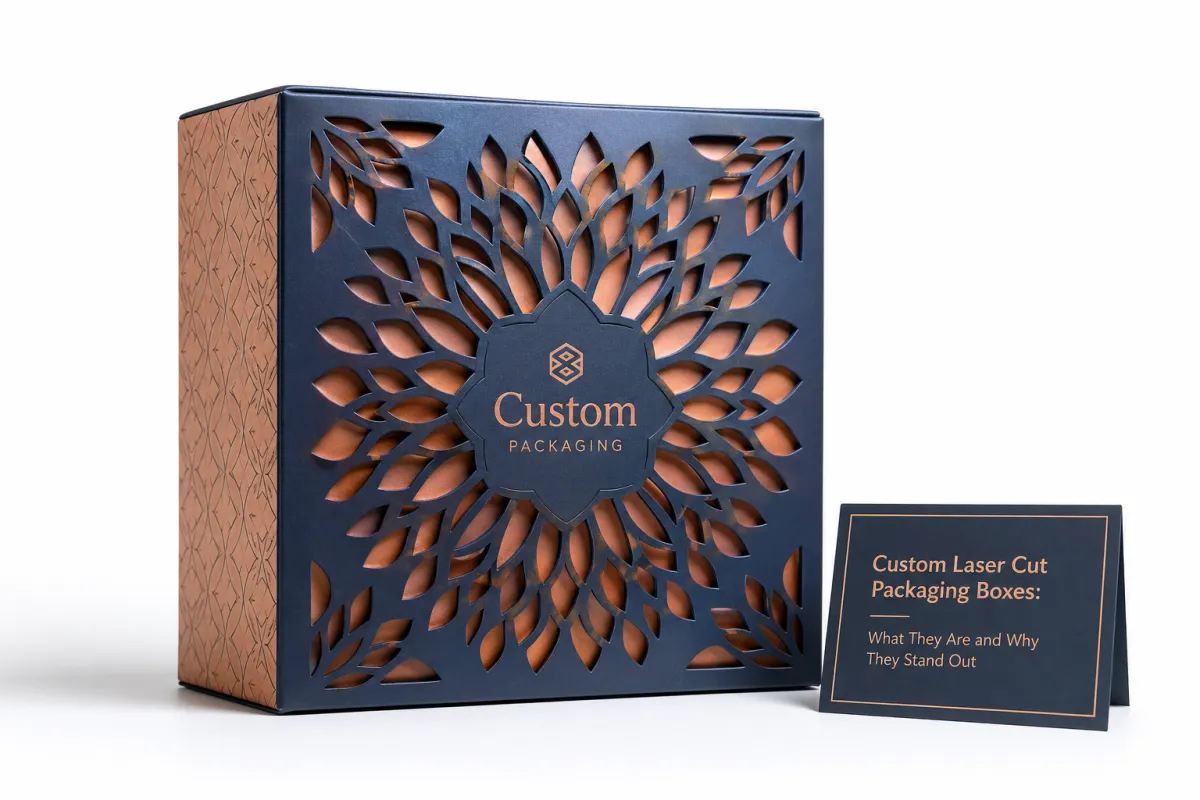
Custom laser cut packaging boxes are boxes with precision-cut patterns, windows, vents, tabs, or decorative edges created by a laser instead of a traditional die. The laser follows a digital path, so the cuts can be extremely fine, highly repeatable, and far more flexible than a standard mechanical punch. That flexibility is why brands use custom laser cut packaging Boxes for Retail packaging, gifting, cosmetics, candles, premium electronics, and seasonal launches where shelf impact matters.
They stand out because they create contrast. A flat panel becomes a reveal. A plain lid becomes a brand moment. A closed box suddenly lets the product breathe a little, literally in the case of vents, and visually in the case of windows or layered patterns. Good laser cut packaging does a lot with very little ink.
The process is less forgiving than standard folding cartons. Weak corners, tiny bridges, or awkward spacing show up immediately. The laser does not smooth those choices over. It cuts exactly what the file tells it to cut. Precision is the selling point and the risk.
From a packaging buyer's point of view, these boxes make the most sense when the box needs to do more than protect. They need to support package branding, showcase the item, or create a premium first impression without jumping all the way to rigid luxury packaging. That middle ground matters, especially for brands that want custom printed boxes with a more distinctive finish.
The best results usually come from simple ideas executed well. A 40% reveal window with clean margins often beats a dense lace pattern that looks great on screen and fragile in production. Custom laser cut packaging boxes reward restraint. They punish decoration for decoration's sake.
The smartest projects start with the product, then the material, then the cut pattern. Pretty concept art is nice. A box that survives packing, shipping, and shelf display is nicer, and honestly, that is the job.
I have watched projects fail for reasons that sounded trivial on a conference call and turned into expensive rework in the sample room. A 3 mm bridge that looked elegant in a mockup can tear once the board is creased. A window that sits 5 mm too high can make the whole pack feel off-balance. Packaging is a small object with a lot of consequences.
How Custom Laser Cut Packaging Boxes Are Made
The production flow for custom laser cut packaging boxes is straightforward on paper and slightly annoying in real life, which is normal for packaging. It usually starts with a concept sketch, then moves to a dieline, then to vector cleanup, then to laser setup, then a sample cut, and finally to full production. Skip one of those steps and the result usually becomes an expensive lesson.
Design artwork and structural artwork are not the same thing. Design artwork is the visual side: logos, type, colors, and image placement. Structural artwork is the flat template that defines folds, panels, tabs, windows, and cut paths. A pretty mockup does not count as a production file. These boxes need both pieces to be clean, because the laser follows the structure file, not the mood board.
The machine follows digital paths to cut, score, or engrave. On thicker paperboard, a laser can handle precise cutouts and fold assists. On lighter stock, the settings need more control so the edges do not scorch or curl. Power, speed, and focus all matter. Too much energy burns kraft stock. Too little leaves rough edges or incomplete cuts. Custom laser cut packaging boxes are a geometry problem first and a graphics problem second.
Most suppliers want a vector format such as AI, EPS, or PDF with proper outlines. Tiny raster images do not help much when the machine needs an exact path. If the job includes a window or decorative pattern, the minimum bridge width should be checked early. A practical range is 1.5 mm to 3 mm for delicate bridges, but the right number depends on the board thickness and the shape itself. There is no magic number that works for every carton, no matter how much sales copy would like there to be one.
After the cut, the finishing steps matter more than people expect. Folding, gluing, inserts, and inspection all shape the final result. Burn marks around a cut edge, misaligned tabs, crushed corners, and fuzzy scoring lines are the kind of defects that show up immediately on custom laser cut packaging boxes because there is nowhere to hide them.
Sample approvals save money. A sample reveals whether the material charred, whether the panel opens cleanly, and whether the window lands where the eye expects it. In practice, a sample is not a formality. It is the difference between calm production and avoidable rework.
One practical detail that gets missed a lot: laser-cut edges can look different depending on the board finish. Uncoated kraft often darkens at the cut line, while coated stock can show a sharper contrast or a slight sheen change. That is not automatically bad. It just means the material choice is part of the design language, not an afterthought.
Design Factors That Affect Custom Laser Cut Packaging Boxes
Design choices decide whether custom laser cut packaging boxes feel premium or just busy. The biggest variables are material, wall thickness, cut complexity, and whether the design is doing a decorative job, a functional job, or both. A laser can create elegant detail, but the material still has to carry the load.
Common stocks for paper-based custom laser cut packaging boxes include kraft board, premium cardstock, C1S artboard, rigid board, and specialty papers. A 300 gsm to 400 gsm stock may work for lighter retail packaging or sleeves, while 1.5 mm to 2 mm rigid board is often better for presentation packaging and gift sets. Thin stock can warp or scorch. Overly brittle stock can crack at tight cut points.
Tiny details matter more than buyers expect. Sharp internal corners can tear in handling. Very small text can disappear after cutting. Lace-like patterns need enough spacing so the panels do not become floppy or fragile. If the design includes a repeated motif, the layout should be checked at full size, not just on a screen. Screen-size confidence is how people end up paying for a second sample.
Product fit is another one that gets ignored until it is too late. Inner dimensions, insert thickness, and acceptable movement during shipping all need to be part of the design. A cosmetic jar, candle, or electronics accessory should not rattle around inside the box. If the item shifts more than a few millimeters, the insert or tuck structure needs adjustment.
Branding choices can go either way. Reveal windows work well when the product color or shape is a selling point. Layered panels can add depth without turning the box into a crowded poster. Foil, embossing, and laser cut accents can work together, but only if one feature leads and the others support it. If every surface screams, none of it sounds premium.
Sustainability also deserves a sober look. Intricate cuts can increase waste if the layout is not planned with sheet yield in mind. That is where packaging design and production planning overlap. Efficient nesting reduces scrap. FSC-certified board helps with responsible sourcing, and the FSC standard is worth checking if recycled or certified content is part of the brief. Laser cut packaging can be visually strong without turning into unnecessary material waste.
Start with a functional box, then add one or two decorative moves that clearly serve the brand. If the cut pattern helps product visibility, ventilation, or unboxing, keep it. If it only exists because it looks clever in a mockup, cut it back. That advice has saved more budgets than any polished render ever has.
If the cut pattern is prettier than the product, the packaging is doing the wrong job.
There is also a quiet design trick that experienced teams use: let empty space do some of the work. Negative space around a window or motif makes the cut feel more intentional and often improves structural strength. It is a small move, but it changes how the box reads from a distance.
Custom Laser Cut Packaging Boxes Cost and Pricing Drivers
Pricing for custom laser cut packaging boxes usually comes down to setup, material, cut time, and finishing. The machine time matters, but it is not the whole story. A simple design with one window and a clean fold can be far cheaper than a dense decorative pattern that takes longer to cut, inspect, and assemble. Setup labor is real. So is file cleanup. So is sample work. Suppliers do not invent those steps for fun.
One useful way to think about cost: low-complexity custom laser cut packaging boxes behave more like a controlled fabrication job, while high-complexity boxes act more like a short-run craft project with industrial constraints. A few extra cut lines can push a project into slower setup and higher scrap rates.
The table below gives directional ranges only. Actual pricing shifts with print coverage, stock choice, finish, inserts, and order quantity. Still, it helps to see how complexity changes the bill.
| Box Style | Typical Build | Indicative Unit Cost at 1,000 pcs | Indicative Unit Cost at 5,000 pcs | Best Fit |
|---|---|---|---|---|
| Simple window cut | Single reveal panel, light scoring, minimal finishing | $0.45-$0.90 | $0.18-$0.35 | Cosmetics, candles, retail packaging |
| Medium decorative cut | Patterned cutout, layered panel, optional insert | $0.85-$1.80 | $0.30-$0.65 | Gift sets, seasonal launches, branded packaging |
| Complex presentation box | Dense laser detail, rigid board, custom insert, higher assembly | $2.50-$6.00 | $1.20-$2.80 | Premium electronics, luxury gifting, display packaging |
The hidden costs are the ones buyers forget. Prototyping, sample revisions, file cleanup, special inserts, hand assembly, and freight on bulky flat-packed cartons can all add up. A cheap quote that leaves out proofing or QC is not really cheap. It is just incomplete.
Order quantity matters because setup labor gets spread across more units. That is why unit cost often drops more sharply between 500 and 2,000 pieces than it does between 5,000 and 10,000. If a launch can tolerate a larger run, the math usually improves. If the project is still experimental, smaller quantities reduce risk, but the unit cost will look less flattering.
If you are comparing suppliers, ask for at least two or three quote options. One can be the minimum viable structure. One can include stronger stock or a better insert. One can include premium finishing. That comparison tells you where the money is going. It also keeps custom laser cut packaging boxes from becoming an emotional purchase disguised as sourcing.
Packaging buyers also underestimate the difference between a box that looks expensive and one that is expensive to build. Dense cut paths, foil, soft-touch coating, and inserted trays all push price in different ways. A clean, well-planned package branding decision often saves more than negotiating a small discount on paper stock.
From the production side, there is a spread between quoted price and true delivered cost. If the supplier is local, trimming freight might offset a slightly higher unit price. If the run is overseas, the lower quote can vanish once shipping, duty, and rework are included. That is not a theory. It is a pattern I have seen enough times to stop pretending otherwise.
Custom Laser Cut Packaging Boxes Process and Timeline
A realistic timeline for custom laser cut packaging boxes starts with briefing and ends with freight, not with the first proof. Most projects need time for concept work, file preparation, sample approval, production, finishing, and shipping. If someone promises everything in a couple of days, they are probably skipping the steps that protect your budget.
For a clean, simple project, a practical schedule might look like this: 2-4 business days for concept and dieline prep, 2-5 business days for sample production, another 1-3 business days for review and revisions, and 10-15 business days for production after approval. Add freight on top of that. Large or complex custom laser cut packaging boxes can run longer, especially if materials need to be sourced or the insert design has not been finalized.
Three things slow projects down the most. First, unclear dimensions. Second, repeated revisions. Third, waiting for sample approval from too many people. Packaging decisions should not move through six layers of opinions before a dieline gets locked. That is how a four-panel box becomes a six-week headache.
For product launches, trade shows, and holiday campaigns, build in buffer time. If the boxes must arrive for a product drop, I would treat the packaging deadline as earlier than the marketing deadline. That is annoying. It is also how you avoid showing up with a great product and a cardboard backup plan.
Approvals should happen in a sensible order. Lock the dieline first. Confirm dimensions and insert fit next. Then approve print content and cut paths. After that, review the final sample under real light and with the actual product inside. A box that looks fine empty can behave very differently once it is loaded.
If the packaging is also meant to survive shipping, test it like shipping matters. The ISTA test methods are a useful reference point for transit checks, especially for drop, vibration, and distribution simulation. Not every project needs full certification, but the discipline behind the standard is worth borrowing. These boxes are visual pieces, yes, but they are still part of a supply chain.
The cleanest timelines usually belong to the cleanest briefs. If the supplier knows the exact product size, target quantity, insert needs, finish, and launch date on day one, custom laser cut packaging boxes move far faster than they do when the request arrives as "something premium, probably black, maybe with a window." That is not a brief. That is a hope.
One more timing reality: holidays and campaign seasons compress everyone else at the same time. Even a small delay on artwork can push a production slot back by a week or more if the supplier is already booked. If the box matters to the sell-through, it should be treated like inventory, not like decoration.
Common Mistakes With Custom Laser Cut Packaging Boxes
The most common mistake is choosing the wrong material. A stock that looks great in a mockup can char too easily, warp under heat, or crack at the narrow points of a detailed cut. Custom laser cut packaging boxes need a material that can actually survive the cut path, not just one that photographs well.
Another common problem is overcomplication. The more detailed the pattern, the more attention the box demands during setup and production. That does not always increase value. A dense pattern can weaken the panel, slow the cut, and raise the chance of cleanup work. In other words, the design gets fancier while the result gets more fragile.
Measurement mistakes are another budget killer. If the insert is off by even a few millimeters, the product can sit crooked, rattle in transit, or stop the box from closing properly. That is especially true for cosmetics, candles, and electronics accessories where the product shape is not a simple rectangle. These boxes punish loose assumptions.
Skipping the sample is a bad habit. A screen mockup does not tell you how the edge will burn, how the fold will hold, or how much the light pattern changes once the box is built. The sample is where reality gets a vote. Ignore it and you are gambling with a production run.
Branding errors show up too. Some teams crowd the cut pattern with logo, copy, and decorative elements until the package looks crowded instead of premium. Others bury the logo where the eye never lands. Good package branding gives the product room to breathe. The cut pattern should frame the message, not fight it.
There is also a strange habit of treating laser cutting like it fixes bad files. It does not. If the vector artwork has stray points, broken paths, or overlapping shapes, the output becomes messy fast. The machine is precise. The file has to be precise too. Precision is not a rescue service.
One useful habit is to review the design at three levels: from arm's length, from shelf distance, and in the hand. That catches a lot of problems early. A cut pattern that reads beautifully at three feet may disappear at ten feet. A box that feels clever on screen may feel fussy in real use. Custom laser cut packaging boxes work best when the first impression survives the second look.
For teams already using custom printed boxes, the transition is easier if the laser cut element has a clear job. Let it show the product, improve airflow, support the unboxing moment, or reinforce the visual identity. If it cannot do one of those jobs, it is probably decorative clutter.
And yes, sometimes the problem is simply too many opinions. A package that has been reviewed by marketing, sales, operations, and leadership can drift into compromise soup. The design loses clarity one comment at a time. I have seen that happen more than once, and it is kinda predictable.
Expert Tips and Next Steps for Custom Laser Cut Packaging Boxes
The smartest way to approach custom laser cut packaging boxes is to make the job easier before you make it prettier. Define the product size. Choose the material. Decide whether the cut is meant to display, ventilate, or decorate. Then ask for a sample before you order volume. That sequence saves time, money, and nerves.
Start with a simple checklist for suppliers:
- Exact product dimensions and weight
- Quantity target and reorder expectation
- Material preference and thickness
- Cut purpose: window, pattern, vent, or decorative edge
- Insert requirement, if any
- Print coverage, finish, and color goals
- Target launch date and freight destination
That kind of brief keeps custom laser cut packaging boxes from drifting into guesswork. It also makes quote comparisons fairer, because you are comparing the same job instead of three different interpretations of the same idea.
I usually recommend asking for two build options. The first should be the functional version: the least complex structure that protects the product and gets the look close enough. The second can add more decorative detail or premium finishing. That side-by-side view tells you exactly how much the extra visual drama costs. Sometimes the upgrade is worth it. Sometimes it is just a very expensive way to say "nice box."
If you already source custom packaging products, use this project as a test case. Compare how the laser cut version performs against your current retail packaging, then document what changed in assembly time, breakage rate, and customer reaction. The best packaging teams track that data instead of arguing about taste.
It also helps to think in terms of tradeoffs. A larger reveal window improves visibility but may weaken the panel. A denser cut pattern looks impressive but can slow production. A rigid board feels premium but costs more and takes more material. Custom laser cut packaging boxes are rarely about finding the single perfect answer. They are about choosing the right compromise for the product and the margin.
From a buyer's point of view, the real goal is simple: make the packaging earn its place. If the box is only there to protect, build it efficiently. If it also has to sell, display, and signal quality, then custom laser cut packaging boxes can do that job very well. Use the box to support the product, not overshadow it. That is usually where the strongest branded packaging lives.
When the brief is clear and the design stays disciplined, custom laser cut packaging boxes can turn an ordinary SKU into something that looks more deliberate, more polished, and more expensive than it really is. That is the point. Not hype. Not overdesign. Just packaging that does its job properly.
For brands planning their next run, custom laser cut packaging boxes are worth the extra attention if the product needs shelf impact, a better unboxing moment, or a clearer premium signal. Get the file right, pick the material carefully, approve one real sample, and the result is usually much better than the average box people settle for.
If I had to reduce the whole process to one practical rule, it would be this: lock the dimensions first, choose a board that can handle the cut cleanly, and treat the sample as the decision point. Everything else is decoration until those three things are right.
What materials work best for custom laser cut packaging boxes?
Kraft board, premium cardstock, rigid board, and some specialty papers usually perform well because they hold detail without tearing. Very thin stock can scorch or warp, while brittle materials may crack at tight cut points. The best choice depends on whether the box needs presentation value, structural strength, or both.
Are custom laser cut packaging boxes expensive to produce?
They can be, but price depends more on complexity and setup than on the fact that they are laser cut. Simple windows and clean cutouts cost less than dense decorative patterns or multi-layer constructions. Higher quantities usually reduce unit cost because setup labor gets spread out.
How long do custom laser cut packaging boxes usually take?
Most timelines depend on file readiness, sample approval, and material availability. A clean, simple project moves faster than a highly detailed design with multiple revision rounds. If the boxes are tied to a launch date, build in buffer time for proofs and shipping.
Can custom laser cut packaging boxes include inserts or windows?
Yes, and that is often the smart move when the product needs protection plus display value. Inserts keep items centered, while windows let the customer see the product without opening the box. The design should balance visibility, support, and the amount of extra assembly required.
What should I send a supplier before ordering custom laser cut packaging boxes?
Send dimensions, product weight, quantity, desired material, print files, and any cut pattern references. Include photos or sketches if the packaging has a unique fold, insert, or branding requirement. The clearer the brief, the fewer sample revisions and cost surprises you will get.