Custom Wine Bottle Hang Tags do a small job with outsized consequences. On a retail shelf, at a tasting table, or inside a gift bag, the neck tag is often the first extra piece of packaging a buyer touches. That first touch changes the read of the bottle faster than people expect.
For wineries, gift programs, event planners, and retailers, the value is not just decorative. A well-made tag adds context, supports branded packaging, and can lift perceived value without changing the bottle, label, or closure. That makes it one of the more efficient tools in wine packaging design.
There is also a practical side buyers appreciate. A hang tag can carry tasting notes, a QR code, a seasonal message, or a price callout while leaving the main label untouched. Because it is highly visible, small decisions in stock, finish, and attachment style have a larger effect than they do on many other printed pieces.
What custom wine bottle hang tags do at the shelf and table
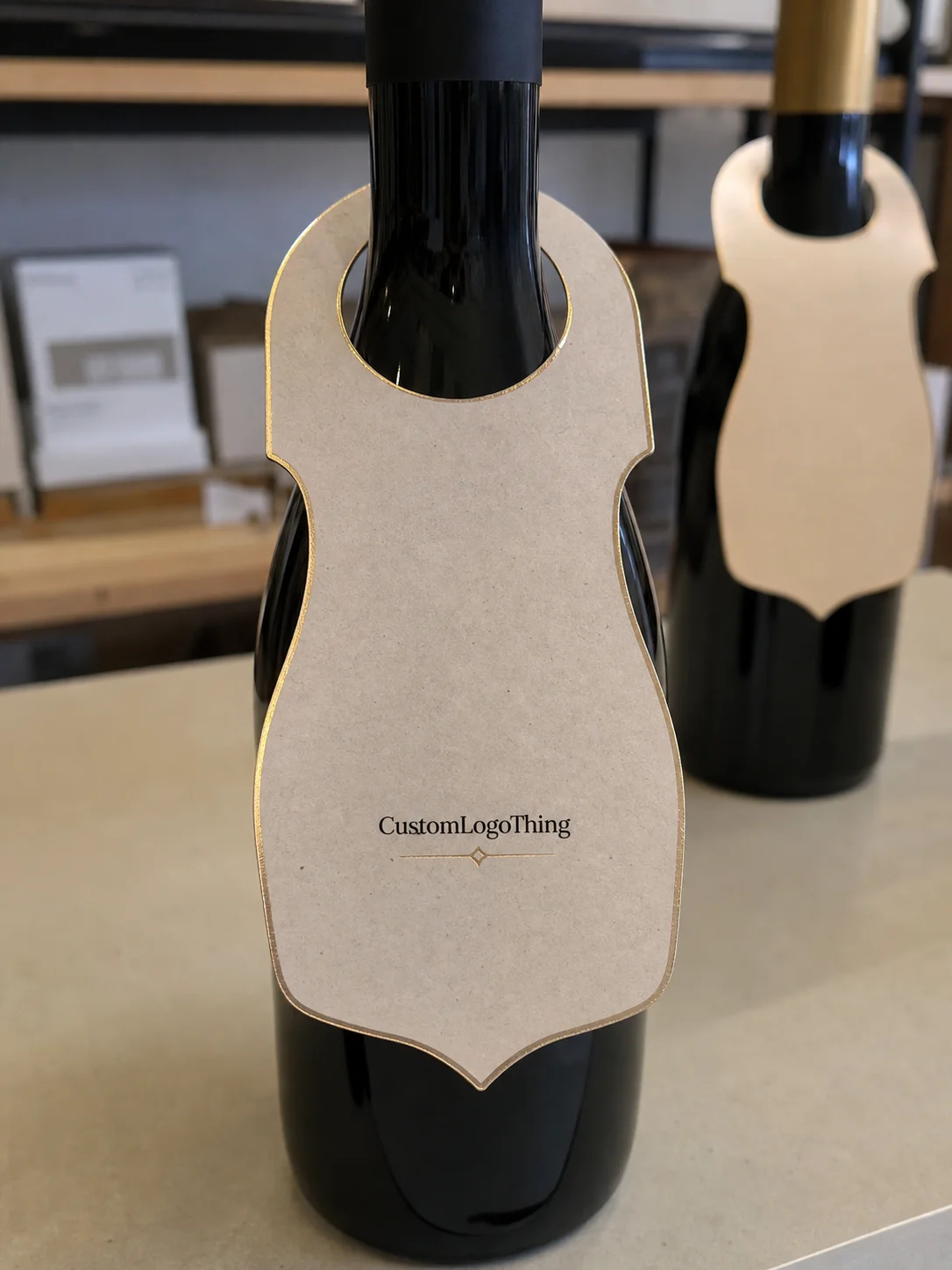
Think about a bottle that already looks polished. The label is clean. The glass is good. The closure feels solid. Then it needs to communicate one more thing: a gift message, tasting note, limited-edition badge, or promotion. That is where the neck tag steps in and does the talking.
A hang tag is usually a small printed card attached around the bottle neck with string, elastic, ribbon, or a punched opening. It can be a simple flat card or a folded format. The structure is uncomplicated, but the visual effect is often bigger than the piece itself. In retail packaging, that small addition can make a product feel intentional instead of merely functional.
These tags show up in very different settings. In wine retail, they help one SKU stand out among dozens of similar bottles. In gifting, they add a personal layer. In hospitality, they can guide customers through pairing notes or bottle-specific details. In events, they carry branding without crowding the label. That flexibility is why Custom Wine Bottle hang tags are useful in both premium and promotional programs.
“A tag is tiny, but the message is not. Buyers often judge the bottle before they ever read the back label.”
There is a business effect as well. Small packaging elements can shift perceived value by a surprising margin, especially when the bottle is presented as a gift. A wine that feels ordinary on a shelf can feel curated once it has a thoughtfully printed neck tag. The logic is similar to upgraded product packaging or custom printed boxes: details signal care.
It helps to separate the common formats. A hang tag is attached by a string or punched hole and carries messaging or visuals. A necker usually wraps partway around the neck and is often more promotional. A label is adhesive and permanent. A collar sits closer to the neck or closure. If the goal is flexible messaging, easy seasonal changes, or gifting cues, Custom Wine Bottle hang tags are often the better fit.
How the hang tag format works on wine bottles
The mechanics are simple, but they matter. Shape determines how the tag hangs. Hole placement affects whether it tilts or stays centered. Attachment style influences whether it moves freely, sits snugly, or tangles during packing. On Bordeaux, Burgundy, and Champagne-style bottles, those choices behave differently because neck diameters and shoulder profiles vary.
Common uses include tasting notes, varietal details, event branding, QR codes, pricing, limited-release messaging, and bottle-specific promotions. In tasting rooms, a hang tag might explain a reserve program. In a corporate gift set, it may carry a thank-you message or recipient name. For a holiday run, it can do seasonal work that the main label cannot easily do.
The reader path matters. What should the buyer see first? Usually the brand or occasion. What follows? The supporting detail, such as a vintage note, pairing suggestion, or call to action. If everything competes at once, the bottle starts feeling busy. Good package branding is often about hierarchy, not volume.
Material choice affects both appearance and performance. A 14pt or 16pt paper card is common for straightforward runs. Coated stock gives sharper color and stronger contrast. Soft-touch lamination adds a muted, upscale feel, though it can increase cost and can complicate recyclability depending on the full structure. Kraft stocks tend to signal artisanal positioning. Heavier boards resist bending better during packing and shipment.
Condensation is the quiet troublemaker. So is handling. A bottle pulled from chilled storage can leave moisture on the neck and weaken certain papers or adhesives if the design is careless. If the tag will live near coolers or ice buckets, ask about coating, paper caliper, and whether the finish is meant for brief contact or repeated handling. For shipping durability, standards used in packaging testing, such as ISTA procedures, are worth discussing with a supplier or pack-out team. See more at ISTA.
Movement matters too. A bottle may look perfect in a mockup and then twist in a case pack. A slightly wider hole, a centered punch, or an elastic loop can help the tag sit properly. If the tag is meant to hang flat in retail packaging, test it on the actual closure instead of relying only on the artwork file.
For brands already using Custom Labels & Tags or a broader mix of Custom Packaging Products, hang tags can act like a flexible layer in the system. They are not a substitute for the main label. They are a communication tool that sits beside it.
Key factors that affect cost, pricing, and MOQ
Pricing for custom wine bottle hang tags comes down to a handful of variables, and none of them are mysterious once they are separated. The main ones are stock weight, print sides, finish choices, die-cut complexity, and whether the tag needs assembly. If a buyer only sees “tag,” it is easy to miss how quickly those details add up.
For simple short-run tags on standard card stock, pricing can stay manageable. A basic single-sided tag on 16pt stock lands in a very different range from a soft-touch, foil-stamped version with a custom shape and ribbon assembly. A practical comparison looks like this:
| Tag type | Typical features | Relative unit cost | Best use |
|---|---|---|---|
| Simple flat tag | One- or two-color print, standard shape, punched hole | Lowest | Retail promos, larger runs, budget-conscious gifting |
| Mid-tier tag | Full color, coated stock, custom shape, one special finish | Moderate | Seasonal wine gift sets, tasting-room messaging |
| Premium tag | Foil, embossing, soft-touch lamination, ribbon or elastic assembly | Highest | Luxury gifts, premium launches, limited editions |
MOQ matters because setup is real. A custom die, a foil plate, or a new assembly step has to be paid for somewhere. When quantities are low, those fixed costs are spread over fewer pieces. That is why more complex tags push unit cost up unless the order volume supports the setup.
Size influences cost in a less obvious way. A larger tag uses more paper, but it can also affect press layout, waste, and how many pieces fit on a sheet. An uncommon dimension may require a custom die or a less efficient nesting pattern. That does not always make it expensive, but it does make the quote less predictable.
Buyers often chase the lowest unit price and forget what the tag is actually doing. A plain tag can be smart for high-volume program work. But if the bottle is a gift, a presentation piece, or a premium SKU, the tag can function like a mini luxury insert. That is often a better spend than adding more ink coverage for its own sake.
A useful comparison is to ask: what does the customer notice first? If the answer is finish and feel, spend there. If the answer is information clarity, prioritize legibility and structure. The best value usually comes from matching the format to the job, not from choosing the most expensive decoration.
As a rough market observation, simple printed neck tags often sit in a lower-cost band for larger runs, while specialty finishes can push pricing up quickly. The jump is not linear. Foil, embossing, and hand assembly add labor and setup costs that can be hard to justify on a low-volume order. Buyers planning short runs should expect a higher per-unit cost than they would see on the same piece at a larger quantity.
Production steps and lead time: from artwork to delivery
The production path for custom wine bottle hang tags is straightforward, but it only stays straightforward if the file prep is clean. A typical workflow starts with a brief, followed by dieline selection, artwork setup, proofing, production, finishing, packing, and shipment. Miss one step and the schedule starts slipping.
Most delays happen for predictable reasons. Bleed is missing. The artwork is supplied at low resolution. Pantone references are unclear. Someone approves the proof late. These are small issues individually, but they can slow an entire program when the tags are tied to a launch, tasting, or event date.
For timeline planning, a simple tag usually moves faster than a custom shape with specialty finishing. A standard printed run may be produced in roughly 12 to 15 business days after proof approval, although that depends on quantity and factory queue. Add foil, embossing, soft-touch, or assembly, and the schedule typically stretches. Shipping time sits on top of production time, not inside it.
Proofing is where buyers protect themselves. A digital proof checks layout, copy, and basic placement. A hard proof or sample is better when color matters, especially for wine packaging that needs to match labels or cartons. If a project uses foil or special stock, ask for a sample or pre-production reference where possible. One approved proof can save a lot of wasted paper and frustration later.
Assembly and packing deserve attention too. Some tags ship flat. Others arrive strung or elasticized. If a tag needs to be kitted with bottles or inserted into gift sets, the packing method changes the labor picture. Bulk packing can be efficient. Pre-assembled sets are more convenient but often cost more. That trade-off shows up quickly in commercial retail packaging programs.
Plan backward from the date that matters. If the bottles are for a holiday window, a launch tasting, or a wedding, count in time for proof revisions, transit, and a small buffer. The difference between calm and chaos is often just one week of lead time.
One production caveat deserves more attention than it usually gets: color shifts. Heavy ink coverage on textured stocks can print softer than the proof screen suggests. Deep blacks may dry differently on uncoated paper than on coated paper. If brand color accuracy is critical, request a controlled sample rather than assuming the same file will behave the same way on every stock.
Step-by-step: how to order the right tag for your bottle
Start with the use case. Is the tag for retail, gifting, a winery tasting room, a corporate event, or a seasonal promotion? The answer changes everything. A trade-show bottle needs speed and clarity. A gift bottle needs emotional tone. A tasting-room tag may need utility first and beauty second.
Next, decide the message hierarchy. What absolutely has to be visible? Usually that is the brand name, occasion, tasting note, price point, or call to action. If a QR code is included, it should support something useful, not just fill space. Pairing notes, a landing page, event registration, or a gift message are all better uses than a generic link.
Then choose size and shape based on the real bottle. Do not design to an abstract rectangle. Put the tag against the neck dimensions, the shoulder curve, and the cap height. A tag that looks balanced on a flat screen can look too large once it is hanging from a slender bottle, or too small on a bold Cabernet silhouette.
Material and finish should follow the brand tone. Kraft and uncoated boards tend to read artisanal. Smooth matte feels restrained and modern. Coated stock supports crisp color. Soft-touch suggests premium gifting. If the bottle is being handed over as a present, tactile cues matter more than they do in a warehouse pickup situation.
Use this simple order sequence:
- Confirm bottle dimensions and closure type.
- Write the key message hierarchy.
- Select approximate size and shape.
- Choose stock, finish, and attachment style.
- Request the printer’s dieline and artwork specs.
- Approve the proof or sample.
- Lock quantity, packing, and delivery timing.
That process sounds basic, but it avoids most of the expensive mistakes. It also gives the supplier enough information to quote accurately instead of guessing at specs. Buyers who send complete information usually get better comparisons on custom wine bottle hang tags and fewer surprises later.
One more practical check: ask whether the quoted price includes assembly, individual packing, or only printed flat tags. Those are not trivial differences. A price that looks low on paper can become less attractive once the labor to thread, bundle, or kit the tags is added.
Common mistakes buyers make with neck tags
The first mistake is designing for a blank page instead of the bottle. That almost always leads to awkward proportions or a tag that crowds the cap. Wine packaging is three-dimensional. A good file respects the shape beneath it.
Second, some buyers choose typography that looks elegant on screen but disappears at tag size. Fine serifs, ultra-light weights, and long lines of text can fail fast once printed. If the tag is small, the type needs room to breathe. Readability beats cleverness every time.
Third, overstuffing the panel. Too much copy leaves no visual rest area, and premium cues disappear. A tag can carry tasting notes and still feel restrained. In fact, restraint usually reads as more expensive than cramming every available millimeter with text.
Fourth, buyers forget the attachment details. If the hole is too small, the ribbon gets crushed. If the elastic is too loose, the tag rotates. If the placement is wrong, the piece can twist or slide under the shoulder. Testing one assembled sample is a cheap way to catch all of that.
Finally, some people assume every finish handles moisture and shipping equally well. It does not work that way. Condensation, abrasion, and case movement can expose weak stock or fragile coatings. If the bottle is chilled, packed tightly, or shipped long distance, ask questions about durability up front. For sustainability-minded buyers, the EPA’s packaging and materials guidance can also be a useful reference point for waste reduction thinking: EPA recycling and packaging resources.
A quieter mistake is approving artwork without checking the back side. Many neck tags are double-sided because the front gets the eye and the back gets the practical information. If both sides are used, the reading order should be deliberate. Random repetition on both faces wastes space and makes the piece feel like a recycled flyer instead of a package component.
Expert tips for better performance and higher perceived value
Use one strong focal message and let the rest support it. That is the simplest way to make a tag feel premium. A bottle with a clear first read looks more intentional than one trying to do five jobs at once.
Match texture to brand personality. Kraft stock suggests rustic or small-batch positioning. Smooth matte feels contemporary. Gloss-coated stock can make color pop, especially for bold seasonal artwork. If the tag is part of a premium gift set, tactile finishes like soft-touch or spot gloss can add a lot of perceived value without changing the bottle itself.
Contrast matters more than people think. Dark glass can swallow weak type, especially in dim retail lighting. Strong contrast between text and background improves legibility quickly. This is basic, but it is also the difference between a tag that reads instantly and one that gets ignored.
Use QR codes only when they create a real benefit. A code that leads to a useful destination can extend the packaging story. A code that lands on a dead page or a generic homepage feels lazy. Good package branding should reward the scan.
There is also a smart operational move: create reusable seasonal templates. If a winery or gifting program runs multiple campaigns a year, building a family of tag layouts reduces reapproval time. It can also help future orders stay consistent across custom printed boxes, labels, and bottle neck pieces.
And do not ignore touch. A buyer often picks up a bottle before they read the tag closely. That moment matters. A soft-touch surface, a crisp die-cut edge, or a well-chosen ribbon can influence the decision more than a second paragraph of copy ever will.
For premium runs, buyers often overlook edge quality. A clean die-cut edge signals better manufacturing control than a fuzzy or slightly crushed edge. If the tag has rounded corners, check that the corners are actually consistent across the batch. Small flaws are easier to see on a hanging piece than they are on a flat printed sheet.
What to do next before you request a quote
Before you ask for pricing, gather the basics: bottle dimensions, intended use, quantity, finishes, and delivery date. If you can also provide a rough content hierarchy, the quote will be more accurate and the design stage will move faster. Suppliers are better at pricing what they can see.
Check your deadline against the likely production path. If you need proofs, revisions, and freight, the calendar gets tight quickly. Build a buffer. Even a week can matter if the tags are tied to a launch or an event.
Compare two or three format options side by side. Do not just compare price. Compare durability, appearance, and how well each option supports the bottle’s role. A low-cost tag may be fine for a short-run promo. A more finished piece may be the better choice for gifting or premium retail packaging.
If the order supports a campaign, holiday, or event season, lock quantity early so the run matches demand. That helps avoid either overbuying or scrambling for a reprint. It also reduces the chance that the final piece feels like an afterthought instead of part of the full presentation.
Used well, custom wine bottle hang tags are small, efficient, and highly visible. They help the bottle speak before anyone opens it. In wine, that first impression often does more commercial work than the back label ever will.
FAQ
How do custom wine bottle hang tags attach to different bottle necks?
They typically attach with string, elastic, or ribbon through a punched hole or slit. The right choice depends on bottle shape, closure type, and whether you want the tag to hang freely or stay centered. Testing one assembled sample is the best way to confirm the tag hangs straight and does not interfere with the cap.
What affects the price of custom wine bottle hang tags the most?
The biggest cost drivers are quantity, material, print sides, shape complexity, and finishing choices. Foil, embossing, soft-touch coating, and custom die-cuts usually raise unit cost. Simple flat tags are usually the most budget-friendly option for larger runs.
What information should be printed on a wine bottle hang tag?
Most buyers include the brand, event name, vintage or varietal note, tasting detail, or gift message. A QR code can be useful if it leads to something practical, like pairing suggestions or a landing page. Avoid overfilling the space; the tag should support the bottle, not compete with it.
How long does it usually take to produce custom wine bottle hang tags?
Timeline depends on artwork readiness, proof approvals, quantity, and finishing complexity. Standard formats generally move faster than custom shapes or specialty finishes. Planning ahead is the best way to avoid delays from revision cycles or shipping buffers.
Can custom wine bottle hang tags be made for gift sets and winery events?
Yes, they are commonly used for gift sets, tastings, weddings, corporate gifts, and promotional campaigns. They are especially effective when the message needs to be personalized without changing the main label. A tag can add value by making the bottle feel deliberate, curated, and ready to present.


