Custom Wine Bottle Hang tags add a second selling surface without asking the main label to do everything. That matters on a crowded shelf, in a tasting room basket, or inside a gift set where the bottle has to communicate more than varietal and vintage before anyone even picks it up.
The tag can carry tasting notes, food pairings, event dates, QR codes, reserve cues, or a short brand story. The bottle still does the heavy lifting. The tag makes the rest of the message visible, and it does it in a place the eye reaches quickly.
Why custom wine bottle hang tags stand out in seconds
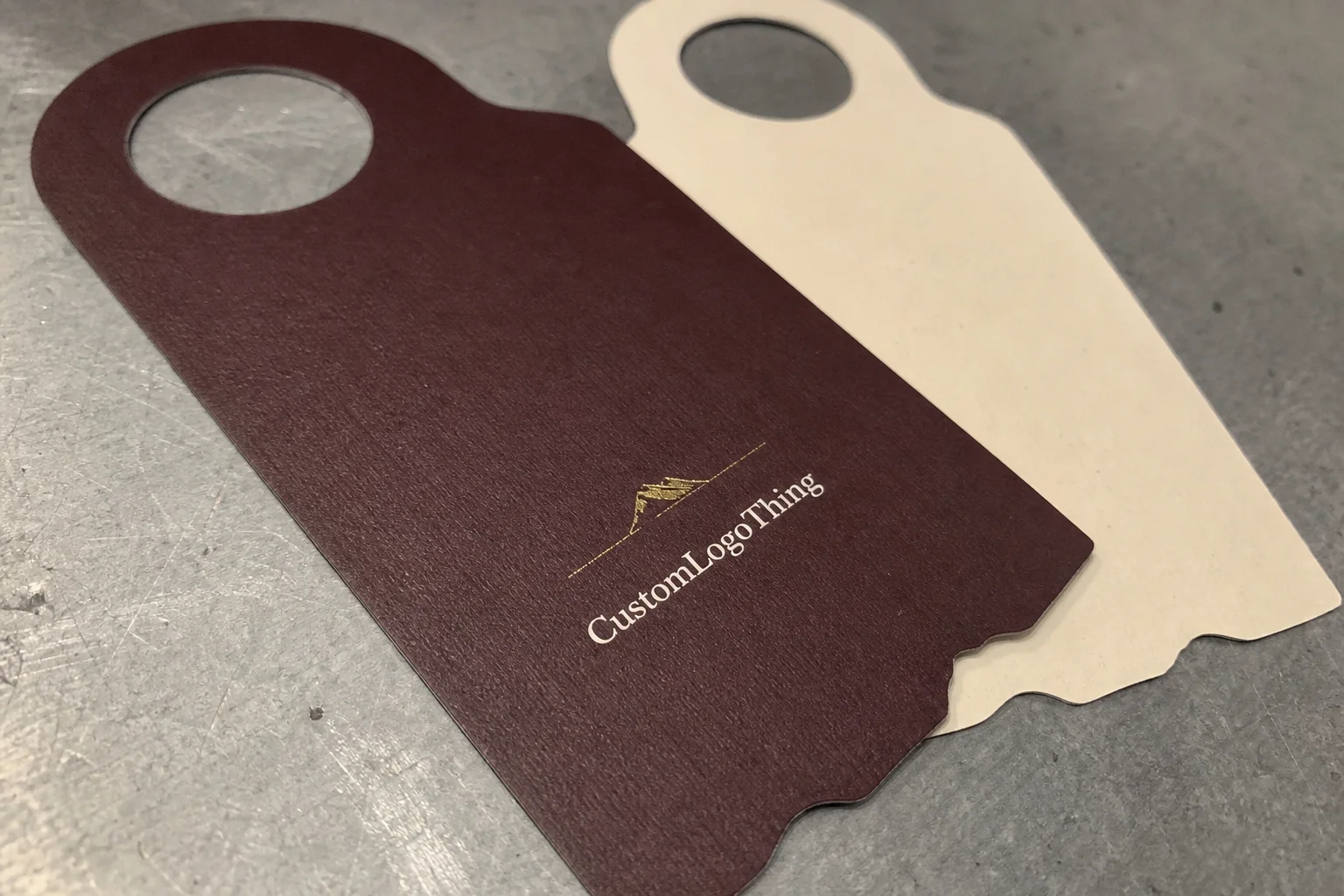
Wine buyers do not read every package line by line. They glance, compare, and decide fast. A hang tag creates a second point of attention above the neck, where the eye lands even if the label is partly hidden by shelving, gift wrap, or a crowded display.
That small shift is useful for wineries, tasting rooms, club shipments, holiday promotions, and limited releases. The main label can stay stable while the tag changes by season, channel, or audience. One run can emphasize a vineyard designation. Another can point to pairing notes. A third can simply announce a new release and give the bottle a little more presence.
The strongest tags organize information instead of repeating it. Brand name, vintage, varietal, and core identity stay on the bottle. The tag handles the extras: awards, cellar notes, club details, sustainability claims, or a short note from the winemaker. Buyers do not need everything at once. They need the right detail in the right place.
There is also a visual effect that gets overlooked. Pulling a message above the shoulder gives the package vertical movement, which makes it feel more deliberate. On a shelf full of flat label rectangles, that change can be enough to separate one bottle from the rest without changing the glass or the closure.
These tags sit in a useful middle ground. They are more expressive than a standard label alone, but far less expensive than a full custom carton or rigid structure. That is why they show up often in seasonal packaging, gift programs, and on-premise use where the bottle has to sell and explain itself at the same time.
A tag should earn space, not borrow it. If it repeats the label, it is decoration. If it adds clarity, it is part of the packaging system.
How hang tags work on wine bottles and closures
The mechanics are simple. A hang tag usually uses a drilled hole, slot, or punched opening with a cord, ribbon, elastic loop, or pre-tied string around the bottle neck. The right attachment depends on the bottle shape, the closure, and how much movement is acceptable during display and transit.
Pre-tied cords and satin loops usually feel the most polished in gift packaging. Elastic loops are faster and more secure, which helps on high-volume programs or mixed bottle shapes. Threaded string is flexible and economical, though it can look rough if the knotting is inconsistent. That inconsistency shows up quickly once the product is on a retail shelf.
Tag size should match the bottle. A small tag can disappear on a tall Bordeaux-style bottle. A large one can overpower a narrower shape or swing too much during handling. The safest starting point is to design for readability from arm’s length, then trim away anything that does not help.
Hole placement matters more than most mockups suggest. A punch too close to the edge can tear under tension. A hole that sits too centered may cause the tag to cover the label or hang awkwardly. Slight offset placement near a top corner often works better for rectangular tags, while a centered punch can suit round or specialty shapes. The difference is minor on screen and obvious in hand.
Compatibility checks are not optional. Foil capsules can stop a tag from lying flat. Oversized shoulders can tilt the piece. Corked bottles may need a longer loop or a wider opening. If the bottle has an unusual silhouette, ask for a sample before approving the run. The same advice applies if the hang tag will sit alongside bottle stoppers, neck wraps, or gift closures.
If you already use Custom Labels & Tags, the hang tag should feel like the same brand system, not a separate project with a different visual language. Typography, spacing, paper tone, and color logic should all feel connected.
Materials, finishes, and design factors that change the result
Material choice changes how the tag feels before anyone touches it. A 14pt C1S stock is common for budget-conscious programs. An 18pt SBS or 350gsm cover stock gives the piece more body and a more premium hand feel. Recycled uncoated stock can work well for rustic or sustainability-led branding, provided the text stays sharp enough under retail lighting.
Finish matters just as much as paper. Matte coatings cut glare and make tasting notes easier to read. Gloss increases saturation and contrast, which helps reds, golds, and dark colors stand out. Soft-touch lamination signals a higher-end line, especially for reserve bottles or gifting sets. Uncoated stock gives a warmer, more tactile surface that fits artisanal or low-intervention positioning.
Design should follow the channel. A tasting room tag can be more conversational and may leave room for staff notes or bottle personalization. A retail shelf tag needs a tighter hierarchy and stronger contrast. A restaurant placement tag may need a QR code, a pairing note, or a by-the-glass price zone. A club shipment tag can lean into story because the buyer already trusts the brand enough to open the box.
Decorative effects work best when they support the message rather than compete with it. Foil can elevate a reserve wine, but too much metallic coverage can make the tag feel louder than the bottle. Embossing adds depth and usually works best on simpler layouts. Spot UV creates a strong contrast on darker designs, though it is a poor choice if staff need to write on the tag.
Durability is part of the design brief. Wine bottles get chilled, handled, reboxed, and shipped across surfaces that are not gentle. If the stock is thin, the coating weak, or the loop fragile, the tag will curl, crease near the hole, or scuff before it reaches the customer. For runs that will travel, think like a packaging buyer and ask whether the piece should pass a basic transit stress check. ISTA publishes useful testing guidance at ISTA, and that mindset is worth borrowing even for a small item.
If sustainability is part of the sales story, certified paper can help. FSC-certified stock does not solve every sourcing question, but it gives buyers a clearer procurement trail. The standard and chain-of-custody framework are outlined at fsc.org.
| Option | Typical Use | Common Price Range | Notes |
|---|---|---|---|
| Simple uncoated tag | Tasting rooms, cellar notes, rustic programs | $0.10-$0.22 per unit at 10,000+ | Good readability, lower finish cost, less resistance to scuffing |
| Coated full-color tag | Retail, gift sets, seasonal promotions | $0.16-$0.32 per unit at 5,000+ | Better color pop, stronger surface protection, standard premium option |
| Soft-touch or laminated tag | Reserve labels, luxury gifting, club releases | $0.24-$0.48 per unit at 5,000+ | Higher tactile value, higher setup and finishing cost |
| Foil, emboss, or specialty finish | Premium launches, limited editions | $0.35-$0.75 per unit at 2,500+ | Best for high-margin programs where finish supports the price point |
The rule is straightforward: the more the tag has to perform as a small piece of product packaging, the more the material has to carry that load without warping, smearing, or feeling flimsy. A cheap stock can cost more in the end if it lowers the bottle’s perceived value.
Cost, pricing, MOQ, and quote drivers
Pricing for Custom Wine Bottle hang tags usually moves with a few predictable variables: quantity, stock choice, ink coverage, finishing, size, and attachment type. Shipping can matter more than expected, especially if the order includes assembly or bundling. A simple single-sided tag is one thing. A custom shape with foil, soft-touch lamination, and pre-tied cord is a different production job.
Volume matters most. Once setup is spread across more units, unit cost tends to fall quickly. A 1,000-piece run may feel easier to approve, but the per-unit cost often improves at 5,000 or 10,000 pieces if the launch calendar can support that quantity. Setup charges, proofing, and finishing can flatten those savings if the run stays too small or becomes too complex.
MOQ usually reflects press setup, die cutting, and material yield. Buyers sometimes assume the minimum is arbitrary. It usually is not. A printer has to balance sheet size, cut efficiency, and press time. If the order must stay small, a standard shape and straightforward finish usually help more than forcing a premium build into a tiny run.
For a quote request, specificity helps. Include bottle dimensions, target size, artwork status, quantity, preferred attachment, and delivery date. If the tag needs to match a related carton or insert, mention that too. That can matter if the line includes Custom Packaging Products such as cartons, inserts, or other branded pieces that should feel visually aligned.
Buyers should also look past the lowest number on the page. The cheapest tag is not a win if it wrinkles in refrigeration, tears near the hole, or prints with weak color density. In premium wine, the packaging is part of the sale. Saving a few cents on paper can cost more in perception than it saves in procurement.
A useful benchmark: for a mid-range full-color job, pricing often lands around $0.18-$0.28 per unit at 5,000 pieces, depending on stock and print coverage. Add specialty finishing and the number rises. Shrink the run and it moves the other way. That is normal. What matters is knowing which variable is driving the change before approving the quote.
Process and timeline from proof to delivery
The workflow is familiar, but delays usually appear in the same places. It starts with a brief: what the tag needs to say, which bottle it must fit, and how it will be used. Then comes dieline selection or custom sizing, artwork setup, proof review, production, finishing, assembly, and shipping. Each stage is easy to underestimate if the schedule is already tight.
The proof stage is where a lot of projects either stay on track or drift. A proof confirms layout, copy, hole placement, and the overall visual direction. It does not guarantee that every bottle will behave the same way in hand. A proof is not a substitute for a sample on the actual bottle, especially if the closure, neck length, or shoulder shape is unusual.
Most Custom Wine Bottle hang tags projects move better when the artwork is print-ready before the quote is approved. If the file still needs copy edits, line cleanup, or image fixes, the clock starts late. If the die must be adjusted because the tag is too long or the punch sits too low, another round of checking gets added. Small issues do not stay small once production begins.
For planning, a realistic timeline is often 12-15 business days from proof approval for a straightforward run, with more time needed for specialty finishes, assembly, or shipping. Rush work can happen, but it narrows the material options and usually raises cost. If the launch date is fixed, earlier approval is the cheaper move.
The most expensive schedule is the one that turns into a rush because the bottle art was treated as an afterthought.
Good project management also means watching the wine calendar, not just the print calendar. Harvest releases, holiday gift programs, club shipments, and trade events compress demand in predictable waves. If you know those windows, the tag order can be built before the schedule gets crowded.
Common mistakes that weaken the final package
Size is the first mistake. Oversized tags can swallow a small bottle and break the visual hierarchy, which makes the entire package feel less refined. A tag should support the bottle, not compete with it. If the shape is petite or unusual, restraint usually reads better than scale.
Copy overload comes next. Too much text turns the tag into a brochure. Tiny type, low contrast, and crowded layouts are hard to read at a glance, especially under warm retail lighting or in a tasting room where people are moving quickly. A short message, one supporting detail, and a QR code usually do more than a dense paragraph ever will.
Durability problems are common too. Thin stock, weak attachment points, and poor finishing can fail in cold storage, transit, or repeated handling. If the piece needs to survive being chilled, stacked, and presented again, the design should be tested under those conditions before the full order ships.
Brand mismatch is another quiet failure. A rustic kraft stock with rough edges may be right for a natural wine program. It can feel wrong on a polished reserve line. The reverse is true as well: a high-gloss, foil-heavy tag can look out of place on a winery built around restraint. Good package design is about fit, not decoration.
Skipping the sample step is the last expensive habit. Screen previews do not show curling, hole stretch, cord length, or how the tag sits beside the label in real light. A physical proof is a small cost compared with reprints, missed launch dates, and releasing a bottle that looks less considered than it should.
Expert tips and next steps for a cleaner launch
Start with one use case. If the bottle is for shelf retail, design for shelf retail. If it is for tasting room promotions, design for conversation and staff handling. If it is for gift packaging, make sure the tag adds perceived value the moment the box opens. Trying to satisfy every channel in one small piece usually weakens the result.
Use one primary message per tag. The rest can live behind a QR code, in a tasting note, or on the bottle label. That keeps the layout legible and gives the wine room to feel composed. For custom wine bottle hang tags, simplicity usually reads as confidence rather than cost cutting.
A practical launch checklist helps avoid last-minute friction:
- Bottle dimensions and neck shape
- Target tag size and orientation
- Artwork files and copy approval
- Stock and finish preference
- Attachment type
- Quantity and delivery date
Ask for a sample or comp before full production, then test it on the actual bottle under the same conditions it will face in market. Check fit, readability, balance, and whether the attachment gets in the way of pouring or boxing. A good sample answers more questions than a long email thread.
If the bottle is part of a wider packaging system, compare the tag against the rest of the line, not just against itself. The label, shipper, carton, and insert should feel like one decision. That is where Custom Labels & Tags and other Custom Packaging Products are worth planning together instead of treating as separate fixes.
Custom wine bottle hang tags work best as a small but deliberate packaging asset: enough structure to improve shelf impact, enough restraint to keep the bottle readable, and enough production discipline to arrive on time. Choose the format around the bottle, the audience, and the calendar, and the tag will do its job. It will help the wine look worth picking up.
What size should custom wine bottle hang tags be for standard bottles?
Most tags need to stay readable without covering the label or shoulder, so the best size depends on the bottle shape and how much information you want to include. A proof or sample on the actual bottle is the safest way to confirm fit before production.
What materials work best for custom wine bottle hang tags?
Heavier paperboard is common for premium presentation, while coated or laminated stocks help with durability. Recycled or uncoated stocks can fit rustic or sustainable branding when readability remains strong.
How much do custom wine bottle hang tags usually cost?
Pricing depends on quantity, stock, finish, size, and attachment style, with unit cost typically dropping as volume increases. Setup, proofing, and specialty finishes can affect the final quote more than buyers expect.
How long does production usually take for custom hang tags?
Timeline depends on artwork readiness, proof approval, finishing, and shipping method. Projects move faster when the dieline and copy are ready before the quote is approved.
What should I include when requesting a quote for custom wine bottle hang tags?
Include bottle dimensions, tag size ideas, quantity, artwork files, preferred material, finish, attachment type, and required delivery date. Those details help suppliers quote accurately and reduce back-and-forth during proofing.
Used well, custom wine bottle hang tags are one of the few low-complexity upgrades that can still change how a bottle is perceived at the shelf, at the table, and in the box.


