Buyer Fit Snapshot
| Best fit | Eco Conscious Packaging for Startups projects where brand print, material claims, artwork control, MOQ, and repeat-order consistency need to be specified before quoting. |
|---|---|
| Quote inputs | Share finished size, material target, print colors, finish, packing count, annual reorder estimate, ship-to region, and any compliance wording. |
| Proofing check | Approve dieline scale, logo placement, barcode or warning zones, color tolerance, closure strength, and carton packing before bulk production. |
| Main risk | Vague material claims, crowded artwork, missing packing details, or unclear freight terms can make a low unit price expensive after revisions. |
Fast answer: Eco Conscious Packaging for Startups: Material, Print, Proofing, and Reorder Risk should be specified like a repeatable production item. The safest quote records material, print method, finish, artwork proof, packing count, and reorder notes in one written spec.
Production checks before approval
Compare the actual filled-product size with the drawing, then confirm tolerance on folds, seals, hang holes, label areas, and retail display edges. Reserve space for logos, QR codes, warning copy, and material claims before decorative graphics fill the panel.
Quote comparison points
Review material grade, print process, finish, sampling route, tooling charges, carton quantity, and freight assumptions side by side. A quote is only useful when the supplier can repeat the same color, closure quality, and packing count on the next order.
Eco conscious Packaging for Startups can look simple right up until you are holding a production sample that feels elegant, costs $0.31 more per unit than the spreadsheet allowed, and weighs just enough to shove the parcel into a higher shipping band. I still remember one skincare launch in Austin where the team approved a premium mailer, then watched the first freight invoice jump by $14,600 in a single month because the carton left 18 mm of dead space on every side. A small change to a 275gsm recycled folding carton, approved after a proof from a converter in Dongguan, cut the dimensional weight, lowered breakage, and kept the return rate under 1.9% instead of creeping past 4%.
Eco Conscious Packaging for startups belongs in the operating plan, not just the pitch deck. A tighter carton spec, a cleaner prepress file, and a more disciplined insert can change freight, unboxing quality, and shelf presence at the same time, especially if your fulfillment center in New Jersey charges by cubic inch and not by sentiment. Founders who make those decisions early tend to build better brand packaging habits, and they usually spend less time fixing preventable packaging failures after launch, which is the kind of calendar drag nobody budgets for in a seed round. The same thinking also improves sustainable shipping materials decisions, because once a box is right-sized, the whole system becomes easier to manage.
Eco conscious packaging for startups is rarely just one material choice. It usually includes recycled cardboard, paper-based inserts, water-based inks, and a structure that protects the product without sending empty air across the country. That combination tends to hold up better in transit and looks more intentional on camera, which matters when a customer is judging the box before they ever touch the product inside. I have seen customers forgive a modest carton that arrived clean and intact, while a glossy, overbuilt package with a crushed corner gets called out in reviews. Packaging is funny that way, kinda unforgiving too.
"The startup did not need a prettier box. It needed a carton that survived parcel carriers, fit the bottle 3 mm tighter, and used 18% less board." - a packaging engineer I worked with during a serum rollout in Shenzhen
What eco conscious packaging for startups really means
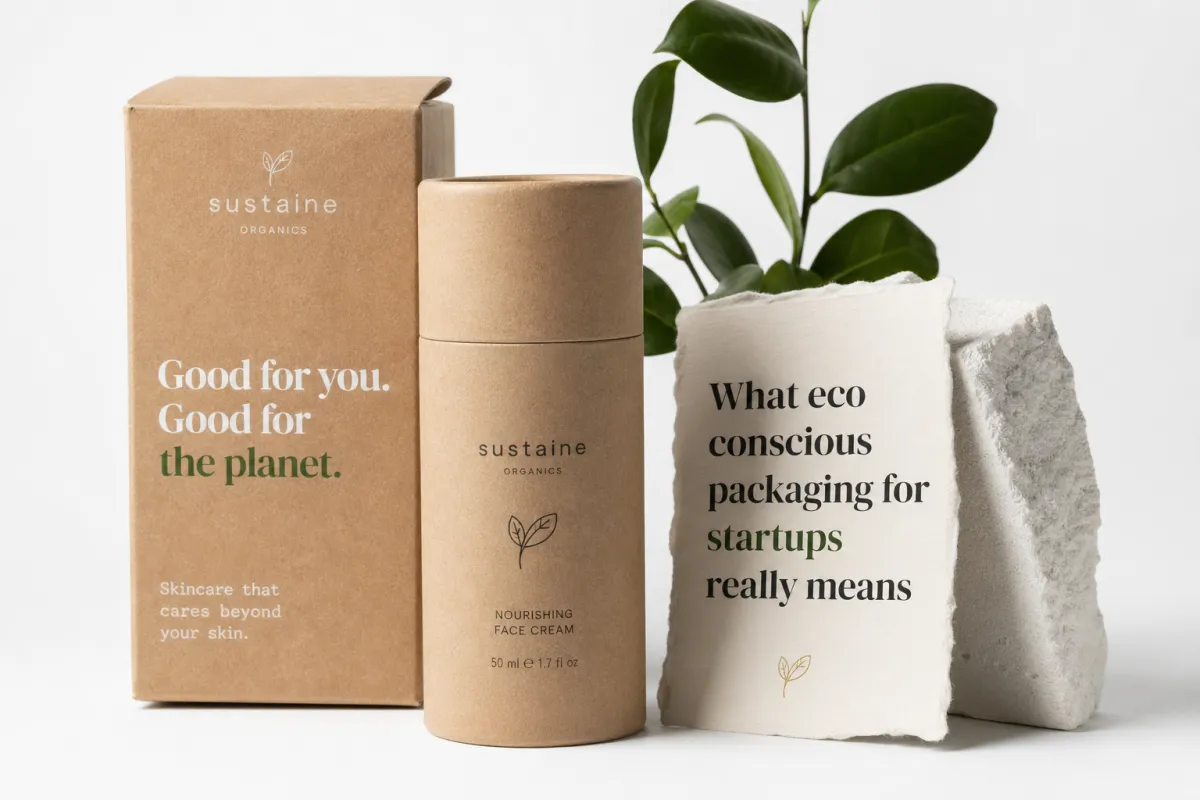
Founders hear "sustainable" and often assume the cost will rise immediately, but that is not always true. During one quote review with a cosmetics brand in Brooklyn, I compared two rigid box options from a supplier in Foshan: the more decorative version came in at $1.42 per unit for 3,000 pieces, while a simpler recycled board carton landed at $0.27 per unit at 5,000 pieces. The decorative box also added 22% more cubic volume, which raised outbound freight by $0.09 to $0.14 per shipment depending on zone. The box looked polished, yes, but it also behaved like it was shipping with a carry-on and a checked bag.
Eco conscious packaging for startups means lowering environmental impact across the full path from fiber source to end-of-life sorting. That includes recycled content, right-sized dimensions, lighter ink coverage, fewer mixed materials, and structures that do not send customers into a recycling scavenger hunt. A package can look responsible and still fail if it combines foil, plastic, and heavy lamination in one build; I have seen that happen with a 350gsm C1S artboard sleeve paired to a PET window, and the disposal instructions became a paragraph nobody wanted to read.
Marketing language and engineering language are not the same thing. If a supplier says a carton is greener, ask for the recycled content percentage, FSC chain-of-custody number, adhesive type, and the exact disposal route by region. A startup does not need a speech about sustainability theory; it needs a spec sheet it can compare line by line, ideally with board calipers listed in millimeters and print coverage measured in square inches. The strongest packaging decisions are measured in grams, millimeters, and grams-per-square-meter, not in adjectives that sound useful on a homepage.
Startups care early because packaging is often the first physical brand touchpoint a customer handles, and that touchpoint can make or break the first review. A buyer may never open the sourcing page, but they will remember a box that arrives dented from a 2,300-mile route, overpacked with filler, or wrapped in layers that feel hostile to the person paying for postage. I have seen a small tea brand in Portland get repeat purchases after moving from a glossy, plastic-heavy mailer to a kraft carton with 1-color black ink and a water-based varnish. The tea did not change, but the packaging branding did, and the reviews started mentioning care, restraint, and clarity in very specific terms.
The business case is stronger than many people expect. Better product packaging can support margin, reduce freight, and build trust with sustainability-minded buyers. If your box is 12 mm too wide, you may pay for empty air on every shipment; if your insert breaks in transit, you pay twice, once for the replacement and once for the lost confidence. That is why eco conscious packaging for startups is not a side project. It belongs in the operating model beside unit economics, fulfillment planning, and the first 90 days of reorder forecasting.
For reference, groups like the Institute of Packaging Professionals and the U.S. EPA recycling guidance are useful starting points when you are checking material claims and disposal language. I still tell clients to review those sources before approving a sustainability statement on a carton, because a vague claim can turn into a customer-service ticket, a retailer complaint, or a compliance problem a quarter later.
How do you choose eco conscious packaging for startups?
Start with the product, not the packaging trend. Measure the item, identify its weak points, and decide whether the job is protection, presentation, or both. A glass serum bottle needs a different strategy than a lightweight apparel kit, and a refill pouch has its own needs around puncture resistance and shelf stability. The best eco conscious packaging for startups usually comes from a short list of Options That Fit the product cleanly rather than a long list of fancy features that look impressive in a sample room.
Ask for material samples before you ask for artwork proofs. Recycled cardboard, molded fiber, paper mailers, and compostable packaging films each behave differently in hand, on a pallet, and under humid shipping conditions. If the package will travel through multiple climates, check how the board, ink, and adhesive respond to heat and moisture. A package that feels perfect in a studio can soften, curl, or crush once it spends a day in a hot truck or a crowded fulfillment lane.
Then compare the actual tradeoffs. A recycled kraft mailer may be ideal for one product line, while a corrugated carton with a molded fiber insert may be better for another. A startup does not need a one-size-fits-all answer to make good progress. It needs a reliable system that keeps damage rates down, shipping costs manageable, and the sustainability story believable from the first order to the fifth reorder.
How eco conscious packaging for startups works
The workflow is more practical than poetic. Measure the product in three dimensions, note the failure points, and write down what actually threatens the shipment: sharp corners, glass, liquids, powder, fragile closures, or pressure-sensitive components. After that comes material choice, structural definition, sampling, artwork, and fulfillment. Skip the measurement step and you end up with a beautiful box that slows the warehouse in Columbus or fails under carrier handling on the first 400-mile route. I have seen both, and neither version feels clever when the claims team is trying to explain damage photos.
Eco conscious packaging for startups usually begins with one of four material families. Corrugated cardboard is the workhorse because it is easy to source, easy to print, and widely recycled in most North American markets. Paper mailers suit light products that are not fragile, especially under 8 oz. Molded fiber performs well for inserts and trays, particularly for electronics and cosmetic jars. Plant-based films and mono-material systems can help when moisture protection matters, although every compostable claim needs scrutiny because the disposal path in Chicago, Dallas, or rural counties may not match the marketing copy.
The strongest packaging design balances structure with logistics. A carton that is 8% smaller on each side may sound modest, yet dead space falls much faster than the percentage suggests because volume compounds quickly. On a factory floor in Shenzhen, I watched a shipment move from a loose 340 mm box to a tighter 318 mm box, and the change saved enough board to reduce case weight by 11% while lowering the parcel rating from 2.4 lb to 2.1 lb. One adjustment, multiple wins. That is the kind of change I like because it shows up in freight, storage, and customer perception all at once.
Converters and suppliers turn a brief into dielines, samples, revisions, and final production. That process can feel slow if your only frame of reference is software, but packaging follows material reality and press scheduling, not a sprint board. A simple Custom Printed Boxes project may need one structural sample, one print proof, and one production approval. A more complex retail packaging program may need two or three sample rounds if the brand wants an exact unboxing feel, special inserts, or tight color matching across recycled board from different mills in Hebei and Jiangsu. There is always a moment where someone says, "Can we just move the logo 2 mm?" and the answer is yes, but the sample has to move first.
What "works" in practice means five things lining up at once: protection, shelf appeal, machine compatibility, shipping efficiency, and end-of-life behavior. If one of those fails, the whole system feels weak. The most elegant mailer in the world is useless if it pops open on a conveyor in a 3PL warehouse or arrives crushed because the board spec was too light for a cross-country lane. I have very little patience for packaging that looks beautiful in a studio and collapses in a warehouse on a humid Thursday.
If you want to browse format options while you are thinking through structure, our Custom Packaging Products catalog is a useful place to compare mailers, cartons, inserts, and display-ready formats side by side.
Cost, pricing, and timelines for eco conscious packaging for startups
Pricing turns on more variables than most founders expect. Material type sits at the front of the line. Order volume follows close behind. Print complexity, finishing, inserts, glue lines, die tooling, and whether the structure requires a new cutter or an existing one all shape the final number. A 2-color kraft mailer is a different animal from a full-bleed carton with spot UV, an embossed logo, and a custom corrugated insert. One is tidy and economical; the other is trying very hard to become the hero of the launch photo shoot.
In early supplier conversations, I usually compare a few familiar starting points. A recycled kraft mailer at 5,000 units might land around $0.15 to $0.24 per unit. A Custom Folded Carton in 350gsm board at 10,000 units may sit around $0.21 to $0.37 per unit, depending on whether the print is one color or full coverage. Molded Pulp Inserts often land around $0.33 to $0.58 per unit at volume because tooling and drying time add cost. A small rigid box can climb to $1.08 to $2.35 per unit before the insert enters the conversation. Those numbers are not magic, but they are enough to keep a founder from pretending packaging should cost the same as a shipping sleeve for a notebook.
| Option | Typical starting price | Best use | Main watchout |
|---|---|---|---|
| Recycled kraft mailer | $0.15 - $0.24/unit at 5,000 | Light apparel, accessories, sample kits | Limited premium feel if print is too sparse |
| Folded corrugated carton | $0.21 - $0.37/unit at 10,000 | Most ecommerce product packaging | Over-sizing can erase freight savings |
| Molded fiber insert | $0.33 - $0.58/unit at 10,000 | Electronics, cosmetics, fragile items | Tooling and sample lead time are longer |
| Rigid setup box | $1.08 - $2.35/unit at 3,000 | Premium retail packaging and gifting | Higher storage cost and material intensity |
The hidden costs usually catch startups off guard. Design revisions can add $85 to $250 each if you are paying outside prepress support in Chicago or Los Angeles. Sample rounds may take 5 to 10 business days per round, and ocean freight from Shenzhen to the West Coast can add 18 to 28 days if you are not air-shipping the first prototypes. A rushed order often adds 10% to 20% in production fees. I have seen a team lose two weeks because they approved a dieline without checking the assembled height against the product cap, and then everyone acted surprised when the carton no longer fit the bottle. Packaging, as a rule, has very little patience for sloppy math.
Timelines usually follow the same sequence: discovery, quoting, structural design, sampling, approval, production, and delivery. Simple runs can move in 2 to 4 weeks if the dimensions already exist and the artwork is ready in a print-safe PDF. More custom or specialty sustainable materials often need 4 to 8 weeks because tooling, drying, or board sourcing takes longer. If the supplier also handles fulfillment, add a few more days for receiving and packing. The calendar moves quickly until you are waiting on the one sample that everyone needs to touch before they can say the fit is "close enough."
One supplier negotiation still sticks with me. A founder in Seattle wanted "cheap and green" in the same sentence and expected the quote to behave like a SaaS contract with fixed pricing and no surprises. Reality pushed back. By moving from a six-part insert to a single folded paperboard cradle, we cut the unit cost by $0.14, but the team still needed one extra proof cycle to get the fit right. Savings were real. Speed still had a price. That mix is normal, even if nobody likes admitting it during budget review.
For brands that want to compare styles before committing to tooling, our Custom Packaging Products page can help you benchmark print methods and structural formats against your current packaging spend.
What usually changes the quote fastest
Material thickness, print coverage, and insert complexity move the number most quickly. Going from uncoated recycled board to a fully printed carton with interior ink can add several cents per unit. Adding foil, embossing, or a custom cavity for a fragile product can add more. In practice, a 1-color exterior print on 300gsm board is far easier to price than a 4-color full wrap with a coated finish and a glued insert. Suppliers can spot budget drift the moment they hear, "and we also want the inside printed in Pantone 347."
How to keep the budget stable
Standardize sizes whenever possible. A startup with three product lines often does better with two carton footprints and one insert family than with three completely different structures. That discipline lowers storage headaches, reduces minimum-order pressure, and makes eco conscious packaging for startups much easier to scale without constant redesign. It also saves you from the special kind of chaos that comes from finding the wrong box on a pallet at 7:30 a.m. before a ship date in a warehouse that is already understaffed.
Key factors that make the packaging truly sustainable
The most sustainable box is usually the one that uses less material without failing in transit. That sounds obvious, yet many brands go the other direction. They choose a recycled or compostable material, then overbuild the structure to feel safe. More fiber, more ink, more board, more freight. Material efficiency often beats a pricier green substrate when the structure is smarter from the beginning. I would take a clean, efficient carton over a clumsy "eco" box almost every time, especially if the cleaner carton came out of a 2023 run test and not a mood board.
End-of-life matters, but only when customers can actually access the right disposal stream. A recyclable carton helps only if local collection exists and the box is not contaminated with food, wax, or plastic-heavy layers. Compostable packaging has value only when the buyer has industrial compost access or a proven collection path within 25 to 40 miles. Reusable packaging sounds ideal, though reverse logistics can become expensive enough to erase the environmental benefit if the return rate is weak. The idea is lovely; the operational spreadsheet is where the romance usually leaves the room.
I have sat through packaging reviews where the base board was FSC-certified, but the conversion spec included a heavy plastic laminate and an adhesive window. The marketing team wanted to describe it as sustainable. The production team did not. They were right. FSC paper matters, but the full build still has to be recyclable or compostable in the real world. The FSC standards are useful, though they are not a free pass, and they definitely do not excuse a sloppy build that starts with a 400gsm board and ends with three non-paper components.
Performance belongs in the sustainability discussion. If the package breaks and the product is damaged, the waste grows beyond one box. A cracked serum bottle can ruin a shipment, trigger a return, and create two pieces of waste instead of one. I tell startups to test moisture resistance, stackability, and drop performance on routes that mirror their actual distribution, whether that is Atlanta to Miami or Shanghai to Oakland. ISTA procedures are worth reviewing, especially if the product ships through parcel carriers or third-party logistics. Their testing framework is practical, not theoretical, and you can find more at ista.org.
Brand consistency matters too. Eco conscious packaging for startups should look intentional, not improvised. A box with one generic green leaf icon and no material data can feel thin. A clean carton with clear recycling guidance, a single ink color, and a quiet material texture often feels more premium than people expect. That is especially true in retail packaging, where the first five seconds on a shelf or in an unboxing video shape the whole impression. A customer notices whether the package feels designed or merely assembled, and they usually notice at the point where the tape line or closure flap catches their eye.
When founders ask for broader materials guidance, I point them to the EPA's waste and recycling pages for claim discipline and disposal basics: EPA recycling guidance. That keeps the conversation grounded in actual disposal behavior instead of slogans that sound useful and mean very little once the package reaches a curbside bin in Ohio or a material recovery facility in California.
Step-by-step guide to building eco conscious packaging for startups
Begin with a packaging audit. List every SKU, every shipping method, every breakage risk, and every current packaging cost. Every one. A startup that sells one serum, one refill pouch, and one gift bundle may think it has three products, but it usually has six packaging challenges once secondary inserts, shipping dunnage, and seasonal kits enter the picture. That audit gives you a baseline before any change goes live, and it keeps the team honest when opinions start floating around the room at the exact moment the numbers should be doing the talking.
Set priorities in order. I usually ask teams to rank protection, cost, unboxing experience, sustainability goal, and fulfillment speed. The order matters because tradeoffs show up immediately. If protection is non-negotiable for a glass bottle, then the material and structure need to work around that fact instead of pretending a lighter board will be enough. Eco conscious packaging for startups works best when the team is honest about the product's physical risk, not just the brand aspiration written into the launch deck.
Choose one pilot format first. A mailer, a carton, or an insert is enough for the first round. You do not need to redesign the entire custom printed boxes line on day one. I have seen more than one founder drain cash by trying to build a perfect system before proving one package in the warehouse. Pick the format that moves the most volume or causes the most damage. Solve that first. The rest gets easier once the noisy problem is under control and the support inbox is quieter by 40 to 60 emails a week.
Request samples and test them under real conditions, not just on a desk. Run drop tests from 30 to 36 inches, check humidity exposure if the product ships through warm regions like Florida or Singapore, and stack cartons for at least 48 hours if your warehouse pallets are loaded tightly. If you need a formal path, map it to ISTA or ASTM methods and document the results. The extra hour spent testing can save a month of returns, plus a few embarrassing apologies to customers who had every right to be annoyed by a bottle arriving in pieces.
Roll out in phases. Validate the best-performing design, then expand to other product lines after you have data. A client I worked with in personal care started with a 120 ml bottle and a 275gsm corrugated shipper. Once the carton held up across 1,000 shipments, they expanded the same board family to a lotion pump and a refill pouch. Their breakage rate dropped from 3.6% to 0.8%, and their customer support team stopped fielding the same "arrived damaged" ticket every morning at 9:15 a.m. That alone probably saved a few desks from being pounded in frustration.
- Audit one SKU and record the current carton size, board spec, and transit damage rate.
- Set a target for unit cost, shipping weight, and recycled content.
- Order two samples with different board weights or insert styles.
- Test both samples in transit-like conditions, not just on a table.
- Launch the stronger option and review the data after 30 to 50 orders.
That approach keeps eco conscious packaging for startups anchored in actual performance rather than guesswork. It also makes the next supplier conversation sharper, because you are no longer asking for "something sustainable." You are asking for a carton that survives a 36-inch drop, keeps dimensional weight under a threshold, and carries a 1-color brand print on recycled board from a known mill in Jiangsu or British Columbia. That is a real brief, and suppliers respond better to real briefs than to broad hopes.
For teams comparing formats and finishing options, a structured catalog like Custom Packaging Products can speed up the shortlist and keep the design brief focused on the right packaging design features from the start.
Common mistakes startups make with eco conscious packaging
Greenwashing is the first mistake. Vague claims without recycled content percentages, certifications, or disposal guidance can backfire quickly. If the box says "eco friendly" but cannot explain whether the carton is curbside recyclable, compostable, or reusable, the claim feels thin. Customers are sharper than brands often assume, especially when they are comparing package branding across similar products in a $28 to $60 price band. They may not use the term "greenwashing," but they can smell vague language from a mile away.
Over-customization is the second mistake. Unique sizes, custom inserts, and unusual finishes can look strong in a sample room, then create chaos in the warehouse. I have seen startups order six box sizes for four SKUs and later realize they were paying to store unused cartons for months at a facility in Rancho Cucamonga. A cleaner system with two standardized footprints often performs better than a one-off design for every product. Fewer part numbers, fewer headaches, fewer "why do we have 480 boxes nobody wants?" conversations.
Mixed materials create another layer of trouble. A carton may look polished with a plastic window, foil stamp, and glossy laminate, yet those layers can make recycling harder or impossible. If the buyer has to peel apart three components, the package has already lost part of its environmental value. The issue shows up often in cosmetic and giftable retail packaging, where teams chase visual impact and forget disposal reality. I understand the temptation, but recycling systems in Toronto, Houston, or Lyon are not impressed by ambition.
Logistics blind spots are just as costly. A package can be sustainable on paper and inefficient in transit. One supplement brand I advised used a paper-based insert that crushed under warehouse stacking after 72 hours on a pallet. The replacement rate climbed, the carbon math worsened, and the team had to relaunch with a stronger corrugated cradle from a converter in Guangdong. The final design used one more gram of fiber but saved far more waste in the field. That is the sort of tradeoff people miss when they focus only on the sample table.
Customer behavior is the last weak link. If the buyer does not know what to do with the package, the sustainability gain may never reach the bin it was meant for. A simple disposal line on the inside flap can help. So can a QR code that explains whether the box is recyclable, how to separate components, and whether the ink coverage affects local recycling. That kind of clarity matters more than another leaf icon, which is usually not doing the heavy lifting people imagine.
"We thought the box was the message. Then we learned the instructions on the box were the real conversion point." - an e-commerce founder during a packaging review meeting
Honestly, the fastest way to avoid these mistakes is to keep the brief brutally specific. If you know the product weight, the drop risk, the shipping lane, and the target cost, eco conscious packaging for startups becomes much easier to evaluate. If you only know you want something green, you are still at the slogan stage, and slogans do not hold up well in a fulfillment center in Ohio at 6:45 a.m. when the label printer is already behind.
Expert tips and next steps for eco conscious packaging for startups
Design for one primary objective first. If protection is the main issue, solve that before adding premium print or seasonal embellishment. If cost is the pressure point, strip the structure down and test the lightest version that still passes drop and stack checks. If the brand needs a more premium feel later, you can layer that in after the structure proves itself. That order keeps eco conscious packaging for startups from turning into an expensive wish list, which is a trap I have seen enough times to recognize the second a team starts talking about foil on a recycled carton.
Ask suppliers for actual data. I mean recycled content percentages, certification documents, minimum order quantities, sample fees, and lead times. A credible supplier should be able to tell you whether a board is FSC-certified, whether the adhesive affects recyclability, and whether the quoted lead time is 12 business days or 28. Ambiguous answers are useful because they reveal risk early. If the answers are fuzzy now, they will not magically sharpen after you sign a purchase order for 8,000 units.
Track results like a finance team, not like a mood board. Measure damage rates, shipping cost per order, packaging spend, and customer feedback before and after the switch. If your breakage rate drops from 2.5% to 0.7% and the average parcel weight falls by 1.2 ounces, that is real value. If the unboxing video looks nicer but the cost per order rises by 11 cents, the tradeoff needs to earn its place. Pretty is not a KPI unless you make it one, and even then it needs a seat next to the actual numbers.
Standardize box sizes across product families whenever possible. One well-chosen carton footprint can support multiple SKUs with a simple insert change. That approach reduces inventory clutter and simplifies reorder planning. It also makes packaging design easier to manage when you launch a new product or a seasonal bundle. I have seen this work especially well in skincare, tea, and small accessories, where a little discipline saves a lot of aisle space, a lot of supplier email threads, and a lot of wasted pallets.
If you are ready to move, here is the sequence I recommend: audit one SKU, get two material quotes, order samples, and compare performance before scaling eco conscious packaging for startups across the full line. That is also the point where a packaging partner can help you compare Custom Packaging Products against your current format and identify where the biggest savings are hiding. Not glamorous work, but usually the most useful kind, especially if the next production slot in Shenzhen is already filling up.
I have spent enough time on factory floors in Dongguan, in supplier meetings in Los Angeles, and in sample rooms where the tape guns never seem to stop to say this plainly: the smartest packaging teams do not chase the loudest sustainability claim. They chase the cleanest structure, the fewest damaged units, and the least empty air in the carton. That is the difference between a box that looks responsible and one that actually performs responsibly. The former gets photographed; the latter gets reordered.
For startups, the payoff accumulates. A cleaner carton lowers freight, a tighter insert reduces waste, and a clearer disposal message builds trust with buyers who pay attention to details like board texture, ink coverage, and the way a tab closes after the first opening. Keep the focus on performance first and sustainability second, and the two usually improve together. That is the real promise of eco conscious packaging for startups, and it is a promise worth taking seriously.
Start with one product, one lane, and one packaging build that can be measured honestly. If the carton survives, the numbers improve, and the disposal instructions are clear, you have a system worth scaling; if any of those pieces fail, fix the structure before you add more print or polish. That is the practical takeaway, and it is the one that saves startups the most money, time, and bad surprises.
FAQ
What is the most affordable eco conscious packaging for startups to begin with?
Start with right-sized corrugated mailers or cartons made from recycled content, because they often land in the $0.15 to $0.24 per unit range at 5,000 pieces. Use one-material builds where possible, keep print to one or two colors, and skip expensive finishes until sales volume supports them. In my experience, that mix gives the best first step for eco conscious packaging for startups without pushing setup costs into the wrong territory.
How long does it take to switch to eco conscious packaging for startups?
Simple packaging changes can move in 2 to 4 weeks if artwork, dimensions, and material choices are already settled. Custom structures, molded fiber inserts, or multiple sample rounds can stretch the timeline to 4 to 8 weeks or longer, and a first proof from a converter in Shenzhen or Jiaxing may still need one revision before approval. Build in time for proof approval, drop testing, and freight, because a rushed launch usually creates more waste than it saves.
Does eco conscious packaging for startups lower shipping costs?
Yes, often it does, especially when the redesign reduces empty space and dimensional weight. A carton that is 10 mm narrower on each side can change the shipping class enough to save money on high-volume orders, and that difference becomes visible fast on routes that bill by cubic inch. The savings depend on product size, carrier rules, and how much material you remove, but the link between better packaging design and lower freight is real.
How can a startup tell if a packaging supplier is genuinely sustainable?
Ask for documented recycled content, certification details, and disposal guidance, then press for specifics on inks, coatings, and adhesives. If the supplier mentions FSC, recycled board percentages, or clear recycling instructions, that is a better sign than generic "green" language. I also ask for sample photos and test data from actual production runs, because credible suppliers usually have both.
Can one packaging format work for all eco conscious packaging for startups?
Not always, because fragile, liquid, and lightweight products have different protection needs. A good standard format can still cover several SKUs if the size spread and transit risks are similar, especially in apparel, cosmetics, and small accessories. Start with one pilot format, then expand only after testing shows it survives the route and supports the right package branding.


