Buyer Fit Snapshot
| Best fit | Molded Pulp Inserts for Bottles projects where brand print, material claims, artwork control, MOQ, and repeat-order consistency need to be specified before quoting. |
|---|---|
| Quote inputs | Share finished size, material target, print colors, finish, packing count, annual reorder estimate, ship-to region, and any compliance wording. |
| Proofing check | Approve dieline scale, logo placement, barcode or warning zones, color tolerance, closure strength, and carton packing before bulk production. |
| Main risk | Vague material claims, crowded artwork, missing packing details, or unclear freight terms can make a low unit price expensive after revisions. |
Fast answer: Molded Pulp Inserts for Bottles: Retail Fit, Compliance Space, Print, and Cost should be specified like a repeatable production item. The safest quote records material, print method, finish, artwork proof, packing count, and reorder notes in one written spec.
Production checks before approval
Compare the actual filled-product size with the drawing, then confirm tolerance on folds, seals, hang holes, label areas, and retail display edges. Reserve space for logos, QR codes, warning copy, and material claims before decorative graphics fill the panel.
Quote comparison points
Review material grade, print process, finish, sampling route, tooling charges, carton quantity, and freight assumptions side by side. A quote is only useful when the supplier can repeat the same color, closure quality, and packing count on the next order.
Molded Pulp Inserts for Bottles: A Practical Guide
I still remember standing beside a glass bottling line in Pennsylvania's Lehigh Valley, watching cases of 750 ml spirits bottles bounce through a carton test while the team held its breath over a 24-case pallet load. The bottles looked elegant on the pallet, but inside the shipper they were rattling like loose tools in a drawer until we changed over to molded pulp inserts for bottles. That one adjustment brought breakage down from 1.8% to just over 0.2% on the next pallet run, and the whole line felt calmer for it. On a Tuesday morning at 9:40 a.m., that kind of result matters more than a polished slide deck ever will.
That is the real value of molded pulp inserts for bottles. They are not just a recycled-fiber alternative to plastic or foam; they are formed packaging parts made from reclaimed paper fiber, often sourced from OCC and mixed paper streams, that stabilize the bottle, absorb abuse during transit, and keep the carton moving through packing, warehousing, and shipping without turning the crew into babysitters for fragile product. A well-designed insert can be the difference between a 12-bottle shipper arriving intact and a claims email that lands in your inbox before lunch.
The packaging teams I work with have learned, sometimes the hard way, that the finish details matter just as much as the fiber sheet on the spec. A 28 mm neck finish, a 3 mm shoulder radius, a 92 mm base diameter, a heavy glass punt, or a tall closure can change the fit completely, especially when the pack is being built in Dongguan, Guangdong or reviewed by a quality group in Monterrey, Nuevo Leon. The right molded pulp inserts for bottles protect product, preserve presentation, and match the way a team actually packs, stores, ships, and opens cartons on the floor. That last part sounds obvious, but a pack that looks perfect on a design bench in California can still fail in a warehouse in Ohio if the neck clearance is off by 2 mm.
What Are Molded Pulp Inserts for Bottles?
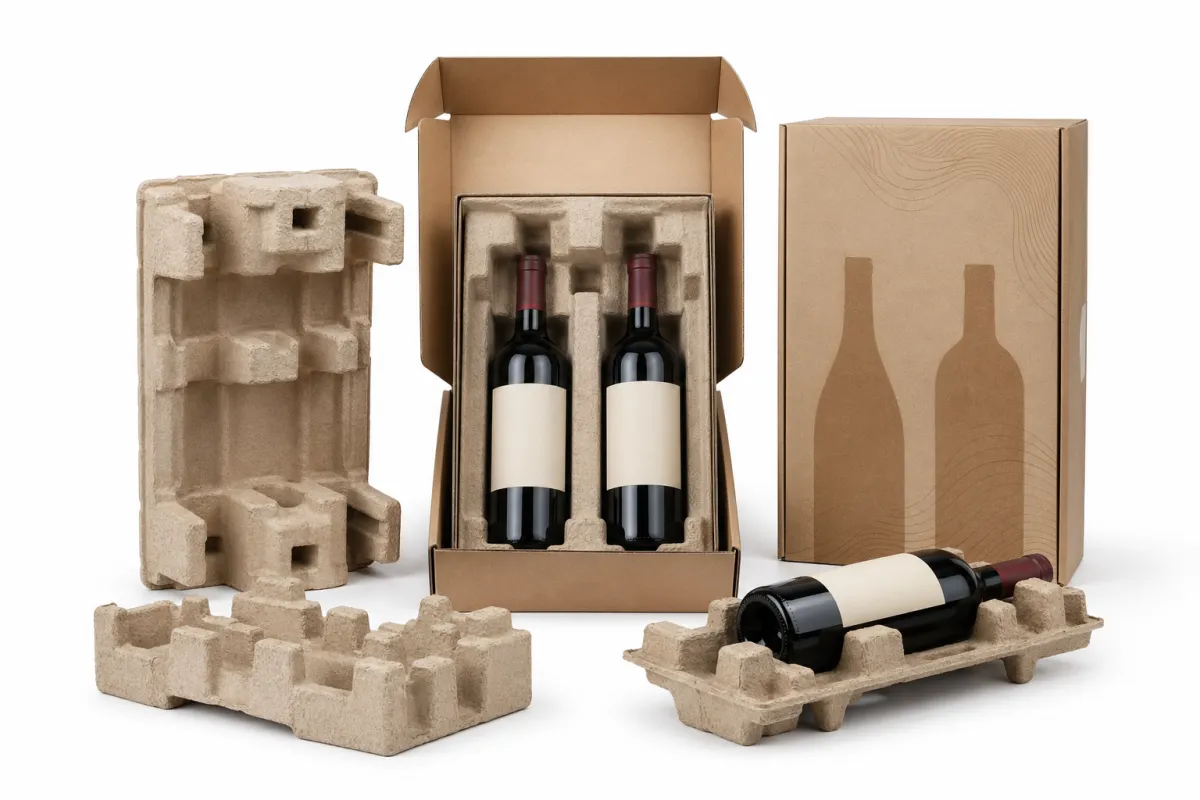
Molded pulp inserts for bottles are formed fiber packaging components made from recycled paper, cardboard, and other plant fibers that are molded to cradle a bottle in transit. Depending on the geometry, they can support the body, shoulder, neck, base, or all four at once. The job is straightforward: hold the bottle steady, spread out impact, and keep the carton from becoming the thing that damages the product. In a 750 ml wine shipper or a 100 ml serum carton, that usually means the insert has to control movement to within a few millimeters.
I have seen these inserts used in beverage, cosmetics, specialty food, candle, and pharmaceutical packaging across plants in Wisconsin, New Jersey, and southern Mexico. A gin brand with a long neck and embossed glass may need a very different form than a 50 ml facial oil bottle or a maple syrup bottle with a wide base and a tamper-evident cap. Molded pulp inserts for bottles show up around glass and plastic alike because the protection problem stays the same even when the package material changes. Different bottle, same headache, unfortunately, and the freight lane usually makes the headache louder.
People sometimes use insert, tray, partition, end cap, and full shipper as if they were interchangeable. They are not. A molded pulp insert for bottles usually means a shaped piece that positions one bottle or a small group of bottles inside a carton. A tray tends to carry several bottles in a shallow nest, such as a 6-pack of 250 ml beverage bottles. Partitions separate bottles inside a larger shipper. End caps protect the top and bottom of a bottle or bottle cluster. A full shipper is the complete corrugated or fiber-based package, not just the insert inside it. In procurement language, they sit alongside molded fiber trays, corrugated partitions, and other protective packaging formats.
“The insert should disappear in the pack-out and still save the bottle.” That came from a beverage client during a plant review in Grand Rapids, Michigan, and it remains one of the clearest definitions I have heard for molded pulp inserts for bottles.
The other point worth saying early is that this is not only a material choice. Protection matters, but so do line efficiency, cube, damage claims, sustainability goals, and the customer's first impression when the carton opens on a kitchen table in Denver or a boutique shelf in Seattle. A good molded pulp inserts for bottles program has to serve the warehouse, the filling line, and the buyer at the same time, or it will fail somewhere along the chain. Packaging rarely gets a second chance to behave well, especially when a retailer is measuring damage rates by the case.
- Beverage: wine, spirits, cold-pressed juice, bitters, and premium water bottles, often in 375 ml, 500 ml, and 750 ml formats.
- Cosmetics: serums, creams, facial oils, and glass treatment bottles with fine closures, such as 30 ml and 50 ml droppers.
- Specialty food: sauces, syrups, olive oil, and condiment bottles that need clean presentation and tight 24 mm or 28 mm cap control.
- Candles: fragrance jars and glass vessels that crack if they ride loose in a carton for a 300-mile regional run.
- Pharmaceutical: dispensers, tinctures, and other regulated bottles that benefit from consistent fit and repeatable cavity depth.
That spread of use cases is why molded pulp inserts for bottles keep showing up in serious packaging conversations. They are practical, not decorative, and they are usually priced that way by converters in Jiangsu, Ohio, or Puebla. On a factory floor, practical usually wins, even if the sales deck is trying very hard to be glamorous.
How Do Molded Pulp Inserts for Bottles Work in Shipping?
The protection mechanism behind molded pulp inserts for bottles is simple once you see it in motion. The insert disperses impact, limits bottle movement, and keeps glass or plastic from slamming into carton walls or neighboring bottles during vibration, compression, or a drop. If the bottle cannot build speed inside the pack, it has far less energy to transfer into a chip, crack, or cap failure. Physics does the heavy lifting; we just have to stop sabotaging it, usually by leaving 6 mm of unnecessary clearance around the shoulder.
In a good design, the fiber structure behaves like a controlled crush zone. The contour at the shoulder spreads load across a wider area. The base pocket resists upward shock from pallet handling. The neck support keeps the closure from swinging or punching through the top of the carton. That is why molded pulp inserts for bottles are more than shaped paper; they answer specific forces that show up in transit, including the 1.2 m corner drop most parcels eventually meet on the way to the customer.
There are a few details I watch every time. Retention ribs help stabilize the bottle body without making the fit too tight. Draft angles matter because the part has to release cleanly from the mold and stack without sticking. Venting and drainage details help during drying and keep the part from trapping moisture. Wall thickness affects stiffness and crush response, and a 600 gsm pulp wall will behave very differently from a 900 gsm shell in the same carton. Stackable geometry matters too, because a neat stack saves warehouse space and makes feeding easier on the line. If a design looks tidy but sticks together like wet pancakes, that is a problem that usually appears at 4:15 p.m., just when the operator is trying to finish a pallet.
- Single-bottle packs: often rely on a cradle or clamshell-style insert for premium presentation and strong retention around a 28 mm neck.
- Multi-pack configurations: need bottle-to-bottle isolation and enough perimeter strength to resist corner drops from 36 in. test heights.
- Heavy or tall bottles: usually need deeper shoulder support and a more rigid base seat, especially for 700 g to 1.2 kg glass.
- Parcel shipping: tends to punish weak corners and loose neck clearance more than palletized freight on a local lane from Chicago to St. Louis.
Molded pulp inserts for bottles also behave differently depending on the shipping lane. Parcel networks are rougher than many brands expect. A carton may be sorted, dropped, tipped, and stacked several times before it reaches the end customer, especially on routes through Memphis, Indianapolis, or Dallas. Palletized freight can be gentler in some ways, but long dwell times, humidity swings, and top-load compression can still crush a weak design. I like to ask for the actual lane, not the hoped-for lane, because those two are rarely the same. The hoped-for lane lives in a presentation deck; the actual lane lives in a warehouse somewhere, chewing things up one pallet at a time.
Tooling is another large part of the story. Custom pulp tooling is matched to the exact bottle profile, which is why a unique bottle shape, a premium emboss, or a heavy spirits bottle often needs a tailored insert rather than a generic tray. I once reviewed a sample for a French-style olive oil bottle that looked fine on the table, then failed the first corner drop because the shoulder sat 4 mm too high and the base pocket was 2 mm shallow. We corrected the geometry, deepened the contour, and the next run held up the way it should. That is the quiet strength of molded pulp inserts for bottles: they can be tuned to the bottle instead of asking the bottle to adapt to the insert.
For shipping validation, I like to see methods that align with common package testing practices from ISTA, especially for parcel and distribution testing. A shop-floor fit check is useful, but it is not the same as a disciplined vibration and drop sequence run on the exact carton, bottle, and closure. Molded pulp inserts for bottles need to survive both the carton handoff and the transport abuse that follows, whether the shipment is going from Nashville to Atlanta or from Los Angeles to Phoenix.
Key Factors That Affect Performance and Fit
Fit starts with the bottle itself. Height, diameter, weight, center of gravity, closure type, and finish geometry all matter. A beautiful insert can still fail if the bottle rides too high, sits too loose, or shifts because the closure adds extra mass above the shoulder. I have seen molded pulp inserts for bottles lose performance because the design respected the glass body but ignored the taller pump or cork that came later in the project, and that kind of miss is maddening because the part looks approved right up until the final assembly changes by 5 mm.
Distribution conditions matter just as much. A bottle shipped to a local retail chain in the Northeast does not face the same abuse as a bottle moving through parcel sorting centers, cross-docks, or a national warehouse network with long dwell times. Temperature swings and humidity can soften marginal fiber and change how a carton behaves under stack load, especially in August in Houston or Savannah where the humidity can sit above 75% for days. If a brand wants molded pulp inserts for bottles to perform consistently, the design has to match the lane, not only the SKU.
Material density and fiber blend influence protection, stiffness, and appearance. A denser insert usually gives a firmer feel and better retention, but it may add cost and weight. Wall thickness and caliper help control crush response, while fiber blend can affect color, surface texture, and recyclability claims. A lighter shell can work fine for a 10 oz plastic bottle; it may be a poor choice for a 1.1 kg glass bottle with a tall shoulder and a premium closure. That is why I treat molded pulp inserts for bottles as engineered parts, not commodity filler. If anyone says, “It’s just pulp,” I know I’m about to have a longer day than planned, usually with a callback from the plant at 6:00 p.m.
Branding and unboxing requirements belong in the engineering discussion too. Premium bottle packaging often needs a clean reveal, predictable nesting, and an insert that supports shelf appeal instead of burying the bottle in a clumsy nest of padding. One cosmetics client in Los Angeles wanted a frosted glass serum bottle to feel like it was presented as a finished object, not a loose component. We adjusted the contour so the label faced forward and the bottle sat 2 mm deeper in the tray, then paired the insert with a 350gsm C1S artboard carton mockup for the reveal test. That is the kind of detail that turns molded pulp inserts for bottles from pure protection into a brand asset.
There is also the question of sustainability targets. Some brands want high recycled content. Others want a specific end-of-life path. A few need a structure that can be recycled in paper streams after use, and they ask for confirmation against local rules in California, the UK, or the EU. The EPA recycling guidance is a useful starting point when your team is drafting disposal language, because the answer is not identical in every market. I also remind clients that molded pulp inserts for bottles are not automatically a sustainability win if they fail early and create rework, repack labor, or product loss. The best environmental story is the one That Actually Works in the box, not the one that only sounds good in a press release from a marketing department in San Francisco.
| Insert Option | Prototype | 5k Units | 25k Units | Best Fit |
|---|---|---|---|---|
| Molded pulp inserts for bottles | $0.62-$1.10 | $0.18-$0.28 | $0.09-$0.16 | Odd-shaped glass, premium presentation, recycled fiber story |
| Foam insert system | $0.28-$0.55 | $0.12-$0.20 | $0.08-$0.14 | Lightweight protection where sustainability pressure is lower |
| Corrugated insert system | $0.35-$0.80 | $0.16-$0.30 | $0.10-$0.18 | Flat-shipping efficiencies and simpler bottle shapes |
| Hybrid pulp + corrugate | $0.70-$1.25 | $0.20-$0.38 | $0.12-$0.22 | Heavier bottles, higher damage risk, premium unboxing |
Those numbers are illustrative, not a promise, but they still show the pattern I see over and over in quotes from Dongguan, Milwaukee, and Monterrey: molded pulp inserts for bottles may not always be the cheapest piece on day one, yet they can become the least expensive total solution when they reduce breakage, simplify pack-out, or cut claim costs. The landed cost conversation should include freight cube, labor time, and the cost of one damaged case in a retail channel that will not forgive it twice, especially if the case has to be reworked at $18 to $25 per hour on the line.
If a team wants to compare material choices honestly, I usually ask three questions. Can the pack survive the lane? Can the line run it at speed, such as 20 to 24 packs per minute? Can the buyer live with the unboxing experience? If any one of those answers is no, the cheapest option is usually the most expensive mistake. That is true for foam, corrugated, and molded pulp inserts for bottles alike, whether the shipment leaves a plant in Ohio or a converter in Zhejiang.
Cost and Pricing: What Drives the Quote
The quote for molded pulp inserts for bottles usually comes down to tool development, cavity count, annual volume, insert size, fiber grade, color, secondary finishing, and how the part is packed for shipment. A simple single-bottle cradle with low relief is one price. A deep, premium insert with tight shoulder registration and a special surface finish is another. If you ask for a figure without sending dimensions, bottle samples, carton constraints, and a target annual quantity like 20,000 or 100,000 units, you are really asking for guesswork. And guesswork is a terrible procurement strategy, no matter how politely it is presented.
Tooling is the first major cost center. Low-volume or highly custom bottle shapes often need a higher upfront investment because the mold has to be built for that exact geometry. That cost gets spread across every unit you produce, so unit price usually falls as volume rises. I have seen molded pulp inserts for bottles priced at $0.31 each in a 5,000-piece run, then drop to $0.11 at 50,000 pieces once the tooling was fully utilized and the line was dialed in, with the first proof approval to pilot samples taking 12-15 business days in a clean, well-run plant.
Shipping weight and cube efficiency matter too. A part that looks slightly cheaper per unit can actually raise total landed cost if it adds pallet weight, increases carton size, or creates wasted air in the shipper. On the other hand, a stronger insert that cuts breakage from 2% to 0.2% can pay for itself faster than anyone expects. That is why smart buyers ask for more than unit price when they evaluate molded pulp inserts for bottles, especially when inbound freight is already running $180 to $240 per pallet on a cross-country lane.
I also recommend comparing the cost of the insert against the cost of the damage it prevents. In one supplier meeting in Guangdong, I watched a converter pitch a lighter 600 gsm spec for a heavy glass bottle because it shaved pennies off the quote. We tested the sample, and the second corner drop crushed the shoulder. The final design moved to a denser wall and a deeper rib pattern, and the total project cost went down because the company stopped eating repack labor and breakage claims. That is the sort of arithmetic people miss when they focus only on the line item. A penny saved on paper can turn into a small fortune lost in damage, especially when a failed pallet has to be relabeled and repacked in a warehouse near Newark.
Here is a simple way to think about the buying decision. Molded pulp inserts for bottles can be more economical than foam or complex corrugated systems when the package is irregular, the presentation matters, or the damage risk is real. If the bottle is simple, light, and shipped in short lanes, corrugated may be enough. If the bottle is premium, heavy, or fragile, the right pulp design often becomes the cleaner long-term answer, particularly for 375 ml spirits, 500 ml olive oil, and 750 ml wine formats.
- Tool development: custom cavity work, prototype pulls, and any mold adjustments after fit testing, often in a 7 to 10 day sample cycle.
- Volume tiers: prototype, pilot, and production pricing should all be requested, such as 1k, 5k, 25k, and 100k units.
- Fiber grade: recycled content, surface finish, and density affect the quote, including whether the plant uses wet-press or dry-press output.
- Packaging format: single-pack, multi-pack, tray, partition, or full shipper changes material usage and die complexity.
- Secondary finishing: trimming, color requirements, or coatings can shift the price by a few cents per unit.
Ask suppliers to quote several volume tiers at once. I usually want prototype pricing, pilot pricing, and full-scale pricing in the same conversation because the economics tell a different story at 2,000 units than they do at 100,000. That side-by-side comparison gives procurement, operations, and sales a chance to agree before the project drifts into a half-approved design that nobody wants to own. With molded pulp inserts for bottles, that early clarity saves a lot of friction later, especially if the packaging line is being prepped in a plant that also runs corrugated shippers on the same shift.
Step-by-Step Process and Timeline
The cleanest molded pulp inserts for bottles projects start with bottle sampling. I want the actual bottle, the actual closure, and the actual carton dimensions before anyone talks about final tooling. A drawing helps, but the physical sample catches the real-world details that CAD can miss: label thickness, shoulder variation, bottom glass thickness, and the way the closure changes the center of gravity. The sample is usually where the truth shows up, whether people are ready for it or not, and it is much easier to fix a 2 mm mismatch before steel is cut in Dongguan or Suzhou.
After that comes the design phase. The converter or packaging engineer builds the insert in CAD, then produces samples for fit checks. At this stage, I like to watch how the bottle drops into the cavity, how much clearance exists at the neck, and whether the base seats evenly. If the project is serious, we also build carton mockups in 350gsm C1S artboard and then run compression, vibration, and drop validation before approving the tooling. A design that only looks right on paper is not ready for production.
Lead time depends on complexity. A straightforward insert with a repeatable bottle profile can move quickly once dimensions are locked. A custom shape with multiple approval rounds takes longer because every change to the shoulder angle or wall depth can affect release, drying, and fit. From my experience, a practical launch window is typically 12-15 business days from proof approval for a simple single-bottle insert, while a more complex premium tray can take 18-25 business days if the mold needs a second revision. That is still faster than correcting a failed launch after cartons are already on a truck.
One of the best projects I ever saw stayed on schedule because procurement, operations, and quality were all in the room at the same time at a facility in North Carolina. Nobody had to translate between departments later. The plant manager wanted line speed, quality wanted drop results, and procurement wanted a price at 25,000 and 100,000 units. Because they all signed off together, the project moved from prototype to launch without the usual three-week stall. That is exactly how molded pulp inserts for bottles should be managed: as a cross-functional packaging decision, not a siloed artifact.
The handoff into production is where discipline matters. Quality checks need to confirm dimensional consistency, fiber density, and release behavior from the mold. The filling team needs a clear pack-out instruction sheet, especially if the bottle has a new closure or a tighter label spec. The warehouse team needs stack guidance, pallet count expectations, and a handling note if the inserts are sensitive to humidity. All of that should live in one document, because molded pulp inserts for bottles tend to work best when the plant sees the same instructions every time, whether the order is 2,500 units or 250,000.
Here is the sequence I usually recommend:
- Collect bottle samples, carton specs, and shipping lane details, including origin, destination, and pallet pattern.
- Define the damage threshold, test method, and acceptance criteria, such as a 36 in. corner drop and a 1.2 m vibration screen.
- Review fit in CAD and with physical samples, then compare the bottle, cap, and label stack-up.
- Run drop, compression, and vibration checks on the exact pack-out, not on a simplified surrogate.
- Approve tooling only after the sample passes the real test and the pack looks right in a 350gsm C1S artboard mockup if presentation matters.
- Document the final spec so future reorders match the approved version, including neck height, cavity depth, and carton grade.
That discipline saves time later. A lot of companies rush the early stage because they want a quote fast, then spend weeks cleaning up avoidable mistakes. The better move is to slow down just enough to get the bottle, closure, carton, and insert all speaking the same language. That is how molded pulp inserts for bottles turn into a reliable production part instead of an expensive experiment that gets called back from the warehouse after the first 800 units.
Common Mistakes with Molded Pulp Inserts for Bottles
The first mistake is designing only around the bottle shape and ignoring shipping abuse. A snug fit on the bench can still fail in a rough freight lane if the carton gets corner drops, stack pressure, or constant vibration. I have seen molded pulp inserts for bottles fail because the team measured the bottle beautifully but never asked how the package would behave after 600 miles on a trailer from Allentown to Atlanta and three warehouse touches in between. The truck does not care how pretty the CAD looked.
The second mistake is overvaluing appearance. A premium-looking insert is nice, and in some categories it matters a great deal, but presentation cannot rescue a part that crushes too easily. If the structure collapses under modest load, the brand will pay for it in damaged bottles, repack labor, and angry customer emails from retail buyers in Chicago or Boston. Pretty is good. Durable is better. Molded pulp inserts for bottles should do both whenever possible, but protection has to lead.
The third mistake is skipping testing with the real bottle, the real closure, and the real carton. A label change, a new pump, or a slightly taller cap can shift the balance enough to create a problem that never showed up in the initial sample. I have seen a cosmetic pack pass every visual review and then fail because the closure added 6 mm of height after the insert had already been approved. That is exactly the kind of surprise these inserts are supposed to prevent, and it usually shows up after a reorder instead of during prototype approval.
Moisture exposure is another issue that gets underestimated. Molded fiber can perform very well, but the spec has to match storage conditions. If a carton sits in a humid warehouse in Houston, Jacksonville, or Savannah, or the inserts are stored near a dock door for two weeks, a light-wall design may soften or lose stiffness before it reaches the line. That does not mean the material is wrong; it means the spec was too light for the environment. In factories, that distinction matters, and it matters fast.
The last mistake is choosing the cheapest option without considering labor or claims. I have watched teams save two cents per unit and spend ten times that amount on slower packing, higher returns, and more customer service work. The cheapest insert is only cheap if it protects the bottle and keeps the line moving. If not, molded pulp inserts for bottles become a lesson in false economy, usually recorded in a spreadsheet no one wants to present to leadership.
In one plant review, a line supervisor told me, “If the insert saves five seconds and two breakages per pallet, I do not care if it costs a penny more.” That line stuck with me because it is exactly how practical packaging decisions get made on the floor, especially on Line 3 where the crews run 18 pallets before the afternoon break.
- Do not approve a sample without actual shipping testing on the exact lane.
- Do not ignore the closure height or label thickness, even if the bottle looks identical.
- Do not assume a dry sample will behave the same in humidity after 48 hours in storage.
- Do not buy only on unit price, especially when breakage claims can exceed the packaging savings.
Most of these problems are avoidable if the team treats molded pulp inserts for bottles as a packaging system rather than a single component. Bottle, insert, carton, pallet pattern, warehouse conditions, and delivery lane all shape the result. Miss one of them and the whole thing gets shaky very quickly, usually right after the pilot run starts looking successful.
Expert Tips and Actionable Next Steps
If I were helping a brand start a project tomorrow, I would begin with a simple checklist. Gather the bottle sample, exact carton dimensions, closure type, label height, shipping method, and acceptable damage threshold. Then tell the supplier whether the pack will move by parcel, pallet, or both, and name the actual cities if the lane matters, such as Portland to Phoenix or Dallas to Orlando. That is the fastest way to get a useful quote for molded pulp inserts for bottles instead of a vague placeholder number.
Next, ask for two prototype paths if the bottle is important. One should optimize protection. The other should optimize presentation and pack speed. A side-by-side comparison often reveals small differences that matter a lot in practice, like whether the bottle drops in cleanly or needs a second hand to seat the base. If you test both versions with the actual bottle and closure, the format becomes much easier to judge honestly, especially when the bottle is moving through a 12-pack master carton or a single-unit gift box.
Do not forget cost scenarios. Ask for a low-volume pilot quote and a full-scale production quote. The tooling payment can make the first run feel expensive, but the unit price may fall sharply once the project reaches volume. I also like to request a note on drying method, fiber grade, and any finish changes, because those details often explain price differences that look mysterious at first glance. It saves everyone from arguing about a number that was never comparable in the first place, whether the supplier is in Florida, Guangdong, or Puebla.
Document the final spec sheet with unusual care. I mean bottle weight, finish diameter, cavity depth, rib locations, carton wall thickness, pallet count, and any humidity warnings. If the file is weak, the next reorder may drift just enough to create fit problems. Good documentation keeps molded pulp inserts for bottles consistent from pilot through repeat production, and that consistency is where the real value lives, especially when the reorder comes six months later from a different buyer or plant manager.
- Request real bottle samples, not just measurements on a drawing.
- Test the exact closure and label combination, including any shrink sleeve or pump collar.
- Ask for pricing at multiple volume tiers, such as 1k, 5k, and 25k units.
- Confirm the shipping lane and warehouse conditions, including humidity and stack time.
- Lock the final spec before the first production run and archive the approved sample for future reorders.
My honest advice is simple: confirm bottle weight, finish, freight lane, and sustainability goals first, then move into sampling before anyone buys tooling. That order saves time, money, and frustration. It also gives molded pulp inserts for bottles a fair chance to prove themselves under real-world shipping conditions instead of under a hand-picked bench test that never had to face a sorter, a dock plate, or a rainy transfer in the middle of a July afternoon.
Frequently Asked Questions
Are molded pulp inserts for bottles strong enough for glass bottles?
Yes, when the design matches the bottle weight, shape, and shipping method, molded pulp inserts for bottles can protect glass very well. Performance depends on wall thickness, retention points, and how much movement the bottle has inside the carton. For heavier or more fragile bottles, I would always ask for drop-tested samples with the exact closure and carton configuration before approving the tooling, ideally using a 36 in. corner drop and a 1.2 m vibration screen on the final pack-out.
How do molded pulp inserts for bottles compare to foam or corrugated inserts?
Molded pulp inserts for bottles often offer a better sustainability story and a cleaner premium presentation than foam. Compared with corrugated, molded pulp usually gives more exact contouring for odd-shaped or high-value bottles. The best choice depends on damage risk, cost targets, cube efficiency, and the look you want at unboxing, especially for 375 ml spirits, 500 ml olive oil, and 750 ml wine bottles that need both protection and shelf appeal.
What information do I need before requesting a quote for molded pulp inserts for bottles?
Provide bottle drawings or samples, exact dimensions, weight, closure type, and label placement. Share carton size, pack count, shipping method, and whether the bottles travel by parcel, pallet, or both. Include volume estimates and target launch timing so suppliers can price tooling and production realistically for molded pulp inserts for bottles, and add any special requirements like recycled content, color, or a premium reveal tray for a gift set.
How long does it take to develop molded pulp inserts for bottles?
Timeline depends on complexity, sample cycles, and whether the insert is fully custom or based on an existing platform. Simple projects can move quickly once dimensions and performance requirements are locked in, while custom shapes with multiple approval rounds take longer because fit testing and production validation matter for molded pulp inserts for bottles. In practice, a straightforward proof cycle often takes 12-15 business days from proof approval, while a more detailed premium project can run 18-25 business days.
Can molded pulp inserts for bottles be recycled after use?
In many markets, molded pulp inserts for bottles can be placed in normal paper recycling streams if they are clean and dry. Local recycling rules vary, so brands should confirm disposal guidance for customers and retail partners in their target regions, including the U.S., Canada, and the UK. Using recycled fiber content can also strengthen the sustainability message before the pack even reaches the end user.
If you are weighing packaging options for a glass, plastic, or specialty bottle line, molded pulp inserts for bottles deserve a serious look because they can protect the product, support the brand presentation, and fit the production floor without forcing awkward compromises. I have seen them solve breakage problems in noisy freight lanes from Texas to New Jersey, clean up premium unboxing for cosmetics in Los Angeles, and cut wasted labor in plant after plant in Guangdong and the Midwest, and that practical track record is exactly why I keep recommending molded pulp inserts for bottles when the shipment has to hold up in the real world.
The clearest next step is to start with the actual bottle, closure, carton, and shipping lane, then test the insert before tooling is approved. If those four things line up, the rest of the project gets a lot less shaky, and the final pack is much more likely to survive the long, messy trip from filling line to customer door.