Buyer Fit Snapshot
| Best fit | eco friendly box inserts price for packaging buyers comparing material specs, print proof, MOQ, unit cost, freight, and repeat-order risk where brand print, material, artwork control, and repeat-order consistency matter. |
|---|---|
| Quote inputs | Share finished size, material target, print colors, finish, packing count, annual reorder estimate, and delivery region. |
| Proofing check | Approve dieline scale, logo placement, barcode or warning zones, color tolerance, and any recyclable or compostable wording before bulk production. |
| Main risk | Vague material claims, crowded artwork, or missing packing details can create delays even when the unit price looks attractive. |
Fast answer: Eco Friendly Box Inserts Price: Costs, Specs, and MOQ should be specified like a repeatable production item. The safest quote includes material, print method, finish, artwork proof, carton packing, and reorder notes in one written spec.
What to confirm before approving the packaging proof
Check the product dimensions against the actual filled item, not only the sales mockup. Ask for tolerance on folds, seals, hang holes, label areas, and retail display edges. If the package carries a logo, QR code, warning copy, or legal claim, reserve that space before decorative graphics fill the panel.
How to compare quotes without losing quality
Compare board or film grade, print process, finish, sampling route, tooling charges, carton quantity, and freight assumptions side by side. A lower quote is only useful if the supplier can repeat the same color, closure quality, and packing count on the next order.
Eco Friendly Box Inserts Price: What Drives the Cost
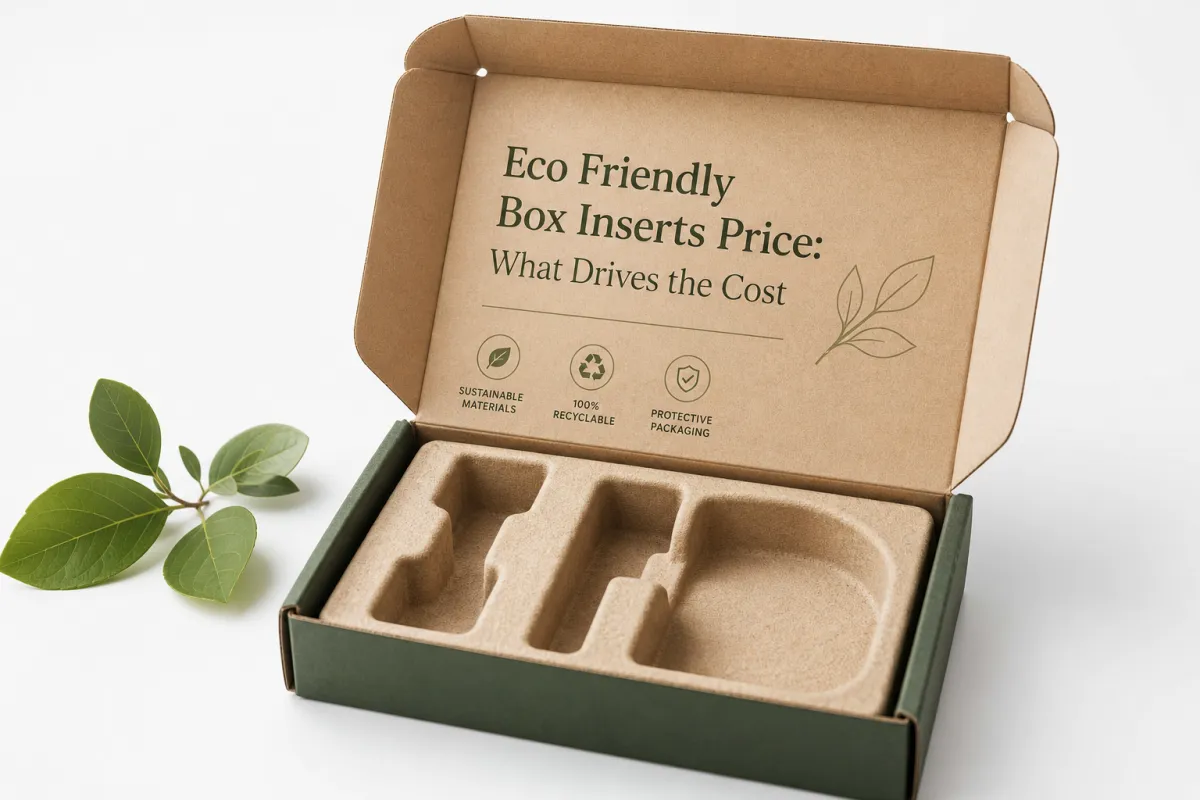
Eco friendly box inserts price is shaped by a lot more than the insert itself. Material selection, cutting method, part count, hand assembly, carton size, freight, and even the way the product is packed at the table all affect the final number. A tray that looks straightforward on a screen can still be expensive to make if it needs tight tolerances, extra folds, or careful manual assembly. Two projects can share the same outer box and still land at very different price points because the insert behaves differently in production.
The cost conversation makes more sense once the whole package is considered. A well-built insert can reduce breakage, limit returns, cut down on void fill, and speed up packing at the fulfillment station. That changes the economics in a real way, which is why eco friendly box inserts price should be measured against the cost of shipping the product safely, not just the unit quote. A cheaper insert that lets a bottle rattle or a cosmetic compact scuff its way through transit can turn into damage claims, repack labor, and unhappy customers. Those costs add up fast for glass, premium beauty items, electronics accessories, and gift sets that need to arrive looking crisp.
Design complexity is usually the first big driver. Tight cavities, nested layers, finger notches, locking tabs, display features, and multi-piece builds all add labor and scrap. Material choice matters just as much. Recycled paperboard is often the most economical for flat-cut shapes, corrugated inserts bring more strength for heavier goods, and molded pulp carries tooling and minimum quantity requirements that affect the budget in a different way. So eco friendly box inserts price rarely comes from a single decision; it comes from the way structure, material, and production efficiency work together.
Buyers often ask for the lowest insert price, then discover the lowest quote is not the lowest cost. A better question is whether the insert protects the product, fits the carton, and supports the presentation customers expect. That approach tends to lead to stronger decisions. A clean paperboard insert can look restrained and still do an excellent job if it keeps a candle centered and prevents scuffing. In that situation, the real eco friendly box inserts price is strong because the packout works the first time and the line keeps moving.
“The cheapest quote can become the most expensive choice when the insert slows packing, creates scrap, or fails in transit.”
Teams that want a clearer view of sustainable packaging standards can lean on industry references. The Packaging School / packaging.org resource hub offers broad packaging education, while the FSC site explains chain-of-custody certification basics. Neither source sets eco friendly box inserts price on its own, yet both make it easier to compare supply options with better context and fewer assumptions.
Choose the Right Insert Material for Your Packout
The clearest way to understand eco friendly box inserts price is to match the material to the product. A sustainable insert is not a one-size-fits-all purchase, and forcing one stock into every application usually pushes cost up instead of down. A supplier worth listening to will talk through protection, presentation, and packing speed before pointing to the cheapest-looking line on the quote.
Recycled paperboard is often the best fit for lighter products, retail gifts, small cosmetics, candles, and subscription items that need a clean presentation inside the carton. It die-cuts neatly, prints well, and can be formed into trays, sleeves, or folded retainers without a lot of drama. Many brands find it delivers the strongest balance of eco friendly box inserts price and visual finish because converters know the stock well and can run it consistently in repeat volumes. Freight weight stays down too, which is a quiet advantage that many buyers only notice after the first shipment cycle.
Corrugated inserts suit heavier bottles, drinkware, tool kits, and products that need edge support or more crush resistance. The flute structure gives the packout real stiffness, especially when the shipping lane is rough or the outer carton is larger than the product footprint. Corrugated can raise eco friendly box inserts price a bit compared with basic paperboard, but the added strength often pays back through lower damage rates and less reliance on foam or extra void fill.
Molded pulp performs well for protective trays, clams, and product shapes that need a formed cavity. Electronics accessories, glassware, and heavier consumer goods often benefit from that style of structure. The tradeoff is tooling. Custom molds can raise the upfront cost, and small runs rarely absorb that expense well. For that reason, eco friendly box inserts price on molded pulp may look higher at the quote stage even when the unit economics improve on larger, recurring programs.
Fiber-based trays and formed paper solutions sit between paperboard and molded pulp in some use cases. They can feel more premium than plain corrugated while still staying fiber-forward and recyclable in many programs. Beauty kits, wellness sets, and higher-end retail boxes often use this kind of insert when the presentation matters as much as the protection. In those cases, the final eco friendly box inserts price reflects both the material and the consistency needed to keep every carton looking aligned on the shelf and on the unboxing table.
| Material | Typical Use | Common Price Range | MOQ Tendency | Notes |
|---|---|---|---|---|
| Recycled paperboard | Cosmetics, candles, subscription items | $0.18-$0.45 per unit | Lower | Best for flat-cut shapes, clean presentation, and modest protection |
| Corrugated | Drinkware, bottles, retail kits | $0.22-$0.55 per unit | Lower to medium | Stronger edge support and better crush resistance |
| Molded pulp | Electronics accessories, glass, formed trays | $0.30-$0.80 per unit | Higher | Tooling and mold economics matter a lot, especially on shorter runs |
| Fiber-based tray | Beauty kits, premium sets | $0.25-$0.70 per unit | Medium | Good balance of presentation, stiffness, and repeatability |
The ranges above are starting points, not fixed quotes. They move with board caliper, print coverage, cavity complexity, carton size, and order quantity. Even so, they give buyers a practical frame for eco friendly box inserts price conversations. Add multiple cavities, lifted platforms, or an unusually tight hold, and the cost climbs. Keep the structure simple with a standard fold pattern, and the price tends to stay more approachable.
Shipping distance and warehouse conditions matter as well. Corrugated usually handles moisture better than thin paperboard across many lanes, while molded pulp can vary if the forming quality is inconsistent. A strong packaging team will ask where the cartons are going, how long they will sit in storage, and whether the insert needs to work in a retail-ready box or a protective shipper. Those details directly affect eco friendly box inserts price because the prettiest drawing on paper is not always the right structure once it is on a truck.
Specifications That Affect Fit, Protection, and Waste
Good specifications are where eco friendly box inserts price starts to feel predictable. Clear product dimensions, material requirements, and handling needs reduce the number of sample rounds and keep scrap under control during production. A detailed spec sheet may not be glamorous, but it saves more money than a cosmetic change to the layout ever will.
The first dimension that matters is the product footprint: length, width, and height. From there, the real question is how much clearance the insert should allow. A cavity that is too snug can make packing difficult and scuff the product during insertion, while one that is too loose allows shifting inside the box. That balance affects eco friendly box inserts price because tighter tolerances usually mean more testing, more revisions, and sometimes thicker stock to keep the insert stable. If the spec is off by even a few millimeters, the whole job can kinda drift into rework territory.
Cavity depth matters just as much as footprint. A shallow cavity can keep a lid visible for presentation, while a deeper cavity can stabilize a bottle or glass component. Finger cuts, pull tabs, and lock points also change the structure. If the end user needs to lift the product out cleanly, the insert may need a shaped retention edge, and that adds another die-cut step. Every added feature tends to push eco friendly box inserts price upward unless it replaces another part of the packout.
Board thickness affects both performance and waste. A 16 pt or 18 pt paperboard insert can work nicely for light cosmetics, while heavier sets may need thicker paperboard, double-wall corrugated, or a formed fiber solution. Thicker stock can improve rigidity and feel, though it also raises material cost and can require a wider cut footprint. A thoughtful spec lowers eco friendly box inserts price over time because the right caliper avoids rework and helps prevent failures during fit approval.
Single-piece construction is often cheaper than a multi-piece build, though not always. If a multi-piece insert removes the need for a separate tray or spacer, the total packout may actually cost less. The same logic applies to glued assemblies. Glue can improve alignment and appearance, but the labor step has to earn its place. Packaging teams that think in terms of the full operation usually land on more stable eco friendly box inserts price numbers across reorder cycles.
Grain direction and fold orientation are easy to overlook. If the board folds against the grain in a critical hinge, the insert can crack or lose resilience, which may force a thicker stock or a redesigned dieline. That looks minor on a drawing, then turns into scrap during a production run. Suppliers who understand structural behavior can often reduce eco friendly box inserts price simply by correcting the dieline before the first tool is cut.
Specs should also cover secondary needs such as label windows, print registration, barcodes, and retail shelf presentation. If an insert will be visible through a box opening, both the printed side and the exposed side need attention. If the product will move through a fulfillment center, the insert should allow quick packing without forcing workers to handle fragile edges. Details like these keep eco friendly box inserts price tied to real warehouse conditions rather than to a perfect sample sitting on a desk.
For brands handling regulated or test-sensitive goods, standards can shape the conversation. ISTA test methods help teams think about drop, vibration, and compression in a repeatable way. You can review the organization at ISTA. A supplier does not need to overbuild the insert, but testing against realistic transit conditions helps make sure the quoted eco friendly box inserts price reflects a package that can survive shipping, not just a package that looks tidy during approval.
Eco Friendly Box Inserts Price, MOQ, and Volume Breaks
Once the material and spec are settled, MOQ becomes the next major lever in eco friendly box inserts price. Minimum order quantity is tied to setup time, material yield, cutting efficiency, and assembly economics. A simple flat-cut insert can often run at a lower MOQ than a molded or heavily fabricated design because the tooling and labor burden are lighter.
Buyers often do themselves a favor by separating sample cost, setup cost, unit price, and freight instead of folding them into one number. A low unit price can hide a high setup fee or a small run that never really absorbs the tooling. For that reason, eco friendly box inserts price should always be read as a landed cost. Ask what the quote includes: dieline preparation, samples, cutting dies, mold charges, insert assembly, packaging, and shipping cartons.
Flat-cut paperboard inserts usually support smaller starting quantities, sometimes in the low thousands or even below depending on the converter and structure. Corrugated inserts tend to follow a similar pattern, although flute choice and board grade will move the numbers. Molded pulp works differently. Tooling raises the entry cost, and the run generally needs more volume before the economics feel comfortable. In that sense, eco friendly box inserts price is tied closely to the number of pieces a program can carry over its life cycle.
Volume breaks make the pattern visible. A run of 2,500 units often carries a higher unit price because setup and cutting time are spread across fewer pieces. At 5,000, the price may improve in a meaningful way. At 10,000 or 20,000, the cost per unit usually drops again if the structure stays simple enough to run efficiently. The tradeoff is storage and cash flow. Buying too many inserts too early can tie up working capital, even when the eco friendly box inserts price on paper looks attractive.
Here is a practical way to think about it:
- Test launch - choose a lower MOQ and a structure that samples quickly.
- Stable SKU - move into a repeatable order schedule with a clear volume break.
- High-run program - optimize die layout, cut yield, and freight packaging to lower landed cost.
This approach keeps the buyer from overcommitting before the design has real-world proof. It also leaves room to refine the spec after the first production cycle. If a product shifts in transit, the next revision can tighten the cavity or change the stock. A manageable first run makes that easier and keeps eco friendly box inserts price honest instead of forcing a large commitment before the structure is proven.
Below is a practical view of how volume breaks often influence buying decisions. The exact numbers will move by project, but the pattern is useful:
| Run Size | Likely Pricing Behavior | Best For | Buying Risk |
|---|---|---|---|
| 1,000-2,500 | Highest unit cost, setup spread over fewer pieces | Launches, pilot programs, product tests | Lower commitment, but less cost efficiency |
| 5,000-10,000 | Strong price improvement | Growing SKUs, repeat campaigns, retail resets | Balanced inventory and better unit economics |
| 20,000+ | Lowest unit cost in many cases | Stable programs with predictable demand | Storage, cash flow, and forecast accuracy matter more |
Shipping method changes the math too. Inserts that ship flat are usually cheaper to move than pre-assembled trays, especially on larger runs. If assembly happens at your facility, the factory price may look lower, but your team carries the extra labor. That is why eco friendly box inserts price should always be judged by who assembles the insert and where that work happens.
For buyers comparing suppliers, it helps to ask for two or three options rather than one. A recycled paperboard version, a corrugated version, and a molded pulp version can reveal a useful spread if the product qualifies for each. Side-by-side pricing makes the structure of eco friendly box inserts price clearer and often points to a practical middle ground. In many cases, the right answer is neither the cheapest material nor the most premium one; it is the simplest insert that still protects the product and keeps the line moving.
Sampling, Production, and Lead Time Expectations
Sampling is the point where a quote becomes a real packaging project. Buyers often focus on eco friendly box inserts price first, but the sample stage usually shows whether the structure is stable or still needs adjustment. That stage should include fit checks, closure checks, retention tests, and a close look at edges and folds that may interfere with the product or with packing speed.
The flow is straightforward, though each step matters: quote, dieline review, sample production, customer fit approval, then full production. If the art, dimensions, or shipping case are still moving, the schedule slows down. Clear communication keeps eco friendly box inserts price tied to actual work instead of forcing the supplier to pad the quote for avoidable revisions.
For a simple recycled paperboard insert, the sample can often move quickly because the structure is die-cut rather than molded. A well-prepared project may go from approval to sample in just a few days. More complex molded pulp jobs usually need more time because tooling or forming adjustments may be required. Production lead time after approval often falls in the 10-20 business day range for many flat-cut projects, although larger quantities or special material grades can stretch that window. This is part of the practical reality behind eco friendly box inserts price: faster turnarounds usually call for standard materials and a finalized spec.
Buyers should also expect sample changes. A first sample may show that the cavity is too tight, the insert is too tall, or the fold lock needs more clearance. That is normal. The whole point is to catch the issue before production. A small dieline adjustment is usually cheaper than a full production correction, and those minor changes can protect eco friendly box inserts price by preventing scrap or reruns.
There is a real difference between a structural mockup and a production-ready sample. A mockup verifies fit and handling. A production sample verifies final board, cutting, and assembly behavior. That distinction matters for teams working to a tight launch date. If a product is headed into retail, the buyer may need an early structural check, then a final approval sample, then the main run. Solid planning keeps the schedule honest and keeps eco friendly box inserts price from being distorted by rush charges.
Material availability also plays into the schedule. Recycled fiber grades can vary by mill and by lead time, and custom pulp formulations depend on mold capacity. When supply shifts, pricing can move too. It is better to ask about acceptable alternates early than to redesign halfway through the project. A supplier who understands substitution logic can usually recommend a board or pulp grade that preserves the spec while protecting eco friendly box inserts price from sudden jumps.
Transit conditions should shape the design review as well. If the goods will pass through several handoffs, the insert may need to survive drop testing. If the packout stays in a controlled retail channel, a lighter structure may be enough. ISTA methods help teams think about that risk in a disciplined way, and that discipline often saves money by preventing overbuilding. Proper testing can reduce effective eco friendly box inserts price because it steers the design toward the right amount of protection instead of the maximum amount.
Teams that want to move quickly usually do best when they approve the dieline as soon as the product measurements are locked. Delays most often come from incomplete product data, shifting carton dimensions, or late artwork changes. The cleaner the handoff, the easier it is to keep eco friendly box inserts price near the original target and still hit the launch date.
Why Choose Us for Sustainable Box Inserts
Custom Logo Things is a practical partner for brands that want protection, presentation, and cost control in the same project. The goal is not to push the most elaborate insert by default. The goal is to recommend the structure that protects the product, fits the carton correctly, and keeps eco friendly box inserts price aligned with the buyer’s actual budget.
That matters because many insert projects run into trouble for simple reasons: the cavity is too deep, the board is heavier than necessary, or the design uses too many pieces. A strong quoting process should surface those issues early. If a product can be held securely in a one-piece recycled paperboard insert, there is no reason to force a more complicated assembly. If a drinkware kit needs more edge support, corrugated may be the better call. Direct guidance like that helps control eco friendly box inserts price without giving up performance.
Manufacturing accuracy is another part of the value. Clean die-cut edges, stable folds, consistent gluing, and disciplined inspection all reduce the chance of a reject run. For buyers, that means fewer delays and fewer surprises. In a packaging program, consistency is worth real money because it keeps the quote close to the landed cost. Good process control is not flashy, but it is one of the biggest reasons eco friendly box inserts price stays workable over repeat orders.
Communication matters too. A strong supplier should explain what is included in the quote, what Changes the Quote, and where the tradeoffs sit. If a design can be simplified to lower cost, that should be said plainly. If a thicker board or a premium finish is the right answer for the product, that should also be said plainly. Buyers do not need hype. They need clear answers about spec, quantity, lead time, and the choices that shape eco friendly box inserts price.
In practice, the best projects usually share three traits:
- Clear dimensions - product size, weight, and packaging format are known before quoting.
- Right-sized structure - the insert is no more complex than it needs to be.
- Realistic quantity - the MOQ fits the launch plan and the reorder cycle.
That sounds simple because it is. The hard part is resisting the urge to over-spec the insert. A heavier board, an extra layer, or a more complicated fold pattern can look safer at first, yet it often raises cost without adding much value. A better path starts with the product, the shipping lane, and the brand presentation, then builds a structure that serves all three. That is where eco friendly box inserts price becomes sensible instead of inflated.
Some buyers also want help with sustainability language. Concrete sourcing makes those conversations easier. FSC-certified fiber can be part of the plan, recycled content can be specified where appropriate, and the supplier can help decide whether the job should be optimized for source reduction, material recovery, or better packout efficiency. Those are real decisions, not slogans, and they affect both the environmental profile and the final eco friendly box inserts price.
The strongest outcome is usually the least complicated insert that does the job well. If the product stays centered, the unboxing feels considered, and the line operator can pack it quickly, the design has done its work. That is the standard we aim for, and it is the standard most buyers should expect when comparing quotes for eco friendly box inserts price.
Next Steps for Eco Friendly Box Inserts Price Quotes
If you are ready to request a quote, gather the product dimensions, approximate weight, target box size, desired material, and estimated quantity. Add product photos if possible. Those details help a supplier identify the most practical structure and keep eco friendly box inserts price grounded in reality instead of guesswork. A one-minute measurement mistake can turn into a round of revisions, so it is worth checking the numbers carefully before sending them out.
The most useful next step is often to ask for two options. One can be the lowest-cost structure that still protects the product. The other can be a slightly more premium option with stronger presentation or better retention. That comparison makes it easier to judge the real value of eco friendly box inserts price rather than focusing only on the cheapest line item. For launches, that side-by-side view is especially useful because it shows how far the budget stretches if the packout is simplified or upgraded.
If the product is fragile, send a sample unit for fit review. That small action can save days of back-and-forth. If the product is not yet final, provide the most likely dimensions and note which numbers may still change. Good suppliers can work with provisional data as long as the risk is clear. That transparency keeps eco friendly box inserts price from becoming a moving target.
A straightforward approval path works best:
- Confirm the product size, weight, and handling needs.
- Review the dieline and choose the material.
- Approve the sample after a real fit check.
- Place the production order once the spec is locked.
That sequence reduces waste, cuts rework, and usually shortens the time from quote to shipment. It also makes it easier to compare suppliers on a like-for-like basis. When the spec is clear, eco friendly box inserts price becomes much easier to judge because the meaningful differences come down to material quality, production discipline, and service.
If you are budgeting for a new SKU or revising an existing packout, start with one clean comparison and one honest sample. That is often enough to see whether recycled paperboard, corrugated, molded pulp, or a fiber tray is the better fit. Then use the quantity break that matches your forecast instead of the one that looks cheapest in isolation. That is how buyers keep eco friendly box inserts price under control without giving up protection or presentation.
For the simplest path forward, compare one or two options, confirm timing, and move ahead with the best-fit spec. That is the most practical way to manage eco friendly box inserts price and get a packaging structure that works in the box, in transit, and at the Point of Sale.
FAQs
What affects eco friendly box inserts price the most?
Material choice, insert complexity, and order quantity usually have the biggest impact on eco friendly box inserts price. Custom tooling, extra folds, glued assemblies, and tight tolerances can raise the quote, while shipping method and whether the insert ships flat or pre-assembled also affect the total cost.
Are recycled paperboard inserts cheaper than molded pulp inserts?
Often yes for simple shapes and lower volumes because paperboard can be die-cut efficiently. Molded pulp can make sense for higher protection needs or when the shape fits the mold well, but the better choice depends on product weight, presentation goals, MOQ, and the total eco friendly box inserts price.
What is the typical MOQ for custom eco friendly box inserts?
MOQ depends on material and construction, but flat-cut inserts usually allow smaller runs than molded options. More complex structures generally need higher quantities to keep unit price reasonable. A good supplier should explain the minimum clearly and offer the nearest practical price break for your eco friendly box inserts price target.
How long does sampling take before production starts?
Sampling time depends on dieline complexity, artwork readiness, and the need for structural changes. Simple flat inserts are usually faster to sample than custom molded or multi-piece designs. Production can start after fit approval and final specification sign-off, which keeps eco friendly box inserts price and timing aligned.
Can I get a lower eco friendly box inserts price by simplifying the design?
Yes, simpler geometry often lowers both material waste and assembly labor. Reducing the number of pieces, relaxing tight tolerances, or choosing a flatter insert can help. The goal is to remove unnecessary complexity without compromising product protection, and that is one of the most reliable ways to improve eco friendly box inserts price.


