Buyer Fit Snapshot
| Best fit | Custom Shipping Box MOQ Pricing projects where brand print, material claims, artwork control, MOQ, and repeat-order consistency need to be specified before quoting. |
|---|---|
| Quote inputs | Share finished size, material target, print colors, finish, packing count, annual reorder estimate, ship-to region, and any compliance wording. |
| Proofing check | Approve dieline scale, logo placement, barcode or warning zones, color tolerance, closure strength, and carton packing before bulk production. |
| Main risk | Vague material claims, crowded artwork, missing packing details, or unclear freight terms can make a low unit price expensive after revisions. |
Fast answer: Custom Shipping Box MOQ Pricing: What Changes the Quote should be specified like a repeatable production item. The safest quote records material, print method, finish, artwork proof, packing count, and reorder notes in one written spec.
Production checks before approval
Compare the actual filled-product size with the drawing, then confirm tolerance on folds, seals, hang holes, label areas, and retail display edges. Reserve space for logos, QR codes, warning copy, and material claims before decorative graphics fill the panel.
Quote comparison points
Review material grade, print process, finish, sampling route, tooling charges, carton quantity, and freight assumptions side by side. A quote is only useful when the supplier can repeat the same color, closure quality, and packing count on the next order.
Custom Shipping Box MOQ Pricing: What Changes the Quote
Custom shipping box MOQ pricing catches a lot of buyers off guard because the number on the quote is rarely just the cost of a carton. It usually folds in board usage, setup time, cutting tools, print prep, packing, and freight. A 250-box quote can look stiff at first glance, then make a lot more sense once you see how much of the price is fixed before the first sheet even runs.
The mistake is treating the lowest unit price as the lowest landed cost. I have seen buyers save a few cents per box, only to spend more on dimensional freight, damage claims, and reorders because the carton was sized a little too generously. A box that is half an inch too big may not sound dramatic. In practice, it can reduce pallet density, increase air in transit, and add waste that nobody budgeted for. That is where custom shipping box MOQ pricing starts acting less like a line item and more like a system.
For most teams, the right order is not the cheapest carton on paper. It is the one that protects the product, fits the packing line, and does not trap cash in excess inventory. That matters for ecommerce shipping, retail packaging, and industrial product packaging alike. If the box is doing its job, you should not be paying for extra board, extra space, or extra handling just because the spec was vague the first time around.
Good packaging buying is rarely about chasing the cheapest carton. It is about balancing protection, print, freight, and inventory so the box performs from the first shipment to the last.
Why custom shipping box MOQ pricing can surprise buyers
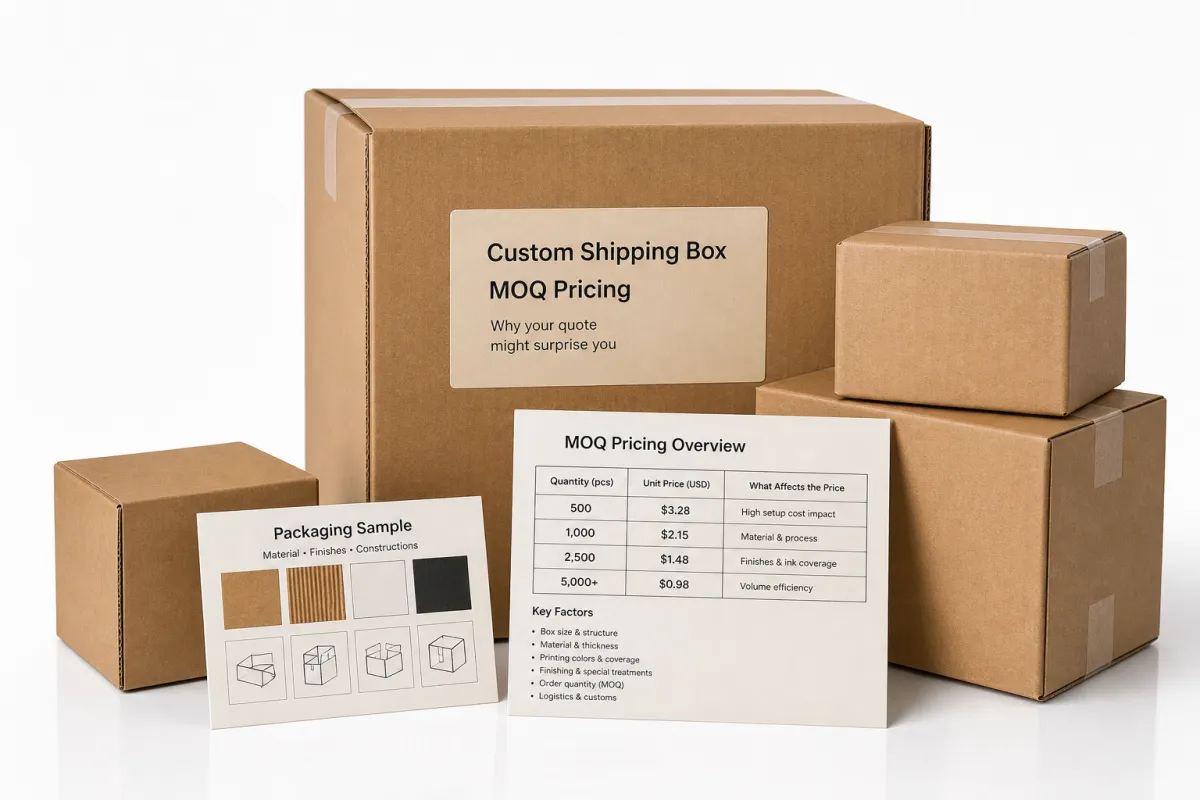
Take two buyers ordering for the same product. One needs 250 boxes. The other wants 5,000. The smaller run almost always carries a much higher unit price, and that is not a bait-and-switch. Fixed costs have to be recovered somewhere, and custom shipping box MOQ pricing has to cover design review, tooling, sample handling, and machine setup whether the order is tiny or large.
What surprises people is that the cheaper unit price can still be the more expensive decision. If a buyer chooses a larger box because it is 3 cents cheaper per piece, freight can climb, corrugate consumption can rise, and product damage can increase. Once return shipping, replacement units, and customer service time enter the picture, the "cheap" carton gets expensive fast. Honestly, that part is kinda predictable once you start tracking landed cost instead of quoting in isolation.
Dimensions matter more than many teams expect. A tiny shift in length or depth changes how blanks nest on a sheet, how many cartons fit on a pallet, and how much void space moves through the parcel network. Those changes affect custom shipping box MOQ pricing in ways that are easy to miss during early sourcing. A quarter inch sounds minor. On a production run, it can move material yield enough to show up in the quote.
The right box is not a "close enough" solution. It is a carton built from the proper corrugate, sized for safe transit, and designed to move efficiently through the warehouse. Buyers who think that way usually get better results from custom shipping box MOQ pricing because the quote reflects the work the box actually has to do, not just the shape on the drawing.
For teams that care about transit testing or fiber sourcing, ISTA test methods are useful when distribution abuse is part of the equation, and FSC certification matters when responsible sourcing is part of the purchasing standard. See ISTA for test guidance and FSC for certification basics. I would not treat either one as a marketing badge first; they are better used as decision tools.
Product details that shape custom shipping box performance
Most Custom Shipping Boxes start with a few familiar structures. The workhorse is the regular slotted carton, or RSC. It is efficient to manufacture, easy to fold, and a strong fit for a wide range of ecommerce shipping and industrial packaging jobs. Mailer-style boxes look more presentation-driven and often suit subscription programs or branded unboxing. Telescoping formats help when height varies or when the product needs extra coverage. Heavy-duty builds, including double-wall corrugated options, make more sense when stacking strength matters more than decoration.
Board structure has a direct effect on custom shipping box MOQ pricing and on how the carton performs in the field. Corrugate type, flute profile, and liner grade all matter. E-flute gives a cleaner print surface and a slimmer profile. B-flute balances cushioning and printability. C-flute is thicker and often better for shipping strength. Double-wall constructions can improve ECT performance and resist crush under heavier loads, but they also increase material cost and converting time. That is why asking for the heaviest board by default is usually the wrong move.
Print and finishing choices matter just as much. One-color flexographic print often keeps custom shipping box MOQ pricing lower than multicolor print or specialty coatings. Interior print, heavy ink coverage, and premium treatments such as soft-touch or aqueous finishes can strengthen package branding, but they add steps and cost. For some custom printed boxes, the outside needs only a logo and a handling mark. That is enough. Not every carton needs to behave like retail packaging.
The practical rule is simple: choose the least complex structure that safely carries the load. For replacement parts, subscription shipments, or standard ecommerce shipping, a clean RSC with disciplined print choices usually beats an overbuilt carton. If the project also needs inserts or alternate pack formats, it can help to review the broader Custom Packaging Products range before locking the spec.
Some items are better judged against a different format entirely. If the product is small and non-fragile, a buyer might compare a carton with Custom Poly Mailers to lower freight exposure. That comparison can change the custom shipping box MOQ pricing discussion very quickly, and sometimes the mailer is the cleaner answer.
Specifications to lock before you request a quote
The quickest route to a useful quote is a precise spec, not a rough description. Internal dimensions are the starting point, but they are not enough by themselves. Buyers should also state product weight, clearance for inserts or cushioning, and any dimensional tolerance that affects fit. If the product uses a sleeve, divider, or molded insert, include that in the build request. A quote built from incomplete dimensions usually misses something important, and then everyone spends time reworking a box that should have been right the first time.
Performance specs deserve the same attention. ECT, burst strength, stacking needs, compression targets, and expected distribution conditions all influence custom shipping box MOQ pricing. A 32 ECT single-wall box may be fine for a light ecommerce item, while a heavier load may need 44 ECT or a double-wall structure. If the cartons will sit in a warehouse for weeks, stack performance matters more than if they move straight from packing to parcel pickup. That detail gets ignored more often than it should.
Artwork details create another common source of surprises. Print coverage, number of colors, bleed, and whether the artwork changes by size all affect prepress and setup. Even a simple one-color logo can require a different plate or die if the size changes. That is why custom shipping box MOQ pricing often shifts when a buyer says, "We just need the same design on three sizes." Same artwork does not always mean same cost, and that distinction matters if you are comparing vendors.
Logistics details matter as well. Include the packing method, pallet pattern, warehouse handling limits, and destination type. A box going to a single distribution center is not the same as a carton moving through multi-node fulfillment. The quote should reflect whether the shipment is domestic, cross-border, or tied to a time-sensitive launch. If the order has to fit a specific pallet height or truck space, say so early. That single note can save money and prevent a lot of waste.
- Internal dimensions: length, width, height, and any fit tolerance.
- Product weight: finished packed weight, not just the item alone.
- Board target: single-wall, double-wall, ECT, or burst requirement.
- Print spec: one color, multiple colors, inside print, or full coverage.
- Fulfillment details: pack method, pallet count, destination, and lead time.
For teams that want less back-and-forth, a short spec sheet usually works better than a long email chain. It also makes custom shipping box MOQ pricing more accurate on the first round, which saves time on both sides.
What affects custom shipping box MOQ pricing the most?
Custom shipping box MOQ pricing comes from a small group of cost buckets, and none of them stay mysterious once you separate the quote. Substrate comes first: more board means higher material cost. Then come die cutting or tooling, printing, converting labor, packing, and freight. If the box needs a custom dieline or a specialized print method, setup becomes a larger share of the total. That is why small runs usually look expensive relative to large runs. The fixed costs are the same; the spread is not.
MOQ thresholds work in a very practical way. A 250-piece run often carries a heavier setup burden per unit than a 2,500-piece run. Once volume rises, the factory can improve sheet yield, reduce machine stops, and buy materials more efficiently. That is where custom shipping box MOQ pricing starts moving in the buyer's favor. There is no mystery in it. It is simply better absorption of fixed cost and better use of board.
Quote structures vary. Some vendors give flat run pricing. Others tier by quantity. Some reprice if the artwork changes or if the box dimensions shift even slightly. You will also see custom shipping box MOQ pricing move when the order is split into multiple drops, when carton size changes pallet count, or when the buyer wants rush production. The more variables in play, the harder it is to hold a sharp rate.
Hidden costs are where many projects drift. Tooling revisions can add expense if the dieline is wrong. Proof rework can slow the schedule and increase prepress time. Split shipments often raise freight. Rework after proof approval is one of the easiest cost drains to avoid because the project already moved through review, then changed direction. In packaging design, late changes are expensive changes. I have seen a simple size correction add more to the final bill than a better board choice would have saved.
| Option | Typical MOQ | Typical unit range | Best fit |
|---|---|---|---|
| Simple RSC, one-color print | 250-500 units | $0.45-$1.10 | Basic ecommerce shipping, replacement parts, low-complexity fulfillment |
| Mailer-style custom printed boxes | 500-1,000 units | $0.70-$1.80 | Subscription boxes, branded packaging, presentation-heavy shipments |
| Heavy-duty double-wall carton | 250-1,000 units | $1.20-$3.50 | Bulkier goods, higher stack loads, industrial product packaging |
| Multi-color, specialty finish, or custom insert system | 1,000+ units | $1.50-$4.50+ | Higher-touch branded packaging, premium launches, complex pack-outs |
Those ranges are not promises; they are working ranges that depend on size, board grade, print coverage, and freight. Even so, the pattern is clear. Custom shipping box MOQ pricing rewards cleaner specifications and higher volume, and it punishes vague briefs and overbuilt structures.
Another way to frame it: board cost may be the visible part, but the real quote is the sum of a dozen small decisions. If the spec includes unnecessary print coverage or a box larger than the product needs, custom shipping box MOQ pricing climbs quickly. If the spec stays lean, the quote usually improves without sacrificing performance.
The best savings are often boring. A tighter dimension, a standard flute, and a simpler print build usually beat a dramatic redesign.
For businesses that buy packaging on repeat, the price is not just a number on a one-time order. It is a system. Custom shipping box MOQ pricing should be evaluated alongside repeatability, reorder consistency, and how much labor the carton adds to the line.
Process and timeline from specs to shipment
A clean quoting process usually starts with intake and spec review. The packaging team checks dimensions, board type, print requirements, and usage conditions, then builds a cost model. If the brief is complete, the quote can move quickly. If it is not, questions follow. Those questions are not delay for delay's sake; they are how the supplier keeps custom shipping box MOQ pricing accurate before anyone commits to tooling or material.
After the first quote comes proofing. A digital proof may be enough for some projects. Others need a sample or a short fit check, especially if the product has tight tolerances or fragile edges. This step matters because it catches misread dimensions, print placement issues, and closure problems before production starts. A sample can feel like an extra step, but it usually protects both sides from avoidable waste.
Once the proof is approved, production begins. Timelines vary with complexity, but many custom shipping box orders run in the 12-15 business day range from proof approval when materials are available and the spec is straightforward. Larger or more complex runs can take longer, especially when board sourcing, color matching, or special coatings are involved. Rush orders are possible in some cases, though custom shipping box MOQ pricing often reflects the added schedule pressure.
Logistics follow production. Buyers Should Know how the boxes are packed, whether they ship flat, and how many cartons fit on a pallet. That detail matters because freight charges are shaped by pallet count and density. In practical terms, the shipping box is part of the logistics system, not a separate item. The carton has to work with receiving, storage, and order fulfillment as one flow.
Clear communication shortens the schedule more than almost anything else. If artwork files are final, dimensions are confirmed, and the destination is known, the project moves faster. If the team is still deciding between two structures, the quote may need a second pass. That is normal. It is also why custom shipping box MOQ pricing should be treated as a process outcome, not a sticker price.
- Intake: product details, quantity, destination, and timeline.
- Review: board grade, print method, and fit requirements.
- Proof: digital review or sample check for accuracy.
- Production: converting, printing, cutting, and packing.
- Dispatch: palletization, freight booking, and shipment.
For companies planning repeat buys, the first order is really the learning order. The second order should be easier, and the quote should become more stable if the spec stays consistent. That is one reason custom shipping box MOQ pricing often improves over time for buyers who keep the structure unchanged.
Formal packaging guidance can help when the shipment is more demanding. The EPA recycling guidance can help teams think about material recovery and fiber use, while ISTA testing stays the better yardstick for transit abuse. Not every carton needs a test protocol, but the logic behind one is useful: boxes should be judged by how they perform in the channel, not by how they look on a CAD file.
Why choose us for custom shipping box orders
Most buyers do not want a dramatic sales pitch. They want a quote that makes sense and a supplier who can explain the math. Transparent custom shipping box MOQ pricing does exactly that: it shows where the money goes, explains what changes the number, and avoids vague language that leaves room for surprises later. That matters whether the order is for product packaging, ecommerce shipping, or a launch tied to branded packaging.
Packaging buyers also need someone who can say plainly when a spec is too heavy. A box does not earn points for being overbuilt. If a simpler board grade will protect the item and still survive the distribution environment, that is the smarter choice. The same logic applies to print. One-color branding may be enough. Full-coverage artwork may be justified for retail packaging or a premium unboxing moment, but it should be chosen because it serves the brand, not because it sounds more impressive.
Consistency is another reason to work with a focused packaging partner. Once a carton is approved, reorders should match the original dimensions, print placement, and performance. That kind of repeatability saves time and reduces receiving issues. It also keeps custom shipping box MOQ pricing more predictable on future runs, which matters for buyers managing inventory and cash flow.
There is a difference between selling a box and solving a shipping problem. The useful partner looks at the whole path: how the carton is packed, how it stacks, how it ships, and how it arrives. That is the same mindset behind the best custom printed boxes. Presentation matters, but protection and freight efficiency still decide whether the project works.
If the project goes beyond one carton style, our Custom Shipping Boxes category is a useful place to compare structures and see how different specs affect the quote. If you need help with order basics, our FAQ page covers common questions without the sales fluff.
In practical terms, the value is in reducing avoidable cost. Buyers often overpay because they over-specify. Others under-specify and pay later in damages. A good quoting conversation should prevent both. That is where custom shipping box MOQ pricing becomes more than a minimum order question; it becomes a decision tool for the full packaging program.
Next steps to get an accurate quote fast
If you want a fast and accurate response, send the facts first. The strongest quote requests include internal dimensions, target quantity, product weight, shipping destination, artwork files, and the delivery deadline. Add whether the cartons must support stacking, pass a drop test, or fit a specific pallet pattern. Those details help the quoting team build custom shipping box MOQ pricing around real conditions rather than assumptions.
I also recommend asking for at least two pricing scenarios. One can show the minimum quantity you are considering, and another can show a volume step-up. That comparison often reveals whether the real savings come from higher quantity, a simpler board grade, or a cleaner print spec. In other words, custom shipping box MOQ pricing is easier to judge when you can see the tradeoff, not just the final number.
If the box will protect fragile, premium, or high-value products, request a sample or at least a spec check before ordering. That extra step is cheap compared with reprinting or replacing damaged units. It is especially valuable for custom printed boxes with tight artwork placement or inserts that must line up precisely. The sample confirms that the product, the carton, and the packaging design all work together.
One rule matters more than most others: compare landed cost, not just unit price. Landed cost includes freight, waste, storage, damage risk, and the labor added to order fulfillment. A box that looks inexpensive on paper can become expensive once those factors are counted. The best custom shipping box MOQ pricing supports the right volume, the right timeline, and the right freight profile.
If you are still deciding between carton formats, reviewing the broader range of Custom Packaging Products can help you compare the role of shipping boxes against other pack options in the same program. That wider view often prevents unnecessary spend and leads to better package branding choices.
Custom shipping box MOQ pricing is not just a quote; it is a snapshot of how well the spec fits the product, the production method, and the shipping channel. Get those inputs right, and the pricing becomes far more predictable.
The most useful takeaway is simple: lock the dimensions, choose the lightest structure that still protects the product, and compare suppliers on landed cost instead of unit price alone. If you do that, custom shipping box MOQ pricing stops feeling mysterious and starts acting like a planning tool.
What is a typical MOQ for custom shipping box pricing?
MOQ often starts lower for simple unprinted runs and rises when custom print, special board grades, or unique dielines are involved. Ask whether the MOQ is based on one size, one artwork version, or one production run, because those can change the minimum. Some vendors can quote a smaller pilot run, but the unit price will usually climb because setup cost gets spread over fewer cartons.
How does custom shipping box MOQ pricing change with box size?
Larger boxes use more board, take more space on a pallet, and usually cost more per unit even when the quantity stays the same. A small reduction in dimensions can sometimes save more than a change in print method because it improves material yield and freight density. If the product has any room to shrink the footprint safely, that is one of the fastest ways to improve the number.
Can I reduce MOQ without sacrificing quality?
Yes, if you simplify the build, reduce print coverage, or choose a standard board structure that is easier to convert. The tradeoff is usually Price Per Unit, not performance, so the key is to remove unnecessary features rather than weaken the box. In plain terms: trim the extras first, not the protection.
What details do you need for an accurate shipping box quote?
Send internal dimensions, product weight, quantity needed, print requirements, destination ZIP or country, and any stacking or drop-test needs. If the box has inserts, artwork, or a tight fit, include the product drawing or sample so the quote reflects the true spec. A good photo helps too, especially if the current pack has a weird closure or an unusual product shape.
How long does a custom shipping box order usually take?
Timing depends on proof approval, sample requirements, material availability, and run size, so quotes should include both production and transit windows. Fast approvals and clear specs shorten the schedule more than almost anything else, especially on repeat orders. If you are working against a launch date, say so upfront rather than hoping the schedule will work itself out.

