Buyer Fit Snapshot
| Best fit | Eco-friendly Candy Packaging Boxes Bulk projects where brand print, material claims, artwork control, MOQ, and repeat-order consistency need to be specified before quoting. |
|---|---|
| Quote inputs | Share finished size, material target, print colors, finish, packing count, annual reorder estimate, ship-to region, and any compliance wording. |
| Proofing check | Approve dieline scale, logo placement, barcode or warning zones, color tolerance, closure strength, and carton packing before bulk production. |
| Main risk | Vague material claims, crowded artwork, missing packing details, or unclear freight terms can make a low unit price expensive after revisions. |
Fast answer: Eco-friendly Candy Packaging Boxes Bulk: Board, Finish, Dieline, and Unit Cost should be specified like a repeatable production item. The safest quote records material, print method, finish, artwork proof, packing count, and reorder notes in one written spec.
Production checks before approval
Compare the actual filled-product size with the drawing, then confirm tolerance on folds, seals, hang holes, label areas, and retail display edges. Reserve space for logos, QR codes, warning copy, and material claims before decorative graphics fill the panel.
Quote comparison points
Review material grade, print process, finish, sampling route, tooling charges, carton quantity, and freight assumptions side by side. A quote is only useful when the supplier can repeat the same color, closure quality, and packing count on the next order.
A candy box can look polished on shelf and still create avoidable waste if the board, coating, and window are pulling in different directions; eco-friendly Candy Packaging Boxes bulk solve that problem by keeping the package practical, presentable, and easier to recover after use in many curbside systems, depending on local recycling rules. From a packaging buyer's point of view, that matters because candy is rarely sold as a one-off item. It usually moves in seasonal assortments, retail programs, gift packs, or private label lines that need repeatability, decent print quality, and a unit cost that stays inside the budget.
Most buyers are not chasing a box that merely signals sustainability. They want product packaging that protects delicate sweets, stacks well in shipping cartons, presents the brand clearly, and still supports a responsible material story. That is where eco-friendly candy packaging boxes bulk become useful: they spread setup costs across more units, standardize the packaging design, and avoid the waste that comes from overbuilt structures or mixed-material finishes that make recycling harder than it should be.
If you are sourcing custom printed boxes for a candy line, the trade-off is usually simple: keep the structure strong, keep the print clear, and keep the material mix under control. The rest of this page walks through the decisions that matter most, from board selection and coating choices to price drivers, timelines, and what a serious supplier should explain without hand-waving. If you also need a broader view of options, the Custom Packaging Products catalog and Wholesale Programs pages are useful starting points for comparing formats and order sizes.
Why Eco-Friendly Candy Packaging Boxes Bulk Make Sense
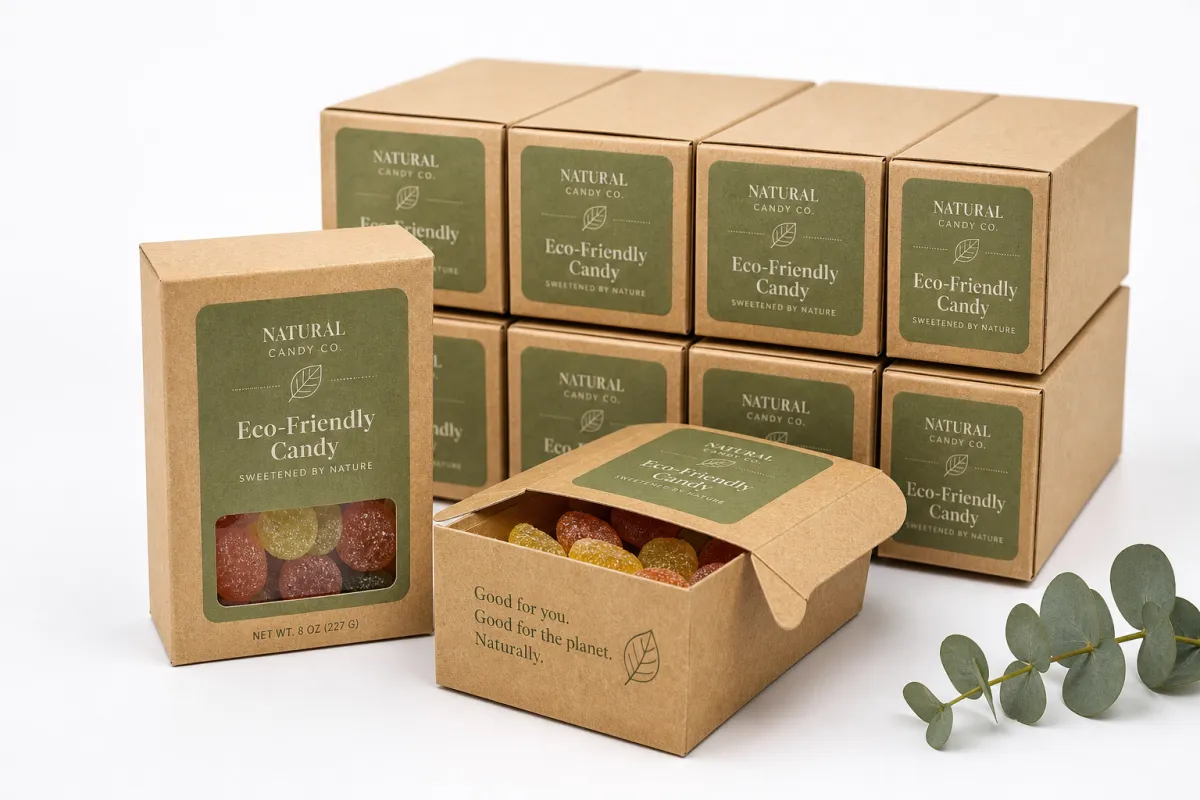
Eco-friendly candy packaging boxes bulk make sense for one straightforward reason: candy is a product where the package has to pull double duty. It needs to look like retail packaging on the shelf, but it also has to protect fragile contents during packing, transit, and store handling. A glossy box with plastic film, metallic foil, and a heavy coating can look premium, yet it may create the exact material mix that slows down recycling. Eco-friendly candy packaging boxes bulk reduce that mismatch by using simpler structures that still hold up in the real world.
Bulk purchasing matters because candy brands often work on seasonal assortments, recurring gift programs, or private label launches where consistency is more valuable than novelty. A 5,000-piece run of eco-friendly candy packaging boxes bulk can support a holiday line, a corporate gift box, or a retail reset without forcing the buyer to reorder every time the assortment changes by a few flavors. The benefit is not only lower unit cost. It is also better planning, fewer design resets, and less risk that a second production run will come back with a slightly different feel or print tone.
Too many buyers focus on surface appearance and forget what the box has to do in shipping. If the candy is moving through master cartons, then the package needs enough rigidity to resist crushing, enough surface treatment to avoid scuffing, and enough print contrast to stay legible under store lighting. Eco-friendly candy packaging boxes bulk work best when they balance those practical needs instead of chasing decoration for its own sake. A box that saves material but collapses in transit is not efficient, and it is not really eco-friendly either.
A box that looks green but ships poorly is not eco-friendly in any business sense. If it crushes candy, scuffs in transit, or needs extra rework on the line, the hidden waste shows up fast.
There is also a production advantage. Once a structure is approved, eco-friendly candy packaging boxes bulk can be repeated with fewer surprises, which helps with fill lines, hand assembly, and carton packing. That consistency supports branded packaging and package branding because the same panel dimensions, the same closure style, and the same print registration keep the whole program looking intentional. For a buyer managing multiple SKUs, that kind of discipline matters more than flashy effects that complicate production.
One more point that gets missed more often than it should: sustainability and performance are not rivals. Good eco-friendly candy packaging boxes bulk do both jobs. They help a brand cut waste, they protect sweets in transit, and they keep the product retail-ready without making the order harder to manage. That is the standard worth aiming for, and it is the standard I would ask any supplier to explain in plain terms before I signed off on a run.
Eco-Friendly Candy Packaging Boxes Bulk: Materials and Print Choices
The material choice sets the tone for the whole job. For eco-friendly candy packaging boxes bulk, the most common starting points are kraft paperboard, recycled paperboard, and SBS when a smoother print face is needed. Kraft has a natural, grounded look that fits artisan sweets, truffles, and farm-style confectionery. Recycled paperboard can lower the environmental footprint while still giving good stiffness for folding cartons. SBS, or solid bleached sulfate, is often chosen when a brand needs a brighter print surface for detailed graphics and cleaner color reproduction. The right call depends on candy weight, shelf style, and how the box will be handled in distribution.
Paper grade matters more than many buyers expect. A light truffle assortment in a slim carton does not need the same caliper as a heavier assortment with molded inserts. For eco-friendly candy packaging boxes bulk, I usually look for a board spec that matches the load instead of overbuilding. A 14pt to 18pt paperboard may be fine for a lightweight gift box, while a heavier retail carton may need something closer to 20pt or a rigid two-piece structure. That is not guesswork. It is basic packaging engineering, and it saves money when the right board is selected early.
Surface finish comes next. Aqueous coating is often the sweet spot because it offers scuff resistance, a clean touch, and a water-based finish that fits the environmental story better than heavy film lamination. Matte or gloss water-based varnish can also work well, especially on eco-friendly candy packaging boxes bulk where the goal is to keep the carton more recyclable while still giving the design enough polish to sell. Low-coverage print layouts are another practical move; fewer ink-heavy areas usually mean less material complexity and, in many cases, a cleaner recycling path.
Window design deserves careful handling. A clear panel can help sell the candy because buyers want to see color, shape, or filling style before they purchase. Still, a conventional plastic film window can complicate recycling if the rest of the carton is paper-based. For that reason, I like to see cellulose-based windows considered first when visibility is needed. They are not always the cheapest option, and they are not always the right fit for every production line, but they often make more sense than a mixed-material window on eco-friendly candy packaging boxes bulk.
Decoration choices should support the box, not fight it. Soy-based or low-VOC inks are a strong fit for eco-friendly candy packaging boxes bulk, especially when the print coverage is moderate and the design leans on color blocking, typography, or simple illustrations. Metallic effects can still be used, but I would keep them targeted rather than flooding the entire surface. Spot UV, foil, and heavy embossing can all add value, yet each one also adds cost, complexity, or a recycling compromise. That is fine if the premium is justified. It is not fine if the effect exists only because the design team liked the sample board.
For buyers who want a practical reference, the paper side of the sustainability discussion is well covered by the EPA's recycling guidance at epa.gov, and FSC certification remains a useful signal when you want traceable fiber sourcing. If a supplier says the board is FSC-certified, ask whether that claim applies to the material itself or the chain of custody. Those details matter. You can review FSC basics at fsc.org.
In the end, the best material is not the fanciest one. It is the one that gives eco-friendly candy packaging boxes bulk enough stiffness, print clarity, and finishing control to work as real retail packaging while staying honest about recyclability. If you choose the board first, then the coating, then the window, the order usually lands in a much better place than if you start with decoration and try to make the structure catch up later. That approach also keeps packaging design decisions grounded in production reality.
Build the Right Box Structure for Candy
The structure is where a candy box earns its keep. For eco-friendly candy packaging boxes bulk, the most useful formats are usually straight tuck end, reverse tuck end, auto-lock bottom, sleeve and tray sets, and display cartons that can move from shipping case to shelf with minimal fuss. Straight tuck and reverse tuck work well for lighter items and standard folding carton lines. Auto-lock bottoms are better when the contents have weight or when speed on the packing line matters. Sleeve and tray sets are a strong fit for gift assortments because they give the box a more deliberate presentation while keeping the product protected.
Candy format changes the structure every time. Chocolate truffles need support so they do not roll or compress. Hard candies can tolerate a simpler carton but still need room control so the product does not rattle. Gummies may be sensitive to heat and surface transfer, which means the inner wrap or insert matters as much as the outer box. Seasonal assortments often combine several candy types in one pack, and that is where eco-friendly candy packaging boxes bulk can get tricky if the internal layout is not planned well. The box might look fine on a flat proof, then fail once the contents start shifting inside it.
That is why inserts and partitions are worth the conversation. Paperboard dividers can separate pieces without introducing plastic trays. Fitted cartons help stop movement and reduce breakage. Grease-resistant wraps may be useful for coated candy or anything that could mark the inside of the carton. When a buyer chooses the right structure, the benefits show up in faster packing, better stacking, and fewer damaged units in the master carton. For eco-friendly candy packaging boxes bulk, those savings often matter more than a small difference in printing price.
Fit testing should not be skipped. A box that is 2 mm too loose can let candy shift during transit. A box that is too tight can crush the contents or make the pack-out line slower than it should be. I have seen orders where the artwork was approved first and the structure was treated like a formality. That is backwards. The dimensions come first, then the insert, then the visual layout. Otherwise, the whole job starts with a compromise that never really gets fixed. Strong eco-friendly candy packaging boxes bulk are built around the product, not around a pretty rendering.
Shipping method also plays a role. If the boxes are going into e-commerce fulfillment, the structure may need more compression resistance than a retail-only carton. If the boxes are distributed by pallet and displayed in-store, then the front panel and stackability become more important. For many brands, the ideal answer is a carton that can do both. That is not impossible, but it does require planning. Good product packaging is not just the outer shell. It is the interaction between board, insert, closure, and final carton loading pattern.
From an operations point of view, the right structure helps control labor. Fewer loose pieces on the line means fewer chances for mispacking. Better flap design means easier folding. More stable cartons mean better master-carton stacking. Those improvements sound small, yet on a bulk order they can reduce downtime and damage enough to justify a better spec. That is one reason experienced buyers keep coming back to eco-friendly candy packaging boxes bulk instead of chasing a different novelty format every season. The box has to work, not just impress for five seconds in a mockup.
Pricing, MOQ, and What Changes the Unit Cost
Price is where the conversation becomes very real. For eco-friendly candy packaging boxes bulk, the unit cost is shaped by board type, box dimensions, print coverage, number of colors, coating, inserts, and structural complexity. A simple kraft folding carton with one or two colors is a very different job from a premium sleeve-and-tray gift box with a window, insert, and specialty finish. If you want a fair quote, you need a full spec sheet. Otherwise, one supplier may price a plain board while another prices a finished retail pack, and the comparison becomes meaningless.
MOQ is usually tied to setup efficiency and material use. Press setup, die cutting, finishing, and make-ready waste all cost money, so smaller runs tend to carry a higher unit price. Larger bulk orders spread those fixed costs across more cartons, which is exactly why eco-friendly candy packaging boxes bulk are attractive to brands with recurring programs. In many custom packaging jobs, a minimum order can start around 1,000 to 3,000 units for a straightforward folding carton, but more intricate structures often push the minimum higher. That is not a trick. It is just how production math works.
It helps to compare pricing against the same variables. Ask whether the quote includes dielines, proofing, setup, and freight. Confirm whether the supplier is quoting the box only or the box with inserts and assembly. Check whether repeat orders can reuse the same tooling. If the answer is yes, that can hold your future costs down. If the answer is no, you may be looking at extra setup fees every time. For eco-friendly candy packaging boxes bulk, this is where disciplined buying really pays off.
| Box Style | Best Use | Typical MOQ Pressure | Indicative Unit Cost at 5,000 |
|---|---|---|---|
| Kraft folding carton, one-color print, aqueous coat | Simple candy bars, small assortments, promotional packs | Low to moderate | $0.18-$0.28 |
| Recycled paperboard carton, four-color print, matte varnish | Retail candy boxes with stronger shelf appeal | Moderate | $0.24-$0.38 |
| SBS carton with cellulose window and paper insert | Premium gift packs and clear-sell assortments | Moderate to high | $0.32-$0.58 |
| Sleeve and tray set with specialty finish | Seasonal confectionery and higher-end branded packaging | High | $0.40-$0.75 |
Those numbers are only directional, because the real quote depends on artwork coverage, board caliper, shipping destination, and how much manual assembly is involved. Still, they give you a practical frame for eco-friendly candy packaging boxes bulk. If one quote looks much lower than the rest, check the spec line by line before celebrating. A cheaper quote can mean lower board quality, fewer finishes, a different print method, or freight that was quietly left out.
One more buyer habit saves money: request price breaks at several quantities. The jump from 3,000 to 5,000 units may be modest, while the jump from 5,000 to 10,000 can reduce the per-unit cost enough to justify the extra stock if your sales cycle can absorb it. That is especially useful for eco-friendly candy packaging boxes bulk tied to holiday programs or recurring retail resets. If the same artwork can be used across multiple SKUs, even better. The artwork standardization improves package branding and keeps procurement simpler.
My practical advice is simple: compare the same board, the same finish, the same quantity, and the same delivery terms. Only then do the economics of eco-friendly candy packaging boxes bulk become clear. A well-priced box is not the lowest number on the page. It is the one that arrives on spec, runs cleanly in production, and holds its retail value without adding hidden costs later. That is the difference between cheap and efficient.
From Proof to Delivery: Typical Process and Timeline
The best orders move through a clear process. For eco-friendly candy packaging boxes bulk, that usually starts with a project brief that covers dimensions, candy weight, units per pack, target quantity, finish preference, and shipping method. Once that is defined, the supplier can prepare a quote and suggest a dieline. After that comes artwork placement, proof review, and then sample or prototype approval if the project needs one. The final steps are production, quality check, packing, and freight booking. It sounds simple, but each step protects the next one.
Delays usually come from incomplete information. If the box size is still changing, every artwork proof becomes temporary. If the finish has not been confirmed, the production schedule can stall while the supplier checks compatibility. If a physical sample is requested late, that adds time before the full run can begin. For eco-friendly candy packaging boxes bulk, the biggest time savings come from making sizing decisions early and giving the printer enough room to manage the file cleanly. A slow approval cycle can add more cost than a slightly better material choice ever would.
A realistic timeline after artwork approval is often 12 to 20 business days for a standard folding carton order, with more complex structures taking longer. Sampling can add a few extra days, and freight time depends on the route and service level. If the candy is tied to a holiday launch or retail reset, build buffer time into the calendar. I would never plan a seasonal drop with no spare days in the schedule. That is how teams end up paying for rush freight or accepting compromises they did not want. Eco-friendly candy packaging boxes bulk reward orderly planning, not last-minute scrambling.
There is also a quality angle. Good suppliers should be checking registration, cut accuracy, fold performance, and coating consistency before shipment. For transit-sensitive orders, it is worth asking whether the packaging has been tested or at least evaluated against common shipping expectations such as ISTA-style vibration and drop concerns. That does not mean every candy carton needs a formal lab program. It does mean the box should be designed with shipping behavior in mind, not just shelf appearance. That is a big part of why eco-friendly candy packaging boxes bulk are best handled by packaging teams that understand both print and logistics.
A clear approval process saves money because it reduces rework. Every extra revision consumes time, and every postponed decision can push a bulk order into the next production slot. Once the structure, print layout, and finish are approved, keep the process moving. If your supplier has a strong proofing workflow, that should be visible in how they mark revisions, confirm dimensions, and flag any artwork that could create problems on press. Good communication is part of the product, especially for eco-friendly candy packaging boxes bulk where repeatability is the entire point.
What to Look for in a Packaging Partner
Not every supplier who says "sustainable" can back it up with usable detail. A strong partner for eco-friendly candy packaging boxes bulk should be able to explain board grades, print methods, coating choices, and the way each decision affects recyclability and protection. If the answer is just broad marketing language, keep asking until the specifics show up. You want a partner who can talk about caliper, finish, fold strength, and print registration in plain terms. That is the kind of conversation that reveals real capability.
Communication matters just as much as materials. Candy packaging often requires precise fit, and a dimension change of even a few millimeters can affect how the candy sits in the box, how the insert locks, and how the panel art aligns. For eco-friendly candy packaging boxes bulk, the supplier should be responsive on dielines, sample comments, and proof revisions. If that process feels sloppy early on, it usually gets worse later. I have seen good materials get undermined by bad coordination more than once, and it almost always starts with poor proof discipline.
Food-oriented handling is another point to check. Even if the box is for indirect food contact, the supplier should understand clean production practices, material sourcing transparency, and any relevant requirements around inks, coatings, and liners. Ask what is appropriate for direct or indirect food use, and ask how the factory handles traceability. If the supplier cannot give a clear answer, that is a warning sign. Strong eco-friendly candy packaging boxes bulk programs rely on disciplined operations, not just attractive mockups.
It also helps to ask about standards. FSC chain-of-custody documentation is a useful sign when fiber sourcing matters, and shipping-oriented projects should not be afraid of tests or references to common performance expectations such as ASTM D4169 or ISTA methods. Those standards do not solve every problem, but they show that the supplier understands packaging as a technical system. That mindset is valuable. It usually means the partner is thinking about product protection, retail presentation, and line efficiency together instead of treating them as separate departments.
Here is the way I would frame the choice: a good partner helps you build retail packaging that looks intentional, runs cleanly, and supports the brand story without making the order fragile or difficult to reorder. The best eco-friendly candy packaging boxes bulk projects often come from suppliers who can balance appearance and function without turning every request into an upsell. That balance is exactly what you want in branded packaging, because candy buyers can tell the difference between a polished carton and a box that only looked good on a render.
The strongest packaging partners are not the ones who promise the most. They are the ones who ask the right questions about product weight, shelf life, freight method, and reorder plans before they quote the job.
Next Steps for Ordering Eco-Friendly Candy Packaging Boxes Bulk
The fastest way to move forward is to gather the practical details first. For eco-friendly candy packaging boxes bulk, that means box dimensions, candy weight, number of pieces per pack, target quantity, preferred board, finish style, and whether the package needs shelf-display value, e-commerce protection, or both. If you already know the candy's physical dimensions, include them. If the product varies slightly from piece to piece, say so early. That kind of detail prevents a lot of back-and-forth later.
Artwork should be ready enough for a preflight check before production starts. Share logos, brand colors, legal copy, and any recycled-content claims you want on the carton. A supplier should review bleed, panel alignment, barcode placement, and readability before the file goes to print. With eco-friendly candy packaging boxes bulk, these small checks are not cosmetic. They protect the whole order from layout errors, weak contrast, or claims that cannot be supported by the chosen material. That is a big part of responsible packaging design.
If the candy is delicate, glossy, or sold as a premium gift item, ask for a sample kit or prototype. A fit check will show whether the closure is tight enough, whether the insert needs adjustment, and whether the structure survives handling without movement. For eco-friendly candy packaging boxes bulk, this step often saves more money than it costs because it reduces the chance of a reprint. I would rather spend a little time on a sample than explain why a full run has to be scrapped because the candies shifted in the tray.
Use the quote comparison stage to confirm lead time, included services, freight method, and reorder expectations. If one supplier includes structural support, proofing, and shipping guidance while another only prices the printed carton, the lower quote is not really lower. Ask about repeat-tool reuse. Ask about production windows. Ask whether the quote reflects the exact board and finish you want. That level of clarity helps eco-friendly candy packaging boxes bulk move from concept to shipment without avoidable delays. It also makes it easier to compare custom printed boxes across suppliers on equal terms.
For brands that want a broader buying relationship, the Wholesale Programs page can be a useful place to align quantity planning with reorder timing, while the Custom Packaging Products page helps you compare different carton styles and related product packaging options. Those two steps, taken together, usually give buyers a much cleaner path to a production-ready order.
By the time you place the order, you should know exactly how the box is built, how it prints, how it ships, and what the next reorder will look like. That is the practical standard for eco-friendly candy packaging boxes bulk, and it is the standard that keeps both the brand team and the production floor happy. If the spec still feels vague at that point, hold the line and clear it up before the run starts; a little patience here usually beats a pile of avoidable waste later.
What materials are best for eco-friendly candy packaging boxes bulk?
FSC-certified kraft and recycled paperboard are the most common starting points because they balance strength, print quality, and easier recycling in many local systems. For a smoother print face, SBS can work well too, especially for premium eco-friendly candy packaging boxes bulk that need sharp color and cleaner graphics. Aqueous coating or an uncoated finish usually keeps the package simpler to recycle, although local recovery rules can vary.
What is a typical MOQ for eco-friendly candy packaging boxes bulk orders?
MOQ depends on the size, print coverage, structure, and finishing, but many custom runs begin around 1,000 to 3,000 units. Simpler folding cartons can sometimes sit at the lower end of that range, while specialty structures and inserts often require more. For eco-friendly candy packaging boxes bulk, the more complex the build, the higher the minimum usually goes. That is just the production setup speaking, not a sales tactic.
Can eco-friendly candy packaging boxes bulk protect fragile sweets?
Yes, if the board caliper, closure style, and insert design are matched to the candy weight and shipping method. A fit sample or prototype is the best way to check movement, compression resistance, and breakage risk before full production. That is especially true for eco-friendly candy packaging boxes bulk that will ship through parcel networks or move across multiple handling points. A box that survives the shelf but fails in transit is not doing its job.
How long does production take for custom candy boxes in bulk?
After artwork approval, production commonly takes 2 to 4 weeks depending on capacity, quantity, and finishing choices. Sampling, revisions, and freight can add time, so holiday launches and large retail resets should be planned early. If you are ordering eco-friendly candy packaging boxes bulk, the safest approach is to lock the spec before the clock starts. Late changes are where schedules go sideways.
How do I compare quotes for eco-friendly candy packaging boxes bulk fairly?
Compare the same box dimensions, board type, print method, coating, and delivered quantity so the pricing is truly equivalent. Ask whether tooling, setup, samples, and shipping are included, because those costs can change the real unit price. If you want a clean apples-to-apples comparison for eco-friendly candy packaging boxes bulk, the quote sheet has to be complete before the price means anything. Otherwise you are comparing two different jobs and pretending they are the same.


