Buyer Fit Snapshot
| Best fit | Eco Friendly Packaging for Soap projects where brand print, material claims, artwork control, MOQ, and repeat-order consistency need to be specified before quoting. |
|---|---|
| Quote inputs | Share finished size, material target, print colors, finish, packing count, annual reorder estimate, ship-to region, and any compliance wording. |
| Proofing check | Approve dieline scale, logo placement, barcode or warning zones, color tolerance, closure strength, and carton packing before bulk production. |
| Main risk | Vague material claims, crowded artwork, missing packing details, or unclear freight terms can make a low unit price expensive after revisions. |
Fast answer: Eco Friendly Packaging for Soap: Retail Fit, Compliance Space, Print, and Cost should be specified like a repeatable production item. The safest quote records material, print method, finish, artwork proof, packing count, and reorder notes in one written spec.
Production checks before approval
Compare the actual filled-product size with the drawing, then confirm tolerance on folds, seals, hang holes, label areas, and retail display edges. Reserve space for logos, QR codes, warning copy, and material claims before decorative graphics fill the panel.
Quote comparison points
Review material grade, print process, finish, sampling route, tooling charges, carton quantity, and freight assumptions side by side. A quote is only useful when the supplier can repeat the same color, closure quality, and packing count on the next order.
Eco Friendly Packaging for Soap: Materials, Costs, Tips
Eco Friendly Packaging for soap sounds straightforward until a cured bar comes off the line with a tiny scuff on one corner, a little ripple from trapped humidity, and a customer-facing sleeve that suddenly looks less “handcrafted” and more like it spent the afternoon in a damp truck. I still remember a contract packing room outside Cleveland, Ohio, where the soap itself was excellent, cured for 28 days on wooden racks, but the wrap started failing after a three-day warehouse hold at 68 to 72 percent relative humidity. That was one of those moments that sticks with you. The package had looked fine on a design board, but once the bar met real air, real handling, and a real freight lane, the weak spots showed up fast.
That is why Eco Friendly Packaging for soap is never just about appearing green. It has to move a bar cleanly from curing rack to shelf to shipping carton without rubbing, sweating, or losing shape along the way. The job is practical first and visual second, and if the package does not protect the soap while keeping waste low, then it is not doing its full job. That is the part a lot of newer brands miss, and honestly, it is the part that separates thoughtful sustainable soap packaging from packaging that only looks thoughtful on the mockup.
In practice, the strongest soap packaging uses less virgin material, matches the bar’s moisture profile, prints cleanly with water-based inks, and protects the soap without turning the format into a tiny engineering drama. When I say eco friendly packaging for soap, I mean something usable: lower waste, a smarter substrate choice, and enough structure to keep the bar crisp, legible, and sellable at a retail price point of $6 to $14. I have reviewed enough board quotes from converters in Shenzhen, Dongguan, Minneapolis, and the Midwest to know that the cheapest sheet on paper is rarely the cheapest package once returns, scuffing, and damaged inventory show up on the ledger. That lesson usually arrives the hard way, and it tends to arrive right when a brand is trying to scale a formula that was supposed to be simple.
That balance matters because soap packaging has three jobs at once: it needs to protect, it needs to sell, and it needs to tell the truth about sustainability. The good news is that eco friendly packaging for soap can do all three if you Choose the Right structure for the bar, the climate, and the channel. The rest of this piece walks through materials, costs, timelines, and the small details I always ask about before I sign off on a production run, including board caliper, adhesive type, and whether the cartons are moving from Guangdong, a domestic plant in Ohio, or somewhere in between. Done well, eco friendly packaging for soap becomes part of the product story instead of an afterthought wrapped around it.
What is the Best Eco Friendly Packaging for Soap?
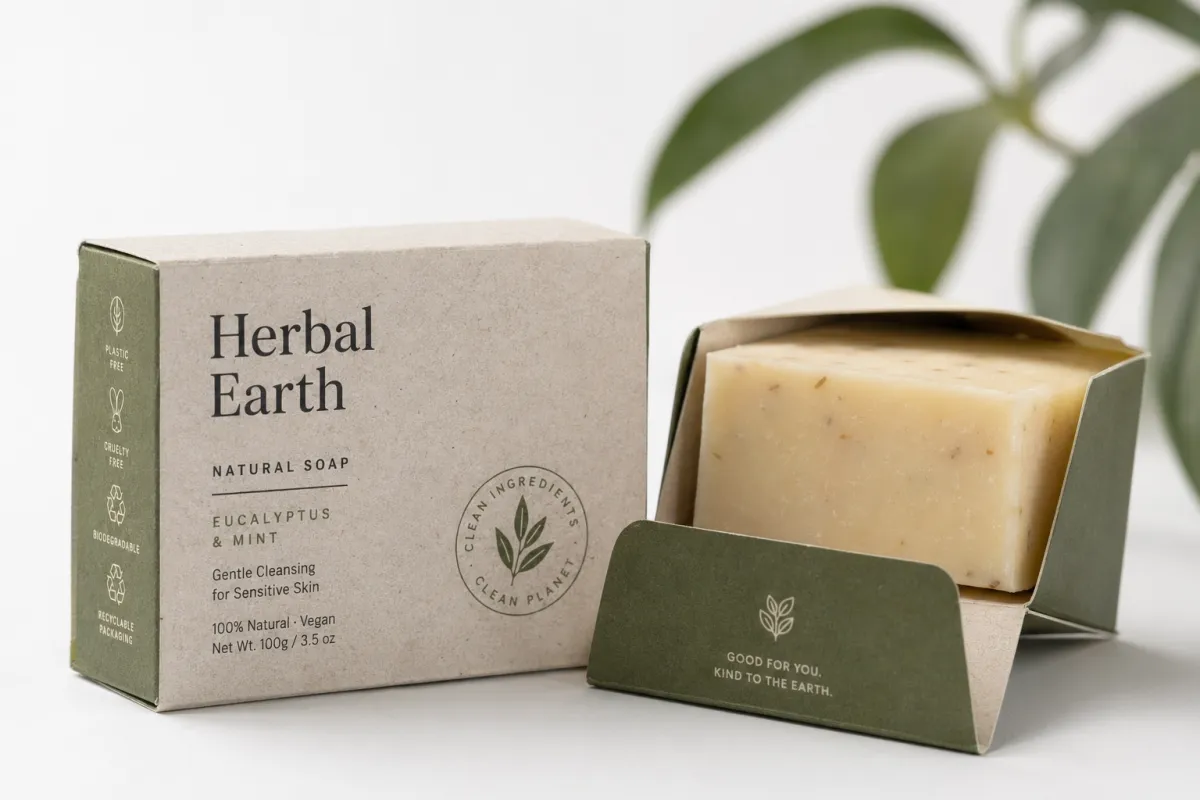
Eco friendly packaging for soap starts with a blunt question I ask on every job: what problem is the pack actually solving, and what is it doing that the soap does not need? A cold-process bar with a 28- to 42-day cure does not need the same protection as a soft glycerin bar with 8 to 12 percent fragrance oil, and that difference can change the structure, the coating, and even the adhesive. On a good job, the package uses just enough material to protect the bar, keep the label readable, and avoid extra layers that never earn their keep.
There is also a large gap between marketing language and material reality. Recyclable, recycled-content, compostable, biodegradable, and plastic-free are not interchangeable, and the smartest eco friendly packaging for soap is the one that matches the actual disposal path in the customer’s hands. A carton made from 100 percent recycled fiber can be a strong option, but if it carries a PET lamination or a full flood UV coat, the recycling story changes quickly. A cellulose film might look low-impact, yet if it depends on industrial composting that most customers in Phoenix, Atlanta, or rural Kansas cannot access, the claim gets thin fast.
The package that works best is not automatically the lightest one or the one with the loudest sustainability claim. It is the package that uses the least material necessary, survives handling, and keeps the product attractive enough that the bar is sold rather than discounted. That is especially true for retail packaging, where a scuffed edge on a $9 bar can erase the benefit of a beautiful print run and leave the brand with dead stock in a warehouse outside Indianapolis. For many brands, the Best Eco Friendly packaging for soap is the one that balances shelf appeal with real-world durability instead of forcing one side to carry all the weight.
I remember a meeting with a small body-care brand that wanted a premium feel without too much packaging. They brought in three bars wrapped in plain kraft bands, and two of them had already picked up faint abrasion marks from a trade-show table in Las Vegas after one afternoon of handling. We switched them to a slightly stiffer sleeve made from 350gsm C1S artboard, reduced the window size by 18 percent, and kept the entire format under 18 grams per bar. The package looked cleaner, the freight count improved by 12 percent, and the customer still got the earthy, low-waste feel they wanted. That is eco friendly packaging for soap in the real world: not idealism, but tradeoffs made carefully, with sustainable soap packaging decisions grounded in fit and finish.
“A soap bar can look gorgeous on day one and still fail if the wrap traps moisture or rubs in transit. The package has to earn its place.”
If you want to compare structures that fit that kind of thinking, take a look at our Custom Packaging Products and see sleeves, cartons, and labels side by side. I often suggest brands begin there before they commit to a custom printed box line, because the format itself drives waste, cost, and shelf performance, especially when the order starts at 5,000 pieces and the freight lane runs from Chicago to Portland. The fastest path to better eco friendly packaging for soap is usually a cleaner structure, not a more complicated one.
For broader context on how packaging choices are judged in the industry, I also like to keep an eye on the material and recycling language used by groups such as packaging.org and the sourcing standards outlined by FSC. Those references do not make a package sustainable by themselves, but they help keep the discussion grounded in actual material systems instead of vague claims, especially when the board is sourced from British Columbia or the adhesive comes from a plant in Wisconsin.
So yes, eco friendly packaging for soap is about sustainability, but it is also about fit, feel, and function. If the bar arrives warped, scuffed, or fragrance-bleed damaged after a 14-day transit cycle, the green claim does not save the sale.
How Eco Friendly Packaging for Soap Works
Eco friendly packaging for soap works best when it handles five practical risks: scuffing, odor transfer, dust, humidity, and over-packaging. Soap may seem dry and simple, but if you have handled thousands of bars, you know the surface can pick up paper fibers, absorb scent from nearby stock, or soften slightly in a warm loading bay at 82 degrees Fahrenheit. In a fulfillment room I visited in Nashville, Tennessee, the soap bars packed closest to the dock door showed the most corner wear because the carton handling path was just 14 feet longer and a little rougher than the rest of the line. Tiny details matter, which is annoying in the moment and very satisfying once you catch them early, especially when the goal is eco friendly packaging for soap that actually survives the warehouse.
The most common structures are paper wraps, kraft sleeves, paperboard cartons, belly bands, molded fiber trays, and paper-based labels. Each one fits a different version of eco friendly packaging for soap. A simple wrap may work for a hard, fully cured bar sold through farmer’s markets in Asheville or Santa Fe. A carton may make more sense for a premium line with a strong scent profile and a retail price above $10. Molded fiber can be excellent for gift sets, especially if the soap is paired with a loofah, balm, or wooden soap dish. The right choice depends on whether the bar is the product, the shelf story, or part of a bundle, and that is why eco friendly packaging for soap is never one-size-fits-all.
Barrier needs change by soap type, and that is where many brands get surprised. A hard milled bar can often live happily inside a paper sleeve with a tight fold and a clean tuck, while a glycerin bar may need a more protective structure because it can attract moisture and sweat under the wrong warehouse conditions. Eco friendly packaging for soap should not pretend all bars behave the same. They do not. Oils, essential oils, humidity, fragrance concentration, and cure time all affect how much protection the package really needs, and a 10 percent difference in cure time can change the fit enough to matter.
Function also comes down to manufacturing behavior. I have watched a beautiful paper wrap fail because the grain direction made the fold crack on the second crease, and I have seen a carton look perfect in art files but scuff at the glue flap because the ink coverage was too heavy. For eco friendly packaging for soap, I care about fold strength, seal integrity, ink adhesion, abrasion resistance, and whether the package survives conveyor handling at 120 packs per minute or a slower hand-pack line at 18 packs per minute. If it cannot survive the actual pack-out rhythm, it is not ready.
There is a sustainability side to performance as well. A design that uses a recyclable board but then adds a thick gloss lamination, a foil stamp, a plastic window, and a magnetic closure stops feeling truly low-impact. Better choices include water-based coatings, low-coverage print, and paper-only constructions that keep the end-of-life story simple. That is one reason eco friendly packaging for soap often looks cleaner and more restrained than luxury skincare packaging from Milan or Los Angeles; the format is doing less, not more.
I usually tell clients to test the package in the same conditions where the soap will live. Put samples in a room at 60 to 70 percent humidity, keep them next to a scented candle box for odor transfer testing, and ship a few in a standard corrugate master carton with kraft void fill. If the package survives that, you have a strong path forward for eco friendly packaging for soap. If it fails there, no amount of brand language will fix it, even if the artwork took 11 rounds of revisions.
Eco Friendly Packaging for Soap: Materials, Costs, and Tradeoffs
Eco friendly packaging for soap gets real the moment you ask for a quote. A simple kraft band might look cheap on the screen, but if it needs a custom die line, a special glue strip, and 10,000 sheets to hit the press minimum, the price picture changes fast. I have sat through those calls with suppliers in Shenzhen and with converters in the Midwest, and the same lesson comes up again and again: the board grade, the print coverage, and the quantity matter just as much as the format. A material that saves two cents per unit can still cost more overall if it forces extra inventory or fails to fit the bar cleanly.
Here is a practical comparison I use when clients are choosing eco friendly packaging for soap. The numbers below are representative for a run of 5,000 units, and I have seen them quoted from facilities in Guangdong, Pennsylvania, and Mexico State depending on the material and the season. For sustainable soap packaging decisions, this is usually the point where the real tradeoffs become visible.
| Material / Format | Best For | Approx. Unit Cost at 5,000 | Main Strength | Main Tradeoff |
|---|---|---|---|---|
| Kraft paper sleeve | Hard cured bars, farmer’s market sales | $0.09-$0.16 | Low material use, simple brand look | Less protection against abrasion and humidity |
| Recycled paperboard carton | Retail packaging, premium handmade bars | $0.18-$0.34 | Stronger shelf presence, better structure | Higher tooling and print complexity |
| FSC-certified board carton | Brands with verifiable sourcing claims | $0.20-$0.38 | Clear documentation, easy brand story | Small premium over standard recycled board |
| Molded fiber tray | Gift sets, layered kits, display packs | $0.24-$0.42 | Excellent fit and presentation | Higher tooling and less print surface |
| Glassine or paper wrap | Minimalist bars, low-waste brands | $0.12-$0.22 | Lightweight and visually clean | Can be weak on friction and odor control |
| Cellulose-based film | Where visibility matters | $0.14-$0.28 | Lets the bar show through | Claim language must be very precise |
| Compostable laminate pouch | Specialty bars or refill packs | $0.22-$0.40 | Barrier performance with a lower-impact story | Needs careful end-of-life verification |
The biggest pricing drivers are easy to name once you have watched a press run from the side of the machine: board thickness, ink coverage, finishing, die complexity, and how many SKUs you ask a supplier to coordinate. Eco friendly packaging for soap gets more expensive when every scent has a different size, a different colorway, and a different insert. If you can standardize the carton width across three fragrances and change only the label panel, the price often drops enough to improve your margin by 3 to 5 points without changing the shelf look.
Minimum order quantity is another place where brands get caught. A 4,000-unit sleeve might quote at $0.14 per piece while a 20,000-unit order drops closer to $0.08, but the larger order ties up cash and takes more storage. I have seen a soap company overbuy 30,000 cartons for a seasonal release and then hold that inventory for nine months because the refill scent changed in September. The unit price looked wonderful on paper. The carrying cost did not. For eco friendly packaging for soap, the best value is usually the smallest order that still gives you a sensible per-unit price and a stable supply plan.
There are real savings to be found without hurting performance. Simplify the artwork from four colors to two. Remove a window if the bar already has strong shelf appeal. Use a standard carton depth rather than a custom one-off that forces a new cutter. Keep the uncoated paper visible, because heavy full-bleed print can push ink use and finishing costs up quickly. If you are buying Custom Packaging Products, ask the supplier to quote a plain structure version alongside the decorated version so you can see where the budget goes. A 350gsm C1S artboard carton with aqueous coating is often enough for many bars, and it can be a cleaner choice than a heavier laminated build.
Honestly, the best buyer mindset is landed cost per sellable bar, not unit cost per package. If a carton costs four cents more but cuts damage, improves brand perception, and lowers returns by even 1 percent, it may be the cheaper choice overall. That is especially true for eco friendly packaging for soap in retail environments, where a damaged face panel on the shelf can kill the sale before a shopper ever picks the bar up.
One more thing: ask for print method details. Water-based inks, soy-based inks, and low-migration systems can all be part of a responsible build, but they are not identical. Ask whether the adhesive is hot-melt or water-based, whether the paper is FSC-certified, and whether any coatings are recyclable under current municipal collection rules in places like Seattle, Toronto, or Amsterdam. Specific answers build trust, and trust is what keeps eco friendly packaging for soap from becoming a vague claim nobody can defend.
Step-by-Step Process and Timeline for Soap Packaging
Eco friendly packaging for soap usually follows a tighter process than brands expect, and the biggest delays are often not on the press line. They happen in the briefing, the artwork revisions, and the sampling stage, especially when the soap comes in multiple scents with different label names and different color accents. I have seen a seven-day print window turn into a three-week delay because the brand changed the fragrance family naming after proof approval, which meant the shelf copy had to be redone across six cartons. That kind of thing can make a project manager develop a permanent eyebrow twitch, so it pays to plan eco friendly packaging for soap with a little extra patience.
The first step is discovery. Before any dieline is drawn, define the bar dimensions, weight, cure time, scent load, sales channel, shipping method, and target shelf price. A 95-gram oatmeal bar packed for a boutique shelf behaves differently than a 145-gram peppermint bar packed for subscription shipping. If you want eco friendly packaging for soap to work, the supplier needs those measurements in millimeters, not guesses in inches. I like to ask for caliper, width, height, and whether the soap corners are rounded or sharp, because that changes the internal fit by more than most people expect.
After discovery comes concepting and sampling. This is where the best suppliers build mockups, test folds, and print on actual stock rather than on a flat artboard preview. A carton that looks elegant in a PDF may buckle at the tuck flap if the fiber direction is wrong. A sleeve may look understated until the seam opens under a little humidity. Good eco friendly packaging for soap development includes at least one physical sample that the team can rub, fold, weigh, and pack into a master carton by hand. I always trust the sample in my hands more than the polished mockup on a screen.
A practical timeline for a simple paper wrap can look like this: 2 to 4 business days for briefing and dieline setup, 3 to 5 business days for mockups, 2 to 4 business days for artwork corrections, and 7 to 12 business days for production after approval. Custom cartons take longer, usually 12 to 18 business days once approvals are locked, and specialty finishes can stretch that further. In one negotiation I handled for a 12-SKU spa line, the press run itself was only nine days; the real drag was coordinating twelve front-panel names and four scent-color systems. Eco friendly packaging for soap only feels simple until the variants multiply and everybody wants one small tweak.
Testing matters more than most launch calendars allow. I always want a rub test, a drop test, a humidity exposure check, and a pack-out trial with the same carton size the fulfillment team will use. For ship-ready formats, I often think in terms of ISTA-style handling and transit testing, because the package has to hold up to vibration, compression, and the kind of corner crush that happens when a pallet shifts. If you want to understand the industry’s test language, the guidelines at ISTA are a solid reference point.
For sustainability claims, I also ask for material documentation before the final run. If the carton is FSC-certified, request the paperwork. If the print uses recycled content, ask for the percentage and where it applies. If the adhesive or coating changes recyclability, that should be stated clearly in the product copy. Brands that handle eco friendly packaging for soap well usually have one person responsible for approvals, one person responsible for artwork, and one person responsible for sustainability claims. That division saves headaches and stops three different people from answering the same question in three different ways.
How to Choose the Right Soap Packaging Material
Eco friendly packaging for soap should start with the soap itself, not the packaging trend of the month. A hard milled bar, a soft handmade bar, and a glycerin bar all need different things. The milled bar can often tolerate a lean paper wrap. The soft bar may need a sturdier carton or a sleeve with better edge support. The glycerin bar, especially one with a strong fragrance oil content, may need a structure that resists moisture pickup and helps the bar stay visually clean on a warm shelf in Houston or Miami. That is why eco friendly packaging for soap is as much about product behavior as it is about materials.
Then look at the sales channel. Retail packaging has to do more visual work, because the shopper is making a snap decision from 3 feet away under LED lighting. DTC shipping packaging has a different job, because it has to arrive intact after moving through multiple hands, conveyors, and trucks. Eco friendly packaging for soap can be very different in each channel even for the same bar. A simple printed sleeve may win at a craft fair, while a carton with a stronger tuck lock may make more sense for an online order that ships cross-country in July.
Climate matters more than most new brands expect. I have had customers in humid coastal regions switch from lighter wraps to heavier paperboard because the soap was softening slightly in storage. The packaging itself was not failing; the environment was. If your warehouse sits at 75 degrees and 65 percent humidity, that is different from a dry inland room at 40 percent humidity. Eco friendly packaging for soap needs to respect that difference, especially if the product sits on pallets for 21 days before it ships.
Brand position is the last major filter. A minimalist zero-waste brand may look best with a belly band and a crisp kraft label, while a premium spa line may need richer print, a better finish, and a carton with more structure. Both can still be eco friendly packaging for soap if the material story is clean and the construction is honest. The question is not whether the pack looks luxurious; the question is whether that luxury is earned through careful design or just layered on through extra material.
Here is a simple way to narrow the choice:
- Choose a sleeve or band if the bar is hard, fully cured, and sold in small batches with low humidity exposure.
- Choose a carton if the bar needs shelf strength, tamper resistance, or better fragrance containment.
- Choose molded fiber if you are building a gift set or a multi-item package that should feel intentional without a plastic insert.
- Choose a paper-based film or wrap if you need visibility but still want a lighter material story.
Build the sustainability claim around facts you can defend. If the board is recycled content, say the percentage. If it is FSC-sourced, say so. If the package is compostable under industrial conditions only, say that clearly. This is how eco friendly packaging for soap earns credibility. Vague green language looks nice for a week; specific documentation keeps customers and retailers comfortable for much longer.
If you are still unsure, ask for samples from a supplier who can produce more than one format. I regularly tell brands to compare a sleeve version and a carton version from Custom Packaging Products before they lock the design. A direct side-by-side comparison reveals more in one afternoon than a dozen emails about best fit ever will, and it usually clarifies which version of eco friendly packaging for soap belongs on the shelf.
Common Mistakes with Eco Friendly Packaging for Soap
Eco friendly packaging for soap fails most often when the brand chooses a label that sounds good instead of a structure that performs well. I have seen “compostable” packages that were too flimsy for the bar, “recyclable” cartons that were laminated in a way most municipal systems would reject, and “biodegradable” claims that nobody could verify. The language may be comforting, but the package still has to do the job. Nature does not care how nice the brochure looked, and a distribution center in New Jersey certainly will not.
Another common mistake is underestimating barrier needs. Essential oils can migrate, printed surfaces can scuff, and soap can pick up moisture in storage if the pack is too open. In a warehouse on the Gulf Coast, I once saw peppermint bars packaged in a very light paper wrap, and by the end of the month the outer rows had softened edges simply from air exposure and carton handling. Eco friendly packaging for soap should not be so minimal that it invites damage, especially when the freight run is 1,200 miles and the summer temperature is 94 degrees.
Oversizing is a quiet budget killer. If a bar measures 82 mm by 55 mm by 24 mm and the carton is built as if it were a much larger spa cube, you waste paper, increase freight weight, and make the product look less precise. A package with too much dead air inside also sounds less premium when the customer shakes the box. Better eco friendly packaging for soap is usually the smaller, tighter fit, provided it still opens cleanly and does not crush the bar.
Overdesign is just as risky. I have watched brands add a foil accent, a plastic window, a gloss coat, a secondary belly band, and a separate hang tag because each idea sounded useful in isolation. By the time the sample came back, the package had become a bundle of mixed materials that was harder to recycle and more expensive to make. The better path is often one substrate, one clear print system, and one finishing choice. Simpler is not boring if the typography and color are handled well, and a 2-color layout often looks stronger than a 5-color one.
Testing is the last mistake to avoid, and it is the one that hurts the most because it is preventable. A proof can look excellent and still fail in a carton drop test, a humidity cycle, or a truck ride across hot pavement. I like to ask brands to run a 10-day pilot with 100 to 250 bars before they commit to full production. That small trial catches problems in eco friendly packaging for soap long before they become expensive problems on a store shelf in Seattle, Dallas, or Halifax.
Here is the short version of what to avoid:
- Do not pick a material only because it sounds green.
- Do not ignore humidity, fragrance load, and storage conditions.
- Do not oversize the pack and waste paper or freight space.
- Do not mix too many finishes and materials in one package.
- Do not skip real-world testing with actual soap and actual cartons.
That list may sound simple, but it comes from watching good products struggle for avoidable reasons. Honest eco friendly packaging for soap is usually the package that does fewer things better, with a board grade like 350gsm C1S artboard or a recycled kraft stock chosen for the right reason.
Expert Tips and Next Steps for Soap Brands
Eco friendly packaging for soap gets easier once the brand stops chasing a single perfect answer and starts comparing two good ones. I tell clients to build at least two paths: one lean version, such as a wrap or sleeve, and one more protective version, such as a carton. That side-by-side view makes the tradeoffs obvious. You can see how much shelf presence, freight weight, and protection you gain for each extra penny, especially on orders of 5,000 to 10,000 pieces.
Run a small pilot before committing to a full order. Use real soap, not test blocks. Put the samples in the same humidity you expect in your warehouse, ship them in the same master cartons, and ask someone on the packing team to handle them exactly the way they would on a normal shift. Eco friendly packaging for soap only proves itself when it survives the actual workflow, not a perfect desk test. I have seen more than one good idea fall apart the moment a real packer had to move fast on a Friday afternoon.
Ask your supplier for the materials story in writing. That means board grade, recycled percentage, FSC chain-of-custody status, print method, adhesive type, coating details, and any end-of-life guidance the supplier can support. If the answer is vague, push for clarity. Brands that do eco friendly packaging for soap well have no problem explaining the construction in plain language. That usually means the package itself was designed with discipline, not just decorated with a sustainability slogan.
Build a packaging brief before you ask for quotes. Put the bar dimensions, target price, scent list, shipping method, shelf environment, and claim requirements into one sheet. Add the exact structural preference if you already know it: sleeve, carton, belly band, or tray. The more specific the brief, the better the quote. I have seen a one-page brief shave three days off the sampling cycle because nobody had to guess about the bar size or the desired finish.
One of the smartest moves I have seen from a small soap maker was standardizing three fragrances into one carton size and changing only the inner label colors. That cut their tooling count, simplified inventory, and made reorders predictable. It also let them buy their eco friendly packaging for soap in larger batches without drowning in stock. That is the kind of practical decision that helps a brand grow without making its packaging story messier, and it works especially well when the supplier is printing in Ohio or Kent, Washington.
Judge the result by the landed cost of a sellable bar, not by the unit price of the box. If the pack keeps the soap in good condition, supports the brand, and stays honest about sustainability, you have the right direction. If you need help choosing a structure, compare samples from our Custom Packaging Products and test them against your actual shipping and shelf conditions. A 6-week test cycle will tell you more than a year of opinions, and it is usually the most reliable way to choose eco friendly packaging for soap that can scale.
Final Thoughts on Eco Friendly Packaging for Soap
Eco friendly packaging for soap is not a single material or a single claim; it is the result of matching the bar, the climate, the sales channel, and the brand story with enough care that the package earns its place. I have seen simple kraft sleeves outperform fancy cartons, and I have seen a slightly stronger paperboard structure save a whole launch from scuffing, returns, and unhappy retailers. The right answer is usually the one that is specific, tested, and honest, whether it is built from recycled stock in Wisconsin or printed on a carton run in Shenzhen.
If you are choosing your next eco friendly packaging for soap run, start with the bar dimensions, pick two realistic formats, ask for real samples, and test them under humidity, shipping, and pack-out conditions that match your business. That process sounds humble, but it saves money and protects the product. In my experience, that is what good packaging does: it makes the soap look like the brand meant every detail, not like it happened by accident after a 12-day rush to press. And when eco friendly packaging for soap is designed that way, it supports the product long after the first impression fades.
FAQs About Eco Friendly Packaging for Soap
What is the best eco friendly packaging for soap for handmade bars?
For most handmade bars, a kraft sleeve, recycled paperboard carton, or simple paper wrap gives a strong balance of low waste, decent protection, and easy printability. If the bar is very soft or highly scented, I usually lean toward a slightly sturdier carton so the corners hold up better and fragrance loss stays lower during shipping. The simplest eco friendly packaging for soap that still survives real handling is often the best value, even if it looks almost too plain at first glance, especially on 90- to 110-gram bars sold at $7 to $12 each. That is also where sustainable soap packaging can stay honest without adding clutter.
Is eco friendly soap packaging really recyclable or compostable?
It depends on the exact material mix, coatings, inks, and adhesives, not just the label on the front panel. A paperboard carton can be recyclable if it avoids plastic lamination and heavy contamination, while compostability usually requires a tightly defined structure and the right disposal conditions. Ask for documentation so the eco friendly packaging for soap claim matches the actual package construction, because green on the box is not proof of much by itself, and a supplier should be able to tell you whether the board came from British Columbia or North Carolina. Recycled paperboard and FSC-certified board are often the easiest places to start when the goal is clarity and credibility.
How much does eco friendly packaging for soap cost?
Cost depends on material grade, print coverage, order size, and whether you need custom tooling or specialty finishes. Simple wraps are usually the lowest-cost path, while cartons and multi-component structures cost more but can improve shelf appeal and protection. A practical quote might look like $0.15 per unit for 5,000 pieces of a kraft sleeve or $0.28 per unit for 5,000 pieces of a recycled carton, and the best comparison is landed cost per sellable bar, which is the number that tells you whether the eco friendly packaging for soap really pays off. Water-based inks and low-coverage print can help keep those costs in check.
How long does custom soap packaging take to produce?
Simple printed wraps can move faster than custom cartons, but the schedule still depends on artwork approval, sampling, and press booking. If you are introducing new materials, new finishes, or multiple scent variants, add more time for proofing and coordination. A realistic eco friendly packaging for soap timeline often includes 2 to 4 business days for dieline setup, 3 to 5 business days for samples, and typically 12 to 15 business days from proof approval to finished cartons, which is the part nobody wants to rush and everybody tries to rush anyway. Water-based coatings and Custom Recycled Paperboard can add a little lead time, but they usually pay back in better performance.
Can eco friendly packaging protect soap in humid shipping conditions?
Yes, but the material and structure have to be chosen for that environment, especially if the bar is soft or fragrance-heavy. Stronger paperboard, tighter folds, and smarter barrier choices usually perform better than ultra-light packaging with no testing behind it. I always recommend testing eco friendly packaging for soap in the same climate and shipping method you plan to use in production, because humidity changes the answer fast and it rarely does so politely, especially in coastal regions like Florida, Louisiana, or Taiwan. A well-built kraft sleeve or carton with the right adhesive can be enough when the cure time and storage conditions are also controlled.


