Buyer Fit Snapshot
| Best fit | Eco Friendly Product Labels Supplier projects where brand print, material claims, artwork control, MOQ, and repeat-order consistency need to be specified before quoting. |
|---|---|
| Quote inputs | Share finished size, material target, print colors, finish, packing count, annual reorder estimate, ship-to region, and any compliance wording. |
| Proofing check | Approve dieline scale, logo placement, barcode or warning zones, color tolerance, closure strength, and carton packing before bulk production. |
| Main risk | Vague material claims, crowded artwork, missing packing details, or unclear freight terms can make a low unit price expensive after revisions. |
Fast answer: Eco Friendly Product Labels Supplier: Material, Adhesive, Artwork, and MOQ should be specified like a repeatable production item. The safest quote records material, print method, finish, artwork proof, packing count, and reorder notes in one written spec.
Production checks before approval
Compare the actual filled-product size with the drawing, then confirm tolerance on folds, seals, hang holes, label areas, and retail display edges. Reserve space for logos, QR codes, warning copy, and material claims before decorative graphics fill the panel.
Quote comparison points
Review material grade, print process, finish, sampling route, tooling charges, carton quantity, and freight assumptions side by side. A quote is only useful when the supplier can repeat the same color, closure quality, and packing count on the next order.
The greenest label is usually the one that prints correctly the first time and survives real use. A solid eco friendly product labels supplier does not stop at recycled stock and a nice pitch. The job is to match material, adhesive, ink, and finish to the container so the label performs without creating extra waste later.
That sounds simple. It is not. I have seen labels that looked virtuous on a spec sheet and then failed in a cold room, on a textured bottle, or after two days of warehouse handling. If you already run a product line, the right partner should save you from reprints, peel-ups, and procurement surprises that turn a cheap quote into an expensive headache. For brands comparing Custom Labels & Tags, the spec matters a lot more than the slogan ever will.
“A label that peels in transit is not eco friendly. It is just waste with better branding.”
What an Eco Friendly Product Labels Supplier Does
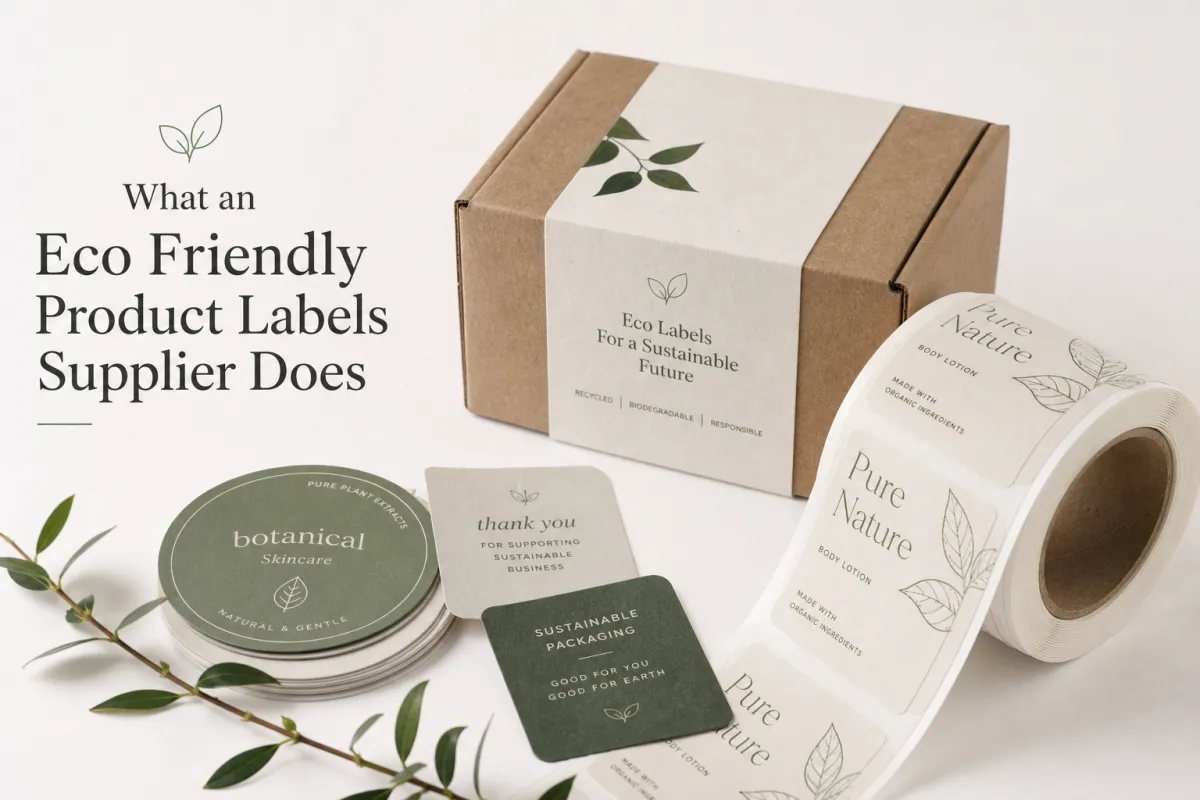
An eco friendly product labels supplier helps brands choose a label that fits the package, the storage conditions, and the end-of-life path. That is the real job. Pretty labels are easy. Useful labels take judgment, and a little humility, too.
Here is the part most buyers miss: sustainable is not one fixed standard. One eco friendly product labels supplier may focus on recycled paper stock. Another may build labels around recyclable polypropylene. A third may specialize in compostable constructions for dry goods and short shelf-life products. None of those choices is automatically right or wrong. The right answer depends on the package, the market, and the disposal route your customer actually has access to.
In practice, a good eco friendly product labels supplier should ask boring questions before quoting anything: Is the package glass, PET, HDPE, or paperboard? Will the product sit in a fridge, freezer, shower, or dry pantry? Is the label going on a squeeze bottle, a candle jar, or a shipping box? Those details decide whether a recycled paper label is smart or whether a moisture-resistant film is the less wasteful option because it avoids failure. The greenest material on paper can still be the wrong call if it falls apart after a week.
The supplier should also help you avoid sloppy green claims. A paper label with no certification is not automatically a problem, but certified stock can make procurement easier when documentation matters. A supplier worth hiring will talk about recycled content, FSC-certified paper, bio-based films, recyclable constructions, and adhesives that fit the package rather than pushing the same eco look on every job. If the answer never changes, the supplier is selling a style, not a solution.
That is why an eco friendly product labels supplier should feel more like a technical partner than a decoration shop. The goal is not to make the label look virtuous. The goal is to make sure the label performs, supports the brand story, and avoids avoidable waste from early failure or reprints.
How an Eco Friendly Product Labels Supplier Works
The workflow is usually straightforward. The details are where projects live or die. A competent eco friendly product labels supplier starts with a brief, checks the product environment, recommends a material and adhesive, then moves through artwork review, proofing, production, finishing, and shipping. Each step can save money or burn it. One wrong assumption early on can turn a sensible order into a stack of unusable stock.
- Discovery: The supplier asks about product type, container material, shelf life, temperature, moisture, and handling.
- Material match: The supplier narrows the choice to paper, film, recycled content, or compostable stock based on real use, not marketing language.
- Artwork check: The supplier reviews bleed, safe zone, barcode contrast, white space, and any compliance copy.
- Proofing: A digital proof, hard proof, or sample run confirms color, size, and layout before bulk production.
- Production: Printing method, die cutting, slitting, and finishing are set to match quantity and turnaround.
- Shipping: Orders are packed to reduce damage and storage waste, then delivered with clear reorder specs.
The printing method matters more than people think. Digital printing works well for short runs, variable data, and quick approvals. Flexographic printing usually makes more sense for larger runs, especially when the design is stable and the order needs tighter unit cost. Sheet-fed jobs can work well for certain paper labels, inserts, and smaller volume programs. A practical eco friendly product labels supplier will not force one method on every project. They will choose based on run size, color count, finishing, and how quickly you need stock.
Sustainability comes from process discipline, not slogans. Smart sheet utilization reduces scrap. Better nesting lowers trim waste. Planning material purchases around real demand avoids dead inventory. Smaller, right-sized production runs cut the chance that labels sit around for a year before a packaging refresh makes them obsolete. That is not glamorous. It still matters.
The handoff points matter most for buyers. Proof approval is one. Container testing is another. If the label is going onto a bottle or jar with curves, condensation, oil, or abrasion, the supplier should want a sample on the actual package before full production. A good eco friendly product labels supplier will not treat that as a nuisance. It is the difference between a controlled launch and a reprint with regrets.
For teams with a lot of label SKUs, the smartest suppliers also keep reorder information organized: exact dimensions, substrate, adhesive, finish, and approved artwork version. That cuts back-and-forth later and keeps future runs consistent. If you are comparing custom label options, this is where a supplier earns its keep.
Materials, Adhesives, and Compliance That Matter
The face stock gets all the attention, which is convenient because it is the easiest part to talk about. A thoughtful eco friendly product labels supplier starts with the package and works backward. Recycled paper can be a strong choice for dry goods, cartons, jars, and brands that want a natural feel without making the spec harder than it needs to be. FSC-certified paper gives buyers documentation that often helps with internal sustainability reporting. Bio-based films, recyclable polypropylene, and compostable stocks each solve different problems, and none of them are magic.
Adhesive choice is just as important as the face material. In some cases, it matters more. Cold storage, condensation, textured glass, squeeze bottles, powder-coated metal, and recycled cardboard all behave differently. A label that sticks on a smooth bottle in a warm room may fail completely on a chilled product. I have watched that happen more than once, and it is never fun to explain to a client why the “budget-friendly” option turned into a rush replacement. If the label is going on something cold, wet, or oily, you kinda need to test it under those exact conditions.
Here is a practical way to think about the main materials and where they fit:
- Recycled paper: Good for dry products, kraft-style branding, and lower-complexity applications.
- FSC-certified paper: Useful when documentation matters and the brand wants verified forestry standards.
- Recyclable polypropylene: Better for moisture, oil, and wipe-clean performance on many consumer goods.
- Bio-based film: Useful when durability is required and the brand wants a lower fossil-based content story.
- Compostable stock: Works for specific product categories, but only if the full package and disposal path support it.
Compliance is where sloppy claims get expensive. If you are labeling food, cosmetics, or household products, you need to think about food contact concerns, recycling stream compatibility, and the wording of any sustainability claims. Regional rules vary, and so do customer expectations. The EPA recycling guidance is a useful reference for how recycling claims and real-world recycling systems can diverge, which is a polite way of saying the package has to work where the customer lives, not just on a brand deck.
If you need documented forest stewardship, the FSC site is worth reviewing because buyers often want the certification language to line up with their procurement files. That kind of documentation matters more than people admit during a kickoff call. A polished label is nice. A label that clears internal review without three rounds of paperwork is better.
Finishes and inks deserve the same scrutiny. Soft-touch lamination, heavy varnish, metallic effects, and specialty inks can improve durability or shelf appeal, but they can also interfere with recyclability or compostability. A smart eco friendly product labels supplier should explain where the line is. For example, a water-based coating may be fine on a recycled paper label for dry goods, while a gloss film might be the better call for a product that sits in a cooler and gets handled constantly. The most sustainable choice is not always the most minimal one. It is the one that avoids failure.
Eco Friendly Product Labels Supplier Pricing and Lead Times
Price is never just price. A careful eco friendly product labels supplier will quote substrate, size, quantity, colors, finishing, die cutting, proofing, and shipping separately enough that you can see what drives the total. The main cost drivers are easy to name and easy to ignore: material choice, label size, quantity, number of colors, adhesive type, finishing, and any testing or sampling you need before launch.
Setup fees hit hardest on small runs. That is just math. If you order 500 labels, fixed setup can dominate the cost per unit. If you order 10,000, the same setup gets diluted and the price drops sharply. That is why an eco friendly product labels supplier may look expensive on a short-run quote and perfectly reasonable on a larger replenishment order. The trick is to compare the right quantities, not just the lowest line item.
For a common 2 x 3 inch label, these are realistic ballpark ranges at 5,000 pieces, depending on print coverage, finish, and adhesive:
| Material | Typical Use | Approx. Price Per Label | Main Tradeoff |
|---|---|---|---|
| Recycled paper | Dry goods, jars, cartons | $0.05-$0.09 | Lower moisture resistance |
| FSC-certified paper | Retail packaging, craft goods | $0.06-$0.10 | Certification adds value, not magic |
| Recyclable polypropylene | Bottles, cleaners, chilled products | $0.07-$0.13 | Less paper-like look |
| Bio-based film | Durable consumer packaging | $0.09-$0.16 | Usually higher material cost |
| Compostable stock | Specialty sustainability programs | $0.11-$0.20 | Not suitable for every package or claim |
Those numbers move with ink coverage, custom shapes, and finish complexity. A full-bleed design with a lot of white ink, a textured liner, or a special varnish will push the price up. A plain one-color label on stock material can come in much lower. The point is not to guess the cheapest material. The point is to ask the eco friendly product labels supplier to quote apples-to-apples so the comparison is honest.
Lead times usually follow the same pattern. Small digital runs can ship in 3-7 business days after proof approval if the stock is already on hand. Flexographic runs often land in the 10-15 business day range, and specialty materials can push that into 15-25 business days if sourcing is involved. A good eco friendly product labels supplier will tell you where the delay lives: sample approval, material sourcing, press queue, or finishing. That beats vague promises every time.
The other cost people forget is reprint risk. A cheaper supplier that misses the adhesive spec or prints on the wrong stock can erase the savings immediately. That is why an eco friendly product labels supplier should quote the exact same size, material, adhesive, finish, and quantity across vendors. Otherwise you are not comparing quotes. You are comparing fantasies.
Step-by-Step: Choosing the Right Supplier
Start with a short requirements list. An eco friendly product labels supplier can only give a useful recommendation if you tell them the product type, container material, storage environment, run size, sustainability goals, and budget range. Leave any of those out and the quote may still look tidy, but it will not be very useful.
Next, shortlist suppliers that can show relevant samples and actual spec sheets. Not generic green language. Not a homepage covered in leaves and vague promises. Ask for a construction that looks like your project, not a best-case marketing example. A serious eco friendly product labels supplier should be able to explain why one adhesive works on a cold bottle and another works on a dry paper tube.
- Set the target: Define the package, shelf life, and sustainability goal in plain language.
- Request the spec: Ask for material, adhesive, finish, and print method before price.
- Review the proof: Check layout, barcode readability, and copy accuracy line by line.
- Test the label: Put samples on the actual container and leave them in real conditions.
- Run a pilot order: Buy a smaller batch before committing to a full replenishment cycle.
That pilot order matters more than most teams want to admit. A label that looks perfect on screen can fail once it sees condensation, abrasion, oil, or uneven container walls. For distribution testing, some brands use ISTA-style checks or simple in-house handling tests to mimic transport abuse. You do not need a lab for everything, but you do need enough friction to catch problems before the full run lands in your warehouse. A dependable eco friendly product labels supplier will encourage that, not rush you past it.
If you are building a wider packaging program, the Custom Labels & Tags catalog can help you compare formats before you commit to one construction. That is useful because a label spec that works for one product may be wrong for the next line extension. Sustainable packaging choices are rarely one-size-fits-all, which is annoying, but also true.
Finally, confirm reorder behavior. Ask whether the supplier keeps your art files, exact die line, and approved spec on record. Ask how they handle color matching on repeat runs. Ask whether they flag material changes if the original stock goes out of production. A good eco friendly product labels supplier should make future orders boring in the best possible way.
Common Mistakes That Blow Up Label Projects
The cheapest quote is often the most expensive mistake. That is not a slogan. It is what happens when the label looks fine in a spreadsheet and fails in a warehouse. A weak eco friendly product labels supplier may underquote by using the wrong material, a weaker adhesive, or a print process that cannot handle your design. If the first run fails, the savings are gone and the reprint bill is sitting right there.
- Buying on price alone: A low quote is not a good quote if the label peels or scuffs.
- Assuming every eco claim matches reality: Recyclable in theory is not the same as recyclable in your actual package stream.
- Skipping container testing: Labels behave differently on glass, PET, HDPE, corrugate, and coated cartons.
- Ignoring storage conditions: Cold, moisture, and heat change how adhesives perform.
- Rushing artwork: Missing copy, bad bleed, or a wrong barcode can waste an entire print run.
Another common problem is vague instructions. If the supplier gets a loose brief, they will fill in the blanks with assumptions. That is how a label meant for a chilled bottle ends up quoted on paper stock that cannot handle condensation. A precise eco friendly product labels supplier should ask for exact dimensions, finish preferences, and any required compliance copy. If they do not ask, that is a warning sign, not a convenience.
Do not ignore the end-of-life story either. Some labels are technically recyclable, but the combination of adhesive, film, and container can still cause trouble in the real recycling stream. Brands sometimes focus on the label in isolation and forget the full package. That is the sort of mistake that creates green claims without useful results. A credible eco friendly product labels supplier will tell you when a recyclable structure fits the package and when it does not.
And test on the actual container. Not a lookalike. Not a sample bottle from another supplier. Real containers have coatings, curvature, texture, and residue that change adhesion. A label that passes a desk test but curls after a week in transit is a waste problem wearing a brand color.
Next Steps With an Eco Friendly Product Labels Supplier
Build a simple comparison grid before you talk to suppliers. Include material, adhesive, MOQ, lead time, price, proofing support, and evidence for any sustainability claim. That makes calls faster and keeps the conversation on facts. A good eco friendly product labels supplier should be able to answer those points without wandering into a sales deck.
Ask for one sample set on the exact container or a close match. Then test adhesion, rub resistance, and appearance under the same storage conditions the product will actually see. Cold storage? Test it cold. High humidity? Test it wet. Shipping cartons? Try a rub and abrasion check. This is where the right supplier earns trust. A weak one will promise the label is fine. A strong eco friendly product labels supplier will want proof.
Plan the pilot order first, then scale only after the label survives handling, shipping, and shelf life without peeling, fading, or looking cheap. That sounds cautious because it is. Caution costs less than a warehouse of reprints. If you need a broader range of formats to compare against your current spec, the Custom Labels & Tags page is a useful place to start narrowing the options.
After that, lock the spec and set a reorder trigger before inventory gets tight. That keeps your production schedule calm and your packaging consistent. A dependable eco friendly product labels supplier should make repeat orders easy, because the point of a good label program is not chasing emergencies every quarter.
If you want the shortest possible version of the buying advice, it is this: choose the eco friendly product labels supplier that can explain the material, prove the adhesive, quote the same spec across vendors, and support testing on the real package. That is the difference between a label that looks green and a label that actually behaves like a smart packaging decision.
What should I ask an eco friendly product labels supplier before ordering?
Ask what exact substrate and adhesive they recommend for your container, storage temperature, and expected shelf life. Then ask for proof of sustainability claims, such as recycled content, FSC certification, or recyclability guidance that matches the package. A practical eco friendly product labels supplier should also confirm MOQ, lead time, proofing process, and whether samples can be tested on the actual product before a full run.
How do I compare eco friendly label supplier quotes fairly?
Compare identical specs only: same size, quantity, material, finish, adhesive, and print colors. Look beyond the unit price and include setup fees, shipping, proof charges, and likely reprint costs if the first run fails. A reliable eco friendly product labels supplier should explain any price difference so you can see whether it is material quality, process efficiency, or just markup.
Do eco friendly product labels cost more than standard labels?
Sometimes yes, especially when the order uses specialty substrates, low-volume production, or custom adhesives. The gap often shrinks on larger runs, and a better-fitting label can save money by reducing waste and reprints. The real question is total cost per approved label, not just the sticker price on the quote from an eco friendly product labels supplier.
How long does an eco friendly product labels supplier usually take?
Small digital runs can move quickly if artwork is ready and the material is in stock. Longer timelines usually come from sample approval, specialty material sourcing, and queue time at the press. If you need a launch date, build in buffer time for testing and one revision round, because miracles are expensive and usually late. That is true even with a fast eco friendly product labels supplier.
What materials work best for sustainable product labels?
Recycled paper works well for dry goods and brands that want a natural look without overcomplicating the spec. Recyclable films or bio-based options are better when the label must survive moisture, oil, or cold-chain handling. The best material depends on the package and environment, so the right answer is the one that performs and fits the disposal path with help from an eco friendly product labels supplier.
Before you place the order, lock the exact spec, test it on the real container, and only then approve volume. That is the practical way to keep the packaging honest, the budget out of trouble, and the label from becoming landfill with a nicer design.

