Buyer Fit Snapshot
| Best fit | Ecommerce Packaging Premium Quality projects where brand print, material claims, artwork control, MOQ, and repeat-order consistency need to be specified before quoting. |
|---|---|
| Quote inputs | Share finished size, material target, print colors, finish, packing count, annual reorder estimate, ship-to region, and any compliance wording. |
| Proofing check | Approve dieline scale, logo placement, barcode or warning zones, color tolerance, closure strength, and carton packing before bulk production. |
| Main risk | Vague material claims, crowded artwork, missing packing details, or unclear freight terms can make a low unit price expensive after revisions. |
Fast answer: Ecommerce Packaging Premium Quality: What It Takes should be specified like a repeatable production item. The safest quote records material, print method, finish, artwork proof, packing count, and reorder notes in one written spec.
Production checks before approval
Compare the actual filled-product size with the drawing, then confirm tolerance on folds, seals, hang holes, label areas, and retail display edges. Reserve space for logos, QR codes, warning copy, and material claims before decorative graphics fill the panel.
Quote comparison points
Review material grade, print process, finish, sampling route, tooling charges, carton quantity, and freight assumptions side by side. A quote is only useful when the supplier can repeat the same color, closure quality, and packing count on the next order.
Ecommerce Packaging Premium Quality: What It Takes
I still remember the first time a buyer told me ecommerce packaging premium quality was the deciding factor. We were standing on a warehouse floor in Dongguan, under fluorescent lights and beside a pallet of 2,400 glass bottles, when two samples sat on the table: one glossy, one plain. The plain one won. Not because it was prettier. Because the corrugated spec was tighter, the closure sat flatter, and the insert held the bottle within 2 mm of center so it survived a 24-inch drop test and a rough two-day parcel route without a scratch. That was the moment I stopped believing premium meant "more decoration." It usually means more discipline, down to the millimeter and the carton seam. For brands chasing ecommerce packaging premium quality, the evidence usually lives in the details that most shoppers never consciously name.
Honestly, I think a lot of brands spend money in exactly the wrong place. They add foil, embossing, and a fancy print effect, then wonder why returns creep up when the corners crush or the product rattles around like a marble in a coffee can. I have seen a company pay an extra $0.90 per unit for surface treatment alone, only to lose more money to damage and re-ships than the finish ever justified. I have also seen a humble matte box with a clean tear strip and a solid insert earn better reviews than a louder, more expensive version. That is ecommerce packaging premium quality in the real world: protection, presentation, repeatability, and brand fit all moving in the same direction. It is also where Custom Printed Boxes, protective inserts, and the unboxing experience start working as one system instead of three separate ideas.
Customers do not spend three minutes admiring the package. They spend three to five seconds judging it. They notice seam alignment, print registration, wall flex, and whether the lid opens with controlled resistance or with that ugly pop that screams cheap packaging. I once watched a cosmetic buyer reject an entire run because the corner folds drifted 1.5 mm off center on a 350gsm C1S artboard sleeve. The product was fine. The box looked tired. That sounds harsh, but packaging is a silent ambassador, and a sloppy one at that. If you want ecommerce packaging premium quality, the package has to feel intentional before the product even comes into view. The same is true for branded packaging, luxury packaging, and premium mailer boxes: the first touch tells a customer whether the rest of the experience will match the promise.
The payoff is practical, not theoretical. Better packaging usually means fewer returns, fewer damage claims, fewer customer service tickets, and stronger unboxing videos shot on iPhones in Austin, Manchester, or Seoul. It can also improve freight efficiency if the structure is sized correctly instead of stuffed with pointless void fill. I have watched a brand move from a loose, oversized shipper to a tighter custom format and cut breakage while improving review language at the same time. That is the part people forget: ecommerce packaging premium quality can lower operating cost and raise perceived value in one shot. Rare, but real, especially when the package is engineered around the product instead of around the marketing deck.
What Makes Ecommerce Packaging Premium Quality?
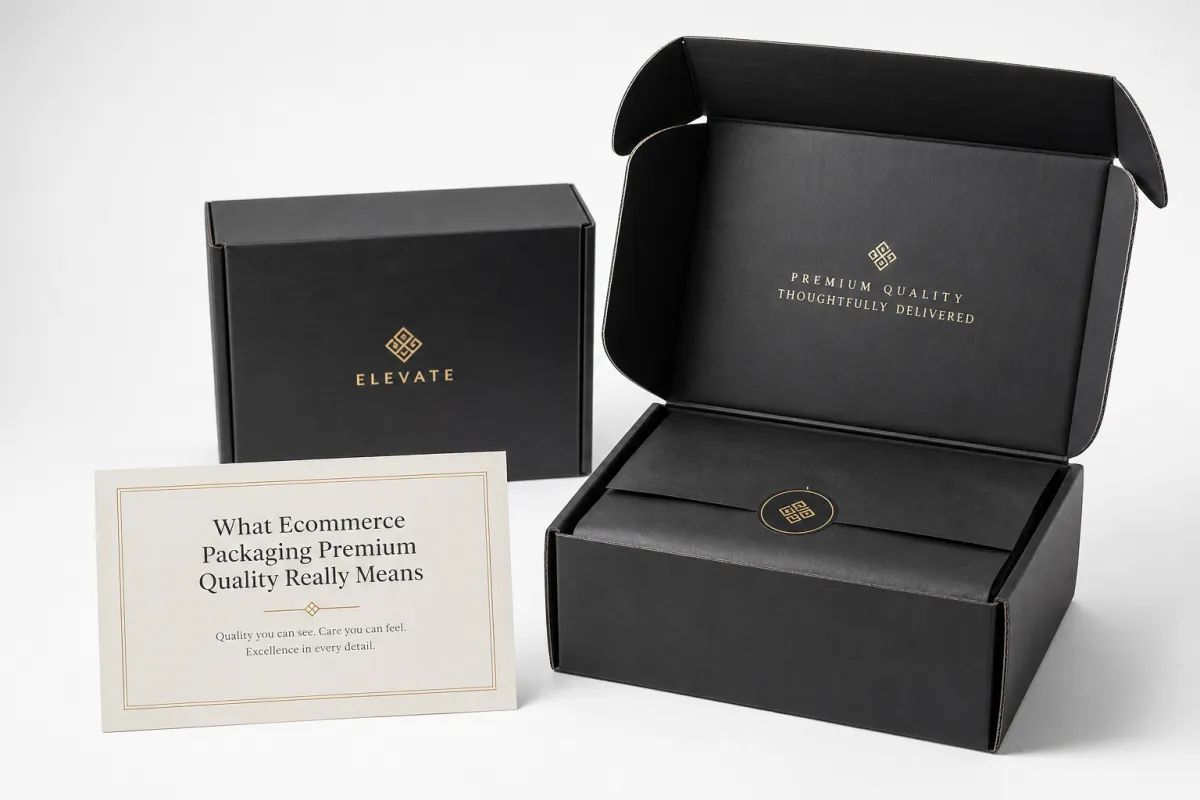
On a Thursday morning at a corrugated plant outside Chicago, I watched a plain brown shipper beat a metallic sample in a side-by-side test. The metallic version looked fancier under the lights, sure. The brown box just performed better. Better flap scoring. Better glue consistency. Better insert fit. The product stopped moving inside the shipper, and that mattered more than a shiny finish. That is the core of ecommerce packaging premium quality: quality starts with how a package behaves under pressure, not how it photographs on a styled table or in a studio shot with a linen backdrop.
People often assume premium means thicker board or more ornamentation. That assumption sends projects sideways. A 48 ECT board with bad fit can feel cheaper than a well-engineered 32 ECT structure, because the first one shows crushed corners while the second one still looks composed after multiple handoffs. I know which one I trust on a warehouse line in Newark or Rotterdam. One looks expensive for ten seconds. The other earns its keep across a 10,000-unit run. Ecommerce packaging premium quality is a mix of board grade, structure, print accuracy, closure strength, and the way the package reinforces the product story without wasting material.
The financial side matters just as much as the visual side. If the package reduces breakage from 2.8% to 0.6% across a 10,000-unit run, the savings can swallow the cost of a better insert or a cleaner finish and still leave room for profit. Premium quality is never only about looks. It is also about lower freight waste, fewer replacements, fewer service complaints, and fewer awkward emails from retail partners asking why half the carton arrived dented after a 300-mile route from a fulfillment center in Nashville. Nobody enjoys those emails; I certainly do not.
"The box looked simple, but the product arrived like it had been handled by a jewelry house," a client told me after we switched from an oversized mailer to a tighter custom printed box with a paperboard insert and a better closure tab. I still remember that line because it captured the point perfectly. Ecommerce packaging premium quality should make the experience feel calm, precise, and dependable, even before the customer sees the product, whether that package is moving through Los Angeles or Leeds.
In a real warehouse, premium quality also means repeatability. I have seen gorgeous samples fail in production because the glue was inconsistent, the folds were just a touch out of square, or the insert needed so much hand fitting that the line slowed to a crawl. A package that works once is a sample. A package that works across 20,000 units is a system. That system is what builds trust in ecommerce packaging premium quality, especially when the same spec has to run again six months later with a different print batch and the same closure tolerance of 1 mm.
For brands comparing formats, our Custom Packaging Products page is a useful place to compare structure options, inserts, and custom printed boxes before requesting a prototype. A few minutes spent comparing structural families can save a week of revisions later, especially if the product is fragile, heavy, or meant to feel gift-ready. If you are deciding between a mailer, a folding carton, and a rigid setup box, the difference between $0.42 and $2.15 per unit only makes sense when the product type and shipping lane are part of the equation.
How Ecommerce Packaging Premium Quality Is Built
I usually start from the inside out. First I measure the product itself, then I map the worst-case shipping path, then I decide how much movement is acceptable inside the box. A ceramic mug, for example, may need a 3 to 5 mm buffer plus a paper-based insert, while a small serum bottle may need a tighter collar and less void fill so the pack feels premium rather than overstuffed. That design logic sits at the center of ecommerce packaging premium quality, because the package has to fit the item and the route it will travel through, not just the mood board.
The development flow looks neat on paper and a bit chaotic in the real world. Discovery comes first: product weight, dimensions, finish sensitivity, warehouse pack-out speed, and carrier profile. Then comes the dieline, prototype sampling, test shipping, revisions, and production approval. Many teams want to jump straight to print artwork, but if the structure is wrong by even 2 mm, the graphics will not save it. The most dependable ecommerce packaging premium quality projects spend time on structure before they spend time on decoration, because a perfect Pantone does nothing for a lid that bows 3 mm in the center.
Testing is where the truth gets embarrassingly loud. I like to see drop tests, vibration simulation, compression checks, and a close-fit audit for anything heavy or fragile. The International Safe Transit Association has practical methods for parcel and distribution conditions, and I often reference those standards alongside shop-floor checks like top-load and corner crush testing: ISTA test methods. For paper-based structures, the question is not just "Can it ship?" It is "Can it ship, open well, and still look premium after a rough ride from Shenzhen to Toronto?" That is the line where ecommerce packaging premium quality proves itself.
The small details separate competent from excellent. Fold accuracy of 1 mm may sound minor, yet on a retail-ready mailer it affects how the lid closes, how the insert sits, and how the front panel frames the logo. Glue consistency matters too. One thin glue line can create a warped flap that catches on a packing machine or leaves a visible gap on the shelf. I have watched an entire batch of luxury retail packaging get reworked because the bottom tabs were offset by 2.5 mm. Painful? Yes. Necessary? Also yes. Premium quality is a tolerance game, and the tape gun never lies, especially at 6:30 a.m. on a Monday shift.
Key Factors That Define Ecommerce Packaging Premium Quality
Material choice is the first real fork in the road. Single-wall corrugated works well for many direct-to-consumer shipments, especially if the item is under 4 lb and the closure is well designed. Double-wall corrugated makes sense for heavier products, multi-item kits, or long parcel routes where compression is part of the story. Folding carton stock, such as 18pt SBS or 350gsm C1S artboard, suits presentation-heavy packaging, while molded pulp or paper-based inserts protect the product without adding foam waste. The right material is the one that matches weight, fragility, and the brand promise behind ecommerce packaging premium quality, whether that promise is built for cosmetics in London or specialty tea in Vancouver.
Finish is another place where restraint usually wins. Matte aqueous, soft-touch lamination, foil stamping, embossing, and spot UV can all elevate a package, but if you use every effect at once, the result can feel crowded and oddly less expensive than a quiet, well-spaced design. I have seen a simple black-on-kraft mailer with one foil logo look more premium than a full-color box covered in heavy gloss because the first package had room to breathe. My honest opinion? Good package branding often means choosing one or two effects and letting the structure do some of the heavy lifting. A $0.15 per unit print upgrade can do more than a $0.90 decorative pileup if it is used with restraint.
Fit and protection affect perceived value more than most teams realize. If the product shifts, corners crush, or void fill balloons out of the box, the customer reads the package as poorly made even before they touch the product. A well-tuned insert can eliminate 60% to 80% of internal movement, and that change often does more for ecommerce packaging premium quality than another round of surface decoration. The goal is not to hide the product inside a fortress. The goal is to let it arrive looking exactly as intended, with no scuffed edges and no rattling at all.
Supplier capability matters too. I care about die-cut precision, prepress control, color consistency, and whether the plant can repeat the same fold and glue quality across multiple runs. A supplier that can hold a Pantone target within a narrow delta and maintain a clean crease at 10,000 units is worth more than a cheaper quote with loose tolerances. That matters especially for branded packaging, where one off-color run can derail a seasonal launch in Berlin or Mexico City. If you are comparing options, ask for material callouts, dielines, and sample photos through Custom Packaging Products before you commit to full production.
The cost lens should stay honest. The best quality is usually the best fit for the product and channel, not the most expensive material on the shelf. A premium direct-mail cosmetic kit may need a folding carton with a paper insert and soft-touch finish, while a subscription accessory set may do better in a tough mailer with one strong print hit and no unnecessary embellishment. I have seen teams save 14% on landed cost simply by reducing oversized void fill and choosing a more accurate board spec. That is still ecommerce packaging premium quality; it is quality with discipline, which is harder to pull off than it sounds, especially when the temptation is to overbuild the box.
| Packaging Option | Typical Unit Cost | Strength | Best Use |
|---|---|---|---|
| Stock kraft mailer | $0.18/unit at 5,000 pieces | Basic shipping protection | Light accessories and low-fragility items |
| Custom single-wall mailer with print | $0.42/unit at 5,000 pieces | Better branding and fit | Beauty, apparel, and small gift items |
| Folding carton with paper insert | $0.68/unit at 5,000 pieces | Strong presentation and control | Premium retail packaging and DTC kits |
| Rigid setup box with custom insert | $2.15/unit at 1,000 pieces | Highest shelf presence | Luxury launches and high-margin gifting |
Those numbers are not universal, and I would never pretend they are. Freight, duty, tooling, and print coverage can move them quickly, especially if the order is split between Ningbo and a fulfillment center in New Jersey. Still, they give a practical baseline for comparing ecommerce packaging premium quality without getting lost in vague phrases like "affordable" or "high-end." The real question is not "What does the box cost?" but "What does the complete landed package cost after damage, labor, and returns are counted?" That question saves more money than another round of guessing ever will.
Step-by-Step Process and Timeline for Premium Packaging
A realistic project starts with discovery and measurements. I like to see exact product dimensions, a photo set of the item in hand, and warehouse details such as pack speed per hour and typical carton stacking height. That first step usually takes 2 to 4 business days if the team is organized. If the product team is still arguing over final dimensions, the schedule slides immediately. Strong ecommerce packaging premium quality projects begin with clear numbers, not vague sketches or "we'll know it when we see it" energy.
Next comes structural concepting and dieline creation. For a simple mailer, that might take 3 to 5 business days. For a multi-SKU kit with nested inserts, it can stretch to 7 to 10 business days because every cavity, fold, and tab has to work together. In one supplier negotiation in Shenzhen, I pushed for a 12 to 15 business day sampling window on an FSC-certified board because the client needed a launch-ready prototype that could survive real parcel shipping. The plant agreed, but only after we locked the board grade and closure method. That kind of discipline belongs to ecommerce packaging premium quality, even before the first production sheet is printed.
Prototype production follows, and this is where too many teams rush. A digital mockup is useful for color and copy, but a real sample tells you whether the closure holds, whether the insert creaks, and whether the box opens with enough friction to feel secure without feeling cheap. I like to test a sample with the actual product plus 10% extra weight, because warehouse teams do not pack in ideal conditions and they never seem to get the memo. If the sample survives that, the odds of a solid launch improve a great deal, whether the product is going to a flagship store in Paris or a DTC warehouse in Phoenix.
Revisions and approvals can be quick or painfully slow. The fastest projects usually have one decision-maker, final product dimensions, print-ready artwork, and a clear view of what must stay fixed. The slowest projects have three departments revising the same fold line and changing the logo placement after the insert is already approved. That kind of churn is expensive because every structural change can trigger a new sample, a new plate setup, or a new finishing proof. If you want ecommerce packaging premium quality without schedule chaos, freeze the critical specs early and stop moving the goalposts after sampling begins.
Manufacturing and launch planning should happen together. I have seen beautiful packaging arrive two days after product launch because nobody planned around a seasonal warehouse surge, and that is a painful failure. A smart timeline includes production, transit, receiving, QC, and buffer days for customs or line congestion. For a standard printed mailer, 18 to 25 business days after proof approval is realistic in many cases; for a specialty box with foil, embossing, or a custom insert, 25 to 40 business days is more honest. That is why ecommerce packaging premium quality should always be discussed with a calendar in hand, not just a design board and a promise.
- Measure the product and the secondary pack space first, down to the millimeter.
- Approve the structural dieline before signing off on artwork.
- Test the sample in real shipping conditions, not only in the studio.
- Lock the board, finish, and insert method before the production slot is reserved.
- Build a buffer for freight, warehouse intake, and seasonal demand spikes.
One of the cleanest ways to speed things up is to reuse proven structures. If a brand already has a mailer that fits a similar item, that existing form can be adjusted faster than designing a new one from scratch. The same is true for standard materials, clear brand guidelines, and a single approvals path. These details keep ecommerce packaging premium quality on schedule and protect the launch from avoidable delays, especially when the supply chain runs through Guangzhou or Long Beach.
Cost and Pricing: What Premium Packaging Really Takes
Pricing starts with structure, then moves through tooling, materials, printing, finishes, inserts, assembly, freight, and warehousing. If any one of those is ignored, the quote looks cheaper than the landed package really is. I have seen buyers focus on a $0.12 difference in unit cost only to discover that the more expensive option packed faster on the line and saved 8 seconds per order. That sounds tiny until you multiply it by 30,000 shipments and realize the "cheap" version was quietly expensive. Real ecommerce packaging premium quality pricing should be measured in total impact, not just carton price.
The biggest cost drivers are usually order volume, package size, board grade, ink coverage, and the number of SKUs that must be packed together. A 3-piece beauty kit with a custom insert will cost more than a single-item mailer, and it should, because the pack-out is doing more work. Specialty coatings and heavy ink coverage also add cost, especially if the design asks for full bleed on both sides and a spot finish on top. That does not mean you should strip away the brand story; it means the story should be engineered with the package, not layered on afterward. That is the practical side of ecommerce packaging premium quality, where a $0.53 tray can outperform a $0.31 tray if it saves labor and damage.
Smart savings are different from false savings. Dropping a foil layer may preserve the premium feel if the typography and structure remain strong. Undersizing the board to save a few cents can create hidden losses through corner crush, replacement shipments, and negative reviews. I would rather see a brand save $0.06 on a finish and spend that money on a tighter insert than shave the board spec and pay for it in damage. Good product packaging economics are rarely about the cheapest line item; they are about the most intelligent tradeoff.
There is also a sustainability angle, and it deserves straight talk. The EPA has practical guidance on recycling and materials management that helps teams think beyond marketing language: EPA recycling resources. If a brand wants sustainable packaging claims, the board, inks, coatings, and inserts need to align with what the supply chain can actually handle. FSC-certified paper, recycled-content corrugate, and paper-based inserts can all fit premium positioning, but they still have to pass drop, crush, and assembly tests before anyone calls them ready.
Here is the budget framework I use with clients: estimate the unit price, add tooling and sampling, then add labor, freight, and the average damage rate. After that, compare the package against the revenue it protects. If a better design reduces breakage by 2% on a $60 item, the return can be immediate. That is why I tell teams not to think only in unit cost. Think in landed cost, customer satisfaction, and repeat purchase rate. That is where ecommerce packaging premium quality starts paying for itself, particularly for products sold across four or five shipping zones.
In one retailer meeting, a buyer pushed for the cheapest possible tray and sleeve set at $0.31 a unit. We redid the math with a stronger board, a cleaner print method, and a paper-based insert that raised the pack cost to $0.53, but the line saved 11 seconds per pack and the breakage rate dropped by more than half. The buyer called it the best trade he had seen all quarter, and I agreed. That is a textbook example of ecommerce packaging premium quality being more profitable than the low bid.
Common Mistakes That Undercut Premium Results
The first mistake is designing for the mockup instead of the shipment. A package can look beautiful on a screen and still fail when it gets tossed into a van, stacked under a heavier carton, or opened by a warehouse picker who is moving too fast. I have watched brands approve a striking sleeve-and-tray set, then discover that the tray popped loose after a single drop because the corner locks were too shallow by 1.2 mm. That is not ecommerce packaging premium quality; that is expensive disappointment.
The second mistake is oversizing. Large boxes with too much void fill feel wasteful, cost more to ship, and let the product wander inside the carton. Customers notice that immediately. They also notice when a package takes up half a recycling bin because it was designed without regard for the actual product size. A tighter fit often looks more premium and reduces dimensional weight charges at the same time. I have seen a brand cut shipping cost by 9% simply by trimming the outer dimensions 14 mm on each side, which is a bigger win than most teams expect from a simple dieline revision.
Fancy finishes can backfire too. Soft-touch lamination feels great, but if the coating scuffs too easily in a fulfillment center, the box arrives with shiny rub marks and damaged corners. Heavy foil can also hide messaging or make the package harder to reproduce consistently across multiple runs. Premium should feel controlled, not loud. In many cases, the strongest ecommerce packaging premium quality package is the one with one excellent print effect and a clear structural story, not three competing decorative tricks. I know that sounds boring to some teams, but boring is often what survives transit from a warehouse in Derby to a doorstep in Dublin.
Skipping sample testing is another costly habit. I once visited a line where a brand approved artwork and box style from PDF alone, only to find the real fold sequence created a gap at the front panel. The first 500 units looked fine on the packing bench and failed the first warehouse shuffle. That kind of oversight is avoidable. If the package has not been ship-tested, compression-tested, and checked on the actual packing line, it is still a draft, not proof of ecommerce packaging premium quality.
Then there are the coordination problems. Late artwork changes, unclear ownership between marketing and operations, and inconsistent assembly instructions can wreck an otherwise well-built project. I have seen a team change a logo lockup after the insert cavities were already approved, which meant the product name on the inside lid no longer matched the outer sleeve hierarchy. That kind of mismatch weakens package branding fast. If you want custom printed boxes to feel premium, every department has to agree on what the package is supposed to say and how it is supposed to function. Otherwise the box becomes a corporate argument with flaps, and those disputes always cost more than they should.
Here is the plain truth: many failures are not material failures at all. They are communication failures with a cardboard wrapper. Strong ecommerce packaging premium quality depends on one clear brief, one approved sample, and one final set of production specs that nobody keeps changing at the last minute, not even during the week before a seasonal launch in September.
Expert Tips and Next Steps for Better Packaging
My first recommendation is to design for the worst-case shipping journey, not the ideal one. Assume a package will be lifted by one corner, stacked under a heavier box, and opened by a tired customer with one hand while the phone is in the other. That sounds kinda harsh, but it is reality in parcel commerce. If a structure survives that path and still opens cleanly, ecommerce packaging premium quality becomes much easier to defend in a budget meeting in Dallas, Sydney, or Hamburg.
I also like to use a simple scorecard for every sample. I grade protection, presentation, cost, and ease of assembly on a 1 to 5 scale, then compare the samples side by side. It sounds basic, but it keeps emotion from taking over when a glossy sample looks gorgeous but takes 18 seconds longer to pack than the plain version. If a sample scores well across all four categories, you are probably close to a strong finish. If it wins only on appearance, it is not done yet, no matter how good it looks under a photo light.
Pilot one high-volume or high-risk SKU first. That gives you data on damage rates, pack-out time, and customer reaction without putting the entire catalog at risk. A single good pilot can teach you more than a dozen slide decks. I have seen brands standardize the rest of their line after one successful pilot because the insert logic, board spec, and closure style all carried over cleanly. That is the kind of operational win that makes ecommerce packaging premium quality repeatable instead of accidental.
Ask suppliers for the full set of facts: dielines, board callouts, sample photos, run notes, and test results. If a vendor cannot tell you whether the corrugated board is single-wall or double-wall, or cannot explain why the fold sequence prevents bulging at the side seam, keep asking until you get a clear answer. Good suppliers are proud of the details. The right ones will tell you whether the structure uses 32 ECT, 44 ECT, or a specific paperboard like 18pt SBS, and they will explain why that choice fits the product and the route from the plant to the customer.
If you are still narrowing formats, use the project as a comparison exercise instead of a yes-or-no decision. Compare a stock mailer, a custom printed box, and a carton with a paper-based insert. Then ask which one wins on damage prevention, pack speed, and brand feel. That is usually the cleanest way to separate guesswork from real value. For a broader look at available structures and materials, the Custom Packaging Products page can help you frame the discussion before requesting prototypes, especially if your team is choosing between three different board grades.
My practical action list is straightforward. Measure the product, request samples, ship test the finalists, and choose the design that gives you the best balance of cost and performance. If sustainable claims matter, verify the paper and board sources, and if the package will touch retail shelves before parcel delivery, check how it looks under fluorescent light as well as in a photo. Those steps take a few extra days, but they save weeks of headaches. That is the path to ecommerce packaging premium quality that holds up in the real world, not just in a pitch deck.
One last thing: do not confuse premium with expensive. I have seen a $0.42 mailer outperform a $1.10 presentation box because the first one fit the product better, packed faster, and arrived cleaner. That is the part that still surprises people who are new to packaging design. Premium is not about spending more for its own sake. Premium is about building a package that earns its place in the customer journey, and that is exactly what ecommerce packaging premium quality should do, whether the order ships from Ohio or Osaka.
Frequently Asked Questions
What does ecommerce packaging premium quality mean in practice?
It means the package protects the product, looks intentional, and performs consistently across real shipping conditions. The strongest version balances structure, material choice, print quality, and user experience rather than relying on decoration alone. A useful test is whether the package arrives intact, opens cleanly, and still feels aligned with the brand after a 1,200-mile parcel route or a handoff through three warehouses.
How much does ecommerce packaging premium quality cost per order?
Cost depends on size, substrate, print method, finish, insert complexity, and order volume. Tooling and sampling add upfront expense, but larger runs usually reduce the unit price. A custom single-wall mailer might land around $0.42 per unit at 5,000 pieces, while a rigid setup box can run about $2.15 at 1,000 pieces. The cheapest package is often more expensive in the long run if it causes breakage or returns.
How long does it take to produce premium ecommerce packaging?
Simple stock-based solutions may move quickly, while fully custom structures and finishes need more lead time. Sampling, revisions, and approvals are usually the biggest timing variables. A straightforward mailer can take 3 to 5 business days for structure development, while a specialty box with foil, embossing, or a custom insert may need 25 to 40 business days after proof approval. Complex inserts and seasonal launch dates should be planned well in advance.
Which materials work best for ecommerce packaging premium quality?
Corrugated board is strong for shipping, folding carton stock works well for presentation, and molded pulp or paper inserts add protection. The right material depends on weight, fragility, transit distance, and the unboxing experience you want. FSC-certified paper, recycled-content corrugate, 18pt SBS, and 350gsm C1S artboard can all fit premium positioning, but they still need to pass drop, crush, and assembly tests before they are approved.
How can I tell if my packaging is truly premium quality?
Run the package through real ship tests instead of relying only on design mockups. Check for clean folds, strong closures, color consistency, and scuff resistance. Premium quality should improve perception without creating extra labor, higher damage rates, or excessive cost. If the structure holds after a 24-inch drop test and still packs within target time, you are much closer to the mark.
Takeaway: start with the product, not the print. Lock the structure, test it in real transit, and only then polish the finish; that is the clearest path to ecommerce packaging premium quality that looks elevated and survives the trip.


