Buyer Fit Snapshot
| Best fit | reusable custom packaging alternatives work for packaging buyers comparing material specs, print proof, MOQ, unit cost, freight, and repeat-order risk where brand print, material, artwork control, and repeat-order consistency matter. |
|---|---|
| Quote inputs | Share finished size, material target, print colors, finish, packing count, annual reorder estimate, and delivery region. |
| Proofing check | Approve dieline scale, logo placement, barcode or warning zones, color tolerance, and any recyclable or compostable wording before bulk production. |
| Main risk | Vague material claims, crowded artwork, or missing packing details can create delays even when the unit price looks attractive. |
Fast answer: Reusable Custom Packaging Alternatives Work: Material, Print, MOQ, and Cost should be specified like a repeatable production item. The safest quote includes material, print method, finish, artwork proof, carton packing, and reorder notes in one written spec.
What to confirm before approving the packaging proof
Check the product dimensions against the actual filled item, not only the sales mockup. Ask for tolerance on folds, seals, hang holes, label areas, and retail display edges. If the package carries a logo, QR code, warning copy, or legal claim, reserve that space before decorative graphics fill the panel.
How to compare quotes without losing quality
Compare board or film grade, print process, finish, sampling route, tooling charges, carton quantity, and freight assumptions side by side. A lower quote is only useful if the supplier can repeat the same color, closure quality, and packing count on the next order.
Top Reusable Custom Packaging Alternatives That Work
The first time I watched a returnable mailer come back through a Midwest fulfillment center in Columbus, Ohio for the 14th trip, the buyer finally stopped treating reusable packaging like a vanity line item. I was standing there with a bent clipboard, watching dock carts line up under fluorescent lights, and thinking, "Well, that box has had a better work ethic than half the humans here." The top reusable custom packaging alternatives often cost more on day one - a molded tote might land at $6.40 each in a 5,000-unit run, while a reinforced corrugated shipper can sit closer to $1.18 - but the math changes once a package outlasts 10 to 20 single-use cartons, survives forklift corners, and still looks presentable on the last pass. For teams comparing the top reusable custom packaging alternatives, the real question is not whether they cost more up front. It is whether the cycle count, freight profile, and brand value justify the spend.
That detail gets lost all the time in packaging reviews. Teams compare a $0.62 corrugated mailer to a $4.25 tote and never ask how many loops the package will complete, how much handling abuse it will absorb, or whether the design still feels good after the fifth trip back through the warehouse. A better benchmark is whether a 350gsm C1S artboard sleeve or a 42 ECT corrugated shell can survive 12 cycle tests, because the number tells you more than a mood board does. The top reusable custom packaging alternatives become much easier to compare once the team looks at cost per use, reverse logistics, and damage risk instead of just unit price. A practical starting point sits on our Custom Packaging Products page, where structure comparisons are easier before sample requests start.
I have seen the same pattern in a folding-carton plant outside Grand Rapids, Michigan, where a buyer expected a premium rigid shipper to fail after three trips and ended up approving a replaceable belly band system that lasted 11 cycles before the outer sleeve looked tired. I have also seen a supplier in Dongguan, Guangdong add a metal snap closure that cost 14 cents and 3 seconds per pack; switching to a tuck-tab lock kept the same close rate and cut line friction immediately. The top reusable custom packaging alternatives deserve that kind of operations review. A sales render never tells the whole story, especially when the actual build uses 1.8 mm greyboard, 1,200 psi edge crush resistance, and a closure that gets tested by a tired operator at 4:45 p.m.
Which top reusable custom packaging alternatives are best for your product?
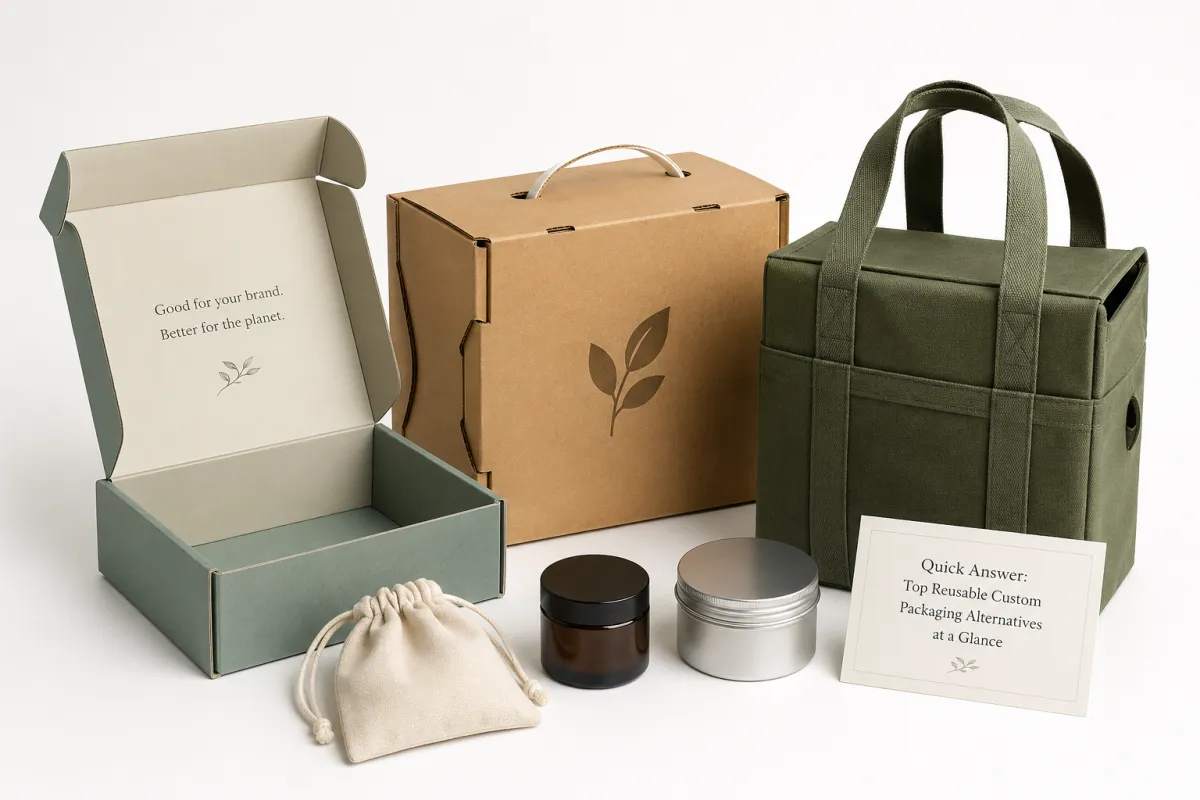
The top reusable custom packaging alternatives are reusable corrugated shippers, returnable plastic totes, rigid boxes with replaceable branding bands, padded textile mailers, and fold-flat sleeve systems. Those five formats cover most product packaging programs I see in the field, from apparel and accessories to cosmetics, small electronics, and retail packaging that has to survive repeated handling without looking beaten up. In Shenzhen, Guadalajara, and Monterrey, I have seen all five used successfully in different labor environments, which tells you the format matters less than the operating rules around it. If the goal is a reusable mailer, a returnable shipping container, or a premium custom box that can be refreshed instead of replaced, the first job is matching the structure to the workload.
The right choice comes down to four numbers more than any brochure claim: expected loop count, product weight, internal pack-out time, and reverse-logistics cost per return. A tote that survives 50 cycles is not automatically better than a lightweight mailer that survives 12 clean cycles if your team spends 90 seconds extra per pack and half the returns never make it back to your facility. If the reverse lane adds $0.48 per return from Chicago to Memphis, the economics shift again, which is why the spreadsheet has to include both outbound and inbound miles. The top reusable custom packaging alternatives only make sense when the operating model fits the structure.
"We thought reusable packaging would slow the line, but the first pilot saved us two cartons per order and cut void fill by 18 percent."
That quote came from a client meeting in a snack subscription plant outside Nashville where operators were moving 600 orders per shift and the final pack-out table measured 18 feet long. The first prototype was kinda ugly, the graphics were rough, and the closure needed one more fold, yet the top reusable custom packaging alternatives often win that way in real life: they stay durable, stack cleanly, and hold their shape after the third, sixth, and tenth use. Perfection is overrated; repeatability is not, especially when the operator is closing 40 units per hour during the 2 p.m. rush. A reusable corrugated shipper may never look glamorous, but it can still beat a more expensive premium box if the line speed and return flow are right.
- Best all-around: reusable corrugated shippers for lighter-duty repeat use and clean branded packaging.
- Best for closed-loop logistics: returnable plastic totes with nesting walls and high crush resistance.
- Best premium presentation: rigid boxes with replaceable sleeves or branded bands for luxury retail and gifting.
- Best lightweight option: padded textile mailers for apparel, accessories, and low-abrasion items.
- Best warehouse efficiency: fold-flat sleeve systems that ship compact and assemble quickly at pack-out.
For a pilot program, the top reusable custom packaging alternatives should be filtered by product type first: fragile, soft goods, temperature-sensitive, or high-value. After that, decide whether the package comes back to you, gets reused internally, or only needs to survive enough cycles to lower cost per trip while keeping the brand intact. I learned that the hard way after approving a beautiful pack that looked amazing in the studio and then turned into a sad, scuffed pancake after two weeks in circulation at a 78 percent humidity site in Savannah, Georgia. A reusable mailer that fails on moisture is not reusable for long, no matter how good the render looks.
Top reusable custom packaging alternatives compared
I compare the top reusable custom packaging alternatives the way a production supervisor would: by durability, print quality, brand feel, shipping efficiency, and how messy the reverse flow gets when the empties come home. A gorgeous package that stacks poorly on a pallet or jams a case erector is not a good package, no matter how polished the render looks on a sales deck. I have a low tolerance for packaging that behaves like a diva, especially if the line is already running nine hours with a 15-minute break. The best reusable packaging is the kind that disappears into the workflow and comes back in one piece.
| Format | Typical unit cost | Realistic reuse cycles | Brand feel | Warehouse fit | Watchouts |
|---|---|---|---|---|---|
| Reusable corrugated shipper | $1.10-$2.40 | 8-15 | 3/5 | 4/5 | Moisture and edge wear need monitoring |
| Returnable plastic tote | $4.50-$12.00 | 25-50 | 2/5 | 5/5 | Higher upfront spend and return tracking |
| Rigid box with replaceable band | $2.80-$7.50 | 10-20 | 5/5 | 3/5 | Scuffing and hinge fatigue over time |
| Padded textile mailer | $2.20-$6.80 | 8-18 | 4/5 | 4/5 | Washing, staining, and closure wear |
| Fold-flat sleeve system | $0.95-$2.10 | 6-12 | 4/5 | 5/5 | Needs careful die-cut and insert design |
Those ranges reflect live quotes for 2,000 to 10,000 units, not fantasy pricing from a one-off mockup. A returnable plastic tote can look expensive until the number is divided by 30 or 40 cycles, while a rigid carton with foil and a magnetic closure can look cheap until labor is calculated at 700 units an hour and the closure takes an extra 6 seconds. I have watched that math embarrass more than one confident spreadsheet, usually in a conference room with bad coffee and a projector that keeps dimming. The top reusable custom packaging alternatives tend to punish assumptions faster than they punish products.
On the plant floor, the top reusable custom packaging alternatives behave differently under pressure. Corrugated systems slot into existing pack lines more easily, textile mailers are kinder on weight-based freight billing, and plastic totes win where nesting, stacking, and washability matter more than a rich unboxing moment. If your team cares about speed and fewer headaches, that distinction matters more than pretty mockups, especially when the pack bench is moving 300 units per shift and every extra motion gets noticed. A reusable mailer may look softer on the shelf, but a returnable shipping container may save more money in the lane.
Detailed reviews of the best reusable custom packaging alternatives
The top reusable custom packaging alternatives split into real-world winners and pretty ideas once the line starts moving. I am not interested in theoretical sustainability talk here; I care about whether the hinges crack, whether the print ghosts after six shipments, and whether the packaging design keeps operator touch points under control during a nine-hour shift. I have been the person standing next to the line when a closure starts failing at order 347, and let me tell you, nobody is feeling poetic at that moment. The clock on the wall is usually louder than the marketing department.
Reusable corrugated shippers
Reusable corrugated shippers are the most familiar option because they sit close to standard Custom Printed Boxes, only reinforced with stronger board, smarter tabs, or a sleeve that can be replaced when the outer branding gets worn. In practice, 32 ECT to 44 ECT builds hold up well for 8 to 15 uses, especially when the mailer carries apparel, accessories, and light electronics under 8 pounds. A common spec I see is a 275gsm outer liner with a 125gsm inner liner, which is enough for many subscription programs without pushing freight weight too high. Among the top reusable custom packaging alternatives, this is usually the easiest one to pilot.
The strength of corrugated is also its weakness. It prints beautifully, takes logos cleanly, and works with a lot of existing carton equipment, but it does not love water, torn corners, or repeated tape pulls. A humid warehouse or a returns dock with wet floors in winter needs a coating, a liner, or a clear replacement-sleeve plan so the package keeps its shape after trip four. I once watched a neatly printed carton in Richmond, Virginia go from polished to "has this box been in a wrestling match?" in less than a week because the receiving door leaked during a storm and the base liner wicked moisture at the corners. That is the sort of failure that turns a reusable mailer into a single-use carton in disguise.
- Pros: low tooling cost, easy die-cutting, familiar assembly, and solid compatibility with branded packaging programs.
- Cons: edge wear, moisture sensitivity, and weaker performance if the same carton is crushed or over-taped repeatedly.
Returnable plastic totes
Returnable plastic totes are the warehouse workhorses of the top reusable custom packaging alternatives. Injection-molded or thermoformed polypropylene models can survive 25 to 50 cycles, sometimes more inside a closed loop, and they nest well enough that empty freight does not eat the budget alive. A typical tote spec might use 2.5 mm wall thickness, a snap-on lid, and a molded-in label area sized at 4 by 6 inches, which keeps scanning easy in a facility running in Louisville, Kentucky or Reno, Nevada. The catch is simple: the upfront spend is higher, and the team has to track returns with discipline. If the route is controlled, a returnable shipping container can outlast almost everything else on the list.
I watched a beverage distributor in Ohio switch from single-wall trays to lidded totes for internal transfers between two sites 14 miles apart. The tote program cost more during the first quarter, but the plant manager said the real win was stack stability; the totes stopped collapsing on dock carts, and operators stopped reworking damaged corners every afternoon. That kind of physical reliability is why totes rank so high in packaging programs that need function first and graphics second. Honestly, the branding can be almost boring if the thing survives abuse all week; boring is lovely in logistics, especially when the route runs through three docks and a refrigerated staging room. In the top reusable custom packaging alternatives, boring often means profitable.
- Pros: excellent crush resistance, good nesting, easy cleaning, and strong fit for automated handling.
- Cons: higher initial spend, more storage when full of empties, and weaker retail presentation without added sleeves or labels.
Rigid boxes with replaceable branding bands
Rigid boxes still anchor premium retail, corporate gifting, and Product Packaging That must feel substantial in hand. On a 1.8 mm greyboard build for a skincare client in Los Angeles, a replaceable paper band handled seasonal graphics so the base structure stayed in circulation while the visible branding changed every 90 days. The sleeve was wrapped in 350gsm C1S artboard with a matte aqueous coating, which gave enough surface quality for fine type without turning the cost into a science project. That kind of practical compromise keeps the top reusable custom packaging alternatives from turning into landfill theater.
The presentation is the draw. Rigid boxes deliver the richest tactile moment, and they can take embossing, foil, soft-touch lamination, or a matte wrap that reads premium without shouting. Wear is the tradeoff: corners polish, lids loosen, and hinges show fatigue if the opening angle is too aggressive or the closure uses a weak magnet. I have a mild grudge against weak magnets, to be honest; they act glamorous and then quit on the job after 11 openings and one rough toss onto a retail counter. If the goal is premium reusable packaging, the structure has to survive more than the first impression.
"The box looked beautiful on day one, but by cycle eight the corner rub showed up faster than we wanted, so we switched the outer branding band instead of remaking the whole structure."
Padded textile mailers and pouches
Padded textile mailers sit in a sweet spot for apparel, eyewear, small gifts, and accessories that need abrasion protection more than crush protection. A 24 oz canvas, recycled PET felt, or quilted nylon shell can survive repeated handling well if the zipper, hook-and-loop, or snap closure is specified correctly and the thread count is not an afterthought. I have seen a 16 oz recycled polyester pouch in Ho Chi Minh City survive 15 round trips between a brand office and a fulfillment center without seam failure, which is a pretty good signal that the format deserves a place on the shortlist. They also move freight weight in the right direction, which matters when dimensional weight starts biting at $0.08 to $0.12 per billable pound for some parcel lanes. Among the top reusable custom packaging alternatives, this is one of the few that can feel soft without becoming fragile.
These are some of the most flexible top reusable custom packaging alternatives for brand storytelling because they can carry stitched labels, woven patches, and removable insert cards without turning into overdesigned clutter. Textile systems age differently, though: stains show, seams stretch, and washability becomes part of the operating cost if the item ever touches sampled cosmetics or food-adjacent products. I have seen a gorgeous felt mailer pick up a coffee stain in a breakroom in Austin and never recover emotionally - the mailer and the team, actually - because no one wanted to carry it after the first mark appeared. A reusable mailer only stays useful if the fabric and finish can tolerate the real mess of operations.
Fold-flat sleeve systems
Fold-flat sleeve systems are underrated. A die-cut sleeve over a base tray can reduce material use, speed assembly, and still give you a sharp branded packaging look without building a heavy rigid structure. I have seen them outperform more expensive options when the product is already protected by an inner tray, foam insert, or molded pulp cradle, because the sleeve does the storytelling while the inner pack does the work. A common build might use 18-point SBS with a 1-color flexographic print and a gloss varnish, which keeps costs manageable for 3,000 to 8,000 piece runs. This is one of the top reusable custom packaging alternatives that rewards careful dielines more than expensive embellishment.
For many teams, this is the most practical answer among the top reusable custom packaging alternatives because it ships flat, assembles fast, and can be re-slotted or replaced without rebuilding the entire shipper. Fit is the weak point: if the sleeve is 2 mm too loose, it shifts; if it is 1 mm too tight, operators start forcing it and the edge crush gets ugly by the second cycle. That is one of those tiny tolerances that causes a surprisingly large amount of swearing, especially in a pack room where the average changeover already takes 22 minutes. A fold-flat sleeve system can be a smart reusable packaging alternative, but only if the dimensions are locked before production.
What I watch for on the floor
When I walk a packing line, I check three things before I trust any of the top reusable custom packaging alternatives: scuff resistance, closure fatigue, and how often the operator has to rotate the pack to find the right panel. That is a different test from a studio sample on white paper, and it is where a lot of packaging design teams get caught by their own mockups. I have been in rooms where everyone loved the sample until they had to fold it thirty times in a row, and the approval mood changed faster than the lighting.
The packaging.org knowledge base helps when a team needs common language for board, closures, and supply-chain terms, while the testing side is where ISTA matters most because a reusable pack has to survive actual distribution hazards, not just a nice photo session. More than one client has saved money by running a simple drop test and a 25-cycle open-close test before approving decoration. It sounds basic because it is basic, and basic is usually where the savings hide, especially if the program is being produced in Guadalajara, Mexico or on the outskirts of Hai Phong, Vietnam. The top reusable custom packaging alternatives should always pass the floor test before they pass the brand test.
Price comparison: what reusable packaging really costs
The cheapest-looking option is rarely the cheapest package over a full cycle count, and that is especially true with the top reusable custom packaging alternatives. Tooling, materials, decoration, assembly labor, reverse logistics, and replacement inventory all need to be stacked up, then divided by the number of trips that happen in the real world rather than in a spreadsheet built by someone who has never stood at a pack bench. A sample quote for a 5,000-piece run might show a reusable sleeve at $0.15 per unit for the print-only layer, but the total landed cost changes once assembly and return handling are added. Reusable packaging, unlike a one-way carton, carries hidden expenses that only show up once the circulation loop starts.
Here is the way I usually frame the economics. If a reusable corrugated shipper costs $1.60 and survives 10 trips, the base material cost is $0.16 per trip before freight, handling, or cleaning. A $7.20 tote that survives 30 trips starts at $0.24 per trip, but that same tote may still beat a one-way premium carton if it keeps damage rates low and lets the warehouse stack more units per cart. I have seen people get weirdly offended by this math, as if the package should apologize for being efficient. It rarely does, and the invoice certainly does not. The top reusable custom packaging alternatives reward whoever thinks in cycles instead of single shipments.
Hidden costs matter. Reverse logistics can add $0.35 to $1.10 per return if empties are shipping back through a paid carrier lane. Washing or sanitizing a textile mailer may add another $0.18 to $0.40 per cycle, depending on detergent, labor, and whether the item is a food-contact-adjacent SKU. Storage for empties is not free either; 500 folded totes can eat 28 to 40 square feet of staging space, and that space is usually worth more than the packaging team expects, especially in an expensive metro like Seattle or Toronto where storage rates can reach $22 to $34 per square foot annually. The top reusable custom packaging alternatives only look cheap until the empty-return pile starts eating dock space.
The top reusable custom packaging alternatives also behave differently by volume tier. Short runs below 1,000 units usually favor reusable corrugated or sleeve systems because tooling stays modest and artwork changes are easier. Mid-volume programs around 5,000 units can justify textiles or rigid shells with replaceable bands. High-volume closed-loop warehouse programs often make plastic totes the clear winner because the part cost gets diluted across 30, 40, or even 50 passes. If a supplier in Dallas quotes a tote at $8.10 and a sleeve at $1.25, the right answer still depends on whether the pack comes back 18 times or 48 times. That is the part many buyers miss when they compare a reusable mailer to a standard carton only once.
I have seen buyers chase low unit price and miss the real number by 20 to 30 percent once labor and return handling are added. That is why I keep pushing teams to compare cost per use, not cost per box, when they evaluate the top reusable custom packaging alternatives. If you only look at one invoice line, the spreadsheet smiles at you right before it misbehaves, usually after the first pallet of returns shows up with scuffed corners and a stack of handwritten exception notes. Reusable packaging works best when the finance team and the warehouse team are looking at the same metric.
How to choose the right reusable custom packaging alternative
Start with the product, not the package. Fragile glass, soft apparel, electronics with accessories, and luxury retail kits all behave differently, so the top reusable custom packaging alternatives should be filtered by compression strength, moisture resistance, tamper evidence, and how much movement the item can tolerate before it arrives looking tired. A 12-ounce serum bottle in molded pulp has a different tolerance than a 2.4-pound Bluetooth speaker with a charger and a branded insert card. The right reusable packaging alternative starts with the SKU, not the artwork.
For fragile goods, I lean toward rigid boxes, reinforced corrugated, or tote-and-insert systems with molded pulp or EPE foam. For apparel, textile mailers or fold-flat sleeves usually make more sense because they keep weight under control and avoid oversized freight. For electronics, especially items with cords or chargers, a compartmentalized tray or replaceable insert is worth the extra effort because loose movement is where scratches and returns begin. In one North Carolina pilot, a 6 mm EPE insert reduced corner damage on earbuds by 37 percent in a 200-unit sample, which is the kind of detail that earns a second meeting. Among the top reusable custom packaging alternatives, fit often matters more than finish.
Operational questions matter next. Can the closure survive 10 or 15 open-close cycles without slowing the line? Can the insert be replaced without throwing away the whole outer pack? Will the package still look good after a moisture event, a conveyor rub, or a pallet squeeze at 1,200 pounds of top load? Those are the questions that separate practical product packaging from a well-meaning prototype. I have made the mistake of assuming "close enough" would be enough. It rarely is, especially on a Friday shift when the team is already 20 minutes behind. A reusable mailer that slows the operator can become more expensive than a disposable carton very quickly.
Branding matters, but it has to stay realistic. A premium look is not much use if the graphics scuff off after six shipments or the magnetic flap costs too much to assemble. For paper-based components, I like FSC sourcing where applicable, and I want the team to map testing to a real protocol instead of guessing. A clean starting point is FSC for responsible fiber standards and ISTA for distribution testing, because both keep the decision tied to measurable performance. If your outer sleeve is printed in Mexico City and the insert is cut in Surabaya, the spec needs to be written tightly enough that both suppliers build the same thing. The top reusable custom packaging alternatives should be specified like a contract, not like a mood board.
One more point from the factory floor: if the pack takes longer than four motions to close, operators will quietly resent it. I saw that in a contract pack-out room in northern Mexico where a beautiful carton with a ribbon tie looked elegant on a sales sheet but cost 11 extra seconds per unit on the line. Simplifying the closure and keeping the brand panel made the whole program easier to run. The team looked relieved, and honestly, so did I, because a 9-second reduction at 500 units a day is more than 1 hour of labor every week. The top reusable custom packaging alternatives that win in practice are usually the ones that respect the packer's hands.
Questions I ask before approving a format
- Moisture: will the material survive humidity, wet docks, or cold-chain condensation?
- Crush: what happens at 2-high, 4-high, or 6-high pallet stacking?
- Closure: can the latch, tab, or zipper survive repeated use without snagging?
- Replacement: can branding panels or inserts be changed without scrapping the shell?
- Workflow: does the line still hit target packs per hour after the reuse features are added?
Process and timeline: from prototype to production
The development path for the top reusable custom packaging alternatives is usually straightforward, but the details can stretch the schedule if the structure is complex or the decoration has multiple layers. A basic reusable corrugated pilot can move quickly, while a custom molded tote or a rigid box with special closures may need engineering, prototyping, and a second round of fit checks before it is safe to launch. If the print partner is in Shanghai and the die-cut partner is in Illinois, the freight and proof cycle alone can add a week. Reusable packaging projects look simple until the prototype has to survive a real supply chain.
- Discovery: define product dimensions, target cycle count, and shipping conditions in a one-page brief.
- Structural recommendation: choose between corrugated, plastic, rigid, textile, or a sleeve-and-tray hybrid.
- Artwork setup: prepare print files, logo placement, and any package branding elements that need registration.
- Prototype sampling: order physical samples and pack actual product units, not empty shells.
- Testing: run drop, compression, and fold-cycle checks on the line and in transit.
- Approval and production: lock the spec, confirm quantities, and release the run.
Lead times vary by structure. A simple reusable corrugated pilot may take 7 to 12 business days after proof approval, while a more engineered tote or rigid system often lands in the 18 to 35 business day range once tooling, print plates, and fit corrections are included. If the program needs custom molded parts, add another 2 to 4 weeks for tooling and sample review, because rushed tooling almost always shows up later as a hinge issue or a bad fit line. A sleeve built from 350gsm C1S artboard with a single-color black logo can sometimes move faster than a laminated rigid box, and that difference matters when the launch date is tied to a national retail reset. The top reusable custom packaging alternatives all move at different speeds, and planning has to respect that.
The testing step is where a lot of teams save money they never planned for. I have watched buyers discover that a 2 mm insert shift turns into damaged corners after only three parcel drops, or that a lid tab snaps when the same tote is lifted by one corner instead of two. That is why I tell people to run actual product samples, actual weights, and actual handling sequences before they sign off on the top reusable custom packaging alternatives for a full order. A 48-hour pilot in a live pack room tells you more than a 20-slide deck ever will. Reusable packaging gets expensive only after the test is skipped.
One more practical detail: if your program must launch alongside a retail reset or a warehouse cutover, build in buffer time for artwork corrections and sample freight. A two-day delay on proof approval can become a two-week delay on launch if the line is waiting on a specific insert thickness or a special print varnish. I have watched that happen in Atlanta and in Eindhoven, and the silence in the room was not the good kind. The top reusable custom packaging alternatives do not forgive a rushed schedule.
Our recommendation: best reusable option by use case
If I had to choose one all-around option from the top reusable custom packaging alternatives, I would pick a reinforced reusable corrugated system with a replaceable branded sleeve for many e-commerce programs. It gives reasonable durability, lower tooling risk, and a familiar pack-out workflow, which matters when a fulfillment center is already moving 300 to 2,000 orders a day and does not want a radical change in motion count. A 44 ECT body with a 350gsm C1S outer sleeve is a practical place to start for many apparel and accessories programs. For a lot of teams, that is the sweet spot between protection, print quality, and repeat use.
For premium presentation, rigid boxes with replaceable branding bands still feel best in hand. They suit luxury skincare, watches, specialty food gifts, and retail packaging that has to impress on the first opening while surviving multiple uses afterward. If the brand story depends on tactile weight, magnetic closure feel, or soft-touch lamination, this is the lane where the top reusable custom packaging alternatives can justify a higher unit cost. I have seen a $5.90 rigid kit sold into a Miami retail program hold up for 12 cycles without losing the "gift" feeling, which is not a trivial outcome. A premium reusable box can earn its keep if the presentation survives the second and third pass.
If logistics is the main objective, returnable plastic totes win more often than not. They stack better, clean better, and survive the roughest handling, especially in closed-loop systems where the pack comes back to the same dock. They can beat cheaper options simply because a damaged carton in a warehouse can cost more in labor than the tote ever cost to begin with. That part surprises people until they see the labor tickets, the rework tickets, and the dock notes all stacked together at the end of the week. In the top reusable custom packaging alternatives, the warehouse usually tells the truth first.
For lightweight apparel, accessories, and subscription kits, padded textile mailers or fold-flat sleeves are usually the smartest move. They keep freight down, support strong package branding, and avoid the bulk of rigid walls when the product itself does not need heavy crush protection. If your line is sensitive to speed, the sleeve system deserves a prototype because it can keep the assembly motion count low while still feeling polished. In one pilot, a two-panel sleeve cut pack-out time from 28 seconds to 19 seconds per unit, which translated into a very real labor reduction over a 3,500-piece run. That kind of improvement is why the top reusable custom packaging alternatives keep getting more attention from operations teams.
If the field is still crowded, build a shortlist around three numbers: expected reuse cycles, pack-out seconds per unit, and landed cost after returns. Then request samples, test them on your own line, and compare the results against your current shipper with real damage data rather than assumptions. That is the cleanest way I know to sort the top reusable custom packaging alternatives from the ones that only look good in a render. A reusable mailer or returnable shipping container should earn its place by performing, not by promising.
For teams ready to move, start with measurements, choose one or two sample structures, and compare them against your current Custom Packaging Products setup under live conditions. If the package can survive your line, your freight lane, and your customer handling, the top reusable custom packaging alternatives stop being an idea and start becoming a real operating advantage. That is the moment the spreadsheets finally stop arguing back, usually around the same time the receiving team stops asking for more tape.
What are the best top reusable custom packaging alternatives for e-commerce?
For e-commerce, I usually start with reusable corrugated shippers, padded textile mailers, and lightweight returnable totes because they balance protection, shipping weight, and repeat use. The best fit depends on whether the package comes back to you, stays in an internal circulation loop, or only needs to survive 8 to 15 outbound trips without looking worn. If your average order value is under $48 and your line moves 400 units a day, the simplest structure often wins. The top reusable custom packaging alternatives for e-commerce should keep labor low and branding intact.
Are reusable custom packaging alternatives actually cheaper over time?
They can be, but only if the package cycles enough times to offset the higher upfront cost, cleaning expense, and reverse-logistics handling. A $6.00 tote that survives 30 trips can beat a $1.25 disposable carton if the return rate is high and the damage rate stays low, which is why the top reusable custom packaging alternatives need a cost-per-use review rather than a simple unit-price comparison. On some programs, the break-even point appears after 9 to 14 uses; on others, it takes 20 or more. Reusable packaging only wins when the loop is honest.
Which reusable packaging material holds up best in warehouse handling?
Returnable plastic totes usually hold up best for repeated warehouse handling because they resist crush, nest efficiently, and clean quickly. Reinforced corrugated and rigid shells can also work well, but they need more care around moisture, scuffing, and hinge wear, especially when a dock crew is moving pallets fast and the pack is being stacked four high. I have seen a 2.8 mm polypropylene tote survive a 6-foot conveyor drop in Indianapolis with only a corner scuff. Among the top reusable custom packaging alternatives, plastic is usually the safest choice for tough handling.
How long does it take to develop a custom reusable packaging solution?
Simple reusable corrugated pilots can move in about 7 to 12 business days after proof approval, while engineered systems with tooling or special closures often need 18 to 35 business days. The timeline changes with print complexity, insert design, and testing, so the top reusable custom packaging alternatives should be planned against your inventory calendar and not squeezed in at the last minute. Add 2 to 4 weeks if tooling has to be cut in Shenzhen or Wuxi before samples can be approved. A reusable mailer may be easy to sketch, but it still needs proper proofing.
What should I ask a supplier before ordering reusable custom packaging alternatives?
Ask about expected reuse cycles, material thickness, cleaning requirements, print durability, replacement parts, and whether the design has been tested with your actual product weight. I also ask for a sample pack-out so I can check fit, hand feel, and operator speed, because a supplier can talk about the top reusable custom packaging alternatives all day, but the line tells the truth in five minutes. If the sample cannot survive 10 open-close cycles and a 36-inch drop, I want to know before the purchase order is signed. A reusable packaging program should be tested like production, not admired like concept art.
After years on factory floors, in supplier meetings, and beside pallet wrappers that never get enough credit, my view is simple: the top reusable custom packaging alternatives work best when they are judged by real cycle count, real handling, and real labor minutes. Pick the structure that survives your warehouse, supports your branding, and fits the way your team actually packs orders, and you will get a result that looks good, ships cleanly, and earns its keep trip after trip. If a package can do that, I trust it. If not, it goes back to the sample table for another round, because reusable packaging only deserves the name when it keeps proving itself after the launch email is forgotten.

