Buyer Fit Snapshot
| Best fit | Ecommerce Packaging Wholesale projects where brand print, material claims, artwork control, MOQ, and repeat-order consistency need to be specified before quoting. |
|---|---|
| Quote inputs | Share finished size, material target, print colors, finish, packing count, annual reorder estimate, ship-to region, and any compliance wording. |
| Proofing check | Approve dieline scale, logo placement, barcode or warning zones, color tolerance, closure strength, and carton packing before bulk production. |
| Main risk | Vague material claims, crowded artwork, missing packing details, or unclear freight terms can make a low unit price expensive after revisions. |
Fast answer: Ecommerce Packaging Wholesale: Costs, Specs, and Ordering should be specified like a repeatable production item. The safest quote records material, print method, finish, artwork proof, packing count, and reorder notes in one written spec.
Production checks before approval
Compare the actual filled-product size with the drawing, then confirm tolerance on folds, seals, hang holes, label areas, and retail display edges. Reserve space for logos, QR codes, warning copy, and material claims before decorative graphics fill the panel.
Quote comparison points
Review material grade, print process, finish, sampling route, tooling charges, carton quantity, and freight assumptions side by side. A quote is only useful when the supplier can repeat the same color, closure quality, and packing count on the next order.
Ecommerce Packaging Wholesale: Costs, Specs, and Ordering
Ecommerce packaging wholesale is not a stationery buy; it is a margin decision that shows up in freight bills, damage rates, and repeat purchase behavior. I still remember a brand call where two cartons looked nearly identical on screen, yet one created a $1.40 swing in landed cost per shipment because it was sized at 14 x 10 x 6 and the other at 15 x 12 x 8. One extra inch here, one extra inch there, and dimensional weight starts chewing through budget like it has a personal grudge. If a team buys ecommerce packaging wholesale without a real spec sheet, the mistake usually gets paid three times: once in unit cost, once in rework, and once in customer service time.
That is why I treat ecommerce packaging wholesale as an operations choice first and a branding choice second. A well-bought mailer can cut assembly time by 8 to 12 seconds per order, reduce filler usage by 20% to 30%, and keep a 3% damage rate from turning into a 7% headache during a promotion spike. Honestly, packaging gets treated like a side character far too often, when it is actually doing a lot of the plot work. The rest of this piece breaks down the formats, Specs, Pricing, Lead Times, and ordering steps I would use with any buyer who wants ecommerce packaging wholesale that performs the way it should.
How do you choose ecommerce packaging wholesale?
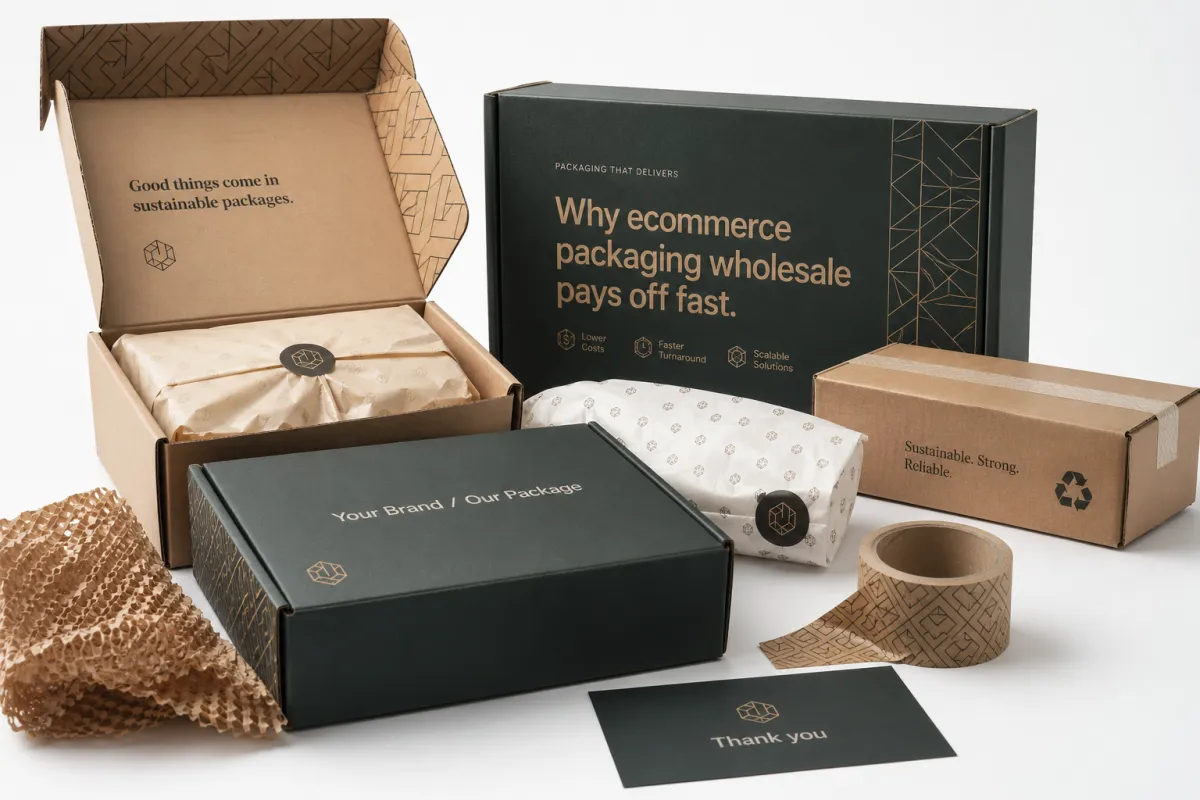
The fastest way to narrow ecommerce packaging wholesale is to start with product weight, breakability, and the real shipping lane. A 4-ounce apparel order can live in a poly mailer or padded mailer, while a glass bottle or mixed kit usually needs corrugated boxes, inserts, and better crush resistance. Once the package has to survive stacking, humidity, or a long last-mile route, the spec changes more than most buyers expect.
From there, compare landed cost instead of unit price. That means unit cost, freight, MOQ, setup charges, and the labor saved or lost on the pack line. If one option reduces dimensional weight, speeds packing, and cuts damage claims, ecommerce packaging wholesale is doing its job even if the per-unit price looks slightly higher on paper.
I also like to sanity-check the packaging against the actual fulfillment flow. If a warehouse is packing 900 orders before lunch, a flap that is hard to fold or a closure that needs a second pass can snowball into overtime. The right material is the one your team can pack fast without babying it. A box that is theoretically perfect but annoying in real life is kind of a trap.
Why ecommerce packaging wholesale pays off fast
Ecommerce packaging wholesale pays off quickly because volume smooths the rough edges of procurement: higher unit prices, repeated setup fees, and packaging drift across SKUs. I saw that during a client meeting with a beauty brand sourcing 12 different mailer styles for 18 products. We standardized the lineup to four sizes, and the buyer told me their packers reclaimed 1.5 hours per shift because nobody had to guess between a 9 x 6 mailer and a 10 x 7 one. Fewer variables, fewer mistakes. That is the practical side of ecommerce packaging wholesale, and it is the part people usually underestimate until their warehouse starts sounding like a broken record of "which carton goes with which SKU?"
In one warehouse walkthrough near Chicago, I handled two boxes that looked the same from arm's length. One was 32 ECT single-wall board; the other was 44 ECT with a denser liner and tighter score lines. The freight class outcome was different, the corner crush resistance was different, and so were the claims. The buyer had been losing about $6,000 a month in replacements because the cheaper box flexed under stacked pallets. I still think about that because the fix was so unglamorous and so effective. That is the kind of hidden gap ecommerce packaging wholesale can close when the spec is written correctly.
The quiet costs usually matter more than the obvious ones. A $0.12 savings on a mailer can disappear once a repack takes 45 seconds, a customer emails photos of a crushed sleeve, and support spends 8 minutes opening a ticket. Add return freight, reshipment, and the brand friction of a poor unboxing, and the cheap option stops looking cheap. I get frustrated with this because it is basic math dressed up as a "good deal." A lot of teams underbuy packaging because they price the box, not the failure. Ecommerce packaging wholesale works best when unit cost, freight, damage, and labor are treated as one equation.
Scale also makes reordering easier. Once you lock a dieline, print spec, and insert profile, you can replenish the same ecommerce packaging wholesale setup in 10,000-unit blocks without retraining the pack line. That consistency matters for apparel, supplements, electronics, and subscription kits, where a 2 mm dimension change can cause a stockout of the wrong size or a wasted carton of oversized void fill. The best procurement teams keep a master spec sheet, a reorder trigger, and a safety stock number for each format. I know that sounds annoyingly orderly, but the alternative is chaos with a barcode.
What most people miss is that ecommerce packaging wholesale is part of the product, not just the shipment. A matte black mailer, a kraft shipper, or a printed insert changes how the customer reads the brand before they even touch the item. I have seen a cosmetics founder lift repeat purchase feedback by switching from plain poly to a small set of Custom Printed Boxes and coordinated tissue in a 6,000-order month. The mailer did not sell the product alone, but it made the product feel worth the price. That feeling matters more than teams admit in boardrooms.
"We thought we were saving 9 cents a unit," one operations director told me after a six-month trial, "but the real win was cutting damage claims from 4.1% to 1.2%."
Product types in ecommerce packaging wholesale
Ecommerce packaging wholesale covers more than corrugated cartons. The main formats are corrugated mailers, shipping boxes, padded mailers, poly mailers, inserts, and branded unboxing components such as tissue, belly bands, and thank-you cards. Each one solves a different problem. A 2-ounce apparel order does not need the same board grade as a 3-pound skincare bundle, and a subscription kit with six components needs different internal separation than a single item shipped in a poly bag. Matching the format to the product is the fastest way to keep ecommerce packaging wholesale efficient.
For apparel, cosmetics, and soft goods, poly mailers or padded mailers often win on speed and cost. They can run as low as $0.11 to $0.24 per unit in high quantities, and they reduce cube better than a box for lightweight orders. For supplements, electronics, and fragile accessories, corrugated boxes and inserts are usually safer because they handle compression and puncture better. I have seen a vitamin seller switch from a flat mailer to a 200# test shipper box and drop corner damage by 60% in two shipping lanes. That is not magic; it is right-sizing in ecommerce packaging wholesale.
Stock packaging makes sense when the launch is small, the graphics are simple, or speed matters more than brand expression. Custom packaging earns its keep when monthly volume climbs, the brand needs shelf presence, or the unboxing moment is part of acquisition. If you are ordering ecommerce packaging wholesale for a subscription kit that ships 2,500 units a month, a custom-printed insert and a standard shipper can be a smart middle path. If you are shipping 40,000 apparel orders a month, a fully branded mailer often pays back faster than teams expect. I have yet to meet a finance person who loves that sentence; they usually pretend not to hear it.
Ecommerce packaging wholesale can do three jobs at once: protect the item, present the brand, and speed up the pack line. That matters in busy fulfillment centers, where a 6-second pause per order compounds into overtime. When I visited a third-party logistics facility outside Dallas, the manager showed me a bin system where every box had a large color-coded label and every insert was pre-folded. Pack rate improved from 180 orders per hour to 214, mostly because they had reduced decision fatigue. Good ecommerce packaging wholesale is operational design as much as print.
There is also a clear difference between single-item and multi-item packaging. A single T-shirt in a size-medium poly mailer wants a different solution than a skincare bundle with three glass bottles and a carded insert. For multi-item kits, internal fit matters as much as outer dimensions, especially if you are using custom printed boxes or branded packaging with more than one cavity. In practice, I tell buyers to map every order profile by weight, fragility, and item count before they quote ecommerce packaging wholesale. That one exercise usually saves two or three rounds of rework, which is a polite way of saying it saves a small mountain of annoyance.
| Format | Typical spec | MOQ example | Example unit price at 5,000 | Best fit |
|---|---|---|---|---|
| Poly mailer | 2.5 mil, 14 x 19, self-seal | 1,000 | $0.15 | Apparel, soft goods |
| Padded mailer | Craft exterior, bubble or paper lining | 2,000 | $0.24 | Accessories, cosmetics |
| Corrugated mailer | 32 ECT, 12 x 9 x 2 | 1,000 | $0.41 | Books, small kits |
| Custom printed box | 200# test or 32 ECT, four-color print | 3,000 | $0.89 | Retail packaging, branded kits |
| Insert set | 350gsm C1S artboard, die-cut slots | 5,000 | $0.14 | Fragile multi-item shipping |
Ecommerce packaging wholesale buyers usually get the best result by mixing formats instead of forcing one material to do everything. A premium apparel brand shipping 18,000 orders a month might use a poly mailer for direct-to-consumer orders, a rigid mailer for gift sets, and a branded insert inside the larger boxes. That blend keeps product packaging economical while preserving package branding where customers actually see it. If you need a broader view of available formats, our Custom Packaging Products page is a practical starting point, especially if you want to compare mailers, inserts, and custom printed boxes side by side.
For buyers who want scale pricing, our Wholesale Programs are built around reorder consistency, not one-off novelty runs. That matters because ecommerce packaging wholesale should protect your supply chain, not complicate it with five different box families and no clear reorder rules. A clean format plan is easier to forecast, easier to store, and easier for your pack line to execute on a Monday morning with 1,200 orders waiting.
Material and performance specifications to compare
Ecommerce packaging wholesale gets expensive when buyers talk in adjectives instead of specs. I ask for board grade, caliper, print method, closure type, and target weight before I ask for price. If a supplier knows whether you need 24 ECT, 32 ECT, or a 200# test box, the quote becomes useful instead of decorative. On the print side, flexographic printing, litho-lam, and digital each carry a different cost curve, and that curve changes again once you add varnish, foil, or soft-touch lamination to ecommerce packaging wholesale.
Size precision matters more than many teams expect. A box that is 1 inch too long can trigger extra void fill, more freight cube, and slower packing. A mailer that is 0.5 inch too tight can crush corners and force repacks. I have seen this in a supplement client meeting where the team had a carton that looked "close enough" on paper, yet the 12-count inner tray rattled because the internal tolerance was off by 3 mm. The result was a 2.8% damage rate until the insert was corrected. That is why ecommerce packaging wholesale should always be quoted against exact inside dimensions, not only the outside size.
Performance specs are not abstract. Crush resistance, puncture protection, and moisture behavior all affect what happens after the box leaves your dock. If shipments are stacked in a 48-inch pallet column, stackability matters. If orders travel through a humid lane, moisture resistance matters. For rigid or high-value retail packaging, a buyer may want a clay-coated liner or a film laminate; for recycled-content programs, they may prefer uncoated kraft with water-based inks. I usually point teams to ISTA test standards because a packaging test protocol gives you more truth than a sales sample ever will.
Sustainability also belongs in the spec sheet. Procurement teams increasingly ask for recycled content percentages, curbside recyclability, and source certification. A box made with 80% recycled fiber and an FSC-certified paperboard can satisfy both brand and compliance goals, but only if the print finish does not block recyclability. I have seen teams lose a recycling claim because they used an unnecessary plastic lamination on a carton that could have worked with aqueous coating. For brands that care about material recovery, the EPA recycling guidance is a good baseline for making those claims carefully.
Ecommerce packaging wholesale works best when you build a one-page spec sheet before you request quotes. Include inside dimensions, board grade, fluting, closure style, print coverage, target ship weight, and whether the item will see drop tests such as ISTA 3A or ASTM D4169. That level of detail saves time on both sides. In one factory negotiation I sat through in Shenzhen, the buyer brought a two-line brief. We spent 19 minutes correcting the dieline, 14 minutes on ink density, and another 11 minutes on the insert fit. The second-round quote was accurate; the first was not even close. I left that meeting with a headache and a renewed respect for people who actually write specifications.
"If the spec sheet is vague, the quote is fantasy," a production manager told me during a line audit, and after watching three revision cycles on 6,000 printed cartons, I agree.
Ecommerce packaging wholesale pricing and MOQ
Ecommerce packaging wholesale pricing is shaped by material, size, print coverage, finish, tooling, and freight distance. A plain stock poly mailer and a four-color custom box live in different economies. The poly mailer may start around $0.11 per unit, while a custom printed box with coated art paper and a matte finish can sit above $0.85 per unit at the same volume. That spread is normal. What matters is whether the packaging cost matches the product margin, the shipment profile, and the brand value you are trying to create through ecommerce packaging wholesale.
MOQ means minimum order quantity, and it can change cash flow fast. A 5,000-unit minimum for a custom insert might be manageable if you ship 1,200 kits a month, but it is awkward if you are still testing the market at 300 units a month. Stock items usually carry lower minimums because there is no new tooling or print setup. For ecommerce packaging wholesale, ask for tiered quotes at 1,000, 3,000, 5,000, and 10,000 units so you can see where the breakpoints actually land. Sometimes the step from 3,000 to 5,000 cuts unit cost by 18%; sometimes it only cuts 4% and ties up storage. The spreadsheet never tells you that with any enthusiasm, so you have to ask directly.
I always tell buyers to ask for five numbers before they approve a purchase: unit price, setup or plate charge, sample fee, expected freight, and the MOQ by exact SKU. Those numbers reveal the real landed cost. I have watched a team choose a quote that was $0.07 cheaper per box only to discover that freight added $480 and the plate charge added $620, erasing the savings on the first run. Ecommerce packaging wholesale should be judged on landed cost, not showroom math.
Stock pricing versus custom pricing is where the biggest jump usually appears. A stock 9 x 6 x 2 mailer may be cost-efficient at 2,000 units, while a custom printed box of the same size may make more sense at 10,000 units because the brand value offsets the setup. The same logic applies to branded packaging and package branding: if the print area is small and the order cadence is steady, custom can be justified earlier than many teams think. If the order volume is unstable, a hybrid approach to ecommerce packaging wholesale often beats a full custom rollout.
There is also a storage cost that never shows up in the quote. A pallet of 10,000 oversized cartons takes space, and space costs money in a fulfillment center. A buyer in New Jersey once told me their warehouse charged an internal handling cost of $18 per pallet per month. The "cheaper" 14-inch box was actually the more expensive choice because it consumed twice the footprint of a 12-inch version. That is why ecommerce packaging wholesale should be reviewed with the warehouse manager, not only the finance team. I would trust the warehouse manager first, frankly; they are the ones staring at the pallet stack when the rest of us are in meetings talking about "efficiency."
To make pricing easier to compare, ask each supplier for quotes on the same spec family: one stock version, one light-custom version, and one fully custom version. In practice, that gives you a cleaner view of the price curve. It also helps if you are trying to decide between ecommerce packaging wholesale and a phased rollout, where you start with stock packaging and move into custom printed boxes once the reorder rate is proven.
Production process and timeline for ecommerce packaging wholesale
The production path for ecommerce packaging wholesale is usually discovery, specs, proofing, sampling, approval, production, quality review, and shipment. Stock items can move quickly because the carton already exists, the print is already set, and the warehouse may only need labeling. Custom orders take longer because artwork, dielines, and material selection all have to be checked before the press runs. For planning purposes, I tell clients to separate "time to quote" from "time to ship"; those are not the same number, and confusing them creates missed launch dates. I have seen a launch slip by two weeks because someone assumed a quote meant the boxes were already on a truck. They were not, and the silence on the other end of the call was very educational.
Proof approval is the most common bottleneck. It can add 2 days or 12 days depending on how many people need to sign off on the print, the insert layout, and the color target. I have seen a food brand lose an entire production week because the legal team wanted one extra line on the side panel and nobody updated the dieline in time. The result was not dramatic, just expensive. That is why ecommerce packaging wholesale should always include a clear proof review owner and a back-up approver.
Good inputs speed everything up. If you send dimensions, target quantity, artwork files in vector format, preferred material, closure style, and delivery ZIP code in the first email, you are already ahead of most buyers. That reduces revision rounds and helps the supplier quote freight properly. I also recommend adding three operational details: ship date, expected monthly reorder volume, and whether the packaging will be used for single-item or multi-item shipping. Those three lines make ecommerce packaging wholesale much easier to schedule.
Some delays are preventable. Missing bleed on artwork can hold a press proof for 48 hours. An unclear dieline can force a new sampling cycle. Late color approval can move a carton order from one press slot into the next. On a supplier call in Guangdong, I watched a buyer lose a five-day window because the team had approved a kraft texture sample before checking whether the ink would hold on that surface. The fix was simple: switch to a smoother liner and approve the test sheet. With ecommerce packaging wholesale, small decisions can ripple through the calendar.
A practical planning framework is easy to use. Stock packaging usually needs less lead time, custom packaging needs more, and any order with inserts or mixed components needs extra buffer. I advise buyers to work backward from the launch date and build in 10 business days for proofing, 10 to 15 business days for production, and 5 to 7 business days for freight if the order moves by ocean or cross-country truck. That is not a guarantee; it is a realistic planning floor for ecommerce packaging wholesale when the artwork is clean and the specs are final.
Ecommerce packaging wholesale also benefits from a quality control checkpoint before shipment. A 10-carton pull, a 100-unit print check, or a compression sample can save a week of rework later. I have seen teams ignore that step and accept a color drift of Delta E 4 when their brand standard required Delta E 2 or better. The prints looked "close enough" in the warehouse lights, but not under retail lighting. For retail packaging, close enough usually means a refund later, and nobody enjoys explaining that to a founder who thought the mockup was final.
Why choose us for ecommerce packaging wholesale
At Custom Logo Things, the point of ecommerce packaging wholesale is not to flood you with options; it is to narrow the field to the formats that will actually ship well and present well. I care about consistent quality, clear communication, and production choices that hold up after the first 1,000 orders. A packaging partner should tell you whether a 24 ECT box is too light for a 7-pound kit, or whether your artwork needs a smoother substrate to avoid dot gain. That kind of guidance is what turns ecommerce packaging wholesale into a decision you can defend internally.
I have sat in vendor meetings where the quote looked good on page one and fell apart on page two because every detail was hand-waved. Our approach is the opposite. We ask for the spec sheet, the monthly run rate, the shipping method, and the target unboxing effect. Then we compare alternatives like stock versus custom, or poly mailers versus custom printed boxes, and we explain the trade-offs in dollars and in handling time. That is especially useful if you are buying ecommerce packaging wholesale for several product lines and want the same visual language across all of them.
One cosmetics client came to me after a supplier had promised "premium" retail packaging but delivered a carton with weak color registration and lids that popped open in transit. We rebuilt the package with a tighter score line, a 350gsm cover, and a matte aqueous finish. Damage dropped, but so did reorder confusion because the SKU family finally shared one spec. That is the kind of operational cleanup that ecommerce packaging wholesale should deliver. Branded packaging should support the product, not force the warehouse to improvise.
We also help buyers think beyond the first run. A good wholesale plan includes reorder thresholds, backup sizes, and a simple way to scale from 3,000 units to 15,000 without redesigning the structure. If you use our Wholesale Programs, the goal is to keep the packaging family stable while giving you room to adjust print coverage or insert details as the brand grows. That stability matters because ecommerce packaging wholesale should be predictable enough for operations and flexible enough for marketing.
Honestly, the best packaging partners do one thing better than everyone else: they reduce uncertainty by 20% or 30% before a PO is issued. That can mean a cleaner proof, a more realistic freight estimate, or a warning that your chosen coating will scuff under a 3-foot drop test. In a market where a 2-cent mistake can become a 200-unit claim, that kind of support is worth a lot. If you want ecommerce packaging wholesale that supports conversion and retention, not just shipment, the buying process has to be that disciplined.
"The supplier who saved us 11 cents on paper cost us two weeks of delays," a brand manager told me, "so now we ask for proof timing, freight assumptions, and QC steps before we compare price."
Next steps for ordering ecommerce packaging wholesale
Start with numbers. Before you request ecommerce packaging wholesale quotes, gather product dimensions, average unit weight, monthly volume, target launch date, and the number of SKUs you want to cover. If you only have two packaging formats in mind, that is fine. In fact, that is often better than presenting five half-formed ideas. A buyer who knows they need 12 x 9 mailers and 10 x 8 custom printed boxes will get a much cleaner quote than a buyer asking for "something branded" with no size, no finish, and no freight destination.
Next, ask for a quote package that includes unit pricing, MOQ, sample options, production lead time, and freight assumptions. I would also ask for one line on setup charges and one line on what changes if the order scales from 5,000 to 10,000 pieces. That lets you see where the cost curve bends. A smart ecommerce packaging wholesale comparison usually includes at least two spec configurations: one cost-lean and one performance-lean. Small changes in board grade, closure style, or print coverage can shift unit cost by 15% to 40%.
If you are sending a first outreach email, keep it tight and specific. Include: product type, exact dimensions, monthly quantity, shipping method, whether the order is fragile, whether you need custom printing, and whether you want sample approval before production. Add your delivery ZIP code and ask for a landed-cost estimate, not just a factory price. That brief is enough for most suppliers to respond accurately. It also shows that you understand ecommerce packaging wholesale as a system, not a catalog exercise.
Then compare the results against what the packaging must actually do. If the goal is lower damage, ask for stronger board or more internal support. If the goal is faster packing, simplify the structure and reduce fillers. If the goal is better brand recall, shift the print budget into the lid, sleeve, or insert where the customer sees it first. I have found that ecommerce packaging wholesale becomes much easier once the buyer can rank those priorities in order: protection, speed, presentation, cost.
Finally, request samples, confirm the spec, and lock the reorder plan. That sounds basic, but it is where many programs fail. A sample approved at desk level may not survive a 4-foot drop, and a pretty box may not fit the real product once the insert is installed. If you want ecommerce packaging wholesale to work across the next three quarters, build the plan around the actual carton, the actual freight lane, and the actual reorder rhythm. Then keep the spec sheet on file so the next purchase is faster, cleaner, and cheaper than the first.
For a direct path forward, send your dimensions, monthly volume, and artwork needs, request samples, confirm the exact specs, and compare two landed-cost scenarios before you place the order. That is the most practical way to buy ecommerce packaging wholesale without getting trapped by avoidable freight, excess filler, or a design that looks better than it ships.
What is the minimum order for ecommerce packaging wholesale?
MOQ varies by packaging type, print complexity, and material, and stock items are usually lower than fully custom runs. For example, a plain poly mailer may start around 1,000 units, while a custom printed box may begin at 3,000 or 5,000 units. Ask for tiered quotes at 1,000, 3,000, and 10,000 pieces so you can see how the economics change before you commit to a larger ecommerce packaging wholesale program.
How long does ecommerce packaging wholesale production usually take?
Stock packaging can often ship faster because there is no print setup or tooling step, while custom orders usually take longer because proofing, sampling, approval, and production all add time. A practical planning window is 10 business days for proofing, 10 to 15 business days for production, and another 5 to 7 business days for freight, depending on the route. Build in extra buffer if your ecommerce packaging wholesale order needs artwork revisions or seasonal capacity.
Which materials work best for ecommerce shipping packaging wholesale?
Corrugated board is a strong choice for fragile, heavy, or multi-item shipments because it handles compression and puncture better than lighter materials. Poly mailers or padded mailers can be efficient for lightweight apparel and soft goods, especially when the goal is to cut cube and packing time. The right answer depends on weight, breakage risk, and the unboxing experience you want from your ecommerce packaging wholesale setup.
Can I get custom printing on ecommerce packaging wholesale orders?
Yes, many wholesale packaging programs support logos, brand colors, and full-panel artwork on boxes, inserts, and mailers. Print method and coverage affect cost, lead time, and MOQ, so the design should match the budget and the shipping profile. Simple artwork usually produces faster approvals and fewer color-matching issues, which is one reason many buyers begin with a smaller ecommerce packaging wholesale pilot before moving into broader custom coverage.
How do I reduce cost when buying ecommerce packaging wholesale?
Right-size the packaging to cut dimensional weight and filler material, and standardize a few core sizes instead of ordering many custom variations. Compare landed cost, not only unit price, because freight, damage, and returns change the real total. If you can simplify the print coverage or move from one-off sizes to a repeatable family of cartons, ecommerce packaging wholesale usually becomes cheaper and easier to reorder.


