Buyer Fit Snapshot
| Best fit | Brand Packaging Wholesale projects where brand print, material claims, artwork control, MOQ, and repeat-order consistency need to be specified before quoting. |
|---|---|
| Quote inputs | Share finished size, material target, print colors, finish, packing count, annual reorder estimate, ship-to region, and any compliance wording. |
| Proofing check | Approve dieline scale, logo placement, barcode or warning zones, color tolerance, closure strength, and carton packing before bulk production. |
| Main risk | Vague material claims, crowded artwork, missing packing details, or unclear freight terms can make a low unit price expensive after revisions. |
Fast answer: Brand Packaging Wholesale: Pricing, Specs, and Ordering should be specified like a repeatable production item. The safest quote records material, print method, finish, artwork proof, packing count, and reorder notes in one written spec.
Production checks before approval
Compare the actual filled-product size with the drawing, then confirm tolerance on folds, seals, hang holes, label areas, and retail display edges. Reserve space for logos, QR codes, warning copy, and material claims before decorative graphics fill the panel.
Quote comparison points
Review material grade, print process, finish, sampling route, tooling charges, carton quantity, and freight assumptions side by side. A quote is only useful when the supplier can repeat the same color, closure quality, and packing count on the next order.
Brand Packaging Wholesale: Pricing, Specs, and Ordering
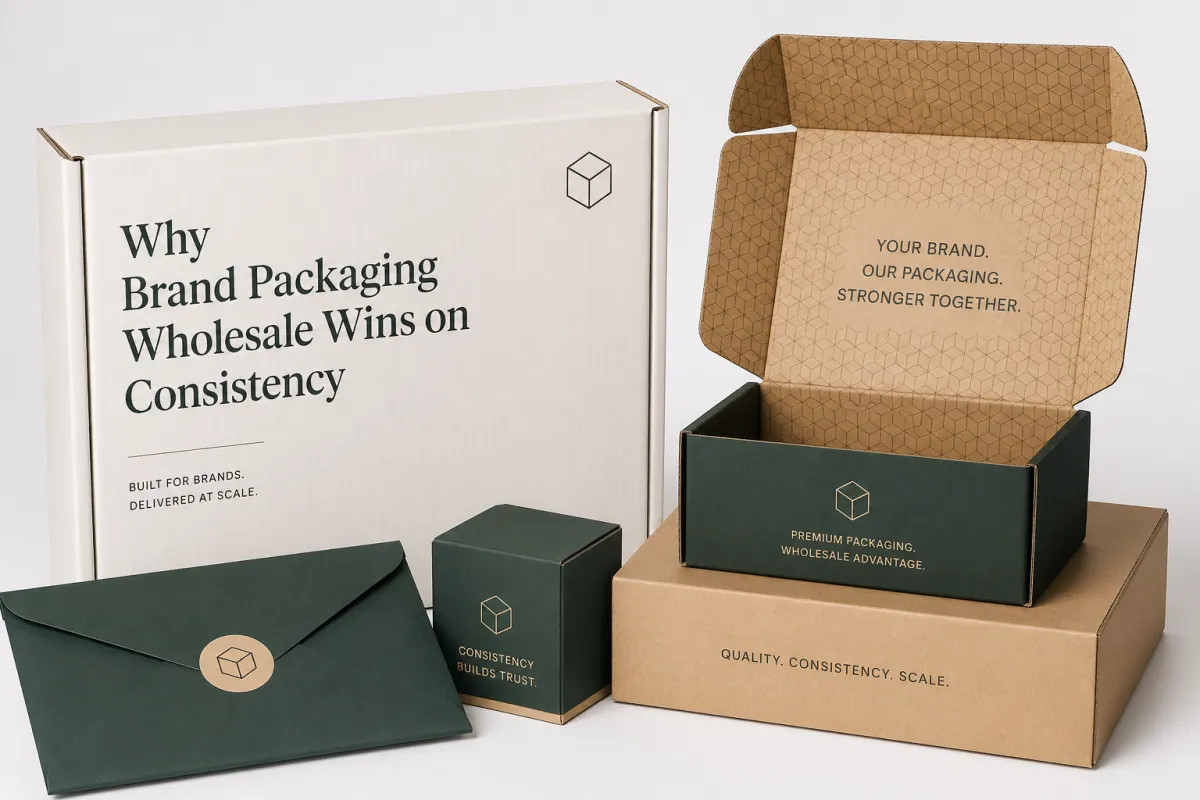
One packaging mismatch can erode trust faster than a markdown can rebuild it. I have watched a premium serum line lose shelf credibility because the carton finish shifted from soft-touch to plain matte across a reorder. Same artwork. Same logo. Different feel. Buyers notice that stuff, even if they can’t name the substrate. That is why serious teams move toward brand packaging wholesale sooner than they expect.
In practical terms, brand packaging wholesale is not a buzzword. It is a repeatable operating model: locked structure specs, controlled approvals, and pricing that starts to make sense only when volume, timing, and file control stop drifting around. Once those variables settle, packaging becomes a system instead of a scramble.
For branded packaging teams, the useful questions are rarely glamorous. What does setup really cost? Which specs actually affect performance? Where do lead times slip? Those answers matter across product packaging for ecommerce, retail, and wholesale distribution. They also decide whether your packaging branding feels deliberate or kinda slapped together.
Why Brand Packaging Wholesale Wins on Consistency
One visual slip can cost more than a print correction
A packaging mismatch can wreck perceived value in a single shipment. If your ecommerce campaign promises premium and half the boxes land with a different sheen, buyers usually do not blame the printer. They blame the brand.
Brand packaging wholesale reduces that risk because the spec does not get reinvented with every reorder. Structure, substrate, ink, and finish standards are locked, reused, and checked against the same benchmark. In high-volume programs, that predictability is often worth more than a slightly lower unit price from a one-off vendor.
When wholesale makes commercial sense
Wholesale buying starts to make sense when demand is repeatable: multiple SKUs, subscription drops, monthly launches, and mixed channels like Amazon, DTC, and retail counters. Packaging stops acting like decoration and starts behaving like an inventory component.
Picture a beauty line with 10 SKUs across refill packs, sample kits, and holiday bundles. Each SKU has different internal dimensions, yet the carton class and finish rules stay close. Instead of treating every order as a fresh design project, brand packaging wholesale turns them into a controlled family of package branding assets with version control built into the process.
The cost logic nobody reads first
Setup has fixed friction. Plate making, die setup, prepress review, and color calibration do not scale down linearly with quantity. Whether the run is 500 pieces or 2,500, those steps still happen once. That is why unit economics improve when lots get larger and specs stop changing.
Run the math: if setup is $420 and variable cost is $0.90 per unit, the per-unit cost works out to $1.74 at 500 pieces and $1.07 at 1,000 pieces. Freight and fulfillment overhead can push that higher or lower, but the pattern stays the same.
Apply that to two channels at once. A standard mailer order of 1,200 units might land at $0.90 each with standard shipping. Add a second channel that needs an extra insert and a color variation, and the unit cost can climb to $1.30 if handled separately. With a wholesale framework across both channels, insert and proof costs are absorbed once, and only the variable pieces move with quantity.
Consistency is brand protection, not just aesthetics
Most buyers underestimate the operational cost of inconsistency. Different unboxing experiences create avoidable customer service tickets: "the lid is loose," "my label is blurry," "this version looks older." That is reputational drag with a postage label on it.
Brand packaging wholesale protects the unboxing experience at scale: same fold accuracy, same color values, same insert placement, same finish response to touch. If your team can recreate the first-batch feel on the 10,000th box, consistency becomes a measurable asset rather than a nice-to-have.
Control with room for negotiation
The decision is not about taking the lowest quote. It is about getting the lowest controllable total cost with predictable quality. In brand packaging wholesale strategy, control includes material substitutions, approved finish stack, approved color references, and a clear tolerance for revisions.
Honest expectation: wholesale does not always produce a lower per-unit quote on day one. Sometimes the first batch costs about the same as spot sourcing. The value shows up in branded packaging governance: fewer surprises, faster reorder cycles, fewer complaints, and fewer emergency airfreight corrections. In my experience, that is where margins get protected.
"A reliable structure beats a prettier one-off print when your team ships weekly. The buyer who controls variance buys fewer emergency reprints."
What Should You Check Before Ordering Brand Packaging Wholesale?
Before you request a quote, decide whether your brand packaging wholesale program is being judged on shelf impact, shipping durability, or both. That answer changes the material stack, the finish list, and the tolerance range. A box that looks perfect in a mock-up can fail the real test if the fold memory is weak or the insert shifts under pressure.
Use this quick filter before any production slot is booked:
- Dimensions: confirm product size, insert depth, and headspace.
- Channel fit: match the format to ecommerce, retail packaging, or wholesale distribution.
- Artwork: lock copy, barcodes, and legal text before proofing starts.
- Budget: separate setup cost from landed cost so the comparison is real.
- Timeline: factor in sampling, approvals, freight, and receiving windows.
If one of those inputs is still moving, your brand packaging wholesale quote is only a placeholder. The teams that save money usually do not start with the cheapest supplier; they start with the clearest brief.
Brand Packaging Wholesale Product Options
Picking the format before arguing over price is where many teams lose momentum. Brand packaging wholesale buyers who start with structure and channel fit usually outpace teams that begin with “I want this design everywhere.”
Map the core categories by job, not by trend.
Mailer boxes
Mailer boxes sit between protection and presentation for direct-to-consumer shipping. For products around 80mm x 120mm x 220mm, a 13pt coated white board with a 300 GSM art card face and a 16-point body can do the job well. They suit medium-weight product clusters where arrival moment matters almost as much as transit durability. In a brand packaging wholesale program, mailers often become the baseline format because they scale cleanly across multiple SKUs.
Folding cartons
Folding cartons work when shelf fit matters and visual cues carry more weight than impact resistance. Cosmetics, nutraceuticals, and accessories often use 300-350 GSM SBS (solid bleached sulfate) with silk or matte finish. The printable surface is excellent, folding is fast, and panel transitions stay efficient at scale. For Custom Printed Boxes that need frequent replenishment, folding cartons are often the most practical route.
Rigid boxes
Rigid packaging is heavier, sturdier, and usually more expensive, with build profiles that include white chipboard, corrugated reinforcement, and rigid inserts. Typical use: premium sets, gift editions, electronics peripherals, and any brand that depends on shelf authority. You rarely need rigid for lightweight consumables unless your package branding strategy depends on a luxury shelf moment. In that case, brand packaging wholesale becomes less about savings and more about signal control.
Shipping boxes
Shipping boxes exist for abuse resistance and dimensional efficiency. Double-wall corrugated, often 5-ply or 7-ply depending on route profile, is common. If your product raises a drop-test concern, these are not decorative tools. They are logistics infrastructure, and the job is damage prevention first. For many brand packaging wholesale buyers, this is the format that keeps return rates from climbing.
Paper bags
Paper bags serve impulse purchases and in-person touchpoints well, especially for retail packaging where weight is low and handling is constant. Custom Printed Kraft Paper bags for light products often sit between 80 and 120 GSM. For food-adjacent retail, barrier films and liners become critical rather than optional. They also matter when your branded packaging needs to carry a premium feel out of the store and into the street.
Tissue
Tissue gets overlooked in wholesale planning. Correctly spec'd tissue adds tactility without pushing the cost curve too hard. A 100-120 GSM embossed tissue for bundles or inserts can replace foam-like fillers in some categories and can be layered with kraft and printed motifs for stronger presentation. In brand packaging wholesale, tissue is a small line item with outsized influence on the unboxing experience.
Labels, stickers, sleeves, and inserts
These are the highest-use accessories in a modular supply model. Pre-cut labels and adhesive sleeves work well for short-format updates such as legal copy changes, QR revisions, and seasonal campaigns. Inserts are where many brands gain efficiency: one insert family can support several box SKUs by changing only the brand sheet or message card. That is especially useful when brand packaging wholesale programs need to stay current without retooling the full structure.
- Labels: fast turnaround, useful for legal, regional, and limited batch updates.
- Stickers: useful for promotions, batch coding, and compliance marks.
- Sleeves: visible branding with less full-structure change risk.
- Inserts: protect and reinforce message architecture inside premium product packaging.
Matching format to product and channel
Overbuilt packaging burns cash. If average weight is under 350 grams and fragility is low, rigid packaging should not be the default. For stable ecommerce products, a strong mailer and printed insert often outperforms rigid on 30-60% lower cost per unit while still preserving perceived value.
Retail counters change the equation. Shelf theft resistance, top-open handling, and tamper cues matter more there. A retail packaging format with reinforced corners and clear face graphics usually beats a lighter shipping-first solution. That is one reason brand packaging wholesale planning has to start with the channel, not the art file.
Custom print, stock + labels, or hybrid
Three sourcing styles, one budget goal:
- Custom printed boxes: highest branding control, highest setup, lowest per-unit at higher volume.
- Stock packaging with labels: fastest, lower entry cost, better for seasonal campaigns and legal changes.
- Hybrid: stock base + custom front label, useful for balancing cycle time and visual differentiation.
Brand packaging wholesale teams often move in a hybrid ladder: launch with stock and labels, then shift to custom printed boxes once sales data stabilizes. That path lowers first-order risk and keeps margin pressure under control.
Bundle thinking changes procurement complexity. If the box, shipper, insert, and labels come from one approved structure, your team avoids three purchase orders, three production calendars, and three quality checkpoints. It also makes brand packaging wholesale easier to forecast, because one family of specs can support several product launches.
Brand Packaging Wholesale Specifications That Matter
Dimensions, tolerances, and fit engineering
Dimensions are where expensive mistakes start. A tolerance of plus or minus 1.0 to 1.5 mm can be fine for some folded cartons, while corrugated structures often need tighter control for locking tabs. Tolerance should be written into the order, not guessed after the dieline is approved.
Dielines need fold lines, glue flap zones, and cut marks as explicit geometry. Ask whether they are fully compensated for die shrinkage and print drift. If not, the correction gets paid for in returns and rework.
Artwork controls: bleed, safe area, and print position
Brand packaging wholesale specs fall apart when artwork is treated as “close enough.” Set these before quoting:
- Bleed: at least 3 mm, often 3-5 mm for full-bleed packaging.
- Safe area: keep critical text 5 mm away from edges on at least one axis; allow more near folds.
- Color placement: define CMYK values and a fallback if spot colors cannot be held.
If a logo uses white type on brand green, test contrast under warm and cool light. A 6% variation in gloss can pass internal review and still fail channel review if shelf lighting reveals shadow shifts. That kind of miss can be expensive in branded packaging because the print itself may be correct while the perceived quality is not.
Material stack choices that change performance and cost
Material selection is not cosmetic. It changes shipping resilience, print profile, stiffness, and rejection risk. Common families include:
- Paperboard (250-350 GSM): best for folded structures and premium graphics.
- Corrugated board: best for transit stress and heavy products.
- Kraft: natural, often recycled appearance, usually less opacity.
- Coated stock: stronger color and cleaner print surface, but not always the eco-preferred route.
If food contact is involved, bring barrier and certification pathways into the brief early. For non-food protective layers, one grade of stock will not handle every task. Coatings, moisture barriers, and safe inks matter in those environments. In brand packaging wholesale, the material stack should be chosen for the product, not for habit.
Print and finish behavior
Printing method shapes detail and timeline as much as price:
- Digital: strong for shorter runs, variable data, and fast updates.
- Offset: stable color on larger volumes; better consistency for brand identity controls.
- Flexo: useful for mid-to-high volume runs with lower per-unit color variability after setup.
Finishes change both look and handling:
- Foil stamping: premium feel, higher risk of registration issues.
- Embossing/debossing: tactile branding for premium positioning.
- Spot UV + varnish: selective gloss and durability where needed.
- Soft-touch coatings: highly recognizable, but watch scratch tolerance and carton heat.
Every finish adds line items. If a batch mixes matte and gloss with foil and UV, budget for separate approvals. A good brand packaging wholesale spec separates finish priority into “must-have,” “nice-to-have,” and “skip if lead time increases.”
Compliance layer: food, shipping, and barcode standards
Compliance is where wholesale buyers get surprised most often. You do not want to find a legal or logistics problem after proofing has already started.
For shipping and durability, reference logistics guidance such as ISTA handling and stacking expectations for your route profile. For barcode scans, include minimum quiet zone widths and print contrast thresholds in the dieline package.
For recycled claims, verify material chain documentation and chain-of-custody language. Many teams rely on FSC claims without checking final conversion certification. If sustainability messaging appears in the brief, treat documentation as part of production scope, not optional marketing copy.
If food-contact products are involved, confirm the relevant material and ink certifications for your use case. I always tell buyers to verify with legal or compliance early; this is not the place to gamble. A cheaper quote is not a pass if it creates exposure later.
Proofing and color control
Proofing is the cheapest place to catch expensive errors. Good color control includes a first digital proof, a prepress check, and a physical sample when needed. Pantone matching should be reserved for cases where color certainty is critical. Otherwise CMYK proofing with explicit tolerances is often more realistic and cost-efficient.
Never skip sample approval for structural runs. A 1.5 mm panel shift can look harmless on-screen and fail at conversion. Brand packaging wholesale buyers who review mock-ups only in PDF often pay for retooling later.
Set a color drift policy too. If spot color variance exceeds the agreed tolerance, define whether the print partner absorbs the correction or a reprint is triggered. That single clause prevents tense reorder disputes.
Brand Packaging Wholesale Pricing and MOQ
Most pricing questions begin with one assumption: “Why is this quote so high?” The answer is usually not bad printing. It is process design, fixed setup, and sometimes poor quantity planning.
What drives price in real runs
Brand packaging wholesale pricing follows real variables you can model:
- Dimensions: larger panels increase stock usage and shipping volume.
- Substrate: GSM, coating, and quality class directly affect cost.
- Print coverage: full-bleed or heavy ink coverage increases run complexity.
- Finishes: foil, UV, soft-touch, and emboss each add prep and inspection steps.
- Inserts: add dieline and fitting work.
- Tooling: dies, plates, and calibration checks.
- Freight: cubic volume and handling class often dominate outbound cost.
To compare accurately, ask for unit price at your exact dimensions and finish stack. If one quote excludes shrink-wrap and another assumes it, you are not looking at the same production run. The same goes for brand packaging wholesale orders that bundle inserts or labels into the same quote.
MOQ explained without the hype
Minimum order quantity exists because setup time is a fixed cost block. If die changeover takes 2 hours and press calibration takes 45 minutes, those hours must be paid whether the order is 300 or 3,000 units.
Simple packaging categories can carry lower MOQs, especially when print is digital and finishing stays standard. More complex rigid programs and foil-heavy jobs usually need higher MOQs because tooling and inspection overhead are heavier.
Volume, savings, and inventory risk
Unit price usually improves as quantity rises. That pattern holds whether the item is labels, mailers, or rigid structures. The dangerous assumption is that lower per-unit price automatically improves landed cost.
Here is the trap: you discount a 2,000-piece run to $0.70 each, then store 3,000 pieces to avoid a reorder. Carrying inventory has a cost, often 20% to 30% of annualized value through storage, obsolescence, and capital lock. If velocity slows, the price advantage can vanish quickly.
How to compare quotes like a procurement lead, not a bargain hunter
Use landed-cost comparisons with one standard sheet. Keep these fields fixed across suppliers:
- Same dimensions and structure
- Same material class (for example, 350 GSM, white, SBS)
- Same finish stack and color model
- Same delivery window and delivery method
- All setup, freight, and inspection costs included
Do not ask “Which is cheaper?” Ask “Which has the lower landed total for my exact brand packaging wholesale spec and forecast window?” That sounds simple. Plenty of teams still skip it, then spend a week untangling shipping surcharges after approval.
Pricing reference table
| Configuration | Typical Qty Range | Indicative Unit Price (USD) | Setup + Freight Notes | Best Use Case |
|---|---|---|---|---|
| Stock mailer + die-cut label (standard) | 500-1,500 | $0.58-$1.05 | Lower setup, lower flexibility for major graphic shifts | Seasonal promos, short reorders, low-risk SKUs |
| Fully custom folded carton, 4-color | 1,000-4,000 | $1.20-$2.40 | Higher setup, better consistency, good print repeatability | Flagship products and recurring DTC SKUs |
| Rigid packaging with UV/foil effects | 2,000-8,000 | $2.80-$6.20 | Higher setup, stricter QC, stronger unboxing cue | Gift sets, premium launches, retail shelf focus |
| Hybrid stock + label + insert bundle | 750-2,500 | $0.90-$1.75 | Fast turnaround; best if legal text changes frequently | Subscription programs and fast-iterating lines |
Realistic savings levers
Before chasing the lowest bidder, use these practical levers:
- Reduce finishing complexity by dropping foil on the first run and keeping emboss for the second wave.
- Standardize dimensions across SKU families.
- Reduce color changes unless they are required for channel differentiation.
- Combine SKUs around one structure and one substrate for shared setup.
- Use hybrid custom-and-stock packaging for low-margin promotional runs.
These changes can trim cost without flattening brand impact. In practical sourcing reviews, the margin gain from simplification often beats the gain from squeezing print rates.
"The cheapest quote on paper can be the most expensive option after adding freight, quality rework, and one delayed launch."
That is why brand packaging wholesale professionals negotiate on specification discipline first, price second. It also explains why packaging branding should be measured over the full reorder cycle, not just the first invoice.
Process and Timeline for Brand Packaging Wholesale Orders
Now for the part teams ask about most: timing. Yes, the launch can still happen. No, it does not depend on luck. It depends on how much complexity you put into the order.
Workflow from first brief to shipment
- Discovery: target market, SKU list, channel split, required deadlines, budget envelope.
- Dieline review: structural fit, fold line checks, glue area, insert tolerance.
- Artwork setup: color space, safe areas, legal text placement, barcode placement.
- Proof approval: digital and physical depending on the risk profile.
- Production: color setup, press run, curing or coating, die checks.
- Quality control: dimensional checks, visual checks, and functional testing.
- Shipping and receiving: method, warehouse check-in, and replenishment timing.
For a catalog-style reorder with a proven dieline and stable artwork, a brand packaging wholesale flow can close in 10-15 business days. For new structures, layered finishes, and food-contact materials, realistic windows are often 18-28 business days or more.
Where delays happen, in plain terms
- Files uploaded in compressed form or in the wrong color mode.
- Last-minute artwork swaps after proof approval.
- Pantone-to-CMYK negotiation loops that were never scoped.
- Special finish sign-off uncertainty, especially with soft-touch and foil.
- Quantity forecasts that change after production slotting.
Each delay creates a cost: premium labor, expedited freight, or slower replenishment. The teams that stay on schedule keep version control strict from day one and treat “minor edits” as schedule events, not free changes.
Sampling as your insurance policy
Sampling is not a luxury. It is risk management. Structural samples confirm folding, seam locking, and insert fit. Print proofs confirm color drift and registration. Finish samples confirm touch and surface response.
Ask for both when possible before the full run. A sample kit for a complex carton family may save a retool cycle worth 8-15% of total first-order spend. If you are testing a custom printed boxes look and feel, test it physically before committing to the full MOQ.
A practical standard I use: if more than two quality gates are uncertain on paper, stop and sample. If only cost-sensitive details are uncertain, negotiate a conditional adjustment clause and move forward with caution.
Logistics planning before first release
Brand packaging wholesale success is not only about production. Freight method, receiving team, and reorder cadence need to be defined before launch day. If freight is air for one region and truck for another, landed costs and packaging choices may split apart.
Plan storage and replenishment with a minimum stock level tied to forecast. If forecast variance is normal, set the reorder trigger at 30% of target weekly drawdown. That gives room for production variability without stockouts or forced overstock.
If your outbound destination is a warehouse, make sure incoming tolerance and inspection windows are coordinated there. A perfect run delivered to a closed receiving area is still late for operations and still affects cash flow.
Timeline reference by complexity
Simple reorder, approved spec: 10-15 business days.
New structure with one special finish: 14-22 business days.
Multiple finishes or major packaging redesign: 20-30+ business days depending on material and approval speed.
That is realistic, not theoretical. If you are close to a peak shipping season, assume extra lead time for queue pressure and reduced carrier flexibility.
For brand packaging wholesale teams, the key is not speed for its own sake. It is predictably right. A controlled schedule beats a fast schedule if speed arrives with hidden defects.
Why Choose Us for Brand Packaging Wholesale
The advantage here is operational, not decorative. You are not buying a brochure. You are buying a repeatable manufacturing process for branded assets, launch velocity, and quality signaling.
Direct manufacturing oversight reduces handoffs and delay loops. Fewer middlemen mean fewer reinterpretations of your packaging design files and fewer gaps when comments need to move quickly.
What is different in practice
We run tighter quality checkpoints around dieline, structure, and finish because buyers for brand packaging wholesale usually need consistency across multiple drops. One missed gate in one supplier chain can create a ripple of returns and rework.
Our process reduces that risk with clear approval nodes and explicit spec lock points. You know what was approved and what remains outside scope. If a change appears later, it is tracked as an addendum rather than a hidden assumption.
Repeat order stability
Reorders should never begin as a fresh negotiation every quarter. If the SKU and structure are fixed, repeat production should reuse the same specs and require only updated quantity and timing. That is where wholesale programs outperform fragmented sourcing.
With direct sourcing in one program, your team reorders by branded packaging families instead of rebuilding full orders. That reduces procurement friction and lowers the odds of mismatched prints. It also helps keep brand packaging wholesale pricing from drifting with every revision.
Practical support that matters
You should expect help in the places where teams usually lose money: file review, material matching, barcode placement, and seasonality planning. Ask for these up front:
- Technical file checklist before job submission
- Proofing sequence and sign-off matrix
- Material compatibility review for finish durability
- Inventory planning framework for refill and bundle campaigns
Support like that is the difference between buying cheaply once and buying correctly, continuously.
Why fragmented sourcing often backfires
In many older workflows, packaging, inserts, and freight are handled by separate vendors. Responsibility looks clear on paper and blurry in execution. One vendor blames dieline, another blames shipping tolerance, while your team absorbs the delay.
A unified brand packaging wholesale model improves accountability. Clear roles, transparent costs, and coordinated release windows reduce escalation loops and cut down on invisible overhead: the hours spent reconciling three different status systems.
See how that connects with the wider operation. If the goal is scale, look at Custom Packaging Products as the spec anchor, track outcomes through Case Studies, and align timing with your internal Wholesale Programs. That is how the process becomes repeatable in practice.
Credibility is not a slogan. It is proof in process steps, documented control points, and predictable outcomes. I have seen teams save time and reduce disputes after moving from ad hoc sourcing to one managed brand packaging wholesale workflow.
Next Steps for Brand Packaging Wholesale Orders
Stop collecting mood boards and start collecting constraints. Good buyers separate strong ideas from strong purchasing.
Gather your minimum required inputs
Before requesting any quote, prepare:
- Exact product dimensions and weight range
- Target quantity per SKU and forecast duration
- Preferred materials and finish priority
- Artwork files (vector, print references, legal copy)
- Final ship date and receiving destination
That package should include your brand packaging wholesale baseline, not a conceptual style pack. Without dimensions and final legal copy, production risk becomes avoidable only after money has already been spent.
Start with one SKU, then expand
My practical recommendation is simple: validate one hero SKU first. Start with the format closest to current sales volume, then expand once fit, color, and timeline are confirmed.
For example, test one folding carton with one finish first; once it holds in production and logistics, fold it into a full line. That reduces pilot risk and keeps the first decision anchored in operational proof rather than guesswork.
Request quote and sample together
Always ask for quote plus sample package in the same round. Comparing price without a physical sample creates false confidence. You need to see edge behavior, fold memory, print feel, and insert fit.
Ask for:
- Proof image and PDF
- Structural sample dimensions
- Landed cost with setup and freight
- Delivery schedule by production milestone
Yes, this takes more coordination. Yes, it usually prevents a second-order delay.
Build your reorder playbook
Define reorder triggers and storage strategy before the first full shipment. Set minimum stock, average consumption, and safety buffer by channel. If weekly demand can vary, your reorder signal must be measurable rather than emotional.
Most teams fail here because they wait for stockouts to trigger action. A disciplined brand packaging wholesale model uses forecasts and trigger points, then confirms them against lead-time assumptions.
Turn inquiry into purchase order
Use a repeatable sequence: scope, sample review, landed-cost alignment, approval log, production start. If each stage has a date and a responsible owner, your program shifts from negotiation chaos to a repeatable schedule.
To close, remember this: brand packaging wholesale is a system for predictable replenishment, not a one-off sourcing exercise. It works when the process is tight, the specs are complete, and the team treats reorders as a planned business cadence.
Brand Packaging Wholesale FAQ
What is the minimum order for brand packaging wholesale?
MOQ changes by format, substrate, and print process. A simple mailer with standard coating can have a lower threshold than a rigid structure with foil or soft-touch requirements. Higher setup complexity usually means a higher minimum because die preparation and press calibration are fixed costs. If you need a lower entry point, start with one SKU and simplify the finish sequence.
How do I compare brand packaging wholesale quotes fairly?
Compare identical dimensions, materials, print coverage, and finish level. Ask for landed cost, not just unit price. Landed cost should include freight, setup, inspection, and any conversion or handling charges. Verify lead time, proof expectations, and quality gates so no quote hides timing assumptions.
Can brand packaging wholesale orders include multiple SKUs?
Yes. Multi-SKU ordering is common when structure families are shared. It works best when materials and production setup overlap. You can sometimes reach volume bands faster, reduce tooling repetition, and simplify approvals. Separate artwork or finish requirements still need separate proofs, so include that timeline impact in planning.
How long does brand packaging wholesale production usually take?
Simple reorders with approved dielines can move quickly, often 10-15 business days depending on workload and destination. New structures, color-critical approvals, or layered finishes usually take longer because sampling and revisions become part of the schedule. Add extra buffer for seasonal peaks and outbound warehouse coordination.
What files do I need to start brand packaging wholesale?
Start with a dieline, vector artwork, exact dimensions, quantity forecast, and finish notes. Include Pantone or CMYK references if color consistency is critical for your packaging branding. Add destination and required delivery date so freight and scheduling can be quoted accurately.
Final thought: you do not win by making the cheapest box today. You win by proving that your brand packaging wholesale workflow can repeat premium-level delivery across six-, twelve-, and twenty-four-month cycles without hidden costs or random quality swings. The actionable move is simple: lock the spec, approve the sample, and build the reorder around the same measurements every time. That is how branded packaging stops being a design expense and starts acting like controlled growth.


