Buyer Fit Snapshot
| Best fit | embossed folding cartons wholesale branding for packaging buyers comparing material specs, print proof, MOQ, unit cost, freight, and repeat-order risk where brand print, material, artwork control, and repeat-order consistency matter. |
|---|---|
| Quote inputs | Share finished size, material target, print colors, finish, packing count, annual reorder estimate, and delivery region. |
| Proofing check | Approve dieline scale, logo placement, barcode or warning zones, color tolerance, and any recyclable or compostable wording before bulk production. |
| Main risk | Vague material claims, crowded artwork, or missing packing details can create delays even when the unit price looks attractive. |
Fast answer: Embossed Folding Cartons Wholesale Branding: MOQ, Samples, Lead Time, and Quote Checks should be specified like a repeatable production item. The safest quote includes material, print method, finish, artwork proof, carton packing, and reorder notes in one written spec.
What to confirm before approving the packaging proof
Check the product dimensions against the actual filled item, not only the sales mockup. Ask for tolerance on folds, seals, hang holes, label areas, and retail display edges. If the package carries a logo, QR code, warning copy, or legal claim, reserve that space before decorative graphics fill the panel.
How to compare quotes without losing quality
Compare board or film grade, print process, finish, sampling route, tooling charges, carton quantity, and freight assumptions side by side. A lower quote is only useful if the supplier can repeat the same color, closure quality, and packing count on the next order.
Embossed Folding Cartons Wholesale gives a brand something print alone cannot quite deliver: a surface that invites touch before the package is even opened. A raised logo panel, a pressed-in border, or a subtle medallion changes how a carton sits in the hand and how it reads under store lighting. Two boxes can carry the same artwork, the same board, and the same dimensions, yet the one with the embossed detail usually feels more deliberate, more finished, and more worth keeping on the shelf a little longer.
For larger orders, embossed Folding Cartons Wholesale is about far more than one attractive prototype. It has to hold the same presence across a full production run, whether the job supports a new retail launch, a seasonal package, a subscription program, or a line extension that needs to match existing artwork without drifting in quality. Clean structure, disciplined art placement, and the right board selection usually do more for the result than piling on extra finishes.
Anyone comparing vendors should think like a packaging buyer, not only a designer. Ask what board will be used, how deep the emboss will run, how the artwork will be registered, and how the quoted quantity relates to tooling and setup. That turns embossed folding cartons wholesale into a clear purchasing decision instead of a fuzzy premium option. If you need support across more than one packaging category, our Wholesale Programs page is a useful place to begin.
Why Embossed Folding Cartons Wholesale Change Shelf Perception
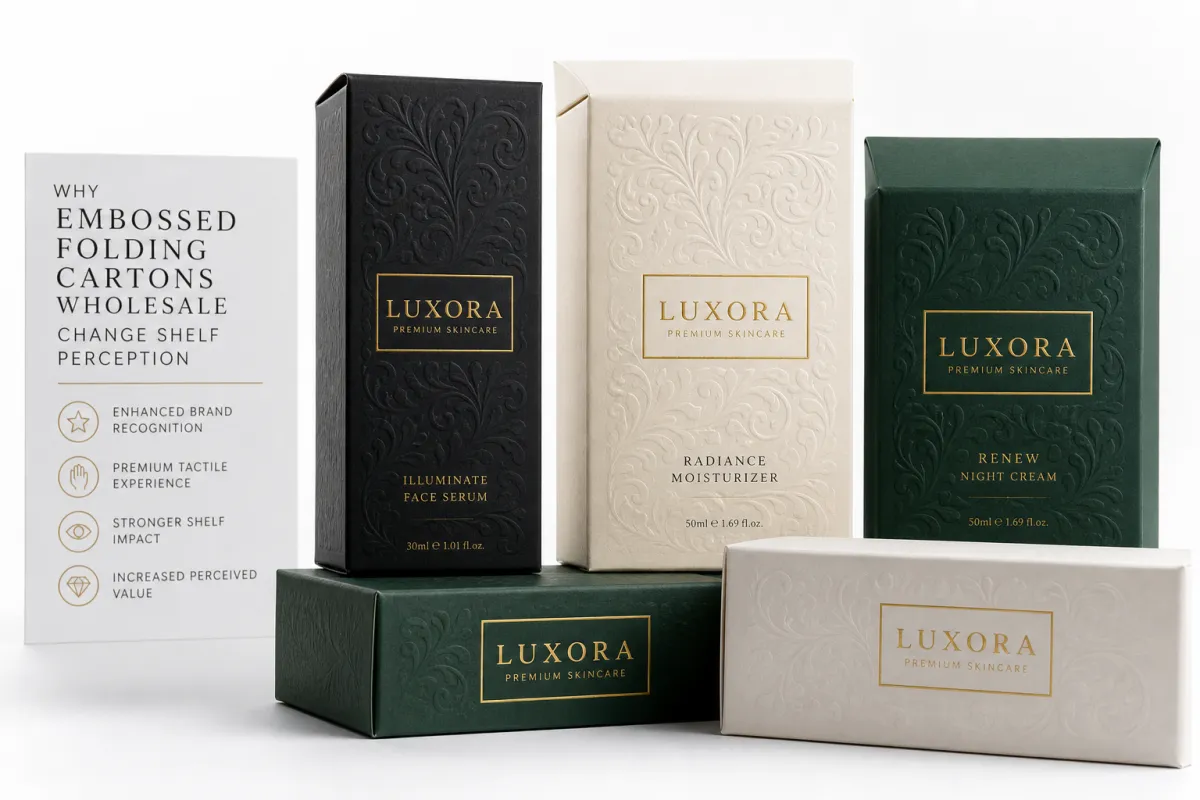
Picture two cartons sitting next to each other on a crowded shelf. The color palette is close, the copy is nearly identical, and both packs use the same basic layout. One front panel is flat. The other carries a raised brand mark that catches the light as soon as someone tilts the carton in their hand. That second pack tends to feel more resolved, and often more expensive, even when the material difference is modest. That is the real strength of embossed folding cartons wholesale: the physical detail leaves a stronger impression than print alone.
Embossing works so well on folding cartons because it adds tactile contrast. The hand notices texture almost instantly. A raised logo, a subtle frame, or a pressed product name gives the carton depth, and depth is read as care. That matters in categories such as skincare, nutraceuticals, candles, chocolates, and specialty retail goods, where many packages share similar board, similar color, and similar shelf behavior. Embossed folding cartons wholesale gives a brand a way to stand apart without turning the front panel into visual noise.
Wholesale ordering also matters because one carton is never the full story. A retail launch may call for 5,000, 10,000, or 50,000 units across several SKU variations, and every carton has to look like it came from the same hand. Set up correctly, embossing creates repeatable presentation from the first case to the last. That consistency is one reason buyers return to embossed folding cartons wholesale after trying flatter, more ordinary options.
The most effective emboss placements are often the most restrained ones. Logos perform especially well when the mark is strong and not overloaded with fine detail. Seal marks and medallions can add authority to the front face. Product names and short claims can be raised just enough to direct the eye. Border accents and framed callout panels also work because they add structure without competing with the artwork. In practice, embossed folding cartons wholesale should support the design, not fight it.
In the packaging reviews I have done, the cartons people keep in hand are usually the ones with one clear tactile idea, not three competing ones. If a brand tries to stack too many effects on one front panel, the pack can start looking busy instead of premium, and that kind of defeats the point.
- Logo panels create the fastest premium signal on shelf.
- Seal marks work well for giftable or heritage-style packaging.
- Product name embossing helps the eye lock onto the main message.
- Border accents add dimension without crowding the front face.
- Corner relief gives a subtle architectural look on clean carton designs.
Retail buyers notice that difference too. They need packaging that photographs well in line sheets and still looks convincing under bright store lighting. Embossed folding cartons wholesale gives them a carton that feels purposeful in both settings, which helps the product line carry a stronger story from the first presentation to the final display.
Embossed Folding Cartons Wholesale: Product Details That Matter
A folding carton begins as a printed flat and ends as a retail-ready package that folds cleanly, glues properly, ships efficiently, and protects the product in the fulfillment chain. That is why embossed folding cartons wholesale should be treated as a structural decision, not only as a decorative one. Common board choices include SBS, C1S artboard, and selected recycled paperboards, depending on print quality, stiffness, and the visual finish you want. For many retail jobs, 14pt to 24pt board is a practical range, though exact caliper depends on product weight and carton style.
Embossing itself comes in a few forms. A blind emboss raises the paperboard without printed registration on top of it, which creates a clean tactile effect and a softer visual read. A registered emboss aligns the raised area to printed artwork, so the logo, seal, or callout lands exactly where the design expects it. There are also combinations where embossing is paired with foil stamping, spot UV, matte lamination, or soft-touch coating. Those combinations can be striking, but they need planning because too many surface treatments can flatten the detail or make the carton look crowded instead of refined. That lesson comes up often in embossed folding cartons wholesale work: restraint usually looks more premium than piling on every available finish.
Blind Emboss vs Registered Emboss
Blind emboss is usually the better choice when the brand wants a quiet premium effect. It fits minimal layouts, monochrome packs, and cartons that rely on strong typography rather than decoration. Registered emboss is more technical because the emboss tool has to line up accurately with the printed elements. That extra precision pays off when the logo has a defined outline or when a brand mark needs to sit neatly inside a shape. For embossed folding cartons wholesale, the right choice comes down to how much visual control the design team needs and how much tolerance the artwork can realistically absorb.
Material choice matters just as much as the emboss type. A lighter board may not hold a deep impression cleanly, especially if the surface is heavily coated. A heavier paperboard can capture detail better, but it also needs a forming setup that does not crack fibers or distort fold lines. Soft-touch coatings, matte lamination, and high-gloss varnishes all change how the emboss catches light. If the surface is too slick, the raised edge can feel less distinct. If the coating is too soft, the detail can appear muted. In practical work, embossed folding cartons wholesale performs best when board and coating are selected together rather than separately.
Structure and Finishing Compatibility
Not every carton style suits every emboss location. Tuck end cartons, reverse tuck cartons, auto-bottom cartons, and sleeve-style cartons each have different stress points and glue areas. If the emboss sits too close to a fold, you are gonna see scuffing or cracking sooner than you would like. If it sits near the glue flap, production can become awkward. Windows, perforations, spot UV zones, and foil panels also affect what is possible. A thoughtful embossed folding cartons wholesale design keeps the raised area away from places where the paperboard must flex the most.
For sourcing and environmental documentation, buyers often ask whether the paperboard can be FSC certified, and that is a fair request. FSC sets chain-of-custody expectations for responsible fiber sourcing, which can matter for brand claims and retailer requirements. You can review that standard directly at FSC. If the package will move through distribution and e-commerce channels, transport testing can matter too. The ISTA test methods are useful reference points for understanding how cartons and secondary packaging are evaluated in transit. These details may not change the look of the carton, but they absolutely affect how confidently a buyer can place an order for embossed folding cartons wholesale.
One more practical point: the more complex the structure, the more important the dieline becomes. A clean dieline is not just a file; it is the production map. The folding sequence, glue flap width, panel sizes, and emboss registration all depend on it. When the structural file is clear, embossed folding cartons wholesale moves from concept to production with far fewer surprises.
Specifications to Confirm Before You Order
The quickest way to protect budget and schedule is to confirm the specs early. For embossed folding cartons wholesale, the core details should be settled before production begins: finished dimensions, board caliper, print side, emboss location, emboss depth, coating or lamination, and whether the carton needs a window or special closure. If even one of those items is vague, the quote can drift away from the real job faster than most buyers expect.
Dieline accuracy deserves special attention. A carton that looks perfect on screen can still misbehave on press if the dimensions are off by a few millimeters. If the box is too tight, the product can crush the front panel or buckle the corners. If it is too loose, the product shifts in transit and the presentation feels cheap the first time a customer opens it. That is why embossed folding cartons wholesale should always be quoted from a real product size, not from a guess based on a previous pack.
Color expectations matter more than many first-time buyers realize. Print coverage, ink density, and coating all change how the emboss reads. A deep black carton with a high-gloss finish reflects light differently than a soft-touch carton in an off-white shade or a natural board tone. If the raised area is supposed to feel subtle, the art direction has to support that decision. If the emboss is meant to be the focal point, the surrounding graphics need enough open space to let it breathe. Put simply, embossed folding cartons wholesale works best when print and relief are planned as one system.
- Finished dimensions determine fit and panel balance.
- Board caliper affects stiffness, emboss depth, and fold quality.
- Emboss location controls how the eye reads the front panel.
- Tolerance limits help the run stay consistent across cases.
- Artwork registration keeps the raised detail aligned to the print.
- Finishing notes clarify whether foil, UV, or lamination is included.
It also helps to ask for a pre-production sample or at least a clear proof path. That catches fit issues, fold issues, and tactile issues that a flat PDF cannot show. A proof gives the buyer a chance to feel the carton, not just look at it. For embossed folding cartons wholesale, that physical check often separates a smooth rollout from an expensive correction.
"If the emboss is a little off, the whole pack feels off." That simple truth shows up quickly in production. The carton may still function, but the premium signal drops the moment registration, fold quality, or board stiffness slips out of line.
When comparing vendors, ask for one quote that includes the dieline, board spec, emboss notes, and finishing details. That keeps everyone on the same file set and makes the comparison honest. A low headline price means little if the quote hides setup charges or leaves tooling unexplained. For embossed folding cartons wholesale, clarity is part of the value.
Pricing for Embossed Folding Cartons Wholesale
Pricing for embossed folding cartons wholesale usually comes down to five main drivers: carton size, board grade, number of print colors, emboss coverage, and the amount of finishing work required. A small tuck-end carton with a simple blind emboss is a very different job from a large folding carton with foil, soft-touch coating, and a registered raised logo. As more steps enter the build, setup time and material handling increase with them.
There is also a difference between one-time tooling and per-unit cost. The emboss tool itself is usually a setup expense, and that can make the first run feel expensive. Once the tooling is made, though, the cost gets spread across the full quantity. That is one reason larger wholesale orders often land at a better unit price even though they need more planning. For embossed folding cartons wholesale, scale matters because the fixed cost is no longer carried by a small batch.
Minimum order quantity follows the same logic. Smaller runs tend to have a higher unit price because press setup, emboss tooling, cutting dies, and finishing calibration are divided among fewer cartons. A buyer asking for 1,000 pieces with several special effects should expect a very different price structure than a buyer ordering 10,000 pieces of the same carton. That is not a penalty; it is how the production math works. If you are comparing quotes, ask for the MOQ outright so the numbers make sense in context. For many embossed folding cartons wholesale projects, the MOQ is the most important figure after the finished spec.
| Option | Typical Use | Tooling | Typical Unit Impact at 5,000 pcs | Notes |
|---|---|---|---|---|
| Blind emboss only | Minimal branding, subtle premium look | Low to moderate one-time setup | About $0.03-$0.08 added per unit | Best on clean layouts with open space |
| Registered emboss | Logo alignment, seal marks, product names | Moderate setup with tighter registration | About $0.05-$0.10 added per unit | Needs accurate dieline and artwork placement |
| Emboss plus foil | Gift sets, prestige retail, seasonal packs | Higher setup due to multiple processes | About $0.07-$0.15 added per unit | Stronger shelf impact, more proofing needed |
| Emboss plus soft-touch or matte lamination | Beauty, wellness, and luxury product lines | Moderate to high, depending on board | About $0.06-$0.18 added per unit | Finish choice changes how the emboss reads |
These ranges are working estimates, not a universal rate card. A compact carton on standard SBS board prices differently from a larger carton on heavy C1S artboard, and a run of 2,500 will not price like a run of 25,000. Freight matters too. So do sampling charges, proofing, and lead time. A quote for embossed folding cartons wholesale should show those lines clearly, or at least explain them, so you can compare vendors on equal terms.
One mistake shows up often: buyers compare only the unit price and ignore the rest. That can create false savings. A cheaper quote with vague board specs and no tooling detail may look attractive until extra charges appear later. A cleaner quote can be the smarter purchase if it spells out the emboss method, die cost, and schedule. For embossed folding cartons wholesale, clarity belongs in the price.
Process and Timeline for Embossed Folding Cartons Wholesale
The usual workflow starts with quote review and artwork intake, then moves into dieline confirmation, emboss tool preparation, proofing, production, finishing, and packing. For embossed folding cartons wholesale, the most efficient jobs are the ones where the buyer sends final dimensions, clean vector artwork, and a realistic target quantity right away. That gives the production team something concrete to build from instead of leaving room for guesswork.
Where does time go? Most often, it goes into artwork revision, dimension correction, and emboss alignment. If the logo needs to sit precisely inside a raised panel, even a small shift can trigger another proof cycle. If the product size changes after the quote is approved, the dieline may need to be redrawn. If the carton uses multiple finishes, the press and finishing sequence may need to be adjusted so one step does not damage another. That is normal on embossed folding cartons wholesale projects, and it is one reason experienced buyers keep the spec sheet tight from the start.
What speeds the job up
Clean files save the most time. Vector logos, outlined fonts, and a complete dieline reduce back-and-forth. Final product dimensions matter too. So does a clear note on emboss location and depth. If the buyer knows whether the carton should feel subtle or bold, the tooling can be prepared more accurately. In practical work, embossed folding cartons wholesale moves faster when the brand team has already made the hard decisions before the job reaches production.
Once the proof is signed off, changes become slower and more expensive. That is not a warning for effect; it is simply how print and converting work. If a fold line is revised after the proof, the cutting die may need adjustment. If the emboss panel shifts, registration has to be checked again. The safest schedule is the one built around a careful approval stage. For embossed folding cartons wholesale, a close proof review protects both time and budget.
What can slow the job down
Late artwork, incomplete carton dimensions, and unclear finish instructions are the most common delays. A note like "make it premium" does not give production enough to work with. Neither does "make the emboss bigger" if there is no measurement or panel reference. The more precise the brief, the better the schedule. That is why the best embossed folding cartons wholesale orders feel straightforward to everyone involved, even when the design itself is fairly elaborate.
Lead time varies with carton complexity and finishing levels. A clean run with approved artwork may move in a relatively short window after proof approval, while a complex pack with new tooling and multiple surface effects takes longer. The schedule depends on board, quantity, and finishing path, so it is wise to ask for a production calendar before confirming the order. A good supplier will explain the critical path instead of hiding behind a vague promise. That is especially useful for embossed folding cartons wholesale programs tied to retail launches or promotional windows.
For buyers shipping into distribution centers, it also helps to ask how the cartons will be packed for transit. Cartons that arrive flattened and neatly bundled reduce handling damage. If the order will move through an environment with strict receiving rules, ask whether case labeling, pallet count, and outer carton configuration can be aligned with warehouse requirements. That kind of planning makes embossed folding cartons wholesale easier to receive, store, and fill.
Why Choose Us for Embossed Folding Cartons Wholesale
Good carton work depends on discipline. The emboss depth has to stay consistent. The registration has to stay clean. The folds have to hold. The carton needs to move from printing to converting to packing without losing the look that made it worth ordering in the first place. That is the standard that matters most for embossed folding cartons wholesale.
A packaging partner should reduce friction, not add it. That means helping with spec review, confirming the artwork is production-ready, checking what the emboss can realistically do on the selected board, and setting a proof path that catches problems early. It also means being direct about what affects price and what affects schedule. When buyers get that level of clarity, embossed folding cartons wholesale becomes a controlled project instead of a guessing exercise.
Technical guidance matters most when the finish choice is doing real work. A soft-touch carton can look refined, but it may mute the raised detail if the emboss area is too small or too busy. A matte laminated carton can show relief beautifully, but only if the artwork leaves enough room for light to move across the surface. A foil accent can frame the emboss and make the logo stand out, but only if registration is tight. That is the kind of material-and-finish thinking that helps embossed folding cartons wholesale read well both on shelf and in the hand.
A carton should feel like it belongs to the brand before the product is even opened. When the board, print, fold, and emboss all work together, the package carries that message naturally.
If you are building a wholesale program across multiple SKUs, consistency matters just as much as style. The same logo height, the same panel placement, and the same tactile behavior across the line can make a collection feel organized and purposeful. That is one reason buyers come back to embossed folding cartons wholesale: it gives them a repeatable visual system, not just a one-off box.
Procurement teams also need straightforward communication. They want the MOQ, the tooling requirement, the likely unit range, and the time needed to move from proof to production. They want the reply to say what can be done, what it will take, and where the tradeoffs are. That style of communication is central to how we handle embossed folding cartons wholesale orders, and it keeps the process easier for everyone involved.
Next Steps for Ordering Embossed Folding Cartons Wholesale
If you are ready to move forward, gather the essentials first: product dimensions, target quantity, artwork files, carton style, and the emboss detail you want to feature. A logo panel, seal mark, product name, or border treatment should be identified before quoting, not after. The clearer the brief, the better the result for embossed folding cartons wholesale.
- Confirm the product size so the carton fits properly and does not crush or rattle.
- Prepare the artwork in a vector format with clean text and clear logo placement.
- Choose the carton style such as tuck end, reverse tuck, or auto-bottom.
- Identify the emboss area and note whether it should be blind or registered.
- Request a quote that includes the dieline, board spec, tooling notes, and timeline.
- Review the proof carefully before approving production.
That quote should make it easy to compare vendors on equal terms. Ask for the board grade, the emboss method, the finishing details, the MOQ, and the estimated schedule in writing. If one supplier offers a lower unit price but leaves out tooling or proofing detail, you do not have a true comparison yet. For embossed folding cartons wholesale, a complete quote is the safer quote.
If you already have a sample carton, send it with the artwork. A physical sample can settle questions about fold style, closure, and panel proportion much faster than a long email chain. If you do not have a sample, a strong dieline and exact measurements will still move things forward. Either way, the path is the same: finalize the spec sheet, send the files, confirm the MOQ, and start the production conversation. That is the most efficient route into embossed folding cartons wholesale when the goal is a carton that looks premium without creating unnecessary delays.
What is the minimum order for embossed folding cartons wholesale?
Minimums vary by carton size, board type, and whether new emboss tooling is needed. Smaller orders usually carry a higher unit cost because setup work is spread across fewer cartons. The most reliable MOQ comes from sending exact dimensions, artwork, and finish requirements so the quote reflects the real production method for embossed folding cartons wholesale.
Does embossing increase the cost of folding cartons a lot?
Embossing does add tooling and setup, so the first run costs more than a plain carton. The per-unit impact gets smaller as quantity increases, which is why wholesale runs usually price better than short runs. The exact increase depends on the size of the emboss area, the board thickness, and whether other finishes like foil or soft-touch coating are included in the same embossed folding cartons wholesale job.
Can embossed folding cartons still use print, foil, or spot UV?
Yes, embossing can be combined with print and other finishes as long as the artwork is planned correctly. The main concern is registration and surface interaction, because one finish can affect how another reads on the carton. A proof stage is important for these combinations, especially when the pack uses foil, spot UV, or a coated surface. That is why many buyers review a sample before approving embossed folding cartons wholesale production.
How long does a custom embossed carton order usually take?
Timeline depends on artwork readiness, proof approval, and whether new tooling has to be made. Clean files and final specs move faster than projects that still need revisions or fit adjustments. Once the proof is approved, production can move in a more predictable way. The safest schedule is the one built after the carton structure and emboss details are confirmed for embossed folding cartons wholesale.
What files do I need to request a quote for embossed folding cartons wholesale?
Send product dimensions, quantity, carton style, artwork files, and any emboss or finishing notes you already know. A dieline or structural reference helps the quote reflect the actual production shape and fit. If you have a sample carton, that is even better because it helps confirm the build details quickly. With those basics in hand, it is much easier to move from quoting into embossed folding cartons wholesale production with fewer delays.
Start with the product dimensions, choose one emboss focal point, and keep the finish stack simple enough for that raised detail to read cleanly. That is usually the smartest path for embossed folding cartons wholesale, because it protects the premium feel without adding avoidable cost or making the carton work harder than it should.


