Buyer Fit Snapshot
| Best fit | embossed kraft bags wholesale for packaging buyers comparing material specs, print proof, MOQ, unit cost, freight, and repeat-order risk where brand print, material, artwork control, and repeat-order consistency matter. |
|---|---|
| Quote inputs | Share finished size, material target, print colors, finish, packing count, annual reorder estimate, and delivery region. |
| Proofing check | Approve dieline scale, logo placement, barcode or warning zones, color tolerance, and any recyclable or compostable wording before bulk production. |
| Main risk | Vague material claims, crowded artwork, or missing packing details can create delays even when the unit price looks attractive. |
Fast answer: Embossed Kraft Bags Wholesale: Pricing, MOQ, and Lead Times should be specified like a repeatable production item. The safest quote includes material, print method, finish, artwork proof, carton packing, and reorder notes in one written spec.
What to confirm before approving the packaging proof
Check the product dimensions against the actual filled item, not only the sales mockup. Ask for tolerance on folds, seals, hang holes, label areas, and retail display edges. If the package carries a logo, QR code, warning copy, or legal claim, reserve that space before decorative graphics fill the panel.
How to compare quotes without losing quality
Compare board or film grade, print process, finish, sampling route, tooling charges, carton quantity, and freight assumptions side by side. A lower quote is only useful if the supplier can repeat the same color, closure quality, and packing count on the next order.
Embossed Kraft Bags Wholesale can give a paper bag more presence without pushing the project into a dense, ink-heavy production run. Texture carries a surprising amount of meaning. Customers notice it quickly, and often before they process the logo itself.
That matters because a bag is never just a container. It moves through the customer’s hand, shows up in photos, sits on a desk or kitchen counter, and quietly carries part of the brand’s reputation. A thin, forgettable bag suggests a thin, forgettable operation. A textured kraft bag communicates something different: deliberate, sturdy, and considered.
Custom Logo Things works with brands that want packaging to justify its place in the budget. Clear specifications. Transparent pricing. Honest guidance on what embossing can do on kraft paper and where the limits begin. If you are comparing embossed kraft bags wholesale options for retail, bakery, apparel, gift, or event use, the details below will help you ask better questions and avoid paying for the wrong build.
Why embossed kraft bags wholesale outperform plain bags
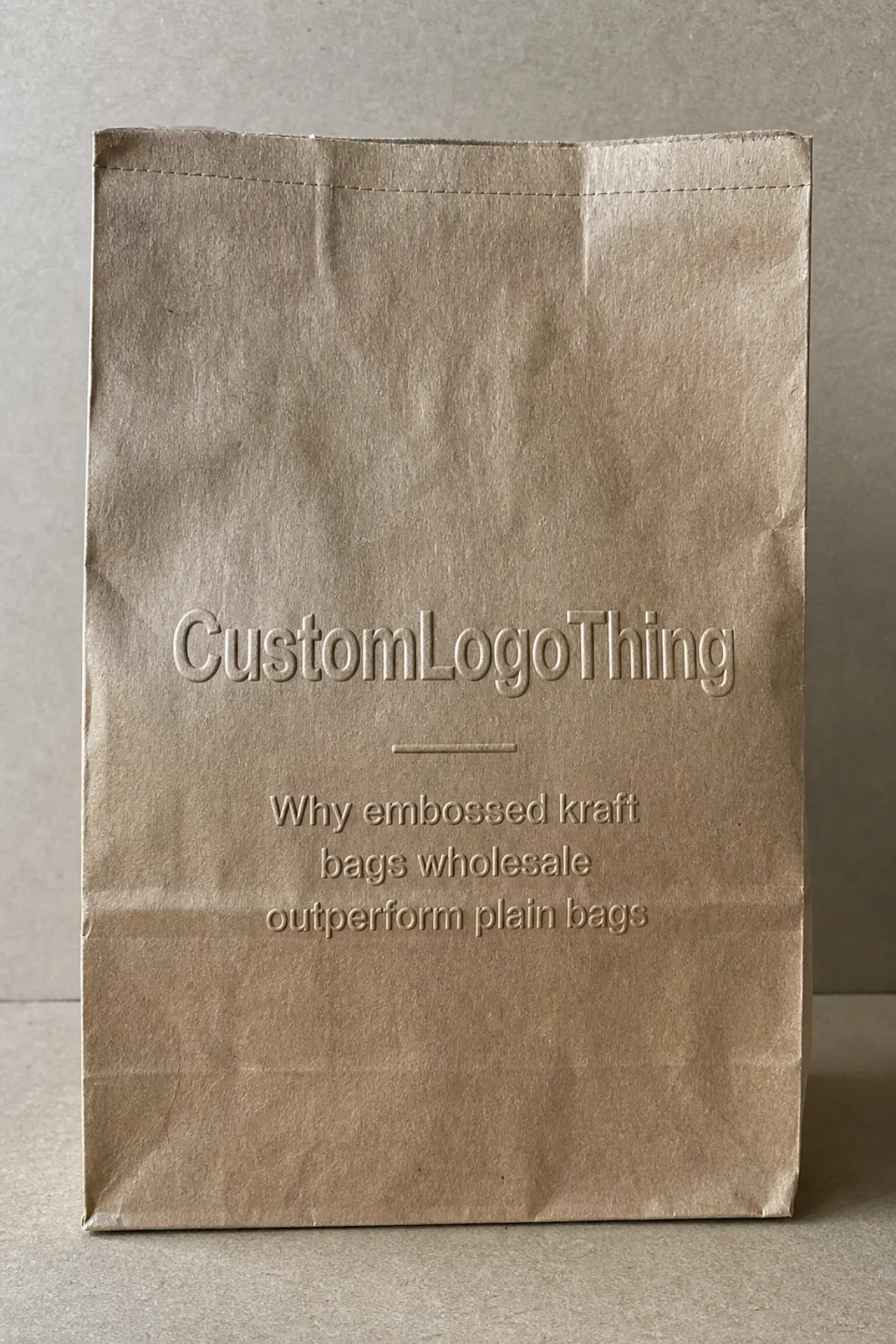
Plain kraft bags still have a place. They move product, hold up to daily use, and keep costs low. Embossing changes the reading of the bag because it adds depth without filling the surface with ink or foil. The logo becomes something the hand can feel, not only something the eye can scan. That tactile cue creates a premium impression with less visual noise than a full print treatment, which is one reason embossed kraft bags wholesale continue to appear in retail packaging specs where first impressions affect sales.
People connect texture with quality almost automatically. A raised mark suggests effort, even when the actual process is efficient and repeatable. That association makes embossed bags a strong fit for boutiques, gift shops, artisanal food brands, premium apparel, cosmetics, and event packaging. The paper still looks natural, but it no longer reads as generic.
The visual benefit is only part of the story. Embossed surfaces often disguise light scuffs better than flat printed areas because the texture breaks up small marks and soft rub lines. That can matter during shipping, on store counters, and after the customer has reused the bag a few times. A scratched flat bag looks tired quickly. A textured kraft bag tends to keep its dignity longer, which is useful when the bag itself is part of the marketing.
Good packaging has two jobs: it carries the product and it signals, without saying a word, what kind of brand is holding the customer’s attention. Embossing does that in a restrained way.
The branding angle gets overlooked more often than it should. Kraft already suggests a natural, grounded, less synthetic identity. Add embossing and the message becomes more polished without losing the paper-first feel. That balance suits brands that want premium packaging without the look of overproduction. Not every customer wants a glossy finish and a wall of ink. Many buyers prefer restraint, texture, and a bag that feels credible on the counter.
For procurement teams, embossed kraft bags wholesale can also simplify design decisions. A single logo mark, pressed cleanly, often performs better than a crowded layout with too many elements fighting for attention. That can lower production risk too. Less ink coverage. Fewer registration issues. A cleaner final result. The bag often looks more intentional while staying close to the cost structure of a standard paper bag.
Embossed kraft bags wholesale product details
Embossing presses artwork into the paper so it appears raised or recessed, depending on the tooling and the bag build. On kraft bags, the effect is usually a raised logo or pressed brand mark that adds texture and depth. The bag does not need to be loud to look finished. That quiet confidence is the point.
Common wholesale bag styles include flat handle, twisted handle, rope handle, euro tote, and luxury gift bag formats. Each one creates a different balance of price, carry strength, and presentation. Flat handle bags are usually the budget-friendly route. Twisted handle bags sit in the middle. Rope handle and euro tote styles move toward premium retail packaging and often support a higher perceived value per unit.
Kraft paper choice matters more than many first-time buyers expect. Natural kraft gives a warm, earthy look. White kraft creates a cleaner backdrop if you want the embossing to stand out more sharply. Recycled kraft supports a more eco-forward message, though the surface can be less uniform. Coated kraft creates a smoother face and can improve print sharpness, but it changes the feel and may move the bag away from the raw kraft look some brands want.
Finish combinations depend on the bag structure and your budget. Some orders are emboss only. Others pair embossing with foil stamping for a sharper premium mark. Embossing can also work with spot printing, but the design needs discipline. Too much activity and the texture loses authority. A small logo, a border line, or a single medallion can work well. A dense illustration usually does not.
Handles and reinforcement deserve real attention. A premium-looking bag that tears at the base is expensive trash with a logo on it. That is not hyperbole; it is a buying reality. Check handle attachment, base board options, reinforced gussets, and carton pack-out so the finished bag matches the way it will actually be used.
For sustainable sourcing, it helps to understand which standards and certifications matter. The Paper and Packaging Board and similar industry resources explain paper-based packaging basics well, while certification bodies such as FSC matter if your brand requires responsibly sourced fiber. For transit testing, many buyers also reference ISTA shipping test protocols when bags are packed in heavier cartons or moved long distances.
Common construction choices
- Paper weight: often 120gsm to 250gsm depending on bag size and carry load.
- Handle types: paper twist, flat paper, cotton rope, grosgrain, or die-cut with reinforcement.
- Bag base: standard glued bottom or reinforced insert for heavier retail use.
- Decorating methods: emboss only, emboss plus foil, emboss plus print, or emboss with spot UV on coated stock.
If you need a broader buying framework, our Wholesale Programs page is a useful starting point for procurement planning and order structure. Deciding what should stay standardized before you customize every detail keeps the process from getting messy.
Specifications to confirm before you request a quote
Most quote delays start with a buyer sending a logo and a quantity, then expecting the supplier to reconstruct the rest. Pricing does not work that way. If you want a useful quote for embossed kraft bags wholesale, send a complete spec sheet. It saves time and gives you a number worth using.
The first items are straightforward: width, gusset, height, and handle length. Those dimensions define the structure of the bag and the amount of paper required. If you also need an insert, reinforced base, or special fold, include that too. A few millimeters can matter more than people expect, especially on smaller gift bags where the emboss area has to stay clear of folds and glue lines.
Paper weight or GSM is another major variable. A 120gsm kraft sheet feels very different from a 200gsm sheet. Heavier stock usually gives more stiffness, better carry confidence, and a cleaner emboss impression. Lighter stock can still work, but large emboss areas or tight detail may distort the surface.
Emboss placement should be confirmed before production starts. Ask where the logo will sit, how large the mark can be, and whether the impression will appear on one panel or multiple sides. Safe margins matter because folds, gussets, and handle attachments all compete for the same space. If artwork lands too close to a crease, the final result can look crooked or partially lost.
Print limits on kraft are real. Darker kraft changes the way inks appear. Fine-line details do not always translate well. Heavy ink coverage can flatten the natural paper look that makes the bag appealing in the first place. If you want inside printing, foil, or multi-color decoration, say so early. It changes tooling and cost, and it affects whether embossing stays visible or gets buried.
Here is the kind of spec sheet that gets a useful response:
- Product type: embossed kraft shopping bag or gift bag
- Dimensions: width x gusset x height in mm or inches
- Quantity: target order volume and repeat forecast
- Artwork: vector file, logo size, emboss location
- Handle: twisted paper, rope, flat, or die-cut
- Paper: natural kraft, white kraft, recycled kraft, or coated kraft
- Use case: apparel, bakery, gift, luxury retail, event packaging
- Destination: delivery address or port
- Packaging: bulk packed, sleeve packed, or custom carton labeling
That level of detail also makes comparison easier. If two suppliers quote the same spec, you can compare real differences instead of trying to decode what one of them forgot to mention.
Embossed kraft bags wholesale pricing, MOQ, and unit cost
Pricing for embossed kraft bags wholesale depends on more than bag size. The main drivers are paper weight, handle type, emboss die size, artwork complexity, finish combination, and whether the build needs a new structure or can use an existing die line. Anyone who gives you one neat price without asking those questions is either guessing or hiding a cost somewhere else.
For rough planning, simple embossed kraft bags can start around $0.18-$0.28 per unit for larger runs in standard sizes with basic handles and a small emboss area. Mid-range custom bags often fall around $0.30-$0.55 per unit, especially when you move into heavier paper, premium handles, or larger logo coverage. Luxury formats with rope handles, foil stamping, or special inserts can move higher, sometimes $0.65-$1.20+ per unit depending on quantity and decoration. Those are practical buying ranges, not promises, because the spec controls the math.
MOQ usually depends on whether the bag is stock-style or fully custom. Simple builds may allow lower minimums, while fully custom embossed bags often require more volume because the die, setup, and production prep need to be spread across enough units. In plain terms: the more custom the structure and finish, the more units you usually need to make the job worth running.
Unit cost tends to fall as quantity rises. That is not clever; it is how setup cost works. A new emboss die, plate, or tooling charge gets spread over more bags at 5,000 pieces than at 500 pieces. That is why a quote can look expensive at low volume and much more manageable at scale. Buyers sometimes compare the per-unit price without looking at the setup line. That is how bad purchasing decisions start.
Ask about the following extra charges upfront:
- Sample cost: plain sample, pre-production sample, or custom sample with artwork
- Die or plate fees: emboss tooling, print plate, foil die, or combined setup
- Packaging upgrades: sleeve packs, retail-ready cartons, barcode labels
- Rush production: accelerated schedule or partial air shipment
- Freight: ocean, air, or courier depending on quantity and deadline
To compare quotes properly, put every supplier on the same spec sheet. Same bag size. Same paper weight. Same handle. Same emboss area. Same shipping term. Otherwise you are not comparing price. You are comparing a smaller bag to a bigger one, or a simpler bag to one with better materials, and calling it a fair test. It is not.
Here is a practical comparison table that buyers can use as a starting point.
| Bag style | Typical MOQ | Common unit cost range | Best fit | Notes |
|---|---|---|---|---|
| Flat handle kraft bag with emboss | 1,000-3,000 pcs | $0.18-$0.32 | Bakery, takeaway, entry retail | Lower cost, simple carry, less premium than rope handle |
| Twisted handle kraft bag with emboss | 1,000-5,000 pcs | $0.24-$0.42 | Apparel, gift, general retail | Good balance of cost, strength, and presentation |
| Rope handle kraft bag with emboss | 2,000-5,000 pcs | $0.38-$0.75 | Premium retail, cosmetics, events | More upscale feel, higher assembly cost |
| Euro tote kraft bag with emboss | 3,000-10,000 pcs | $0.55-$1.20+ | Luxury retail, gifting, boutiques | Often includes reinforced top edge and premium handle finish |
One more thing: MOQ should be clear at the quote stage. Ask whether it applies per size, per design, per color, or per emboss die. That detail matters more than people want to admit. A supplier can say "low MOQ" and still mean low only if you order one exact configuration. Ask before you budget around it.
Process and lead time: from artwork to delivery
The fastest orders begin with clean information. For embossed kraft bags wholesale, the quoting stage usually needs dimensions, quantity, handle choice, emboss area, artwork file, and shipping destination. Leave out the destination and freight becomes a guess. Leave out artwork size and the emboss die becomes a guess. Guessing costs money.
After quote approval, the proofing stage begins. That usually includes die line setup, artwork review, and one or more revision rounds. At this point, the supplier checks whether the logo can sit cleanly within the bag panel, whether the emboss detail is too fine, and whether any elements need simplification. Vector files are best. AI, PDF, or SVG files with outlined fonts and clean line work reduce back-and-forth. A good proof does more than display the design. It shows how the design will behave on paper.
Production usually follows a standard sequence:
- Material selection and paper cutting
- Emboss die setup and impression test
- Printing or foil work, if included
- Bag forming, folding, and gluing
- Handle attachment and reinforcement
- Inspection for alignment, strength, and finish
- Carton packing, labeling, and shipment prep
Typical lead times often land around 12-15 business days after proof approval for straightforward custom orders, though more complex projects can take longer. If the bag uses special handles, foil, larger emboss areas, or custom inserts, plan for 15-25 business days depending on the production calendar. Freight adds its own clock, especially during busy shipping periods.
What slows things down?
- Missing or low-resolution artwork files
- Unclear emboss placement or logo size
- Complex finishing, especially emboss plus foil
- Peak-season production queues
- Freight congestion or routing changes
Buyers should ask for a written schedule with milestones. Not a loose promise. A written schedule. You want the proof approval date, the production start window, the inspection checkpoint, and the estimated ship date. That makes it easier to manage launches, store openings, and replenishment planning.
If a supplier references shipping performance, a transit test standard like ISTA can help frame expectations for heavier cartons or long-distance distribution. It does not make every package indestructible, but it gives structure to the conversation about what the shipment should survive.
Why choose us for embossed kraft bags wholesale
Manufacturing control is the real difference between a bag that looks premium on screen and one that arrives looking rushed. Tight process control gives cleaner alignment, consistent emboss depth, stronger seams, and fewer surprises in the carton. That matters because wholesale packaging only works when the first box and the fifteenth box look the same.
We keep customization practical. Size adjustments. Handle upgrades. Internal printing if the design needs it. Reinforcement options. Packing methods that fit the channel. A boutique bag does not need the same spec as a bakery bag. A gift bag does not need the same structure as an apparel bag. The build should match the use, not the other way around.
Quality checks should cover the issues that fail in the field: handle pull, edge finish, fold accuracy, surface alignment, and box-to-bag consistency. If the emboss sits off-center on one sample, it will probably sit off-center across the run unless the process is corrected. Wholesalers who catch that early save themselves the cleanup later.
We also try to make sourcing less frustrating. That means clear pricing breakdowns, sample guidance before volume production, and honest feedback when a requested combination is likely to look overworked. If the logo is too detailed for the emboss area, say so. If a rope handle moves the job into a different price bracket, say that too. Buyers do not need drama. They need a supplier who tells them what is possible, what is not, and what the cost tradeoff looks like.
For more context on packaging materials and design expectations, industry references such as the Paperboard Packaging Council and certification resources from FSC can help frame decisions around material sourcing and sustainability claims. That matters especially when brand marketing needs to line up with procurement documentation.
Buyers should compare responsiveness, not only price. A cheap quote with weak communication tends to get expensive later. Rework, delays, and missed specs have a way of wiping out the savings. The better choice is usually the supplier who can execute the same bag consistently and give straight answers before production starts. That is what keeps embossed kraft bags wholesale from becoming a headache.
Next steps to get an accurate embossed kraft bags wholesale quote
If you want a quote that is actually useful, send the basics in one message: dimensions, quantity, bag style, artwork file, emboss area, handle preference, and target budget range. That is the quickest route to a real number instead of a vague placeholder. If your target cost matters, say it upfront. A supplier can often steer you toward a better spec without making you start over.
Ask for written confirmation of MOQ, sample cost, production time, and freight method before you send any payment. That sounds obvious, yet people still skip it. Do not assume the minimum quantity applies the same way across all designs. Ask whether it is per size, per design, or per emboss die. If the answer feels fuzzy, keep asking until it does not.
Request a mockup or die line early if the logo placement is tight or the emboss area needs to sit near folds. A good mockup saves more money than almost any other step because it catches layout problems before tooling starts. If you are comparing multiple suppliers, give them the same specification sheet. That is the only fair comparison. Everything else turns into price theater.
From a buying standpoint, the next move is simple: get a sample pack or a formal quote, review the sample against your spec sheet, and then place the full embossed kraft bags wholesale order with the details locked. That is how you keep the bag looking premium, the budget under control, and the timeline realistic.
When the specification is clear, embossed kraft bags wholesale can be a strong packaging choice. The bag looks natural, the logo gains depth, and the overall presentation feels more considered without drifting into overdesigned excess. That is the balance most brands want, and it is usually the one that sells.
FAQ
What is the typical MOQ for embossed kraft bags wholesale orders?
MOQ depends on bag size, paper weight, handle type, and whether a new emboss die is required. Simple stock-style bags usually allow lower quantities than fully custom builds with special finishes. Ask whether the MOQ applies per design, per size, or per color so you do not get trapped by vague quoting.
Are embossed kraft bags wholesale orders still recyclable?
Plain kraft bags are generally recyclable, but added finishes can change that depending on local rules. Foil, heavy lamination, or mixed-material handles may reduce recyclability compared with simple kraft construction. If sustainability matters, confirm the full material stack before approving production.
How much does embossing add to unit cost on kraft bags?
Embossing usually adds setup or tooling cost first, then a smaller per-bag impact as volume increases. Larger emboss areas, deeper relief, and more complex artwork cost more than a small logo mark. The real answer comes from a quote with the same size, paper weight, and handle spec.
Can I combine foil stamping with embossed kraft bags wholesale?
Yes, many projects combine foil and embossing, but the bag structure must support both processes cleanly. Expect tighter registration requirements, higher setup cost, and usually a longer lead time. Request a proof first because bad alignment on kraft looks cheap fast.
What artwork files should I send for embossed kraft bag production?
Vector files are best, usually AI, PDF, or SVG, with fonts outlined and lines kept clean. Send the logo at the exact size you want embossed so the supplier can check detail depth and readability. Include a note for any critical placement, safe margins, or areas that should not be embossed.

