Buyer Fit Snapshot
| Best fit | Factory Direct Mailing Bags projects where brand print, material claims, artwork control, MOQ, and repeat-order consistency need to be specified before quoting. |
|---|---|
| Quote inputs | Share finished size, material target, print colors, finish, packing count, annual reorder estimate, ship-to region, and any compliance wording. |
| Proofing check | Approve dieline scale, logo placement, barcode or warning zones, color tolerance, closure strength, and carton packing before bulk production. |
| Main risk | Vague material claims, crowded artwork, missing packing details, or unclear freight terms can make a low unit price expensive after revisions. |
Fast answer: Factory Direct Mailing Bags: Film, Print, MOQ, and Carton Packing should be specified like a repeatable production item. The safest quote records material, print method, finish, artwork proof, packing count, and reorder notes in one written spec.
Production checks before approval
Compare the actual filled-product size with the drawing, then confirm tolerance on folds, seals, hang holes, label areas, and retail display edges. Reserve space for logos, QR codes, warning copy, and material claims before decorative graphics fill the panel.
Quote comparison points
Review material grade, print process, finish, sampling route, tooling charges, carton quantity, and freight assumptions side by side. A quote is only useful when the supplier can repeat the same color, closure quality, and packing count on the next order.
Factory Direct Mailing Bags: What Buyers Should Know
If you buy factory direct mailing bags, the cheapest quote can turn into the priciest choice once a seam opens, a bag arrives undersized, or the packing line starts slowing down because the mailer does not open cleanly. That is the part many teams miss. They are not just buying a plastic sleeve. They are buying a production spec, a converting process, and a shipping component that has to survive real handling, real heat, real stacking, and real customer expectations.
For e-commerce brands, subscription programs, and fulfillment teams, factory direct mailing bags often land in a practical middle ground between cost control and brand presentation. They sit inside the broader poly mailer category, but the factory-direct route gives buyers more control over film thickness, adhesive strength, opacity, print setup, and carton packing. If you want a useful place to start, our Custom Poly Mailers page shows common sizes and customization options. For a wider look at how packaging choices affect shipping performance, the resources at packaging.org are a solid reference.
The value of factory direct mailing bags does not come from being the lowest price on paper. It usually comes from tighter specification control, repeatable production, and fewer surprises after the order is placed. Buyers who understand the material grade, closure style, print method, and minimum order quantity usually end up with a better result. Buyers who ask for a “standard bag” without any real detail still receive a quote, but the final product may have little to do with what the brand actually needed.
What Factory Direct Mailing Bags Actually Are
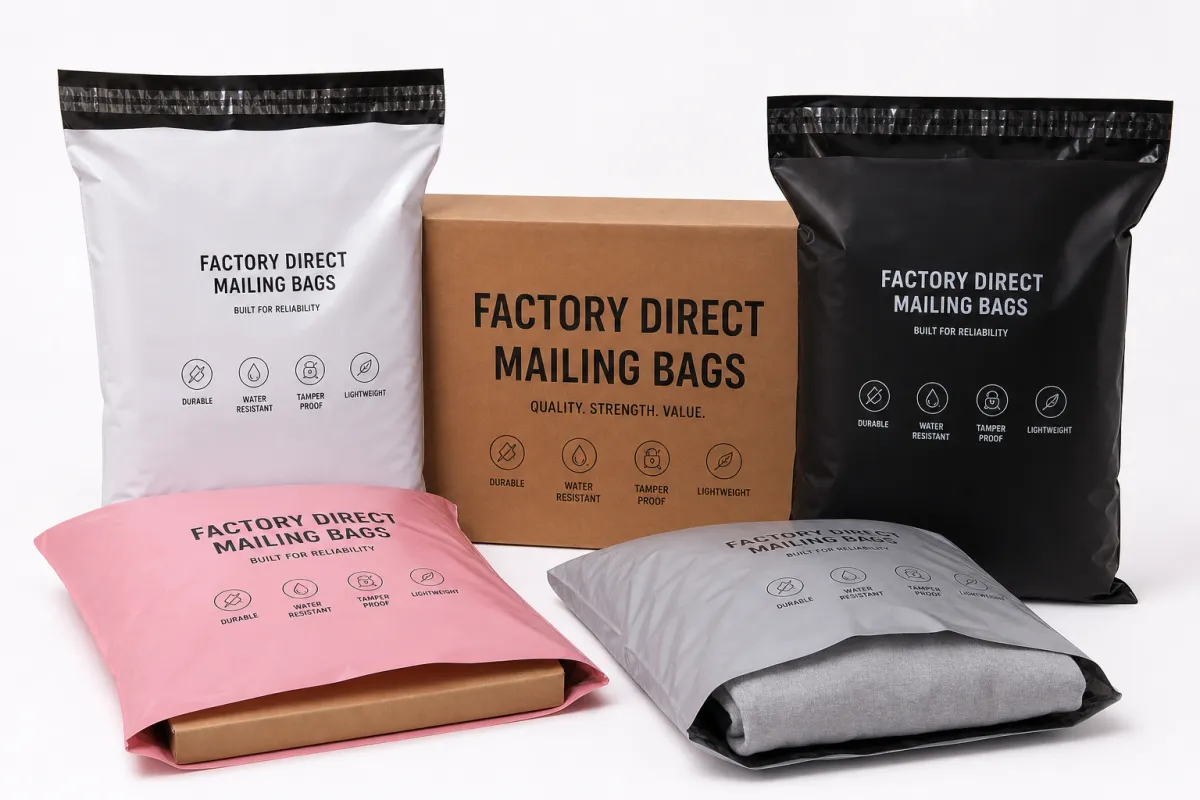
Factory direct mailing bags are poly mailers purchased straight from the manufacturer rather than through a distributor, broker, or retail channel. That sounds simple, but the practical difference matters. Fewer middle layers usually mean fewer markups, a clearer path to custom specs, and better visibility into the exact construction being ordered. It also means the buyer can request precise dimensions, film gauges, adhesive performance, and print setup instead of settling for whatever happens to be sitting in a warehouse.
These bags are typically used for lightweight, non-fragile products: apparel, soft accessories, books, document sets, lightweight cosmetics, and subscription items that do not need a corrugated box. They are not a universal packaging answer, and that needs to be said plainly. They are not the right choice for sharp-edged, heavy, or crush-sensitive products. Still, for the right SKU mix, they reduce shipping weight, take up less storage space, and usually move through packing stations faster than a box-and-fill method.
The real comparison is not bag versus bag. It is material grade versus material grade, thickness versus thickness, seal performance versus seal performance, and batch consistency versus batch inconsistency. A mailer that looks fine in a sample photo can still disappoint if the adhesive weakens after a temperature swing or the film feels too thin for the shipping lane. I have seen bags pass a desk check and then fail the first time they sat in a warm dock area for a few hours. Experienced buyers look at unit cost, yes, but they also care about tolerance control, repeatability, and how the bag behaves after thousands of orders. A cheap mailer that varies from run to run is not cheap for long.
Factory direct does not mean lowest price every time. A domestic stock option can win when freight is lower and lead time matters more than print customization. A factory quote can look attractive until freight, customs, artwork revisions, and carton requirements are added. The real advantage is control. Buyers can decide whether the mailer should be plain, branded, opaque, tamper-evident, or reinforced with a stronger closure. That level of control separates a planned packaging purchase from a random online order.
If sustainability matters to the brief, avoid vague claims. Recycled content, downgauged film, and reusable formats all have a place, but the bag still has to perform in transit and in the warehouse. The EPA’s recycling guidance at epa.gov/recycle is a useful reminder that local recycling rules vary widely, which means “recyclable” on a spec sheet does not automatically translate into practical curbside behavior. Packaging teams run into that gap often, and it is a little easier to be honest up front than to explain it later.
Factory direct mailing bags fit best when the product is lightweight, order volume is steady, and the brand wants consistent output over time. If any one of those pieces changes, the spec should change too. That is not overthinking. That is basic production discipline.
How Factory Direct Mailing Bags Work From Order to Delivery
The order flow for factory direct mailing bags is usually more structured than buyers expect. It begins with a quote request, but a good factory will ask for more than quantity alone. They should want bag size, film thickness, printing details, closure type, pack count, shipping destination, and whether the order is plain stock or a custom run. If those questions never come, the process may feel quick, but that speed often hides missing details.
After the spec is confirmed, artwork setup begins. For printed factory direct mailing bags, the factory may use plate-based flexographic printing or a digital process depending on volume, color count, and finish. Flexo usually makes sense at higher quantities. Digital printing can fit shorter runs or projects where the artwork changes more often. Either way, the printer has to account for color matching, logo placement, bleed, and film behavior because plastic behaves differently than coated paper. It stretches, reflects light, and shows scuffs more easily than many buyers expect.
Material selection follows. Film thickness affects puncture resistance, seal reliability, and stiffness. A thinner bag can shave off a little unit cost, but if it splits under pressure or feels flimsy in the hand, the savings disappear in the form of returns and repacking labor. Seal quality matters just as much. A weak adhesive or a poorly tuned heat-seal process can leave bags that open too easily in transit or peel under load.
For buyers who want a realistic process map, the flow usually looks like this:
- Quote and spec alignment.
- Artwork submission and technical review.
- Sample or proof approval.
- Material sourcing and print setup.
- Production, converting, and finishing.
- Quality check and carton packing.
- Freight booking, export documents, and delivery.
Factory direct mailing bags usually move faster when the buyer is organized. Sampling can take a few days to a couple of weeks depending on complexity. Bulk production often falls in the 10-20 business day range after proof approval, though custom printing, special film, or larger volumes can extend that window. Freight may add another week or several weeks depending on whether the shipment moves by air, ocean, or domestic truck. The factory is rarely the only variable. Approval speed often becomes the real bottleneck, and somehow that catches people off guard every time.
For transit testing, many buyers check printed or plain bags against internal standards or shipping simulations. ISTA publishes test procedures that help teams evaluate package performance under vibration, drop, and handling stress. If you want a baseline reference, ista.org is a useful place to begin. Not every mailer needs formal lab testing, but if the product is margin-sensitive or the return rate is already a problem, testing costs far less than guessing.
Factory direct mailing bags work best when both sides treat the order like a production process instead of a casual purchase. That means clear specs, realistic timing, and a willingness to verify details before the bags are made in bulk. It sounds plain because it is. Plain is good in packaging.
Key Cost and Pricing Factors for Factory Direct Mailing Bags
Pricing for factory direct mailing bags comes down to a handful of variables, and almost all of them are visible if the buyer knows what to ask for. The main drivers are bag size, film thickness, print coverage, number of colors, closure style, recycled content, side gussets, tear strips, and any special finishing. Change one of those and the quote changes. That is normal. What is not normal is expecting the same price after requesting a thicker film, extra print, and a custom size that uses more material.
Low-MOQ orders often look expensive on a per-unit basis because setup costs get spread across fewer bags. A 1,000-piece order can feel pricey next to a 10,000-piece run even if the factory margin is the same. That is simple arithmetic, not bad behavior. As the order volume rises, unit cost usually falls. Repeat orders often look far better than the first run because setup and approval work have already been completed.
Here is a practical pricing snapshot for custom runs. These are broad ranges, not promises. The exact number depends on the spec, print method, and freight lane.
| Option | Typical Spec | Best For | Tradeoff | Approx. Unit Cost |
|---|---|---|---|---|
| Plain stock mailer | 2.5-3 mil, standard size, no print | High-volume basics | Lowest branding value | $0.06-$0.14 |
| Single-color custom mailer | 3 mil, logo print, standard closure | Brandable e-commerce shipping | Setup cost added | $0.10-$0.22 |
| Full-color custom mailer | 3-4 mil, higher coverage, custom art | DTC brands, subscription kits | More expensive print prep | $0.14-$0.30 |
| Heavy-duty mailer | 4-5 mil, stronger adhesive, extra opacity | Heavier apparel, sharper edges | Higher material cost | $0.18-$0.40 |
That table is a useful starting point, though it leaves out the hidden costs buyers sometimes forget to include. Freight is the obvious one. A strong FOB unit price can look impressive until shipping, customs, brokerage, or domestic transfer fees are added. Artwork revisions also add cost, especially when the buyer keeps changing the size after sample approval. Sample fees, rush charges, carton label changes, and storage if the order arrives early can also move the total more than expected.
Factory direct mailing bags can save money, but only when the spec is tight. A vague request like “good quality mailing bags” creates quote drift. One factory may assume 2.5 mil, another may assume 3 mil, and a third may quote an entirely different construction. Then everyone acts surprised by the comparison. It is preventable. Provide the exact size, thickness, closure, print area, carton count, and delivery destination, and the pricing becomes much easier to compare.
Thicker film is not only about durability. It also changes the feel of the package in transit and can reduce returns caused by snagging or seam failure. A few extra cents per unit can be cheaper than replacing damaged goods. That matters most for products with sharp corners, small hardware, or anything that shifts inside the mailer. The budget discussion should include damage risk, not only line-item cost.
How to Choose the Right Specs Before You Order
Before ordering factory direct mailing bags, start with the product rather than the packaging. That sounds simple because it is. A soft T-shirt, a hardcover book, a cosmetic box, and a bundle of accessories all move differently in transit. The right bag for lightweight apparel can be the wrong bag for a boxed product with sharp corners. Trouble usually begins when the mailer gets chosen first and the product second.
The main spec checklist should cover width, length, bottom expansion, film thickness, seal style, opacity, print area, adhesive strength, and whether tamper evidence matters. If the bag is meant for customer-facing branding, surface finish and color fidelity matter too. Matte and gloss each solve different problems. Matte hides scuffs better. Gloss can make colors stand out, but it also shows fingerprints and handling marks more easily. That difference matters more than many buyers realize.
Factory direct mailing bags should match the packed product, not the imaginary dimensions in a spreadsheet. Measure the product as it ships, not only as it sits on a shelf. Leave room for insertion, flap closure, and any internal label or tissue. If the bag is too large, the package can look sloppy and shift during transit. If it is too tight, packing slows down and the seal gets stressed. Either way, the warehouse absorbs the cost.
Use the following logic when choosing thickness:
- 2.0-2.5 mil for lighter items with low puncture risk.
- 2.5-3.0 mil for standard apparel and accessories.
- 3.0-4.0 mil for heavier soft goods or mixed SKUs.
- 4.0 mil and up for added durability, rough handling, or sharper edges.
That is not a universal rule, and it should not be treated like one. Some films perform better at the same thickness because the resin blend is stronger. Some lower-gauge films work well because the product is soft and forgiving. Sample testing matters more than the marketing sheet. If a recycled-content claim is part of the plan, verify the percentage and make sure it is backed by documentation. For brands with environmental positioning, accuracy matters more than noise. A bad claim causes more damage than no claim at all.
Factory direct mailing bags also benefit from production samples. Ask for a pre-production proof if the design is color-sensitive, especially when the logo uses dark solids, gradients, or fine text. A red logo on white film can look crisp in a digital mockup and muddy on the finished bag if the ink density is off. The same applies to metallic tones, deep blues, and artwork that sits too close to the seam. A proof is cheaper than a reprint.
If the choice is between plain and printed factory direct mailing bags, ask one blunt question: does the print remove another cost elsewhere? In some programs, custom printing replaces separate labels or branded inserts. In others, it is mostly a branding decision. Both are valid. The math should still be honest. Packaging teams waste time pretending every custom feature pays for itself. It does not. Sometimes it simply looks better, and that alone can justify the choice.
Step-by-Step Buying Process for Factory Direct Mailing Bags
The buying process for factory direct mailing bags becomes much easier once the internal brief is clear. Start with order volume. Then define product dimensions, target mailer size, brand requirements, and shipping lane. If the bags will move through a hot warehouse, a rough handling zone, or a long-haul freight route, the spec should account for that. A mailer that works for local dispatch may be the wrong choice for cross-country transit.
Next, request quotes using a proper spec sheet. The best comparison comes from apples-to-apples data: same size, same thickness, same print coverage, same quantity, same delivery terms. If one factory quotes a 2.5 mil bag and another quotes 3 mil, the lower price is not really lower. It is just a lighter build. That sounds obvious, yet it gets missed all the time.
Factory direct mailing bags should be reviewed against sample performance, not appearance alone. Check seal quality by applying pressure to the closure. Check print clarity under real warehouse lighting. Check opacity by holding the bag against a bright source if privacy matters. Check scuff resistance by rubbing the surface lightly after packing. A bag that looks fine on a desk can look rough after it moves through a fulfillment line.
Artwork approval should happen on the actual bag size, not a square mockup placed inside a PDF. Bleed, logo placement, and readability all shift once the artwork is wrapped around a real poly surface. Small text near a seam can disappear. Fine lines can break up. Bold color blocks can show banding if the print setup is weak. That is why proofing matters. A mockup previews the idea. It is not the final object.
If the spec is fuzzy, the quote will be fuzzy. If the quote is fuzzy, the final bags usually are too.
Before production begins, confirm lead time, freight method, carton count, palletization, and replacement terms if the shipment arrives damaged or misprinted. That is not paranoia. It is organization. Factory direct mailing bags are a production item, so the commercial terms should be treated like production terms. Ask whether the factory will reprint a defective run, how quality issues are documented, and who carries responsibility once the bags leave the port or warehouse.
One more practical point: line up internal approvers early. Nothing slows a packaging project down like waiting three days for a logo sign-off while the production slot disappears. Factory direct mailing bags are easier to manage when the brand, operations team, and procurement team agree on the spec before the quote chase begins. That is not glamorous. It is how jobs stay on track.
Common Mistakes Buyers Make With Factory Direct Mailing Bags
The most common mistake with factory direct mailing bags is choosing only by price. Cheap film can work fine when the product is light and forgiving, but the moment seam failures, split corners, or inconsistent adhesive show up, the savings disappear into returns and extra labor. A bag that costs two cents less but triggers repacking on one out of every fifty orders is not a bargain. It is a hidden cost.
Another frequent mistake is writing vague specs. “Standard size” and “good quality” are not specifications. They are guesswork. The factory cannot quote accurately if the buyer does not define dimensions, thickness, print area, closure type, and quantity. Vague language also creates room for disputes later. Nobody enjoys arguing over what “good” meant six weeks ago.
Factory direct mailing bags also get overdesigned more often than they should. A full-coverage print can look impressive in a presentation and still feel excessive in daily use. If artwork crowds the closure area, disappears in the folds, or makes the bag feel busy, the brand effect drops quickly. A simple, clean layout often performs better than an overworked one. That is especially true for bags handled by warehouse staff all day and then opened by customers in five seconds.
Timeline mistakes are just as common. Buyers approve art late, change dimensions after sampling, or assume shipping will move faster than it actually does. Ocean freight is not a local courier. Customs does not care that a campaign launches next Tuesday. If a project has a hard deadline, the schedule needs room for proof revisions, production, transit, and a delay buffer. Anything less is a hope-based plan, and hope is not a logistics strategy.
Factory direct mailing bags should also be tested with the real product mix, not just one ideal sample item. A mailer that handles a folded T-shirt may fail on a bundle with a zipper pouch or accessory box inside. Test the hardest SKU, not the easiest one. That gives a more honest read on puncture resistance, seal performance, and packing speed.
Then there is the recycling claim problem. People see “recyclable” and assume the story is finished. It is not. A bag may be technically recyclable, but local collection rules vary and the end user may not know where to take it. That is why sustainability claims need careful wording. The most reliable buyers talk about material reduction, right-sizing, and recyclability only where the claim is truly supportable.
Factory direct mailing bags work best when the buyer respects the technical side. Packaging is not decoration. It is a shipping component. Treat it that way and it starts behaving like one.
Expert Tips for Better Factory Direct Mailing Bags Orders
If you want better results from factory direct mailing bags, buy with the next two or three months in mind instead of reacting to the next emergency. That does not mean overstocking recklessly. It means ordering enough to cover predictable demand spikes so you are not paying rush pricing during the busiest week of the season. Emergency buying always costs more, and the bill usually arrives with little warning.
Standardize sizes wherever possible. Many brands create a custom bag for every SKU and then wonder why fulfillment gets messy. A tighter size lineup often reduces cost, simplifies inventory, and shortens training time for packers. If two products can live in the same mailer without damage or wasted space, that is usually the better call. Less variety can be an advantage in packaging.
Factory direct mailing bags should also be tested in the real packing environment. That means the actual table height, actual lighting, actual operator speed, and actual product mix. Sample reviews at a desk reveal very little about how the bag behaves in a busy line. The most useful feedback comes from people who have to pack hundreds of orders before lunch. They notice seal speed, stiffness, and opening ease immediately.
Small logistics details matter more than they sound. Carton counts, pallet height, label placement, and inner pack quantities can save real labor at the warehouse. If the box count is awkward, workers waste time. If labels are hard to read, receiving slows down. If the carton count is too low, storage space gets eaten up. None of that shows up in the polished sample photo, but all of it shows up on the floor.
It also helps to agree on a short list of technical tolerances before production. Ask how much variation in size the factory allows, what print registration limits they use, and how finished bags are inspected for defects. A decent factory should be able to explain its tolerance range, inspection process, and packing standard. If those basics are hard to describe, caution is smart. Factory direct mailing bags are simple products, but simple products still need discipline.
Brand consistency matters too. Keep artwork changes to a minimum between runs. Constant minor edits create inconsistency across shipments and complicate reorders. If a design works, hold it steady for a while. Packaging teams often chase novelty when stability would save more money and produce a cleaner customer experience. Fancy is overrated if the bag shows up late.
Factory direct mailing bags also benefit from a steady relationship with the factory, and that does not mean being overly friendly or pretending every order is perfect. It means fast feedback, clear specs, and realistic expectations. Endless revision rounds do not help. The right answers early do.
Next Steps for Choosing Factory Direct Mailing Bags
Before talking to a supplier about factory direct mailing bags, gather three basics: product dimensions, monthly volume, and whether the bag needs print or can remain plain. Those three inputs remove a huge amount of guesswork. If you already know the shipping lane and target lead time, even better. The more concrete the brief, the stronger the first quote will be.
Then ask for three things together: a sample, a bulk quote, and a realistic timeline. That makes comparison easier because the options are being judged on equal terms rather than on half the story. A low unit price does not mean much if the sample is weak or the delivery window misses the launch date. Factory direct mailing bags should be judged as a full package: price, durability, branding, and timing.
If the team is unsure which direction to take, build a simple decision grid. Rank each option on price, strength, brand impact, and lead time. Most projects need a tradeoff somewhere. That is normal. A slightly higher unit price may avoid damage. A simpler print may help hit the deadline. A standard size may make reorders easier. There is no perfect answer, only the one that fits the operation best.
Here is a practical order path that keeps things organized:
- Measure the packed product, not just the product.
- Choose the thickness based on handling risk.
- Request samples and compare them with real inventory.
- Confirm artwork, carton counts, and freight terms.
- Place the first run with enough buffer to avoid a stockout.
Factory direct mailing bags are most useful when the buyer treats them like a production decision instead of an impulse buy. That means clear specs, real testing, and honest price comparison. Done that way, the bags do what they are supposed to do: protect the product, keep fulfillment moving, and make the brand look competent instead of improvised. That matters more than many teams like to admit.
FAQ
What are factory direct mailing bags used for?
They are used for shipping lightweight, non-fragile products like apparel, books, accessories, and soft goods. They reduce shipping weight, save storage space, and are often chosen for branded e-commerce orders because they can be printed and sealed quickly.
How do I compare factory direct mailing bags pricing?
Compare the same bag size, film thickness, print setup, and quantity across every quote. Add freight, artwork, sample, and any rush charges before deciding based on unit price alone. Check whether the quote changes at higher quantities, since the first order is often the most expensive.
What thickness should I choose for mailing bags?
Use thinner film for light, low-risk items where cost control matters most. Move up in thickness when the product has edges, extra weight, or a higher risk of tearing in transit. Test a sample with your real product before ordering a full run.
How long do factory direct mailing bags take to produce?
Sampling can take a few days to a couple of weeks depending on artwork and approval speed. Bulk production usually takes longer for custom printing or special specs. Shipping method matters as much as production, so ask for a full timeline from approval to delivery.
Can I order custom printed factory direct mailing bags in small quantities?
Yes, but small runs usually cost more per bag because setup costs are spread across fewer units. Some factories offer lower MOQs for digital printing or standard sizes. If volume is uncertain, start with a limited run and test demand before scaling up.
Factory direct mailing bags work best when the buyer respects the numbers, tests the sample, and treats the spec like a real production decision. That is the difference between a packaging purchase that quietly supports the operation and one that keeps creating expensive little problems nobody asked for.