Buyer Fit Snapshot
| Best fit | Freight Packaging Pricing projects where brand print, material claims, artwork control, MOQ, and repeat-order consistency need to be specified before quoting. |
|---|---|
| Quote inputs | Share finished size, material target, print colors, finish, packing count, annual reorder estimate, ship-to region, and any compliance wording. |
| Proofing check | Approve dieline scale, logo placement, barcode or warning zones, color tolerance, closure strength, and carton packing before bulk production. |
| Main risk | Vague material claims, crowded artwork, missing packing details, or unclear freight terms can make a low unit price expensive after revisions. |
Fast answer: Freight Packaging Pricing: Production Review should be specified like a repeatable production item. The safest quote records material, print method, finish, artwork proof, packing count, and reorder notes in one written spec.
Production checks before approval
Compare the actual filled-product size with the drawing, then confirm tolerance on folds, seals, hang holes, label areas, and retail display edges. Reserve space for logos, QR codes, warning copy, and material claims before decorative graphics fill the panel.
Quote comparison points
Review material grade, print process, finish, sampling route, tooling charges, carton quantity, and freight assumptions side by side. A quote is only useful when the supplier can repeat the same color, closure quality, and packing count on the next order.
Freight Packaging Pricing Guide: Costs, Factors, Timeline
I once watched a freight packaging pricing guide save a shipper more money with a 12-cent molded pulp insert than with a full carton redesign, and that still surprises people. The carton looked cheap at $1.14 a unit for 10,000 pieces, but the damage claims were eating $8,700 a month because the product rattled like coins in a jar on a Dallas-to-Atlanta lane. One small change, one less customer complaint, and one less pallet of returns later, the math finally lined up.
That is the part most teams miss. A freight packaging pricing guide is not just a material quote. It is the cost of keeping a product alive from dock to dock, plus the labor to build it, plus the risk you carry if the shipment fails, plus the freight class changes that can add $40 to $120 per pallet on common LTL lanes. If you only compare board price, you are basically judging a truck by the paint job and ignoring the engine, the axle load, and the miles it has to run.
I am Emily Watson, and after years of walking factory floors in Shenzhen, Dongguan, and Huizhou, plus a few grimy cross-dock sites in Los Angeles and Newark that smelled like plywood and diesel at 6:15 a.m., I can tell you this: the cheapest spec on paper is often the most expensive decision in practice. So let us break down the freight packaging pricing guide in plain English, with numbers, timelines, and the details suppliers hope you forget to ask about.
Freight packaging pricing guide: what it really covers
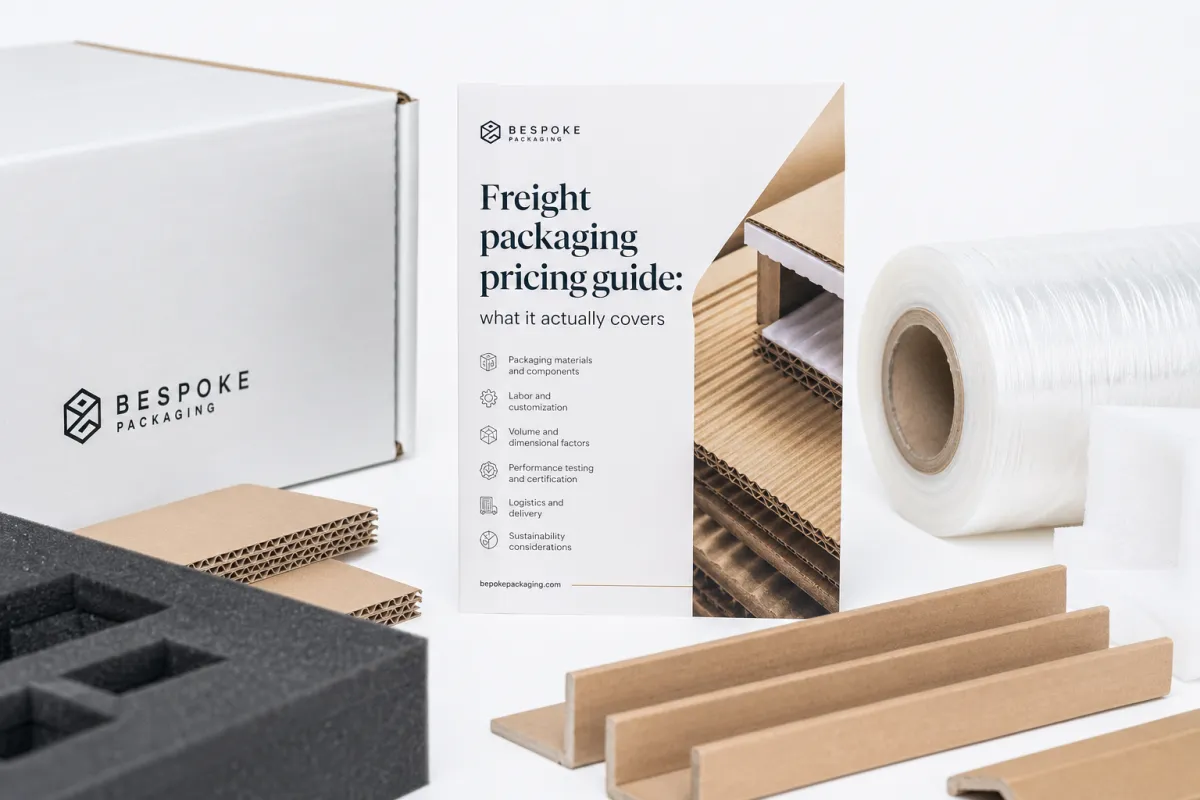
Freight packaging means anything that protects product during transit: pallets, cartons, inserts, wraps, straps, edge protectors, stretch film, dunnage, crates, and the foam corner you only notice when the invoice lists 4,800 units. A freight packaging pricing guide should cover all of that, because the package is not one item. It is a system built around weight, impact, stacking, and the actual route the shipment takes, whether that is 260 miles from Columbus to Nashville or 2,600 miles from Shanghai to Chicago.
Here is the cleanest way I explain it to buyers in a first meeting: packaging cost is what you pay for the materials and build, freight cost is what the carrier charges to move the cube, damage cost is what you lose when the product breaks, and labor cost is what your team burns while assembling the thing 200 times a day. Mix those together and your freight packaging pricing guide turns into a mess. Separate them, and you can actually make a decision using real numbers instead of assumptions.
One client in Southern California sent me a case of molded parts in a single-wall carton with loose kraft fill. The quote looked beautiful at $0.88 per unit for 8,000 units. Then the claims started: cracked corners, crushed lids, and a return rate that hit 4.2% in one quarter. We swapped in a 32 ECT double-wall shipper with a die-cut insert, and the failure rate dropped to under 0.5% within 60 days. The packaging cost went up by 19 cents. The total landed cost dropped by more than $14,000 on the first production run. That is a freight packaging pricing guide doing actual work, not decorative math.
I also see confusion between freight packaging and retail packaging. Retail packaging is built to sell a product on a shelf with branding, print, and presentation, like a 350gsm C1S artboard carton with spot UV and a Euro hole. Freight packaging is built to survive a forklift driver who is moving 1,600 pounds at 5 a.m. with one eye open. Sometimes the same structure can serve both jobs, especially for DTC brands in Austin or Brooklyn, but most of the time the rules are different. The freight packaging pricing guide should reflect that difference, or somebody will pay for gloss where they needed compression strength.
"If the box survives the showroom but dies on the pallet, it was the wrong box." I heard that from a plant supervisor outside Ho Chi Minh City while we were testing a line of appliance kits on a 48 x 40-inch pallet pattern, and he was right. Freight packaging pricing guide decisions live or die in the warehouse, not in the mockup room.
For buyers who want a benchmark on testing language, I keep ISTA methods close at hand, and I also check sourcing claims against FSC when paperboard or plywood is part of the spec. That habit has saved me from a few awkward conversations with compliance teams in Munich and Singapore, especially when a supplier says "certified" but cannot produce the lot number.
What belongs in a freight packaging pricing guide?
A freight packaging pricing guide covers the full cost picture, not just the box or crate line on a quote. That means corrugated packaging, pallets, void fill, inserts, labor, tooling, testing, freight class, and damage exposure all belong in the same conversation. If one of those pieces is missing, the quote may look tidy but still miss the true landed cost.
In practice, a freight packaging pricing guide should answer three questions fast: what protects the product, what does it cost to build, and what does failure cost if the shipment gets crushed, tipped, or delayed. That is why the best quotes read more like a packaging system analysis than a price list. The difference is not academic. It is usually the gap between a clean delivery and a pile of returns.
When the answer is clear, buyers can compare options on equal terms. A 32 ECT shipper with paper fill may be fine for one lane, while a double-wall carton with a die-cut insert or a plywood crate may be the better fit for another. The freight packaging pricing guide exists to show that tradeoff in numbers instead of guesswork.
How the freight packaging pricing guide process works
A good freight packaging pricing guide starts with data, not with a sales pitch. When I get a project brief, I want the product dimensions, unit weight, stackability, fragility, shipping lane, storage conditions, carrier type, and whether the thing is going to sit in a humid warehouse for 30 days before it moves. If I do not get that up front, I assume the quote will need a revision later. Usually it does, and usually by at least one carton size.
The quote flow is pretty consistent. First comes the discovery call, which should take 20 to 30 minutes if the buyer comes prepared. Then a packaging engineer looks at the product and decides whether to standardize on an existing structure, customize a known format, or redesign the pack entirely. After that comes sample prep, which may take 3 to 7 business days for simple corrugated work or 10 to 15 business days if a die-cut insert or crate is involved. Testing follows, then revisions, then approval, then production. That whole chain is part of the freight packaging pricing guide whether people like it or not.
I had a cosmetics distributor in Chicago insist they needed a "quote only" without samples. The numbers looked tidy for two days. Then they sent the real bottles, and we discovered the shoulders were 4 mm wider than the original spec and the neck finish was a half-turn deeper. That tiny mismatch added 18 minutes of hand fit-up per carton on the line. At $22 an hour, that mistake became expensive fast. The freight packaging pricing guide was never the problem. The missing dimensions were.
Here is the part that slows projects down: incomplete information. Buyers skip sample approval, send old drawings, or leave out the pallet height limit and then act surprised when the supplier asks for another week. I have watched a simple freight packaging pricing guide turn into a six-round email marathon because somebody forgot to mention that the destination DC in Reno rejected any pallet taller than 56 inches. That one detail changed the carton count, the stretch wrap usage, and the final carrier quote. I still remember staring at that thread and thinking, "This could have been one email." Unfortunately, it was eleven.
Packaging engineers do not just stare at board thickness and guess. They look at compression loads, cube efficiency, assembly labor, and transit method. A product that rides by LTL on mixed pallets has very different needs than a full truckload shipment with clean handling and no cross-dock stop. A smart freight packaging pricing guide uses those realities to decide whether a 275# test single-wall carton is enough, whether 44 ECT double-wall is safer, or whether the product needs a crate with 1/2-inch plywood, 3-inch deck screws, and ISPM-15 stamped lumber from an approved supplier.
Cost drivers in any freight packaging pricing guide
The biggest cost lever in a freight packaging pricing guide is not the first number you see. It is the combination of board grade, protection level, labor, and cube. A 32 ECT carton with paper void fill may be fine for a rigid item moving 200 miles on a clean lane. A fragile machined component moving 1,400 miles with two cross-docks may need a 44 ECT or 275# test carton, foam corners, and a tighter pallet pattern. That extra protection can raise the unit price by $0.28 to $1.90, but it can also cut a $60 replacement part from the equation. I have watched that trade play out more times than I can count.
Material choice matters more than most buyers admit. Corrugated board, EPE foam, EPS foam, molded pulp, edge protectors, plywood, and solid wood all carry different costs and different failure risks. In one supplier negotiation in Dongguan, I watched a crate maker quote $26.40 for a simple pine crate and another quote $31.10 for the same size because one used dry stock, better fasteners, and cleaner ISPM-15 stamping. The first quote looked good until we asked about warping at 18% humidity during a 14-day ocean transit. That is how a freight packaging pricing guide gets real: not by chasing the lowest number, but by checking the failure mode.
Labor is another quiet thief. Hand assembly, kitting, hot-melt glue time, tape time, corner placement, carton folding, and inspection all show up in the final price. If a pack takes 4.5 minutes to build and your line labor is $24 an hour, that is roughly 18 cents in labor before you count rework. Multiply that by 12,000 shipments and the "small" labor difference becomes a four-figure line item. A freight packaging pricing guide that ignores labor is usually written by someone who does not stand near the line in Monroe, Ohio, at 3:30 p.m. on a Thursday.
Cube optimization deserves its own line because freight charges often rise with size faster than they rise with weight. I have seen a package lose 0.75 inches on each side, cut pallet layer count by one extra row, and reduce the freight bill by 11%. The packaging itself cost 6 cents more. Still worth it. The right freight packaging pricing guide looks at total cubic inches, pallet pattern, and stack height, not just the unit price on the material ticket.
Testing and compliance also have a price tag. Drop testing, compression checks, vibration testing, and shipping simulation can cost anywhere from $250 to $1,500 depending on how formal the program is and whether you need third-party documentation. Export work adds another wrinkle. If the shipment crosses borders and the wood is not stamped correctly, you may be looking at delays, inspections, or a rejected load at the port in Long Beach or Felixstowe. Standards like ASTM and ISTA exist for a reason, and a freight packaging pricing guide should assume they matter instead of treating them as optional paperwork.
Hidden expenses are where people get ambushed. Tooling for a new die-cut insert can run $80 to $250 for a simple sample tool and much more for production tooling, especially if the insert is 350gsm C1S artboard with tight die tolerance. MOQs can force you into 1,000 or 5,000 units when you only wanted 300. Rush charges, split shipments, sample freight, and art revisions can each add another $35 to $250. A freight packaging pricing guide without those numbers is not a guide. It is a bedtime story with a spreadsheet cover.
| Packaging option | Typical unit cost | Best use | Tradeoff |
|---|---|---|---|
| Single-wall corrugated with paper fill | $0.65-$1.25 | Rigid items, short lanes, low breakage risk | Lowest cost, but weak on impact and compression |
| Double-wall carton with die-cut insert | $1.80-$4.60 | Mixed lanes, moderate fragility, repeat shipments | Higher material cost, but better stability and lower claims |
| Plywood or pine crate with dunnage | $18.00-$45.00 | Heavy equipment, export freight, high-value parts | More labor, more weight, and usually slower build time |
One more thing: some specs are not just "stronger." They are also cleaner. I have had buyers choose a more expensive kraft insert over foam because their brand standards banned loose particulates in the box after a July audit in Toronto. That is package branding meeting freight reality. If you are shipping a product that eventually becomes retail packaging on a shelf, that choice matters. If you are shipping industrial hardware in a plain shipper, it may not. The freight packaging pricing guide should let those decisions breathe instead of forcing every SKU into one material family.
There is also a sustainability angle that a lot of teams pretend is abstract until the CFO asks for numbers. FSC-certified board, recyclable corrugated, and right-sized packs can lower waste and reduce storage spend. A program that swaps a 14 x 12 x 10 carton for a 12 x 10 x 8 carton can cut void space by more than 20% and reduce pallet usage by a full lane over 500 shipments. A freight packaging pricing guide that includes environmental and warehouse efficiency factors usually ends up closer to the truth.
Step-by-step freight packaging pricing guide for shippers
If I were starting from scratch, I would begin with a packaging audit. List the product SKU, current damage rate, shipping lane, annual volume, current spend, and the exact carton or crate dimensions. Do not skip the boring part. The boring part is where the savings live. A freight packaging pricing guide becomes useful only after you know what you are currently paying and what it is costing you in claims, rework, and carrier adjustments.
Next, match each SKU to the right protection level. Not every product needs a custom-built structure. I have seen teams force 27 SKUs into one oversized box because it was easier for procurement. That approach looks tidy until the lighter parts start moving inside the carton and the heavy parts crush the bottom seam. A freight packaging pricing guide should let you standardize where it makes sense, then customize only where the risk actually changes.
Then ask for at least two quotes that use the same assumptions. Same dimensions. Same board grade. Same foam density. Same pallet pattern. Same MOQ. Same test requirement. If one vendor quotes a 275# box with no insert and another quotes a full packaging system with kitting, you are not comparing apples to apples. You are comparing a cardboard box to a small engineering project. That is not a freight packaging pricing guide. That is procurement theater in a white shirt.
When quotes come back, compare total landed cost. That means materials, labor, freight impact, testing, setup, and damage exposure. A unit price of $1.70 can be cheaper than $1.10 if the better pack reduces claims by 2% and saves 9% on cube. The best freight packaging pricing guide does not stop at the invoice line. It keeps going until the shipment is in the customer’s hands and the product is still intact, whether the final stop is Denver, Dublin, or Dubai.
I keep a simple rule for rollout: never approve a new pack without a sample run and a build-time check. If a pack saves 14 cents but adds 90 seconds to each assembly, you may lose the savings in warehouse labor. One client in Dallas discovered that a clever insert design required two extra folds and one extra piece of tape. The materials were cheaper by 11 cents, but line speed dropped enough to erase the benefit. Their freight packaging pricing guide looked brilliant right up until the shift supervisor started timing the builds with a stopwatch. That was the moment everyone got quiet.
If you need a starting point, I often send teams to our Custom Packaging Products page first so we can anchor the discussion to real structures instead of guesses. A clean product brief, a sample spec, and a 30-minute review call are worth more than three pages of vague email language, especially when the target is a 12- to 15-business-day turnaround from proof approval to production start.
Timeline matters too. A simple freight packaging pricing guide project can move from spec to sample in under a week if the dimensions are clean and the materials are standard. A custom crate or export pack may need 2 to 3 rounds of revision, especially if the buyer wants print, branding, or special handling features. That is normal. What is not normal is expecting a custom spec to materialize in 48 hours because someone said "rush" in all caps. I have seen that exact email subject line cause three people to sigh at once in a Guangzhou conference room.
Common mistakes that inflate freight packaging pricing guide costs
The biggest mistake is comparing a bare carton quote to a tested packaging system. People do it all the time, then wonder why the "cheap" option creates more claims. A box is not just a box once you add inserts, tape, palletizing, and a carrier network that may drop it twice before delivery. The freight packaging pricing guide has to reflect the whole chain, or the buyer is just chasing a low number with no end state in mind.
Under-specced packaging is another classic mistake. It looks affordable because the material line is tiny, then the returns start piling up. I visited a site in Louisville where they were using 24 ECT cartons for a 19-pound assembled component because the old spec "never had a problem." After one summer heat wave and a rough LTL lane, the bottom flaps started failing. The freight packaging pricing guide should have caught that. The production team certainly did not.
Overpacking is the mirror-image problem, and it wastes money just as fast. Heavy foam, oversized cartons, and unnecessary crates increase material use, increase cube, and often increase freight class. I have seen buyers add 1.8 pounds of dunnage to a 14-pound product and then complain about the freight bill. That is not the carrier being greedy. That is the spec being lazy, and the invoice is just reporting the crime.
Warehouse labor is another hidden bleed. A package that takes 7 minutes to build can be perfectly protective and still be a bad choice if the line is already crowded. At $20 to $26 per hour, every extra minute has a cost. If a freight packaging pricing guide does not include assembly time, the total cost number is fiction. Very neat fiction, but fiction all the same, especially when a 2-shift operation is turning 18,000 units a month.
Vague supplier briefs cause a lot of the pain. If you send a vendor "need packaging for metal parts" and expect a useful answer, you are asking for trouble. The parts might weigh 3 pounds or 33 pounds. They might have sharp edges, oil residue, or one fragile protrusion that needs a 6 mm clearance. The supplier is not psychic. A freight packaging pricing guide works only when the input is specific enough to drive a correct recommendation, including part drawings and a real destination ZIP code.
"The spec was the problem, not the quote." A purchasing manager told me that after we found out their 2-cent tape change had doubled labor on the packing line in Monterrey. She was annoyed, but she was right.
Another mistake: forgetting that freight packaging and product packaging are not the same conversation. A brand team may obsess over Custom Printed Boxes, satin ink, or package branding on the outer shipper, while the operations team just needs a box that survives 48 inches of drop exposure and a 40-inch pallet pattern. Both priorities matter, but not equally. The freight packaging pricing guide has to rank them by risk, not by who shouts the loudest in the meeting or who has the prettiest mockup on a Monday afternoon.
Finally, teams sometimes blame the supplier for a bad result that came from a bad brief. If you do not specify target carrier, storage environment, or test standard, you are leaving room for the wrong assumptions. A supplier can only quote the spec in front of them. That is why a freight packaging pricing guide should come with a checklist, not just a price sheet, and that checklist should include a ship date, a destination warehouse, and a sample sign-off date.
Expert tips to lower freight packaging pricing guide spend
The fastest way to lower spend is to standardize a small number of proven pack formats. I like seeing teams settle on three or four sizes instead of 18 almost-identical cartons that waste board and warehouse space. Standardization cuts setup time, reduces SKU confusion, and usually improves buy volume. A freight packaging pricing guide gets better the moment you stop custom-building every shipment like it is a one-off prototype assembled in a hurry on the shop floor.
Negotiate on annual volume, not just on the next PO. Suppliers price stability differently from one-off business, especially if they can forecast 50,000 units instead of 5,000. I have won better pricing by showing a vendor a committed 12-month run with two replenishment windows than by chasing three quotes in one week. The freight packaging pricing guide works better when the commercial side is predictable, and predictability usually comes from a real volume plan in Newark, Nashville, or Rotterdam.
Use sample testing early, before the line is locked in. I once saw a $0.40 pulp insert prevent a $40 replacement part and two ugly phone calls from a distributor in Phoenix. That is not an exaggeration. A single drop test, compression check, or short vibration run can save a project from expensive guesswork. If you want the cleanest freight packaging pricing guide, test the cheapest fix before you sign off on the expensive one.
Ask for material alternatives. A lower-cost board grade, a lighter insert, or a different flute direction may perform just as well for a specific lane. I do not mean "cheap it out." I mean check whether a 44 ECT double-wall is doing the job of a crate that costs 6 times more. I have seen teams save 11% to 17% by changing the internal support structure and keeping the outer carton exactly the same. That is the kind of freight packaging pricing guide result that makes finance smile without making operations panic.
Review damage data every quarter. Not once a year. Quarterly is enough to catch a bad lane, a new carrier, or a packaging change that looked harmless in sample but failed under volume. Keep the data simple: shipment count, claims, defect type, lane, and unit cost. If one route starts showing 1.8% damage and the others sit at 0.3%, the freight packaging pricing guide should steer your next redesign there, not everywhere else.
Do not ignore cube and pallet efficiency. Shrinking a carton by 1 inch on two sides can sometimes improve pallet utilization enough to save a full pallet position per truck. That matters. In some lanes, freight is not won by shaving 4 cents off materials. It is won by fitting 8 more cases on the pallet and reducing the number of truck moves by one. The best freight packaging pricing guide always asks, "What does this do to the load plan?"
And yes, package branding still has a place. If you are shipping direct-to-consumer or high-touch retail packaging, a cleaner printed outer shipper can support the brand without blowing the budget. Just keep the print spec disciplined. One-color flexo on a kraft shipper costs a lot less than full-panel embellishment, and it often does the job for runs of 2,500 or 10,000 units. A freight packaging pricing guide that ignores brand value entirely is too blunt; one that overstates it is just expensive marketing in a corrugated costume.
One practical note from a factory visit in Vietnam: we cut a client's packing time by 22% simply by changing the carton score line and rotating the insert orientation 90 degrees. No fancy software. No heroic procurement negotiation. Just a better packaging design. That is why I keep telling buyers that the freight packaging pricing guide is not about finding the cheapest material. It is about finding the least wasteful system, down to a 3 mm score adjustment that saves 11 seconds per box.
Next steps to apply the freight packaging pricing guide
If you want to use a freight packaging pricing guide properly, start with three files: the product spec, the damage log, and the lane list. The product spec should include exact dimensions, weight, finish, and any fragile features. The damage log should show claims by type, not just total count. The lane list should identify carrier type, warehouse location, and destination. Without those three things, the rest is guesswork dressed up as procurement, whether the warehouse is in El Paso, Montreal, or Kaohsiung.
Then build a comparison sheet with five columns: unit cost, labor cost, freight impact, claim risk, and rollout time. That sheet forces everyone to look at the same numbers. I have watched teams argue for 40 minutes over a carton that cost $0.07 more, only to discover that the higher-cost option saved $1.30 in freight and 12 minutes of build time. A freight packaging pricing guide is useful only if it makes that tradeoff visible in black and white.
After that, ask for a sample run and a short test batch. I like 25 to 50 units for a first pass, because it is enough to catch fit problems without wasting a full production run. Record build time, seal quality, and damage results. If the new pack adds 90 seconds per build or fails one out of 25 drop trials, you have your answer before spending on 5,000 units. That is a freight packaging pricing guide decision with some discipline behind it, not a guess made after lunch.
Set a review date for the next shipping cycle. If the product ships weekly, review after the first three loads. If it ships monthly, review after the first two cycles. Small issues compound fast, and nobody wants to discover a bad pack after 14 pallets have already gone out the door. A freight packaging pricing guide should be treated like a living document, not a file that gets buried in a folder named "final-final" on a shared drive.
Keep the focus on the real goal: less waste, fewer claims, better handling, cleaner labor math. That is what a freight packaging pricing guide is supposed to deliver. Not prettier spreadsheets. Not louder opinions. Actual savings with fewer broken units and fewer headaches for the warehouse team. I have spent enough time on factory floors in Suzhou and Savannah to know that is the only kind of improvement that sticks past the first quarter.
Bring one SKU, one lane, and one quarter of claims data, then price two pack options against the same assumptions. If the cheaper spec loses once labor, cube, and damage are counted, you have your answer. That is the cleanest way to use a freight packaging pricing guide, and it is the only move that really matters before you sign off on the next run.
Frequently asked questions
How do I estimate freight packaging pricing for a pallet shipment?
Start with pallet size, product weight, and the protection level you actually need, then add material, labor, and freight impact. If the shipment is 48 x 40 x 56 inches and the product is fragile, the quote should reflect that reality, not a fantasy spec. A freight packaging pricing guide works best when the vendor gets the same dimensions and handling assumptions you use internally, along with the exact lane and target transit time.
What is included in freight packaging pricing quotes?
Most quotes should include materials, assembly labor, tooling or setup fees, and testing if the pack is custom. Some suppliers also fold in pallets, dunnage, print, and compliance work, especially for export or branded packaging. Always ask what is excluded, because rush fees, sample freight, and rework can show up later like a bad invoice ghost with a $185 surprise line item.
Does stronger freight packaging always cost more?
Not always. Better packaging can reduce freight cube, damage claims, and rework costs, which means a slightly higher material price may still lower the total landed cost. A freight packaging pricing guide should compare the full outcome, not just the sticker price on the corrugate or crate, especially on lanes where one returned pallet costs more than 500 boxes.
How long does freight packaging setup usually take?
Simple standard packaging can move quickly, while custom packs usually need time for sampling and approval. Plan for extra time if drop testing, compression testing, export rules, or unusual handling requirements are involved. The fastest freight packaging pricing guide projects are the ones with complete specs on day one, because vague briefs are where timelines go to die, usually after 3 or 4 revision cycles.
What is the best way to cut freight packaging costs without increasing damage?
Right-size the package, standardize where possible, and remove any overbuilt material that does not add protection. Test alternatives before switching, and compare them against actual damage data, not gut feelings from the lunchroom. A freight packaging pricing guide should lead you toward a repeatable spec sheet, because repeatable specs are easier to buy, build, and improve across 1,000 shipments or 100,000.
Freight packaging is one of those areas where a 6-cent decision can save or cost thousands, and the freight packaging pricing guide is the tool that keeps that decision honest. If you use real specs, real samples, and real damage data, the numbers stop lying to you. That is the point: better input, fewer surprises, and a shipment that survives the trip from plant to customer without a detour into claims. Start with one SKU, one lane, and one clean comparison, and the right answer usually shows up pretty quickly.


