Buyer Fit Snapshot
| Best fit | Personalized Packaging Tape Custom Logo projects where brand print, material claims, artwork control, MOQ, and repeat-order consistency need to be specified before quoting. |
|---|---|
| Quote inputs | Share finished size, material target, print colors, finish, packing count, annual reorder estimate, ship-to region, and any compliance wording. |
| Proofing check | Approve dieline scale, logo placement, barcode or warning zones, color tolerance, closure strength, and carton packing before bulk production. |
| Main risk | Vague material claims, crowded artwork, missing packing details, or unclear freight terms can make a low unit price expensive after revisions. |
Fast answer: Personalized Packaging Tape Custom Logo: How It Works should be specified like a repeatable production item. The safest quote records material, print method, finish, artwork proof, packing count, and reorder notes in one written spec.
Production checks before approval
Compare the actual filled-product size with the drawing, then confirm tolerance on folds, seals, hang holes, label areas, and retail display edges. Reserve space for logos, QR codes, warning copy, and material claims before decorative graphics fill the panel.
Quote comparison points
Review material grade, print process, finish, sampling route, tooling charges, carton quantity, and freight assumptions side by side. A quote is only useful when the supplier can repeat the same color, closure quality, and packing count on the next order.
Personalized Packaging Tape Custom Logo: How It Works sounds modest until you watch it take over a shipping line in Dallas at 7:40 a.m., when 26 cartons a minute are moving past a pack table and one strip of printed tape changes the look of the entire outbound load. I remember standing beside that dock with a cold coffee, watching 1,200 parcels move before lunch, and realizing the seam told a brand story before any label did. That is the quiet strength of Personalized Packaging Tape Custom Logo: one narrow band can make a standard corrugated carton feel intentional, branded, and ready for a doorstep without forcing a full box redesign or a 12-week print schedule. It is a small move with an outsized effect, the kind of detail that separates plain shipping from branded packaging.
Personalized Packaging Tape Custom logo means packaging tape printed with a company name, logo, tagline, or repeating pattern so the tape seals the carton and carries the brand at the same time. I have seen teams use 2-inch pressure-sensitive BOPP film for everyday outbound shipping, 70gsm water-activated kraft tape for heavier cartons, and paper-based options for recycled Product Packaging That needs a lower-gloss finish. The right spec usually depends on carton weight, whether the line is hand applied or machine dispensed, the storage temperature, and how much visual impact the package needs once it lands in Chicago, Phoenix, or a regional sort hub in Ohio. In many cases, it is the simplest form of Custom Printed Tape, but it still has to earn its place on the line.
That flexibility is why buyers keep coming back to it. A team that ships 500 rolls in March and 2,000 rolls in November does not always want to commit to Custom Printed Boxes, especially when SKU counts keep shifting by quarter and a 14-SKU launch can turn into 22 SKUs by the next reorder. Personalized packaging tape custom logo can cover a seasonal launch, a short-run promotion, or a product line that changes too often to justify new carton art. For teams comparing packaging layers, I often point them to our Custom Packaging Products selection because the tape should fit the whole shipping system, not sit there as a lonely add-on that never quite earns its keep.
What Is Personalized Packaging Tape Custom Logo?
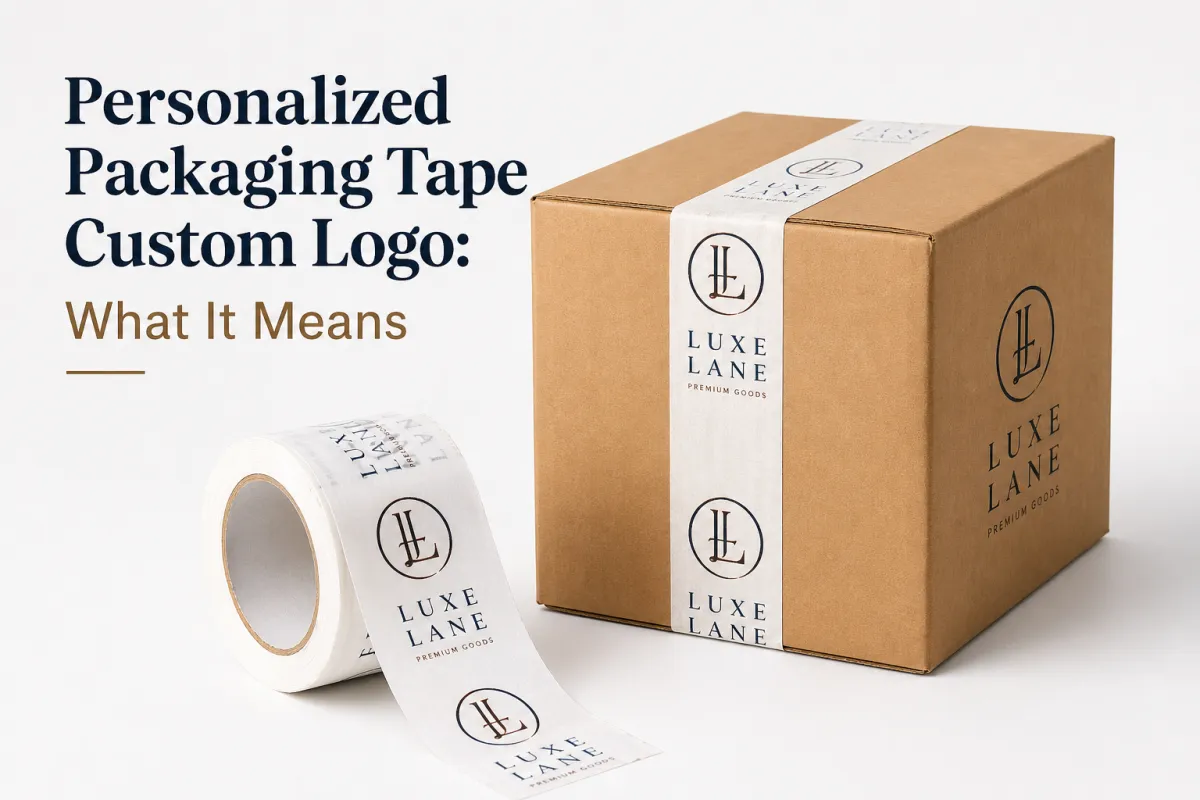
On the warehouse floor, personalized packaging tape custom logo does more than dress up a seam. It tells the receiver who shipped the box, helps a mixed pallet read more clearly in motion, and gives a plain corrugated shipper a cleaner first impression before the label is scanned. A 2-inch tape printed in black on kraft board can read almost like a custom carton panel from 4 to 6 feet away, especially when the repeat lands every 9 to 12 inches and the contrast stays sharp on a line moving 18 cartons per minute. That is why Branded Packaging Tape often becomes a high-visibility substitute for more expensive carton decoration.
The formats differ more than most buyers expect. Pressure-sensitive tape is the familiar one: usually a BOPP film with acrylic or hot-melt adhesive on one side, easy to dispense by hand or through a machine. Water-activated tape uses a kraft or reinforced paper stock with starch adhesive that bonds into the carton fibers, which is why many fulfillment managers trust it for 35-pound to 55-pound cartons and tamper-evident sealing. Some buyers ask for paper-based printed tape to match recycled product packaging or to keep the shipper's finish closer to a natural, low-plastic look. I get why; a glossy roll can feel a little too loud if the brand is trying to look calm and precise.
- Pressure-sensitive BOPP tape: fits fast hand application, lighter cartons, and high-volume shipping lanes where speed matters.
- Water-activated kraft tape: suits heavier loads, a cleaner tear pattern, and a stronger tamper-evidence signal.
- Paper-based printed tape: works well for brands that want a softer visual style and a closer match to recycled packaging design.
"We kept paying for custom printed boxes on every launch, and half the inventory aged out before we used it. Switching to personalized packaging tape custom logo let us keep the cartons standard and still look branded on the dock."
That line sounds familiar because I heard nearly the same thing from a beverage client in Columbus, Ohio, after a supplier review that covered 6 box sizes, 3 board grades, and nearly $18,000 in dead inventory from a seasonal line that moved slowly after the first 30 days. Once they moved to personalized packaging tape custom logo, they simplified the box inventory, kept package branding consistent, and still had room to print a batch code or 18-character tagline without reworking a carton plant in Pennsylvania. Smaller order commitments matter. Faster artwork changes matter too. For brands that need a practical branded packaging layer, tape can beat a full custom box program by a wide margin.
There is also a trust element that gets overlooked. A sealed seam with personalized packaging tape custom logo gives customers a quick signal that the parcel has not been opened and reclosed in transit. It will not replace a true security seal across every lane, but it supports tamper evidence, carton identification, and a more coherent customer experience from packing table to front porch. I have seen teams use it to connect product packaging, retail packaging, and subscription shipments so the whole operation feels like one brand family rather than three disconnected systems. That matters when the same customer sees 3 different carriers, 2 warehouse shifts, and only 1 logo on the box.
How Personalized Packaging Tape Custom Logo Is Made
The artwork handoff decides whether personalized packaging tape custom logo starts clean or turns into a pile of revisions that makes everyone grumpy. I always ask for a vector logo file first, ideally AI, EPS, or PDF, because a raster image from a screenshot will not hold its edge when it repeats across a 300-yard roll. Brand colors matter too. If the customer wants Pantone 186 C red or a specific navy like PMS 296 C, that needs to be stated up front along with repeat length, tagline text, and any minimum stroke width. I prefer to keep fine strokes above 0.25 pt so the print stays legible after converting.
Proofs should not live only on a screen. A good supplier should place the design on a 350gsm C1S artboard mockup for carton visualization, then show the repeat on a 2-inch tape face in both white and kraft contexts. That lets a buyer see how the logo behaves against brown corrugate, high-white folding carton stock, and the seam overlap itself. I have seen a 14 mm mark that looked crisp in a PDF disappear on real tape because the line weight was too light for a 12-inch repeat. Paper and film are unforgiving that way.
Most personalized packaging tape custom logo jobs use flexographic printing on a converting line. The printer runs the tape through engraved plates, transfers ink in the chosen colors, and keeps registration tight so the repeat lands where it should. A one-color job is usually the simplest route, but two- and three-color designs are common when the brand wants a stronger package branding hit. Every extra color brings more plate work, more setup time, and a little more risk of shift if the press is not tuned carefully. Printing is a little unforgiving that way. It does not care how nice the mockup looked on your laptop in Dallas or Shanghai.
I saw that firsthand at a Shenzhen facility winding 10,000-yard master rolls for an apparel client with distribution centers in California and Illinois. The operator showed me how a jumbo roll gets printed, cured, slit to width, rewound, boxed, and palletized before it leaves the plant. The floor looked orderly. The discipline sat in the details: tension control, drying temperature, and repeat consistency over long runs. If the print drifts by 2 or 3 millimeters, the logo starts to look tired by the third carton on a conveyor. Personalized packaging tape custom logo is a process problem as much as a design problem, and that part gets ignored too often.
Substrate and adhesive selection matter just as much as the artwork. Acrylic adhesive is a common pick for general shipping because it stays clear and handles typical storage conditions well. Hot melt has strong initial grab, which helps on dusty corrugate and busy packing tables. Rubber-based adhesive can fit difficult surfaces or chillier environments. On the backing side, BOPP film is the workhorse, while kraft paper and reinforced water-activated stock are used when the customer wants a paper finish or more tear resistance. For a simple repeat job with stock materials, I have seen proof approval to shipment land in 12 to 15 business days from proof approval; special colors, custom dies, or material shortages can stretch the timeline. And yes, everyone always hopes they will be the exception. They usually are not.
For brands that care about transit testing, I like to compare the proposed tape against ISTA methods and the way the carton will actually be handled. The International Safe Transit Association has useful references at ISTA, and if the shipper is using certified paper stock, the chain-of-custody details on FSC are worth confirming before the order moves forward. A line packing 800 cartons an hour does not care about marketing language; it cares about whether the seam holds through vibration, temperature swings, and a few rough transfers in a facility that may be 38 degrees at dock doors and 82 degrees near the pack line.
Key Factors That Shape Cost, Quality, and Performance
Pricing for personalized packaging tape custom logo usually comes down to five things: quantity, color count, substrate, adhesive type, and setup work. As a market example, a one-color 2-inch BOPP roll at 5,000 pieces can land around $0.15 to $0.29 per unit, while a more complex three-color print or a water-activated kraft build can move into the $0.28 to $0.60 range depending on plate charges and material grade. Those numbers shift with resin pricing in Guangdong, freight out of Ningbo, and seasonal demand in the U.S., but they give a buyer a solid frame for comparison. The same logic applies whether you call it custom logo packaging tape or printed shipping tape: the production inputs drive the quote.
Short runs always cost more per roll, and the reason is plain. The press still needs calibration, the plates still need mounting, and the line still needs a test sequence before the first saleable roll comes off. I once sat through a supplier negotiation in Atlanta where a buyer wanted 600 rolls, 3 colors, and a tight Pantone match, then acted surprised when the quote looked high. The setup time was being spread across too few finished units. Personalized packaging tape custom logo rewards volume, repeat orders, and artwork that stays stable for several cycles. That part is not glamorous, but it saves money and a lot of back-and-forth.
Performance is where the shop floor decides whether the tape earns its keep. Adhesion to corrugated board, hold in 35-degree cold storage, behavior in 85 percent humidity, and performance on double-wall cartons all matter. For heavier freight, I prefer testing the seal after 24 hours of dwell time rather than judging it the moment it leaves the bench. A carton stacked under 40 pounds of mixed freight will expose weak tape quickly, even if the first mile looks fine. If you want a more technical framework for transit handling, ISTA testing standards are a strong reference point for distribution teams moving into package qualification work.
| Option | Typical Use | Ballpark Price at 5,000 Units | Strengths | Watch-outs |
|---|---|---|---|---|
| Printed pressure-sensitive BOPP | Everyday outbound shipping, retail fulfillment, mixed SKUs | $0.15 to $0.29 per roll | Fast application, clear print, broad substrate choice | Less tear resistance than kraft; needs clean carton surfaces |
| Water-activated kraft tape | Heavier cartons, tamper-evident shipping, premium product packaging | $0.28 to $0.55 per roll | Bonds into corrugate fibers, strong security feel, paper look | Requires dispenser setup and moisture control |
| Reinforced water-activated tape | Double-wall cartons, high-value goods, long transit lanes | $0.42 to $0.78 per roll | Highest holding strength, excellent for rough handling | Higher material cost and more dispenser upkeep |
That table is why I tell buyers not to judge personalized packaging tape custom logo on price alone. A lighter BOPP film can be the right answer for 18-pound cartons headed to a regional zone, while a reinforced kraft strip makes more sense for 55-pound parcels that will sit in a trailer for 2 days and then be sorted again in Indianapolis. The right choice depends on shipment value, carton weight, line speed, and how much of the packaging design needs to be seen versus simply held together. I usually tell clients to reserve the heavier format for the cartons that truly need it and use standard printed tape for the rest. Saves money. Saves nerves. Saves the warehouse from acting like every box is a museum piece.
If you are comparing tape against full carton art, start with the box counts already in play and check whether a simple branded packaging layer can solve the need without creating extra inventory. That is why many operations teams keep a short list of custom packaging products ready for repeat buys. It keeps the order cycle tidy, reduces dead stock, and gives the team one less reason to overcomplicate the shipping line with too many carton versions or too many board grades.
Step-by-Step Guide to Ordering the Right Tape
Before anyone orders personalized packaging tape custom logo, I like to start with a use-case audit. Is the tape for outbound shipping, retail fulfillment, warehouse sealing, or a promotional launch? Each use needs a different balance of appearance and performance. A subscription box line may care more about presentation and the unboxing moment. A palletized industrial shipment may care more about shear strength, seam retention, and how the seal looks after a forklift transfer at a 42-inch stack height. Clarifying that early usually saves a round of revisions later, and honestly, revisions are where good moods go to die.
- Gather the artwork: send a vector file, note the brand colors, and state whether the logo should repeat every 8, 10, or 12 inches.
- Specify the roll details: choose width, core size, yardage, carton count, and whether the tape will be hand applied or machine dispensed.
- Review the digital proof: check legibility at arm's length, overlap behavior, and the contrast on both kraft and white cartons.
- Test a sample: close 10 to 20 actual cartons, let them sit overnight, then inspect edge lift and seam grip the next morning.
- Set the reorder point: place the next run before inventory drops below 6 weeks of usage, especially if lead time runs 12 to 15 business days.
That proof stage matters more than many buyers expect. A logo that looks perfect in a PDF can disappear when it sits across a brown seam, and a tagline that reads fine on a monitor can look too tight once the repeat is printed on a 2-inch tape face. I ask clients to review proofs at both 100 percent zoom and from 6 feet away, which is closer to what a picker or customer actually sees in a warehouse aisle or on a front porch. Personalized packaging tape custom logo has to work in motion, not only in a design file.
For reorders, I always push teams to keep a simple internal spec sheet with the exact roll width, core ID, adhesive type, repeat length, and approved artwork file name. That single page can save a day of back-and-forth with purchasing. It also makes it easier to standardize around 2 or 3 SKUs instead of ordering a different tape for every carton size. If your team already has a preferred supplier list, add a note about the carton types and the storage conditions so the next run stays consistent with the original. Small filing habits, big relief later.
That is also a good moment to compare 2 material options rather than 1. Ask for a printed pressure-sensitive version and a water-activated version on the same artwork, then close a dozen cartons with each and check the difference after 48 hours. Personalized packaging tape custom logo is one of those purchases where a small side-by-side test can prevent a lot of regret later. If you need a broader starting point, our Custom Packaging Products page is a useful place to line up the tape with the rest of the shipper lineup.
Common Mistakes to Avoid With Printed Tape
The first mistake I see is low-resolution artwork. A 900-pixel JPG pulled from a website may look acceptable on a screen, but it breaks down fast when the logo repeats 40 or 50 times across a roll. I watched a Chicago buyer lose a full day because the logo outline had to be rebuilt from scratch after the first proof came back fuzzy. If you are serious about personalized packaging tape custom logo, start with a proper vector file and treat the proof like production artwork, not a rough draft. Screenshots are the enemy here, plain and simple.
The second mistake is choosing tape based on appearance alone. I have seen a bright printed tape look fantastic on the sample card, then lift at the edges after 36 hours in a cold room because the adhesive was wrong for the board grade. Test on your actual corrugated board, not just on a generic sample carton. Check it in the real warehouse temperature range too, whether that means 38 degrees in a chill dock in Minneapolis or 82 degrees near a sun-facing staging area in Texas. Personalized packaging tape custom logo only works if it sticks in the conditions you actually have.
The third mistake is overdesigning the strip. Too much copy, too many colors, or tiny details can make the print unreadable once the tape is folded around a box seam. A logo with a 1/8-inch stroke may look elegant in a design mockup, but it can vanish on a moving conveyor if the overlap lands in the wrong place. I usually recommend a bold mark, a short tagline if needed, and enough negative space to let the brand breathe. That gives the package branding room to read cleanly instead of turning into a noisy mess.
The fourth mistake is timing. Seasonal launches, holiday peaks, and new retail packaging programs all have a habit of arriving faster than a purchasing calendar expects. I have seen teams assume rush production would be available, then discover that plate making, curing, and freight transit together added 7 to 10 days to the schedule. Another easy miss is seam mismatch: the tape width is wrong for the carton seam, so the print lands half on the flap and half on the sidewall. That makes personalized packaging tape custom logo look off-center even if the artwork itself is perfect. Frustrating? Absolutely. Preventable? Also yes.
Personalized Packaging Tape Custom Logo for Better Branding and Reorders
If I had to reduce the whole topic to one rule, it would be this: personalized packaging tape custom logo should support the brand, not fight the workflow. High contrast matters first. A black logo on kraft board or a white logo on a dark carton usually reads better than a subtle tone-on-tone look, especially if the package will be photographed in a warehouse or opened on social media. Good packaging design is not only about the art; it is about how quickly a human eye can identify the brand at 3 feet, 10 feet, or through a phone camera in under 1 second.
In practice, the best programs behave like a manufacturing plan rather than a one-time marketing buy. Forecast by month, keep a safety stock of at least 1 full cycle, and standardize around 2 or 3 tape SKUs instead of 10. That approach helps the operations crew, the buyer, and the brand team all at once. A lot of package branding gets messy because every new carton size triggers a fresh decision. Personalized packaging tape custom logo is much easier to manage if the tape stays consistent and the carton lineup does not keep multiplying. I know that sounds boring. It is. It also works.
Ask your supplier for repeat length guidance and seam placement advice before the run starts. If the repeat is 10 inches long and the seam is 9.5 inches wide, the logo may disappear exactly where you wanted it most. I learned that lesson while standing with a corrugator buyer in Raleigh, North Carolina, who wanted the logo centered on the top panel but had not measured the flap overlap on the actual box style. A 30-minute check with a ruler and a sample roll would have saved them 2 reprint days. Detail like that is why personalized packaging tape custom logo should always be matched to the box construction, not only the artwork.
For a practical next step, audit the cartons you already use, gather the logo files in vector form, request a sample spec sheet, and compare 2 material options before you place the first run. If the goal is to keep the brand visible without locking into custom printed boxes right away, personalized packaging tape custom logo is usually the cleanest place to start. It is cost-aware, operationally simple, and still strong enough to make product packaging feel intentional from the first seal to the final delivery photo. Pick the carton styles you ship most often, test two tape constructions on those exact boxes, and let the packaging line decide the winner instead of guessing from a mockup.
Frequently Asked Questions
How much does personalized packaging tape custom logo usually cost?
Cost depends on roll quantity, print colors, substrate, and whether you choose standard pressure-sensitive tape or a specialty option like water-activated tape. In practical terms, a 5,000-piece run of personalized packaging tape custom logo can land around $0.15 to $0.29 per unit for a one-color BOPP spec, while a smaller 300-roll test may run materially higher because setup and plate costs are spread across fewer finished rolls. I always ask for pricing at 2 or 3 quantities so buyers can see whether the step from 2,500 to 5,000 rolls improves the economics enough to justify the larger buy.
What artwork do I need for custom logo packaging tape?
A vector file is best, such as AI, EPS, or PDF, because it keeps edges sharp during repeat printing. Give the supplier the exact logo colors, any tagline text, and the repeat pattern you want, even if it is just a simple centered mark every 10 inches. If you only have a raster file, ask for cleanup before production starts. Personalized packaging tape custom logo is much easier to approve when the printer is working from clean art instead of trying to repair a low-resolution file under a tight deadline. A proof placed on 350gsm C1S artboard also helps your team judge color and spacing before the first roll is printed.
How long does personalized packaging tape custom logo take to produce?
Lead time depends on proof approval, plate creation, press scheduling, and the material selected. Simple jobs can move quickly, but personalized packaging tape custom logo with multiple colors, special adhesives, or unusual roll widths may take longer, especially if the shop is already booked on another converting run. A safe planning window is usually 12 to 15 business days after proof approval for straightforward work, with extra time added if the shipment has to cross regions or if the order lands near a peak packaging cycle in Q4.
Is printed tape strong enough for heavy shipping cartons?
Yes, if the tape type and adhesive are matched to the carton weight and shipping environment. Heavier cartons may need stronger adhesives or reinforced water-activated tape for a more secure seal, especially if the load will sit in a hot trailer or be stacked under mixed freight for 24 to 48 hours. I recommend testing personalized packaging tape custom logo on the actual corrugated board before committing to a full run, because a tape that looks great on a sample shipper may behave differently on double-wall board or recycled board with a rougher surface.
Should I start with tape before ordering custom printed boxes?
If you need a flexible brand layer without committing to a full carton redesign, yes. That is the path I would take for most teams that want to improve package branding quickly, control inventory, and keep the door open for future custom printed boxes if the program grows. Personalized packaging tape custom logo gives you a lower-risk way to test color, placement, and customer response, and it can carry the brand cleanly while you learn what volume, carton size, and shipping lane actually deserve a bigger packaging investment. For a lot of businesses, that first run is the difference between a $2,000 experiment and a $20,000 packaging overhaul.

