Buyer Fit Snapshot
| Best fit | Furniture Packaging Supplies Custom projects where brand print, material claims, artwork control, MOQ, and repeat-order consistency need to be specified before quoting. |
|---|---|
| Quote inputs | Share finished size, material target, print colors, finish, packing count, annual reorder estimate, ship-to region, and any compliance wording. |
| Proofing check | Approve dieline scale, logo placement, barcode or warning zones, color tolerance, closure strength, and carton packing before bulk production. |
| Main risk | Vague material claims, crowded artwork, missing packing details, or unclear freight terms can make a low unit price expensive after revisions. |
Fast answer: Furniture Packaging Supplies Custom: Quote Scope should be specified like a repeatable production item. The safest quote records material, print method, finish, artwork proof, packing count, and reorder notes in one written spec.
Production checks before approval
Compare the actual filled-product size with the drawing, then confirm tolerance on folds, seals, hang holes, label areas, and retail display edges. Reserve space for logos, QR codes, warning copy, and material claims before decorative graphics fill the panel.
Quote comparison points
Review material grade, print process, finish, sampling route, tooling charges, carton quantity, and freight assumptions side by side. A quote is only useful when the supplier can repeat the same color, closure quality, and packing count on the next order.
Furniture Packaging Supplies Custom: A Practical Guide sounds dull until one chipped corner turns into a $68 refund, a $94 re-ship, and a buyer who now associates your brand with damage. I still remember watching a $12 chair corner fail because the outer box looked fine and the insert was off by 4 millimeters. Four millimeters. That is the kind of number people shrug at right up until it starts costing real money. That is why I keep coming back to Furniture Packaging Supplies Custom: it fixes the part people most often guess at, the seam between a finished piece and the abuse of a truck, a dock, or a warehouse stack in Atlanta, Rotterdam, or Los Angeles. It is also where Custom Corrugated Boxes, Molded Pulp Inserts, and edge protectors stop sounding like buzzwords and start acting like damage control.
I have seen the same flaw in three very different places: a small e-commerce label in Chicago, a mid-size case-goods plant outside Shenzhen in Guangdong, and a white-glove retailer in Dallas. The furniture was built well, the finish looked expensive, and the package failed in a quiet place. Usually it was a 2 mm gap, a corner block that compressed too easily, or a carton that buckled when a 48-inch stack sat on top of it. Honestly, that last one still annoys me. Furniture Packaging Supplies custom exists to stop that kind of failure before it spreads through returns, claims, and customer service logs, and it does that better than any stock carton ever could.
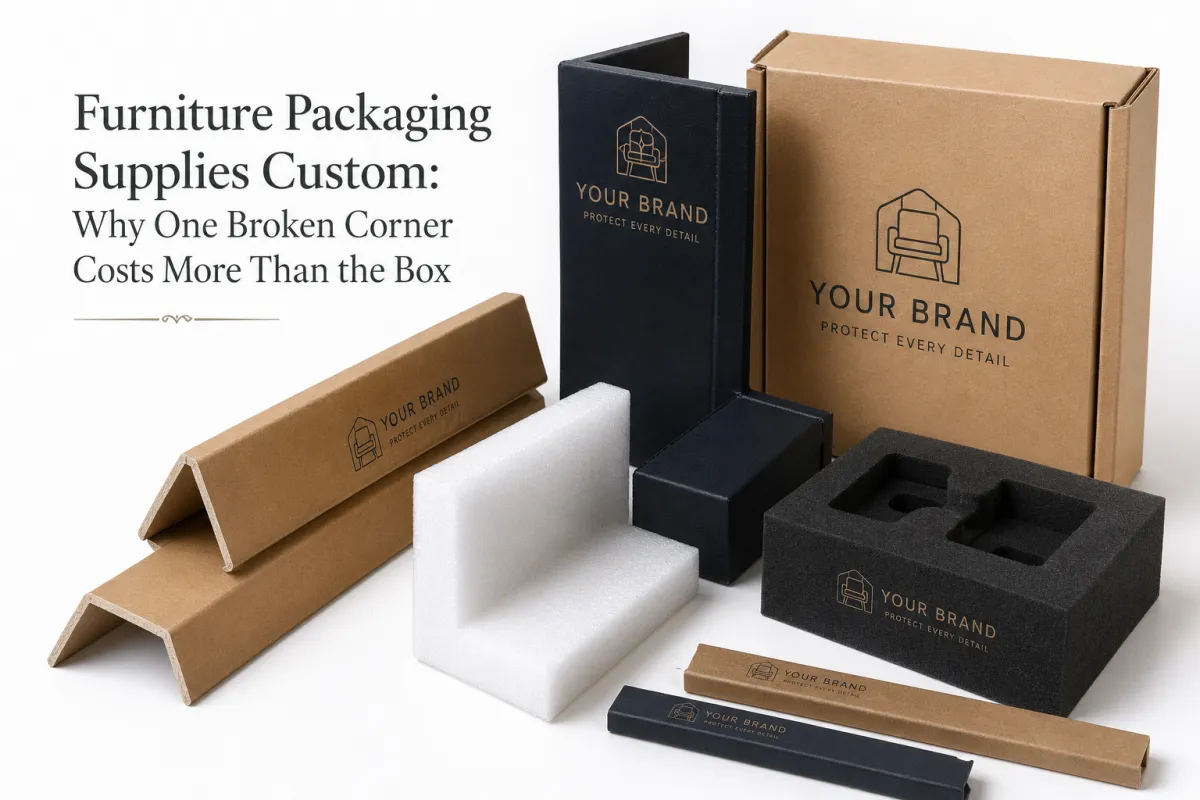
Furniture Packaging Supplies Custom: Why One Broken Corner Costs More Than the Box
The first time I really understood furniture packaging supplies custom was during a supplier visit in Dongguan where a lacquered sideboard arrived with one clean dent on the back rail. The carton showed no visible damage. That part frustrates people because it refuses to look dramatic. The outside looked fine, yet the load shifted inside because the internal fit was off by less than half an inch. One small failure became a $180 replacement, $74 in freight, and a dealer who stopped trusting that line for two months. That is not a packaging issue. That is a business issue wearing cardboard, and it is why protective packaging deserves a line item instead of a shrug.
Good furniture packaging supplies custom is not foam everywhere and hope. That approach burns money, fills a warehouse in Dallas or Columbus with waste, and still leaves you with damage. I have seen teams stuff extra material into a carton like they are trying to win a pillow fight. It never ends well. The real job is matching protection to the actual product: weight, finish, corners, hardware, assembly state, and shipping lane. A painted dresser going LTL to a regional distribution center needs a different package than a flat-pack shelf moving by parcel, and both differ from a walnut dining table shipped on a pallet with mirrors and legs separated. The differences show up in the bills as much as the breaks, which is why furniture packaging supplies custom usually saves more than it spends.
Most mistakes start with the carton dimensions alone. That is packaging design done backwards. Real furniture packaging supplies custom begins with the damage risk, not the tape measure. If the hazard is corner crush, build for corners. If the hazard is abrasion, use a surface-safe contact material. If the hazard is movement, lock the product in place. If humidity during storage is the weak point, spec the board and wrap for that lane in humid ports like Savannah or Ho Chi Minh City. The package should answer the failure, not the mockup. I wish more teams would say that out loud before ordering a thousand boxes.
I still remember a negotiation with a carton converter in Dongguan where the sales rep kept pushing a prettier printed box with thinner board. I asked him to stand by the drop tester and watch what happened to the leg rail. He went quiet after the second drop from 30 inches. That is the honest version of furniture packaging supplies custom: it is not about making the box look expensive. It is about keeping a $12 corner from becoming a $120 problem.
"The box did not fail. The pack-out did." I have said that in too many client meetings from Chicago to Shenzhen, and I was right almost every time.
Another reason furniture packaging supplies custom matters is simple geometry. Furniture has more surface area, more corners, and more contact points than most products. Glass inserts, polished veneer, powder-coated steel, and upholstered arms fail in different ways. A stock carton can protect a boring rectangle. It cannot intelligently protect a cabinet with protruding legs, a mirror, or a headboard with decorative trim. The right package often saves more than it costs because it cuts claims, replacement labor, and rework. Cheap packaging is only cheap on paper, which is one of those truths that keeps showing up in every budget meeting like an unwanted cousin with a spreadsheet. If you are comparing options, custom packaging products and furniture packaging supplies custom are often two ways of naming the same decision: protect the product or pay for the damage later.
What Furniture Packaging Supplies Custom Includes
Furniture packaging supplies custom usually means a system, not a single box. I am talking about corrugated cartons, die-cut inserts, foam corners, molded pulp trays, edge protectors, stretch wrap, dust covers, pallet layer pads, and sometimes reinforced outer sleeves. The mix changes by category. A flat-pack bookcase may need a heavy carton and a 350gsm C1S artboard insert. An upholstered chair may need a dust bag, a corner shield, and a snug carton. A mirror or glass tabletop usually needs edge protection first and carton strength second. The materials are less glamorous than the furniture, but they do the heavy lifting, especially when the shipment has to survive a rough LTL lane or a crowded 3PL floor.
In furniture packaging supplies custom, the outer layer and the internal layer do different jobs. The outer layer keeps the load from being crushed, punctured, or mistreated in transit. The internal layer keeps the product from moving, rubbing, or twisting. If the product can slide 3/8 inch inside the box, it will, and it will do that at the worst possible moment. I have watched a test carton survive a 36-inch drop and still fail because the finish scuffed where the armrest touched the insert. No one gets credit for a box that survives while the product gets ugly. A customer does not open a carton and say, "Well, at least the corrugate did fine."
The right mix also depends on the product line. Retail Packaging for Small accent tables is not the same as bulk packaging for case goods, and that is where branded packaging starts to matter. A custom printed carton can cut warehouse mistakes because the SKU, orientation arrows, and pack-out steps are visible before the box is opened. In a plant in Monterrey or a 3PL in Columbus, that can shave 20 to 40 seconds off each pack-out, which matters when a team handles 600 units a day. It also tells the buyer the product was packed on purpose, not shoved into whatever carton was nearby. That is package branding doing actual work, not decoration, and it is one more reason furniture packaging supplies custom is closer to operations than to graphics.
- Corrugated cartons for outer protection, print, and stack strength, often 32 ECT for light SKUs and 44 to 48 ECT for heavier units.
- Foam or molded pulp for corner control and shock absorption, with PE foam at 1.7 to 2.2 lb density or molded pulp at 2.0 to 2.5 mm wall thickness.
- Edge protectors for long panels, table tops, and polished rails, especially on 60-inch and 72-inch parts.
- Stretch wrap and dust covers for storage, cleanliness, and moisture control during 30- to 60-day warehouse holds.
- Layer pads and pallet sheets for unitizing larger furniture shipments on 40 x 48 inch or 42 x 48 inch pallets.
- Labels and graphics for orientation, SKU control, and retail packaging presentation, often printed in black plus one spot color to keep costs around $0.15 per unit at 5,000 pieces.
There is a material tradeoff here, and that is where many brands get careless. Foam is light, but not always recyclable in the channels your customer actually uses in California, Ontario, or the Netherlands. Molded pulp can look and feel better for sustainability, but it may need more space and careful design. Heavy board protects well, but it raises freight cost if you overbuild the carton. A good supplier talks about weight, recyclability, appearance, and storage space in the same conversation. If they only talk about "premium feel," they are selling a brochure, not furniture packaging supplies custom.
For paperboard sourcing and responsible forest claims, I ask suppliers to show FSC documentation and the mill name, not just the logo on the sleeve. A 350gsm C1S artboard from a certified mill in Wisconsin or British Columbia is easier to verify than a vague "eco" claim from a spec sheet. You can read more at FSC. If a supplier cannot explain how the board is sourced, labeled, and stored, I slow the order down. That usually saves a headache later, and trust me, headaches in packaging always seem to arrive right before launch.
How Furniture Packaging Supplies Custom Is Designed and Tested
The design process for furniture packaging supplies custom starts with the product, not the box. I want the actual dimensions, the real weight, the finish type, the hardware locations, and the way the item leaves the warehouse. If it ships partially assembled, I need that detail. If the leg set protrudes, I need a photo. If the piece has a fragile veneer, I need to know whether the problem is abrasion, impact, or both. Good packaging design begins with a failure map, and yes, I know that sounds a little dramatic. Packaging people are allowed one dramatic phrase per meeting, especially if they are trying to reduce the damage rate rather than explain it later.
Then the sample gets built. I have seen suppliers rush this step with the confidence of someone who has never paid a claims invoice. That usually ends badly. The better move is to build a sample around dummy loads or a real unit, then run corner drops, edge drops, vibration checks, and compression tests. If the team wants a testing reference, I usually point them to the ISTA testing standards library and then remind them that the package still has to survive the actual lane, not just a lab floor. Lab results are useful. Freight reality is ruder, and furniture packaging supplies custom has to answer both.
When I visited a plant making custom trays for a matte-black media console in Shenzhen, the team had passed every paper spec but ignored the coating. The first friction test left faint gray rub marks on the finish after only 12 cycles. It was not a dramatic failure. It was worse. It was subtle enough that the customer would notice after unboxing and think the product had already been used. That is the kind of detail furniture packaging supplies custom has to catch before full production. I still get annoyed thinking about how close that line came to a pile of returns for something that looked "fine" in the sample room.
Stackability, warehouse fit, and pallet discipline
One reason furniture packaging supplies custom succeeds or fails is stack behavior. A carton that looks fine on one pallet layer can collapse on the third layer if the board grade is too light or the insert spreads load the wrong way. Warehouse fit matters too. If the box is awkward for a conveyor, a wrap station, or a hand truck, the packing team will find a shortcut. That shortcut will show up later as damage. People love blaming carriers. Sometimes the real villain is a box that was impossible to handle cleanly. I have seen more damage caused by awkward handling than by the truck ride itself, which is not exactly comforting but it is useful.
I ask three questions before I approve a design: can it be stacked, can it be palletized, and can a warehouse crew pack it the same way 100 times in a row? If the answer to any of those is no, the structure needs another round. This is where furniture packaging supplies custom gets practical. It is not enough to keep the furniture from breaking. The system also has to fit the operations team, the dock schedule, and the space you actually rent by the square foot in Los Angeles, Toronto, or Hamburg.
One more thing: smart suppliers do not stop at dimensions. They ask how the item is stored, whether the boxes sit in humid conditions, whether the product gets double-handled, and whether the final destination is parcel, LTL, or white-glove delivery. That is the difference between a packaging vendor and someone who understands furniture packaging. I can usually tell within five minutes which one I am dealing with, and the clue is usually whether they ask about humidity numbers like 55 percent RH or just say "it should be fine."
What Actually Changes Furniture Packaging Supplies Custom Pricing?
The quote for furniture packaging supplies custom changes for a handful of boring reasons, and boring is where the money lives. Board grade is one. Foam density is another. Add insert complexity, print coverage, die tooling, order volume, pallet counts, and freight. If you need a Custom Printed Box with a fit-specific insert and mixed-material pack-out, expect the price to climb fast. If you order simple cartons in a larger run, the unit cost drops. That is not a mystery. That is manufacturing, plus math, plus the part everyone ignores until the invoice lands.
I have sat through enough supplier calls to know that low-volume work gets expensive because setup time has to be spread across fewer pieces. If a converter spends two hours on a new die and a small run only needs 800 cartons, you pay for that setup somewhere. Same story with furniture packaging supplies custom tooling. One mold, one die, one sample cycle, and one revision can move the number by hundreds of dollars. The quote format matters too. Some vendors quote by unit, some by board foot, some by pallet load, and some bury half the cost in freight. Read the line items like an adult. I know that sounds blunt. It is blunt because it is true.
| Packaging option | Typical build | Best use case | Ballpark unit cost at 5,000 pcs | Notes |
|---|---|---|---|---|
| Single-wall carton + die-cut insert | 32 ECT to 44 ECT board, paperboard insert | Flat-pack furniture, light case goods | $1.10 to $1.85 | Lowest freight weight, good for repeat SKUs |
| Double-wall carton + corner blocks | 44 ECT to 48 ECT board, molded or foam corners | Heavier tables, cabinets, mirrors | $1.90 to $3.40 | Better crush resistance on LTL lanes |
| Molded pulp + printed carton | 2.2 lb molded pulp, branded outer box | Retail packaging and eco-positioned products | $2.20 to $4.25 | Good story for branded packaging, but needs fit testing |
| Foam-fitted premium system | PE foam or EPE, high-coverage custom print | High-gloss or fragile finishes | $3.80 to $7.50 | Higher protection, more material waste if overused |
That table is only a starting point, because furniture packaging supplies custom pricing also reacts to the hidden costs people forget. Damage claims are obvious. Warehouse labor is less obvious. Extra cubic inches can raise freight bills far more than the buyer expects. I once reviewed an account where the package upgrade added $0.42 per unit, but the oversized parcel charge and the lower return rate saved more than $18,000 in the first quarter. That is the kind of number that quiets a room. Cheap quotes are often the ones that ignore the cost of failure, and furniture packaging supplies custom is rarely cheap for the right reasons.
"If the supplier cannot explain where the extra $0.38 went, they are hoping you will not notice the die charge, the print charge, or the freight charge." That line has saved me more than once.
Brands also forget that the cheapest packaging is not always the lightest. A thinner carton may cost less per unit and cost more in claims. A premium-looking insert may make the product feel better and increase scrap because it does not hold shape. Furniture packaging supplies custom should be priced against the full system: material, labor, freight, storage, and damage risk. Otherwise you are comparing one number to a fantasy, and fantasies are terrible at accounting.
Furniture Packaging Supplies Custom Process and Timeline
The usual furniture packaging supplies custom process starts with a discovery call, and that call should be more detailed than most people expect. I want the product dimensions, weight, finish type, ship method, target budget, annual volume, and the damage history from the current package. If you have photos of crushed corners, scuffed veneer, or bent legs, send them. That information beats guesswork every time. A supplier worth your money will ask for the same thing, and if they do not, I would be a little suspicious.
After that comes measurement and sampling. If the product specs are clean, a simple sample can move in about 7 to 10 business days. If tooling is needed, add another week or two. Full production often lands in the 12 to 15 business day range from proof approval for repeat cartons in Chicago, while more complex mixed-material packs can take 18 to 20 business days if the print requires a second proof. Furniture packaging supplies custom slows down the moment someone says, "Can we just move the insert another quarter inch?" Yes, but now the clock starts again. I have lived that sentence more times than I care to admit.
What speeds the job up is simple: accurate dimensions, actual product photos, known shipping lanes, and a clear understanding of how the warehouse packs each SKU. What slows it down is just as simple: unfinished product specs, six finish variations, vague performance targets, and late changes after the sample is approved. I have seen a launch slip by three weeks because the client changed one leg finish from matte black to piano black after the prototype. That single change altered the surface contact material. Small change, big delay, very annoying. Packaging has a long memory for tiny decisions, and furniture packaging supplies custom punishes improvisation more than most people expect.
For teams building a new product line, I like to pull the pack-out details into Custom Packaging Products once the sample is approved. That keeps the carton, insert, labels, and any accessory kits tied to one spec instead of three different emails and a bad memory. It also helps operations because the warehouse is not guessing which version is current. Furniture packaging only works if the line can run it the same way every time, whether the order ships from Nashville, Ningbo, or a third-party warehouse in Ontario.
- Discovery call with dimensions, photos, finish notes, and shipping lane data.
- Sample build using the actual furniture or a close dummy load.
- Testing for drops, vibration, compression, and surface rub.
- Revision if the product shifts, scuffs, or compresses too much.
- Approval and production once the pack-out survives repeated handling.
- Warehouse handoff with a clear pack sheet, labeling, and stack instructions.
I do not like seeing furniture packaging supplies custom treated as an afterthought on a launch calendar. If the product is coming off the line in May, the packaging conversation should start in March, not after the first customer complaint. That is how brands end up paying air freight for replacement boxes and trying to fix a structural problem with tape, prayers, and a lost weekend. I have seen the "we will fix it later" plan. It costs more than fixing it now. Every single time.
Expert Tips and Next Steps for Furniture Packaging Supplies Custom
If you want furniture packaging supplies custom to pay off, build a packaging brief before you request quotes. Keep it to one page and include product dimensions, weight, finish type, shipping method, damage history, and target budget. Add whether the item is parcel, LTL, or white-glove. Add whether the product ships assembled or flat. Add whether the customer will see the pack-out, because retail packaging and transit-only packaging are not the same job. I know that sounds obvious. It is amazing how often obvious gets skipped when everyone is rushing.
I also tell buyers to compare at least three suppliers on more than price. Look at sample quality, revision speed, lead time, material options, and whether the team asks smart questions about warehouse handling. A supplier that understands furniture packaging supplies custom will ask about pallet heights, humidity, carton orientation, and how often the SKU changes. A supplier that only asks for the box size is usually guessing. Guessing is expensive. It just wears a nice shirt and sends a polished quote from a sales office in Shenzhen, Dallas, or St. Louis.
Before full rollout, ask for a drop-test or compression-test plan. I am not talking about a vague "we tested it." I mean actual conditions: corner drops from 30 inches, vibration for the route type, stacked compression at the planned pallet height, and a quick inspection for rub marks. If the product shifts, scuffs, or shows corner damage in sampling, the design is not ready. That is not failure. That is useful data. Better to learn from a $200 sample than a $20,000 production run, especially when the alternative is a warehouse full of regret.
My favorite way to roll out furniture packaging supplies custom is to start with the top-selling SKU and the highest damage-rate SKU first. If that solution works, I scale it to the rest of the line. That saves cash, keeps the team focused, and avoids the classic mistake of redesigning everything at once. For branded packaging and custom printed boxes, start with the hero product, not the whole catalog. Otherwise you will spend more time arguing about artwork than fixing damage, and I have been in those meetings. They are long. They are loud. They are never as productive as the people in the room think they are.
Here is the action plan I hand to clients who want fewer claims and less drama:
- Audit damage rates by SKU and by lane for the last 90 days.
- Gather clean specs, product photos, and finish details for the fragile items.
- Request samples from at least three vendors, including one that offers molded pulp or paperboard alternatives.
- Test the pack-out with real handling, not wishful thinking.
- Roll out the approved design in phases so the warehouse team can learn it without chaos.
Honestly, I think the smartest brands treat furniture packaging supplies custom as part of product development, not as a shipping nuisance. The box, the insert, the labels, and the pack sheet shape the customer experience. If you get them right, the product arrives looking deliberate, not battered. If you get them wrong, the furniture may survive, but the brand takes the hit. That is why I always push teams to invest in furniture packaging supplies custom early, test it hard, and choose the solution that protects the product without wasting material or cash.
What are furniture packaging supplies custom used for?
They protect furniture during storage, warehouse handling, palletizing, and shipping, whether the route is parcel, LTL, or white-glove delivery. The point is to build around the item's size, finish, fragility, and shipping method instead of forcing everything into one stock box. I have seen that mistake too many times in Texas warehouses and Guangdong factories, and it always costs more later. Good furniture packaging supplies custom also reduces scuffs, corner crush, and the false economy of repeat claims.
How much do furniture packaging supplies custom cost?
Pricing depends on materials, print coverage, tooling, complexity, and order quantity. A simple carton system at 5,000 pieces might land around $1.10 to $1.85 per unit, while a multi-part insert setup or premium retail finish can push the unit price to $3.80 or more. The quote only makes sense if you compare it against damage risk and freight, not just the box line. That is why furniture packaging supplies custom should be priced as a system, not a single SKU.
How long does it take to make custom furniture packaging?
Simple samples can move in 7 to 10 business days, and full production often takes 12 to 15 business days from proof approval for repeat runs. More complex builds with tooling, print revisions, or mixed materials can stretch to 18 to 20 business days. Lead time slows down whenever dimensions are incomplete or the product changes after sampling. I wish I could say that part is rare. It is not, which is one reason furniture packaging supplies custom works best when the brief is finished before the quote request.
What materials work best for custom furniture packaging?
Corrugated board works well for many cartons and outer packs, especially 32 ECT through 48 ECT depending on weight. Foam, molded pulp, corner blocks, and edge protectors are chosen based on the product's weight, finish sensitivity, and how rough the shipping lane tends to be. The "best" material is usually the one that protects the product without creating a freight mess or a recycling headache in Toronto, Berlin, or California. For many lines, furniture packaging supplies custom ends up being a mix of board plus an insert, not a single-material solution.
How do I know if my furniture packaging supplies custom are strong enough?
Test them with drop, vibration, and compression checks before full rollout. If the product shifts, scuffs, or shows corner damage in sampling, the design is not ready yet and needs another pass. That extra pass is annoying, sure, but it is still cheaper than replacing damaged furniture, especially when a single claim can run $120 to $300 after freight and labor. Strong furniture packaging supplies custom should pass the lab and the warehouse floor.
If you want the short version, build furniture packaging supplies custom around the real abuse, not the brochure. Audit the damage, test the lane, lock the weak points, and stop paying for preventable corner failures. That is how furniture packaging supplies custom saves money, protects the product, and keeps the customer from opening a box that already lost the fight. Do that first, then worry about the print.