If you are sourcing garment hang Tags Wholesale Private Label, the tag is doing more work than most buyers realize. It is a branding cue, a compliance carrier, and often the first physical proof that a product belongs on a retail rack. A weak tag can make a well-made garment feel unfinished. A good one does the opposite without drawing attention to itself.
That difference shows up quickly in real buying decisions. Buyers handle the garment, glance at the tag, and make assumptions about price point, quality control, and whether the brand understands retail presentation. You do not need overdesigned packaging. You need a tag that prints cleanly, holds up in handling, and matches the garment, the channel, and the budget.
For customlogothing.com buyers, the practical challenge is usually not creativity. It is control. Once stock, format, finish, and production method are locked, the rest becomes far easier to manage. Ignore those basics and the quote will drift, the proof cycle will slow, and the tag will start looking like a compromise instead of a deliberate brand element.
Why private label hang tags change the first impression fast
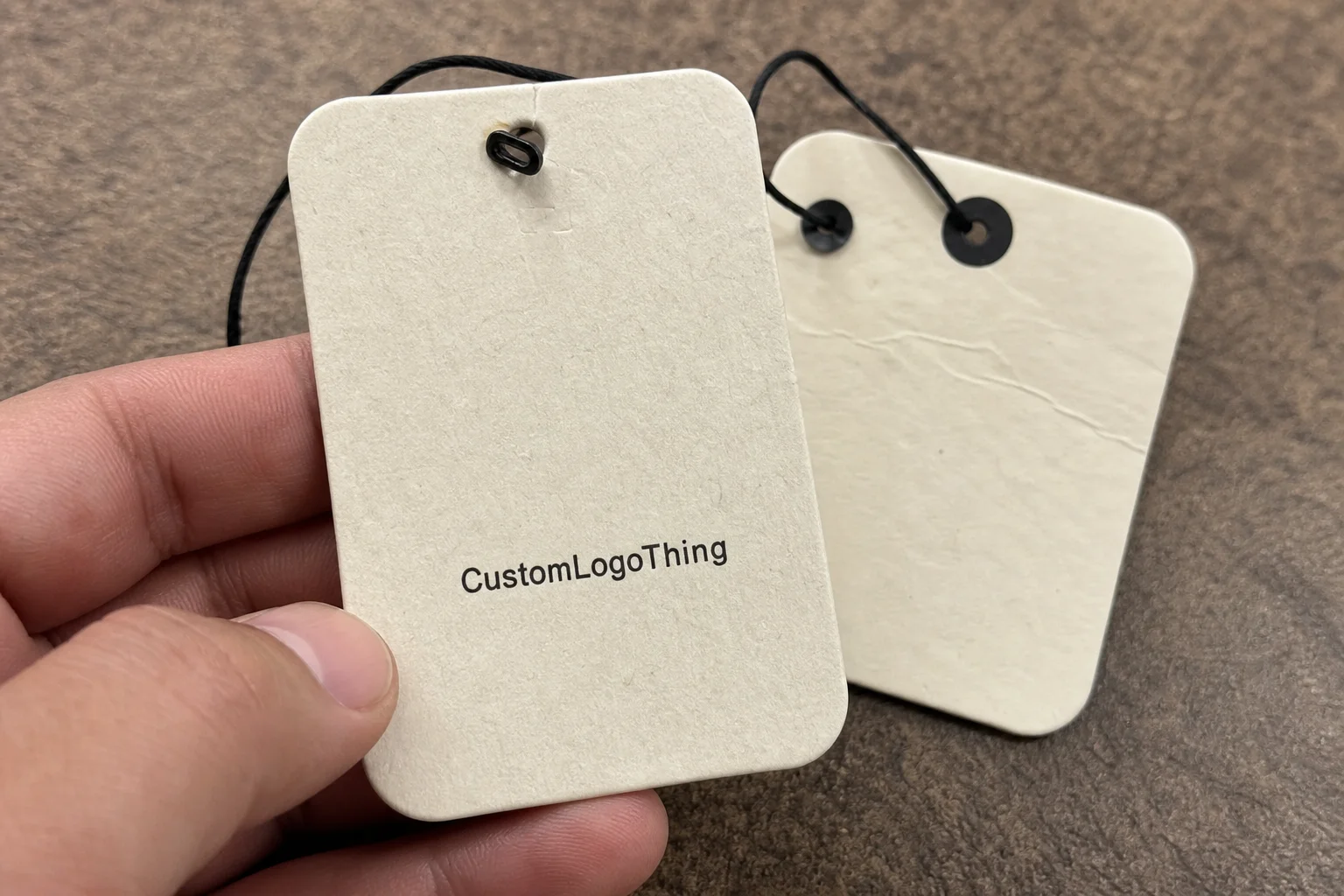
A shopper usually touches the hang tag before they feel the fabric. That tiny interaction matters. In store, the tag sits in the buyer’s hand while the garment is still on the hanger. In product photography, it may be one of the first details visible in a thumbnail, a lookbook, or an unboxing shot. Either way, it becomes part of the brand’s evidence.
Private label hang tags help smaller brands look organized and established. That matters for boutiques, DTC labels, and seasonal collections that cannot afford sloppy presentation. The tag does not have to be loud. It has to be coherent. Clean hierarchy, correct color, and consistent finish usually signal more professionalism than a tag covered in decorative effects.
Wholesale ordering also protects consistency across products. One approved tag system across tees, denim, outerwear, and accessories is easier to manage than a dozen slightly different versions created by different people at different times. The cost of inconsistency is not just visual. It creates extra approvals, extra file cleanup, and extra chances for the wrong version to reach production.
For private label brands, hang tags usually serve three functions:
- Signal brand quality and price position
- Carry product, barcode, or compliance information
- Support shelf appeal, giftability, and perceived resale value
That last point is easy to dismiss, but it matters. A strong tag can make a garment easier to gift, easier to display, and easier for a customer to justify at a higher retail price. It is not magic. It is packaging doing the job packaging is supposed to do.
One practical buyer observation: the tag often reveals whether the rest of the line was planned in advance. If the paper stock, punch location, barcode, and string choice all feel aligned, the brand usually looks more credible. If the tag looks improvised, the product can feel temporary even when the fabric quality is good.
Product details that make garment tags feel premium
Format changes the entire read of a tag. Common options include flat tags, folded tags, swing tags, booklet tags, and multi-piece label sets. Flat tags are simple and economical. Folded tags give more copy space without making the front face crowded. Booklet tags are useful when a brand needs room for product story, multiple languages, fabric details, or a small sustainability statement. Multi-piece sets work well when branding, pricing, and care information all need to stay coordinated.
Attachment method changes both appearance and handling. A cotton loop reads softer and more natural. A plastic fastener is common in mass retail because it is quick and consistent. Safety pins can work for some apparel, but on premium garments they often look utilitarian. Elastic loops are useful for accessories and items that need a little give. The right attachment is usually the one that matches the garment’s positioning and the retailer’s handling standard, not the cheapest line on the quote.
Finishing is where buyers either sharpen the presentation or overspend on effects that do not improve the tag. Matte lamination creates a restrained, modern surface. Gloss adds brightness and makes saturated color pop more strongly under light. Soft-touch lamination feels premium in hand and is often used for higher-end basics or fashion-forward labels. Foil stamping, embossing, and UV spot can lift a logo or key graphic, but they should support hierarchy, not replace it. Rounded corners are worth considering for durability, especially on tags that will be handled repeatedly in stores or warehouses.
Use case should drive the spec. Denim can support heavier board and stronger graphics. Activewear usually performs better with lighter tags, cleaner typography, and a layout that is easy to scan at a glance. Luxury apparel tends to benefit from thicker stock and more tactile finishes. Accessories often need smaller formats with very clear hierarchy so the item can be identified immediately.
“A good hang tag does not compete with the product. It frames it.”
That is the standard worth aiming for. If the tag is overloaded with copy, decorative shapes, and extra effects, the customer sees confusion before they see the brand.
Material, size, and print specifications buyers should lock in
Stock is the first technical decision, and it drives both cost and hand feel. For most retail apparel, 14pt to 18pt cardstock is a workable range. Many standard programs sit at 14pt-16pt because that balance keeps the tag stiff enough without pushing costs too high. Premium labels often move to heavier board or textured specialty stock, especially when they want a more substantial feel in the hand. Thin paper always looks thin. That is not a style statement; it is a practical buying reality.
Size should match the garment and the amount of information the tag needs to carry. Smaller rectangles work for basics and compact items. Taller vertical formats are common in fashion-forward labels because they create more visual presence without widening the silhouette. Custom die-cut shapes can help a brand stand apart, but they should be chosen for a reason. If the shape makes the tag harder to stack, easier to bend, or more expensive to produce, the novelty may not be worth it.
Print method affects both price and consistency. Digital printing is usually the better choice for shorter runs or variable content. Offset printing tends to make sense for higher quantities because it offers better color consistency across larger batches. Specialty finishing adds cost, but it can be justified if the garment has a higher retail target and the tag needs to support that positioning. The smarter choice is the method that fits the run size, lead time, and finish expectation, not the one with the most impressive name in the quotation.
Before approving artwork, lock down the specifications that actually affect production:
- Logo files in vector format, ideally AI, EPS, or PDF
- Pantone targets or approved CMYK values
- Front and back copy
- Barcode, QR code, or SKU data if required
- Hole placement and hole diameter
- String, loop, or fastener length
- Care text, fiber content, and country of origin details if the tag carries compliance information
The compliance side matters more than many first-time buyers expect. In apparel, hang tags often work alongside sewn labels, size labels, and packaging inserts to support product identification. If the tag doubles as a retail information card, the design still has to stay readable. Overcrowding the layout usually creates a tag that looks expensive in the mockup and confusing in the hand.
For brands selling into structured retail environments, it helps to cross-check packaging expectations against industry references such as PMMI packaging resources and, for transit or fulfillment concerns, ISTA testing standards. Those references are useful because tags do not exist only on a computer screen. They have to survive packing, sorting, storage, and handling without bending, scuffing, or losing legibility.
One more production constraint often gets overlooked: the smallest type on a tag is usually the first thing to fail when coating, lamination, or barcode placement is not planned early. A design that looks acceptable at 100 percent on screen may still produce weak contrast in print. That is why proofing against actual stock matters.
Garment hang tags wholesale private label pricing and MOQ basics
Pricing comes down to six variables: stock, size, color count, finish, attachment, and quantity. A plain 16pt tag with one-color print and standard hole placement costs far less than a custom die-cut tag with foil, embossing, and a cotton loop. Buyers know this in theory, but the quote still surprises them when every decorative choice gets priced separately. That is normal. Finishing is real work, and real work costs money.
For garment hang tags Wholesale Private Label, MOQ usually depends on print method and finishing complexity. Simpler digital runs can start in the low hundreds. More specialized jobs, especially those with custom shapes or multiple finishing steps, often need a higher minimum. Wholesale pricing only makes sense when the buyer has enough demand, enough forecast confidence, or enough product variety to justify the setup.
Here is the practical tradeoff:
| Order type | Typical quantity | Approx. unit cost | Best for | Watch-outs |
|---|---|---|---|---|
| Short run | 200-500 pcs | $0.35-$0.80 | New launches, testing designs | Higher setup share, fewer finish options |
| Mid run | 1,000-3,000 pcs | $0.18-$0.42 | Small brands, seasonal drops | Custom finishes raise the quote quickly |
| Bulk run | 5,000+ pcs | $0.08-$0.22 | Reorders, multi-SKU retail programs | Storage and forecast accuracy matter |
Those ranges are typical, not universal. A simple tag on standard cardstock will sit toward the low end. Foil, embossing, custom shapes, specialty stock, and multi-piece formats push the cost up. Setup fees, die charges, proofs, samples, and shipping are often separate line items. If the quote looks too neat, ask what is missing before approving it.
My practical rule is straightforward: standard dimensions and standard finishes keep budget control easier. Custom shapes and heavier embellishment can raise perceived value if the garment is positioned correctly, but they can also burn margin quickly if the retail price is too low to support them. Paying for premium finishing on a commodity-priced item usually creates a prettier expense, not a better business decision.
For brands building repeat orders, wholesale planning tends to improve both unit cost and production discipline. You can review Wholesale Programs and compare the economics against your sales calendar before committing to a format that only looks inexpensive on paper.
A second cost reality is waste. If you change artwork every season, or if each SKU has its own tag variation, your inventory risk climbs. A shared base format with small variable fields can reduce reorder headaches and make pricing easier to forecast.
Process and lead time from artwork to delivery
The workflow should be simple enough to manage without drama: inquiry, quote, artwork check, proof approval, sampling if needed, production, finishing, packing, and shipping. If a supplier skips one of those steps, or rushes past the artwork check, the risk shifts to the buyer. Most tag problems are not mysterious. They are file problems, approval problems, or measurement problems.
Typical timing depends on complexity. Straightforward digital orders can often move in about 7-12 business days after proof approval. Standard printed runs with basic finishing often land around 12-15 business days. Custom shapes, foil, embossing, or booklet formats usually need more time, sometimes 15-20 business days or longer depending on the approval cycle and production queue. Rush orders are possible in some cases, but only when the supplier can still protect print quality and finishing accuracy.
Approvals control the schedule more than buyers want to admit. One delayed proof can stall the run. Missing font outlines, unclear hole placement, low-resolution barcodes, or conflicting Pantone references are enough to stop production. That is not a sales tactic. It is how reprints happen.
Here is what can usually be expedited:
- Standard stock selection
- Simple digital print jobs
- Basic hole drilling and stringing
- Proof review when the buyer responds quickly
Here is what usually cannot be rushed without risk:
- Complex finishing such as foil and embossing
- Custom die-cut tooling
- Large bulk quantities with tight color matching
- International freight during peak shipping periods
Shipping planning matters more than many buyers expect. Domestic freight can be manageable on smaller orders, while international fulfillment needs extra buffer time for transit, customs, and possible handoff delays. If the tags are tied to a seasonal drop, order earlier than feels comfortable. That is usually the difference between a controlled launch and a scramble.
Another timing issue is sample approval. A physical sample can catch stock feel, print sharpness, hole placement, and attachment behavior in a way a PDF never will. That step may add time, but it can also prevent a full reprint. On a small order, a sample is often cheaper than one correction cycle.
How a private label tag supplier reduces rework and mistakes
A good supplier is not just taking an order. They are checking the details that buyers often miss. Bleeds, trim margins, hole position, font size, barcode contrast, and string length all affect whether the tag works once it reaches production. Catch a mistake before printing and it costs minutes. Catch it after printing and it costs money, time, and patience.
Color control is another major issue. If a logo red shifts from one batch to the next, the brand starts looking inconsistent across collections. That may not matter on a mockup, but it shows immediately when an item is photographed, merchandised, or displayed next to prior seasons. Experienced buyers do not choose suppliers on price alone because the cheapest quote can become expensive once the second run does not match the first.
Sampling helps reduce that risk. A physical sample reveals actual stock weight, print clarity, surface finish, and attachment behavior. If you are ordering garment Hang Tags Wholesale private label as part of a repeat brand system, sample approval is a low-cost safeguard. It also exposes problems that are easy to miss on screen, such as weak contrast after lamination or text that becomes too tight once the layout is trimmed to size.
Coordination matters too. A stronger vendor can align tag specs with the rest of the packaging system: folded labels, inserts, polybag stickers, and retail-ready presentation. That is especially useful when the brand wants one visual language across packaging instead of a bundle of separate decisions. Consistency is hard to fake once the product is in hand.
Inventory planning is part of the same discipline. Reorders should match the first batch closely. If a supplier changes stock, coating, or print method without warning, the next run can look slightly different. That difference may be small on a spreadsheet and obvious in a store set. Reliability, communication, and accuracy are the real wholesale value.
For brands that need packaging consistency across multiple components, the Custom Labels & Tags category is a useful place to keep the system aligned instead of piecing it together one product at a time.
If sustainability matters to the brand, ask about FSC-certified paper through FSC materials. Not every product line needs it, and not every budget can support it, but for some retail programs it is a meaningful signal when the paper choice is actually appropriate for the product and the run size.
Next steps to order the right apparel tags without guesswork
Start with three decisions: tag size, stock, and finish. Those choices shape most of the look and most of the cost. Once they are fixed, the rest of the spec usually falls into place more quickly. If you leave them open, every quote turns into a design debate.
Before requesting pricing for garment hang tags wholesale private label, gather the essentials:
- Logo file in vector format
- Quantity by SKU or collection
- Exact dimensions
- Stock or paper preference
- Finish choice
- Attachment method
- Any compliance copy or barcode data
Then ask for a proof. A digital proof is the minimum. A physical sample makes sense when the tag is a new format, a higher-value item, or part of a brand system that has to match previous packaging. Proofing protects against the usual mistakes: wrong hole placement, cropped logos, weak contrast, barcode issues, or a tag that looks polished on screen and awkward in hand.
Plan the reorder window around the sales calendar rather than around optimism. If the next drop ships in eight weeks, tags should be ordered early enough to absorb proof changes, production delays, and freight variability. Brands that stay ahead of packaging usually look more organized because, frankly, they are more organized.
If the project is still undecided, compare a standard tag system against a premium one and look at the numbers beside the visual effect. If the finish truly supports the product price, keep it. If it only adds cost, cut it. The goal is not to impress a spreadsheet. The goal is to make the garment look ready for retail.
For buyers ready to source garment hang tags wholesale private label, the cleanest path is to confirm specs early, approve proofs quickly, and lock production before seasonal pressure builds. That reduces mistakes more effectively than any last-minute design tweak.
FAQs
What is the usual MOQ for garment hang tags wholesale private label?
MOQ varies by material, print method, and finishing. Standard custom runs often start in the low hundreds. Digital or simpler specs may allow lower quantities, while specialty finishes and custom shapes usually require higher minimums.
How much do private label garment hang tags cost per piece?
Unit cost depends on stock, size, print colors, finish, and quantity. Bulk orders lower the per-piece price, while foil, embossing, and custom die-cuts increase it. Setup fees and shipping may be separate.
How long does production take for wholesale hang tags?
Simple orders can move faster, while complex jobs with special finishes take longer. A typical range is about 7-12 business days for straightforward digital work and 12-20 business days for more involved runs after proof approval.
Can I add barcodes, QR codes, or care instructions to private label tags?
Yes. Many apparel brands use hang tags for SKU tracking, scan-to-shop links, and product care details. Keep the layout clean so the tag remains readable and does not become crowded.
What do I need before requesting a quote for garment hang tags wholesale private label?
Have your logo file, quantity, size, stock preference, finish, and attachment method ready. Include any required compliance text or barcode data so the quote reflects the real production setup.