A Woven Labels Supplier Quote for vitamin brands is more than a price check. It decides how a supplement line feels on a tote, pouch, towel, shaker sleeve, launch kit, or wellness accessory, and whether the brand mark survives the kind of handling that happens after the bottle has left the shelf.
Small textile labels do not carry the legal weight of a supplement facts panel. They do something different. They make a secondary item feel intentional. For vitamin and wellness companies, that detail can influence whether a customer keeps the accessory, photographs it, reuses it, or forgets it five minutes after opening the mailer.
The Label Detail Vitamin Buyers Notice Before the Capsule Count
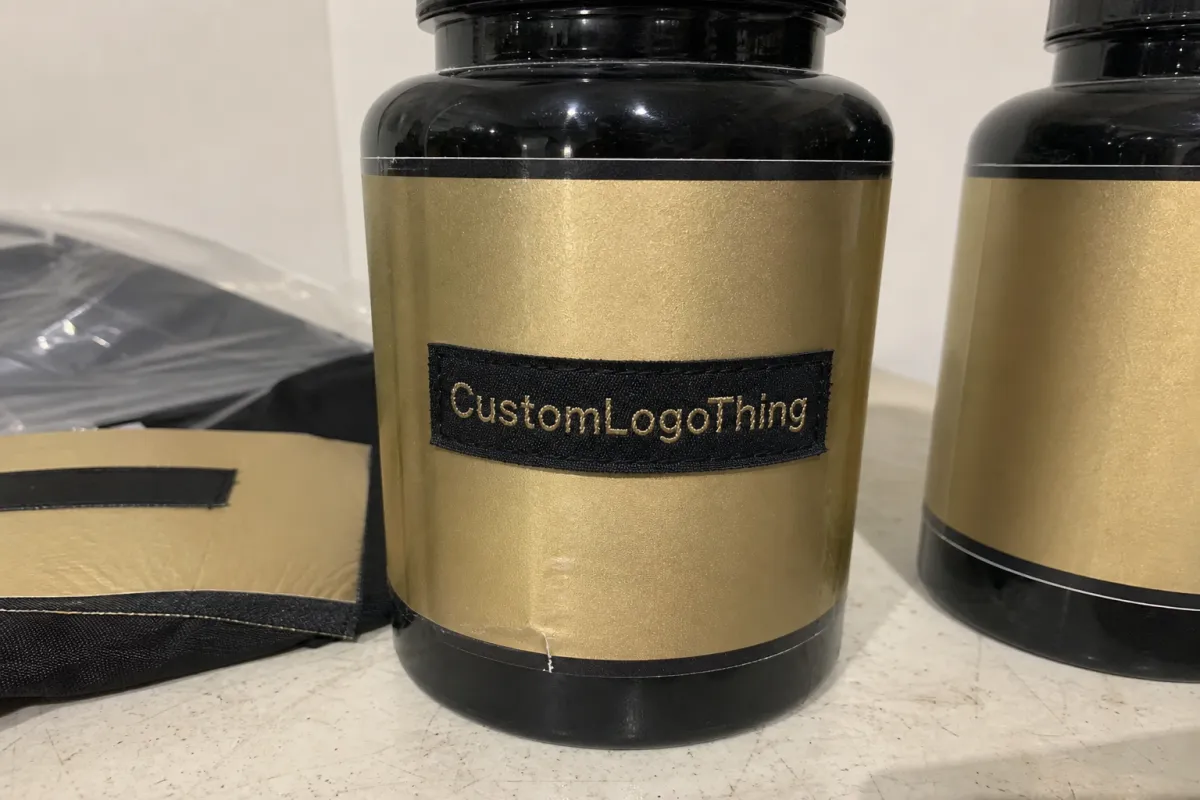
Vitamin shoppers often register the outer presentation before they count capsules or compare milligrams. A drawstring pouch, gym towel, canvas tote, sample bag, or branded kit lands in the hand first. That early tactile signal matters, especially in categories where dozens of brands make similar promises around energy, sleep, immunity, hair health, gut support, or athletic recovery.
Supplement teams usually spend serious time on bottle shapes, closure colors, label substrates, foil accents, claims review, and compliance copy. Secondary touchpoints get less discipline. A generic bag, loose sticker, or thin paper tag can undercut the work done on the primary package.
A woven label fixes part of that gap without forcing a full packaging redesign. On a tote, towel, pouch, or promotional textile, it gives the brand a durable identity point at a relatively low unit cost. It also behaves like part of the item rather than an afterthought attached at the end of the campaign.
Compared with stickers or basic hangtags, woven labels tolerate rubbing, folding, light moisture, packing friction, and repeated use. That durability is useful for subscription kits, retail gift-with-purchase programs, trade-show giveaways, gym partnerships, and influencer mailers. The box may be recycled the same day. The pouch may stay in a gym bag for months.
The practical scope is narrow but valuable: woven brand labels for vitamin and supplement companies using textile-based accessories, pouches, canvas bags, apparel, towels, sample kits, subscription boxes, display pieces, and gift sets. If the surface bends, gets handled often, or needs a premium cue that paper cannot provide, woven labels deserve a place in the sourcing conversation.
Most buyers want three things: brand consistency, a quote they can defend, and a label that will not disrupt production. The fastest route is to define where the label will live before asking a supplier to price it.
Where Woven Labels Fit in Vitamin Brand Packaging and Merch
Vitamin brands request woven labels for repeatable use cases: launch kits, wellness challenge packs, gym towels, tote bags, drawstring bags, shaker sleeves, branded apparel, collagen sample pouches, sleep-mask sets, and influencer mailers. These items sit outside the regulated supplement container, but they still carry the brand into retail, events, unboxing content, and daily routines.
The commercial logic is simple. Woven labels make a keepable item feel owned by the brand. Inserts disappear. Stickers peel. A sewn or properly attached label remains visible through multiple uses, giving the brand repeated exposure without buying the same impression again.
There is also a systems advantage. A small woven label can align a tote, pouch, towel, and kit insert with one flagship SKU or product family without changing approved bottle artwork. That coherence matters in retail, where shoppers compare brands quickly. It matters in subscription models too, where the second or third shipment has to feel like part of the same program, not leftover inventory with a logo added later.
Different buyers approach the category from different angles. Founders may be trying to make a first launch look less provisional. Procurement managers may need repeatable specs and fewer surprises. Private-label vitamin companies may need one construction that can support several brand programs. Wellness studios, nutrition subscription brands, and contract packagers may care most about durability through kit assembly and shipping.
One boundary should stay clear. Woven labels are appropriate for brand marks, size information, care details, origin details, decorative messaging, and accessory branding. They are not the right place for regulated supplement facts, dosage instructions, warnings, allergen statements, or disease-risk claims that belong on approved primary packaging. A woven logo tab can support trust. It should not carry compliance copy that requires precision, revision control, and regulatory review.
For brands comparing suppliers, the sharper question is not “Can you make a label?” It is “Can you make the right label for the exact surface, attachment method, and launch schedule?” That change in wording prevents a surprising amount of rework.
Product Details: Materials, Weaves, Folds, and Finish Options
Woven labels are usually made from polyester threads woven on looms to form logos, lettering, borders, and background fields. Printing places ink on a substrate; weaving builds the design into the structure. That difference explains the texture, depth, and wear resistance buyers expect from this label type.
Three weave types appear most often. Damask is the standard choice for finer detail, smoother definition, and a more premium hand feel. Satin has more sheen and can suit luxury wellness, beauty-adjacent supplements, or minimalist launch kits where the label should feel polished rather than rugged. Taffeta is the economical option for simple artwork, utility tabs, and lower-complexity merch.
The right weave depends on the design. A wordmark with thin strokes usually needs damask. A bold icon with one or two colors may work well in taffeta. A high-sheen label can look elegant on a pouch but too glossy on a natural canvas tote. Material context changes the read.
Fold style affects both the finished look and the way the label is attached. A straight cut works for flat applications, patches, or labels sewn around the perimeter. An end fold is common when the label needs clean side edges or will be sewn onto a bag, towel, or apparel panel. A center fold suits neck labels, hem labels, side tabs, and small branded loops. Manhattan fold gives a neat top edge, often used where the label sits in a more visible apparel position. Book fold adds structure when the label needs to feel thicker or more tab-like.
Backing and edge finishing create many of the practical differences buyers notice only after production starts. Heat-cut edges reduce fraying on many constructions. Ultrasonic cutting can produce a clean edge on suitable materials. Sew-on labels are usually the most durable choice for bags, apparel, and towels. Adhesive backing can help with temporary positioning or certain non-wash applications, but it should not be treated as a universal substitute for stitching. Iron-on backing works for some textiles, though fabric composition, heat tolerance, and wash expectations need to be checked first.
Design limits should be addressed early. Woven labels handle bold marks, simple typography, borders, and high-contrast color relationships well. They do not reproduce gradients, photographic detail, tiny legal copy, or very fine decorative effects with the same precision as print. If the vitamin brand relies on subtle color blends or micro text, keep the woven label focused on the core mark and let printed packaging carry the detailed information.
The tactile result also shifts brand perception. Thread density, label thickness, edge softness, sheen, and contrast can make the same wellness brand feel clinical, natural, athletic, premium, or promotional. Vector artwork and Pantone references are not just production paperwork. They help the supplier translate brand character into thread, where color and light behave differently than ink on paper.
Specifications to Prepare Before Requesting a Label Price
The cleanest quotes arrive when the buyer provides a complete spec set. A supplier typically needs label size, quantity, fold type, weave preference, thread color count, artwork file, backing choice, target application, packing requirements, delivery location, and deadline. If one of those pieces is missing, the quote becomes more provisional and the follow-up chain gets longer.
Dimensions are not administrative trivia. A 0.5-inch side seam tab, a 1.5-inch bag label, and a 3-inch patch behave like different products. They consume different loom time, thread volume, cutting labor, folding labor, and inspection time. A small size change can alter unit price and determine whether a logo reads cleanly at arm’s length.
Artwork should be supplied as vector whenever possible. AI, EPS, and production-ready PDF files are the most useful. A high-resolution PNG can work as a visual reference, but it often needs redrawing before weaving. That redrawing step is where a competent supplier flags line weights that are too thin, spacing that will close up, borders that may wander, or lettering that will not hold once translated into thread.
Color planning influences cost and clarity. Fewer thread colors usually produce cleaner reproduction and fewer matching issues. Too many shades in a compact label can turn a crisp supplement logo into a muddy patch, especially when thin strokes or small letters are involved. Strong contrast often outperforms decorative complexity.
Legibility deserves its own review. Tiny serif type, long ingredient claims, and dense legal phrasing rarely belong on woven labels. For a vitamin brand, the label should reinforce recognition. It should not be asked to carry compliance language it cannot display cleanly. If more copy is needed, move it to the printed carton, bottle label, insert, or approved digital asset.
Application details change the recommendation. A tote bag label needs abrasion resistance. An apparel label may need a softer hand against skin. A towel label should be checked for wash exposure and edge comfort. A wellness kit label may prioritize presentation over heavy wear. If a co-packer, apparel maker, or fulfillment team will sew or attach the labels, that workflow should be stated in the quote request.
A buyer who sends application surface, size, artwork, quantity, and attachment method in the first message usually gets a sharper quote. A buyer who sends only a logo usually gets questions back.
What Shapes a Woven Labels Supplier Quote for Vitamin Brands
A Woven Labels Supplier Quote for vitamin brands is shaped by quantity, size, weave type, thread colors, fold style, backing, finishing complexity, packing method, sampling, freight, and rush requirements. Those variables are not cosmetic. They determine loom setup, production speed, inspection time, and landed cost.
MOQ is tied to setup. Loom preparation, artwork conversion, cutting, folding, proofing, and quality checks all contain fixed work. Once those costs are spread across more pieces, the unit price drops. Small runs can be produced, but the per-piece price is usually higher because the setup burden has fewer labels to absorb it.
Size and color count often move pricing more than buyers expect. A bigger label uses more thread and more loom time. Extra colors can slow weaving and complicate matching. Special folds, custom packs, backing layers, and individual bagging add handling. Rush production can be even more expensive because it affects labor scheduling and may force air freight instead of a slower, cheaper shipping method.
Market pricing varies widely by supplier, country of origin, construction, and volume, so exact numbers should be treated carefully. As a broad planning range, simple woven labels in larger quantities may land in the low cents per piece, while smaller runs, premium damask, multiple colors, special folds, or custom packing can move materially higher. Sampling, setup, and freight may be separate line items. A quote that looks cheap at the unit level can still be expensive once proofs, shipping, and rework risk are counted.
Useful supplier quotes show the pieces clearly: sample or proofing fee, bulk unit price, setup cost if charged, packaging cost, freight, estimated lead time, and any special inspection or labeling requirement. If all of that is compressed into one opaque number, comparing suppliers becomes guesswork.
Price should be requested at more than one quantity. Ask for pilot, reorder, and campaign-volume tiers. A quote curve reveals whether the unit price falls sharply with volume or barely moves. That difference helps decide whether to buy only for a launch, consolidate multiple programs, or build inventory for repeat kit assembly.
| Option | Typical Use | Relative Cost Pressure | Buyer Tradeoff |
|---|---|---|---|
| Taffeta, simple art, one or two colors | Basic bag tabs, utility merch, low-complexity kits | Lowest | Good economy, less detail |
| Damask, moderate detail, end fold | Retail accessories, premium pouches, branded apparel | Mid-range | Better clarity, tighter artwork discipline |
| Damask or satin, multiple colors, special folding, custom packing | Launch kits, influencer sets, premium wellness programs | Highest | Stronger presentation, more proofing and QC required |
The lowest unit price is not always the lowest total cost. A bargain run becomes expensive if labels arrive with weak edge sealing, inconsistent folds, off-color thread, poor count accuracy, or a logo that needs to be remade. Procurement teams should compare landed quality, not only the first number on the quote sheet.
For buyers building broader packaging standards, the ISTA testing protocols are useful for thinking about handling and shipping stress. The Packaging School and Packaging Alliance resources can also help teams frame durability and presentation decisions across the full package system. These references do not replace supplier diligence, but they make the questions sharper.
Production Steps and Lead Time From Artwork to Delivery
The production path is direct: inquiry review, artwork check, spec confirmation, digital proof, sample or pre-production approval, bulk weaving, cutting, folding, quality inspection, packing, and shipment. It sounds simple. Delays usually appear when the buyer treats it as automatic.
Proofing absorbs the most avoidable time. Unclear artwork, missing Pantone references, late size changes, fold revisions, sample corrections, holidays, customs checks, and shipping upgrades all add friction. A clean vector file with confirmed dimensions can move much faster than a low-resolution logo that needs to be rebuilt and approved in stages.
Proof review should be literal. Check logo proportions, thread colors, label dimensions, fold orientation, seam allowance, cut position, and backing. A digital proof may look tidy on screen and still fail once the label is sewn onto a real bag or tucked into a seam. If the label will be applied by another vendor, send that vendor the approved construction details before bulk production starts.
Physical sampling is especially useful for premium vitamin launches, retail accessories, or programs where color accuracy carries brand risk. Thread sheen, thickness, and contrast read differently in hand than they do in a PDF. A sample lets the team judge the label against the actual tote, pouch, towel, or garment rather than a clean mockup.
Lead time varies by supplier and specification. A straightforward repeat order can move quickly if the artwork and approved sample are already on file. A new custom label with sampling, revisions, and international shipping needs more buffer. Brands should also account for the time needed by co-packers, apparel decorators, fulfillment teams, or kit assemblers after the labels arrive.
Shipping belongs in the schedule from the beginning. Air freight can rescue an urgent campaign but raises landed cost. Sea freight or consolidated shipping can work for planned, larger runs but requires more calendar discipline. Customs and receiving time should not be ignored, particularly if the labels must arrive before a packing line, event date, or retail ship window.
A good label order should feel almost invisible by the time assembly begins. The real work happens earlier: artwork cleaned, sample approved, attachment method confirmed, and delivery timed to the rest of the launch.
Quality Checks That Prevent Reorders, Returns, and Brand Drift
Quality control matters for vitamin brands because trust is built in small increments. A fuzzy letter, shifted border, scratchy edge, or wrong color may look minor by itself. Place that item beside a polished competitor, and the brand starts to feel less disciplined.
Core inspections should cover size tolerance, fold accuracy, cut edge cleanliness, thread color consistency, logo sharpness, backing adhesion if used, fraying resistance, and packing count accuracy. Count accuracy is easy to underestimate. If a kit run needs 10,000 pieces and the shipment is short, the cost is not just the missing labels; it is the stalled assembly work.
Different uses need different checks. Bag labels should tolerate abrasion and flexing. Apparel labels should be soft enough for the placement. Towel labels may need wash and edge-comfort review. Promotional kit labels should remain presentable after packing, transit, and handling. Testing should reflect the real journey, not an ideal shelf condition.
Several mistakes repeat across supplement and wellness programs. Tiny serif type becomes unreadable. Too many thread colors compress into a dull blur. Seam allowance is forgotten until the first sewn sample covers part of the mark. Adhesive is chosen for a surface that really needs stitching. Label corners are too sharp for a product meant to touch skin. None of these errors is unusual. All of them are easier to fix before bulk production.
Approved samples should be kept as reorder references. That is especially important for seasonal campaigns, line extensions, and programs sourced across more than one production window. A retained physical sample reduces interpretation drift and gives both buyer and supplier something concrete to compare against.
For brands extending this discipline across the full package, FSC can be relevant when paper-based components enter the system, while ISTA guidance helps teams think about shipping stress. A woven label may be small, but it still lives inside a larger packaging chain. One weak component can distort the customer’s read of the whole product.
Action Steps to Get an Accurate Quote Without Delays
The best way to get an accurate estimate is to send a complete brief the first time. Include logo artwork, label size, target quantity, preferred weave, fold style, backing, application surface, delivery address, deadline, and any packing or counting requirements. If the project has a target budget, say so. A supplier can often suggest a smaller size, simpler weave, lower color count, or different fold before the quote hardens.
Reference photos are useful. A tote seam, pouch edge, towel corner, garment neckline, or kit component shows how the label will function in the real world. That context can change the recommendation more than another paragraph of brand description.
Ask for tiers and options rather than one fixed number. Sample plus bulk. Standard lead time versus rush. Sew-on versus adhesive. Two sizes if the artwork is flexible. Damask versus taffeta if the design is simple enough. These comparisons give procurement teams something practical to evaluate.
State the business objective as well. A retail launch has different risk than a subscription-box refill. An influencer seeding project may tolerate lower inventory certainty but demand stronger presentation. An evergreen reorder program needs consistency and stable documentation. Suppliers can price more intelligently when the use case is not hidden.
If the label must connect with a broader packaging order, review related constructions under Custom Labels & Tags. For projects where artwork review, construction choice, or quantity comparisons need to be discussed before quoting, use Contact Us with the spec checklist and application photos. If internal teams need examples of how branded components are structured across programs, Case Studies may help frame the brief.
To request a Woven Labels Supplier Quote for vitamin brands without losing days to clarification, prepare the specs, send usable artwork, describe the application, and ask for proof-based pricing. The quote should be clear enough for a buying meeting and specific enough for the production floor.
FAQs
What information is needed for a woven label quote for vitamin brands?
Send the label size, quantity, artwork, fold type, weave preference, thread colors, backing, application surface, delivery location, and deadline. If the specifications are still being shaped, include product photos and a note on intended use so the supplier can recommend a workable construction.
What is the typical MOQ for custom woven labels for supplement companies?
MOQ varies by supplier, label size, weave, finishing, and setup requirements. Larger runs usually lower the unit cost because loom setup, artwork conversion, and finishing are spread across more pieces. Ask for several quantity tiers so pilot-run pricing can be compared with reorder or campaign-volume pricing.
Are woven labels suitable for vitamin packaging or only apparel?
They work well on textile-based packaging and accessories such as tote bags, drawstring bags, towels, apparel, pouches, wellness kits, and promotional merchandise. They are not a replacement for regulated supplement facts panels, dosage instructions, warnings, or required compliance copy on primary packaging.
How long does it take to produce woven labels for a vitamin brand launch?
Lead time depends on artwork readiness, sampling, approval speed, order quantity, finishing complexity, and shipping method. Build in extra time if the labels must coordinate with co-packing, apparel production, influencer kit assembly, event deadlines, or retail delivery windows.
Can a woven labels supplier match vitamin brand colors accurately?
Suppliers can match closely using thread libraries and Pantone references, but woven thread reflects light differently than printed ink. For critical brand colors, request a physical sample before bulk production and keep the approved sample as the reference for future reorders.


