For a wine retailer, a Woven Labels Supplier Quote for wine shops is a packaging decision, not just a decoration line item. The label may be tied to a bottle neck, sewn onto a carrier, attached to a gift set, or used on a reusable retail item. In each case, it affects shelf presence, handling, perceived value, margin, and reorder consistency.
A useful quote should spell out weave type, finished size, edge finish, color count, tolerance, lead time, MOQ, and reorder terms. Wine retail often depends on small-batch programs, seasonal gift packs, tasting-room bundles, and private-label runs, so the cheapest piece price is rarely the whole answer. The right supplier should show how the label will behave on the package and what the second order will look like.
A quote should tell you how the label will behave on the pack, not just what the unit price is.
Why wine shops notice woven labels before the bottle does
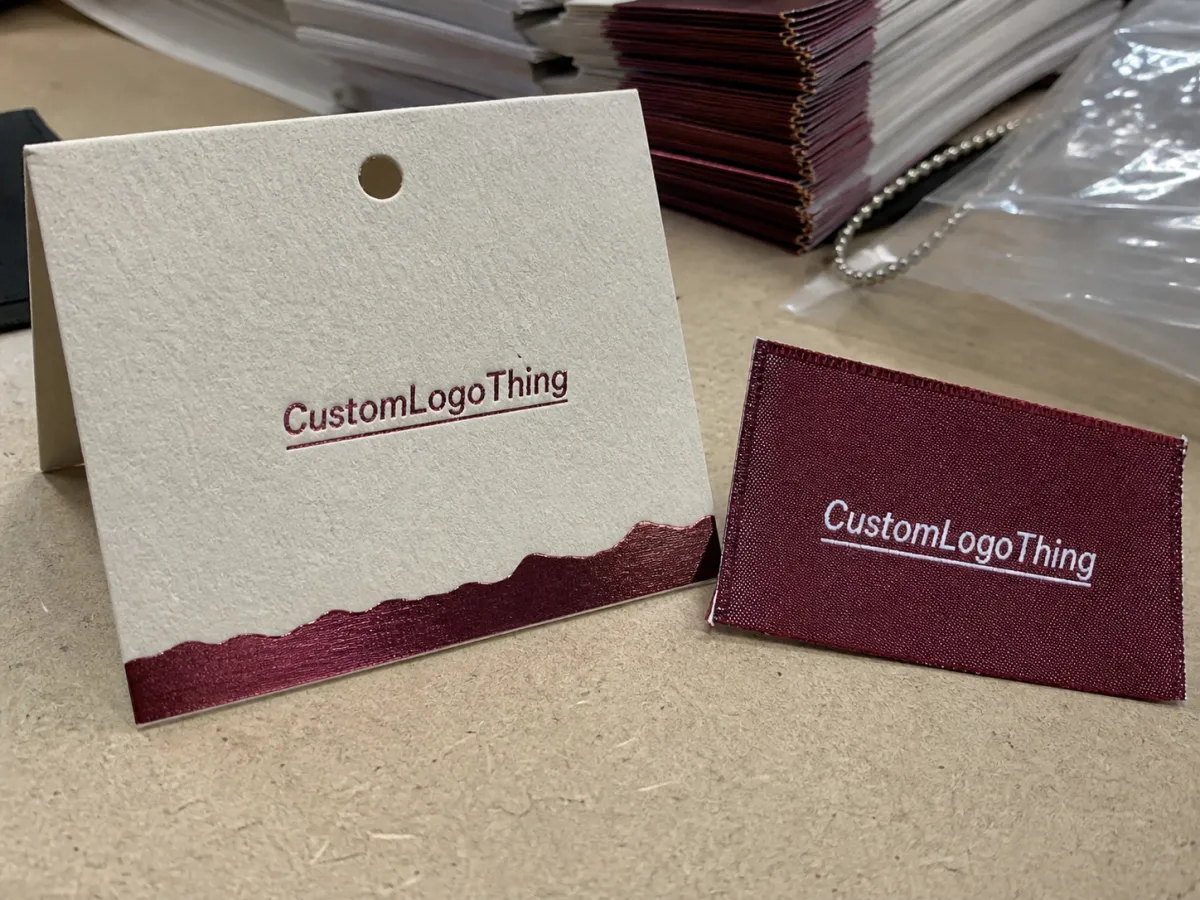
Wine packaging is handled constantly. Shoppers turn bottles, lift gift bags, compare baskets, and touch ribbons or carriers before buying. Woven labels add texture in those moments. Thread definition, stitch density, and a clean edge finish can make a private-label bottle, gift set, or reusable bag feel more finished than a flat printed cue.
The advantage is strongest where the label is touched, rubbed, folded, or reused. Neck tags on bundles, branded loops on carriers, apron labels, ribbon ties, and sleeve inserts all expose weak construction quickly. A loose weave can blur fine text. A rough edge can fray or look worn before the product sells. A poorly sized label can twist on cord or bunch against a seam.
Woven labels are not the best answer for every use. If the item is purely informational, temporary, or price-sensitive, printed paper or card may be smarter. If the item is expected to signal quality, survive handling, or support a reusable format, woven construction is worth considering. For a related product comparison, see Custom Labels & Tags.
Weave density, edge finish, and color control that change shelf impact
Weave density controls how much detail survives production. A tighter weave gives cleaner borders, steadier letterforms, and better support for small logos or fine type. A standard weave works well for bold marks, crests, simple names, and larger shapes. If the artwork looks crisp on screen but contains thin strokes or tiny copy, the supplier should confirm whether the weave can hold it.
Edge finish affects both durability and fit. Folded ends protect edges and suit sewn or attached applications. Center folds work when the label wraps around a seam or needs a tucked presentation. Straight cuts can work for inserts and lighter packaging cues, but they need more care if the label will rub against cord, rough fabric, or paperboard. Sewn edges feel sturdy, though they add bulk and may keep the label from sitting perfectly flat.
Color control is one of the easiest ways to protect both appearance and budget. Woven labels usually perform best with a restrained palette and strong contrast. Black on natural, white on deep green, gold on burgundy, and navy on cream are common because they read quickly under warm shop lighting. More colors add complexity, but they do not automatically improve shelf impact.
| Label choice | Best use | Typical strengths | Quote impact |
|---|---|---|---|
| Tight weave | Small logos, fine type, premium bottle neck pieces | Sharper detail, cleaner edges | Higher unit cost |
| Standard weave | Retail bags, carriers, inserts with bold marks | Good balance of price and legibility | Moderate |
| Folded finish | Reusable bags, sewn-in applications | Better edge protection, better hold | Slightly higher |
| Straight cut | Insert cards, lightweight packaging cues | Simple, low bulk | Lower, depending on size |
If the order uses metallic thread or exact brand colors, ask how the supplier controls run-to-run variation. Thread dye lots can shift, and light can change the appearance of woven direction. A strong quote should explain how the approved sample, production run, and reorder will be matched closely enough to sit together on the same shelf.
Material and size specs for bottle necks, carriers, and inserts
Accurate pricing starts with exact dimensions. Finished width, finished length, fold style, visible face area, and attachment margin all affect material use and setup. The quote request should also say whether the label will be sewn, tied, tucked, glued, inserted, or wrapped around a seam. Each method changes the usable design area.
For narrow bottle neck pieces, compact layouts are usually safest. The logo needs enough contrast to read without crowding the edge. Carrier and tote labels can often use a longer horizontal format, allowing a brand name, origin cue, or short seasonal message. Insert labels should stay simple because they may be partly hidden once tissue, card, or ribbon is folded.
Material feel matters. A softer woven construction may sit better against ribbon or fabric. A stiffer build may hold shape better on a bag edge, card insert, or sleeve. If the label is used on reusable carriers, aprons, or shop merchandise, ask about abrasion and wash resistance. If it is used on paperboard or gift packaging, ask whether the edge finish will lie flat or curl after attachment.
Fit is often where good labels fail. A label can be well made and still look wrong if it twists on cord, puffs off paperboard, or bunches at a seam. Tell the supplier the packaging surface, the label’s job, and the expected handling. Decorative bottle sleeve labels, reusable carrier labels, tasting-event tags, and insert pieces should not all be quoted as if they are the same object.
Useful briefs are short but specific. Include finished size, visible face size, quantity, application surface, attachment method, color count, and target ship date. If the supplier responds by shrinking the artwork until it fits instead of adjusting the structure, ask for another option. Legibility should be protected before production starts.
Pricing, MOQ, and quote variables for custom runs
Headline price can be misleading. The real cost depends on quantity, weave density, color count, finish type, label size, attachment requirements, proof changes, and schedule. A proper quote should separate these variables so the buyer can see what is driving the price.
MOQ is often the point where setup costs stop dominating the unit price. Small test runs are useful for seasonal launches or new private-label programs, but the piece price is usually higher because tooling, file preparation, and production allocation are spread across fewer labels. Once volume rises, unit economics usually improve quickly.
As a planning range, simple low-volume woven labels may fall around $0.18 to $0.35 per piece, while larger repeat orders may drop below that depending on size, finish, and color count. Tight weave, metallic thread, unusual sizing, special packaging, or rush handling can increase cost. These figures are directional only; they are most useful for understanding which decisions move the quote.
| Run type | What usually happens | Price behavior | Best for |
|---|---|---|---|
| Low-MOQ test run | Higher setup share, slower cost recovery | Higher unit price | New designs, seasonal trials |
| Standard production run | Setup spread across more pieces | Better unit economics | Core packaging lines |
| Repeat order | Existing file may reduce admin time | Often the best price point | Reorders and steady programs |
Ask what is included before comparing suppliers. Sampling fees, freight estimates, tax handling, artwork revisions, packing method, and file retention all affect landed cost. If proof changes are chargeable, that should be stated early. If production files can be reused on reorder, that should be in writing.
Packing also matters. A low unit price is less useful if labels arrive crushed, damp, miscounted, or difficult to handle during assembly. Ask whether the labels are carton-packed, moisture-protected, counted before dispatch, and labeled clearly by design or batch.
Process and turnaround: from artwork check to shipment
The usual sequence is inquiry, artwork review, proof approval, production, quality check, packing, and dispatch. Most delays happen before production because dimensions are unclear, artwork needs cleanup, or the buyer has not confirmed how the label will attach to the package.
Separate the schedule into proofing, production, and transit. A supplier may review artwork in a few working days but still need time for material allocation, weaving, finishing, inspection, and packing. That distinction matters for holiday gift sets, tasting events, grand openings, and private-label launches with fixed dates.
For planning, many buyers see proofing completed in a few working days and production in roughly 12 to 15 business days after approval. Actual timing depends on label complexity, order size, finish type, and queue position. Rush service can help only if the file and specs are already settled.
For time-sensitive programs, ask which stage can be compressed. Sometimes it is proof approval, sometimes finishing, sometimes freight. If the artwork is still changing, paying for a rush slot will not solve the main bottleneck.
Shipping protection should be part of the process discussion. Labels can be damaged by moisture, crush, or carton movement, especially when shipped with other retail materials. The International Safe Transit Association is a useful reference point when transit risk needs to be handled formally.
Artwork setup and proofing rules that avoid costly delays
The cleanest proof starts with vector artwork, outlined fonts, and exact color references. Fine type, thin rules, and delicate crests can disappear in weaving if the file is not built for thread. A disciplined artwork brief usually saves more money than late negotiation.
Common proof errors are simple: the logo is flipped, a fold is on the wrong side, punctuation disappears, thread color looks different from the screen color, or the text is too small for the weave. These issues are avoidable if the buyer checks the proof against the final package instead of reviewing it as a flat graphic.
- Confirm finished size and visible face area.
- Confirm quantity and color count.
- Confirm fold, cut, or sewn finish.
- Check orientation against the intended packaging surface.
- Verify spelling, punctuation, and logo placement.
- Confirm whether reorders will use the same file.
The proof stage is also where tolerance should be discussed. Ask how much weave shift is acceptable, how color variance is judged, how revisions are tracked, and what happens if a batch falls outside the approved range. A repeatable approval record protects the first order and the reorder.
If sustainability documentation matters, request it before approval. Paper wraps, cartons, and insert cards may need supporting records. The Forest Stewardship Council is a practical reference when paper components or chain-of-custody claims must be verified.
What a wine-shop supplier should prove before you place the order
Strong suppliers show relevant samples, explain weave limits, discuss color consistency clearly, and answer reorder questions directly. The buyer should be able to ask what happens six months later when the same label is needed again and receive a practical answer.
Small-batch flexibility is important in wine retail because demand is uneven. Seasonal drops, tasting-room events, gift sets, and private-label runs may not justify the same quantity every time. A supplier that only works at one large quantity may be attractive on piece price but difficult to use in practice.
Compare how suppliers handle file retention, proof approval, repeat runs, and setup charges. Can the production file be reused? Are setup costs reduced or waived on reorder? Are color references and approved dimensions stored? These details can affect total cost more than a one-time discount.
Quality control should be specific. Ask how the supplier checks thread alignment, edge finish, count accuracy, color consistency, and packing before shipment. If a batch misses spec, the response should include clear correction terms, photo records, tolerance notes, or a remanufacturing policy.
For wine-shop packaging, repeatability is often more valuable than novelty. A label that can be reordered cleanly, packed consistently, and matched later is more useful than a dramatic sample that cannot be reproduced.
Next steps for a production-ready quote and first run
To get a useful quote, send one clear request with finished size, quantity, color count, attachment method, packaging surface, and target ship date. Those details allow the supplier to price accurately instead of padding the estimate for unknowns.
Request two scenarios: the smallest workable MOQ and the expected reorder or post-launch volume. This comparison shows where the unit price improves and whether the first run should stay conservative or support a wider release.
For a first run, keep artwork simple enough for weaving, confirm proof timing in writing, ask whether the same file can be reused, and compare landed cost rather than piece price alone. A good Woven Labels Supplier Quote for wine shops should give you clear specs, honest pricing, realistic timing, and a production record that can be repeated.
What should I include in a woven labels supplier quote for wine shops?
Include finished size, quantity, color count, fold or cut style, attachment method, target ship date, and whether the labels will be used on bottles, bags, inserts, or reusable carriers. The clearer the application, the more reliable the price and lead time.
What MOQ is typical for custom woven labels used in wine shop packaging?
MOQ varies by construction and finish, but many suppliers start their economic range around 500 to 1,000 pieces for simple builds. Smaller test runs may be possible, though they usually carry a higher unit cost because setup is spread across fewer labels.
How long does woven label production usually take after approval?
After proof approval, a common production window is roughly 12 to 15 business days, depending on complexity, quantity, finish, and queue position. Proofing, packing, and transit should be treated as separate schedule items.
Which woven label finish works best for bottle bags and gift packaging?
Folded or sewn-edge finishes usually work well on reusable carriers and fabric packaging. Straight-cut styles can work for inserts and lighter packaging cues. The right finish depends on whether the label must lie flat, wrap around a seam, or survive repeated handling.
Can I reorder the same woven label later without starting over?
Usually yes, if the supplier retains the production file and the artwork does not change. Reorders are often faster than first runs, but price can still shift if quantity, materials, finish, or shipping conditions change.


