Gold Foil Labels Custom: Order Premium Logo Labels
Gold foil labels custom orders are not expensive just because they shine. They cost more when the build has to be exact: crisp artwork, a stable substrate, the right adhesive, and enough process control to keep small details readable at production speed. That is why these labels show up so often in branded packaging, product packaging, and premium garment branding that needs to feel intentional from the first glance.
The appeal is straightforward. A metallic label can make a small logo read faster, lift a folded garment visually, and pull a packaging set together without adding clutter. The risk is equally straightforward. If the design is too crowded, the wrong material is chosen, or the finish is mismatched to the surface, the result looks cheap instead of premium. The gap between those two outcomes is usually smaller than buyers expect.
For clothing brands, the label has to do more than look good in a mockup. It needs to survive handling, folding, shipping, and, in some cases, repeated wear. That is where the details matter. A label that works on a box may fail on textured fabric. A label that looks clean at 100 percent on screen may turn muddy once it is reduced to a 20 mm tag. The production realities are less forgiving than the sales language around them.
Why gold foil labels custom orders look pricier than they are
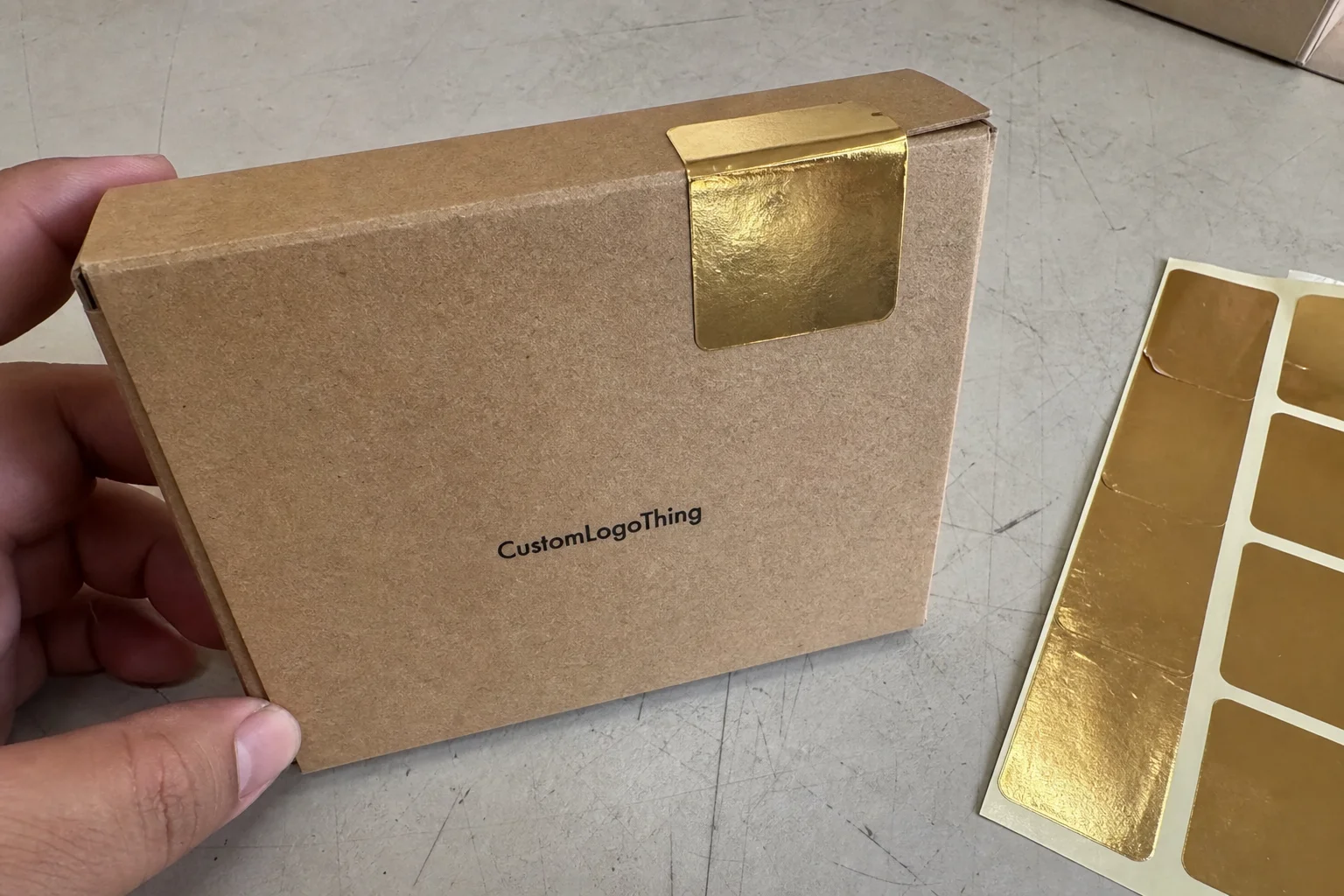
The price jump usually comes from setup and control, not from the foil itself. Metallic transfer is only one part of the job. The larger cost is in making sure the artwork registers cleanly, the edges stay sharp, and the label can be repeated across a run without drifting out of spec. On small-format work, the tolerance window is narrow. That is why a design that looks simple can still require careful production work.
There is a reason premium brands use foil on the things customers handle first: neck labels, hang tags, box seals, inserts, and exterior packaging. The effect is immediate. Gold catches light before the rest of the design has a chance to explain itself. Used well, that gives a product line a more finished presentation. Used badly, it looks like decoration pasted on after the fact.
One practical lesson shows up again and again in quote reviews. More foil coverage does not automatically improve the result. Dense metallic areas can flatten the artwork, obscure small type, and make the design feel less refined. Thin strokes, script lettering, and tight spacing also become risky very quickly. A label can be premium without being busy.
A good foil label is not just shiny. It is legible, stable, and consistent at the exact size the customer sees on the product.
That distinction matters because packaging and garment branding are judged as a whole. Buyers rarely separate the label from the rest of the box, tissue, insert, or tag stack. They just decide whether the brand feels coherent. Foil works best when it supports that system instead of competing with it.
How metallic foil labels are made for clothing applications
Most foil label jobs follow a predictable sequence: artwork prep, stock selection, foil application, cutting, backing, and inspection. The sequence is simple. The execution is not. Small errors in alignment or file prep show up immediately once metallic elements are involved, especially on narrow labels where there is little room to hide a flaw.
Vector artwork is the safest starting point. Foil edges need precision, and raster files can introduce softness that becomes obvious at small sizes. Thin lines, tiny serif fonts, and crowded elements need particular care. If the artwork is not built for the label size, a proof round is usually unavoidable. That is not overhead for its own sake. It is the difference between a usable label and a batch that looks fine only on a monitor.
There are several foil methods used for apparel-related labels. Hot foil stamping creates a strong metallic impression with clear edges on suitable surfaces. Foil printing or foil lamination can be more forgiving for some flexible label stocks and finer detail. Embossed foil adds tactile depth and often reads as more premium on packaging, but it also increases setup complexity and can slow turnaround. Not every product needs raised detail. Flat foil is often the more practical choice.
For garments, testing matters more than first-time buyers expect. A proof can look excellent and still fail once the label is attached to a curved seam, a textured textile, or a high-friction area. That is why a sample is worth requesting whenever the logo is complex, the substrate is unusual, or the placement is close to movement points. Mockups are useful. They are not enough.
From a production standpoint, the real question is not whether foil can be applied. It is whether the application can hold up on the chosen stock, at the chosen size, with the intended use. That is the line between decorative and dependable.
Materials, adhesive, and finish choices that determine wear
Material choice decides whether the label acts like a premium component or a fragile accessory. For clothing, paper stock can work for short-life or decorative uses, but synthetic film usually performs better against abrasion, handling, and moisture. Woven constructions are often better for sewn-in branding, while specialty label stocks can be tuned for specific garment or packaging surfaces. If the label is paper-based and the brand wants to make sourcing claims, checking FSC certification is sensible. The claim should be verifiable, not assumed.
Adhesive is where a lot of projects go wrong. Permanent adhesive makes sense on packaging and some non-fabric surfaces, but it is not automatically right for clothing. Removable adhesive can be safer for temporary use, though it may not hold well on textured materials. High-tack adhesive helps on coated cartons or polybags, yet the same strength can be too aggressive on delicate textiles. If the label is going directly on a garment, heat activation or sew-in placement is often more reliable than glue alone.
| Label option | Typical look | Wear profile | Best use | Indicative price at 5,000 pcs |
|---|---|---|---|---|
| Foil-printed paper label | Bright shine, clean edges | Good for light handling, weaker in moisture | Retail inserts, box labels, short-life branding | $0.10-$0.18 per unit |
| Foil on synthetic film | Sharper shine, more consistent detail | Better abrasion and moisture resistance | Apparel tags, packaging labels, higher-touch items | $0.12-$0.24 per unit |
| Embossed foil label | Raised metallic detail | Good if the substrate is chosen correctly | Premium launches, gift sets, luxury package branding | $0.18-$0.35 per unit |
| Woven or sewn-in label with foil detail | Soft, textile-based finish | Strong for garment wear, less glossy | Neck labels, interior branding, apparel lines | $0.20-$0.40 per unit |
Finish also changes how the label reads. Gloss increases contrast under retail lighting, but it can create glare. Matte softens the reflection and often makes gold look more controlled, especially on dark garments or boxes. Soft-touch coatings can improve hand feel, though they are not always compatible with every construction. If the goal is a more refined look, a better starting point is usually restrained foil coverage or light embossing, not piling on extra effects.
A useful rule: match the label to the product, not the other way around. A heavyweight jacket can support a more decorative label. A lightweight tee cannot. The more the fabric stretches, moves, or rubs, the more conservative the build should be. The same logic applies if you are aligning labels with a broader Custom Labels & Tags program across multiple SKUs.
For teams coordinating labels with boxes and inserts, basic packaging standards are worth knowing. The Packaging School and industry resources at packaging.org are useful for general terminology, and the Forest Stewardship Council is the reference point for paper sourcing claims.
Cost, pricing, MOQ, and quote drivers buyers should check
Price moves in predictable ways: size, foil coverage, substrate, adhesive, color count, and custom cutting all change the quote. Embossing and specialty coatings add another layer. None of that is surprising. What surprises buyers is how quickly a small design change can move the job from simple to expensive. A tiny logo with a lot of detail can cost more to run than a larger, simpler mark because the line has less margin for waste.
MOQ behavior is equally predictable. Small runs carry a higher per-unit cost because setup work is fixed. Once the machine is running, unit cost drops as quantity rises. A 1,000-piece order is often materially more expensive per label than a 5,000-piece order, and 10,000 pieces can bring further savings if the same materials and artwork stay in place. If the design is still being tested, starting smaller is sensible. If the design is locked and the product is already in market, lower unit costs usually justify the larger run.
Comparison only works if the quotes are built on the same spec. Ask every vendor for the same dimensions, the same stock, the same adhesive, the same foil coverage, and the same proofing terms. Otherwise, the cheapest number may simply be missing a few costs that show up later.
- Ask whether proofing and revisions are included.
- Confirm plate fees, die fees, and setup charges.
- Check shipping separately, especially for heavier packed runs.
- Ask how reprints are handled if the approved proof is correct but the final run misses spec.
For budget planning, a simple foil label with limited coverage typically sits near the low end of the range, while an embossed or highly customized label can rise quickly. The easiest way to control cost is not to strip quality from the build. It is to simplify the artwork and the construction before production starts. An overworked label on a weak stock is not a cost-saving measure. It is a future replacement order.
If the label needs to fit into a broader launch that includes Custom Packaging Products, keep unit economics tied together. Customers notice when the packaging feels expensive but the labels look like an afterthought, or the reverse. Consistency has a price, but inconsistency usually costs more.
For shipping-heavy programs, it is reasonable to think about transit stress. If labels are packed inside custom printed boxes or other cartons that will move through distribution, ask whether the construction has enough resistance for common handling. Industry testing bodies such as ISTA exist because cartons are not gentle in real life.
Process and turnaround: from artwork file to final shipment
The workflow sounds uncomplicated: send artwork, review a proof, confirm materials, produce, inspect, ship. The weak point is usually the information gap. Foil work is less forgiving than plain print, so any ambiguity in the file or spec can create a chain of delays.
Artwork approval tends to be the biggest bottleneck. Missing dimensions, non-vector files, fuzzy logos, and vague finish requests all create extra rounds. Custom cutting and specialty surfaces add time too. So does seasonal demand, which tends to rise exactly when everyone wants the same thing at once.
Clean specs speed everything up. Include dimensions, file type, quantity, substrate, adhesive, finish, and deadline in one place. If the label has to coordinate with other package components, say so upfront. Matching a label to a broader visual system is easier when the production team understands the full application.
Typical turnaround for a straightforward foil label order often lands around 12 to 15 business days after proof approval, though that changes with complexity. Custom finishing, sample requirements, stock substitutions, and large runs can push it longer. Rush service is possible in some cases, but it usually comes with tradeoffs: fewer material options, shorter proofing windows, and more pressure on artwork readiness. Speed is mostly a function of clarity.
That is the part many buyers underestimate. The factory rarely slows down because foil is difficult. It slows down because a question was not answered before the job entered the queue.
Common mistakes that make foil labels fail on apparel
The most common mistake is trying to do too much in a tiny space. Small labels do not reward ambition. They punish it. If the design includes too much text, too many thin lines, or too much foil coverage, legibility drops fast and production gets harder. When the logo needs a microscope, the label needs simplification.
Placement is the second problem. A label that performs well on a smooth carton may not behave the same way on ribbed knit, stretch fabric, or a curved seam. Surfaces matter. Adhesive that is fine on one product line may fail on another because the texture, movement, or tension is different. Reusing the same backing spec across every SKU is a shortcut that often causes returns.
Another error is treating decorative finish like industrial durability. A shiny label is not automatically wash-safe, rub-safe, or friction-safe. If the label is going on clothing, ask for durability checks before volume. ASTM references can help frame the conversation, but the core requirement is simpler: test the label under conditions that resemble the actual use case.
Brand consistency fails too. If one SKU uses a different foil tone, label size, or edge treatment, the line starts to look fragmented. If the metallic color clashes with the garment or box palette, the label feels arbitrary. A label should fit the whole product story, not interrupt it.
Before approving a full run, do a basic wear check. Rub the label. Fold it. Hold it under store lighting. Place it beside the garment and the rest of the package. That is a short test, but it catches a lot. A good label should support the presentation, not create a new problem for the merchandising team later.
Next steps for ordering the right label run
Start with the use case. Where does the label go? How is it attached? How much handling will it see? Those three questions determine more than any sales copy does. If the label is part of a premium launch, the material and finish should support presentation. If it lives on a high-wear garment, durability has to outrank shine.
Put the spec in writing before requesting quotes. Keep it brief, but complete: dimensions, artwork file type, quantity, backing, finish, deadline, and intended surface. If the label has to match the rest of the product line, include the packaging context too. That keeps the foil label aligned with the broader brand system instead of looking like an isolated decision.
- Request a sample if the artwork is new.
- Order a pilot run if the surface is unusual.
- Keep the layout simple if the label size is small.
- Compare quotes on total cost, not just unit price.
Used with restraint, gold foil labels custom work can make a garment or package feel more finished without becoming loud. The important part is the specification discipline behind it: the right substrate, the right adhesive, the right finish, and a design that still reads at production size. That combination is what separates a premium label from an expensive mistake.
For brands building around package branding, garment presentation, and consistency across custom printed boxes, the label deserves the same level of attention as the rest of the launch. The closer the details are held to spec, the better the result. Gold foil labels custom only look simple after the process is already under control.
Are gold foil labels custom suitable for everyday clothing wear?
Yes, if the material and backing are selected for fabric use rather than decorative display. They work best on garments where presentation matters and the label is not exposed to constant abrasion. For high-wear items, durability testing matters more than shine.
What file format works best for custom gold foil labels?
Vector files such as AI, EPS, or a clean PDF are safest because foil edges need precision. Tiny text and hairline detail are risky at small sizes. If the logo is complex, ask for a proof before approving a full run.
How do I compare pricing for gold foil labels custom quotes?
Check size, quantity, foil coverage, material, adhesive, and any setup fees. Make sure the quote includes proofing, shipping, and reprint policy so the numbers are actually comparable. The lowest unit price is not always the lowest total cost.
What affects turnaround time the most?
Artwork approval is usually the biggest variable because revisions delay the queue. Special finishes, custom cutting, and stock availability can extend production. Fast approvals and complete specs are the easiest way to keep the order moving.
Should I order a sample before a full run?
Yes, if the design is new, the garment surface is unusual, or the label will face heavy wear. A sample confirms color, adhesion, size, and readability before you commit to volume. One test run is cheaper than replacing a batch that was specified poorly.