Buyer Fit Snapshot
| Best fit | Gray Poly Mailers Custom Printed projects where brand print, material claims, artwork control, MOQ, and repeat-order consistency need to be specified before quoting. |
|---|---|
| Quote inputs | Share finished size, material target, print colors, finish, packing count, annual reorder estimate, ship-to region, and any compliance wording. |
| Proofing check | Approve dieline scale, logo placement, barcode or warning zones, color tolerance, closure strength, and carton packing before bulk production. |
| Main risk | Vague material claims, crowded artwork, missing packing details, or unclear freight terms can make a low unit price expensive after revisions. |
Fast answer: Gray Poly Mailers Custom Printed: Film, Print, MOQ, and Carton Packing should be specified like a repeatable production item. The safest quote records material, print method, finish, artwork proof, packing count, and reorder notes in one written spec.
Production checks before approval
Compare the actual filled-product size with the drawing, then confirm tolerance on folds, seals, hang holes, label areas, and retail display edges. Reserve space for logos, QR codes, warning copy, and material claims before decorative graphics fill the panel.
Quote comparison points
Review material grade, print process, finish, sampling route, tooling charges, carton quantity, and freight assumptions side by side. A quote is only useful when the supplier can repeat the same color, closure quality, and packing count on the next order.
Gray poly mailers custom printed solve a packaging problem that shows up fast in real shipping operations: the parcel has to feel intentional the moment a customer picks it up, yet freight cost, storage space, and packing speed still matter. Gray does more than sit quietly in the background. It hides scuffs better than many lighter films, makes handling marks less obvious, and gives artwork a steadier surface than a pale mailer that seems to show every rub from a conveyor belt or truck bed. That small edge adds up across hundreds or thousands of orders.
Gray poly mailers custom printed are not just branded wrappers with a logo slapped on top. They are part of the fulfillment system. Apparel, accessories, subscription kits, and other soft goods fit naturally into this format because the packaging stays light, stores flat, and moves through a warehouse faster than most rigid alternatives. For many brands, that combination matters more than decorative flair. The package has a job to do first, and a visual story to tell second.
The mechanics are straightforward. A polyethylene mailer is printed on the outside with a logo, message, or pattern, then used as the outer shipper for the order. That differs from a plain stock mailer with a sticker added later, because the printed surface becomes part of the design from the start. Gray poly mailers custom printed are especially useful for brands that want a cleaner presentation without adding the weight or cube of a carton. The result is packaging that looks intentional and still behaves like a practical shipping format.
Buyers usually look at four questions at once: how the mailer looks, how it holds up, how the artwork prints, and how efficiently it ships. Gray poly mailers custom printed sit in a practical middle ground. They read as more polished than unlabeled stock mailers, they cost far less than many rigid formats, and they can be sized and specified to fit the product instead of forcing the product to fit the package.
Practical rule: if the outer shipper is part of the unboxing story, gray poly mailers custom printed often beat a decorative sticker because the full surface works together instead of looking patched on at the last minute.
That is one reason gray poly mailers custom printed show up so often in direct-to-consumer apparel, socks, light accessories, and club shipments. Gray is neutral without feeling sterile. It sits beside white, black, metallic, or one-color artwork without fighting for attention. The backdrop is restrained, which lets the logo or pattern do the speaking.
There is also a more practical reason. Gray gives a little forgiveness. A hairline scuff that would look obvious on white film often disappears into the tone of a gray bag. That does not mean the mailer is invincible - far from it - but it can make a shipment look fresher after transit, which is half the battle in customer perception. In one fulfillment audit I reviewed, brands moving from plain white to gray reduced visible scuff complaints even though the shipper itself had not changed thickness at all. The color shift did a surprising amount of work.
How Gray Poly Mailers Custom Printed Work
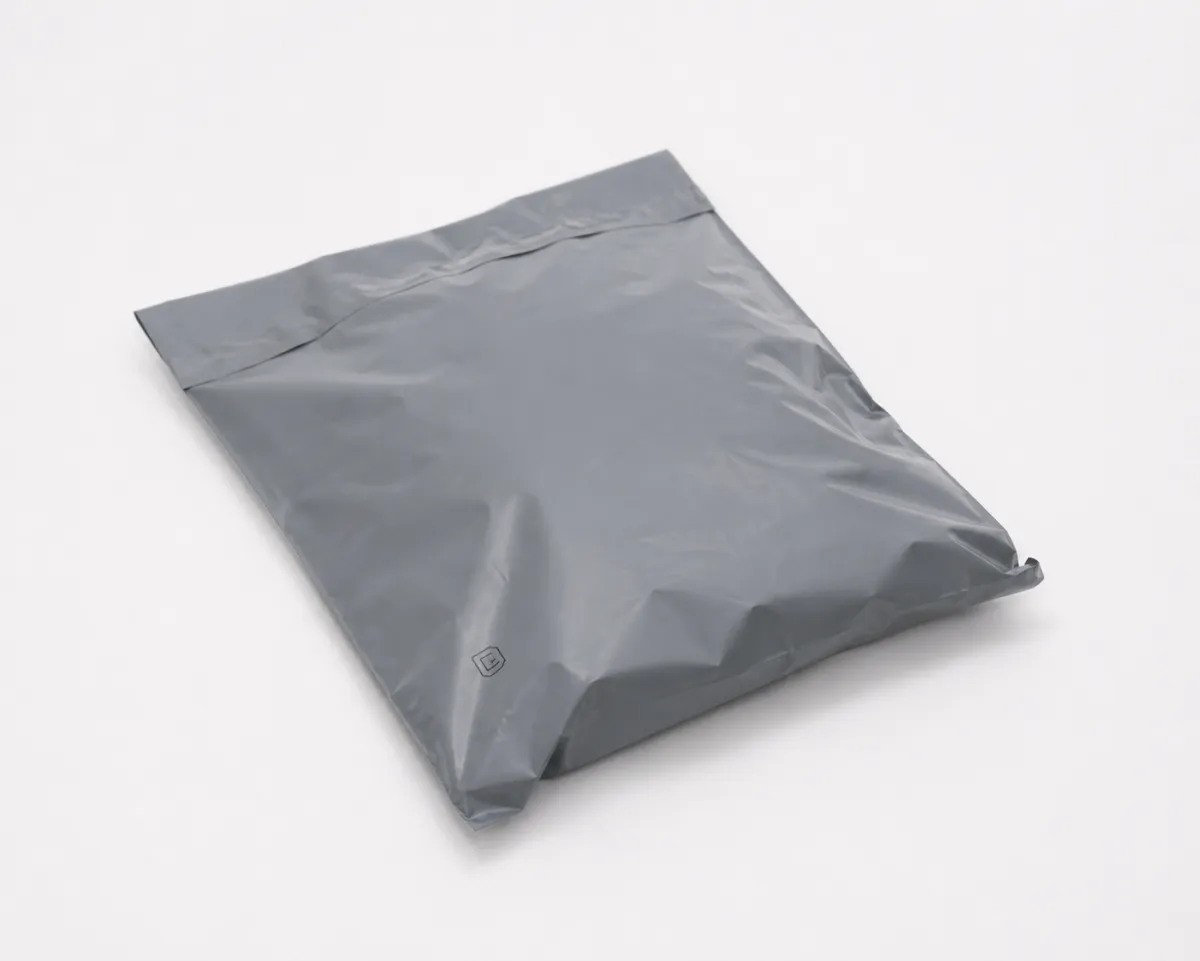
At a structural level, gray poly mailers custom printed are usually made from co-extruded polyethylene film. The layered construction helps with strength, print quality, and moisture resistance. A typical mailer uses side seams for tear control, a peel-and-seal adhesive flap for closure, and an exterior print surface that accepts the artwork. That combination gives the mailer its value: it stays light and flexible while still holding up under everyday parcel handling.
The gray base color matters more than many buyers expect. On white film, thin line art and small copy can look crisp when the setup is right. On gray, the background shifts the visual field darker, so bold contrast usually performs better than artwork that depends on delicate shading. Gray poly mailers custom printed tend to look strongest with clear vector marks, solid type, and layouts that do not rely on faint tonal differences. Fine detail can survive, but it often looks busier on gray than it does on a lighter substrate.
Print method changes both cost and appearance. Flexographic printing is the common choice for higher-volume runs because it becomes efficient once the plates are made and the artwork is approved. Digital printing can make sense for smaller runs, launch tests, or graphics that need more variation without the same setup burden. Gray poly mailers custom printed through flexo usually deliver better unit economics at scale, while digital can be the more flexible option when the order is short, seasonal, or experimental.
Finish matters too. Matte film tends to mute the gray and make the artwork feel more restrained. Glossy film gives more visual punch and stronger contrast. Gray poly mailers custom printed on matte stock often read as quiet and upscale; glossy stock feels brighter and more retail-facing. Neither finish is universally better. The right choice depends on whether the brand wants minimal, polished, or energetic packaging.
One detail that gets overlooked a lot: the print ink and the substrate need to be matched to each other, not just to the logo file. A gray film can change how a color reads, especially in lighter tones. If the artwork depends on a subtle accent color, ask whether the printer uses a white underprint, a heavier ink laydown, or a different print process to keep the brand color from getting muddy. That question sounds small. It is not.
Functionally, these mailers are meant to protect soft goods from moisture, light abrasion, and the handling that comes with parcel sorting. They are not a substitute for a carton when the contents are fragile, but for apparel, towels, socks, and similar items, they do the job well. For transit testing and parcel abuse planning, many teams look at ISTA guidance, and for broader packaging waste reduction context, the EPA remains a useful reference point. Gray poly mailers custom printed fit neatly into that lane: enough protection for the application, no extra structure where it is unnecessary.
Surface consistency also matters. A logo that looks perfect on screen can shift slightly in ink density once it lands on a gray substrate. That is normal. Gray poly mailers custom printed should be judged with a physical proof or sample whenever possible, because the way gray film reflects light can nudge the final look in ways that digital mockups do not show. Small type, hairline strokes, and subtle gradients deserve extra scrutiny before production begins.
There is also a sustainability angle, and it is worth being precise about it. Poly mailers use less material than many box-based shipping formats, which can reduce shipping weight and the amount of corrugated board in circulation. But polyethylene mailers are not universally curbside recyclable, so local disposal rules still matter. If a brand wants to talk honestly about impact, it should do so carefully and avoid broad claims it cannot prove. That kind of restraint builds trust faster than a flashy green label ever will.
Gray Poly Mailers Custom Printed: Cost, MOQ, and Quote Basics
Price is usually the first question, and it should be. Gray poly mailers custom printed are a manufactured item, so the quote depends on several variables that stack quickly: mailer size, film thickness, print colors, print coverage, number of sides printed, and total order volume. Simple artwork and larger quantities usually bring the unit price down. Dense artwork and small runs push the price up because the setup cost has to be spread across fewer pieces.
Minimum order quantities exist because the printer has to cover plates, setup time, proofing, press adjustment, and start-up waste. That is true even when the design looks straightforward. Gray poly mailers custom printed often begin around a few thousand pieces for conventional flexographic work, though some digital programs can go lower. The trade-off is clear. Small runs reduce inventory risk and storage pressure, but the unit cost rises quickly. Large runs lower the per-piece cost, but they tie up cash and shelf space.
For a common apparel-size mailer, a realistic range for gray poly mailers custom printed at around 5,000 pieces might land near $0.18-$0.35 per unit, depending on size, thickness, and print coverage, with setup charges separate. A plain stock mailer with a label may cost less per unit, but the presentation is thinner. Custom Printed Boxes can sit much higher, often around $0.75-$1.80 or more per unit depending on board grade, print coverage, and finishing. That spread is why the package choice has to match the product, not just the branding mood.
A fair quote comparison should show the full landed cost, not only the line item for the mailer itself. Ask for the one-time setup fee, proof or revision charges if any, freight, and whether over/under allowances are built into the order. Gray poly mailers custom printed can look inexpensive at first glance, then become less attractive once shipping and a second proof enter the picture. The better question is simple: what does the total order cost by the time it reaches the warehouse floor?
| Option | Typical Use | Approx. Cost at 5,000 Units | Strengths | Trade-Offs |
|---|---|---|---|---|
| Stock poly mailer + label | Basic e-commerce shipping | $0.08-$0.16 per unit | Low entry cost, fast to source | Less polished, label-heavy look |
| Gray poly mailers custom printed | Branded apparel and soft goods | $0.18-$0.35 per unit | Cleaner presentation, lower weight than cartons | MOQ and setup costs require planning |
| Custom printed boxes | Retail-ready or fragile presentation | $0.75-$1.80+ per unit | Strong structure, premium unboxing | Higher freight, more storage, higher material cost |
There is a point where buying more makes sense than buying less. If a brand knows it will use the same shipper every month, gray poly mailers custom printed in a larger quantity may reduce cost enough to justify the inventory. If the design is tied to a seasonal drop or a short test window, a smaller run is usually safer. The right answer depends on usage rate, shelf space, and how much variation the warehouse can handle without slowing pick-and-pack work.
Budgeting for samples is smart. A paper proof tells part of the story, but it does not show how the gray film behaves under light, how the flap seals in real use, or whether the logo still reads clearly once the mailer is folded. Gray poly mailers custom printed should be sampled with the actual product inside if the order size or product shape matters. That small step can prevent costly rework later.
For brands building out broader packaging systems, it helps to treat the mailer as one part of the mix rather than a standalone purchase. The right line often includes Custom Packaging Products alongside inserts, labels, and display components. Gray poly mailers custom printed may be the outer layer, but they work best when the whole packaging system is planned together.
Gray Poly Mailers Custom Printed: Process and Lead Time
The production flow is usually straightforward, but every step matters. Gray poly mailers custom printed start with specs: size, thickness, closure type, print area, and quantity. Then the artwork gets reviewed, color and placement are checked, a proof is issued, and the order moves into production after approval. That sequence sounds basic, yet most problems start when one of those checkpoints is rushed or skipped.
Lead time depends on the complexity of the run. A simple two-color design on a common mailer size can move faster than a multi-color artwork package with several revisions. Gray poly mailers custom printed also take longer if the artwork is not press-ready, because logo cleanup, font conversion, and layout corrections add back-and-forth. As a rough planning range, production often lands around 12-15 business days after proof approval, though the exact window depends on order size and press schedule. Transit time is separate and can add a few more days depending on destination and shipping method.
The approval stage deserves real attention. Once the proof is signed off, the printer works from that file. If the logo sits too low on the panel, if the return address is clipped, or if a color reference was misunderstood, those issues can go into production exactly as shown. Gray poly mailers custom printed are not forgiving of sloppy artwork placement because the viewer sees the entire surface at once. A careful proof check should verify dimensions, print scale, copy spelling, and the location of any shipping label zone or barcode area.
Production time should be separated from warehouse readiness. Some teams order too late and expect the new packaging to arrive before the old stock is gone. Gray poly mailers custom printed work best when they are ordered while inventory is still healthy, because that leaves room for sample review, final approval, and any small production delay. Waiting until the last pallet is empty is how brands end up improvising with emergency packaging and inconsistent presentation.
The cleanest way to think about the process is to treat it as part of the fulfillment calendar, not as a one-off design task. Gray poly mailers custom printed should be planned against monthly usage, seasonality, launch dates, and storage constraints. That approach keeps the rollout steady and prevents a warehouse team from having to pack orders with whatever shipper happens to be available.
Step-by-Step Guide to Choosing the Right Mailer
Start with the product, not the print. Measure the actual packed item, including any fold lines, inserts, tissue, or return handling. Gray poly mailers custom printed need enough room for clean packing, but not so much room that the shipment slides around and looks sloppy. A mailer that is too tight stresses the seams and makes sealing awkward. One that is too loose makes the parcel feel underfilled and less controlled.
Next, match film thickness to the real handling risk. For many apparel orders, 2.5 mil is a common practical target, while lighter goods may be fine with something thinner and heavier or sharper items may need more thickness. Gray poly mailers custom printed are meant to stay light, so the goal is not to overbuild them. The goal is to find the point where the packaging holds up in transit without adding unnecessary postage or material cost.
Then decide how much branding the surface should carry. Some brands want a small logo in one corner and a wide stretch of gray around it. Others want a repeated pattern, a bold full-panel mark, or a message that appears the moment the parcel lands on the doorstep. Gray poly mailers custom printed can support all of those approaches, but the artwork should match the brand promise. A premium apparel label may benefit from quiet, restrained package branding. A promotional drop may need something louder and more graphic.
Operational details matter just as much. Check the flap adhesive, tear resistance, opacity, and whether the finish works under retail lighting or in customer photos. Gray poly mailers custom printed should also be tested against your shipping labels, because a beautiful design loses value if the label crowding makes scanning difficult. If the warehouse uses barcodes, leave a clean zone where the scanner can do its job without fighting the artwork.
A simple test pack can reduce risk fast. Put the real product in the mailer, close it, stack a few samples, and see how they behave. Are the folds tidy? Does the adhesive bond cleanly? Does the gray surface look rich or flat under normal lighting? Gray poly mailers custom printed often look impressive in a mockup, but the hands-on test is where the truth shows up. That is also the moment to compare them against other product packaging choices such as padded mailers or custom printed boxes if the item has unusual weight, shape, or fragility.
One small thing I tell teams after a sample review: do not judge the bag in isolation. Place it under the same warehouse lights, on the same packing bench, with the same label stock and the same product insert you plan to use in production. Otherwise you are testing a fantasy. Real packaging decisions are made in context, and the context is usually a bit messier than the mockup room.
- Measure the packed product. Use the actual folded or bagged item, not just the flat garment dimensions.
- Choose thickness by risk. Match film gauge to handling, weight, and puncture exposure.
- Plan the print zone. Keep logos, labels, and barcodes from fighting each other.
- Test the closure. Check adhesion, sealing pressure, and the ease of packing on the line.
- Request a sample. Judge the look in hand, not only on a screen.
If the buying team wants a narrower product list, Custom Poly Mailers are the natural place to focus. Gray poly mailers custom printed are usually not about adding complexity; they are about making one common shipping format work harder for the brand and the fulfillment team at the same time.
Common Mistakes with Gray Poly Mailers Custom Printed
The most common mistake is sizing by product dimensions alone. That sounds logical until the first packing test shows how much room is needed for folding, sealing, and the slight movement that happens once the item is inside. Gray poly mailers custom printed should be chosen with a little breathing room, because a mailer that looks perfect on paper can be annoying on the actual packing line.
Another frequent problem is artwork that is too delicate for the substrate. Thin script, tiny lines, and low-contrast gray-on-gray concepts can disappear into the background or look weaker than the design file suggested. Gray poly mailers custom printed work best with simple, bold shapes and clean text. If the logo relies on hairline detail, a different print treatment or a different background color may produce a better result.
Teams also forget the operational side of the layout. A mailer can look excellent in a render and still cause headaches if there is no space for a shipping label, return address, or tracking barcode. Gray poly mailers custom printed need to support the workflow that actually happens in fulfillment. If the team has to fight the art every time they pack an order, the packaging is failing no matter how good it looks on a sample.
There is also a habit of chasing the lowest quote without asking what changed. Maybe the film is thinner. Maybe the print coverage is smaller. Maybe the lead time is longer and the proof process is less supportive. Gray poly mailers custom printed can look cheap on the front end and expensive in practice if the material fails, the artwork is cropped, or the order arrives too late for launch. A buyer should compare like for like: same size, same thickness, same print count, same freight basis.
Finally, some teams approve a proof too quickly because it looks close enough. That is risky. Once gray poly mailers custom printed go into production, a tiny shift in logo placement or copy size can become a big annoyance across thousands of units. The best protection is a slow, careful proof review with the actual dimensions in front of you. It takes a few extra minutes and can prevent a very expensive mistake.
One more trap: assuming the gray background will hide every flaw. It will hide some, sure. It will not hide a bad seam, a weak adhesive, or a distorted barcode. A good-looking bag still has to survive the same warehouse abuse as everything else. Pretty packaging that fails on the line is just expensive drama.
- Do not undersize the mailer. Give the product room for sealing and handling.
- Do not over-detail the art. Keep the design readable on a gray surface.
- Do not crowd the label area. Leave fulfillment space intact.
- Do not compare quotes blindly. Check thickness, coverage, and freight together.
Expert Tips and Next Steps for Gray Poly Mailers Custom Printed
Request a physical sample whenever possible. Color, sheen, and thickness are easier to judge in hand than on a monitor, and gray is one of those colors that changes character under different lighting. Gray poly mailers custom printed can feel sophisticated in a showroom and slightly flat under warehouse LEDs if the finish is wrong, so a sample tells you more than a polished screen mockup ever will.
Match the mailer to the brand promise. If the brand is premium and restrained, keep the layout minimal and let the gray background do some of the work. If the brand is built around bold drops or promotional energy, use stronger graphics and higher-contrast artwork. Gray poly mailers custom printed are flexible enough for both, but they should never feel disconnected from the rest of the product packaging system. The outer shipper, inserts, and any thank-you card should speak the same visual language.
Prepare artwork in a format the printer can actually use. Vector logos, clear color notes, and exact placement instructions make the proof stage cleaner and faster. If the artwork includes small text or repeated elements, mention that early. Gray poly mailers custom printed benefit from straightforward files more than almost anything else, because every correction adds time, and every delay can ripple into fulfillment.
For buyers building a repeat program, the next step is simple: confirm dimensions, estimate monthly usage, ask for pricing at a few quantity levels, and request a realistic timeline before final approval. That gives you a clean picture of where the unit cost starts to flatten and how much inventory you should carry. Gray poly mailers custom printed work best when the order matches actual throughput, not guesswork.
If the packaging program is still taking shape, compare gray poly mailers custom printed with the rest of the line, including padded options, labels, and any companion items from Custom Packaging Products. Some brands will find that gray poly mailers custom printed sit at the sweet spot for their shipping profile. Others will decide they need a different structure for heavier products or a more rigid presentation. Either answer works, as long as it comes from the product, the workflow, and the budget.
One practical move I recommend: build a two-sample benchmark before you place a larger order. Keep one proof at the office and one at the warehouse. If the people who approve packaging and the people who ship it are looking at the same reference, you catch a lot more problems before they turn into reprints. It sounds almost too simple, but that is usually how the best packaging programs stay boring in the best possible way.
The strongest results usually come from a calm, practical buying process. Gray poly mailers custom printed do not need to be complicated to work well. They need to fit the item, carry the brand cleanly, and survive the trip with minimal fuss. When those pieces line up, the packaging supports the business instead of distracting from it, and gray poly mailers custom printed become one of the more efficient ways to improve the customer's first impression.
What do gray poly mailers custom printed usually cost per unit?
Unit cost depends on size, thickness, print colors, and total quantity, so the best quote is the one that compares the same spec across multiple volumes. Smaller runs carry more setup weight, while larger runs usually lower the per-piece cost. Always ask for the full landed total, because freight and proofing can change the real number more than people expect.
How long does it take to produce gray poly mailers custom printed?
Lead time depends on artwork readiness, proof approval speed, print method, and order size. Clean files move faster, while revisions slow the schedule down. It is smart to plan for production time plus shipping time, especially if the mailers are tied to a launch, seasonal drop, or a warehouse restock deadline.
What artwork works best for gray poly mailers custom printed?
Simple logos, bold type, and high-contrast layouts usually print best on gray film and stay readable at a glance. Vector files help keep edges crisp, and clear placement notes help the printer keep the design aligned. Tiny copy and delicate line art should be avoided unless the print process has been confirmed for that level of detail.
Are gray poly mailers custom printed strong enough for apparel orders?
Yes, as long as the size and film thickness match the product weight and handling conditions. They are a common choice for apparel, socks, and lightweight accessories that do not need a rigid carton. If the contents are heavier or have sharp edges, ask for a thicker film or another packaging format to reduce puncture risk.
What should I ask before ordering gray poly mailers custom printed?
Ask about minimum order quantity, pricing breaks, lead time, print limitations, adhesive type, and whether proof revisions are included. Confirm the exact print area and film thickness, and request a sample if one is available. It also helps to check the mailer against your shipping labels, inserts, and product size before you approve the final layout.
Gray poly mailers custom printed work best when the order is built around the actual product, the real fulfillment workflow, and a clean visual brief that the printer can reproduce without guesswork. Get the size right, keep the artwork readable, compare the total cost instead of only the unit price, and ask for a physical sample before approval. That is the practical takeaway: choose the spec that your warehouse can pack efficiently, your customer can recognize instantly, and your printer can produce without surprises. Do that, and the packaging will do exactly what it should - support the brand, protect the shipment, and keep operations moving without unnecessary friction.

