Buyer Fit Snapshot
| Best fit | Green Packaging Selection projects where brand print, material claims, artwork control, MOQ, and repeat-order consistency need to be specified before quoting. |
|---|---|
| Quote inputs | Share finished size, material target, print colors, finish, packing count, annual reorder estimate, ship-to region, and any compliance wording. |
| Proofing check | Approve dieline scale, logo placement, barcode or warning zones, color tolerance, closure strength, and carton packing before bulk production. |
| Main risk | Vague material claims, crowded artwork, missing packing details, or unclear freight terms can make a low unit price expensive after revisions. |
Fast answer: Green Packaging Selection: Artwork Proof, Packing Count, and Landed Cost should be specified like a repeatable production item. The safest quote records material, print method, finish, artwork proof, packing count, and reorder notes in one written spec.
Production checks before approval
Compare the actual filled-product size with the drawing, then confirm tolerance on folds, seals, hang holes, label areas, and retail display edges. Reserve space for logos, QR codes, warning copy, and material claims before decorative graphics fill the panel.
Quote comparison points
Review material grade, print process, finish, sampling route, tooling charges, carton quantity, and freight assumptions side by side. A quote is only useful when the supplier can repeat the same color, closure quality, and packing count on the next order.
Green Packaging How to Choose: Why the Greener Label Can Mislead You
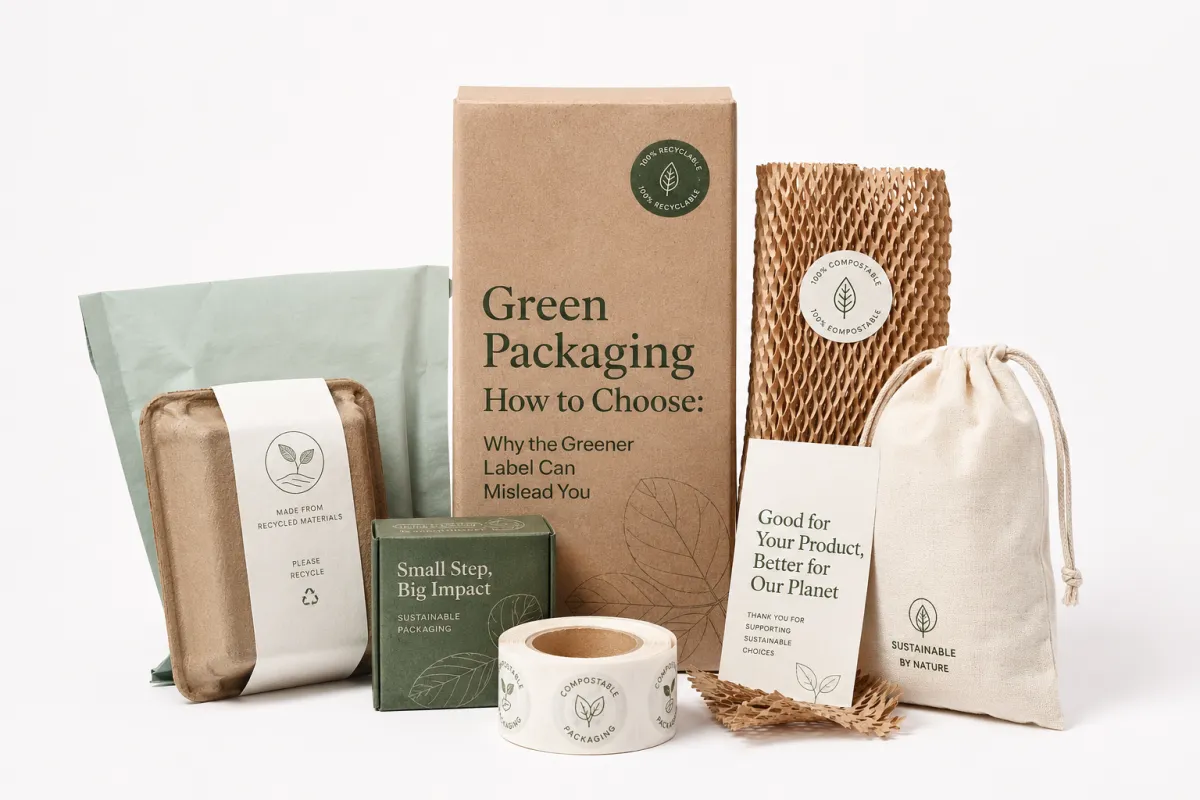
A client once switched from plastic clamshells to a recycled-paper-style tray because the spec sheet looked cleaner and the marketing team could finally say “more sustainable.” Two weeks later, the first pallet came back from warehouse: edges delaminated, wax line compromised, and the entire lot failed curbside recovery checks because the packaging could not be separated cleanly.
That event taught me the hardest lesson early in my sourcing work: green packaging is not a mood board. I have spent enough time on conversion floors to see products fail not because the idea was weak, but because the design promise ignored handling reality. What looks like a greener answer in a spec rarely performs as a system-level solution.
Greener labels are often sold like simple badges, but each package has at least three lives: shelf performance, logistics stress, and end-of-life treatment. If any one of those drops, the benefit score does not hold. You can absolutely have a package with high recycled content and still lose money because it tears during sortation.
Start with this distinction before anything else: recyclable, compostable, reusable, and recycled-content are different claims with different obligations. Compostable options, for example, require the right industrial route and usually a strict collection network. Recyclable solutions depend on polymer clarity, print and adhesive compatibility, and municipal sorting behavior. Reusable systems move risk toward return loops and reverse logistics. Recycled-content helps with virgin material reduction but does nothing by itself about recovery success.
From a technical standpoint, skipped details are expensive. If a package cannot survive vibration, humidity, pallet heat, and repeated handling, the whole sustainability stack collapses. A cracked carton or popped seal is not just a quality issue; it is a compliance and waste issue too.
So green Packaging How to Choose begins with use case reality. A snack pouch, a premium cosmetic carton, and a shipping tray for hardware have nothing in common beyond “packaging.” They differ in shelf life, impact resistance, and consumer expectations, and those differences change which environmental claim is actually meaningful.
That is why the strongest teams use evidence, not adjectives. They treat “green” as one decision dimension among product safety, channel demands, and margin, because that is where packaging actually gets tested.
How Do You Choose Green Packaging Without Losing Performance?
The safest way to think about Green Packaging How to Choose is to separate two tracks: what the material can do, and what the claimed end-of-life story requires. The tracks cross often, but they never perfectly overlap by default. You’re gonna get the best outcome only when both tracks are designed together.
Materials usually enter from familiar families: paper-based flexibles, molded fiber, glass, metal, mono-material films, biopolymer blends, and post-consumer recycled composites. Their failure modes are different, and so are their strengths. Paper and corrugated perform well where print quality and conversion maturity matter; molded fiber gives structure and impact cushioning; mono-material films usually score well on seal performance; glass and metal hold premium perception and barrier control but move freight cost and breakage risk upward.
Barrier performance is where many programs fall apart, and it is usually the first hidden cost you see. Oxygen transmission, moisture migration, puncture resistance, temperature stability, and light shielding are not footnotes. If a pouch sweats through in transit or a cream formula oxidizes before first sale, any sustainability badge becomes hard to defend.
Claims must be interpreted like legal definitions, not slogans. “Recyclable” means a qualified pathway exists under specific collection and sorting conditions; it is not a permanent waiver from local policy uncertainty. “Recycled content” is about feedstock composition. “Compostable” is only useful where industrial infrastructure and contamination controls match the formulation. “Bio-based” tracks raw material origin but not automatically lower climate impact if energy mix or disposal outcomes are poor.
What separates practical teams from branding-only teams is evidence depth. Chain-of-custody records, conversion notes, residue composition, certificate versions, and independent test data should move with the sample pack, not stay in a marketing deck. Fiber runs often align with FSC or PEFC traceability, while transport durability is proven through ASTM and ISTA-like testing logic.
Recovery design is often quietly ignored until after launch. Coatings, adhesives, barrier inks, and laminates alter disassembly and sorting behavior faster than most people expect. A premium finish can be visually perfect and still be a recovery blocker if it pushes a package into a mixed stream with uncertain sorting behavior.
My practical shortcut is this: if the package does not survive normal pick, pack, ship, and return motion without a measurable increase in defects, it is not greener in practice. That sounds blunt, but it is the only standard that matters when returns and complaints hit the books.
Key Factors That Shape a Green Packaging Decision
Green Packaging How to Choose is manageable once you stack constraints in order. Product specs sit first: weight, fragility, shelf life, climate exposure, and handling stress define the acceptable material window. Everything else is optimization, not foundation.
Channel differences are a major source of late-cycle failures. E-commerce introduces repeated scans, drops, and turbulence; retail adds vertical stack compression, shelf friction, and display limitations. A carton optimized for direct-to-consumer can be a poor fit in stores if dimensions or visual cues get out of place.
Brand strategy also belongs early, not at launch. If your pricing model depends on premium perception, rough transitions in texture or print can reduce perceived value fast. You can still be green, but you may need upgraded surface finish, better structural design, or alternate graphics to keep intent and trust aligned. Ignoring this link produces avoidable brand erosion.
Compliance is not paperwork theater. Food-contact materials, local packaging waste rules, labeling requirements, and local collection marks can differ by country, city, and even by distributor. I once reviewed a program where a compliant claim in one region became a legal issue in another because a marker color and resin family changed at one production site.
Operations conversion can reshape the whole shortlist. Existing form-fill-seal speeds, die-cut geometry, and carton-forming limits determine what can run at volume. Any material that lowers reliability or raises scrap by forcing machine instability can erase the environmental advantage quickly. A greener label does not pay for line downtime by itself.
End-of-life behavior is where teams lose continuity if they leave it to the end. A closure style that looks simple to designers can block practical recycling, while unclear disposal text can create consumer confusion in markets with strict sorting rules. Material is only one half of recoverability; post-consumer actionability is the other.
Before finalizing alternatives, I advise teams to benchmark current packaging against realistic replacements side by side, including current conversions and return handling. Using options from Custom Packaging Products helps make tradeoffs visible without getting trapped by one seductive profile.
Trade-offs will remain. Expect compromises across protection, cost, compliance, and operations, because few materials are dominant across every dimension. The better decision is usually not the “top-ranked everywhere” package, but the one that performs consistently under your real constraints.
Green Packaging How to Choose: Step-by-Step Decision Workflow
The cleanest outcome comes when teams stop debating ideals in a circle and convert green packaging how to choose into a repeatable sequence. A fixed method keeps design teams, logistics teams, and finance in the same frame instead of arguing from different baselines.
Step 1: Define the problem in measurable terms. Replace “greener” with explicit targets such as maximum allowable damage percentage, barrier targets, shelf-life floor, budget band, and retailer acceptance thresholds. For example, “reduce unit weight by 12%, reduce returns by 20%, and keep packaging cost within ±3%” is usually far more useful than a broad direction.
Step 2: Gather baseline data. Track current waste percentages, machine stoppages, complaint categories, freight damage, return causes, and inventory distortions linked to packaging defects. Packaging cost is rarely the root issue in full; conversion waste and reverse logistics often dominate.
Step 3: Build a weighted scorecard. Score each candidate on environmental outcome, physical performance, compliance, and operational burden. Weights should reflect category-specific risk: food-contact pouches prioritize barrier and safety claims, while cosmetics can weight brand tactile perception more heavily. The score only works if the weighting assumptions are documented and revisited quarterly.
Step 4: Shortlist three families, not ten. A compact list makes comparison honest. Ask suppliers for data sheets, conversion parameters, disposal pathway notes, finishing options, print compatibility, and seal behavior. Branded packages should include proofing on varnish and inks because surface treatment can alter both recyclability and durability.
Step 5: Run pilots under real conditions. Use true fill weights, actual closures, actual routes, and real pallet geometry. Test seal strength, compression tolerance, drop behavior, thermal stability, vibration response, and throughput consistency. If your primary channel is e-commerce, include parcel simulation; if it is retail, include shelf and handling cycles.
Step 6: Run cross-functional go/no-go review. Marketing validates claim language and brand consistency. Operations validates equipment compatibility and labor load. Finance validates landed cost and contingency exposure. Legal validates labeling and recovery disclosures. Green packaging how to choose becomes far less political when every function signs off the same evidence package.
Step 7: Write a decision record. Capture selected substrate, structural design, finishes, print stack, disposal basis, and test outcomes in one controlled spec. The record protects future audits, redesigns, and team changes during reorders or re-runs.
Early rejections are often the cheapest part of the project. If one cycle shows poor seal integrity, thermal drift, or unexpected abrasion, kill or redesign fast. A lamination or geometry correction now is cheaper than a launch-line emergency.
If launch speed is a constraint, run a staged rollout on a high-volume SKU first. A controlled learning wave gives visibility without freezing the entire catalog and usually uncovers conversion surprises earlier than an all-at-once migration.
Cost and Pricing: True Cost of Green Packaging, Not Just Unit Cost
Most teams still evaluate green packaging through a narrow lens: unit price today. That is where green packaging how to choose starts getting distorted. A lower bill of materials line can hide transport losses, returns, and downstream handling penalties that erase the margin in six months.
Total cost of ownership is broader by design: materials, conversion effort, tooling amortization, labor, scrap, freight, storage space, breakage, and service burden. A $0.04 premium per unit can become a profit-positive move if it drops damage rates and improves retailer pass rates enough. I have seen this in two CPG runs where replacement rates fell by enough to offset material changes within one quarter.
Watch recurring pricing traps before you sign. Recycled board may increase mass and dimensional weight. Compostable films may need tighter process windows and closer sealer control. Molded inserts can slow pack-out if nesting pattern is suboptimal. Small unit-cost savings vanish quickly when line efficiency degrades.
Order-volume behavior is often overlooked. Most suppliers quote a headline rate that hides setup charges, plate costs, conversion complexity, and print-density premiums. Always request landed-cost scenarios for low, medium, and annual volume bands. The best decision band is often the middle tier where yield and throughput stabilize.
| Option | Typical Use | Indicative Unit Cost | Strengths | Watch-Outs |
|---|---|---|---|---|
| Recycled paperboard carton | Retail folding cartons, sleeves, small product packaging | $0.08-$0.22 at 5,000-10,000 units | Good print quality, broad converter familiarity, often compatible with existing lines | May need coating or caliper adjustments for moisture and scuff resistance |
| Molded fiber insert or tray | Protective dunnage, gift sets, fragile items | $0.14-$0.35 depending on tooling and density | Strong protection, fiber-based story, good for reducing void fill | Higher tooling cost and tighter dimensional tolerance requirements |
| Mono-material PE or PP pouch | Lightweight food, supplements, refill packs | $0.06-$0.18 depending on barrier and print coverage | Low weight, lower dimensional freight, dependable sealing | Recyclability depends on collection system and exact laminate structure |
| Compostable film | Specific food or service programs with compost access | $0.10-$0.28 with qualification and volume factors | Strong fit where composting infrastructure exists | Verification is critical, and not all markets accept compostable routes |
| Glass or metal container | Premium retail, reuse, food preservation | $0.18-$0.60 depending on size and finish | High shelf presence and premium recovery narrative | Higher freight, breakage risk, and handling cost sensitivity |
Use three cost horizons to keep the numbers honest. Horizon one is immediate purchase order cost. Horizon two is a 12-month operating view including scrap, tooling changes, line changeovers, and replacement rates. Horizon three is life-cycle spend across production, fulfillment, use, and recovery outcomes. Teams that stop at horizon one are often still doing packaging shopping, not strategy.
Negotiation should be phased the same way. Early pilot quantities reduce commercial risk. Shared development costs can be justified when qualification is complex. Long-term agreements may be useful when resin and fiber prices are volatile, but only if volume and compliance clauses are explicit.
Most practical savings happen before a full redesign: remove unnecessary laminates, reduce overpack, and standardize gauges across adjacent SKUs. Those moves often lower both cost and environmental load without major process churn.
As a rule of thumb, a 1–3% unit premium is often acceptable when it lowers returns, spoilage, or penalties by a larger margin. Keep that equation visible at launch and again at six- and twelve-month checkpoints.
Process and Timeline: From Shortlist to Production Without Surprises
Timelines become realistic only when you agree on them before sample signoff. Without that discipline, unresolved technical issues surface at exactly the wrong point: right before launch commitments, and everybody starts rushing alternatives.
Discovery usually takes 1–2 weeks. During this phase, capture current failure modes, define sustainability goals in numbers, and lock core product needs. Product engineering, sourcing, and brand owners should align on measurable outcomes, not adjectives.
Supplier screening usually takes 2–3 weeks. Require composition transparency, certificate references, disposal instructions, certified collection claims, lead-time assumptions, and minimum-volume logic. If a supplier cannot walk through conversion flow and test assumptions clearly, you should not push them forward.
Sample build and testing usually takes 3–4 weeks, longer if artwork or tooling changes are substantial. Validation should include dimensional stability, seal behavior, compression, vibration, drop resistance, thermal exposure, and throughput consistency. Bottle formats need closure torque checks; cartons need edge crush and scuff tests; pouches need puncture and barrier retention checks.
Pilot production usually takes 2–4 weeks. This is where run-to-run variance appears. One successful pass is encouraging but meaningless unless it repeats across shifts and operators. Repeatability is what protects green packaging how to choose from becoming anecdotal luck.
Launch readiness usually takes 2–3 weeks. At this stage final artwork, QA criteria, handling instructions, waste labels, and claim language must be finalized. Joint simulation with warehouse, transport, and sales teams catches operational errors before live fulfillment begins.
Reference standards help teams speak the same language. Technical reviews should map to recognized frameworks like ISTA methods and accepted certification practices for fiber and polymer claims. Those references slow nothing down; they prevent repeated “we thought it meant X” assumptions.
Five delays keep reappearing in most programs: raw material shortages, approval hold-ups, print lead times, conversion mistakes, and failing tests late in the schedule. Gate-based calendars and one accountable owner reduce these delays because every team has a fixed decision checkpoint.
Common Mistakes When Trying to Choose Green Packaging
One common mistake is worshipping a single metric and ignoring everything else. Recycled content alone is rarely enough; if barrier failure leads to spoilage or product loss, the sustainability value erodes quickly. Damage-related waste is usually more expensive than any input reduction you celebrated on paper.
Another mistake is accepting supplier language without an audit trail. Brochures can be persuasive, but traceability data is what protects procurement. Demand certificates, chain-of-custody IDs, batch-linked test reports, and disposal instructions matched to your actual geographies.
Teams also mess up by changing too many variables at once. Altering resin grade, seal settings, structure depth, and finishing in one cycle makes root-cause analysis nearly impossible. Controlled A/B pilots with single-variable changes keep causality visible and rework manageable.
Municipal and retailer acceptance constraints are often forgotten until after launch. A format that passes in one city can be misrouted in another due to label restrictions, contamination limits, or collection boundaries. The result is emergency relabeling, additional conversion runs, and in some cases channel withdrawal.
Logistics effects can be counterintuitive. A lighter package is often assumed to be cheaper to ship, but if it increases dimensional weight, causes jams, or creates crush points, it can increase true logistics cost anyway. Supply chains reward predictable handling quality as much as material reduction.
These issues are manageable with a disciplined scorecard, third-party verification, and staged pilots. If a supplier cannot support these steps reliably, they may still be a future fit, but probably not a launch-ready partner.
Dual-channel brands feel this pressure most. Retail and direct-to-consumer routes impose conflicting constraints on shape, handling, and customer expectations. If a design can pass both, it is usually a strong indicator that the green packaging how to choose process is actually working.
Expert Tips and Actionable Next Steps After You Choose Green Packaging
Decision is not the finish line; it is the midpoint of the work. Once a package is in circulation, every quarter should reconfirm that material, claims, and process controls still align. Small shifts in suppliers, ink lots, or line settings can slowly affect performance if nobody is watching.
Build a supplier scorecard with required fields before replenishment: composition, recycled-content floor, valid certificate IDs, recyclability route map, disposal caveats, transport durability, and lead-time assumptions. A recurring gap in any field is a signal to pause and correct before stock commitments compound the issue.
Use a high-volume SKU for first live pilot and then validate monthly. It gives enough data volume to spot defect patterns, labor impact, and customer reaction early. A stable result there is far more useful than a short perfect batch on a low-volume niche SKU.
Ownership boundaries should be explicit, not implied. Sourcing manages supplier execution and commercial claims. Engineering owns fit, conversion limits, and performance thresholds. Marketing controls visual language and positioning. Quality handles inspections and audit cadence. Legal owns claims and disclosure language. Shared accountability prevents claim drift and keeps green packaging how to choose from becoming a marketing afterthought.
Run routine checks: quarterly claim validation, monthly rejection and weight trend review, and immediate review of any supplier-material variation. Subtle shifts in basis weight or seal chemistry can alter both shelf performance and recovery profile over time.
If your portfolio includes cartons, sleeves, and mailers, comparing structures early in Custom Packaging Products can reduce the risk of lock-in to a weak format before tooling is signed off. You are not choosing “one green idea,” you are choosing a repeatable sourcing logic.
“A greener package is one that protects the product, works through fulfillment systems, and behaves honestly at the disposal stage.”
Use this post-selection checklist every time you refresh: confirm baseline metrics, request three technical submissions, run one controlled pilot, compare objective test results, and lock launch criteria in one document. That sequence turns sustainability intent into measurable performance over time.
Teams with mixed channels win when process outruns hype. Their practical advantage is not a perfect score card; it is disciplined monitoring of the three numbers that matter every quarter: damage rate, recovery rate, and total cost.
How do I know if a package is truly greener when suppliers only use eco buzzwords?
Start with evidence that can be traced: chain-of-custody data, verified recycled-content records, exact recycling or compost routing notes, and test reports for the exact structure you are buying. Then compare those documents against the actual systems your customers use. If claims cannot be tied to real geography-specific recovery pathways, the “green” statement is probably marketing-first and weak on execution.
How to choose green packaging on a tight budget without losing performance?
Use a 360-degree model that includes materials, conversion, scrap, freight, storage, and returns. Then make only one or two structural changes at a time, such as gate optimization, barrier tuning, or gauge standardization across SKUs. A controlled approach usually gives better results than a complete material shift with unknown operating effects.
How can I choose green packaging for fragile items while keeping protection levels?
Map damage vectors first: drop height, stack compression, puncture exposure, and vibration profile. Build a protective geometry baseline before switching material families. Pilot under real transport and handling conditions, then only then finalize the claim language and disposal design. Protection keeps the product alive; messaging only explains it afterward.
What is the fastest way to choose green packaging for e-commerce SKUs?
Start with a short shortlist and a narrow A/B pilot. Track damage modes, return reasons, and dimensional weight across two to three fulfillment cycles. In this channel, durability and corner resistance usually carry more weight than ambitious material claims until reliability is proven.
How can a brand verify claims after choosing green packaging?
Put checkpoints into the purchasing rhythm: certificate validity, supplier process audits, and monthly variance tracking on defect patterns and packaging weight. Internal dashboards should monitor objective indicators like returns, rejection reasons, disposal complaints, and supplier variation. Claims survive longer when evidence is updated, not remembered.
Takeaway: For green packaging how to choose, start with your hardest real-world constraint, shortlist only three to five candidates, test them under actual channel conditions, and only then approve claims against the documented evidence trail; repeat that check at least quarterly so your sustainability story stays true in factories, on trucks, and with customers.


