Buyer Fit Snapshot
| Best fit | Wholesale Eco Friendly Shipping Tape for Modern Brands projects where brand print, material claims, artwork control, MOQ, and repeat-order consistency need to be specified before quoting. |
|---|---|
| Quote inputs | Share finished size, material target, print colors, finish, packing count, annual reorder estimate, ship-to region, and any compliance wording. |
| Proofing check | Approve dieline scale, logo placement, barcode or warning zones, color tolerance, closure strength, and carton packing before bulk production. |
| Main risk | Vague material claims, crowded artwork, missing packing details, or unclear freight terms can make a low unit price expensive after revisions. |
Fast answer: Wholesale Eco Friendly Shipping Tape for Modern Brands should be specified like a repeatable production item. The safest quote records material, print method, finish, artwork proof, packing count, and reorder notes in one written spec.
Production checks before approval
Compare the actual filled-product size with the drawing, then confirm tolerance on folds, seals, hang holes, label areas, and retail display edges. Reserve space for logos, QR codes, warning copy, and material claims before decorative graphics fill the panel.
Quote comparison points
Review material grade, print process, finish, sampling route, tooling charges, carton quantity, and freight assumptions side by side. A quote is only useful when the supplier can repeat the same color, closure quality, and packing count on the next order.
Wholesale Eco Friendly Shipping Tape for Modern Brands
Wholesale Eco Friendly Shipping tape looks like a small line item until cartons start leaving the building by the hundreds. Then it stops being an afterthought and starts acting like a real operating material. I have seen teams blame the tape when the real culprits were dusty flaps, mismatched dispensers, or a carton grade that was never a good fit in the first place. That is usually how these things go. The tape gets the blame because it is visible, but the system around it is often the thing that needs fixing.
That matters because tape influences more than closure. It affects pack speed, package protection, customer perception, and the amount of rework a warehouse has to absorb. Five seconds lost on one carton sounds minor. Multiply that across a shift, and you have real labor. A weak seal on a heavy box is not minor either. For brands shipping at volume, the right wholesale eco friendly shipping tape can steady the pack line without forcing the team to learn a whole new routine.
Buyers sometimes start with the wrong comparison. Roll price is easy to quote, but it hides the cost of labor, waste, retapes, downtime, and claims. Once those pieces are included, the decision changes fast. Wholesale eco friendly shipping tape should be judged by seal reliability, application speed, carton compatibility, and cost per shipped order. That is the math that actually matters when the order is recurring and the usage is constant.
Brands that compare transit packaging, branded consumables, and shipping materials together usually discover that tape is the quiet hinge in the whole setup. It can support a cleaner unboxing story. It can reduce plastic content. It can speed up the line. It can also slow everything down if the spec is off by even a little. The sections below break down what buyers should check before placing a wholesale eco friendly shipping tape order, from construction and specs to pricing and lead times.
Wholesale Eco Friendly Shipping Tape: Why the Numbers Matter
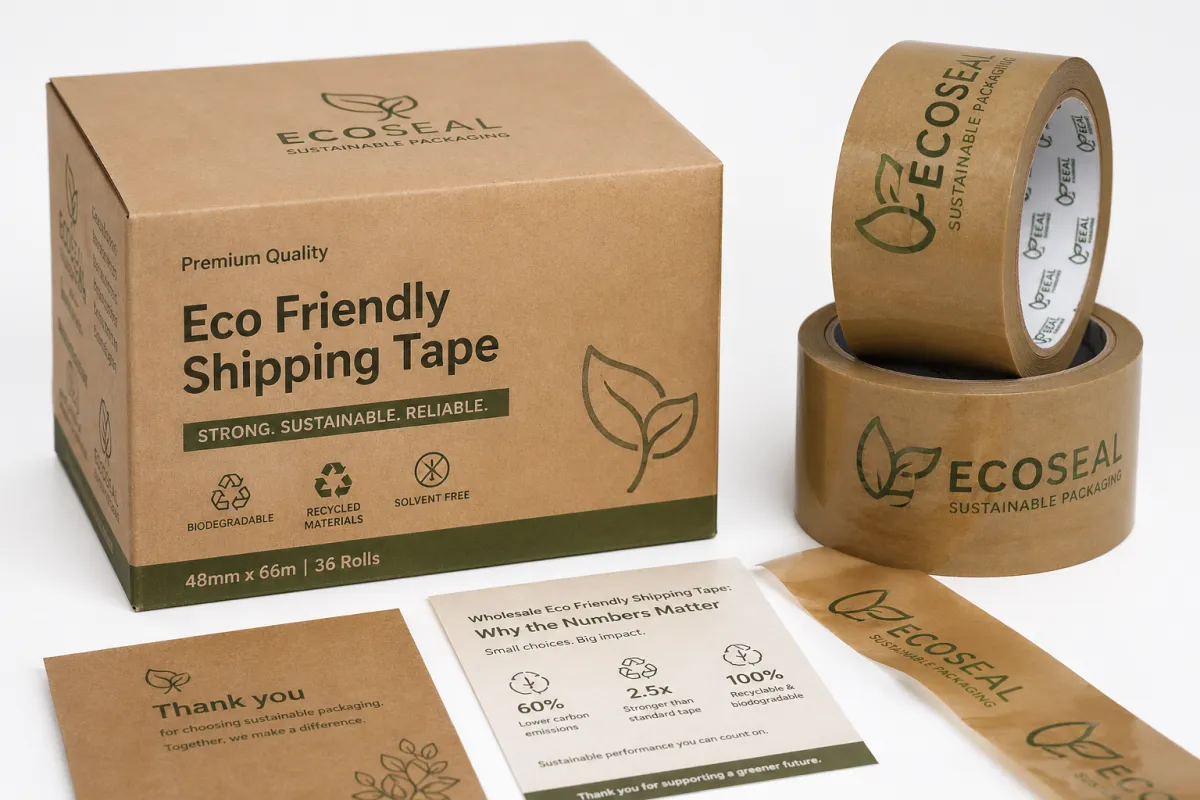
Most tape conversations start with material ideals and end with carton failures. That order is backwards. The first filter should be how the tape behaves in the shipping environment the product actually lives in. A warehouse with dust, humidity swings, mixed carton grades, and constant motion is not a lab bench. A roll that looks excellent in a spec sheet can behave very differently on recycled corrugate, especially if the surface is rough or the flap carries print. With wholesale eco friendly shipping tape, the real test is simple: does it seal cleanly on the first pass, and does it stay in place through handling, sortation, and transit?
The phrase "eco friendly" hides a wide range of constructions. Paper-based tape, recycled-content film tape, and water-activated kraft all sit under the broad label of wholesale eco friendly shipping tape, but they do not perform the same way. Some are built for fast hand application. Others are built for stronger fiber bonding. A few are meant to reduce plastic content while still fitting standard pack stations. The carton should drive the choice, not the marketing line.
Tape can affect labor in ways that stay invisible until they show up in a shift report. If a carton needs two strips instead of one, that extra motion multiplies across the day. If the roll splits in the dispenser, the operator slows down. If the adhesive does not bite on recycled corrugate, the box gets retaped. A minor supply item then starts eating minutes, and those minutes are not free. With wholesale eco friendly shipping tape, the hidden labor cost usually matters more than the roll price.
A tape that saves a penny but adds two seconds per carton is not really saving money. It is just moving cost somewhere else.
The customer-facing side matters too. Tape sits on the outside of the box, which means it becomes part of the first physical impression. Clean branding can make a plain carton feel deliberate. Poor adhesion does the opposite. For brands that want sustainability claims to feel credible, wholesale eco friendly shipping tape should support the story without demanding weaker seals or slower throughput. That balance is the whole trick.
The buying model works better when it stays grounded. Compare cost per sealed carton, not cost per roll. Compare retape frequency, not just tack on a spec sheet. Compare downtime from dispenser jams, not only material savings. That is where wholesale eco friendly shipping tape earns its place in a program. If the tape reduces waste, keeps the line moving, and holds cartons shut, it has done its job.
There is another layer buyers sometimes miss. Transit packaging systems work together. Tape interacts with corrugated flute structure, closure style, dimensional weight, and the product inside the box. Lightweight apparel shipments have different needs than dense components or multi-item kits. A tape that works beautifully in one lane may be wrong for another. Wholesale eco friendly shipping tape matters most as part of the whole packing system, not as a standalone commodity.
For broader sourcing support, many buyers also review Wholesale Programs and compare tape against other Custom Packaging Products so the shipping and branding stack stays aligned. That process is usually stronger than buying each item in isolation and hoping the pieces fit later.
What Can Wholesale Eco Friendly Shipping Tape Do for Shipping Line Efficiency?
At the start of a sourcing project, most teams assume this is only a materials question. In practice, it is also an operations question. A few simple adjustments in the carton sealing workflow can produce a bigger shift than a dramatic brand refresh. If a packaging team can close flaps faster, use fewer touchpoints, and avoid late rework, throughput rises without anyone needing a fancy new process.
That is where comparing wholesale eco friendly shipping tape by behavior can uncover the hidden gains. A slightly narrower width with stable adhesive may reduce misalignment, improve operator comfort, and lower waste at the seam. A different core size can stop dispenser stutter and quietly improve cycle consistency. The effect feels small on paper, yet it compounds in a busy fulfillment facility like compound interest. Small differences become measurable by the end of the week.
Think of the carton, tape, and hand dispenser as one shipping system rather than separate purchase lines. If one part is out of tune, the whole route slows. If one part is consistent, the operation feels easier even before staffing or software change. That is the kind of improvement people notice only after it is gone.
In my own experience reviewing warehouse setups, the most successful tape programs were rarely the cheapest on paper. They were the ones that reduced second-touch handling. Operators did not have to fight the roll. Supervisors did not have to answer daily complaints. The line just kept moving, which sounds boring until you realize boring is exactly what good packaging procurement should deliver.
Wholesale Eco Friendly Shipping Tape Product Details
Three common directions come up in wholesale eco friendly shipping tape. Paper-based tape is the first, usually kraft or white paper stock, and it appeals to brands trying to reduce plastic at the pack line. Recycled-content tape is another route, using recycled paper facings or recycled-content film construction depending on the product type. Water-activated tape, often kraft-based, is the third path and is widely used where a stronger carton closure is needed. Each option has a place. Each one carries a different set of tradeoffs.
Paper-based tape is the most direct Fit for Brands that want a cleaner material story and a straightforward visual. It often works well for light to medium parcels, subscription cartons, and ecommerce shipping programs where the team values simple hand application and a tidy look on the box. Recycled-content options can help reduce virgin material use while keeping familiar application habits. Water-activated tape is more specialized, but it can deliver a firmer bond to corrugated fiber surfaces, especially in rougher transit conditions.
Adhesive choice matters just as much as the facestock. Pressure-sensitive adhesive is common for fast hand application and works well in general fulfillment settings. Water-activated adhesive behaves differently: once moistened, it penetrates the carton fibers and creates a bond that is difficult to peel cleanly. That is useful for heavier parcels, high-value items, and cartons that need a tamper-evident look. In wholesale eco friendly shipping tape, the adhesive is not a side detail. It is the performance decision.
Print options shape the buying decision too. Some programs only need unprinted stock tape. Others need a one-color custom print, repeat logos, or simple messaging such as "sealed for protection" or a brand mark running the length of the roll. Print coverage changes cost, proofing time, and minimum order expectations. It also changes visual impact. A light repeating logo can strengthen brand recognition without making the box feel overdesigned. Heavy coverage, by contrast, adds setup steps and can extend lead time.
Compatibility is another practical issue. Buyers should ask whether the tape works with standard hand dispensers, carton-sealing machines, or water-activated equipment. They should also ask whether the tape supports their recycling stream goals. Paper-based wholesale eco friendly shipping tape usually fits cleanly with corrugated packaging programs, though local recycling rules vary. Plastic film tape may still be acceptable in some operations, yet it can be less appealing for brands trying to simplify material separation. Sustainability claims should be tied to the actual build, not vague language.
For organizations shipping mixed box formats, the safest approach is to match the tape to the most common carton. The broadest SKU is not always the best SKU. A tape that works well on 32 ECT corrugated may not be right for heavier double-wall boxes. That is where wholesale eco friendly shipping tape buying gets more precise. Buyers who define the use case clearly usually get a better quote and a better result.
Independent standards help here. The ISTA test framework is useful for understanding how packaged goods survive transit, while FSC certification matters when the fiber sourcing story needs third-party support. For environmental claims and materials guidance, the FSC system can help buyers verify responsible fiber sourcing rather than relying on generic green claims.
| Option | Best Use | Typical Strength Profile | Common Tradeoff |
|---|---|---|---|
| Paper-based pressure-sensitive tape | Light to medium ecommerce shipping and branded cartons | Good general sealing; easy hand application | May need careful dispenser setup on dusty cartons |
| Recycled-content tape | Programs focused on reduced virgin material use | Comparable to standard stock when matched well | Performance varies by substrate and adhesive |
| Water-activated kraft tape | Heavier parcels, stronger closure needs, tamper evidence | Strong fiber bond and solid package protection | Usually needs dedicated application equipment |
| Custom printed tape | Brand visibility and repeatable packing identity | Depends on base construction and print coverage | Artwork approval adds time and cost |
That table is the real starting point for wholesale eco friendly shipping tape selection. It keeps the conversation anchored in application rather than assumptions. A buyer can compare options by line speed, carton strength, and branding needs before getting pulled into roll price alone. That is the practical way to buy shipping materials at scale.
Custom packaging teams often pair tape decisions with box and mailer decisions. If the packaging mix includes softer items, a brand might compare tape against Custom Poly Mailers. If the shipping lane leans toward heavier cartons, the box style itself may deserve a review before the tape spec is finalized.
Key Specifications That Decide Seal Strength and Speed
A serious wholesale eco friendly shipping tape quote starts with specification discipline. Width is the first number. Common widths often sit around 48 mm or 72 mm for carton closure, though the right choice depends on the box and the application tool. Wider tape can improve coverage across a carton seam, but wider is not automatically better. If the operator is closing small cartons, extra width can create waste and slow handling.
Thickness or basis weight comes next. For paper-based products, basis weight gives a clearer picture than the casual phrase "heavy duty." For water-activated tape, the facestock and reinforcement profile matter as much as the adhesive. Tensile strength shows how much force the tape tolerates before breakage. Adhesive coat weight can influence bite on rough corrugate. Roll length and core size decide whether the dispenser runs smoothly or becomes a nuisance at the pack station. Every one of these specs affects wholesale eco friendly shipping tape performance in real order fulfillment conditions.
Environment matters too. A dusty warehouse can reduce adhesive performance if cartons are dirty. Humidity can change how paper-based tape behaves on the flap. Cold storage can slow tack development. Long transit lanes and rough handling can expose weak seams that looked fine at pack-out. This is where test data and floor testing beat assumptions. A tape that performs in a dry sample room may act very differently on a loading dock with temperature swings and high throughput.
Pressure-sensitive and water-activated formats deserve separate evaluation. Hand-applied pressure-sensitive tape is usually the fastest route for small to medium packs, especially if the goal is to keep application simple. Water-activated tape, by contrast, can reduce retaping and improve closure integrity on heavier cartons, but it often requires a dedicated dispenser and some training. For wholesale eco friendly shipping tape, speed is not just how fast the roll goes on. It is the total time from carton fold to finished seal.
One useful rule is to let the shipment define the spec. Light apparel, books, and accessories can often use a simpler tape build. Dense, high-value, or multi-item kits usually justify a stronger closure system. If the carton is exposed to automated sortation, vibration, or long-haul transit stress, buyers should lean harder on seal strength and less on lowest-roll-cost thinking. The tape has to fit the journey.
ASTM guidance can help during spec review. Peel adhesion, tensile properties, and related test methods provide a way to compare products with more discipline than a brochure can offer. The point is not to drown in standards jargon. It is to prevent a purchase from becoming a guess. Wholesale eco friendly shipping tape should be selected with enough data to support repeat ordering, not with a one-time sample that happened to look good in an office.
Buyers should also ask for sample rolls on the actual carton stock they use. That is the quickest way to see whether the tape behaves as expected. A sample should be tested on the same corrugated grade, folded the same way, with the same dispenser and the same operator. If the carton has coated print, recycled fibers, or irregular surfaces, those details matter. A supplier quote is only as useful as the box it was matched to.
In practice, the best wholesale eco friendly shipping tape choice is often the one that lowers friction at the line. Not the flashiest roll. Not the widest spec sheet. The product that seals consistently, clears the dispenser, and holds through transit is usually the winner. That is especially true when the pack team handles repeat volumes and cannot afford a training project every time a new roll arrives.
Pricing, MOQ, and What Changes the Quote
Pricing for wholesale eco friendly shipping tape is driven by more than raw material. Substrate choice matters first. Paper facestock, recycled-content stock, reinforcement, and coating systems all change the base cost. Adhesive system matters next. Pressure-sensitive constructions and water-activated constructions sit in different Cost and Processing buckets. Print complexity matters as well, because every added color, coverage area, or logo version adds setup work.
Roll length and packaging format also influence the quote. A longer roll can reduce changeovers, but it can raise unit pricing. Shrink-wrapped bundles, boxed rolls, pallet counts, and core packaging all feed into freight and handling costs. Certification or compliance requirements can move the number too, especially if the buyer wants FSC-related documentation or specific sustainability paperwork for internal reporting. Wholesale eco friendly shipping tape is a commercial product, so the quote reflects the whole supply chain, not just the tape face.
MOQ is simple in concept and easy to misread in practice. Stock tape usually allows lower entry quantities because it does not require custom setup. Custom printed or specialty constructions often need a higher minimum because the press setup, tooling, or quality control process has to be recovered across the run. That does not mean the larger MOQ is a bad deal. It only means the buyer should compare the break-even point carefully.
Here is a useful way to think about it: if a custom branded roll saves labor, reduces waste, or strengthens the unboxing experience enough to justify a larger buy, the MOQ may be reasonable. If the artwork will change every quarter, a stock roll with a smaller minimum might be smarter. Wholesale eco friendly shipping tape buyers often get the best result when they separate "nice to have" print effects from the closure performance the box actually requires.
Cost per sealed carton is the metric that keeps everyone honest. Suppose a lower-cost roll requires a second strip on half the cartons. That extra strip brings labor, machine time, and waste into the equation. Suppose a slightly higher-priced water-activated roll reduces retapes and claim issues. That can save money even though the roll price is higher. The true comparison is not roll versus roll. It is closed carton versus closed carton.
There are several practical ways to control spend without lowering performance:
- Standardize widths across the highest-volume cartons so the team uses fewer SKUs.
- Consolidate artwork versions to reduce print changeovers and proofing time.
- Forecast repeat orders early so freight can be planned instead of rushed.
- Choose the lightest spec that still protects the carton in real transit.
- Review whether one tape construction can cover multiple box types safely.
Those steps are especially useful for ecommerce shipping operations that live on recurring demand. A small improvement in tape management can lower pack-line friction across an entire quarter. That kind of efficiency rarely shows up in a single quote comparison, but it shows up in labor reports and customer service logs.
For brands that need to balance packaging spend across multiple formats, it helps to review tape alongside box and mailer programs. A well-tuned carton lineup paired with the right seal can reduce avoidable dimensional weight surprises and lower replacement shipments. The tape is not responsible for dimensional weight, of course, but the closure choice can affect how confidently the pack team uses a carton size and how much wasted motion happens on the line.
Production Process and Timeline for Wholesale Orders
The production path for wholesale eco friendly shipping tape is straightforward once the inputs are clear. It usually starts with carton details, application method, average box weight, and monthly volume. Then comes artwork, if the tape is custom printed. After that, the supplier reviews the spec, confirms the construction, prepares samples or proofs, and moves into production. Finally, the rolls are packed and shipped according to the buyer's delivery window.
Sampling is where expectations need to stay realistic. A stock roll can move quickly because there is little or no artwork setup. Custom printed work adds proofing time because the design needs to be checked for placement, color, and repeat length. Water-activated systems may need additional setup because dispenser compatibility and adhesive behavior have to be verified. Buyers should assume that custom work takes longer, not because the process is slow, but because there are more steps to get right.
Lead times vary more than many buyers expect. A change in roll width can affect tooling. A different adhesive can affect curing or coating schedules. A larger order may require more production time even if the construction is simple. Print-heavy tape adds proof approval and quality control steps. It is better to build a realistic calendar than to assume a standard number applies to every order. In practice, the order that looks easy on paper may be the one that needs the most coordination.
Here is a typical planning sequence for wholesale eco friendly shipping tape:
- Confirm carton type, weight, and closure method.
- Choose stock or custom printed construction.
- Review sample rolls on actual cartons.
- Approve artwork or specification sheet.
- Book production and reserve freight timing.
- Hold safety stock for the next reorder cycle.
That last step gets overlooked more often than it should. Safety stock protects against seasonal demand spikes, carton changes, and freight delays. A brand with stable shipping volume does not need to overbuy, but it does need a buffer. If this is a recurring consumable, the cost of a stockout is usually higher than the cost of carrying one extra pallet.
This is also where communication matters. Buyers should tell the supplier whether the tape is feeding manual packing stations, semi-automatic case sealers, or a mixed environment. They should also share whether the operation handles fragile goods, subscription kits, or heavier merchandise. The more specific the use case, the less guesswork there is in the final build.
Brands building a broader packaging program can coordinate the order with other items such as Custom Shipping Boxes. That creates a cleaner system for artwork, carton sizing, and seal performance. It also reduces the risk that a carefully designed box is paired with the wrong tape.
Why Buyers Choose Us for Wholesale Eco Friendly Shipping Tape
Consistency is the first reason buyers stay with a wholesale eco friendly shipping tape supplier. If the roll length drifts, the adhesive laydown changes, or the tape behaves differently from one batch to the next, the pack line notices immediately. Repeat orders should feel boring in the best possible way. Same width. Same bond. Same roll behavior. That kind of predictability protects labor planning and keeps the operation calm.
Another reason is technical guidance that stays grounded. Not every carton needs the strongest possible construction. Not every brand needs custom print coverage. Sometimes the honest recommendation is a different width, a different adhesive, or even a different format entirely. That is the value of working with a supplier that treats wholesale eco friendly shipping tape as a use-case decision, not a one-size-fits-all sale.
Documentation matters more than many marketing pages admit. Sustainability claims should be supportable. Carton compatibility should be clear. Testing should be explainable. If a buyer needs to answer internal procurement, operations, or brand teams, they need facts they can stand behind. That includes details on recycled content, fiber sourcing, adhesive type, and whether the tape is suitable for the intended recycling stream. Vague green language does not help anyone close a procurement review.
There is also a supply continuity angle. Tape is a high-frequency consumable. If it is late, the pack team feels it the same day. If the reorder process is awkward, the buyer feels it next month. A good wholesale eco friendly shipping tape program reduces friction at every step: quoting, sampling, proofing, delivery, and reordering. That is not flashy. It is useful.
For buyers who want to keep all packaging programs aligned, our Custom Packaging Products range makes it easier to coordinate tape with cartons, mailers, and brand applications. That can be especially helpful for teams reviewing package protection across multiple shipping lanes at once.
Honestly, the best feedback we hear from packaging teams is not "this tape is exciting." It is "this tape stopped being a problem." That is what good wholesale eco friendly shipping tape should do. It should disappear into the workflow and leave behind a clean closure, a consistent look, and fewer surprises.
Good tape also respects the physical reality of the box. It should bond to corrugated edges without curling. It should unwind without fighting the operator. It should keep up with order fulfillment instead of slowing it down. If a product does those things while supporting a lower-plastic or fiber-forward material strategy, it earns its place.
Some buyers ask whether a greener tape can still fit a serious commercial operation. The answer is yes, but only if the specification is handled with discipline. This is not a symbolic purchase. It is a working component of the shipping system. Treat it that way and it performs like one.
After enough warehouse visits, one pattern keeps repeating: teams do best when they stop treating tape as a commodity and start treating it like a closure system. That shift changes the questions they ask, the sample they approve, and the way the line performs under pressure. It is a small change in language that leads to a better buying decision.
Next Steps: Build a Trial Order That Proves Performance
The smartest way to buy wholesale eco friendly shipping tape is to test it on the real box before scaling the order. That means gathering four inputs first: carton type, average box weight, daily or monthly volume, and application method. Those details tell the supplier much more than a generic request. They also reduce the odds of paying for a product that looks right but behaves wrong.
From there, run a small pilot with the actual cartons, the actual dispensers, and the actual shipping conditions. Track failures, retapes, and application time. If the team uses different cartons across SKUs, test the highest-volume box first and then the second most common carton. Compare two or three constructions side by side. That may sound basic, but it is how buyers separate a strong wholesale eco friendly shipping tape candidate from a merely acceptable sample.
Do not rely on a single hand-applied test in a quiet office. A tape that feels fine on a desk may be awkward in a warehouse with gloves, motion, and time pressure. Use the same operators who will apply the product in production. Watch how the roll behaves at speed. Watch whether the tape seats cleanly on the flap. Watch whether the carton holds through rough handling. That is the only test that really matters.
Once the data is in, finalize the width, adhesive, print, and reorder cadence. If the test shows one spec outperforming the others, lock it in before seasonal demand ramps up. If the test shows no meaningful difference, choose the simpler option and save complexity for the areas that actually need it. This kind of selection should come from evidence, not habit.
For brands moving from trial to repeat supply, the goal is stability. Stable performance. Stable lead time. Stable reorder process. That is what turns tape from a recurring expense into a controlled part of the shipping system. And over time, that is what makes wholesale eco friendly shipping tape worth buying in volume.
If you are narrowing the field, start with one carton, one dispenser, and one week of real-world data. That is enough to tell you whether the tape belongs in the program or whether it is just pretending to. The right wholesale eco friendly shipping tape will not only fit the box. It will fit the pace of the business.
What makes wholesale eco friendly shipping tape different from standard packing tape?
It usually uses paper-based or recycled-content construction instead of conventional plastic film. The adhesive system is chosen to balance seal strength with recyclability or lower material impact. Performance still needs to be tested on real cartons, because eco-friendly does not automatically mean weaker or stronger.
Is wholesale eco friendly shipping tape strong enough for heavy cartons?
Yes, when width, adhesive, and roll construction are matched to the carton weight and transit stress. Reinforced or water-activated options are often better for heavier parcels and longer routes. A real-box test is the best way to confirm seal reliability before a full purchase.
What is the typical MOQ for custom wholesale eco friendly shipping tape?
MOQ depends on whether the tape is stock, custom printed, or a specialty construction. Higher setup work usually means a larger minimum order, especially for custom colors or logos. Ask for both stock and custom pricing so you can compare the break-even point.
How long does wholesale eco friendly shipping tape usually take to produce?
Sample and proof time is usually shorter than full production, especially for unprinted stock formats. Custom printed orders take longer because artwork approval, setup, and quality checks add steps. Freight timing should also be built into the plan so inventory arrives before the reorder point.
Can wholesale eco friendly shipping tape work with standard dispensers?
Many pressure-sensitive rolls can, but water-activated tape often needs a dedicated dispenser. Core size and roll diameter must match the tool to avoid jams and uneven application. A quick compatibility test is worth doing before switching an entire packing line.
Does paper-based wholesale eco friendly shipping tape always recycle with corrugated boxes?
Usually it is a better fit for paper recovery streams than plastic film tape, but local rules still vary. Facilities should check the requirements of their municipality or recycling vendor before treating any tape as universally acceptable. The material build matters, and so does the local system it enters.


