Buyer Fit Snapshot
| Best fit | Custom Holographic Sticker Labels projects where brand print, material claims, artwork control, MOQ, and repeat-order consistency need to be specified before quoting. |
|---|---|
| Quote inputs | Share finished size, material target, print colors, finish, packing count, annual reorder estimate, ship-to region, and any compliance wording. |
| Proofing check | Approve dieline scale, logo placement, barcode or warning zones, color tolerance, closure strength, and carton packing before bulk production. |
| Main risk | Vague material claims, crowded artwork, missing packing details, or unclear freight terms can make a low unit price expensive after revisions. |
Fast answer: Custom Holographic Sticker Labels: Material, Adhesive, Artwork, and MOQ should be specified like a repeatable production item. The safest quote records material, print method, finish, artwork proof, packing count, and reorder notes in one written spec.
Production checks before approval
Compare the actual filled-product size with the drawing, then confirm tolerance on folds, seals, hang holes, label areas, and retail display edges. Reserve space for logos, QR codes, warning copy, and material claims before decorative graphics fill the panel.
Quote comparison points
Review material grade, print process, finish, sampling route, tooling charges, carton quantity, and freight assumptions side by side. A quote is only useful when the supplier can repeat the same color, closure quality, and packing count on the next order.
Custom Holographic Sticker Labels: What You Need to Know
The first time I watched a roll of custom holographic sticker labels move under inspection lights in our Shenzhen, Guangdong facility, I stayed near the rewind station longer than I should have, just to watch the color break shift across the film as the roll turned. What caught my attention was not the ink at all. It was the way the face stock carried the visual effect before the press even did its part, and that detail changes the entire way a label should be planned. Once you understand that, you stop treating holographic labels like ordinary printed stickers with a shiny finish and start treating them like a material system with its own rules.
I have seen launch teams spend serious money on product photography, packaging copy, and carton mockups, then lose the shelf moment because the label looked flat beside a glossy box printed on 350gsm C1S artboard with soft-touch lamination. I have also watched a label that cost less than twenty cents carry more visual weight than a much pricier jar ever had a right to expect. Custom holographic sticker labels can do that when the construction, print method, and cut all move in the same direction. The trick is knowing where the shine helps and where it starts talking over the product.
Custom packaging works best when every part of the pack feels related instead of loud for the sake of being loud. A label, carton, insert, and hang tag can all be produced to the same dieline logic in factories around Dongguan, Ningbo, and Suzhou, and that shared structure usually matters more than a reflective effect by itself. Better branded packaging, cleaner package branding, and labels that fit the product surface all pull more weight than a flashy finish alone. If you need matching cartons, inserts, or hang tags, our Custom Packaging Products page is a useful place to compare formats and finishes, including folding cartons in 350gsm C1S artboard, rigid boxes with 1200gsm greyboard, and hang tags with 600gsm card.
What Are Custom Holographic Sticker Labels?
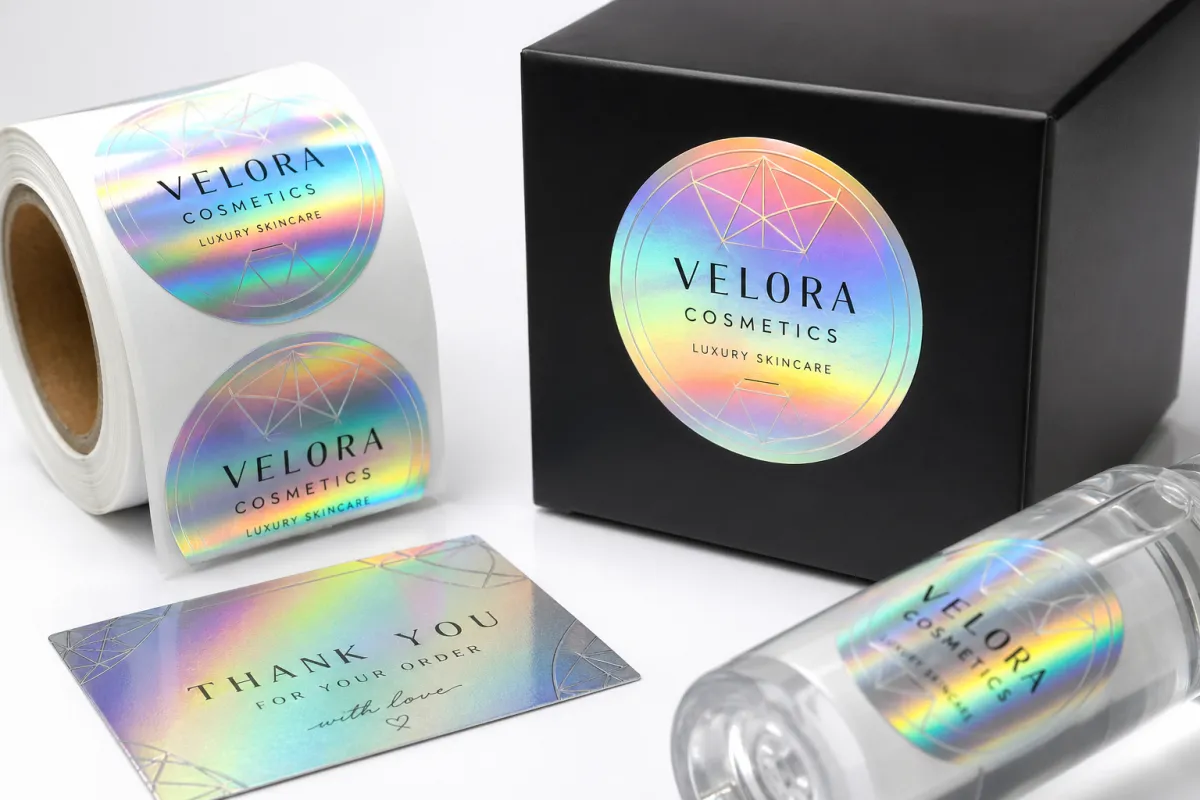
Custom holographic sticker labels are pressure-sensitive labels made with a holographic face stock, so the surface catches light in shifting bands of color and depth. Most are built on a 25 to 50 micron film and paired with either permanent acrylic adhesive or removable adhesive, depending on the surface and the life of the product. Peel one from the liner and apply it to a jar, bottle, tin, or carton, and you get a premium visual effect without relying on the ink layer to do all the heavy lifting. The shimmer usually comes from the film itself, while print and finishing direct the eye to the brand name, product details, or seal.
These labels show up constantly in cosmetics, supplements, candles, craft beverages, health and beauty kits, and event giveaways, especially in places where the shelf is crowded and launch cycles move fast. I have stood on packaging floors where a 40 mm round label on a serum bottle changed the whole tone of a line from ordinary stock to something that felt deliberate and collectible. That is the part buyers feel before they can explain it, and it matters when a shelf has 18 competitors within a couple of meters. Custom holographic sticker labels grab attention from several feet away, which is useful in a crowded aisle and even more useful in a trade show booth where everyone is trying to shout without saying much of anything useful.
Two production styles come up again and again. Full-coverage labels use holographic material across the whole face, so the shimmer stays visible edge to edge. Accent labels keep the effect on a logo, border, seal, or pattern, which gives the design room to breathe when ingredients, barcodes, or regulatory copy need to stay readable. Full coverage can look striking, though it can also turn messy if the artwork is already busy. I tend to favor restraint here, because I have seen more than one founder confuse “more shine” with “more premium,” and those are not the same thing. A 75 mm by 120 mm bottle label has limited real estate, and every millimeter already has a job.
The real value of custom holographic sticker labels is not decoration for its own sake. The finish should support the product story, not interrupt it, whether the product is a 60 ml essential oil bottle, a 500 g candle jar, or a 250 ml tonic in a glass flute. When the material, copy, and shape all work together, the package feels intentional. When they do not, the surface starts shouting over the message. Good packaging design carries real weight, and a strong design usually beats a louder one in the real world.
I once sat across from a skincare founder who asked for “more sparkle” on a new line. We tested three versions on 15 bottles in a Brooklyn sample room: a full holographic build, a version with a 22 mm logo accent, and a standard matte film. The accent version won because the product name stayed clean under 4000K retail lighting and the shelf read held up at arm’s length. The lesson was simple, even if the meeting took an hour to get there: custom holographic sticker labels perform best when the effect helps the sale instead of swallowing the surface. My note to myself afterward was basically, “Shiny is not a strategy.” A little blunt, sure, but accurate down to the millimeter.
How Custom Holographic Sticker Labels Are Made
The build is straightforward once the layers are broken down. Most custom holographic sticker labels begin with holographic face stock, then an adhesive layer, a release liner, printed graphics, and sometimes a laminate, varnish, or protective topcoat. Each part has a separate job. The face stock creates the shimmer. The adhesive controls the bond. The liner keeps the roll stable. The finish helps the print survive scuffing during packing, shipping, and application. On retail bottles moving through warehouse handling in Shanghai or Suzhou, we often specify a 60 micron gloss laminate because it adds a useful layer of abrasion resistance without making the label too stiff.
Printing method changes the result in a way clients can feel the moment the labels arrive. Digital printing often makes sense for shorter runs because setup is faster and artwork changes are easier to manage. Flexographic printing usually fits larger orders with repeat artwork and tighter control over production consistency. I have seen a 5,000-piece job lose color balance because the printer rushed a weak CMYK build on reflective film, and that one mistake turned the whole run into a lesson nobody asked for. That is why I always ask whether the supplier is using white ink, a spot underbase, or a full white flood under the graphics on custom holographic sticker labels. If they cannot answer clearly, I start getting suspicious in a very practical, mildly annoyed sort of way.
Die-cutting and kiss-cutting determine how the labels separate from the liner and how they behave in use. Die-cut labels are cut all the way through the face stock to the liner shape, while kiss-cut labels cut only the top layer and leave the backing intact. Rolls usually suit machine application, and sheets work well for hand application or smaller studios. A bottle line running 1,200 units an hour normally needs rolls. A craft table with 300 jars can manage fine with sheets. I have worked both jobs, and yes, the smaller setup still finds a way to create chaos if the spacing is off by 0.5 mm or if the roll core is 3 inches when the applicator was set for 1.5 inches.
The holographic pattern changes design rules in a way that surprises people who only ever look at the art on a screen. Dark colors usually sit better on reflective stock, but thin lines can disappear fast. Transparent zones can look elegant when the film has enough depth and the brand wants a jewel-like effect. White ink often makes the difference between a crisp logo and muddy print. Reflective material punishes careless layout. Custom holographic sticker labels reward strong structure, clear type, and clean separation between the effect and the information, especially when the type is held above 7 pt and the logo gets at least 2 mm of quiet space around it.
The production path usually goes in this order: artwork review, digital proof, material confirmation, sample or prepress approval, print, laminate or varnish if needed, die-cut, matrix removal, slit or sheet finish, inspection, then packing. Most quality problems show up before the press ever starts. Missing bleed, incorrect cut lines, and the wrong unwind direction cause more trouble than bad ink ever did. If you want a reference point for label formats, our Custom Labels & Tags page shows the roll and sheet builds we typically supply, including 2-inch core rolls for hand application and 3-inch core rolls for automated applicators.
One detail from the factory floor has stuck with me. If a supplier cannot tell you the liner caliper, the unwind direction, and the core size without digging through three separate notes, they are not ready to ship your custom holographic sticker labels at scale. That is not fussiness. That is the difference between a smooth launch and a line stoppage because the rolls were wound backwards and the applicator jammed. I have watched a perfectly good morning go sideways because somebody guessed instead of measuring, and that kind of mistake is never charming when a 10,000-piece order is waiting to move out of a warehouse in Dongguan by 4:00 p.m.
Cost and Pricing Factors for Custom Holographic Sticker Labels
Pricing for custom holographic sticker labels comes down to five main variables: material, print coverage, cut complexity, adhesive choice, and quantity. A 1-inch circle on basic holographic film sits in one price band. A multi-layer die-cut shape with spot gloss, cold-chain adhesive, and full-bleed print lives in a very different one. Anyone quoting those as if they were the same is guessing, not manufacturing, and the difference usually shows up the moment the job hits prepress in Shenzhen or Wenzhou.
Small runs cost more per label because setup costs do not shrink just because the order is small. A 1,000-piece run may land in the $0.28 to $0.45 range per label depending on size and finishing. At 5,000 pieces, I often see quotes in the $0.14 to $0.22 range, and a straightforward spot-accent build can come in around $0.15 per unit for 5,000 pieces when the shape is simple and the adhesive is standard permanent acrylic. At 20,000 pieces, the same label can drop to $0.07 to $0.12 per piece. Those are realistic working ranges, not promises carved into stone, because every detail changes the math on custom holographic sticker labels. Anyone who tells you pricing is fixed before asking about size and finish is probably trying to get you off the phone.
People get caught when a quote looks cheaper by a small amount and the extra charges show up later. Tooling, proof revisions, special adhesive, and freight can turn the apparently lower bid into the expensive one. I have seen a client choose a bargain quote and then pay an extra $130 for a second proof because the die line missed by 1.8 mm. The cheaper option stopped looking cheap very quickly, which is one of those moments that is funny only after the invoice has been paid, usually three weeks later when the freight bill from Shenzhen lands and nobody remembers the original conversation.
Full holographic coverage usually costs more than a spot effect because the specialty stock covers more area and the print handling needs more care. Standard paper labels remain the least expensive route, film sits in the middle, and a premium holographic build rises higher because the face stock itself carries more visual weight. If the design only needs a shimmering logo, a partial effect can keep the budget in line while the pack still feels premium. That is often the sweet spot for brands that want impact without setting the budget on fire, especially on beauty lines that ship in batches of 2,000 to 8,000 units.
Here is a practical comparison I use with brand owners who want to see the tradeoffs clearly:
| Label Type | Typical Use | Estimated Cost at 5,000 pcs | Print Complexity | Best For |
|---|---|---|---|---|
| Full holographic coverage | Cosmetics, limited editions, gift sets | $0.16-$0.22/unit | Medium to high | Strong shelf presence |
| Spot holographic accent | Logos, seals, premium branding | $0.12-$0.18/unit | Medium | Readable layouts with shine |
| Standard paper label | Dry goods, retail inserts, general packaging | $0.05-$0.10/unit | Low | Lowest cost per piece |
| Standard film label | Bottles, jars, moisture-prone packaging | $0.08-$0.14/unit | Low to medium | Durability without the shimmer |
Those ranges shift when lamination, specialty adhesive, or complex shapes enter the picture. A rounded rectangle is easier and cheaper than a seven-point star or a label with internal cutouts. Freight also matters more than people want to admit. A pallet shipped by air from Asia can erase the savings from a lower unit price very quickly, especially if a 900 kg shipment leaves Hong Kong on a three-day service instead of going by sea from Yantian. If the project needs transit testing, ask about ISTA methods like ISTA packaging test standards. For paper-based materials, FSC-certified sourcing is worth asking about when the brand story depends on responsible materials.
I usually tell buyers to ask a better question than “What is the cheapest label?” The better question is “What is the least expensive label that still survives use, looks right on shelf, and does not fail after two days in a cooler at 4 degrees Celsius?” That mindset saves money on custom holographic sticker labels because a label that peels, clouds, or curls is just a costly mistake wearing a shiny finish. I have seen too many good products get saddled with bad labels because someone was trying to save pennies in the wrong place.
Ordering Custom Holographic Sticker Labels Step by Step
The cleanest order process starts with a short, specific brief: label size, application surface, finish preference, quantity, and deadline. If you can tell a supplier whether the label goes on a 50 mm cosmetic jar, a 330 ml bottle, or a candle tin with a curved shoulder, you are already ahead of most of the market. Precision in the brief reduces revisions and keeps the quote honest, especially when the supplier is calculating on a 3-inch core roll and a 1.5 mm gap between labels.
Artwork prep matters just as much. Good files need bleed, safe area, a vector die line, and the correct color mode. I have seen a product launch slip by nine days because the designer sent a JPEG with no cut path and no white layer plan. That sort of delay is avoidable, and I will admit it makes me a little grumpy because it is such an easy thing to prevent. Custom holographic sticker labels punish vague artwork because reflective stock makes weak lines, poor contrast, and loose spacing harder to hide, particularly on labels smaller than 60 mm wide.
A realistic timeline depends on the spec. Clean artwork and standard stock can typically move from proof approval to shipment in 12 to 15 business days, while a plain reprint on existing tooling may land closer to 7 to 10 business days. Add a custom die, special adhesive, lamination, or sample approval, and the window is more likely 12 to 18 business days. If the order needs a mold change or a completely new die shape, the schedule can stretch farther. Nobody likes that answer, but it is the right one. I would rather be slightly unpopular and correct than cheerful and late.
Before production starts, I always ask clients to confirm these details in writing:
- Label dimensions in millimeters or inches, not “roughly card-sized.”
- Shape, including any rounded corners or internal cutouts.
- Finish choice: full holographic, spot holographic, or mixed design.
- Adhesive type for glass, plastic, paperboard, freezer, or textured surfaces.
- Roll or sheet format, plus core size and unwind direction.
- Quantity, overage allowance, and packing method.
I like to tell clients to think about the product in the real world, not only in the mockup. A label for a cold brew bottle should be checked against condensation after 30 minutes in a 4-degree cooler. A label for a candle should be tested against heat during transport in a truck trailer that can hit 38 degrees Celsius. A label for a supplement bottle should survive warehouse handling and retail display. That is the difference between attractive custom holographic sticker labels and Packaging That Actually performs. The mockup may get applause; the sample earns trust.
Here is the decision path I use with launch teams:
- If the goal is a product launch with heavy shelf competition, choose full holographic or a strong accent treatment.
- If the goal is a retail restock with clear instructions and barcodes, choose an accent-heavy design with higher contrast.
- If the goal is an event giveaway or promo drop, choose a bolder finish and keep the copy short.
- If the product faces moisture, heat, or frequent handling, upgrade the adhesive and ask for a sample test.
For brands that need the rest of the packaging to match, I often pair the label discussion with carton specs, inserts, and retail display pieces. That is where product packaging and package branding start behaving as one system instead of three separate purchases. When the label, carton, and outer box share the same visual language, the shelf story gets stronger very quickly. It also saves everybody from the awkward moment where the box says luxury and the label says “we ran out of time,” which I have seen happen more than once on a Friday afternoon in Dongguan.
Common Mistakes With Custom Holographic Sticker Labels
The biggest mistake is chasing the finish before checking readability. I have watched teams approve beautiful mockups that looked excellent on a screen and then turned into unreadable smears on real film under 3000K store lighting. Custom holographic sticker labels need contrast first. Shine comes second. If a customer cannot find the product name at arm’s length, the label is failing, even if the foil effect looked impressive in the presentation deck.
Low-contrast artwork gets swallowed fast on reflective stock. Thin gray text, pale gradients, and delicate line art often disappear in store lighting. The fix is straightforward: use stronger type, add white ink, simplify the graphic, or move the holographic effect to one area instead of the entire face. That is not a design downgrade. It is practical packaging design, and in my experience practical usually wins once the boxes are stacked on a shelf and not on a mood board, especially when the line needs to sell 3,000 units in the first month.
The wrong adhesive causes another mess. Curved bottles, cold storage, matte jars, and textured surfaces all behave differently. A label that bonds fine to glass at room temperature may fail on a refrigerated bottle with condensation. I worked through a job where a client wanted to save $0.012 per unit by switching to a lighter adhesive. We tested it on 24 sample jars in a 4-degree cooler in Qingdao. Six labels curled at the edge within 48 hours. That “saving” would have cost far more in returns, replacements, and the kind of customer emails nobody wants to read on a Monday.
Skipping samples is another classic error. A rendered proof on a monitor cannot show how light moves across custom holographic sticker labels. In hand, the effect may be brighter, duller, or more directional than expected. Print one sample sheet, hold it under daylight and store lights, and check it against the actual bottle or box. A 20-minute test can prevent a 2,000-unit headache, and I promise that is a much nicer problem to solve than reworking a shipment already packed for export.
Overloading the design is the final trap. Too many effects make the label look confused. Holographic face stock, metallic type, a gloss flood, six taglines, and three icons can turn premium into messy very quickly. I prefer one strong visual move and a clean type hierarchy. That approach works better for cosmetics, craft beverages, and even Custom Printed Boxes when the rest of the line needs to feel coordinated instead of loud. A little discipline goes a long way, which is not the same thing as being boring.
One of my bluntest rules is simple: if the label needs a paragraph of explanation, the design is doing too much. The best custom holographic sticker labels usually need one glance, one logo, and one clear product name, often on a 45 mm x 70 mm label or a 90 mm round. Everything else should support that first read. If the customer has to stop and decode it, the label has already asked for too much work.
Expert Tips for Better Custom Holographic Sticker Labels
If readability matters, use holographic as an accent rather than the whole stage. A logo band, corner mark, or seal can create a premium signal without making ingredients and barcodes harder to scan. For food, beverage, and supplement packs, that balance matters more than most founders want to admit, especially when the barcode has to pass on the first scan at a warehouse in Atlanta or Rotterdam. I have seen more labels saved by restraint than by more sparkle, and that still surprises people who think the answer is always “make it shinier.”
Build artwork with thicker type, stronger contrast, and enough negative space to let the eye rest. A 6 pt font might look elegant in the software window; on reflective film, it turns into tiny dust. I usually push clients to 8 pt or higher for supporting copy and keep the main title large enough to read from 4 to 6 feet away. That is a shelf test, not a theory. Custom holographic sticker labels still need to do the job, and the job starts with being legible on the actual pack, not just in the PDF sent from a studio in Manhattan or Manchester.
Ask for swatches before you commit. A sample sheet or material chip tells you more than a polished PDF ever will. It also helps the team compare three options side by side: full holographic, partial accent, and a more restrained premium film. When I visited a supplier in Guangdong, a buyer on the next table saved a $3,000 mistake simply by asking for two swatches and holding them against the actual bottle color under daylight. That kind of boring move pays off, and it is usually the difference between a confident sign-off and a week of second guessing.
Supplier details matter far more than people think. Confirm core size, unwind direction, label gap, and application method before you approve the run. If a line uses automated labeling, tell the vendor the machine model. If the pack is hand-applied, say so. A reel wound the wrong way can shut down a line for half a day. That is why I am persistent about specs on custom holographic sticker labels. Being persistent saves time later, even if it makes the early emails a little longer than everyone hoped, especially when the machine is a Z-301 or a Herma applicator set up for a 76 mm core.
One negotiation habit from the factory side has saved more than one launch: ask for three quote options instead of one. I ask suppliers for a baseline spec, a value-engineered option, and a premium option. On a recent candle label order in Suzhou, the difference came out to $0.034 per unit between a standard film, a spot holographic accent, and a full-coverage version. The client chose the middle option because it looked rich without pushing the launch over budget. That kind of comparison is more useful than arguing over a single line item.
For brands building a full lineup, matching the label to the outer carton matters too. The same holographic accent can appear on the product label, the retail sleeve, and the display box so the shelf presentation feels deliberate from every angle. That is where Custom Packaging Products can help the whole line feel connected instead of stitched together from unrelated pieces. I have seen that kind of alignment turn a decent product family into one that feels much more finished, especially when the cartons are printed on 350gsm C1S artboard with a matte varnish and the label carries just enough shine to echo the box.
If you want the shortest rule I know, it is this: use enough shine to earn attention, but not so much that the copy becomes unreadable. That balance is what makes custom holographic sticker labels useful instead of merely decorative. I know that sounds simple, but simple is usually hard-earned after a few rounds in prepress, a press check in Shenzhen, and one or two expensive sample corrections.
How to Choose the Right Custom Holographic Sticker Labels Next
Start by measuring the actual label area on the product, not the fantasy area on the design mockup. A jar with a 65 mm flat panel is not the same as a bottle with a curved shoulder and 8 mm of taper. Then decide what matters most: premium shelf impact, barcode readability, water resistance, or simple decoration. That one decision narrows the path for custom holographic sticker labels fast, and it keeps the artwork from getting overbuilt before the material is even selected.
Gather the artwork files, quantity target, finish preference, and deadline before you request quotes. If you already know whether you want full coverage, spot accents, or something quieter, the supplier can price it accurately the first time. If you do not know, ask for two or three build options. It is much easier to compare a $0.16 label and a $0.21 label when both use the same shape and stock, and when both are quoted against the same 12 to 15 business day schedule from proof approval. That keeps the discussion grounded and saves time.
Compare at least two sample options before you lock in the order. I would rather see a client choose between a brighter holographic film and a more restrained accent than force a single look that nobody fully likes. The sample phase also reveals whether the adhesive suits glass, plastic, or coated paperboard. It is far cheaper to learn that on 10 samples than on 10,000 finished labels, and far less embarrassing too, especially if the order is shipping into retail in Vancouver or Dallas.
“If the label does not survive the way the product lives, the shine is just expensive decoration.”
That line came from a press operator I worked with near Dongguan, and he was right. He had watched too many brands chase appearance without checking performance. Good custom holographic sticker labels should handle real use, hold their edge, and look sharp under retail lights. Otherwise they are just shiny stickers with trust issues, and I have seen enough of those land in the waste bin after a single round of returns.
Use this final checklist before you approve production:
- Confirm the exact size and shape in millimeters.
- Choose the finish: full holographic, spot holographic, or mixed treatment.
- Match the adhesive to the bottle, jar, box, or pouch surface.
- Approve the proof with bleed, color, and white ink checked.
- Order a small overage for spoilage, application errors, or future restocks.
If you are still deciding, I usually suggest asking for one version that pushes the effect and one version that keeps it quieter. The contrast makes the answer obvious in hand. Then move forward with the option that protects readability and shelf impact at the same time. That is the cleanest way to buy custom holographic sticker labels without wasting money or second-guessing the choice every time the shipment lands.
When the brief is clear, the specs are tight, and the sample looks right under real light, custom holographic sticker labels do exactly what they should: lift the package, support the brand story, and make the product feel more valuable the moment someone picks it up. The actionable next step is simple: measure the label area, pick the finish goal, and request a sample on the actual container before you commit to the run. That small bit of homework saves more money than a fancy render ever will, and it keeps the label doing its real job instead of just looking pretty on a screen.
Are custom holographic sticker labels waterproof?
They can be, but only if the face stock, adhesive, and topcoat or laminate are built for moisture exposure. For bathroom products, fridge items, or drink packaging, ask for water-resistant or fully waterproof construction instead of assuming it comes standard, and request a 24-hour soak test if the product will sit in ice or condensation.
How much do custom holographic sticker labels cost?
Price usually depends on quantity, size, cut complexity, and whether the holographic effect covers the full label or only part of it. For a simple 5,000-piece order, a realistic price can sit around $0.15 per unit for a spot-accent design, while small runs may land between $0.28 and $0.45 each depending on finishing and tooling.
How long does it take to produce custom holographic sticker labels?
Proofing can move quickly if the artwork is clean, but production time depends on material availability, print method, and finishing steps. A straightforward order typically ships 12 to 15 business days from proof approval, while custom shapes, specialty adhesives, and added lamination can extend the timeline to 18 business days or more.
What artwork works best for custom holographic sticker labels?
Bold type, strong contrast, and simplified graphics usually perform better than thin lines and overly detailed artwork. If the label uses heavy holographic coverage, white ink or dark text is often needed to keep the design readable, and type set below 7 pt often disappears once the label is under retail lighting.
Do custom holographic sticker labels stick to curved bottles and jars?
Yes, if the adhesive is chosen for the surface and the label material has enough flexibility to wrap cleanly. For tight curves or textured containers, ask for a test sample because a standard adhesive can lift at the edges, especially on a 25 mm radius bottle shoulder or a jar with condensation.