Buyer Fit Snapshot
| Best fit | To Carbon Neutral Mailer Options That Truly Work projects where brand print, material claims, artwork control, MOQ, and repeat-order consistency need to be specified before quoting. |
|---|---|
| Quote inputs | Share finished size, material target, print colors, finish, packing count, annual reorder estimate, ship-to region, and any compliance wording. |
| Proofing check | Approve dieline scale, logo placement, barcode or warning zones, color tolerance, closure strength, and carton packing before bulk production. |
| Main risk | Vague material claims, crowded artwork, missing packing details, or unclear freight terms can make a low unit price expensive after revisions. |
Fast answer: To Carbon Neutral Mailer Options That Truly Work: Film, Print, MOQ, and Carton Packing should be specified like a repeatable production item. The safest quote records material, print method, finish, artwork proof, packing count, and reorder notes in one written spec.
Production checks before approval
Compare the actual filled-product size with the drawing, then confirm tolerance on folds, seals, hang holes, label areas, and retail display edges. Reserve space for logos, QR codes, warning copy, and material claims before decorative graphics fill the panel.
Quote comparison points
Review material grade, print process, finish, sampling route, tooling charges, carton quantity, and freight assumptions side by side. A quote is only useful when the supplier can repeat the same color, closure quality, and packing count on the next order.
Orders can pile up in a 20-foot carton while the fulfillment team is still waiting on the next shipping label. A lighter parcel looks tidy on a dashboard, but the emissions story behind the mailer may still be muddy. That gap is why this guide to carbon neutral mailer options matters: it gives you a practical way to compare claims, verify boundaries, and defend the choice when procurement, sustainability, and customer support all ask different questions.
Teams rarely move at the same speed. Procurement wants a number. Operations wants a material that will not slow the line. Sustainability wants a claim that will survive scrutiny. My experience with packaging reviews is blunt: the best result shows up when all three groups work from the same guide to carbon neutral mailer options framework and measure the same metrics, not just the same brochure language. Otherwise, everyone ends up talking past each other and the decision gets weirdly foggy.
Brands using Custom Logo Things mailers often assume “recycled” equals “lower carbon.” The assumption is common, and usually incomplete. A recycled substrate can still carry a heavy transport footprint, a weak conversion story, or an offset claim with almost no documentation. This guide to carbon neutral mailer options keeps the discussion practical instead of drifting into theory-heavy compliance theater.
Start with the product, not the slogan. A 300g apparel item packed in a padded mailer may need a very different structure than a 50g supplement bottle. A 100g accessory box can justify a larger shell if it prevents damage and repacking. Every change in geometry, coating, and substrate affects carbon performance, freight weight, and return risk. Chasing paper weight alone often creates a prettier failure later.
If your team already tracks scope 3 emissions or owns a sustainable packaging roadmap, the right mailer choice can do more than reduce footprint. It can simplify reporting, improve customer perception, and lower the hidden cost of rework. That is the practical value of a guide to carbon neutral mailer options: it connects climate claims to shipping reality.
Guide to Carbon Neutral Mailer Options: What It Really Means
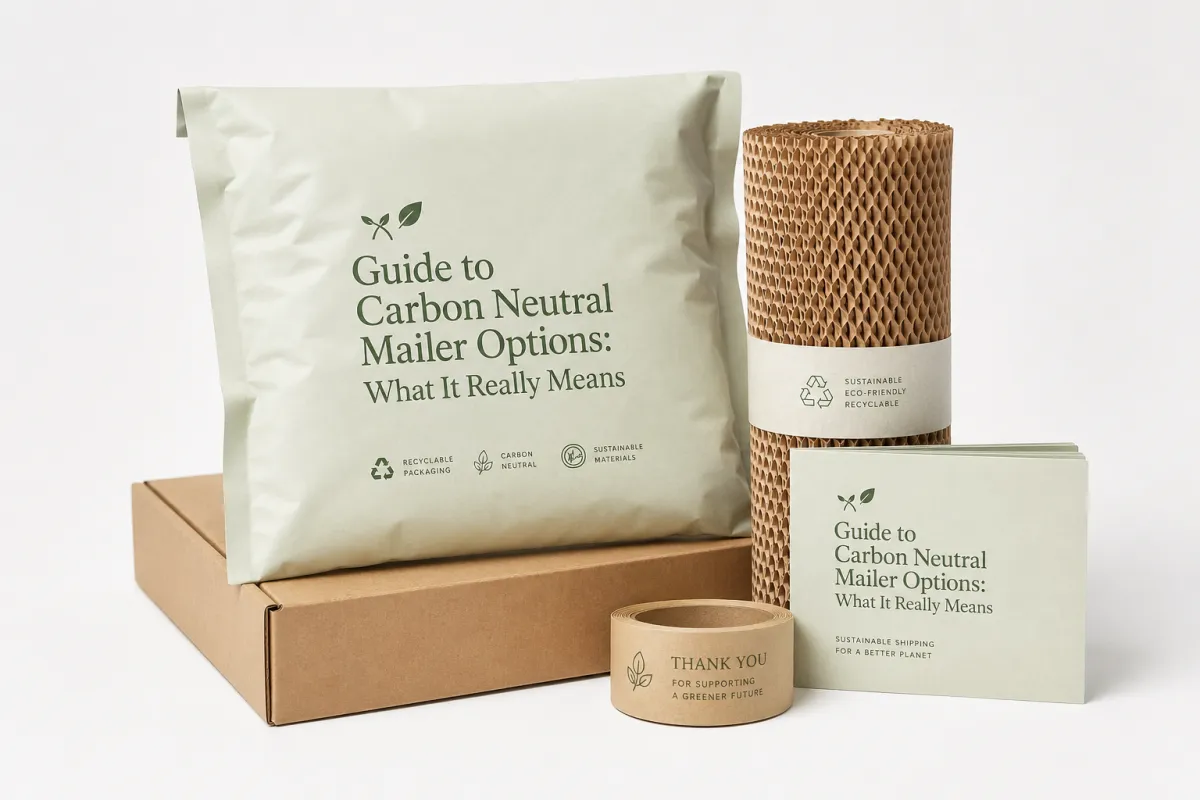
Carbon-neutral versus carbon-light, in plain language
Carbon neutral has a specific meaning. It means the estimated emissions tied to a product's lifecycle have been balanced through verified reductions, removals, or offset credits inside a defined accounting boundary. It does not mean recycled, compostable, or less plastic by default. In a serious guide to carbon neutral mailer options, those terms stay separate: carbon footprint, recyclability, and biodegradability are different tests with different evidence.
The distinction I use in sourcing reviews looks like this:
- Carbon reduced means the item creates fewer emissions than the baseline.
- Carbon neutral means the remaining emissions are balanced to net zero inside the chosen boundary.
- Recyclable means the material can re-enter a recovery system where that system exists.
- Compostable means the material can break down under specific conditions, which does not automatically lower manufacturing emissions.
The phrase carbon neutral mailer options is therefore less about branding and more about accounting discipline. Data quality matters as much as material choice. Plenty of teams make the label look tidy and the proof look thin. That creates trouble later, usually during claim review or customer questions. Nobody wants a sustainability page that sounds polished and collapses under one basic procurement audit.
Why this framing changes sourcing decisions
A mailer can appear economical if you look only at procurement price. If you include damage claims, repacking labor, and returns, the picture changes fast. A mailer that tears in transit on just 2% of a 10,000-piece campaign can wipe out theoretical savings in a hurry. That is why this guide to carbon neutral mailer options starts with measurable outcomes instead of packaging poetry.
Fulfillment lines often move 500 to 2,000 packs an hour. A choice that adds 12 seconds per order may look small on paper and large by Friday afternoon. Multiply that delay across a quarter and the labor cost becomes impossible to ignore. My rule is simple: aim for sustainability gains that survive both accounting and the packing bench.
How Do Carbon Neutral Mailer Options Work?
The short answer
Carbon neutral mailer options work by measuring the emissions tied to a mailer's lifecycle, reducing those emissions where possible, and balancing the remaining footprint with verified offsets or removals. The process usually includes material sourcing, conversion, shipping, and end-of-life assumptions. If any of those pieces is missing, the claim becomes harder to defend and less useful for procurement.
In practice, the best carbon neutral mailer options combine three things: a lower-emission substrate, efficient production, and documentation that shows how the balance was calculated. That is why a strong guide to carbon neutral mailer options always asks for boundaries first and price second. If a supplier cannot explain the scope cleanly, you are probably gonna spend extra time untangling the claim later.
Lifecycle footprint: extraction, production, transport, use, and end-of-life
To judge whether a supplier’s claim deserves trust, map the footprint across five stages: raw material extraction, conversion, conversion waste, outbound shipping, and final handling. Leave out one of those pieces and the result is no longer a full guide to carbon neutral mailer options assessment. Freight is the usual blind spot, especially when domestic and international legs are folded into a neat, optimistic summary.
A paper mailer converted in one region and shipped 1,600 miles inland can carry higher transport emissions than a local poly mailer powered by a cleaner grid mix. That comparison surprises people because the material story sounds greener than the logistics story. If a supplier uses a narrow scope boundary, the carbon number may look polished and still fail once an auditor starts asking questions. Full-chain logic beats best-case assumptions every time.
That is the point where emissions accounting becomes a decision matrix. If a vendor says one piece equals 50 g CO2e and the calculation only includes material and direct electricity, the number is not comparable to a claim that includes transport, adhesive, printing, and waste. Your guide to carbon neutral mailer options should demand matching boundaries before price discussions begin. Otherwise you are comparing apples to oranges, and the spreadsheet will lie with a straight face.
How emissions are calculated
Credible calculators usually draw from four inputs:
- Material type and recycled content percentage
- Energy mix at the production facility, including renewable share
- Transport routes and distances across air, ocean, and ground legs
- Production waste rate and conversion scrap
Some vendors go deeper and add machine energy per unit, coating type, lamination, and curing energy. If those fields are missing, ask why. If the supplier cannot provide them, do not assume the number is conservative. Missing data often hides the most expensive part of the story, and the most carbon-intensive part too.
For a practical example, we ask for a sample set with explicit inputs: unit weight, film thickness, average print coverage, coating, shipment corridor, and annualized volume. Without those details, the comparison is decorative rather than useful. The strongest numbers usually come from a Life Cycle Assessment (LCA) with clear boundaries and versioned assumptions.
Many teams also cross-check methodology against public references. For climate definitions and calculation context, review EPA's climate resources. For packaging and logistics testing, ISTA’s published packaging and logistics standards remain the reference point for shipment-ready mailers.
“The first question I ask suppliers is not the price. It is: what exactly sits inside your emissions boundary?” — a common internal standard in sustainable packaging sourcing reviews
Where offsets fit, and why timing matters
Offsets are not a shortcut past the hard part. They close the loop after the footprint is measured; they do not replace the measurement itself. A supplier claiming carbon neutrality may retire credits before shipment volume is known, or after actual production and logistics are verified. The second method is usually easier to defend because the retirement tracks real units, not forecasted ones.
Ask for registry links. If the claim includes a registry name, project type, project ID, and retirement date, the claim is much stronger than a vague “offset included” line. In this guide to carbon neutral mailer options, offset transparency is not optional. Programs that skip this step are often designed for marketing copy, not audit readiness.
Timing matters even more for recurring replenishment cycles. A monthly program for 15,000 packs can be reconciled cleanly if the forecast matches the production cadence. Event-driven campaigns are less forgiving. In those cases, insist on a crediting method that can handle cancellations, ramp-ups, and partial fills without turning the paperwork into a guessing game.
Key Factors That Shape Carbon Neutral Mailer Options
Material families and when they make operational sense
If you are choosing between Custom Poly Mailers, kraft-recycled paper, compostable blends, or paper-based liner hybrids, begin with a practical question: what can the mailer afford to fail at? If return rates are already high, durability usually beats theoretical carbon efficiency. Damage has a nasty habit of undoing the story everyone tried to tell upstream.
In this guide to carbon neutral mailer options, the main categories break down like this:
1) Recycled Paper Mailers — Useful for moderate-weight products with limited abrasion in transit. Apparel, books, and flat kits under 900g often fit here. Paper in the 90–170 gsm range with water-based inks can print well and still present as premium.
2) Recycled Poly Mailers — A strong fit when moisture resistance and tear strength matter. Monomaterial constructions with 40–60% PCR content can compete well on lifecycle terms for heavier SKUs, especially when produced at scale and shipped from a lower-intensity grid region.
3) Compostable blends — Best reserved for brands whose message truly depends on compostability and whose disposal infrastructure matches the claim. That said, compostable does not automatically mean lower carbon than a recycled option. A thicker biodegradable laminate can use more material, which can erase end-of-life gains.
4) Mailers with paper-based liners — Useful for rigid inserts and sensitive items that need shape retention. These can cost more and often increase unit weight, so they deserve a strict volume-to-value test before rollout.
Certification signals that actually carry weight
FSC chain-of-custody claims, recycled content verification, and offset registry evidence are the proof layers I keep seeing in strong proposals. A paper mailer without chain-of-custody language is not automatically a problem, but it is harder to defend in centralized procurement and sustainability reporting.
Look for these items in a quote:
- Material certification, such as recycled content declarations or a chain-of-custody path
- Third-party registry proof for offsets
- Boundary and methodology notes for the emissions model
- A stated test method for durability, often tied to ISTA and ASTM references
If an offer mentions ASTM and ISTA but gives no version, lot testing, or assumptions about package weight, treat that as a warning sign. Ask for the exact references. For many brands, FSC alignment plus an ASTM-compatible physical test plan is enough to move a review from “possible” to “pilot candidate.”
Performance requirements: the hidden carbon cost of fragility
A mailer chosen only for the carbon spreadsheet can fail the moment it reaches the packing floor. Tear resistance drops. Seams split. Print rubs off on humid routes. Replacement orders rise, and each replacement creates new transport emissions, new labor, and new customer frustration. A 1.8% increase in damage can erase a 10% premium advantage in a quarter. I have watched that pattern repeat in small and mid-size DTC programs more than once.
Moisture sensitivity deserves special attention. A 70 gsm coated structure can improve shelf life and protect the label, but it also changes emissions and cost. In the guide to carbon neutral mailer options, those details matter early because they keep redesign work from landing on your desk later.
For e-commerce shipping, the real goal is durability inside the damage profile. If the mailer passes a laboratory test and fails the customer return journey, the climate claim gets weakened by avoidable repacking and extra transport. That is the sort of detail that makes this guide to carbon neutral mailer options feel operational rather than philosophical.
Guide to Carbon Neutral Mailer Options: Cost and Pricing
What drives unit cost before offset and certification
Cost is never just one number. To understand it, separate at least five buckets:
- Substrate choice: recycled paper, poly, or compostable blend premium
- Print coverage: full-wrap artwork with heavy ink can add processing and drying cost
- Volume tier: 1,000 units price very differently from 10,000 units
- Tooling and setup: prepress, die, and approval cycles
- Environmental layer: certification, emissions verification, and offset fee
Typical commercial quotes often land in ranges like 5,000 units at:
| Mailer type | Typical unit price (5,000 pcs) | Offset/verification treatment | Operational strengths | Typical risks |
|---|---|---|---|---|
| Recycled paper mailer | $0.18 – $0.28 | +10–18% if included in quote | Strong brand image, good print, medium stiffness | Moisture sensitivity, possible swelling under wet conditions |
| Recycled poly mailer | $0.22 – $0.36 | +8–15% depending on claimed carbon model | Higher tear resistance, lower water risk | More complex conversion for custom perforation |
| Compostable blend mailer | $0.28 – $0.52 | +12–22% if climate balance is bundled | Very visible material story, useful for narrow claims | Higher freight for equivalent protection, limited disposal access |
| Paper-based liner hybrid | $0.30 – $0.60 | Varies: sometimes separated certification line-item | Excellent rigidity and presentation | Higher weight, higher freight emissions, premium setup |
Those numbers are directional. Paper supplier location, shipping corridor, and print process can move both the floor and the ceiling. The useful question is not who is cheapest in unit terms, but who is cheaper across landed cost and exception handling.
In this guide to carbon neutral mailer options, landed-cost comparison is the default. A program handling 5,000 to 20,000 shipments each month needs the full picture: returns, support tickets, and labor all belong in the analysis. A cheaper mailer that increases repacking or damaged returns often ends up more expensive after two billing cycles.
What to request in your quote, with line-item clarity
Ask for a quote format that includes these fields:
- Unit price by volume tier (1k, 2.5k, 5k, 10k)
- Setup fee and artwork adjustment charges
- Minimum order quantity (MOQ)
- Offset structure and whether climate cost is included or separate
- Certification references and verification date
- Lead time and sample pricing
Request the same list from at least three suppliers. That is how you force an apples-to-apples comparison in this guide to carbon neutral mailer options. If one supplier says “carbon neutral included,” ask for retirement proof, project type, and boundary assumptions immediately. Vague wording tends to hide uneven assumptions.
Buyers get surprised here all the time. One spreadsheet arrives clean, another arrives with a “we can revise this” note, and a third buries the sustainability fee inside a setup line. The last one usually looks cheap until the final invoice lands. The fix is simple: normalize the fee lines before choosing.
Step-by-Step Guide to Choosing the Right Mailer
Step 1: Define the protection envelope
Begin with the SKU itself. Apparel bends and folds. Electronics fail under drops. Beauty products leak or soften with heat. Sample kits mix shapes and weights in ways that expose weak points quickly. Use real specs rather than a general sense of “light” or “fragile”:
- Product net weight and outer dimensions
- Expected handling temperature and humidity exposure
- Average return reason and customer damage complaints
- Brand presentation requirements, including window or full print finish
If your SKU has high return risk, start with the stronger structure. That is not anti-environment. Replacements create emissions too. This is one reason the guide to carbon neutral mailer options gives performance the same weight as the climate claim.
Step 2: Narrow down and test sample data
Most teams shortlist three to five options and drop the rest. Keep the process tight and disciplined:
Option screen: remove any mailer that lacks emissions boundary details. Option short list: keep 3–5 materials by weight, durability, and print constraints.
Review sample kits that show the actual size and finish, not just a PDF mockup. Then ask for a test packet with each candidate:
- Drop and compression behavior
- Seal strength retention after handling simulation
- Print rub test and color consistency
- Documentation for recycled content and carbon accounting assumptions
Use the same courier test corridor for every sample. Route differences can distort the results and make one option look better for the wrong reason. A solid guide to carbon neutral mailer options treats the test protocol as part of the product, not as a side note.
Step 3: Run a controlled pilot before broad rollout
Pick one SKU line and run a controlled batch. For a first packaging switch, 300 to 500 pieces per candidate is a practical pilot size. Compare damage rate, packing speed, and complaint frequency across options. A basic scorecard can include:
- Damage incidents per 100 shipments
- Average packing time delta in seconds
- Weight variance and scan accuracy
- Returned-to-origin rate
- Observed moisture or tear issues from fulfillment staff
Teams often stall here because the marketing story sounds good enough. Then returns start trickling in, and the “green” decision turns into a small internal dispute. Piloting early avoids that. Scale only the option that survives both environmental and operational pressure. Otherwise the project turns into a nice-looking deck and a messy warehouse problem.
Step 4: Build the decision matrix
Your final matrix should include at least four weighted columns: carbon claim quality, durability, unit economics, and customer experience. If you ship through a fulfillment partner, add carton compression and labor compatibility too. In this guide to carbon neutral mailer options, a simple 1–10 weighted model keeps the decision from drifting into opinion.
Useful threshold examples:
- Claim quality: minimum 8/10 with documented boundary and registry proof
- Damage risk: must not exceed the current baseline by more than 0.5%
- Cost: must fit budget with no hidden setup surprises
- Speed: packing impact under +5 seconds per order
That structure is not perfect. It is practical, and practical wins in packaging. It keeps sustainability tied to execution instead of brochure language.
Process and Timeline for Carbon Neutral Mailer Options
From first request to delivery, step by step
A realistic timeline for most small-to-mid-size runs looks like this:
- Discovery and brief (3–5 business days): define SKU, volumes, finish, and claim scope.
- Initial quotes and qualification (3–7 business days): gather at least three comparable offers.
- Sample production and review (5–12 business days): include print and conversion tests.
- Artwork proofing and approvals (2–5 business days): legal, brand, and compliance checkpoints.
- Emissions verification (4–10 business days): registry and methodology checks.
- Production run (4–10 business days for standard builds, longer for complex coating or die work).
- Offset retirement and documentation (1–3 business days once actual volume is posted).
That puts a typical project around two to six weeks, depending on volume and customization. Recurring SKUs with stable artwork can move faster. New structures need more buffer, especially if compliance or sustainability teams are involved.
Where delays usually appear
Most delays show up in two places:
- Documentation loops between compliance, procurement, and design teams
- Supplier-side paperwork for offset retirement or certification letters
If internal approvals run one after another, momentum disappears. Parallel review works better. Procurement, sustainability, and operations should all review the same dossier at the same time. That approach can cut five to eight business days from a project without changing the supplier at all.
From a guide to carbon neutral mailer options perspective, the process should look like a launch plan, not an email chain. Use one tracking sheet with clear owners for emissions, art, and schedule. Nobody should have to discover a missing attachment at the proof stage. That's the kind of slip that slows a project down and makes everyone mildly cranky.
Internal alignment mechanics
In the first 15 minutes of a sourcing call, agree on three outputs: target launch date, acceptable claim depth, and cost treatment. Everything after that gets scored against those three outcomes. That is where the guide to carbon neutral mailer options stops being abstract and starts behaving like a working decision tool.
“The vendors worth keeping are the ones who can show every step clearly enough for internal sign-off.”
Common Mistakes to Avoid With Carbon Neutral Mailer Options
Conflating end-of-life labels with full lifecycle impact
A common mistake is treating recyclable or compostable as a proxy for low carbon. That is not how the accounting works. Compostability speaks to disposal under the right conditions. It does not automatically say anything about manufacturing emissions or freight. The same confusion shows up in buyer notes, legal claims, and supplier decks. The claims need to stay separate.
Another recurring mistake is assuming lighter means cleaner. A thinner mailer can fail in transit and create a replacement loop that raises emissions and irritates customers. One failed shipment can erase the climate benefit of several offset certificates in a small batch. Weight matters, but only after performance does.
Accepting vague claims without registry-level proof
Watch for phrases that dodge verification: “carbon neutral through our sustainability partners,” “offsets purchased,” or “eco-certified” with no ID numbers attached. Ask for:
- Registry name
- Project type (reforestation, renewable energy, methane capture)
- Retirement ID and date
- Emission boundary used (cradle-to-gate or cradle-to-grave)
If a quote includes these details, it belongs in the serious column of your guide to carbon neutral mailer options shortlist. If not, treat it as marketing language, not decision-grade evidence.
Ignoring operational drag and redesign costs
Packaging pilots fall apart when teams pick a greener mailer and later discover slower packing, more waste at prep, or a redesign loop for labels and inserts. A 0.15 second increase per unit sounds tiny. Across 20,000 monthly orders, it turns into more than 50 labor hours a month. That is not a rounding error.
Set benchmarks early. If the current average pack time is 45 seconds, define a tolerance band and reject options outside it. This keeps the sustainability decision grounded in reality. A guide to carbon neutral mailer options that tolerates operational regression usually does not survive the quarter. The shiny option on paper can become the annoying option in the warehouse, and the team will feel it fast.
Ignoring total cost of ownership
Many teams compare only unit price per mailer. That leaves out setup, redesign, returns, and quality failures. Freight from supplier to fulfillment hub belongs in the model. So do customer support costs when packaging damage claims rise.
Ask finance for a three-month blended scenario, not a one-line unit comparison. If the greener option costs $0.04 more but lowers damage by 1.5% and leaves labor untouched, it may be the better choice. If it cuts carbon claims but adds 2% more returns, the math starts to unravel.
Expert Tips and Next Steps for Carbon Neutral Mailer Options
Practical rule that prevents expensive mistakes
Rule: choose the most durable mailer that still meets your carbon and cost target. It sounds obvious. Teams still forget it, usually because the climate story is easier to sell than a damage chart. In a guide to carbon neutral mailer options, durability is not the enemy of sustainability. It is one of the conditions that makes sustainability believable.
My preferred proof packet is concrete: emissions boundary, offset registry, recycled content evidence, and tested performance samples. If a supplier can produce each item consistently, the path to scale becomes much easier. If they cannot, you already know the rollout is going to get bumpy.
Rollout blueprint: one line, one mailer, one measurement loop
Use this sequence:
- Pick one product line with stable volume.
- Test one candidate mailer style for a controlled order window.
- Track damage, repacking, packing speed, and customer complaints for at least 1,000 shipments.
- Keep the best performer, then expand only after the numbers hold.
The point is repeatable certainty. Not a one-time hero project. Not glossy promise language with weak tracking. The strongest outcomes in guide to carbon neutral mailer options come from disciplined measurement and a refusal to scale a hypothesis without evidence.
Build your vendor checklist and freeze communication language
Before you sign, hand legal and marketing a final approved language block. Keep the wording exact and avoid vague claim drift:
- “Carbon footprint calculated using [boundary],”
- “Carbon balance verified through [registry],”
- “Certification date [month/year],”
- “Retired credits count [x] by [id].”
That protects trust and cuts claim creep. If the sustainability page, fulfillment scripts, and supplier paperwork all match, teams move faster and disputes drop.
My bottom-line position for teams at Custom Logo Things and beyond: treat this guide to carbon neutral mailer options as a decision framework, not a slogan. If a material is cheaper but unpredictable in use, the program is vulnerable. If it is verifiable, durable, and operationally stable, it has a real chance of surviving actual shipping volume.
A credible guide to carbon neutral mailer options gives you language that satisfies climate ambition and fulfillment reality. Perfection is not the goal in month one. Better data, cleaner documentation, and honest trade-offs matter more. The actionable move is simple: define the claim boundary, test one mailer against your damage rate, and only then scale the option That Holds Up in the warehouse and on the ledger.
Frequently Asked Questions
What are the best carbon neutral mailer options for small brands?
Small brands usually do best by starting with one SKU and one structurally simple mailer family. Recycled paper and recycled poly are often the most practical starting points because both can be sourced repeatably at lower minimum quantities. Ask for clear offset documentation before you commit, and choose suppliers that can share concise emissions summaries plus samples. A staged rollout keeps cash flow under control while you validate damage and packing speed. That way you are not betting the whole operation on a pretty mockup.
Are carbon neutral mailer options better than compostable mailers?
Not automatically. Compostable describes end-of-life behavior under the right conditions, while carbon neutrality covers emissions across production, transport, and balancing. In many operations, a durable recycled or poly option with verified offset retirement performs better in real shipping than a compostable mailer that fails durability tests. For high-friction routes, packaging reliability usually matters more than disposal messaging. Compostable can be the right answer in some programs, but it is not a free pass.
How much do carbon neutral mailer options usually cost?
Costs vary by material, print coverage, and production volume. Small runs often carry higher unit costs, while larger volumes usually narrow the premium gap. Expect a range in setup and unit costs, with offset/verification either bundled or listed separately. Compare landed cost, not only unit cost, because rework, returns, and freight can erase a small per-piece savings quickly. A quote that looks cheap on day one can get expensive once the exceptions start showing up.
How long does it take to switch to carbon neutral mailer options?
Simple swaps can move quickly if artwork and stock are already in place. Custom development usually adds sample, proofing, and verification steps. A practical working window is often a few weeks for straightforward runs, longer for high customization, larger volumes, or more complex claim documentation. Build buffers around approvals so procurement, sustainability, and fulfillment can review in parallel without last-minute surprises. If the calendar is tight, trim the variables before you trim the testing.
How can I verify a carbon neutral mailer claim?
Ask for the emissions boundary and check whether it includes transport and production waste. Ask for registry references, retirement proof, and project specifics. If recycled content appears in the claim, ask for the supporting certification route and date. Then compare at least two suppliers. Differences in wording usually reveal who is transparent and who is mostly sales-ready. If a supplier gets twitchy about basic proof, that tells you plenty.

