Buyer Fit Snapshot
| Best fit | Custom Labels Custom Printed projects where brand print, material claims, artwork control, MOQ, and repeat-order consistency need to be specified before quoting. |
|---|---|
| Quote inputs | Share finished size, material target, print colors, finish, packing count, annual reorder estimate, ship-to region, and any compliance wording. |
| Proofing check | Approve dieline scale, logo placement, barcode or warning zones, color tolerance, closure strength, and carton packing before bulk production. |
| Main risk | Vague material claims, crowded artwork, missing packing details, or unclear freight terms can make a low unit price expensive after revisions. |
Fast answer: Custom Labels Custom Printed: How They Work, Cost, Sizes should be specified like a repeatable production item. The safest quote records material, print method, finish, artwork proof, packing count, and reorder notes in one written spec.
Production checks before approval
Compare the actual filled-product size with the drawing, then confirm tolerance on folds, seals, hang holes, label areas, and retail display edges. Reserve space for logos, QR codes, warning copy, and material claims before decorative graphics fill the panel.
Quote comparison points
Review material grade, print process, finish, sampling route, tooling charges, carton quantity, and freight assumptions side by side. A quote is only useful when the supplier can repeat the same color, closure quality, and packing count on the next order.
I still remember a $2,000 candle run that turned into a warehouse headache because custom labels custom printed on the cheapest adhesive looked perfect on a proof PDF, then started lifting in a 38F cold room before the pallets even reached the loading dock. The labels were 2.25 x 3.5 inches, printed on 52lb semi-gloss paper, and the adhesive was only rated for room-temperature retail use. Cute on screen. Useless on a bottle. I was staring at the first failed case thinking, with the kind of calm usually reserved for disaster movies, that the wrong glue can cost more than the label order itself.
In practical terms, custom labels custom printed means pressure-sensitive labels built to your exact size, shape, substrate, adhesive, finish, and branding needs instead of pulled from a generic stock roll. I have seen them on 4 oz tincture bottles in Portland, 16 oz sauce jars in Chicago, corrugated mailers in Atlanta, and folding cartons using 350gsm C1S artboard in Monterrey. The right label improves shelf impact, supports package branding, and keeps operators from improvising ugly fixes on the line. A label may be small, but on a retail shelf in Dallas or a fulfillment line in Shenzhen, small mistakes scale fast.
Most people look at a label and see a sticker. That is the mistake. It is a compact piece of branded packaging that has to survive shipping vibration, warehouse dust, cold storage, hand abrasion, and the occasional fulfillment associate with a tape gun and a deadline. I have seen a perfectly balanced design ruined by one careless sweep of a box cutter, which always arrives with the confidence of a surgeon and the accuracy of a blunt spoon.
If you have ever watched a container sample sit in a cooler overnight and come back with the corner edge curling up, you already know the part that design decks tend to ignore: labels live in the real world, not in a mockup. That gap is where most packaging problems start.
Custom Labels Custom Printed: What They Are and Why They Matter
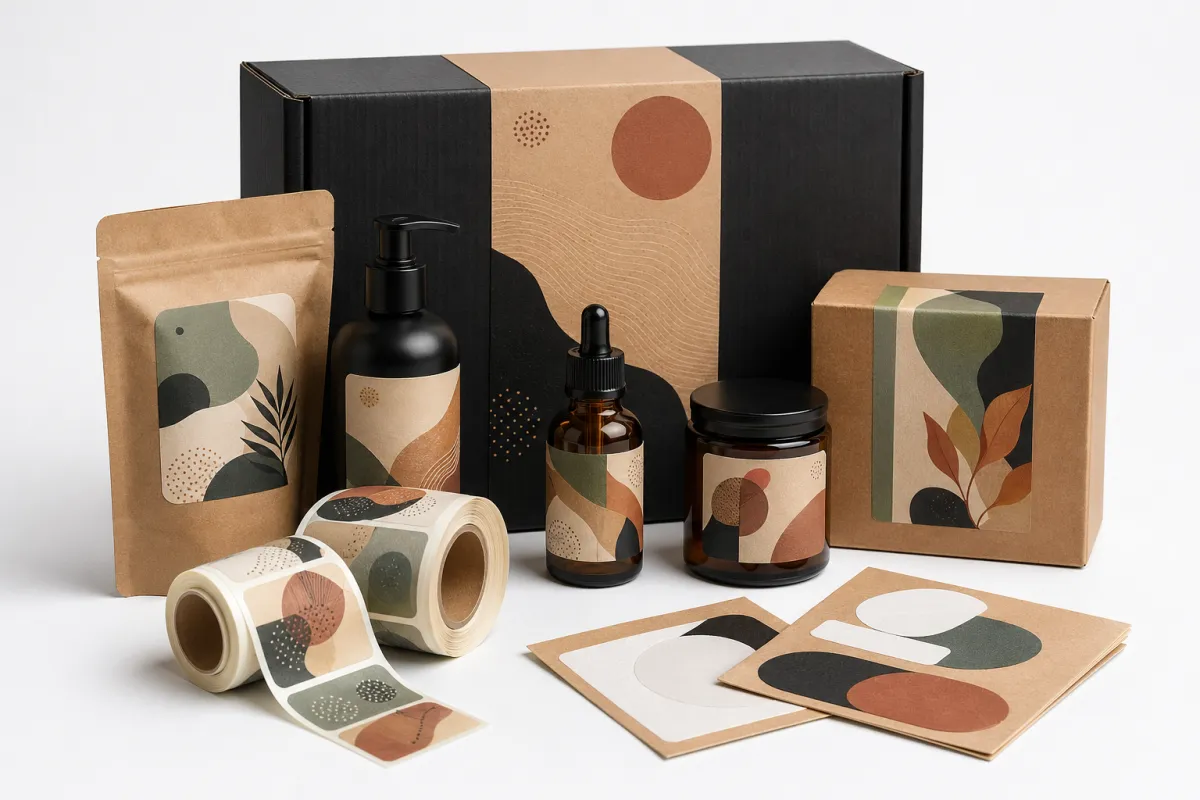
I learned this the hard way on a cold-storage project for a food client in Ohio. The labels were 3 x 4 inches, printed in CMYK on white BOPP with a permanent acrylic adhesive, and the buyer signed off in ten minutes because the proof matched the brand red perfectly. Then the first shipment sat at 41F for two nights, condensation formed on the bottle shoulders, and the corners started lifting like they were trying to escape the pallet. The reprint cost $480, the repack labor cost another $1,100, and the client lost a full production day. That is the difference between attractive graphics and custom labels custom printed for real-world use.
They matter because they do several jobs at once. A good label tells shoppers what the product is, carries ingredient or regulatory copy, helps the brand stand out on retail packaging, and still looks deliberate next to the box, pouch, or bottle it lives on. I have seen brands win shelf space in Minneapolis and Manchester simply because the label finish and the carton were designed together instead of being ordered from two vendors who never spoke. That is why custom labels custom printed are not a side purchase. They are part of the product, and often the part that gets handled most.
People often ask where they show up most. The answer is almost everywhere: glass jars, PET bottles, kraft mailers, corrugated boxes, squeeze tubes, poly bags, cosmetics, supplements, soy candles, and shipping cartons moving through distribution centers in Shenzhen, Jiangsu, and Dongguan. If you are building Custom Packaging Products around a product launch, the label spec should sit next to the box spec, not buried in an email thread with 37 replies and one mislabeled attachment. When I visited a line in Shenzhen last spring, the buyer who treated the label and carton as one system had fewer rejects than the buyer who treated them like separate purchases. That pattern repeats with the predictability of a freight invoice.
"We thought the label was the cheap part until the freezer disagreed." That came from a client after a 5,000-unit test run in a Pennsylvania cold room. He was right, and the extra $380 for freezer-grade adhesive would have saved him two days of labor and a warehouse manager who had stopped smiling.
If you want the short version, custom labels custom printed give you control over the things that matter: size, shape, substrate, glue, finish, and how the label behaves on your actual container. Generic stock can work for office folders or return-address labels. For product packaging, it is usually the wrong tool, especially if your container has a curve, a chilled fill, or a surface that is not fully smooth.
- Jars and bottles: Need curvature, moisture resistance, and edge hold after 24 hours in a cooler.
- Pouches and sachets: Need flexible face stock and an adhesive that grips soft films.
- Boxes and mailers: Need crisp die cuts and finish choices that match the carton texture.
- Cosmetics and supplements: Need small type, compliance text, and a shelf-ready appearance under store lighting.
- Candles and specialty goods: Need heat tolerance and labels that do not wrinkle when touched repeatedly.
One more thing: paper labels are not automatically "cheap" in the way buyers hope they are. If the product sweats, chills, oils up, or gets handled a lot, the budget fix can become the expensive choice pretty quickly.
How Custom Labels Custom Printed Are Made
The process starts with information, not artwork. A good supplier will ask for product dimensions, label size, application method, surface type, quantity, storage environment, and ship date before anyone touches a press. I have sat through quote calls where the buyer only knew, "I need something small and round." That is not enough. Custom labels custom printed need a real spec sheet, or you end up paying for guesswork with your own budget, often at $80 to $250 in reproof fees when the file has to be rebuilt from scratch.
Artwork Setup That Saves Money
Here is where a lot of good-looking files go off the rails. A design can look perfect on a laptop and still fail on press because the bleed is too tight, the safe zone is ignored, or the barcode was exported at a resolution that belongs in a screenshot from 2008. For custom labels custom printed, I want vector files like AI, EPS, or PDF whenever possible, with the dieline supplied by the printer and the fonts outlined if the file will move between teams in Toronto, Los Angeles, and Shenzhen. If the label wraps around a bottle, the wrap needs to be measured on the actual container, not guessed from a photo of a sample in a studio. Die-cut labels are unforgiving that way.
Color targets matter too. CMYK is fine for many jobs, but if your brand relies on a specific red, a near-black navy, or a metallic green used across SKUs, I want a Pantone callout or a hard sample in hand. On one project, a cosmetics client approved a proof under office lighting in Seattle and then hated the first run because the magenta leaned warmer in daylight. That added a second proof, a $95 plate adjustment, and another week. Custom labels custom printed are not judged by the monitor. They are judged by warehouse light, store light, and the hands of people who do not care about the mood board.
I have had clients tell me the proof "looked right enough," and that phrase almost always turns into a rerun. A label proof is a contract, not a vibe check.
Printing, Materials, and Finishing
For shorter runs and fast changes, digital printing is usually the easiest fit for pressure-sensitive labels. For larger quantities, flexographic printing often wins on unit price once setup is spread over enough labels. Specialty methods enter the picture when a brand wants foil, embossing, textured varnish, or a heavy white underlay on clear film. I have negotiated enough quotes to know this: the right method depends on quantity and finish, not on whatever a salesperson says is "best" that week. A 1,000-piece reorder in Dallas and a 50,000-piece launch in Rotterdam do not belong on the same press logic.
Material choice changes everything. Paper is cheaper and works for dry, indoor use. BOPP, usually 2.0 to 3.0 mil thick, holds up better against moisture and scuffing. Vinyl and polyester are tougher and make sense for harsher conditions. Clear films work when the brand wants a no-label look on transparent containers. The adhesive matters just as much. Permanent, removable, freezer-grade, and high-tack formulas each solve a different problem. If I am comparing a generic stock to an Avery Dennison face stock or a 3M adhesive, I read the spec sheet line by line because that is where the real differences hide. That is why custom labels custom printed are usually quoted as a system, not just a sticker count.
Finishing comes next: laminates for abrasion resistance, varnish for light protection, foil for premium shelf impact, embossing for texture, die-cutting for shape, and slitting or sheeting for the final packing format. I once saw a snack brand save $1,100 on a reorder by moving from a full laminate to a targeted varnish, because their cartons already protected the label from scuffing inside the case pack. Another client in Leeds saved 14 percent by switching from full-bleed foil to a 12 mm foil border. Small changes matter more than most launch meetings admit, especially when the difference shows up as $0.02 per unit across 25,000 pieces.
- Proof approval: Final visual sign-off before plates, dies, or press time are committed.
- Sample check: Test a few labels on the actual package, not a flat white sheet.
- Adhesion test: Check peel strength after 24 hours, especially in cold or humid storage.
- Barcode scan test: Verify readability under the scanner model your warehouse uses.
- Final inspection: Confirm count, cut quality, roll direction, and core size before shipping.
Cost Factors for Custom Labels Custom Printed
The short answer is that cost depends on size, shape, material, adhesive, finish, quantity, and how much help the artwork needs. The longer answer is that custom labels custom printed are priced like most packaging jobs: setup costs hit small runs harder, and scale lowers the unit price once the press and material are locked in. A 2 x 3 inch paper label in a clean rectangle is a very different quote from a clear BOPP label with white ink, a matte laminate, and a Custom Die Cut. I wish that distinction were more obvious to buyers, but the packaging universe seems committed to hiding math in plain sight.
I have seen simple digital orders start around $150 to $400 for 500 to 1,000 pieces when the art is ready and the specs are basic. I have also seen 5,000-piece orders land at $0.15 per unit for straightforward paper labels, then jump to $0.24 to $0.38 per unit once a brand adds foil, an unusual shape, or a short-run reprint with multiple SKUs. That is not the printer being dramatic. That is the math of materials, plates, setup, and finishing. Custom labels custom printed can be cheap per piece at scale, but the quote only makes sense if the volume is doing enough work to spread the overhead.
| Option | Typical Use | Price Signal | What It Usually Includes |
|---|---|---|---|
| Paper matte label | Dry indoor products, inserts, simple retail packaging | Often $0.03-$0.08 per label at 10,000+ units | Basic print, standard die, no heavy protection |
| BOPP gloss or matte | Bottles, jars, pouches, moisture-prone products | Often $0.05-$0.12 per label at 5,000+ units | Better durability, cleaner handling, stronger shelf life |
| Clear film with white ink | Transparent containers, premium brand look | Often $0.10-$0.22 per label at 5,000+ units | Special print handling, extra ink layer, careful registration |
| Special finish label | Foil, embossing, textured varnish, premium launches | Often $0.18-$0.40+ per label depending on tooling | Extra setup, more steps, tighter quality checks |
Where buyers overspend is usually obvious once I see the quote. They order a custom shape when a standard rectangle would fit. They ask for a heavy laminate when the package never sees abrasion. They reorder 500 pieces when the actual forecast needs 3,000. Then they call it a supplier problem. No. It is a planning problem. If you are building a full package system, it is worth comparing the label spec against Custom Labels & Tags and the rest of the branded packaging stack so the numbers line up before production starts in Dongguan or Taichung.
My practical advice: ask for the same artwork in two or three material options, then compare the real cost difference. A change from paper to BOPP may add pennies, but a change from a standard die cut to a complex shape can add dollars in tooling. I once watched a beverage client save $920 on a 10,000-label order by dropping an expensive foil border that nobody noticed on shelf. The product still looked sharp. It just stopped paying for decoration nobody needed, which is usually the best kind of decision in manufacturing.
If you are comparing quotes from different suppliers, make sure you are comparing the same adhesive, same finish, same roll direction, and same count. Otherwise the low number is just a decorative number.
Timeline and Ordering Process for Custom Labels Custom Printed
The order process is usually straightforward if the buyer brings the right information. Quote, spec review, artwork prep, proof, approval, production, finishing, packing, and delivery. That is the normal path for custom labels custom printed. It only gets ugly when people skip the details and then wonder why the schedule drifts two days every time someone "just has one small change." Those tiny changes are where deadlines go to die, usually after a proof has already been sent to a plant manager in Shenzhen who had the machine scheduled for something else.
- Quote request: Share size, shape, quantity, container type, and application method.
- Spec check: Confirm material, adhesive, finish, and whether the order ships as rolls or sheets.
- Artwork prep: Send the dieline, logo files, and any barcode or compliance copy.
- Proof review: Check layout, color callouts, and tiny text before approval.
- Production: Print, cut, finish, inspect, and pack the labels for shipment.
For simple digital work, I have seen a clean order move in 3 to 5 business days after proof approval. More complex runs with foil, embossing, or flexographic setup usually take longer, often 10 to 15 business days depending on press time, material stock, and whether the die already exists. Custom labels custom printed do not like late changes. A missing barcode file, a size correction, or a brand team that wants one more version can add a full day or two without warning. I have had buyers ask on a Thursday for Monday delivery after approving a vague mockup on Wednesday. That is not a schedule. That is wishful thinking with a calendar app.
Rush orders can happen, but only if the supplier already has the right stock and open machine time. If the substrate has to be imported from Vietnam, or if the adhesive has to be special-ordered from a vendor in Wisconsin, the rush fee will not magically fix the calendar. I have negotiated plenty of rush jobs in a facility outside Shenzhen, and the answer is usually the same: faster is possible, but only if the starting spec is clean and the buyer stops changing the finish halfway through. That part can be painful, but the alternative is worse. Nobody wants a warehouse full of almost-right labels.
A realistic example helps. Day 1: quote request with exact dimensions, quantity, and container photos. Day 2: artwork file check and proof. Day 3: buyer approves the proof and confirms shipping format. Days 4 to 6: printing and finishing. Day 7: final inspection and packing. Days 8 to 10: transit, depending on carrier and destination. That is a reasonable lane for custom labels custom printed when nobody creates drama in the middle. Which, in packaging, is rare enough to feel like a public holiday.
Key Factors That Affect Performance and Shelf Life
The label has to match the surface first. Glass is not plastic. Coated paperboard is not powder-coated metal. Curved bottles behave differently from flat cartons, and soft pouches are a different animal again. I have watched labels stick beautifully to a smooth PET bottle and fail on a textured tube because the adhesive never found enough contact area. For custom labels custom printed, the surface is half the battle, and sometimes the whole match.
Then comes the environment. Refrigeration, moisture, oil, heat, ultraviolet exposure, and shipping friction can each ruin a decent label in a different way. For shipping tests, I lean on the standards and guidance used by the industry, especially ISTA for transit testing and FSC when paper sourcing matters to a brand's sustainability claims. Small disclaimer, because people mix these up all the time: FSC speaks to forest sourcing and chain of custody, not whether a label will survive condensation or freezing. I am not romantic about this. If the label has to survive a warehouse in Phoenix, a freezer in Toronto, or a delivery truck in August, it needs to be chosen for that reality, not for a neat rendering in a pitch deck.
Real-World Testing Beats Optimism
I always tell clients to test on the actual package. Put the label on the real bottle, the real box, or the real pouch. Leave it in the fridge for 24 hours. Rub it with a gloved hand. Drop it in a shipping carton and shake it around a little. If you sell anything oily, cold, or high-touch, that test is worth more than three rounds of approval from a conference room in Austin. Custom labels custom printed should not fail because a buyer assumed the adhesive would behave nicely. Assumptions are wonderful in fiction and terrible in packaging.
Adhesive choice is where many problems start. Permanent adhesive works for most products that should stay labeled for life. Removable adhesive helps with temporary branding or promotional use. Freezer-grade adhesive is built for cold-chain products that sit at 0F to 41F. High-tack adhesive grabs rough or low-energy surfaces better than standard glue. I have seen a supposedly "premium" label peel off a polypropylene jar after three days because the adhesive spec was wrong by one line. That one line cost the client 1,200 replacements at roughly $0.19 each, and that is the kind of surprise nobody wants on a Monday.
- Glass: Usually friendly, but cold condensation can still cause edge lift.
- Plastic: Needs the right adhesive for low-energy surfaces like PP or PE.
- Corrugate: Great for boxes, but dusty surfaces reduce initial bond.
- Powder-coated containers: Often need high-tack adhesive and testing.
- Curved bottles: Need flexible face stock and careful wrap calculation.
Readability matters too. Barcode contrast, lot code placement, ingredient panels, warning text, and expiration date space are not decorative features. They are operational requirements. A label can look beautiful and still be a failure if the scanner will not read it or the compliance copy wraps over the seam. With custom labels custom printed, I care less about cute and more about legible, durable, and legally usable. Cute does not pass inspection, and the warehouse team in Liverpool will not forgive it.
Common Mistakes With Custom Labels Custom Printed
The first mistake is bad artwork. Low-resolution logos, missing bleed, tiny type, and weak contrast are all common, and they all get more expensive when the press is already booked. I have opened too many files where the buyer used a screenshot for the logo and then wondered why it looked fuzzy on a 3-inch label. That is not a print problem. That is a file problem. Custom labels custom printed cannot rescue bad source art every time, no matter how much everyone wishes the machine could read minds.
The second mistake is ordering before the spec is locked. People approve a label size from memory, then the container arrives and the curve is different by 6 mm. Or they assume every printer uses the same template, which is adorable in the same way that assuming all factories use the same carton cutter is adorable. They do not. A clean dieline matters because the fit determines whether the label sits flat or fights the package. I have seen a 4 mm measurement error turn into a 4,000-piece relabeling job in a facility outside Kuala Lumpur. That is the sort of error that makes a spreadsheet quietly feel hostile.
The third mistake is choosing the wrong material for the environment. Paper labels on cold bottles. Removable adhesive on a permanent application. Uncoated stock in wet storage. Every one of those choices is a future complaint hiding in a production order. Custom labels custom printed are only good if they survive the product's actual life, not the optimistic life in someone's head. A label that peels on day three is not a design choice; it is a return request waiting for a tracking number.
The fourth mistake is chasing the lowest quote without reading the fine print. A low unit price can hide plate charges, proof fees, tooling, or a minimum that makes reorders awkward. It can also hide waste if the supplier has to rerun because the artwork was wrong. I have seen brands save $120 on paper and lose $1,500 in delays. That is not savings. That is theater with a purchase order attached.
The fifth mistake is underordering. Forecasts are messy, sure. Still, if you know a launch can move 3,000 units in the first month, a 1,000-label order means you will be paying more for emergency replenishment later. With custom labels custom printed, the painful price is often not the first order. It is the second order placed too late, usually with an express freight bill from Shenzhen to Chicago attached. I have watched teams do this twice and still act surprised the third time. Human beings are very committed to learning the same lesson in different lighting.
"We saved $0.02 a label and spent $900 fixing the fallout." That is the kind of sentence I hear after a buyer learns the hard way that packaging decisions do not exist in isolation.
What Should You Check Before Ordering Custom Labels Custom Printed?
Start with the real container, not the mockup. Confirm the exact size, the wrap area, and the surface texture, then choose the adhesive for the environment the product will actually live in. A clean order for custom labels custom printed usually comes down to six things: the package, the material, the finish, the application method, the storage conditions, and the ship date. If one of those is vague, the quote may still look fine, but the label may not survive the job.
- Surface: Glass, plastic, corrugate, or coated board each behave differently.
- Adhesive: Permanent, removable, freezer-grade, or high-tack should match the use case.
- Format: Rolls suit automated lines; sheets suit hand application and short runs.
- Artwork: Vector files, correct bleed, and a clean dieline reduce rework.
- Testing: Check moisture, cold, abrasion, and barcode readability before approval.
If you are building a broader packaging line, think about the label together with cartons, inserts, and mailers so your custom labels custom printed do not clash with the rest of the branded packaging. That is where Custom Packaging Products help: the box, the label, and the outer shipper can look like one plan instead of three unrelated purchases made in a rush before launch. I have seen a supplement brand in New Jersey gain shelf confidence just by aligning the label finish with the carton texture and the outer shipper color. It sounds small. It is not.
One negotiation tip that saves real money: ask for pricing at two quantities and two material options. For example, get 2,500 and 5,000 pieces, then compare paper versus BOPP or matte versus gloss. You will see the breakpoints quickly. Sometimes the jump to a higher quantity only adds a few hundred dollars while cutting the unit price by a wide margin. Other times, the premium finish costs more than the brand can justify. That is useful information, not a failure. In my opinion, useful information is worth more than a flashy quote from any sales deck.
My last piece of advice is boring, which usually means it is good advice: document what worked. Keep the exact substrate, adhesive, finish, roll direction, and approval notes in a folder where the next buyer can find them in under 30 seconds. The next time you order custom labels custom printed, that note will save you from reinventing the wheel with a three-person email chain and an argument about whether "matte" means matte or just less shiny than last time. I have been in that argument. It was not art. It was damage control.
When the specs are clear, custom labels custom printed stop being a headache and start doing the job they were supposed to do from the beginning: hold up, look right, and help the product sell without creating a mess on the line. On a good run in Dongguan or Leeds, that can mean 20,000 labels packed, inspected, and on a truck within 12 to 15 business days from proof approval.
The practical takeaway is simple: before you place the next order, test the label on the real container, in the real environment, with the real adhesive. That one step catches most of the expensive mistakes before they get printed.
How much do custom labels custom printed usually cost per order?
Pricing depends on size, material, quantity, finish, and whether you need rolls or sheets. Small runs often cost more per label because setup, proofing, and press time are spread across fewer pieces. I have seen modest digital orders land around $150 to $400 for 500 to 1,000 pieces, while a 5,000-piece paper order can come in near $0.15 per unit and a clear BOPP job with white ink can move closer to $0.22 per unit. If a quote looks suspiciously cheap, I read it twice and then one more time because I have trust issues, honestly.
How long do custom labels custom printed take to produce?
Simple digital orders can move in 3 to 5 business days after proof approval if the files are clean and the stock is in hand. Specialty finishes, flexographic runs, and custom die work usually take longer, often 10 to 15 business days. A realistic production lane for a 10,000-label order is proof on Monday, approval on Tuesday, production later that week, and shipment the following week from a plant in Shenzhen or Taichung. The biggest delays usually come from late proof changes, missing dielines, or last-minute artwork edits.
What file format is best for custom labels custom printed?
Vector files like AI, EPS, or PDF usually work best because they stay sharp at any size. Include bleed, outline the fonts if needed, and make sure barcode art is clean and high contrast. Send the exact dieline or template so the label fits the container instead of fighting it. If you only have a screenshot, the fix usually takes more time than the original design work, and that is how a 15-minute file request turns into a two-day delay.
Can custom labels custom printed handle refrigeration or moisture?
Yes, but only if the stock and adhesive are chosen for cold or wet conditions. Freezer-grade and high-tack adhesives are built for tougher environments than standard paper labels, especially on bottles held at 34F to 41F or products moved through humid loading docks in Houston or Miami. Test on the real package before approving a full order, because guessing is how labels fail in the field. I have seen condensation do more damage than some warehouse accidents.
Should I order custom labels custom printed on rolls or sheets?
Rolls are usually better for machine application or higher-volume packing lines, while sheets can work well for hand application, short runs, or office-based fulfillment. The right choice depends on how the labels will be applied, not just which option looks cheaper on the quote. If the format matches your process, custom labels custom printed are easier to store, easier to apply, and a lot less annoying six weeks later, especially when the reprint arrives from a factory in Guangdong.


