Buyer Fit Snapshot
| Best fit | To Edible Packaging Films projects where brand print, material claims, artwork control, MOQ, and repeat-order consistency need to be specified before quoting. |
|---|---|
| Quote inputs | Share finished size, material target, print colors, finish, packing count, annual reorder estimate, ship-to region, and any compliance wording. |
| Proofing check | Approve dieline scale, logo placement, barcode or warning zones, color tolerance, closure strength, and carton packing before bulk production. |
| Main risk | Vague material claims, crowded artwork, missing packing details, or unclear freight terms can make a low unit price expensive after revisions. |
Fast answer: To Edible Packaging Films: Artwork Proof, Packing Count, and Landed Cost should be specified like a repeatable production item. The safest quote records material, print method, finish, artwork proof, packing count, and reorder notes in one written spec.
Production checks before approval
Compare the actual filled-product size with the drawing, then confirm tolerance on folds, seals, hang holes, label areas, and retail display edges. Reserve space for logos, QR codes, warning copy, and material claims before decorative graphics fill the panel.
Quote comparison points
Review material grade, print process, finish, sampling route, tooling charges, carton quantity, and freight assumptions side by side. A quote is only useful when the supplier can repeat the same color, closure quality, and packing count on the next order.
Guide to Edible Packaging Films: How They Work and What They Really Cost
The first time I wrote the phrase guide to edible packaging films in a notebook, it was after watching a starch-based wrap dissolve in a cup of 94 C tea during a packaging demo in Shenzhen's Nanshan district. The sample vanished in under 90 seconds, which looked impressive until the line supervisor pointed at the condensation on the cup rim and asked the better question: what happens after 30 minutes in a 32 C warehouse? That is the gap between a sample and a system, and it is usually where the real cost shows up.
The appeal of edible packaging is easy to understand, even if the operating reality is a little less glossy. The format can reduce secondary waste, simplify portioning, and give a product a more deliberate finish without pretending packaging problems disappear just because the concept sounds responsible. I have seen edible films used for 3 g seasoning sachets, 12 g instant drink sticks, soup toppers that dissolve in 20 to 30 seconds, and condiment pods made for foodservice trays in Guangzhou and Dongguan. Some brands arrive asking for biodegradable packaging or a water-soluble film when what they really need is a temperature limit and a fill-weight tolerance. The strongest projects start with a blunt question: will this survive a 14-day transit window, a humid storeroom at 75 percent relative humidity, and a filling line running 42 packs a minute?
Teams comparing edible formats with standard flexible packs or Custom Packaging Products often start with the wrong metric. They focus on the concept before shelf life, handling, and cost per unit. A beautiful film that curls at 68 percent humidity does not help anyone, and a sample that looks pristine in a 23 C lab can fail after 48 hours in a warm backroom in Miami. I have seen people fall in love with a material that looked like a small miracle under controlled lighting, only to watch it go limp after one afternoon in an unair-conditioned receiving bay. The same thing happens with food-grade film samples that are never tested outside a white lab bench.
This guide to edible packaging films breaks down what the material is, where it succeeds, where it fails, how pricing is built, how long development takes, and which assumptions collapse first. The glossy version is rarely the useful one. The useful version usually includes one awkward humidity test, two formulation revisions, and at least one person asking, "Why did the seal pass at 48 C but fail at 52 C?"
What Is a Guide to Edible Packaging Films?
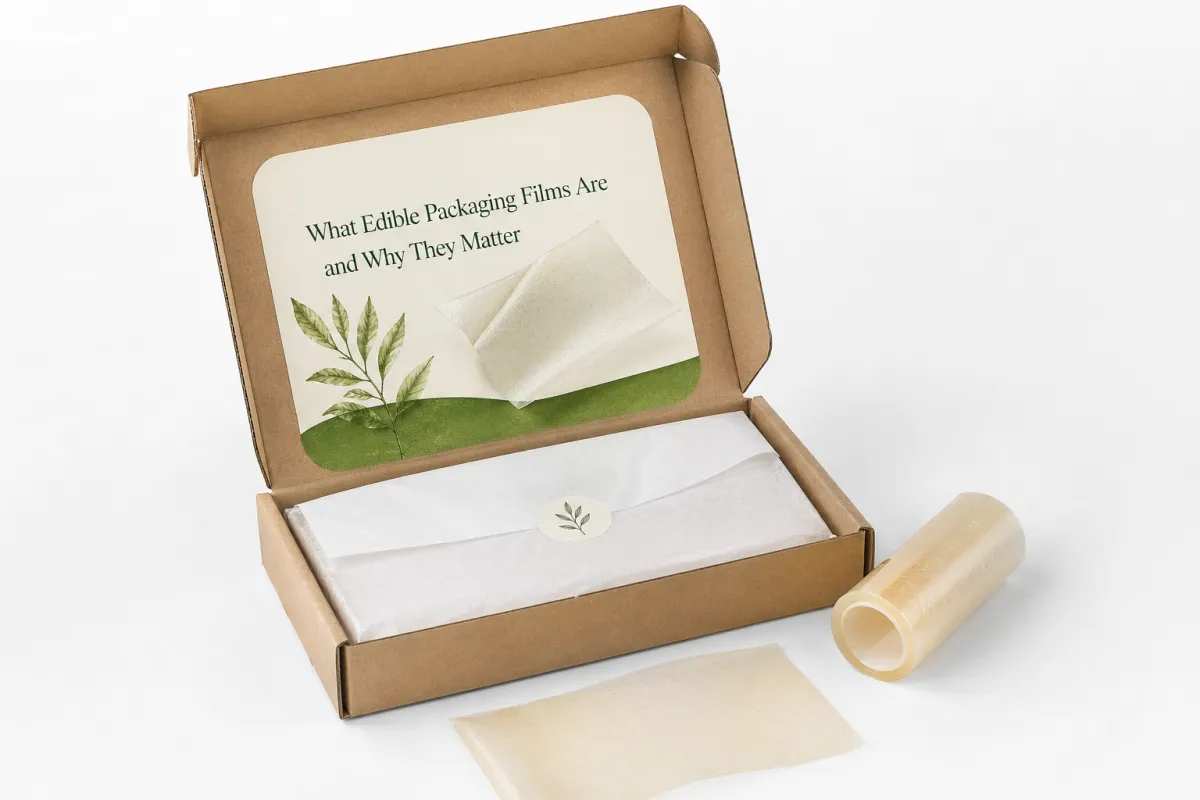
A guide to edible packaging films is really a decision tool. It helps a brand decide whether edible packaging, a dissolvable sachet, or a food-safe wrap fits the product and the supply chain, or whether a conventional flexible package is still the smarter answer. That question matters because edible packaging films behave differently from standard plastics, compostable layers, and paper-based alternatives. A water-soluble film might look ideal on a slide deck and still be the wrong choice for a greasy filling, while a starch blend may be perfect for a dry seasoning but miserable near heat and humidity. The point of this guide to edible packaging films is to separate the romantic part of the idea from the part that actually ships.
It also gives teams a way to compare materials without getting lost in marketing language. Pullulan, gelatin, alginate, pectin, and seaweed-derived systems all sit under the edible umbrella, yet they do not perform the same way. One film may dissolve fast in warm liquid, another may hold shape longer in transit, and another may be better suited to a premium presentation. In practical terms, the guide to edible packaging films helps buyers ask the right questions before they commit money to a pilot that was doomed by moisture from the start.
"The sustainability pitch sold the concept. The warehouse sold the truth." A snack buyer in Chicago said that after a July trial with 18,000 units went sideways, and the line still sounds accurate months later.
What Edible Packaging Films Are and Why They Matter
Edible packaging films are food-safe films made from ingredients that can be eaten, dissolved, or degraded depending on the formulation and intended use. The common building blocks include starch, pullulan, gelatin, alginate, pectin, and seaweed-derived systems. That list matters because a guide to edible packaging films is not useful if it stops at the label and never explains why one 30 micron film behaves differently from another 60 micron one. I learned that in a trial outside Hangzhou, standing beside a supplier who could recite the ingredient list perfectly but could not explain why the film went tacky after a 7 C temperature swing. Ingredients are only half the story. Moisture migration and plasticizer balance do the other half.
Brands care because edible films can support a sustainability story that feels tangible rather than decorative. They can also reduce secondary waste, simplify portion control, and create a cleaner presentation for snacks, condiments, instant beverages, and sample packs. I have watched a 6 g seasoning pod in a clear edible sleeve do more for shelf appeal than a carton covered in recycled-content slogans ever could. The difference is practical, not poetic. Customers notice when packaging looks intentional, and they notice even faster when it dissolves in the wrong way. A pack that turns cloudy in 40 seconds instead of 10 can change the whole eating experience.
People get carried away by the promise and forget the conditions. Moisture, heat, grease, and rough handling can turn a clever idea into a sticky mess with surprising speed. A film that looks stable in a dry lab at 22 C can fail in a truck at 35 C and 75 percent relative humidity, which is not a theoretical edge case in places like Houston, Singapore, or coastal Guangzhou. I have seen a tray pass a neat bench demo and then go soft in a delivery van that felt like a greenhouse with bad intentions. A serious guide to edible packaging films should make room for that reality from the start.
Edible packaging is not only for sustainability theater. In the right application, it cuts waste, simplifies use, and improves handling for the consumer. In the wrong one, it creates complaints, returns, and a lesson in humidity control that nobody wanted to pay for twice. I am skeptical of any pitch that makes the operational work sound effortless, especially when the supplier is quoting a pilot at $0.22 per unit for 5,000 pieces and still promising miracles. Packaging rarely rewards optimism; it rewards discipline and a clear spec sheet.
Think of the film as one component in a larger package system, not the whole story. A material can work beautifully for a dry powder or a quick-dissolve sachet and fail the moment oil, salt, or moisture enters the equation. That trade-off is not a footnote. It is the central design problem. I have seen teams spend two weeks arguing over print colors while the real issue sat in plain sight: the film did not like the product, and the product had 9 percent residual moisture.
How This Guide to Edible Packaging Films Works in Real Products
The guide to edible packaging films makes more sense once you look at ingredients and mechanics together. Starch-based systems are usually more affordable and easier to source, yet they can be sensitive to moisture and brittle unless the plasticizer ratio is tuned carefully. Pullulan tends to offer cleaner mouthfeel and more predictable dissolution, which is why it appears in strips, sachets, and quick-release formats. Gelatin can feel smooth, though its animal origin and humidity sensitivity matter. Alginate and pectin are useful where film formation or release behavior needs a different profile, and seaweed-derived systems often attract attention because the ingredient story is easy to explain on a retail shelf in Tokyo, Singapore, or Melbourne. I am not immune to that appeal either; seaweed sounds neat, and it photographs well under 4000K lighting.
Thickness changes everything. A 25 micron film behaves differently from a 60 micron film, and that shift affects seal strength, transparency, storage stability, and consumer feel. Add glycerol or sorbitol and flexibility improves, but tear resistance and water uptake change too. Moisture content deserves the same attention. A 3 percent swing can turn a crisp sample into a floppy one after two days of poor storage. I keep coming back to that because it is one of those small variables that causes disproportionately large headaches. That is why a guide to edible packaging films has to focus on formulation, not just the headline material name.
The real threats are humidity, oxygen, grease, and temperature swings during shipping or on the filling line. A film can be edible and still be completely wrong for a hot, oily, or highly humid product. I reviewed a powdered drink concentrate launch in Miami where warehouse humidity hovered around 78 percent for most of the afternoon. By the second day, the film edges had started to tack, and the line operator had little patience for the sustainability presentation. He wanted the jaws to stop sticking at 49 C, which was fair. He was not there to admire a theory.
Operationally, edible does not mean "anything goes." It means the film is built from ingredients and processes that fit food-contact rules, ingredient disclosure requirements, and the sensory profile of the product. If the film is meant to disappear in the mouth, taste neutrality matters. If it is supposed to dissolve in liquid, the release speed needs to be consistent enough that breakfast does not require a lab manual. I have had plenty of good ideas ruined by overcomplicated instructions; consumers are even less forgiving, especially when the pack is meant to disappear in 15 to 30 seconds. And yes, sometimes a project sounds clever in a meeting and then turns kinda ridiculous on the line.
Common applications include:
- Sachets for 2 g to 10 g powders, flavor bases, and instant drink mixes that dissolve in water at 20 to 40 C.
- Wraps for small portions or toppings that need a clean, simple presentation in retail packs or hotel amenity kits.
- Dissolvable pods for controlled dosing in foodservice, with fill weights often between 5 g and 15 g.
- Flavor pouches that release content after tearing or water contact, especially in sample programs and travel packs.
- Protective coatings for specialty food items where the film is part of the handling experience and must survive 24 to 72 hours in distribution.
The guide to edible packaging films also has a line-level reality check. Sealing temperature, dwell time, jaw pressure, and fill temperature all influence whether the pack survives. In one factory visit in Guangzhou, a 40 micron starch film was being run at a jaw setting 8 C too hot, from 148 C instead of the recommended 140 C. The seal looked fine for 30 seconds, then two corners split under a light compression test. Nobody in the room needed a speech after that. The machine had already delivered one, in the least polite way possible.
Key Factors That Decide Performance and Price in a Guide to Edible Packaging Films
Price begins with raw materials, but it does not stop there. The guide to edible packaging films gets expensive when the formulation is custom, the thickness window is narrow, the print has to register cleanly, and the seal must survive heat, cold-chain storage, or 6 to 12 months of retail life. Pullulan-based systems often cost more than starch blends because the raw material and processing are less forgiving. Add flavoring, embossing, or multi-layer behavior and the quote rises quickly. I have seen more than one buyer blink at a quote that looked fine until someone added "and we also want it to taste neutral." Neutrality, apparently, is not free.
Hidden costs show up where buyers least want to look. Minimum order quantities can be the first surprise. Sample rounds can be the second. Then comes lab testing, shelf-life validation, and line adjustments that never made it into the first spreadsheet. I have seen a buyer in Austin approve a $0.14 unit quote only to find that testing, setup, and extra moisture barrier work pushed the pilot cost to nearly $9,600 before the first carton shipped. That moment tends to silence a room. It also explains why "cheap" is one of my least favorite words in packaging discussions.
Prototype pricing is nearly always harsher than production pricing. A sample run of 500 pieces may land at $1.20 to $3.50 per unit because the supplier is paying for setup, small-batch processing, and extra hands. At 5,000 pieces, the same format might fall to $0.15 to $0.68 per unit, depending on the material and print requirements. At 50,000 units or more, a mature spec can drop further, sometimes into the $0.08 to $0.22 band. The guide to edible packaging films looks costly at sample stage because uncertainty still has a price tag attached. That is not a flaw in the math. It is the math.
| Material | Typical Thickness | Best Fit | Rough Cost at 5,000 Units | Main Risk |
|---|---|---|---|---|
| Starch blend | 40-70 micron | Dry seasoning, low-moisture sachets | $0.15-$0.42/unit | Brittleness without the right plasticizer balance |
| Pullulan | 25-35 micron | Quick-dissolve strips, clean-mouthfeel formats | $0.30-$0.68/unit | Moisture pickup during storage |
| Alginate or seaweed-based | 30-60 micron | Specialty food applications, controlled release | $0.26-$0.60/unit | Heat sensitivity and seal constraints |
| Gelatin | 20-40 micron | Confectionery, smooth dissolving systems | $0.24-$0.53/unit | Animal origin and humidity sensitivity |
| Pectin | 35-60 micron | Fruit systems, acidic fillings | $0.28-$0.62/unit | Seal window and formulation tuning |
The budget trap is not only a bad quote. It is a quote that looks excellent until the product fails in transit or on the shelf. One supplier in Dongguan told me they could do a pilot at $0.11 per unit. Fair number on paper. Then we asked for humidity resistance, a 30-day storage spec, and a real line trial. The price jumped to $0.27, the lead time grew by three weeks, and the "cheap" option looked honest only after the first lie was stripped away. That sort of thing happens more often than people admit in presentations.
A practical budget framework helps. I usually tell teams to set three numbers: a pilot budget for samples and trials, a production budget for expected unit cost at volume, and a contingency reserve of 10 to 20 percent for compliance work or failed tests. Serious projects need that reserve. Sloppy ones will not be saved by it, but it will expose weak spots early. I like numbers because they make wishful thinking look embarrassing faster, especially when the difference between the pilot and production quotes is $0.19 per unit.
Step-by-Step Process and Timeline for Edible Packaging Films
The guide to edible packaging films follows a fairly fixed path, even if the details get messy. First comes the product brief. Then ingredient review. Then lab samples. Then bench testing, pilot production, shelf-life checks, and final approval. Simple projects move quickly. Customized or regulated projects do not. Anyone promising otherwise is probably selling optimism by the kilo, and I have met enough of those people to recognize the scent.
- Product brief: define the food, fill type, storage temperature, moisture level, and target shelf life. This usually takes 2-3 days if the team has the actual fill weight, not just a mood board.
- Ingredient review: confirm food-contact fit, allergens, and sensory limits. Expect 3-5 business days if the supplier replies from Shenzhen, Dongguan, or Suzhou within one cycle.
- Lab samples: request 2-3 film options with different thicknesses or plasticizer ratios. The first sample round often takes 7-14 business days from proof approval.
- Bench testing: check seal performance, tack, tear behavior, and appearance on your own product. This can take 1-2 weeks if the team actually tests, not just talks.
- Pilot run: use the real filling line, not a desk mockup. A pilot usually takes 1-3 weeks once everyone has a machine slot and the cartons are in-house.
- Shelf-life validation: run humidity, heat, and transport tests. Depending on the claim, this can stretch from 30 days to 6 months.
Time slips most often in custom formulations, regulatory checks, line trials, and compatibility issues that only appear under real conditions. A film that looked fine in a tray can stick to a nozzle. A package that sealed well at one temperature can fail after operators speed up the line. I have watched a launch lose ten business days because the team forgot that the filling room sat at 19 C in the morning and 27 C by afternoon. The guide to edible packaging films is unforgiving about temperature drift. It also has a peculiar talent for punishing anyone who assumes the machine will probably behave.
If you want to shorten the timeline, lock product specs early, send actual filled samples instead of empty concepts, and test on the real machine. I once cut a pilot from 6 weeks to 19 days because the client shipped the finished powder blend instead of a marketing mockup. That sounds obvious. It rarely feels obvious in the middle of a project, especially after three calls about a color chip that had nothing to do with the film. The fastest teams are usually the ones that stop improvising.
Collect the right documents at each stage:
- COAs for incoming materials, ideally dated within the last 90 days.
- Food-contact declarations or ingredient disclosure sheets that name each major component.
- Migration or migration-screening data if the application needs it for a 12-month shelf-life claim.
- Storage conditions with humidity and temperature limits, such as 20-25 C and under 60 percent RH.
- Handling instructions for operators, warehouses, and fulfillment teams, including acclimation time.
For teams that want a broader packaging benchmark, I usually point them to packaging.org for industry context and ISTA for transport testing standards. If a package has to survive vibration, compression, and hot trucks, a pretty sample is not evidence. It is just a pretty sample, and pretty samples have a terrible habit of making people overconfident.
If the spec includes outer cartons or retail packaging, ask whether the secondary packaging needs FSC paperwork. A 350gsm C1S artboard carton from Dongguan can keep the system looking clean while the edible film handles the portioning inside. I have learned not to treat the outer carton like an afterthought; it has an annoying way of becoming the reason a launch slips by two weeks.
Common Mistakes When Using Edible Packaging Films
The biggest mistake is choosing the material because the sustainability story sounds good. I have seen that mistake far too many times. The guide to edible packaging films is supposed to keep teams away from it. If the film cannot handle the product's moisture level, oil content, or fill temperature, the story will not rescue the launch. Marketing can shape the narrative. Operations still has to ship the boxes. And operations, unlike branding decks, has a nasty habit of reminding everyone what actually happened.
Flavor transfer and odor pickup cause trouble more often than buyers expect. If the film is sweetened or flavored, it can alter the product experience. If it sits near strong carton adhesive or warehouse chemicals, it can absorb odor. I reviewed a confectionery trial where the film tasted fine on day one but picked up a faint cardboard note after 7 days in storage at 24 C. Consumers do not always describe that kind of change, though they absolutely notice it. They just say the product feels off, which is somehow even worse because now everyone has to decode the mystery.
Skipping humidity testing is a classic error. The film will not behave the same in a dry lab, a humid warehouse, a summer truck, and a retail display under lights. Testing one condition is not testing. It is hoping, and hoping is a weak procurement strategy. I get why people do it; humidity testing is not glamorous, and no one gets applause for preventing a problem that never happened. Still, the absence of applause is not the same as the absence of risk, especially in coastal cities like Shenzhen, Miami, or New Orleans.
"It sealed fine on Monday, then Friday's humidity wrecked it." A production manager in New Jersey said that after a pilot run with 12,000 units, and it remains one of the clearest summaries of why climate tests matter.
Another mistake is treating a small lab sample like a production-ready material. A 20-piece sample can look beautiful and still fail at 10,000 units because line speed, fill weight, and storage conditions are different. The guide to edible packaging films works best when the team accepts that line trials are not optional. They are the moment where theory meets the machine. I would love to say there is a cleaner way to learn this, but the packaging world rarely offers gentle lessons.
Operator training gets neglected too often. Storage rules, acclimation time, and seal temperatures all matter. If a film needs 24 hours to acclimate or a specific 48-52 C seal window, the warehouse and line crew need to know before the cartons arrive. Good intentions do not fix sticky jaws. A nicer PowerPoint does not either. I have seen a perfectly good material blamed for what was really a bad setup and a rushed shift handoff at 6:45 a.m.
Expert Tips for Better Results With Edible Packaging Films
Start with product requirements, not the material. Shelf life, fill temperature, and consumer use case should drive the decision. A guide to edible packaging films becomes much easier to use once you accept that a 3-minute sauce packet and a 6-month dry snack have nothing in common beyond the word "packaging." I have seen teams pick the film first and the product second. That only looks efficient on a whiteboard, usually right before the whiteboard gets erased by reality.
Ask suppliers for actual data, not adjectives. I want water vapor transmission rate, oxygen barrier, seal strength, migration information, and storage limits. I also want the test conditions spelled out. ASTM methods matter because test language matters. If a supplier says "good barrier" but cannot tell you whether the number came from ASTM F1249, ASTM D882, or an internal method run in a lab in Suzhou, you are dealing with a pitch, not a specification. "Trust us" is not a technical metric, no matter how confidently someone says it.
For buyers who want a practical cross-check, the guide to edible packaging films pairs well with basic transport testing and materials context. I send teams to packaging.org when they need a plain-English industry baseline, and to ISTA when the conversation turns to distribution stress. That combination is less glamorous than a brand mood board, but it tells you more about whether the pack will survive the truck. It also tends to end arguments faster, which I consider a bonus.
Run side-by-side testing against your current package. Compare leakage, consumer feedback, line efficiency, and total cost. The guide to edible packaging films should never be used in a vacuum. If your current pack costs $0.06 per unit and the edible option costs $0.24, the new format has to justify the gap with measurable value, not only with better language. I like a good story as much as the next editor, but a spreadsheet remains annoyingly persuasive.
Use edible films strategically. Sometimes they are the primary wrapper. Sometimes they are a secondary barrier, or one part of the system rather than the entire thing. I have seen edible sleeves work well inside Custom Printed Boxes for a premium sampler, because the outer box carried shelf presence and the film carried portioning. That is smarter than forcing one material to do every job at once. Honestly, that restraint is a sign of a mature project, especially when the outer box is printed on 350gsm C1S artboard and the inner film only needs to handle a 9 g snack.
Build a supplier scorecard. Mine usually includes price, responsiveness, certifications, lead time, sample quality, and willingness to support trials. One supplier might win on cost at $0.19 per unit but fail to answer a technical question for four days. Another might quote $0.24 per unit and send test data, a storage guide, and three sample variants in one week from a plant in Jiangsu. The cheaper option is not always cheaper. I have had enough purchase orders turn weird to know that time has a cost even when nobody writes it down.
Clear specs help more than negotiation tricks. I once sat through a supplier meeting where the quote moved from $0.31 to $0.17 per unit after we clarified that the client did not need print, scent, or a high-gloss finish. That is real money. It also explains why the guide to edible packaging films should begin with hard requirements, not soft language. The more precise the brief, the less drama later. And I say that as someone who has spent too many afternoons untangling avoidable drama.
Next Steps for Testing Edible Packaging Films
Define one product and one success metric before asking for samples. If you request ten ideas from three suppliers, you will end up with too many options and too little data. The guide to edible packaging films works best when the brief is narrow: one fill, one storage condition, one shelf-life target, one consumer use case. Narrow does not mean small-minded. It means you are serious enough to test something properly.
Prepare a short RFQ with the essentials: product name, fill temperature, target shelf life, monthly volume, storage conditions, whether the film must be flavor-neutral, and whether you need print or no print. If the film has to fit other branded packaging components, include the box structure, carton size, and how the product will be merchandised in retail packaging. That keeps quotes closer to reality and saves at least one painful week of back-and-forth. I wish I could say it saves two weeks, but suppliers still need time to ask follow-up questions that should have been in the first email.
Ask every supplier for three things: a sample pack, compliance paperwork, and a realistic lead time. If they hesitate on any of those, the answer is already in the hesitation. The guide to edible packaging films is full of glossy promises, but paperwork is where the useful information lives. Promises are free. COAs are not. That distinction has rescued more projects than any fancy presentation ever did.
Run the pilot in three stages:
- Bench test: check handling, seal, and basic appearance in a controlled setup at 22 C and 50 percent RH.
- Line test: run the actual machine at the intended speed and temperature, such as 38 packs per minute at 50 C seal jaws.
- Limited customer trial: send a small batch of 100 to 300 units to real users and gather feedback on taste, handling, and stability.
That sequence catches problems before they become expensive returns. It also gives the team room to adjust the packaging design, storage rules, or film specification instead of pretending the first failed sample is a crisis. It is not a crisis. It is data. Sometimes annoying data, sure, but still data. I would rather learn from a broken seal than from a warehouse full of returns sitting in Atlanta or Rotterdam.
Before placing an order, compare the film against your current product packaging on moisture performance, seal quality, cost per unit, and storage tolerance. Then compare supplier technical support against the price. That is the real guide to edible packaging films, not a sales deck, not a trend report, and not a hope-and-pray purchase order. If the rest of the pack needs to fit the job, start with Custom Packaging Products that serve the product instead of decorating the problem. I say that with affection for good design and zero patience for packaging that only looks busy.
If you are mapping a launch right now, the practical takeaway is simple: pick one product, write one strict spec, and test the film under the messiest real condition you can reproduce before you commit volume money. That is the point where a good idea becomes a shippable package.
FAQ
What are edible packaging films, and how are they different from compostable film?
Edible packaging films are designed to be safely eaten or dissolved, while compostable film is designed to break down under the right composting conditions. The two can overlap, but they solve different problems. Choose based on how the product behaves, not on which label sounds better in a pitch meeting. Ask for ingredient disclosure and performance data before making a decision. I have seen more confusion from those two labels than I care to remember, especially in projects that cross between Shenzhen, California, and the UK. A guide to edible packaging films should help separate those categories before anyone signs off on the wrong material.
How much do edible packaging films usually cost per unit?
Unit cost depends on material type, thickness, print complexity, and order size, so prototype pricing is usually much higher than volume pricing. A small test run can land above $1.00 per unit, while a production order at scale may fall under $0.25 per unit depending on the spec; a common quote for 5,000 pieces is around $0.15 to $0.68 per unit. Testing, compliance paperwork, and line setup often add more than buyers expect. The most frustrating part is not the number itself; it is discovering that the number had been hiding extra work the whole time. A realistic guide to edible packaging films always makes room for those hidden costs.
How long does the edible packaging films process take from sample to launch?
Simple projects can move through sampling and basic testing in 3 to 6 weeks, but custom or regulated projects usually take 8 to 16 weeks or longer. The biggest delays usually come from shelf-life testing, line trials, and fixing moisture or seal issues. Build revision time into the schedule so a failed first sample does not blow up the launch calendar. I would budget a little extra patience too, because packaging seems to detect deadline pressure and respond with stubbornness. A guide to edible packaging films is useful partly because it shows where time really goes.
Can edible packaging films handle hot, oily, or moist foods?
Sometimes, but only with the right formulation and often with added barrier support. High moisture, grease, and heat are the main reasons edible films fail, so test the actual product, not a clean lab demo. If the application is demanding, the film may work better as a secondary element than as the only barrier. I am more cautious than most sales decks here, and for good reason: hot soup at 85 C is not impressed by enthusiasm. The best guide to edible packaging films treats those limits as design inputs, not afterthoughts.
What should I ask a supplier before ordering edible packaging films?
Ask for barrier data, compliance documents, seal performance, and storage requirements, not just a glossy sustainability pitch. Confirm MOQ, lead time, sample policy, and whether the supplier can support line trials. Request a recommendation based on your exact product, because generic answers are where bad launches begin. If they can only speak in slogans, keep your wallet in your pocket and ask for the test sheet instead. That is the simplest way to use a guide to edible packaging films without getting pulled into a sales story.


