Buyer Fit Snapshot
| Best fit | To Gusseted Poly Mailers projects where brand print, material claims, artwork control, MOQ, and repeat-order consistency need to be specified before quoting. |
|---|---|
| Quote inputs | Share finished size, material target, print colors, finish, packing count, annual reorder estimate, ship-to region, and any compliance wording. |
| Proofing check | Approve dieline scale, logo placement, barcode or warning zones, color tolerance, closure strength, and carton packing before bulk production. |
| Main risk | Vague material claims, crowded artwork, missing packing details, or unclear freight terms can make a low unit price expensive after revisions. |
Fast answer: To Gusseted Poly Mailers: Film, Print, MOQ, and Carton Packing should be specified like a repeatable production item. The safest quote records material, print method, finish, artwork proof, packing count, and reorder notes in one written spec.
Production checks before approval
Compare the actual filled-product size with the drawing, then confirm tolerance on folds, seals, hang holes, label areas, and retail display edges. Reserve space for logos, QR codes, warning copy, and material claims before decorative graphics fill the panel.
Quote comparison points
Review material grade, print process, finish, sampling route, tooling charges, carton quantity, and freight assumptions side by side. A quote is only useful when the supplier can repeat the same color, closure quality, and packing count on the next order.
Guide to Gusseted Poly Mailers
Marcus Rivera
The guide to Gusseted Poly Mailers started making sense to me on a wet afternoon in Shenzhen, standing beside a pack table in Longhua District while a folded hoodie, a return card, and a tissue-wrapped sample were loaded into a mailer that looked too small right up until the side gussets opened and the whole package settled into place. I have spent enough time around extrusion lines in Suzhou, carton plants in Dongguan, and fulfillment floors in Cebu to know that a bag like this is not a minor packaging choice. It changes how the product sits, how the seal behaves, how the label prints, and how the parcel survives a rough ride across a carrier network. A good guide to gusseted poly mailers has to start there, with structure and motion, not with a Price Per Unit.
That matters because the right mailer can save a pack station from turning into a daily wrestling match. If your team ships apparel, books, soft goods, or bundled retail kits, the difference between a flat sleeve and a gusseted bag can mean cleaner pack-out, fewer splits, and a lot less muttering from the people actually sealing the orders. I have watched a line in Dallas slow to a crawl because every package needed a second attempt at closure, and nobody on the floor was exactly in a forgiving mood by 4 p.m. That kind of friction is real, and honestly, it is why a guide to gusseted poly mailers is useful in the first place.
If you are comparing flexible packaging options, this guide will walk through structure, sizing, testing, cost drivers, ordering timelines, and the common mistakes that still trip up otherwise sharp teams. For brands already looking at printed bags, our Custom Poly Mailers page is a practical starting point, and Custom Packaging Products is helpful if you want to compare mailers with cartons, inserts, or a hybrid pack-out. That comparison is not academic. The wrong format usually costs more in labor than in film, and labor is where the budget quietly goes to disappear.
What Are Gusseted Poly Mailers?
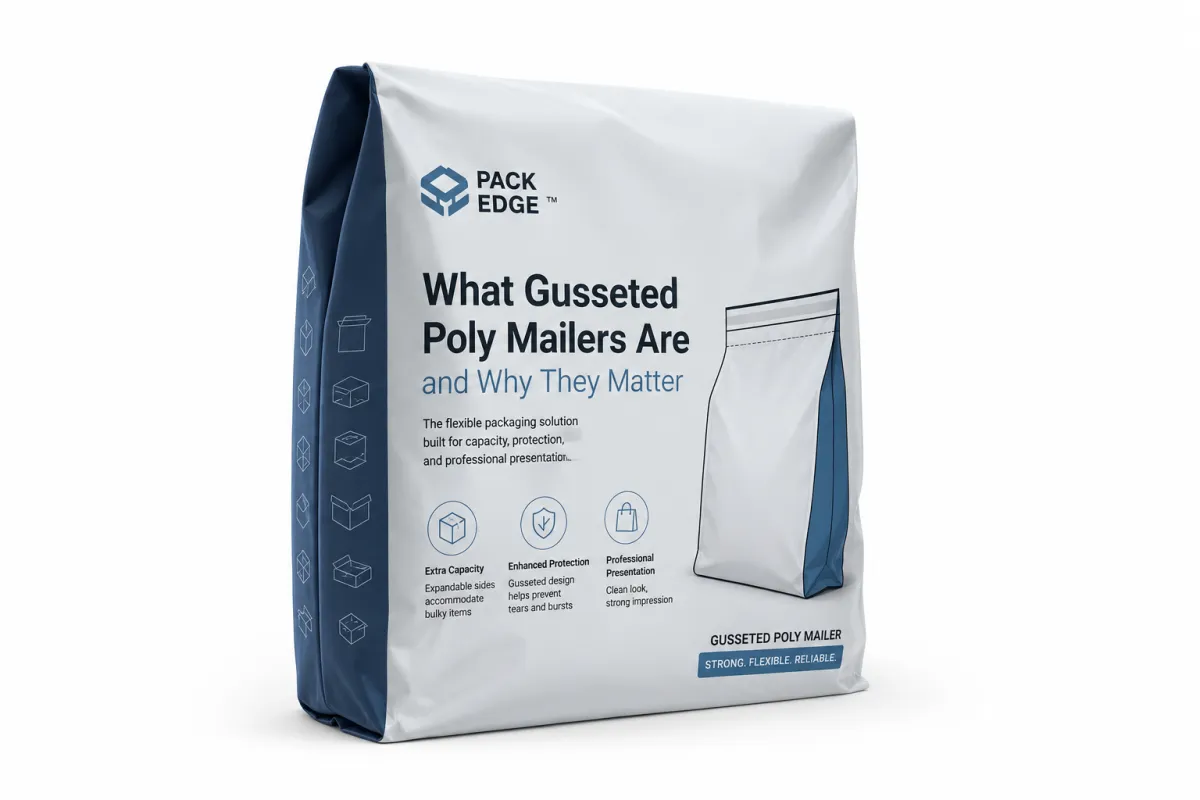
Gusseted poly mailers are flexible shipping bags with an expandable side or bottom panel that gives the package extra depth once it is loaded. That extra panel is the whole point. Instead of forcing a 1.5-inch-thick bundle into a flat sleeve that only wants to behave like an envelope, the gusset opens and lets the package take the shape of the product. I still remember the first time I saw a good one in production and thinking, "Well, that is just a bag with manners." It is a simple structure, but it solves a very specific problem with a lot more grace than many rigid formats.
A flat mailer works for items that are nearly one plane: a thin T-shirt, a lightweight insert, maybe a document set. A gusseted mailer gives you room for folded hoodies, jeans, paperbacks, small boxed sets, and soft goods that would otherwise bulge or fight the seal area. Once the thickness rises, the bag starts doing a better job of holding the load without looking overstuffed or stressed. That is not just a cosmetic win. It helps with stacking, tote fit, label readability, and the general sanity of the people moving product through the building. On a good day, that matters. On a bad day, it really matters.
The short version is this: a gusseted mailer is built to hold volume without turning into a brick. It gives soft and semi-soft products a more controlled footprint while keeping the weight and cost lower than a carton. For many e-commerce teams, that balance is exactly the sweet spot, and the guide to gusseted poly mailers earns its keep right there.
Why Gusseted Poly Mailers Matter in Real Shipping
In the warehouse, the difference shows up fast. A packer can slide an item into a gusseted bag, peel the adhesive liner, seal the flap, and move on with one smooth motion when the size is right. If the bag is too shallow, the same order becomes a fight: the film wrinkles, the seam pulls, and the label ends up somewhere near the fold line where nobody wanted it. I have seen a pack lead in Indianapolis shake his head at a row of overstuffed mailers and say, with the kind of tired honesty only a warehouse can produce, that the bags were "kind of acting personal." He was not wrong.
That is why this guide to gusseted poly mailers matters for operations teams. The structure can cut seconds out of every pack cycle, and seconds compound fast when you are shipping 1,000 or 10,000 parcels a week. Those seconds also affect training. A new hire usually learns a gusseted bag faster than a finicky flat one, because the bag gives the product a little room instead of forcing perfect hand placement every time. Simpler pack-out is not glamorous, but it is the kind of simple that keeps a line moving during a holiday surge.
There is also a presentation benefit that people tend to underestimate. A well-sized gusseted mailer looks intentional. The contents sit evenly, the closure lies flatter, and the parcel feels finished before it ever reaches the customer. That matters for apparel brands, subscription boxes, and DTC labels that care about the first impression on delivery. I am not saying the mailer has to be fancy. It does not. But if the package arrives looking like it lost an argument with the contents, the customer notices.
"A gusset is not decoration," a production lead told me during a late-night run in Columbus while we were checking seal bars on a 2.5 mil white mailer from a plant in Jiangsu. "It is the part that keeps the bag from fighting the product."
That line stuck with me because it is true in practice, not just on a spec sheet. Gusseted mailers are often the right middle ground for products with some flex but not enough crush sensitivity to justify a carton. If the item can settle without damage, the mailer should probably do the job. Shipping a hoodie in a box the size of a bread loaf is a familiar kind of waste, and I have never met a fulfillment manager who felt proud of that decision after the freight bill showed up.
How Gusseted Poly Mailers Work in Real Shipping
The construction is straightforward once you look at it in cross-section. You have the film body, usually LDPE or a blend like LDPE/LLDPE, the folded gusset panels tucked into the seams, and an adhesive closure at the top flap. Film thickness is usually measured in mils, and in custom runs I often see 2.0 mil, 2.5 mil, or 3.0 mil specified depending on the product and handling risk. Thicker film usually buys you more puncture resistance, while thinner film tends to be easier to open and lighter on freight. There is a real tradeoff there, and pretending otherwise is how teams end up with packaging that looks fine until the first rough drop test.
When the bag is loaded, the gusset opens rather than stretches like elastic. That distinction matters. An unfolded gusset distributes the load more evenly, helps the package keep a squarer profile, and gives the seal area a better chance of lying flat. A too-tight flat sleeve creates stress at the edges and around the opening, especially if the contents are folded with inserts or tags. I have watched crews in a warehouse outside Phoenix try to flatten a package that clearly wanted to be deeper, and the bag won that argument every time. Packaging always wins arguments. It just charges you later.
For a practical guide to gusseted poly mailers, the key thing to understand is that the bag should match the shape of the bundle, not the other way around. A folded sweatshirt, a pair of jeans, a paperback, and a soft kit with a few components all behave differently in transit. The gusset gives each of them a pocket that is flexible enough to load easily while still staying tidy enough for the parcel network. That is why teams often switch from cartons to mailers for soft goods: less air, less void fill, less labor, and usually a cleaner receiving experience at the warehouse end.
Here is the part that buyers sometimes miss: the gusset improves capacity, but it does not create crush protection. If the item is fragile, has a screen, or needs hard-impact resistance, you may still need a carton, a corrugated sleeve, or a rigid insert. I have seen people try to force a mailer to solve a problem it was never meant to solve, and that almost always ends in a replacement shipment and a very quiet budget meeting. The honest version of the guide to gusseted poly mailers says the same thing every time: use the bag for soft or compressible loads, and use something harder when the product actually needs a bodyguard.
In one practical setup I saw at a denim brand in Denver, the team moved from a flat sleeve to a 12 x 15 + 3 inch gusseted mailer, removed one layer of void fill, and shaved enough pack time off the line to notice it in the first week. That kind of change is not dramatic on paper. In the building, though, it feels different. People move a little faster, the bin space opens up, and the pack room stops feeling like it is one bad hour away from chaos.
Key Factors That Change Fit, Protection, and Performance
Fit starts with the packed bundle, not the product spec on its own. A medium hoodie may measure one way on a hanger and something completely different once it is folded with a polybag, a hang tag, and a card insert. A book with a dust jacket is not just a book, either; it changes shape at the spine and around the corners once it is bundled. The guide to gusseted poly mailers has to begin with the real shipping form of the item, because that is the version the carrier is actually going to handle.
Film thickness changes performance more than some buyers expect. A 2.0 mil mailer is lighter and usually easier to pack quickly. A 3.0 mil bag is more resistant to punctures, especially when the load has sharp edges, a zipper pull, or a hard corner sitting near the film. That extra thickness costs more, but the cost can be worth it if your returns team is dealing with torn corners or split seams. I am usually happy to spend a little more on a bag that does not behave dramatically the first time it brushes against a box edge. That is not extravagance; that is simply avoiding a future problem.
Closure strength deserves real attention too. I have seen a lower-cost adhesive pass sample review and then fail after a warehouse temperature swing from one shift to the next. The bag looked clean on the bench, then popped open after a rough parcel drop because the adhesive and film were never properly matched for the climate and handling conditions. If your guide to gusseted poly mailers stops at appearance, it is missing the part that actually keeps product inside the package. Ask for seal consistency, peel behavior, and tamper evidence if you need it. Pretty print is nice; a closed bag is nicer.
Print placement changes once the mailer expands. A layout that looks beautiful on a flat proof can wrap around the gusset seam in the finished package, which is why I always ask for a loaded sample before final approval. Logos near the fold can distort. Return instructions can disappear into the seam. Barcodes can land where scanners hate them. I have had designers tell me a flat mockup looked "fine" while standing beside a filled sample that clearly disagreed. The sample is the honest one, every time, and usually the only one telling the truth.
Testing matters as much as the artwork. A basic pack-out check is fine for a first pass, but I like to see the bag loaded with the real product, then dropped, vibrated, and stacked in a way that resembles the actual network. The ISTA testing framework is a good reference point because a package that survives a tidy desk test is not the same thing as a package that survives conveyor vibration and a 36-inch drop onto concrete. I have watched bags behave beautifully on a clean table and then fail the instant gravity gets a vote.
Environmental claims deserve the same care. If a supplier says a film has recycled content, ask for the percentage by weight and written proof of the claim. If a mailer is coextruded, the claim may apply to only one layer, not the entire structure. For paper inserts or cartons, chain-of-custody documentation matters, and an FSC certificate should be clear enough to withstand a retailer audit without a scramble for missing paperwork. Trust is built by documents that can survive scrutiny, not by a confident sales pitch and a smile.
Guide to Gusseted Poly Mailers Process and Timeline
Ordering starts with a real spec conversation, not just a size request. The most useful intake details are folded dimensions, product weight, bundle shape, print coverage, adhesive style, and whether the bag will be packed by hand or on a semi-automatic station. I have seen a one-line note that simply said "need mailers for shirts" turn into three rounds of sample changes because nobody mentioned the bundle was 2.75 inches thick with tissue and a hang card. That sort of omission happens more than people admit, and the guide to gusseted poly mailers is a lot more useful when it prevents that headache before it starts.
Sample review should reflect the real load. Send the heaviest version of the bundle first, not the lightest. If the pack includes a hoodie, a tee, and a card insert, the hoodie should set the size requirement because that is the item most likely to push the gusset and test the closure. Add the real sealing method too. If the team presses the flap by hand, say so. If a roller is used, say that as well. Adhesive feel changes with packing method, and a bag that behaves nicely one way can be fussy the other way. That is not a flaw in the bag; it is a sign that the process needs to match the material.
A typical timeline has four parts: sample review, artwork proofing, production, and freight. Stock bags can move quickly, sometimes in 3 to 7 business days. Custom Printed Mailers often need 12 to 15 business days after proof approval, and more complex jobs can stretch to 18 to 25 business days when there are multiple print colors, special finishes, or a custom adhesive spec. If you need a launch date to hold, work backward from the ship date and include receiving time. Warehouse intake, pallet scheduling, and carrier delays all deserve a line in the calendar. I learned that one the hard way from a Jiangsu supplier whose production was on time, while the freight forwarder in Ningbo held the finished pallets for two extra days because of a rain backlog. The bags were ready. The truck was not.
- Spec intake: collect dimensions, thickness, finish, print area, and quantity.
- Sample step: confirm fit with the actual product, not a photo or a flat mockup.
- Proofing: approve artwork placement, barcode zones, and color targets.
- Production: run the film, print, slit, fold, and finish the bags.
- Shipping: include transit time, receiving time, and a small buffer for inspection.
The calendar is part of the product, even if nobody likes hearing that. A late pallet can be as disruptive as a bad die-line, because both have the same effect: the warehouse is ready, the bags are not. A careful guide to gusseted poly mailers treats timing as a packaging variable, not a separate administrative issue that gets handled later by somebody in procurement.
Guide to Gusseted Poly Mailers Cost, Pricing, and Lead Times
Price depends on a stack of variables at once: size, film gauge, gusset depth, print coverage, adhesive style, and whether the order is stock or fully custom. The guide to gusseted poly mailers only works if buyers compare like with like, because a plain stock bag and a 2-color printed custom bag are not the same thing just because they share a size. If the film is different, the closure is different, and the freight terms are different, the quote is already telling two different stories.
I have seen pricing for a 10 x 13 + 2 inch gusseted mailer land around $0.08 per unit for 5,000 pieces on a plain stock run, around $0.18 per unit for a custom printed 2.0 mil bag, and around $0.26 to $0.32 per unit for heavier 3.0 mil work with more coverage. Those numbers move with resin pricing, finish, and shipping method, but they are useful enough to help a buyer build a real budget instead of guessing. Setup charges can land anywhere from roughly $120 to $450 depending on print method and the number of colors. That first invoice is rarely the whole story, though. Freight, pallet fees, and receiving charges often show up later and change the math in a hurry.
The first order is usually the most expensive on a unit basis because of setup and minimum quantities. After the artwork and tooling are approved, the per-bag cost usually improves. I once reviewed a quote in Austin that looked fantastic at $0.14 each until freight, pallet charges, and storage pushed the landed cost closer to $0.21. That is why landed cost belongs in the guide to gusseted poly mailers, not just the headline unit price. Headline price is for conversation. Landed cost is for paying the bills.
Lead time and price are not the same thing. A low quote can ship slowly if the plant is overloaded or if proof approval sits untouched for a week. A fast quote can cost more if it needs a rush lane or split freight. The cleanest view is the full one: bag price, setup, freight, receiving, and the cost of storing the order for a 30-day run. I have seen more than one buyer celebrate a cheap quote before the freight invoice arrived, and that moment never ages well. Any honest guide to gusseted poly mailers should define the total delivered cost before the purchase order goes out.
| Option | Typical Spec | Typical Unit Price at 5,000 Pieces | Best Use | Main Tradeoff |
|---|---|---|---|---|
| Plain stock gusseted mailer | 10 x 13 + 2 inch, 2.0 mil, white | $0.08 to $0.11 | Basic apparel and soft goods | Limited branding and fewer finishing choices |
| Custom printed gusseted mailer | 10 x 13 + 2 inch, 2.0 mil, 1-2 color print | $0.16 to $0.24 | E-commerce branding and retail presentation | Higher setup and proofing time |
| Heavy-duty gusseted mailer | 12 x 15 + 3 inch, 3.0 mil, reinforced seal | $0.24 to $0.35 | Thicker apparel, books, and mixed kits | Less flexible and usually more expensive to ship |
One supplier in Guangdong once suggested dropping a 2.5 mil structure down to 2.0 mil to trim a few cents off the unit price. On paper, the savings looked tidy. Then we ran rough handling tests on thicker bundles and saw seal-edge splitting that would have cost much more in replacement shipments than the savings ever covered. That is the real lesson here: the guide to gusseted poly mailers only works when the quote is measured against performance, not against a spreadsheet that wants to tell a prettier story than the bag can support.
Step-by-Step Selection Guide for the Right Mailer
Start with the product mix. List the SKUs, group them by thickness, and note how they are packed today. A shirt folded to 9 x 11 inches is one thing; that same shirt with a polybag, a card insert, and tissue wrap is something else entirely. I like to sort those bundles into three buckets: thin, medium, and bulky. That simple step makes the guide to gusseted poly mailers much easier to apply on a real fulfillment floor, and it helps prevent the classic mistake of trusting what the sample looked like on a table instead of what it did inside the package.
Next, measure the packed bundle, not the loose product. Use a ruler or caliper on the final folded form and record width, length, and thickness. If the bundle is 10 inches by 12 inches by 1.75 inches thick, the mailer needs enough depth to open without pulling the seams tight. I usually want a little breathing room. A bag that closes with force on the bench can split later when it is stacked, bent, or dropped in transit. I have never met a carrier who handled a parcel like it was borrowed porcelain, not in Memphis, not in Chicago, and not on a rainy route out of Tacoma.
Then choose a tentative size and test loading speed. A packer should be able to load the item, peel the liner, seal the flap, and lay the finished package flat without fighting the bag. If the gusset makes the mailer spring back open or wrinkle at the fold line, the bag may be the wrong size or the adhesive may be too short for the actual depth. The guide to gusseted poly mailers is really a guide to saving seconds per unit, because seconds turn into hours when the order volume gets large. If you have ever watched a line slow down because one bag keeps reopening like it has opinions, you already know why this matters.
A short sample run tells you more than a polished mockup. I ask teams to load 10 to 20 units, then check for punctures, excess void space, weak seal engagement, and barcode placement problems. A real test should also include a pause of 10 to 15 minutes so the product can settle, because soft goods shift after the air escapes and the bundle relaxes. That is also a good time to compare the result with other packaging in Custom Packaging Products if the team is deciding between mailers and another format. A package that looks perfect for 30 seconds is not necessarily the same package you get after the bundle settles, which is why patience is part of the test.
- Measure the bundle: capture the packed size in inches or millimeters.
- Match the gusset: make sure the depth supports the thickest bundle without strain.
- Test the seal: verify closure on a clean bench and again after a few minutes of settling.
- Check presentation: confirm the logo, return label, and handling marks stay readable.
- Lock the spec: save dimensions, film, print, quantity, and reorder trigger in one sheet.
The final step is documentation. Put the finished size, film gauge, print method, adhesive style, and reorder threshold into one sheet so the next purchase matches the first one. I have seen teams lose weeks because a new buyer reordered by memory and missed a one-inch gusset difference. In a mature guide to gusseted poly mailers, consistency is not boring. It is money. Stable packaging is often the thing that keeps the rest of the operation from wobbling.
Common Mistakes When Ordering Gusseted Poly Mailers
The biggest mistake is sizing by length and width alone while ignoring thickness. A mailer that fits a 12-inch garment is not automatically right for a 12-inch garment folded with tissue, a tag, and an insert card. The gusset is the variable that changes the fit, and if you ignore it, the package will tell you the truth later when the seams are under pressure and the adhesive is stretched at the top edge. That truth usually arrives after a run has already left the dock, which is not the moment anyone wants to learn a packaging lesson.
Another common error is choosing the cheapest option without checking how the film behaves under load. I have seen buyers save a fraction of a cent by selecting a thinner sheet, only to watch the package puncture on a zipper pull or split at the corner during a drop test. That is false economy, and it shows up quickly in replacement shipments and customer service tickets. A practical guide to gusseted poly mailers has to be honest about that. Saving a penny is pleasant. Processing a return is not.
Skipping sample testing is another one I would not forgive. A bag can look perfect on a spec sheet and still load badly on the actual table because the gusset opens in the wrong place or the seal area is too short for the folded bundle. I once saw a merchandising team approve a print proof for a white mailer with a narrow barcode zone, then discover during pack-out that the label crossed the gusset fold and failed scanning. One sample run would have caught it in 20 minutes. Instead, they got a warehouse full of packages and the kind of silence that tells you somebody has already started updating their resume.
Seasonal spikes cause trouble too. A team that buys for a steady 8,000 units a month can get caught flat-footed when holiday volume jumps to 14,000. If the reorder point is too low, the warehouse starts rationing bags right when the line is busiest. That is why the guide to gusseted poly mailers should include a safety buffer, especially for brands that see a sharp swing between spring, fall, and end-of-year demand. I have lived through enough "we thought we had enough" moments to know how quickly optimism evaporates, usually right around the first week of November.
Overbranding can also create headaches. Too much copy near the gusset fold, too many colors on the seal area, or a cluttered back panel can hide return instructions and make the package look busy instead of polished. A clean one-color print on matte white or matte black often looks better than a layout that fights the fold lines. A lot of teams print too much because they want to fill the space, not because the package needs it. My honest take is simple: if your artwork needs a breathing coach, it is probably doing too much, especially on a 10 x 13 bag with a 2-inch gusset.
One buyer told me after a failed launch, "We saved $300 on bags and spent $1,800 on rush replacements." That line stuck with me because it captures the real math of packaging decisions.
Expert Tips and Next Steps for Gusseted Poly Mailers
Standardize on a small set of sizes whenever you can. Three well-chosen bags often cover far more SKUs than people expect, and that keeps procurement cleaner, storage simpler, and packer training easier. I have seen teams run a 10 x 13 + 2, a 12 x 15 + 3, and a 14 x 19 + 4 inventory set for months without needing a box for most apparel orders. In a guide to gusseted poly mailers, restraint usually beats a giant catalog of odd sizes. The warehouse will thank you, and so will anyone who has to explain the budget later.
Document the pack test with photos, weights, and pass-fail notes. A folder with 10 images, a product weight of 14.2 oz, a seal test result, and a note on barcode placement is worth more than a vague memory six months later. If the buyer changes, the evidence still lives in the file. If the factory changes, the evidence still travels with the spec. That kind of recordkeeping sounds dull, I know, but it has saved more than one launch week, and it does the job without drama.
Coordinate with warehouse staff, procurement, and the packaging supplier before changing SKUs. I cannot count how many times a spec looked perfect in purchasing but slowed the line because the flap peeled too aggressively or the finished bag was one inch wider than the tote bins allowed. A good rollout starts with a pilot batch, one line supervisor, and a short review after 200 to 500 units. That small trial is often enough to catch a handling problem before it becomes a full inventory problem. If the crew hates the bag, they will tell you faster than any survey will, usually before lunch on day one.
For brands comparing formats, this is the right moment to review both mailers and the rest of the package stack in one place. Our Custom Packaging Products catalog can help teams compare mailers, boxes, inserts, and labels without losing sight of the whole pack-out plan. If the shipment is mostly soft goods, the guide to gusseted poly mailers usually points straight back to a mailer. If the item is rigid or fragile, the answer may still be a box with better crush control. My strongest feeling here is simple: the package should match the product instead of pretending to be something else.
If you want the shortest path to a smart decision, measure one current shipment, compare it to two sample sizes, and place a pilot order of 500 or 1,000 pieces before you scale. That approach has saved me more time than any spreadsheet, and it usually tells you quickly whether the design belongs in the packing room or not. Follow that process, and your next buy becomes a working guide to gusseted poly mailers instead of a guess made under pressure. That is the whole point: fewer surprises, fewer replacements, and fewer late-night calls from a warehouse manager who just discovered the bags do not fit the way everyone swore they would.
The most practical takeaway is also the least flashy: measure the packed bundle, confirm the gusset depth, test the seal with real product, and run a small pilot before committing to a larger order. If those four steps are done well, the bag choice gets easier, the line runs cleaner, and the next reorder is based on data instead of a hunch. I have seen that kind of discipline save a brand real money on a 20,000-piece annual buy, and that is the sort of unglamorous win I will always take.
FAQ
How do I size gusseted poly mailers for apparel and soft goods?
Measure the fully folded, packed bundle instead of the flat garment dimensions, because a hoodie, tee, or sweater changes shape once it is bundled with tissue, tags, or inserts. Add enough room for the gusset to open without pressing the seams hard, and test the heaviest item in the bundle first since that usually sets the real size requirement. A 10 x 13 + 2 inch mailer may handle one folded shirt easily, while a two-piece apparel set may need a 12 x 15 + 3 inch bag. I usually tell teams to measure twice and pack once, because nothing wastes energy like discovering your supposed perfect size after 400 units are already on the dock. That advice sits near the center of any guide to gusseted poly mailers, because fit is always the first decision that matters.
Are gusseted poly mailers better than flat poly mailers?
They are better when the product has thickness, an irregular shape, or a small stacked bundle that needs expansion room. Flat mailers still work for very thin items, but they often create more seam stress and a tighter fit around the contents. I usually recommend a gusseted design when you want cleaner loading, better volume use, and a package that does not fight the product during closure. If the bag feels like it is auditioning for a wrestling match, the flat style is probably the wrong choice, especially for a 2.5-inch-thick bundle. That is exactly the kind of comparison a practical guide to gusseted poly mailers should make before a purchase order goes out.
What affects gusseted poly mailers pricing the most?
Size, film thickness, print coverage, and closure style usually drive the biggest cost differences. Minimum order quantity and setup charges can raise the first-order price even when the unit cost looks attractive at scale, and freight or storage should always be included in the comparison. A quote at $0.18 per unit can be very different from another $0.18 quote once pallets, delivery terms, and receiving fees are added. I have seen people celebrate a quote before the freight invoice arrived, and honestly, that moment never ages well, especially when the shipment lands at a port and still needs drayage. A solid guide to gusseted poly mailers treats landed cost as the real number.
How long does custom gusseted poly mailer production usually take?
Timelines depend on stock material, print complexity, proof approval, and the factory's current workload. A simple stock order may move in a few business days, while a custom printed run often needs 12 to 15 business days after proof approval, with more complex work taking longer. Build in shipping and receiving time so the mailers arrive before your inventory switch date, not after the warehouse has already changed SKU. I have seen more than one launch day squeezed by a "small" freight delay that turned out not to be small at all. That is another reason the guide to gusseted poly mailers keeps production and freight in the same conversation.
What products work best in gusseted poly mailers?
Apparel, folded textiles, books, kits, soft home goods, and lightweight boxed products are common fits. They are especially useful when the product is thicker than a flat mailer can comfortably handle, or when you want a cleaner pack-out with less wasted volume. If the item is fragile or crush-sensitive, confirm whether a mailer alone is enough protection before you place the order. My rule is simple: if the product can tolerate a little flex, the mailer has a good shot; if it needs a bodyguard, bring a box, ideally one with the right corrugated rating and a proper insert. That practical filter is central to any guide to gusseted poly mailers worth reading twice.


