Buyer Fit Snapshot
| Best fit | Order Custom Eco Kraft Tape for Branding and Shipping projects where brand print, material claims, artwork control, MOQ, and repeat-order consistency need to be specified before quoting. |
|---|---|
| Quote inputs | Share finished size, material target, print colors, finish, packing count, annual reorder estimate, ship-to region, and any compliance wording. |
| Proofing check | Approve dieline scale, logo placement, barcode or warning zones, color tolerance, closure strength, and carton packing before bulk production. |
| Main risk | Vague material claims, crowded artwork, missing packing details, or unclear freight terms can make a low unit price expensive after revisions. |
Fast answer: Order Custom Eco Kraft Tape for Branding and Shipping should be specified like a repeatable production item. The safest quote records material, print method, finish, artwork proof, packing count, and reorder notes in one written spec.
Production checks before approval
Compare the actual filled-product size with the drawing, then confirm tolerance on folds, seals, hang holes, label areas, and retail display edges. Reserve space for logos, QR codes, warning copy, and material claims before decorative graphics fill the panel.
Quote comparison points
Review material grade, print process, finish, sampling route, tooling charges, carton quantity, and freight assumptions side by side. A quote is only useful when the supplier can repeat the same color, closure quality, and packing count on the next order.
Order Custom Eco Kraft Tape for Branding and Shipping has become one of those packaging decisions that looks tiny in procurement and surprisingly large on a dock. I have watched brands spend $0.15 per roll on 5,000 pieces and then save more than that in labor because cartons were easier to identify, stack, and route. For teams trying to balance shipping efficiency with presentation, the decision to order custom eco kraft tape can matter more than the line item suggests. A buyer thinks they are changing only the tape, then the cartons start reading more clearly, the packing crew stops hunting for labels, and the shipment starts behaving like it came from a company with a plan. That is the sort of improvement I trust because it shows up in the daily details: a 50 mm x 50 m roll, a clean one-color logo, and a carton seal that holds from the first pallet to the last box.
I watched one fulfillment crew outside Columbus switch to order custom eco kraft tape on a 2,400-carton outbound lane, and the difference showed up in the first shift. The dock lead told me the logo tape made the cartons readable from roughly 30 feet away, which sounds minor until you are moving 180 cartons an hour and every box looks identical under sodium warehouse lights. The brand did not buy decoration. It bought a faster visual signal, and the result was fewer mis-picks, fewer questions, and fewer minutes spent opening the wrong pile. Packaging people like to talk about aesthetics, but the real story is usually speed measured in seconds per carton. That is the part operations remembers long after the mockup gets approved.
That matters because tape is not just a closure. It is part of branded packaging, and it starts speaking before a customer opens the box. In buyer conversations, I keep hearing the same three goals: keep cartons closed, make the package look deliberate, and tell a cleaner material story that can stand next to a 350gsm C1S artboard sleeve or a recycled corrugate carton without looking improvised. Order custom eco kraft tape can handle all three, but only when the substrate, adhesive, and print method are selected with actual numbers in hand instead of a quick glance at a mockup. If the spec is guessed, the results usually are too.
A lot of packaging teams stumble early because they judge tape by logo appearance alone and ignore carton surface, shipping temperature, dispenser compatibility, and order volume. I get why. The render is easier to look at than the spec sheet. But packaging punishes narrow thinking, and the penalties show up in ugly places: edge lift on dusty board, unwind drag on a hand dispenser, or a logo that disappears when a seam crosses it. The smarter decision is operational. You want one tape that supports sealing, package branding, and line efficiency, whether the plant ships 200 cartons a day or 20,000. That is exactly why order custom eco kraft tape deserves a real spec review, not a five-minute price hunt between other tabs. Honestly, that five-minute hunt is where a lot of expensive mistakes are born.
Why order custom eco kraft tape instead of plain packing tape
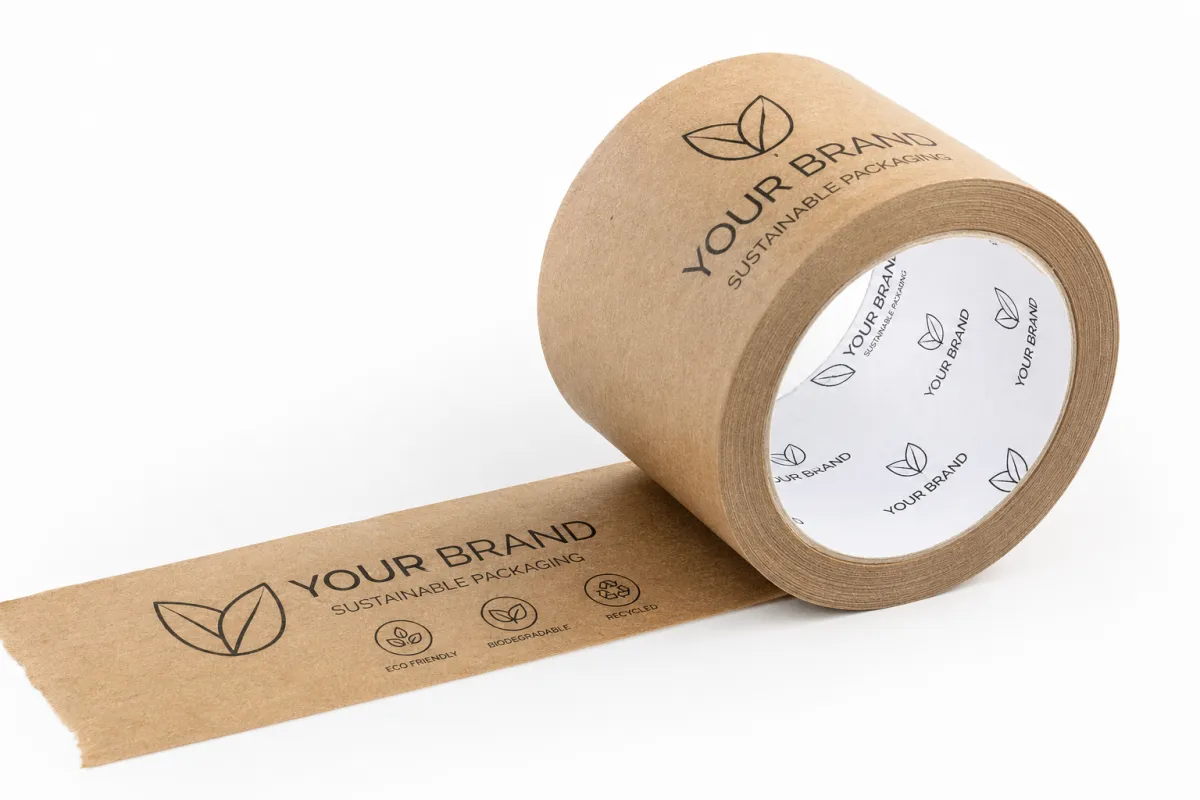
I still remember a night shift at a fulfillment center outside Columbus where the outbound crew kept losing time because half the cartons on the dock looked identical. Standard brown corrugated, clear film tape, one paper label curling at the edge, and enough confusion to add 12 to 15 extra minutes to each wave. The team changed to order custom eco kraft tape with a bold one-color logo, and the supervisor told me the real win was not appearance. It was speed. People could identify cartons at a glance, which reduced mix-ups during busy pick waves and made the dock feel less like a puzzle. I have a soft spot for fixes like that because they are not theatrical; they are measurable.
That is the practical payoff. Order custom eco kraft tape gives the carton a finished face, strengthens the visual story of product packaging, and makes the brand visible the moment the case leaves the sealer. It also cuts down on extra sleeves, temporary stickers, and corrective markings that slow the line. For brands shipping direct-to-consumer, retail packaging, or subscription boxes, that matters because the first impression starts on the shipping side of the carton, long before the unboxing moment. If you have ever opened a box and thought, “Someone planned this down to the last 25 mm of tape,” then you already understand the value.
There is a quieter advantage procurement teams notice. Order custom eco kraft tape can simplify packaging decisions because one printed closure often replaces a scattered set of labels, inserts, and backup stickers. I have seen that in client meetings where a brand wanted a cleaner presentation for Custom Printed Boxes, but the budget could not support another print stage. A printed tape spec gave them a visible brand layer without changing the carton die-line or stretching the artwork schedule. That kind of compromise is not boring to me; it is smart, especially when the alternative is adding a second production week to a launch that is already supposed to go out Tuesday.
“We stopped losing mixed cartons at the dock the week the logo tape went on the line. The packers could spot our boxes from 20 feet away, and the mis-ship rate dropped almost immediately.”
That came from a warehouse manager who had spent two seasons dealing with mis-ships and chargebacks. He was not talking about aesthetics. He was talking about fewer reworks, less overtime, and a calmer outbound shift. Calm is underrated in warehouses. If your operation wants that result, order custom eco kraft tape should be evaluated as an operations tool first and a branding tool second. That mindset leads to better choices on width, print repeat, and adhesive strength, and it usually keeps the conversation honest.
For buyers comparing options, it helps to place order custom eco kraft tape alongside the rest of the packaging stack. If your cartons already carry strong artwork, the tape can echo the same palette. If your boxes are plain, the tape can become the visible brand element that ties the shipment together. Either way, it can work alongside Custom Packaging Products without forcing a full redesign of the current packaging line. I like that flexibility because packaging budgets are rarely infinite, and the ones that are usually come with strings attached anyway.
Custom eco kraft tape materials, adhesives, and print options
The construction is simple on paper, but the performance depends on how the layers work together. Order custom eco kraft tape usually means a kraft paper face stock in the 60-70 gsm range, a pressure-sensitive adhesive, and a printable surface that handles logos, repeat patterns, or short brand messages well. The paper face gives the tape a natural look; the adhesive does the real work of holding a carton closed through handling, conveyor contact, and truck vibration. A lot of packaging materials look honest in theory. Only a few actually behave that way once they meet a moving pallet and a 14-hour shift.
On standard carton board, most buyers can get good initial tack with a well-matched adhesive. On recycled board with a rougher top sheet, the same tape may need a wider laydown or a stronger adhesive profile. If you order custom eco kraft tape for rough recycled board, the adhesive and width matter more than the mockup. I have seen dusty cartons at a beverage plant in New Jersey cause edge lift on narrow tape, and the fix was not fancy artwork. It was a wider roll, a slightly tackier adhesive, and a cleaner application path at the dispenser. That is why order custom eco kraft tape should be matched to the surface, not only to the artwork. Packaging fails in the unromantic places: dust, humidity, rough board, and rushed application at 5:15 p.m.
Print method matters too. Flexographic printing is common because it handles repeat runs efficiently and keeps artwork registration steady across large quantities. If the design is one logo in one or two colors, that is usually the most economical route. When buyers ask about heavy detail, gradients, or small text, I usually steer the conversation back to viewing distance and shipping environment. If a message needs to read from three feet away, strong contrast and clean shapes usually outperform ornate art. That is true whether you are buying Custom Printed Boxes or tape. Tiny type on kraft stock can look elegant on a screen and then vanish in real life, especially on a 75 mm roll that wraps tightly around a seam.
| Option | Typical MOQ | Typical Unit Price | Best Use | Notes |
|---|---|---|---|---|
| 1-color kraft tape, 50 mm x 50 m | 3,000 rolls | $0.15-$0.19/roll | Simple logo and repeat branding | Common starting point for order custom eco kraft tape; often printed in Dongguan, Guangdong |
| 2-color kraft tape, 50 mm x 50 m | 5,000 rolls | $0.22-$0.29/roll | Stronger visual identity | Better for retail packaging and direct shipping; proof turnaround is usually 24-48 hours |
| Wide format kraft tape, 75 mm x 50 m | 5,000 rolls | $0.28-$0.36/roll | Heavy cartons and high-visibility seals | Useful on larger corrugate panels and export cartons moving through Ningbo, Zhejiang |
| Custom length roll, 1-color | 5,000 rolls | $0.19-$0.25/roll | High-volume pack stations | Can reduce changeovers on busy lines in Shenzhen, Guangdong or Wenzhou, Zhejiang |
That table is a practical starting point, not a final quote. Freight, pallet count, carton configuration, and proof changes can move landed cost more than buyers expect, especially on smaller orders. Still, it shows why order custom eco kraft tape works well for brands that want an economical visual upgrade without printing every SKU on a fully custom carton. A one-color run at 5,000 rolls can sit near $0.15 per roll before freight, while a 75 mm, two-color run can climb closer to $0.36 depending on roll count and packing method. The math gets even nicer when you are replacing a pile of secondary labels or a last-minute patchwork of branded stickers that nobody wants to count twice. That kind of waste is sneaky; it never shows up as one giant cost, just a dozen annoying little ones.
From a sustainability standpoint, paper-based tape can support cleaner recycling workflows in many operations, but the claim should always be handled carefully. The tape still needs to work with the carton, the adhesive, and the route the package takes after shipment. I point buyers to the EPA’s recycling guidance at EPA recycling resources and to paper sourcing references from the Forest Stewardship Council when they ask how to speak accurately about material choices. Good sustainability language is specific, not vague, and order custom eco kraft tape should be described that way too. I trust specific claims. Vague ones make me suspicious, especially after reading too many specs that used “eco-friendly” as if it were a material grade.
Here is the quick selection checklist I use before recommending a spec:
- Carton surface: virgin corrugate, recycled board, coated board, or dusty stored cartons.
- Adhesive target: standard closure, cold warehouse use, or higher tack for rough recycled board.
- Print style: one-color logo, two-color logo, or repeating brand message.
- Roll size: width, length, and core size that fit the dispenser.
- Line speed: hand application, bench dispenser, or machine seal application.
Once those five details are clear, order custom eco kraft tape becomes a much easier decision because the options narrow to what will actually seal the box and survive transit. That is the part people skip when they get excited about a render. A packaging render is a promise; the dock is the receipt, and the receipt usually knows whether the adhesive worked at 18 degrees Celsius or failed after two pallet corners.
What specifications should you confirm before you order custom eco kraft tape?
Specification work saves more time than most buyers expect. Before you order custom eco kraft tape, confirm tape width, roll length, core size, print area, and the visible logo repeat after the tape crosses a seam. A 50 mm roll can be right for standard cartons, yet a 75 mm format may look better on larger cases where the seal needs more presence and the logo needs room to breathe. I tend to think of it like tailoring: the wrong fit is obvious, even when the fabric itself is good and the cost per roll is attractive.
Box surface matters just as much. Recycled corrugate, coated cartons, and dusty environments can all change how quickly the adhesive grabs the board in the first 30 seconds after application. I had a client in a produce operation test a roll that looked perfect on a clean sample box, only to find the same tape lifted slightly on cartons stored in a dusty receiving area. A short carton test solved the issue in one afternoon, and it saved them from ordering the wrong spec of order custom eco kraft tape. The funny part was that the “perfect” tape failed because the real world had the audacity to be messy. Packaging does that, especially when pallets sit in a 70 percent humidity room for three days.
Five details I ask for before quoting
First, I ask for the exact carton style and the surface finish. Second, I want the logo file in a vector format, usually AI, EPS, or print-ready PDF. Third, I need to know how many colors the artwork uses, because one-color and two-color runs are priced differently. Fourth, I ask whether the tape must work on hand dispensers, because the unwind and core size have to match the existing tools. Fifth, I ask for an estimated monthly usage number, because volume affects both pricing and production planning when you order custom eco kraft tape. If the buyer says 8,000 rolls in Q1 and 2,000 in Q2, the quote should reflect that, not a one-size-fits-all guess. That may sound basic, but basic is often the first thing rushed out the door.
Artwork limits matter more than many design teams expect. Thin fonts can disappear on kraft stock, and tiny negative spaces can fill in once the print hits the paper face. If the logo includes a small tagline, I usually suggest testing it at actual size on a carton panel before approval. That is one reason order custom eco kraft tape should be reviewed like a packaging component, not treated like a quick promo item. A tape proof that looks tidy on a laptop can look like a smudge once it is wrapped around corrugated board, especially if the seam overlap lands within 10 mm of the type.
Trial runs are worth the time. A short sample on the actual box tells you three things very quickly: whether the tape grips the board, whether the tear is clean at the dispenser, and whether the brand mark remains readable after the seam folds. If those three points are good, the rest of the order usually moves without drama. If one fails, the fix is easier before production starts. That is the simplest way I know to reduce risk when you order custom eco kraft tape. I would rather spend one afternoon testing a 3-roll sample than spend a full week arguing with a 3,000-roll mistake.
“The proof looked fine on screen, but the carton test showed the logo was too close to the edge. Moving it 8 mm fixed the whole run, and the seam no longer cut through the brand mark.”
That came from a cosmetics buyer who had already lived through one bad print revision on other packaging design work, so she understood the value of catching problems early. The same logic applies here. If your packaging team handles both retail packaging and ship-ready cartons, a good spec sheet for order custom eco kraft tape keeps everybody aligned without turning the approval cycle into a long email chain that nobody wants to inherit on Friday afternoon. One clear spec can save three meetings, two file exports, and a very annoyed production coordinator.
Pricing, MOQ, and what affects custom eco kraft tape costs
I like to explain pricing the way a plant manager would review a line change: material first, print complexity second, then roll size, quantity, freight, and sample work. When buyers order custom eco kraft tape, the quote is rarely only about the tape itself. A simple one-color run on a standard width may land near $0.15 per roll at 5,000 pieces from a factory in Dongguan, while a wider format, multi-color print, or custom roll length can lift the number because setup and handling take more time. If someone tells you every tape quote is the same, I would assume they have not spent time near a production floor or watched a press crew recalibrate registration between runs.
Minimum order quantity is usually tied to the simplicity of the job. If the artwork is clean and the width is standard, the entry point can be more accessible. If the design has multiple colors or the roll size is unusual, the MOQ often rises because the press has to stay set longer and the waste allowance changes. In practical terms, a buyer who wants to order custom eco kraft tape for a limited launch can often keep costs in check by using a standard size and a clear one-color logo. That is the sort of decision that makes finance breathe easier and production stay sane, which is not a bad combination for a packaging line.
The color count is one of the easiest pricing levers to understand. Each additional color can affect setup time, press handling, and inspection. I have seen a two-color logo outperform a more detailed three-color version simply because it read better on brown kraft stock and cost less to run. That is why a strong supplier will talk through design, not just accept the artwork and send a quote. The best outcome is not the most decorated roll; it is the one that works at scale when you order custom eco kraft tape, whether the production run is 3,000 rolls in Guangdong or 10,000 rolls shipped through Ningbo.
There are hidden variables too. Freight can add more than expected if the rolls ship as a partial pallet. Rush production can carry a premium if a launch date moves up. Special pallet builds, carton changes, or extra proof revisions can also affect the total. For a cleaner budget, ask for the total landed cost, not just the roll price. That is especially true if you are comparing tape against other branded packaging options, or if you are building an account plan through our Wholesale Programs. I have seen buyers save pennies on the roll and lose dollars on the freight, particularly on air shipments from southern China to the U.S. West Coast. The invoice tells a different story once logistics gets involved.
Here is a simple way to think about cost drivers when you order custom eco kraft tape:
- Lowest cost: one-color logo, standard width, standard roll length, larger quantity.
- Mid-range: two-color logo, standard width, moderate quantity, carton test requested.
- Higher cost: wider tape, custom length, multiple colors, rush timing, or revised artwork.
For many buyers, the better question is not “What does the roll cost?” but “What will each sealed carton cost once freight and production timing are included?” That shift in thinking helps teams compare order custom eco kraft tape against labels, sleeves, or changes to custom printed boxes. If you buy packaging by the pallet, you already know the cheapest-looking spec is not always the cheapest landed result. A $0.02 difference on paper can become a real number once 16 pallets, 2 proofs, and a rushed freight booking enter the picture.
How do you order custom eco kraft tape without slowing production?
The cleanest path is straightforward: request a quote, submit artwork, review the digital proof, approve the spec sheet, run production, inspect quality, and schedule freight or pickup. That sequence sounds obvious, but delays creep in when files are incomplete or the carton test happens too late. If the buyer knows what they need before they order custom eco kraft tape, the process can move with little friction. I wish every order arrived that tidy. Some do. Some arrive with a logo exported from a screenshot, a carton size from memory, and a deadline that was apparently set by optimism and caffeine.
The fastest approval path
The fastest orders are the ones where the brand sends a vector logo, confirms the tape width, shares carton photos, and states a target ship date up front. In that situation, proofing can move quickly because the supplier is not trying to guess at seal width or art placement. I have had quotes turn around in a day, proofs approved the next morning, and production start immediately after. A realistic timeline for many standard runs is 12-15 business days from proof approval, plus freight time based on destination and pallet count. If the shipment is headed to Los Angeles, Austin, or Toronto, the transit window will look very different from a local pickup in Guangdong.
That timeline keeps launch planning honest. If a customer wants to order custom eco kraft tape for a campaign with a fixed ship date, they should work backward from freight, not forward from the quote. A West Coast destination on a full pallet moves differently than a regional pickup, and the difference can matter as much as the print itself. I have watched a launch nearly slip because someone forgot that “production ready” and “physically on-site” are not the same thing. Packaging loves those little traps, especially when customs clearance is involved.
Where orders usually stall
Most delays are not caused by the tape line; they are caused by missing inputs. Low-resolution artwork is a common one. Unclear color instructions are another. A buyer may send a logo in RGB, then wonder why the proof looks different on kraft stock. I have also seen delays from last-minute carton changes after the proof was already approved. If the carton size changes, the visible logo repeat may need to change too, and that pushes the schedule. The best way to order custom eco kraft tape without losing time is to freeze the packaging specs before production starts.
A good prep list keeps the process moving:
- Vector artwork in AI, EPS, or print-ready PDF format.
- Tape width, roll length, and core size.
- Estimated monthly usage and first-order quantity.
- Carton material type, including recycled or coated board.
- Launch date, shipping destination, and preferred freight method.
If you already use a hand dispenser or a machine sealer, say so early. A tape that works perfectly on a bench dispenser may not be the best choice for automated packing lines. I have seen small differences in unwind behavior create drag on a line running 18 cartons a minute, and that kind of issue is easy to avoid if the supplier knows the application. Good suppliers ask those questions before you order custom eco kraft tape, because they understand that the tape has to fit the process, not just the brand color. Tape is not a poster; it is a moving part that should disappear into the work once the carton is sealed.
There is also a communication benefit. When the timeline, carton type, and quantity are clear, the quote becomes easier to compare against other packaging solutions. That helps buyers judge whether tape, labels, or a change to product packaging gives the best return for the run. If the order is part of a broader packaging refresh, the supplier can coordinate it with other Custom Packaging Products so the artwork and lead times do not collide. I have seen that coordination save teams from the kind of calendar mess that makes everyone pretend they “just need one more day,” which is usually code for “nothing is ready yet.”
Why choose us for custom eco kraft tape
The best supplier is not the one that talks the loudest about branding; it is the one that understands corrugate, adhesive behavior, and repeatable output on a packing line. At Custom Logo Things, the value sits in the packaging knowledge behind the quote. When you order custom eco kraft tape through a team that understands carton sealing, you get guidance on print registration, adhesive fit, and the practical details that keep orders moving. That kind of advice is not flashy, but it keeps people from making expensive mistakes on a 6,000-roll reorder that should have been simple.
My experience on the factory floor has taught me that small process controls make a big difference. A roll that is 2 mm off spec can slow a dispenser. A weak unwind can frustrate operators. A print line that drifts by a few millimeters can make the logo look careless on the seam. Good quality checks catch those issues before the shipment leaves the dock. That is the kind of discipline buyers should expect when they order custom eco kraft tape, especially if the tape will be used every day on a packaging line. One bad roll can feel trivial in purchasing and enormous in production, which is one of those delightful little mismatches that keeps operations managers awake at 2:00 a.m.
Service matters as much as the spec sheet. Clear proofs reduce back-and-forth. Practical advice shortens the approval cycle. Responsive quoting helps procurement lock in a budget without guessing. I have seen too many teams lose a week because a vendor treated the order like a graphic project instead of a packaging item. The right partner should ask about the board grade, the dispenser, and the seal pattern, because those details directly affect performance. That is the difference between selling tape and supporting branded packaging. I have a strong opinion here: if the supplier does not ask about the carton, they are not done asking enough questions.
There is a reason seasoned buyers keep reorder specs on file. Once the right roll is identified, repeat ordering becomes much easier, and the packaging team can stay focused on shipments rather than constant rework. If you need help choosing between paper-based closure options, review our FAQ for common questions, or use our wholesale path when the volume justifies a standing spec. For many brands, order custom eco kraft tape is the practical middle ground between plain packing tape and full custom printed boxes. It is a middle ground with real benefits, which is rarer than it sounds when budgets are tight and lead times are not.
Here is the honest fit statement I use with clients: choose the supplier that can help you pick the right construction, not just the cheapest roll. Cheap tape that fails on rough recycled board costs more in labor than it saves in purchasing. A proper spec for order custom eco kraft tape should hold the box, reinforce the brand, and keep the pack line steady. If the tape looks nice but peels at the first temperature swing, it is not a good buy. It is just an expensive nuisance in a brown suit, and the warehouse will notice before marketing does.
What to prepare before you order custom eco kraft tape
Before you order custom eco kraft tape, gather the files and facts that let a supplier quote accurately the first time. Start with your logo file, then note the tape width you want, the approximate monthly usage, and a photo of the carton surface you plan to seal. If you can share the box dimensions and a sample of the board type, even better. A matte recycled carton behaves differently from a coated retail carton, and the adhesive recommendation may shift accordingly. That is not nitpicking; that is the difference between a tape that cooperates and a tape that argues with the carton for three weeks.
Decide early whether the print should be one color or two, whether you need a standard or custom roll length, and whether the tape has to work with a hand dispenser or a machine application. Those are not small details. They affect the art layout, the production setup, and the way the tape performs in the real packing area. If you are planning a launch, send the target ship date and the shipping destination along with the quote request so the freight math is realistic. That matters more than most buyers expect when they order custom eco kraft tape, particularly if the order is going from Shenzhen to a warehouse in Ohio or from Ningbo to a retail hub in Vancouver.
I also recommend asking for a digital proof and, if possible, a carton test before full production. That one step has saved more than one client from avoidable rework. I have seen a small logo move 10 mm to avoid a seam, a wider seal approved because the carton was heavy, and a color simplified because the kraft stock made the original version too busy. Those are small decisions on paper, but they make the final package feel intentional and well built. The best order custom eco kraft tape projects usually look simple because the hard work happened before the first roll ran. Simplicity is often just the visible residue of careful decisions.
If you want the process to move smoothly, use this final checklist:
- Send vector art and brand color references.
- Confirm the carton type and seal location.
- Choose the width, length, and core size.
- State the quantity, launch date, and destination.
- Request a proof and approve it quickly once the layout matches your carton.
That preparation turns a quote request into a production-ready order and helps the team build a spec that fits your actual operation. If your goal is cleaner shipping, better presentation, and a tape spec that supports your packaging design without complicating the line, send the details and get ready to order custom eco kraft tape with confidence. I like that kind of outcome because it feels earned rather than accidental, and it usually survives the first 1,000 cartons without complaint.
How much custom eco kraft tape should I order for a small launch?
Base the quantity on carton count, sealing pattern, and how many seams each box uses, then add a small buffer for setup waste and testing. If the launch is limited, ask for the lowest practical MOQ with a standard width and simple print, because that usually keeps the first run efficient. A short pilot run is especially useful if the carton surface is new or the shipping lane includes rough handling, so you can order custom eco kraft tape with less risk. I am a fan of pilots precisely because they reveal the awkward stuff before the awkward stuff becomes expensive, and a 200-roll trial is cheaper than reworking 2,000 rolls later.
What file format do you need when I order custom eco kraft tape?
Vector artwork is best, especially AI, EPS, or PDF files with outlined fonts and clean edges. Send Pantone or CMYK references if color accuracy matters, and include any no-print zones or repeat preferences so the proof reflects the final layout. Low-resolution web files slow the process down and can soften the final print, which is why suppliers prefer proper production files before you order custom eco kraft tape. A screenshot is not a file format, no matter how confidently someone emails it.
How long does custom eco kraft tape production usually take?
Proofing can move quickly when the artwork is complete, while production starts only after spec approval. A realistic schedule for many standard runs is 12-15 business days from proof approval, plus freight based on distance and pallet count. The fastest orders are the ones where the buyer confirms size, artwork, and carton type up front, which is why planning ahead helps when you order custom eco kraft tape. If the deadline is unmovable, say so early; it saves everyone from pretending gravity bends for marketing calendars and 4:00 p.m. shipping cutoffs.
Will eco kraft tape stick well to recycled cartons?
Yes, but performance depends on the carton surface, dust level, and adhesive choice. If the board is rough or the environment is humid, test a sample on the actual carton before full production. A wider tape or a different adhesive can improve seal reliability on demanding boxes, and that is often the most practical adjustment when you order custom eco kraft tape for recycled corrugate. Recycled board is common, which is great, but it also means the tape has to earn its keep on every shift.
Can I order custom eco kraft tape with more than one print color?
Yes, multi-color printing is possible, but each added color can affect setup time and cost. Simple two-color graphics often balance brand visibility and budget better than detailed artwork, especially on natural kraft stock. If color count matters, ask for a proof that shows how the design will read on the tape face before you order custom eco kraft tape. I usually tell buyers to favor clarity over decoration; the cartons are doing the travel, not the artwork.
If you are ready to move from plain closure tape to a cleaner branded package, send your logo files, carton details, width target, and first-order quantity so the spec can be built around the carton instead of around a guess. The right roll makes shipping easier, supports your brand, and keeps the packing line steady from the first shift to the reorder. More importantly, it gives you a repeatable standard: one tape grade for the actual board you ship, one print layout that stays legible across the seam, and one approval process that does not need rescuing at the last minute. That is the practical takeaway if you want to order custom eco kraft tape without creating new headaches for production.

