Buyer Fit Snapshot
| Best fit | To Moisture Resistant Shipping Boxes projects where brand print, material claims, artwork control, MOQ, and repeat-order consistency need to be specified before quoting. |
|---|---|
| Quote inputs | Share finished size, material target, print colors, finish, packing count, annual reorder estimate, ship-to region, and any compliance wording. |
| Proofing check | Approve dieline scale, logo placement, barcode or warning zones, color tolerance, closure strength, and carton packing before bulk production. |
| Main risk | Vague material claims, crowded artwork, missing packing details, or unclear freight terms can make a low unit price expensive after revisions. |
Fast answer: To Moisture Resistant Shipping Boxes: Board, Finish, Dieline, and Unit Cost should be specified like a repeatable production item. The safest quote records material, print method, finish, artwork proof, packing count, and reorder notes in one written spec.
Production checks before approval
Compare the actual filled-product size with the drawing, then confirm tolerance on folds, seals, hang holes, label areas, and retail display edges. Reserve space for logos, QR codes, warning copy, and material claims before decorative graphics fill the panel.
Quote comparison points
Review material grade, print process, finish, sampling route, tooling charges, carton quantity, and freight assumptions side by side. A quote is only useful when the supplier can repeat the same color, closure quality, and packing count on the next order.
A carton can look perfect on the pallet and still go soft the minute humidity gets involved. That is the annoying part. The failure usually starts before anyone notices it, then shows up later as sagging flaps, scuffed print, or a box that just does not stack like it should. A solid guide to moisture resistant shipping boxes starts there, because moisture usually appears as a damp dock, a cold trailer with condensation, or a rainy handoff at the receiving door. Nothing dramatic. Just enough to ruin the day.
For brands that care about package protection, the right guide to moisture resistant shipping boxes is not about pretending corrugated board can become waterproof. It is about slowing water uptake, keeping the board useful long enough for transit packaging to do its job, and protecting product value through storage, shipping, and order fulfillment. That matters for printed goods, food-adjacent items, hardware, cosmetics, small appliances, and anything else that starts looking tired once the carton softens.
The real question is blunt: will this box survive the lane, or just look good in a sample room? A practical guide to moisture resistant shipping boxes has to answer that without hiding behind jargon. Coatings, board selection, closure style, and cost all matter. So does the route. So does the weather. So does the warehouse that leaves pallets sitting around a little too long.
Why Moisture Resistant Shipping Boxes Matter
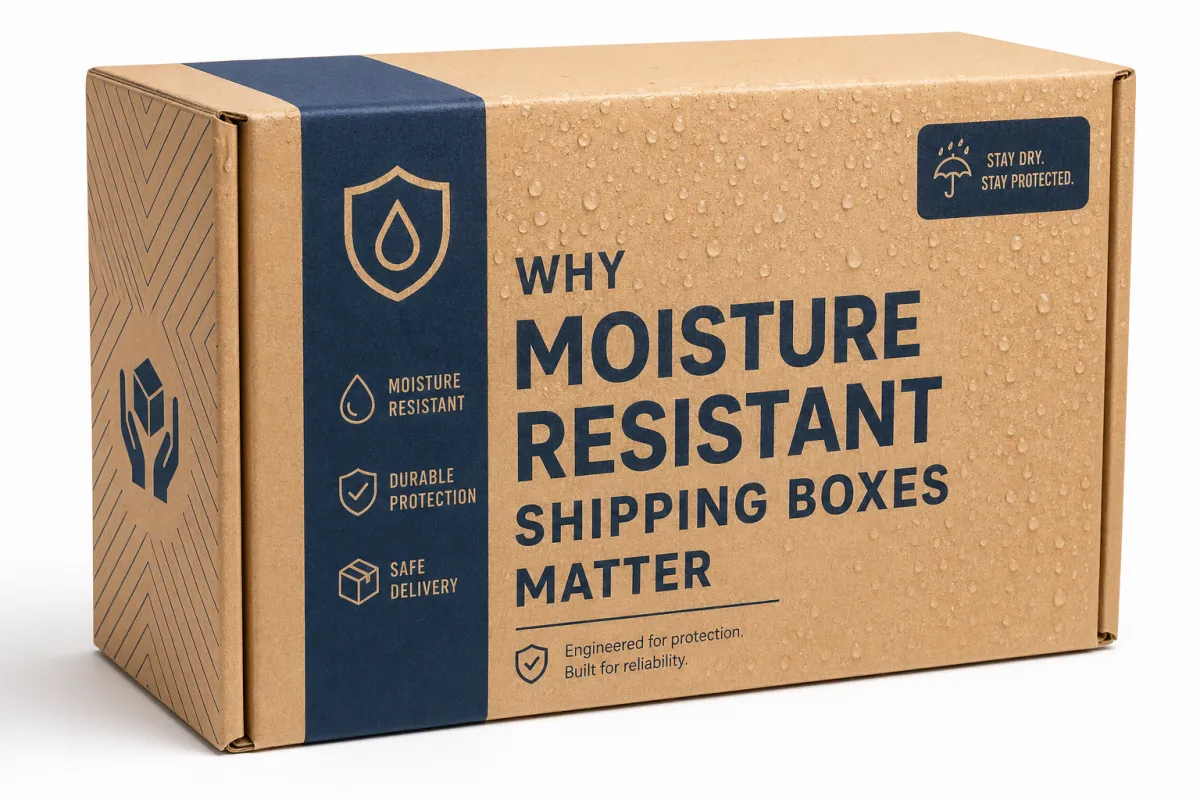
A carton can be square in the morning and sag by lunch if the air is wet enough. That is the hidden problem a guide to moisture resistant shipping boxes has to deal with. Moisture weakens corrugated board before a lot of teams realize anything is wrong. The liner fibers pick up water, the flute loses stiffness, and the box that handled stacking pressure yesterday starts giving up sooner than expected. Kind of rude, honestly.
There is a very practical side to this. Labels curl. Ink smears. Adhesive slips. Printed finishes lose their clean look and start spotting. In ecommerce shipping, that means damaged branding, unreadable barcodes, and returns that have nothing to do with the product. In industrial and retail shipments, the bill gets bigger if the carton is shielding parts that can rust, stain, or get marked up by a bit too much humidity.
Moisture resistant packaging is built to delay water uptake. That is the point. It does not promise a carton that can sit in a flood and laugh about it. It buys time. Time is what gets a box through a humid cross-dock, a refrigerated transfer, a stormy delivery route, or a short stretch of storage on the receiving side. That is why moisture resistance belongs in the same conversation as shipping materials, dimensional weight, and the strength rating on the carton.
It also helps to separate moisture resistance from waterproofing. Waterproof packaging is usually a different beast entirely, often built with barrier films, sealed edges, or rigid structures. Most corrugated packaging is made to resist moisture exposure, not sit underwater. That difference matters. A carton that performs well in one lane can be the wrong answer in another.
If you are comparing outer cartons against the rest of your packaging stack, the broader setup matters too. A brand building a full shipping system may need Custom Packaging Products, while a project focused on outer protection may be better served by Custom Shipping Boxes. For lighter-weight mail streams, Custom Poly Mailers can reduce exposure in a different way, though they are not a substitute for a moisture-resistant carton when crush protection still matters.
Moisture damage is sneaky. By the time a box looks tired, the board strength may have been slipping for hours.
That is why a serious guide to moisture resistant shipping boxes starts with the route, the environment, and the failure points. Not with a buzzword. Not with a coating name. With the actual problem.
How Moisture Resistant Shipping Boxes Work
Corrugated board is layered. Each layer has a job. The outer and inner liners carry print and take abuse from handling. The fluted medium gives the box its separation and stiffness. In a guide to moisture resistant shipping boxes, that structure matters because moisture does not attack every layer the same way. Once water reaches the paper fibers, the board softens and strength drops faster than most buyers expect.
Adhesives matter too. A strong board with weak bonding between the flute and liner can fail early, especially in humid or wet conditions. Water-resistant adhesives are one of those quiet upgrades that do not get much attention, but they can make a real difference when a box sees repeated handling, temperature swings, or long storage times. In practice, guide to moisture resistant shipping boxes performance depends on the full build, not one magic feature.
Several protection methods show up again and again. Aqueous coatings can add moisture resistance without changing the carton’s feel too much. Film laminations and poly layers create a stronger barrier, though they usually add cost and can affect recyclability or print texture. Wax alternatives still appear in some programs, but they are not always the right call if the goal is a cleaner recycling stream. For many brands, the right guide to moisture resistant shipping boxes solution is a tradeoff between barrier level, board performance, and sustainability targets.
Box design matters just as much. A well-made carton with clean score lines, tight seams, and sensible closure methods will resist moisture better than a sloppy box with gaps or exposed edges. Even the fold style changes the outcome. A tuck flap, an overlap seam, and a glued manufacturer’s joint do not behave the same once humidity rises. If the closure creates a weak point, moisture will find it. It always does.
That is why moisture resistance should be treated like a system. The board, coating, adhesive, labels, tape, and storage environment all work together. One of the biggest lessons in a practical guide to moisture resistant shipping boxes is simple: one feature rarely fixes a lane problem if the rest of the package is still fragile.
For teams that want a technical anchor, the packaging industry has a long habit of testing against real transit conditions. Organizations like the ISTA publish test methods that help simulate drops, vibration, compression, and environmental stress. If recycled-content claims or paper sourcing language matter, the FSC system is another useful reference. Those resources do not pick a box for you, but they keep the decision grounded in something sturdier than a sales claim.
Picture two cartons with the same exterior size and the same ECT rating. One uses standard liners. The other adds a moisture-resistant coating plus a stronger adhesive system. In a humid lane, the second box may keep its strength much longer. That is the practical difference a guide to moisture resistant shipping boxes should make obvious.
Key Factors That Affect Performance and Cost
Choosing the Right carton starts with the kind of moisture exposure you are actually paying to avoid. A box that sits in a dry fulfillment center for twenty minutes is not solving the same problem as a box that moves through cold docks, coastal transport, and overnight curbside exposure. A practical guide to moisture resistant shipping boxes starts by separating exposure time, humidity level, direct water contact, and product sensitivity. Those are not interchangeable.
Board grade is one of the biggest cost drivers. Heavier liners and stronger flute combinations usually cost more, but they can improve compression strength and help the carton resist warping. Coating type matters too. Aqueous protection is often more affordable than film lamination, while a heavier barrier build may cost more upfront but reduce damage claims later. In a guide to moisture resistant shipping boxes, these should be treated as performance layers, not competing buzzwords.
Order quantity changes the math fast. At 5,000 units, a modest moisture-resistant spec may land at one price. At 25,000 units, the same carton can drop because setup and material purchasing are spread across more boxes. Print coverage also affects pricing. A simple one-color outside print is not in the same universe as full coverage with tight registration, specialty coatings, and polished branding. For buyers watching dimensional weight and freight cost, the outer box has to earn its place in both protection and shipping efficiency.
Here is a useful comparison for teams evaluating a guide to moisture resistant shipping boxes spec:
| Option | Typical Use | Moisture Resistance | Relative Cost | Notes |
|---|---|---|---|---|
| Standard corrugated | Dry, short transit lanes | Low | Lowest | Works for basic package protection when humidity is not a major factor |
| Aqueous-coated corrugated | General ecommerce shipping and mixed storage | Moderate | Low to medium | Often the best first step in a guide to moisture resistant shipping boxes |
| Poly-laminated corrugated | Higher humidity, longer dwell, premium branding | High | Medium to high | Stronger barrier, but may affect recyclability and print feel |
| Specialty barrier construction | Demanding lanes, sensitive products, repeated handling | Very high | Highest | Best when moisture, abrasion, and storage risk all matter together |
The table is not a universal answer, because the right spec depends on what the product can tolerate. Paper goods may need stronger moisture control than a hardware item, even if the hardware is heavier. A cosmetic line may care more about appearance than raw compression, while a parts distributor may care most about legible labels and dry surfaces. A good guide to moisture resistant shipping boxes reflects those tradeoffs honestly.
Operational fit matters too. A carton that performs beautifully on paper but slows the pack line is not automatically the better choice. If it needs extra sealing steps, awkward tape placement, or hand-applied inserts, labor can erase the benefit. That is why buyers need to look at the full order fulfillment system, not just the carton price. Sometimes the slightly pricier box cuts rework, damage, and replacement shipments. That is real savings, not spreadsheet theater.
Think about the warehouse itself. Moisture-resistant packaging can work well, but if pallets sit on concrete floors or skids are staged near dock doors for too long, even a strong carton will struggle. Good shipping materials work best when the handling environment supports them. Storage height, pallet wrap quality, staging time, and seasonal swings all matter more than people want to admit.
Honestly, one of the most common mistakes is comparing a moisture-resistant carton only against a standard dry-lane carton on unit price. That skips the hidden costs. A small increase in pack price is easier to justify when the box prevents one damaged case, one return cycle, or one complaint from a customer who does not care how cheap the carton was. The best guide to moisture resistant shipping boxes keeps that bigger picture in view.
How do you choose moisture resistant shipping boxes?
A clean selection process keeps the decision tied to the actual shipping lane. Start by mapping the product from pack-out to final delivery. Where does it sit after filling? Does it go onto a pallet, into a trailer, through a cross-dock, or straight into parcel handling? Those details matter because a guide to moisture resistant shipping boxes only helps if it reflects the points where moisture is most likely to show up.
Step 1: Define product sensitivity
Some products can tolerate a little surface moisture and still arrive in good shape. Others cannot. Printed materials may wave or smear. Metal parts may face corrosion. Food-adjacent goods may pick up odor or lose shelf appeal. Premium retail items may survive structurally but still fail if the carton looks tired on arrival. A practical guide to moisture resistant shipping boxes starts by naming the failure mode, not just the product category.
Step 2: Match the box to the environment
Humidity, seasonal weather, refrigerated transfer, and long warehouse dwell times all affect performance. A carton for a dry inland route can be simpler than one for a coastal lane or a summer shipment moving through hot, wet air. If your product moves through ecommerce shipping with unpredictable last-mile handoffs, the box may need more protection than a bulk B2B carton with controlled receiving. The tighter the environmental match, the less you spend on features you do not need.
Step 3: Test before scaling
Sampling should never be skipped. Order a small run, then check how the box behaves after real handling, not just a bench test. Compression checks help, but so do exposure trials that simulate humidity, cold storage, or damp receiving conditions. Some teams compare cartons after one day, three days, and a week in rough conditions to see how quickly the board changes. That kind of evidence makes a guide to moisture resistant shipping boxes a lot more trustworthy than a spec sheet alone.
When testing, look at more than one outcome. Does the board warp? Do the flaps curl? Are the labels still readable? Is the tape holding? Can the box still stack without sagging? Those details tell you whether the package protection is real or just decorative paperwork. If you want a stronger benchmark, the transit-testing approach used by ISTA methods is a solid reference for building a repeatable evaluation process.
A box is only “moisture resistant” if it survives the lane you actually use, not the lane you hoped for when the spec was written.
Step 4: Lock in the production timeline
Once the spec is chosen, continuity becomes the next problem. A carton can be well designed and still fail your program if it arrives late or changes without warning between runs. Build time for artwork approval, material selection, sampling, and replenishment planning. Most buyers want a clean path from proof approval to production so inventory stays stable. A good guide to moisture resistant shipping boxes should protect the supply plan too, because shortages push teams into rushed substitutions and those usually make everything worse.
At this point, the conversation usually expands beyond the box itself. Some SKUs need a moisture-resistant carton. Others work with a more basic outer package and a different inner barrier. That is where comparing the carton against the rest of your shipping materials pays off, including inserts, tape, dunnage, and secondary wraps. The right answer is often a package system, not a single component pretending to be the hero.
One practical way to manage the decision is to build a simple matrix with five columns: moisture exposure, compression need, print requirement, cost target, and lead time. If a carton checks three boxes but misses two critical ones, it is probably the wrong spec. A good guide to moisture resistant shipping boxes keeps the process disciplined and repeatable.
For brands buying across multiple product formats, the selection process also helps separate outer-carton needs from lighter mailers and display packaging. A team may use Custom Shipping Boxes for heavy or fragile products, then reserve Custom Poly Mailers for low-crush items that need a different kind of protection. Lane-by-lane thinking usually saves money and cuts confusion.
Common Mistakes When Choosing Moisture Resistant Shipping Boxes
The biggest mistake is assuming all coated cartons behave the same. They do not. Two materials can both be described as moisture resistant and still perform very differently in actual humidity. One may only slow surface dampness. The other may hold up far better under real transit conditions. A strong guide to moisture resistant shipping boxes has to say that plainly, because vague language gets expensive fast.
Another common error is overbuying protection. Some teams specify a heavy barrier box because it sounds safer, but the lane does not justify the extra spend. If a carton only needs to survive a short, dry parcel route with one rainy handoff, a premium construction may add very little value. The right guide to moisture resistant shipping boxes balances risk and spend instead of treating every shipment like the apocalypse is scheduled for Tuesday.
Closure systems get ignored too often. Strong board means little if the tape is weak, the seam is poorly designed, or the fold pattern leaves gaps. Moisture often enters at the edges first. That makes the closing method part of the moisture strategy, not an afterthought. I have seen teams choose a better carton and still get poor results because the seal design did not fit the environment.
It is also easy to focus on burst or ECT numbers and ignore the moisture risk sitting right in front of you. Those ratings matter, but they do not tell the whole story if the carton softens before it ever reaches its compression limit. In damp storage or rainy transit, moisture may be the primary stress, not stacking force. A careful guide to moisture resistant shipping boxes should connect board strength to environmental exposure instead of treating them like separate conversations.
Testing in the real shipping lane is another step teams skip too often. Lab tests are useful, but real life includes dock delays, weather swings, and handling that no tidy test setup fully captures. If the first sign of trouble is damaged product after launch, the company is already paying for the lesson. That is why a practical guide to moisture resistant shipping boxes always recommends pilot runs before full conversion.
Here are a few mistakes worth watching for in order fulfillment and storage:
- Leaving cartons directly on damp concrete during staging.
- Using tape that loses hold in humid conditions.
- Ignoring print and barcode durability when the carton gets wet.
- Choosing a box that saves pennies but creates returns.
- Skipping a seasonal review on coastal or refrigerated lanes.
There is another subtle mistake too: not checking how the carton interacts with pallet wrap, inserts, and outer labels. Moisture protection is rarely about one feature. It is the package as a whole. That is why a full guide to moisture resistant shipping boxes needs to look beyond the board itself and into the surrounding packaging system.
Expert Tips for Better Moisture Protection in Shipping
Start inside the shipper, not outside it. If the product itself is vulnerable, the carton may need help from barrier bags, desiccants, molded inserts, or a cleaner internal wrap. A moisture-resistant box can slow water uptake, but it will not solve every problem by itself. The best guide to moisture resistant shipping boxes usually pairs the carton with the right inner packaging.
Warehouse handling matters just as much. Keep boxes off the floor where possible. Avoid long exposure near open dock doors. Make sure pallet loads are sealed before they sit in a humid corner of the building. Even a capable carton will underperform if it is staged in the wrong spot. That operational discipline is part of package protection, even if it never shows up in the spec sheet.
Label and ink choices deserve real attention. Moisture resistance should extend to the information on the carton, not just the board under it. Barcodes need to scan. Branding needs to stay legible. Shipping documents need to remain readable after handling. If labels curl or smear, the carton may still hold together structurally and still fail the distribution process. That is another reason a guide to moisture resistant shipping boxes should involve both packaging and operations teams.
Seasonal review is worth the time. Summer humidity affects cartons differently than winter condensation, and coastal lanes behave differently than inland routes. If your product moves across regions, you may need more than one packaging spec. A buyer who reviews the lane once a year is usually in better shape than one who sets the carton and forgets it. The most reliable guide to moisture resistant shipping boxes is the one that gets updated when the route changes.
For brands that care about sustainability language, keep the claims clean. Not every coating or laminate belongs in the same recyclability bucket. The EPA’s recycling guidance is a useful reference point when you are thinking about downstream handling and waste claims: EPA recycling guidance. If recycled fiber sourcing matters, FSC information can also help teams describe the material story accurately.
Finally, document what works. A simple log of damage rates, warehouse feedback, and seasonal issues can save a lot of future guesswork. Purchasing can use that data when comparing quotes, operations can use it when setting packing standards, and quality can use it when reviewing returns. A strong guide to moisture resistant shipping boxes should end in repeatable decisions, not guesswork dressed up as expertise.
One more practical thought: if your product line includes mixed formats, build a tiered packaging program. Some items may only need upgraded cartons. Others may need a broader system with inserts and other shipping materials. That is where comparing carton specs inside your larger transit packaging strategy saves money without cutting corners.
Next Steps for Moisture Resistant Shipping Boxes
The cleanest path forward is simple: start with the product, the lane, and the budget, in that order. Review how sensitive the item is to humidity, softening, corrosion, odor transfer, or cosmetic damage. Map the route from pack-out to delivery so you know where moisture exposure is most likely. Then compare carton cost against the real cost of damage, returns, and replacement shipments. That is the backbone of a sensible guide to moisture resistant shipping boxes.
Once the risk is clear, request samples of the shortlisted constructions and test them under the same conditions they will face in the field. If the boxes will sit in a humid warehouse for two days, test them that way. If they will move through cold-chain or rainy delivery lanes, simulate those conditions as closely as possible. A sample that looks fine on a desk is not enough. A good guide to moisture resistant shipping boxes depends on actual performance data.
It also helps to build a decision matrix that compares moisture resistance, compression strength, Price Per Unit, print needs, lead time, and fulfillment speed. That gives your team one reference point when multiple options look acceptable on paper. The best packaging decisions are rarely made on one metric alone. They come from weighing the full set of tradeoffs and choosing the carton that supports the whole operation.
Before finalizing anything, bring operations and fulfillment into the conversation. The box has to run well on the floor, fit the packing process, and work with the rest of your shipping materials. If the carton slows packers or creates sealing problems, the hidden cost can outweigh the protection benefit. The strongest guide to moisture resistant shipping boxes is the one that fits both the technical need and the daily workflow.
For many buyers, that means comparing a few packaging paths side by side. Some projects call for a more specialized outer carton, while others can pair a standard shipper with additional inner protection. If you are building a broader program, it is worth reviewing Custom Packaging Products as part of the same decision, because the best answer is often a coordinated package rather than a single upgraded component.
In the end, a guide to moisture resistant shipping boxes is really a guide to smarter packaging decisions. The right carton slows water absorption, protects board strength, preserves branding, and helps products arrive in saleable condition without overspending on features you do not need. Choose based on the route, the product, and the real handling environment, and moisture resistant shipping boxes become a practical tool instead of a vague premium add-on.
FAQ
What makes moisture resistant shipping boxes different from regular corrugated boxes?
They are built to slow water absorption and help the board keep its strength longer in humid, wet, or condensation-heavy conditions. In a practical guide to moisture resistant shipping boxes, the difference usually comes from coated liners, stronger adhesive systems, and better board construction rather than from one magic material.
Do moisture resistant shipping boxes need a plastic coating to work well?
No, not always. Aqueous coatings, board selection, and adhesive choices can all improve resistance, and many programs use those options successfully. Plastic or film layers may offer stronger protection, but they also change cost, recyclability, and print feel, so the right choice depends on how much moisture exposure the shipment will face.
How do I choose the right moisture resistant shipping box for my product?
Start with the product’s sensitivity to humidity, softening, corrosion, and cosmetic damage, then match the box to the shipping lane and storage time. A good guide to moisture resistant shipping boxes also recommends testing a sample in real conditions before ordering at scale, because that is the fastest way to confirm the carton performs where it matters.
Are moisture resistant shipping boxes more expensive?
Usually yes, because better materials and coatings add cost to the carton. The extra spend can still pay off by reducing damage claims, returns, and replacement shipments. Pricing depends on order volume, custom sizing, print complexity, and the type of protection used, so two boxes described the same way can still land at very different price points.
Can moisture resistant shipping boxes be recycled?
Many can be recycled, but it depends on the coating, liner, and local recycling rules. Paper-based coatings are often easier to recycle than heavy plastic laminations or wax treatments. If recyclability matters, confirm the material structure before placing the order, and make sure the claims match how the carton is actually built.

