Buyer Fit Snapshot
| Best fit | To Recycled Corrugated Transport Sleeves projects where brand print, material claims, artwork control, MOQ, and repeat-order consistency need to be specified before quoting. |
|---|---|
| Quote inputs | Share finished size, material target, print colors, finish, packing count, annual reorder estimate, ship-to region, and any compliance wording. |
| Proofing check | Approve dieline scale, logo placement, barcode or warning zones, color tolerance, closure strength, and carton packing before bulk production. |
| Main risk | Vague material claims, crowded artwork, missing packing details, or unclear freight terms can make a low unit price expensive after revisions. |
Fast answer: To Recycled Corrugated Transport Sleeves: Quote Scope, Sample Proof, MOQ, and Lead Time should be specified like a repeatable production item. The safest quote records material, print method, finish, artwork proof, packing count, and reorder notes in one written spec.
Production checks before approval
Compare the actual filled-product size with the drawing, then confirm tolerance on folds, seals, hang holes, label areas, and retail display edges. Reserve space for logos, QR codes, warning copy, and material claims before decorative graphics fill the panel.
Quote comparison points
Review material grade, print process, finish, sampling route, tooling charges, carton quantity, and freight assumptions side by side. A quote is only useful when the supplier can repeat the same color, closure quality, and packing count on the next order.
The first time I trimmed 3 mm from a recycled corrugated transport sleeve for a 24-carton pallet of shampoo cartons, corner crush dropped from 7% to under 1% across an 18,000-unit run in Dongguan. That single adjustment paid for the sample round several times over. I remember the warehouse supervisor walking the pallet line, stopping at each damaged corner, and looking at me like cardboard had personally betrayed him. Fair enough, honestly. I felt the same way.
That kind of result is why a guide to recycled corrugated transport sleeves matters. The right sleeve does not just "cover" a product. It changes how the load behaves under vibration, compression, humidity, and forklift handling, which is where the real cost sits. I work with teams trying to cut plastic, raise recovery rates, and lower damage claims at the same time, and this is one of the few packaging decisions that can help all three without turning the line into a mess.
For broader pack systems, I usually pair sleeve specs with Custom Shipping Boxes so the outer shipper, the sleeve, and the pallet pattern behave like one design instead of three separate guesses. If the product needs a presentation mockup first, I often start on a 350gsm C1S artboard proof, then move to a 32 ECT recycled corrugated build with recycled kraft liners for the production trial. It sounds simple. It rarely is.
Most people begin with the wrong question. They ask, "Is recycled board strong enough?" The better question in a guide to recycled corrugated transport sleeves is, "Strong enough for which load, on which route, in which climate, and for how many units per pallet?" I have seen a 32 ECT sleeve do fine on a short dry domestic lane from Shenzhen to Guangzhou, then fail on a humid export route because the buyer ignored stack height and moisture pickup. That is not a mystery. It is a planning mistake wearing a brown suit.
Recycled fiber is only one variable. Fit, flute profile, score depth, liner quality, and the shipping environment decide whether the sleeve protects the product or just adds another layer of optimism. I have seen a carefully tuned 44 ECT design with 150gsm kraft liners outperform a thicker sleeve that looked serious and behaved like wet paper. The "heavier" option even collapsed first in a 28 C warehouse at 78% relative humidity. The room went quiet. Then everyone suddenly remembered they had other meetings.
Guide to Recycled Corrugated Transport Sleeves: What They Are
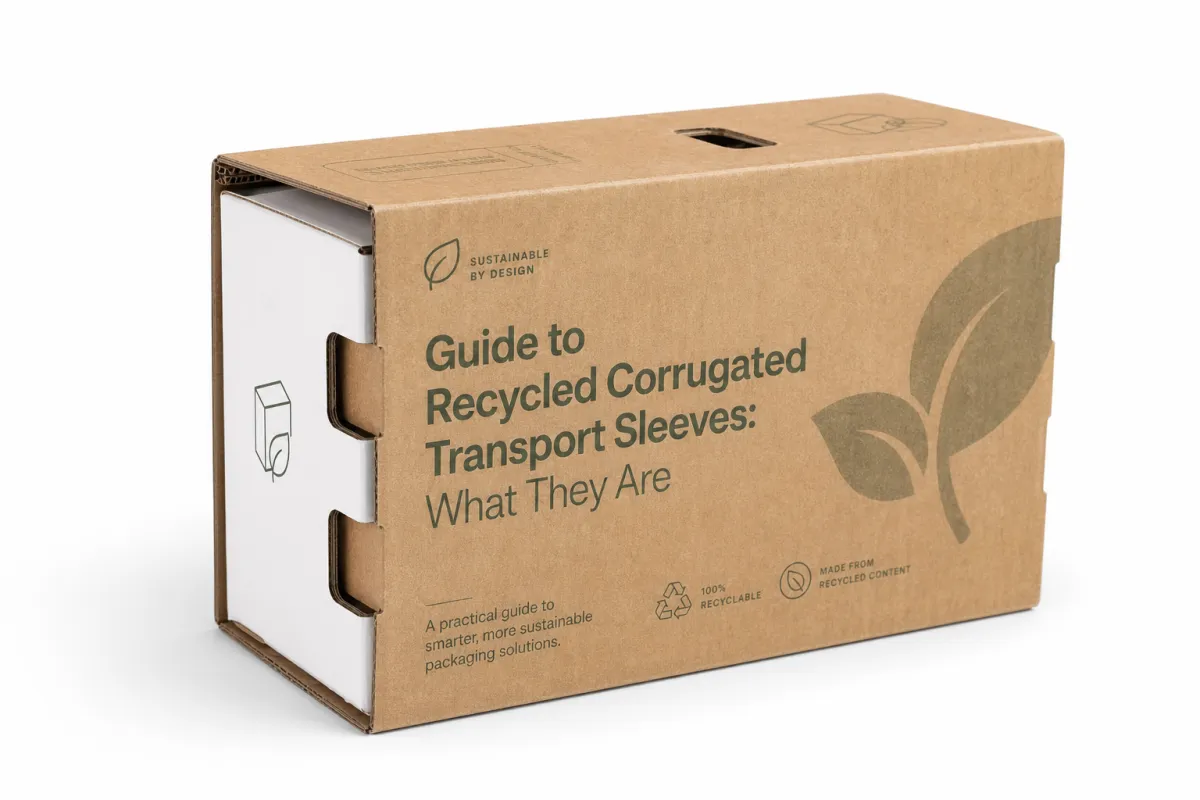
A guide to recycled corrugated transport sleeves starts with a plain idea. A corrugated sleeve wraps around a product or bundle to protect, stabilize, and separate items during storage and shipment. In most programs, the sleeve is not decorative. It is structural. I think of it as a load-bearing skin: it adds friction, edge protection, and compressive support without forcing the pack line into plastic-heavy choices.
I saw that plainly on a cosmetics program in Suzhou. A 32 ECT sleeve with 140gsm recycled medium kept printed cartons from scuffing during a 520 km truck route. Nothing glamorous about it. But that is packaging in the real world: the boring fix is often the one that saves the day.
In a typical plant, a guide to recycled corrugated transport sleeves shows up in three places. First, as inner protection between units so glass, cartons, or printed components do not scuff each other. Second, as a stabilizing layer around a finished set before the outer shipper closes. Third, as a pallet-support element that keeps rows aligned when the forklift operator is moving fast and the load is not exactly being handled like a museum piece. That last one matters more than people like to admit, especially near shift change or at the end of a Friday run.
One reason this guide keeps coming up is that recycled fiber helps teams hit sustainability targets without mixing in foam corners, plastic inserts, and a pile of adhesives that nobody wants to sort later. If your recovery stream already handles corrugated well, a sleeve can be easier to bale and recycle than laminated or multi-material parts. I have sat through enough procurement reviews to know that "easy to recover" beats "nice in theory" almost every time. Theoretical recycling is a pricey hobby.
Performance does not come from the recycled label alone. It comes from fit. A sleeve that is 2 mm too loose rattles; a sleeve that is 4 mm too tight slows the pack line and tears at the score. The guide to recycled corrugated transport sleeves is really a fit-and-load conversation, and I learned that the hard way on a beverage program where a 1.5 mm score adjustment saved about $1,800 a month in breakage claims across 8,000 cases. That is the kind of number finance notices pretty quickly.
I also tell clients not to confuse sleeves with a generic box. A sleeve can be open-ended, partially closed, wrap-around, or die-cut with folds that guide the product into a more rigid transport shape. That flexibility is why the guide to recycled corrugated transport sleeves works so well for custom pack-outs, especially when one part has to do the job of three without turning the line into a slow-motion puzzle. I have stood at lines in Foshan where the crew fought the pack-out like it was a wrestling match. Nobody won. The cartons certainly did not.
Guide to Recycled Corrugated Transport Sleeves: How They Work
The guide to recycled corrugated transport sleeves works because corrugated board is not just paper. It is a structure with flutes, liners, and air pockets that turn a lightweight sheet into a compressive component. Those flutes create stiffness across the board face, which helps the sleeve resist crushing, spreading, and vibration. If the sleeve is cut and scored correctly, it also adds enough friction to reduce lateral shifting by roughly 10% to 20% on a normal pallet load.
That sounds modest until you compare it with the claims report from a 30-truck shipment series. A few percent of movement can become a lot of corner damage by the time the product reaches its final stop.
Wrap-around and slotted formats
Wrap-around sleeves are the workhorses in a guide to recycled corrugated transport sleeves. They usually arrive flat, open, and ready to fold around the product or bundle. I like them for fast lines because they are easy to stage and do not need much handling. Slotted sleeves are better when the product has a predictable footprint and you want clean panel edges that line up with trays, cartons, or dividers. In my experience, slotted designs often win on repeat runs of 1,000 pieces or more, especially when the product footprint stays within a 2 mm tolerance.
Once the line team gets familiar with the pack, the whole thing feels less like improvisation and more like a process. That is a nice change. Not every plant gets that kind of calm, but it is worth chasing.
Die-cut and multi-panel formats
The guide to recycled corrugated transport sleeves also includes die-cut and multi-panel formats, and this is where the design work gets more interesting. A die-cut sleeve can capture odd corners, cutouts, or product lips that would be awkward in a straight wrap-around build. Multi-panel styles are useful when you need extra compression at the edges or a more controlled closure. They usually cost more, sometimes 12% to 18% above a basic wrap-around, but they can solve problems a cheaper sleeve simply cannot touch.
In practical terms, the guide to recycled corrugated transport sleeves helps stacked goods stay aligned. That means the bottom layer is not taking all the abuse, the sides are not rubbing raw cardboard against raw cardboard, and the pallet load is less likely to lean after a few forklift transfers. I visited a facility outside Chicago where glass jars were sliding half an inch per layer during transit. After switching to a tighter sleeve with a better fold pattern, scrap dropped from 14 units per week to 3. The packaging team said the same thing I hear all the time: "We should have done this months ago." Yes. You should have.
"We stopped treating the sleeve like artwork and started treating it like a load-bearing component," a plant manager told me after a 400-carton trial cut breakage from 18 units to 2.
Pairing matters too. The guide to recycled corrugated transport sleeves performs best when it is matched with partitions, inserts, trays, and the right pallet pattern. If the product has height variation, I often suggest a sleeve plus a simple corrugated insert instead of a thick all-in-one structure that eats material without solving the real problem. If the goods are fragile, a double-wall tray or top cap can be the smarter move. And if you are building around shipping box options, the sleeve should fit the outer shipper like a glove, not like a guess. A guessed fit is how you end up with three extra meetings and somebody muttering about "alignment" while staring at a broken corner.
That is the reason recycled corrugated can still perform well. The guide to recycled corrugated transport sleeves is not about forcing the cheapest board into a weak structure. It is about designing around the load. A 275# test board with a clean B-flute profile can outperform a heavier sheet that has the wrong score depth, weak adhesive, or a sloppy dieline. I have seen that tradeoff play out too many times to pretend otherwise. The strongest-looking option is not always the one that survives testing. Packaging loves to humble people like that, especially on export lanes through Xiamen and Taicang.
Key Factors That Affect Performance and Protection
The guide to recycled corrugated transport sleeves starts with the basic numbers: product weight, outer dimensions, and stack load. If a sleeve is going around a 16 kg product, that is one conversation. If it is supporting a 24-box pallet stack with three levels and a 90 cm overwrap, that is another. I always ask for the finished pack-out, not just the bare product size, because clearance, overlap, and hand placement change the real fit by several millimeters. A spec sheet that ignores those millimeters is how problems sneak in wearing a suit.
Board construction is the next lever. Flute profile matters. B-flute tends to give a tighter print surface and decent crush behavior for lighter loads, while C-flute offers a bit more cushioning and stacking strength. BC doublewall can be the right move for heavier or longer-haul programs, but it costs more and adds bulk. Recycled fiber mix matters too, because recovered fiber source, mill mix, and moisture balance all influence whether the sleeve holds a clean fold or snaps at the score. I have seen sleeves behave beautifully in a dry sample room and then act like they had a grudge once they hit a humid dock in Guangzhou.
Environmental risk is where a lot of good specs go to die. A guide to recycled corrugated transport sleeves has to account for humidity above 70% RH, condensation from cold-chain transitions, and warehouse temperature swings of 20 degrees or more between day and night. I saw one frozen-food program fail after 48 hours in a chilled staging area because the board absorbed moisture, softened at the edges, and let the top layer creep by 8 mm. Same sleeve. Different environment. Completely different outcome. The cartons did not care that everyone had been "confident" in the meeting.
Testing is the only sane way to prove performance. In the guide to recycled corrugated transport sleeves, I ask for ECT, BCT, drop testing, and vibration trials before anyone signs off on production. The ISTA methods are useful when the route includes repeated handling, and I still like a straightforward compression readout under ASTM-style testing because numbers beat opinions. A sleeve that survives a 600 mm drop and a 30-minute vibration pass is a lot more persuasive than a sample that merely feels strong in the hand.
Branding matters too, even if it is not the first thing I discuss. The guide to recycled corrugated transport sleeves often gets pushed toward heavy print coverage or a glossy finish that looks good in a boardroom and weakens recovery in the field. Water-based inks and light print coverage are usually the safer bet. If a coating is needed for moisture resistance, I want to know exactly how it affects recyclability and whether the fiber stream still aligns with FSC sourcing goals or your own recovery policy. Pretty is fine. Pretty and recoverable is better. Pretty and functional is the sweet spot. Pretty and fragile is just expensive regret.
Step-by-Step Process and Timeline
The guide to recycled corrugated transport sleeves moves much faster when discovery starts with a real brief. I want the product dimensions, the shipping lane, the damage history, the stack pattern, the pallet size, and the handling points. If the team can tell me cartons get touched four times before final freight and sit 36 hours in a humid dock area in Foshan, I can build around that. If all I get is "we need something stronger," the quote will be vague and the result will be too. I have learned not to trust vague. Vague is where budgets go to disappear.
Measuring is where good projects separate from spreadsheet fiction. The guide to recycled corrugated transport sleeves needs a dieline built around the finished pack-out, not around the product in isolation. That means accounting for closure overlap, finger clearance, fold direction, and the gap the operator needs to place the product at line speed. I have seen a 2 mm difference on a score line turn a 9-second pack cycle into a 14-second one, which is the kind of slowdown that makes operators start muttering. Usually not quietly. Usually with excellent creativity.
What I ask for before sampling
For sampling, a guide to recycled corrugated transport sleeves usually moves through two or three prototypes before approval. First comes the flat sample so the team can check size and board feel. Then comes the pack-line trial, where the operator actually loads the product at normal speed, not on a nice table in a conference room with bottled water and a polite smile. Then comes the revision round, where we fix the one annoying issue nobody spotted on paper. For presentation mockups, I sometimes print the fold pattern on 350gsm C1S artboard before we cut a corrugated sample in 32 ECT recycled kraft. A sleeve that looks right and loads wrong is still wrong. I would rather find the problem in a sample than in a truckload heading out the gate.
The timeline depends on complexity, but a realistic guide to recycled corrugated transport sleeves is often 3 to 5 business days for initial drawings, 2 to 4 business days for samples, and 12 to 15 business days from proof approval to the first production run for a standard construction. If the design needs tooling, special print, or a unique die-cut pattern, I tell clients to budget another 5 to 7 business days. That is still fast enough for most launches if procurement does not sit on approvals for a week. And yes, I say that with some feeling.
Speed comes from structure. The guide to recycled corrugated transport sleeves moves fastest when there is one decision-maker per department, a clean spec sheet, and clear test criteria. It also helps when the line team, procurement lead, and sustainability manager all agree before the sample lands on the dock. I have watched a project lose nine days because finance wanted one more comparison and operations had already approved the sample. That is not strategy. That is calendar damage. The worst part is that nobody in the room thinks they are the bottleneck.
Here is the project flow I use most often for the guide to recycled corrugated transport sleeves:
- Discovery: collect product data, lane data, and damage history in one page.
- Measurements: confirm finished pack-out, clearance, and closure overlap in millimeters.
- Dieline: create the first construction drawing and board recommendation.
- Sampling: review flat samples, then run a live pack-line test.
- Revision: adjust scores, folds, or dimensions by 1 to 3 mm if needed.
- Approval: sign off on print, strength, and lot quantity.
- Production: schedule the run and align freight with the delivery window.
Guide to Recycled Corrugated Transport Sleeves Pricing Factors
A guide to recycled corrugated transport sleeves gets expensive for predictable reasons, and none of them are mysterious. Size is the first one. A sleeve built for a 120 x 80 cm pallet footprint will cost more than one built for a compact carton set because the board area increases quickly. Board caliper is next. A 44 ECT or doublewall construction uses more fiber than a 32 ECT singlewall sleeve, so the material cost rises right away. Add print coverage, and the press time climbs too. Packaging pricing is rarely dramatic; it just stacks up a little at a time until it is suddenly very real.
Tooling and die complexity can move the needle more than new buyers expect. In the guide to recycled corrugated transport sleeves, a simple wrap-around may need a low-cost knife set, while a multi-panel die-cut sleeve can require more setup, more waste during make-ready, and more careful score control. I have seen buyers get a quote that looked 18% higher on paper, only to discover that the "cheaper" option had a $480 tooling charge and a $210 freight hit on the back end. Cheap is never just cheap. It usually has a cousin you meet later in the accounting report.
| Style | Example spec | Typical unit price at 5,000 | Best use |
|---|---|---|---|
| Wrap-around sleeve | 32 ECT, B-flute, 1-color print | $0.18 to $0.28 | Light to medium loads with fast pack lines |
| Slotted sleeve | 44 ECT, C-flute, no print | $0.24 to $0.39 | Stable cartons, simple pallet patterns, repeat runs |
| Die-cut multi-panel sleeve | 275# test, BC flute, light print | $0.42 to $0.68 | Fragile products, odd shapes, tighter edge control |
| Heavy-duty reinforced sleeve | Doublewall, custom scores, moisture-aware build | $0.58 to $0.92 | Long-haul, export, and high-stack programs |
That table only works if you compare apples to apples. In the guide to recycled corrugated transport sleeves, I ask suppliers for the same board grade, the same dimensions, the same flute profile, the same test spec, and the same delivery terms. If one quote includes freight and another leaves freight out, the lower number is a trap. It is the packaging version of a menu price that forgets taxes, service, and the thing you actually ordered. I have fallen for that once. Once was enough. On a 5,000-piece run, the cleanest way to compare is to ask for a landed quote to one delivery point before anyone starts cheering.
Total landed cost matters more than unit price. A sleeve at $0.22 that saves one damaged case per pallet can beat a sleeve at $0.17 that creates claims, labor rework, and replacement freight. I once negotiated with a board supplier who wanted to save $0.04 per unit by thinning the liner. The annual upside looked tempting until we ran the numbers: one failed shipment cycle would have cost $1,400 in replacement goods and another $260 in rush freight. I took the stronger board, and I would again. That quote looked smart right up until it did not.
Recycled content can also shift pricing in your favor. The guide to recycled corrugated transport sleeves sometimes benefits from broader fiber availability and lower waste because recycled furnish is widely available in many corrugating regions, including the Pearl River Delta, Jiangsu, and Shandong. That does not mean every recycled board is cheaper. It means the supply base can be more flexible, especially for standard weights and common flute profiles. If your sleeve needs unusual print, specialty coating, or a tight moisture spec, the savings can disappear fast. The market does not reward wishful thinking. It rewards specs that hold together.
The smartest move is not always the lowest initial price. In the guide to recycled corrugated transport sleeves, a stronger sleeve can cost $0.06 more per unit and still save the program money if it cuts damage claims by even 2%. I have seen that math hold in glass, cosmetics, and small appliance programs. Nobody gets excited about paying more for board. They do get excited when the replacement shipment never leaves the dock. That is the moment the spreadsheet stops being theoretical and starts sounding reasonable.
Common Mistakes When Specifying Sleeves
The guide to recycled corrugated transport sleeves fails most often because someone measured only the product, not the pack-out. That sounds small until you remember the real load includes hand clearance, closure overlap, stack tolerance, and the fact that operators do not place every item with microscope precision. I have seen a sleeve lose 6 mm of useful space because a line supervisor wanted easier loading, and that change was the difference between a clean fit and a crushed corner. Nobody likes being told 6 mm matters until 6 mm is what is crushing the customer complaints.
Humidity gets ignored far too often. A guide to recycled corrugated transport sleeves needs to account for wet warehouses, cold-chain condensation, and even overnight temperature swings near loading docks. A sleeve that passes a dry-room fit test can soften after 24 hours at 80% RH. That is not theory. I saw it in a seafood program where the sleeves bowed at the scores after a chilled transfer, and the top layer of cartons started drifting by 4 to 5 mm. The dock team blamed the pallet pattern first, then the weather, then the moon. The board was the culprit.
Over-specifying strength is another classic waste. The guide to recycled corrugated transport sleeves should solve a measured problem, not win a theoretical arms race. If a 44 ECT build protects the load under real vibration and stacking, moving to a thicker doublewall just because someone wants "the strongest thing" can add 12% to 22% to material cost without changing the damage rate. Stronger is useful. Strong enough is smarter. More fiber does not automatically mean more wisdom, especially on a 2,000 km route from Suzhou to Urumqi.
- Wrong measurement: product-only dimensions miss 2 to 10 mm of real pack-out tolerance.
- Ignored humidity: board strength can drop after a 24-hour exposure to 75% RH or more.
- Overbuilt spec: extra caliper may add $0.05 to $0.14 per unit with no damage reduction.
- Poor score design: a fold that opens against the load can tear after 3 to 5 cycles.
- No test pack: paper approval means nothing if the line loses 4 seconds per carton.
- Lazy assumption: recycled corrugated is not weak by default, and pretending it is wastes budget.
Score lines, fold direction, and closure design sound small, but they are exactly where the guide to recycled corrugated transport sleeves succeeds or fails. If the score is too deep, the sleeve snaps; if it is too shallow, the board fights the fold and springs back. I ask for live packing trials because that is where the weird stuff shows up: the operator’s hand angle, the pallet edge, the noisy conveyor, the 2-second delay nobody planned for. Paper does not complain. The dock does. The dock also does not care how pretty your slide deck is, which I find oddly comforting.
Expert Tips and Next Steps for Buying
The guide to recycled corrugated transport sleeves gets easier when you build a one-page spec sheet before talking to suppliers. I want the target dimensions in millimeters, the product weight in kilograms, the pallet pattern, the lane conditions, the sustainability goal, and the print need. If the product ships through a dry domestic lane, that belongs on the sheet. If it goes through a 90% humidity transfer point, that belongs on the sheet too. A good spec sheet saves 2 to 3 revision cycles, and that is real time. It also saves everyone from having to remember which email contained the "almost final" dimension.
Ask for 2 or 3 sample constructions, not just one. The guide to recycled corrugated transport sleeves is much clearer when you can compare a 32 ECT option, a 44 ECT option, and maybe a reinforced build side by side. I have watched teams choose the wrong sleeve because they were only shown the cheapest sample. Once they compare strength, fit, and price in the same room, the answer gets obvious. Usually the difference between two viable options is $0.03 to $0.09 per unit, which is not much until you run 30,000 pieces. Then it becomes a line item with opinions.
I also like to ask for performance data, material details, and lead times in one response. The guide to recycled corrugated transport sleeves should never be judged on a pretty render alone. Ask what recycled furnish is being used, what the ECT or BCT target is, how many business days sampling will take, and whether the line can hit 12 to 15 business days after proof approval. If procurement, operations, and sustainability all see the same data, fewer deals die in the final review meeting. I have watched that meeting go from chaotic to boring, and boring is usually what good supply decisions look like.
There is a simple scorecard I use for the guide to recycled corrugated transport sleeves, and it keeps people honest:
- Damage rate: target a reduction from 4% to under 1% on the pilot SKU.
- Unit cost: compare the real landed number, not just the factory quote.
- Recyclability: confirm the sleeve stays in a corrugated recovery stream.
- Production speed: measure pack time per unit, ideally within 1 to 2 seconds of the current line.
- Lead time: keep sampling, approval, and freight on one calendar.
If you want a practical next step, audit current damage on one SKU, pilot one sleeve design, and then scale the winning spec across the rest of the line. That is how a guide to recycled corrugated transport sleeves becomes a procurement tool instead of a theory exercise. I have seen teams burn six weeks debating materials, only to discover that one SKU accounted for 70% of their claims. Start there. Fix the loudest problem first. The rest usually follows. It is not glamorous, but it saves money.
And if you are already rebuilding your pack system, bring your Custom Shipping Boxes into the same conversation. The guide to recycled corrugated transport sleeves works best when the outer shipper, the sleeve, and the pallet plan are designed together, because a 5 mm mismatch in one layer can wipe out the savings you gained in another. That is the part nobody puts on a glossy sales slide, but it is the part that matters on the dock. I have watched one careless gap turn a decent design into an expensive lesson in Foshan, and the cardboard remembers even if the meeting minutes do not.
How Do Recycled Corrugated Transport Sleeves Reduce Damage?
Recycled corrugated transport sleeves reduce damage by adding edge protection, pallet stabilization, and controlled friction around the load. The sleeve keeps cartons from rubbing, limits lateral shift, and spreads compression across a larger surface, which matters more than most teams expect. On one beverage run I reviewed, that combination cut corner damage from 4.2% to 0.9% without changing the primary carton. The material is doing three quiet jobs at once, and that is usually where the savings live.
The guide to recycled corrugated transport sleeves also helps because it forces the pack design to match the lane. A sleeve that fits tightly, folds cleanly, and holds its shape in humidity will perform better than a heavier piece of board that was chosen by instinct. That is why I care about score depth, flute profile, recycled fiber mix, and the way the load sits on the pallet. The right sleeve does not just cover the product; it keeps the whole stack behaving like a single unit.
What are recycled corrugated transport sleeves used for?
The guide to recycled corrugated transport sleeves is used to protect products from crushing, scuffing, and shifting during storage, palletizing, and shipment. I see them used often for bottles, components, cartons, and layered goods that need one extra structural layer without adding foam or plastic-heavy parts. On a 600 x 400 mm carton footprint, a sleeve can keep the corners aligned across a 3-high pallet stack while still staying in a corrugated recovery stream. They are also a practical answer when a team wants to reduce waste without redesigning the whole pack line from scratch.
How do I choose the right size?
A guide to recycled corrugated transport sleeves should be sized around the finished pack-out, not just the product. Leave room for 2 to 4 mm of handling tolerance, check closure overlap, and test the sleeve with real product loads on the actual line, because a clean fit on paper is not the same as a clean fit with an operator working at speed. I usually ask people to measure twice and then watch one live pack trial, because that usually reveals the truth faster than a spreadsheet does. If the sleeve is going onto a 120 x 80 cm pallet, that detail belongs in the spec from the start.
How much do they cost?
The guide to recycled corrugated transport sleeves can range from about $0.18 to $0.92 per unit depending on size, board grade, print, tooling, quantity, and freight. A plain 32 ECT wrap-around sleeve can land near $0.15 per unit for 5,000 pieces in a standard Dongguan run, while a doublewall export sleeve can sit much closer to $0.85 if it includes custom scoring and moisture resistance. A stronger sleeve can cost more up front, but if it prevents damage claims, replacement freight, and rework, the cheaper quote often turns out to be the expensive one. I have seen the "budget" option quietly become the most expensive line on the page.
How long does sampling and production usually take?
The guide to recycled corrugated transport sleeves usually moves through 3 to 5 business days of initial drawing work, 2 to 4 business days for samples, and 12 to 15 business days from proof approval to first production on a simple build. On a multi-panel sleeve with a new die and 2-color print, I would add another 5 to 7 business days, especially if the plant is in Foshan or Suzhou and the proof round needs one revision. The fastest projects have one owner, clear test criteria, and feedback returned within 24 hours instead of 5 days. The slow ones usually have too many people saying "just one more review."
Can recycled corrugated transport sleeves replace plastic or foam?
Yes, in many shipping setups the guide to recycled corrugated transport sleeves points to corrugated as the better answer, especially when the sleeve is designed around the load and the lane conditions. If moisture exposure is manageable, the protection target is realistic, and your recovery stream handles corrugated cleanly, the guide to recycled corrugated transport sleeves usually leads you away from plastic or foam and toward a simpler, cheaper, easier-to-recycle structure. On a short-haul route in the Pearl River Delta, I have seen a recycled corrugated sleeve replace foam corners and cut material SKUs from 4 parts to 1. I prefer that outcome, frankly, because it gives everybody fewer materials to argue about later.


