Buyer Fit Snapshot
| Best fit | To Warehouse Shipping Boxes projects where brand print, material claims, artwork control, MOQ, and repeat-order consistency need to be specified before quoting. |
|---|---|
| Quote inputs | Share finished size, material target, print colors, finish, packing count, annual reorder estimate, ship-to region, and any compliance wording. |
| Proofing check | Approve dieline scale, logo placement, barcode or warning zones, color tolerance, closure strength, and carton packing before bulk production. |
| Main risk | Vague material claims, crowded artwork, missing packing details, or unclear freight terms can make a low unit price expensive after revisions. |
Fast answer: To Warehouse Shipping Boxes: Production Review should be specified like a repeatable production item. The safest quote records material, print method, finish, artwork proof, packing count, and reorder notes in one written spec.
Production checks before approval
Compare the actual filled-product size with the drawing, then confirm tolerance on folds, seals, hang holes, label areas, and retail display edges. Reserve space for logos, QR codes, warning copy, and material claims before decorative graphics fill the panel.
Quote comparison points
Review material grade, print process, finish, sampling route, tooling charges, carton quantity, and freight assumptions side by side. A quote is only useful when the supplier can repeat the same color, closure quality, and packing count on the next order.
Guide to Warehouse Shipping Boxes: Cost, Fit, and Timing
A warehouse box that misses by an inch can create a mess that travels all the way to the invoice. Repacking. Damaged goods. Freight charges that swell because the carton carried empty air. A dock team spending five extra minutes on one order becomes 50 extra minutes across a shift. That is why this guide to warehouse shipping boxes matters more than it looks at first glance. In fulfillment and ecommerce shipping, the box is not packaging theater. It is the first line of cost control, the first layer of protection, and a surprisingly direct input into margin.
This guide is for buyers who need decisions that survive contact with a real tote, real SKU, and real forklift traffic. It is about sizing logic, material specs, testing discipline, and rollout timing that can survive the first busy week, not a polished PowerPoint. If you are sourcing Custom Shipping Boxes or comparing broader Custom Packaging Products, the objective is practical: choose a box system that matches the warehouse floor, your carrier constraints, and your SKU mix without adding handling chaos.
From real-world runs, the biggest improvement came from stopping early-size decisions and making box changes in the same cadence as SKU changes. The team at one distribution center I worked with used to buy by old templates; they switched to monthly SKU-variance reviews and cut repack activity by roughly 17% in three months. That was not luck. It was fewer assumptions, more measurement, and a lot less improvisation.
Guide to warehouse shipping boxes: the mistake that quietly breaks delivery promises
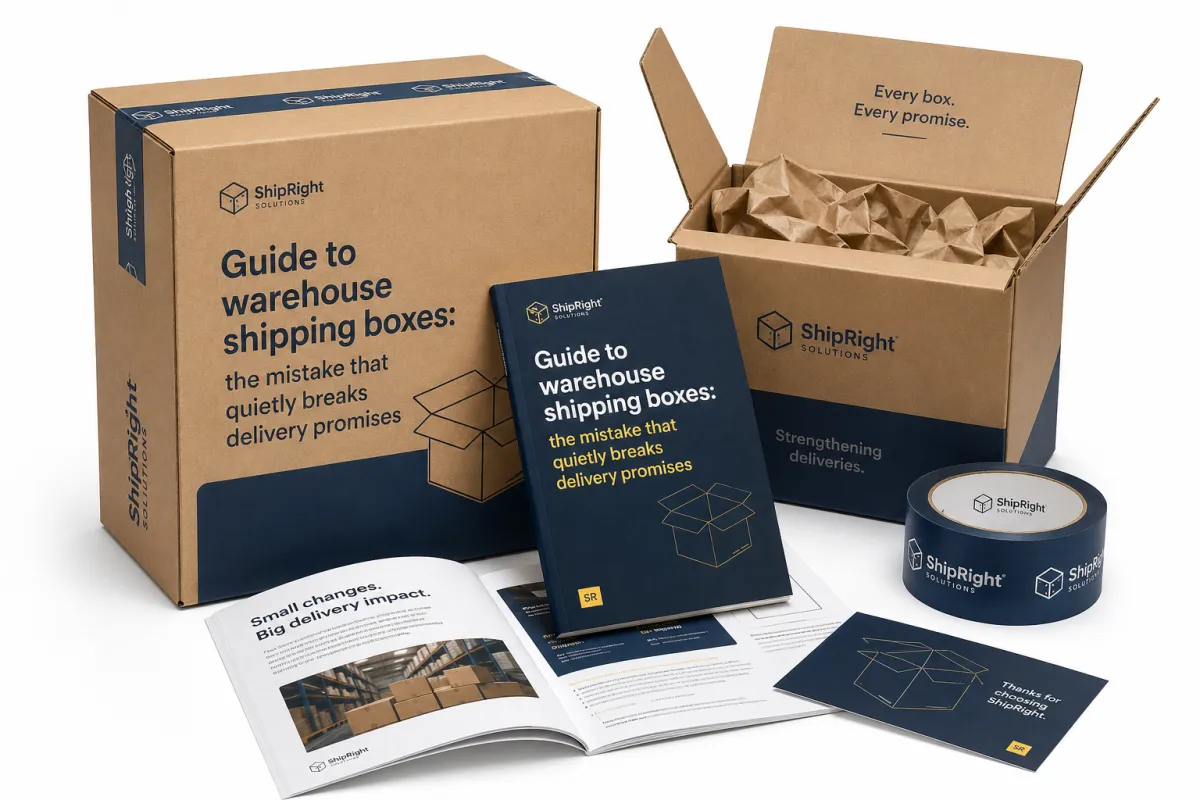
The costly mistake is rarely the cracked wall of a carton that arrives on a dock. It is the chain reaction that follows a poor fit: repack labor, scan retries, delayed staging, and claims that show up as a cash flow problem by quarter end. One poorly sized load can look manageable, then cascade into extra touchpoints that add up to serious delay.
In plain language, a warehouse shipping box acts like a freight-grade node inside your flow. It supports storage transfer, pick-and-pack, staging, and final shipment. It may be single-use corrugated, reusable, or mixed-use, but the box choice determines whether handling is predictable or improvised. When the physical format shifts every month, the operation loses rhythm and eventually pays for it in labor.
Fit and strength create more than protection; they create consistency. A box that is sized for cube efficiency and tested for compression or drop events will usually outperform a premium-looking box that only works on paper. Label placement matters too, because clear handling instructions on every family reduce the chance of wrong closure, upside-down loading, or bad orientation at the line.
A box that looks correct on a spreadsheet and collapses at the dock is not a savings. It is a future claim.
The cost side is equally direct. Carrier billing can pivot on actual weight, dimensional weight, and stack geometry. A box that carries dead space can inflate the invoice even when the item is perfectly packaged. A box that buckles under load converts one missed delivery into multiple replacement costs and a customer support spiral.
Some teams ignore this because each problem feels small at the moment it happens. Then they wonder why performance metrics look contradictory: utilization looks fine, complaints still rise, and margins are softer each month. In this guide to warehouse shipping boxes, the focus is the opposite of theater: choose materials, specs, and operating rules that keep the system stable before the first trailer doors open.
How do warehouse shipping boxes fit inside a logistics workflow?
A box never behaves in isolation. In a normal flow, it touches picking, packing, weighing, dimensions capture, sealing, staging, loading, transportation, unloading, and receiving. If one touchpoint is weak, the next team assumes extra risk.
Static strength matters on the dock and in the warehouse while stacked. Dynamic strength matters in motion, where vibration and handoffs turn a good-looking carton into a weak link. Empty space has a cost because voids let the load shift and increase scuff, puncture, and corner deformation risks. That is why fit is not just a space calculation; it is a handling risk reducer.
Single-wall corrugated is common for lighter, stable items and shorter handling paths. Double-wall brings better load-bearing for heavier parts, rougher handling, and higher vertical density on pallets. Reusable totes work well in closed-loop environments with strong reverse logistics, but they are never truly plug-and-play.
That last part is why some loops collapse. The return path needs real assets, scan events, and parking/storage discipline. I saw one client lose 18% of totes to cross-dock drift because the team did not designate a return bin at the destination. The tote purchase decision was fine; the process design was not. The tote itself looked “efficient,” but the operation treated it like single-use packaging.
Physical constraints can defeat the fanciest carrier-approved box. Aisle width, cart geometry, scanner line-of-sight, and pallet overhang can all create subtle friction. A carton may ship beautifully yet jam a flow rack or force a detour at the pick station. In that case, the right guide to warehouse shipping boxes starts with the floor plan, not the printer proof.
For teams handling mixed weight and shape profiles, combining box families with other protective formats can reduce cost and complexity. Flat products, cushions, and low-fragility parcels can sometimes go in Custom Poly Mailers while rigid SKUs stay in corrugated. That distinction is often the first real lever.
Guide to warehouse shipping boxes: key factors for choosing the right fit
The first question is not “what box is cheapest,” it is “what box fits the workload without costing more labor later.” Sizing starts with the longest dimension of the product, then adds only the cushioning and bracing the product truly needs. A rigid appliance can often tolerate tighter tolerances; electronics in sensitive assemblies usually need softer handling allowances.
Next comes weight and expected stress. Corrugated choices are often discussed through burst, edge crush, and compression behavior. You do not need to memorize a spec sheet, but You Need to Know what failure mode matters for your lane. If the box sits under 6-10 cartons on a loaded pallet for long periods, static compression matters more than a small margin in initial unit cost.
Product profile changes everything. Sharp parts can slice dividers and corner reinforcements if unsupported. Moisture-sensitive loads may need barrier layers or controlled warehouse humidity, not just a bigger box. Fragile components may need partitioning or foam elements that trade bulk for shock management. That is why package protection is usually a system of layers, not a single material choice.
Carrier compatibility should be decided at the same time as warehouse compatibility. Pallet patterns, barcode readability, and pallet height limits can drive box preference as much as material properties. Inconsistent carton footprints often slow sortation and complicate receiving inspection because scanning lanes are built for regularity.
One hidden risk in this area is dimensional weight surprises. A slightly larger external size may look fine in a quote and still push parcels into higher carrier pricing bands. That tax arrives in a way that is almost always annoying: no big headline, just a line-item that repeats forever.
Sustainability should be real, not decorative. Recycled content, FSC claims, and recyclable structure are useful when they align with performance and volume. For broader context, the EPA paper and paperboard guidance is a practical reference point for stewardship conversations. In this guide to warehouse shipping boxes, stewardship should follow function, not replace it.
The best practical play is grouping SKUs into three families: small, standard, oversized. Then assign one primary carton family and one backup family to each. The fewer exceptions you lock in, the more your operation feels like a machine and less like a test lab every day.
Common fit logic that actually works
A sizing rule beats guessing every shift. Start with longest dimension, add tested protection allowance, then validate both pallet efficiency and dimensional-weight impact together. If protection creates too much volume, tighten cushioning strategy before increasing box size.
For mixed-SKU environments, a two-core strategy usually works best: one high-volume standard and a short fallback set for outliers. That keeps the floor moving and reduces the temptation to “just force it” into a generic carton. Forcing always creates hidden cost.
In one warehouse run, a single outlier SKU drove 11% of repacks because it had no proper fallback. The fix was adding a second oversize box family, not redesigning every SKU. Sometimes the shortest path is a little extra shape control, not a full custom redesign.
Step-by-step guide to warehouse shipping boxes specification
A real specification process starts with data, not opinions. Begin with a SKU audit covering cube, weight, fragility, and shipping frequency. Group SKUs by physical behavior, not by supplier, and keep that clustering visible to both operations and sourcing teams.
Step 1: Build the SKU clusters. You need at least three buckets: high-volume stable items, high-volume variable items, and low-volume irregular items. The high-volume stable group often supports tighter standardization, while the irregular group usually benefits from backup sizes.
Step 2: Build a box matrix with primary, secondary, and temporary substitution options. Keep stockout behavior planned instead of hoping procurement can fill gaps at 4 p.m. on a Friday. A weak matrix turns every station into a makeshift office.
Step 3: Review warehouse constraints before finalizing the size set. Measure pallet footprints, conveyor throat dimensions, cart access clearance, and overhead heights where applicable. A technically correct box that is hard to move becomes expensive almost immediately.
Step 4: Run a short pilot, then measure it. Two to four weeks is usually enough to spot whether the selection works under real demand swings. Track damage incidents, air percentage, scan accuracy, pack speed, and utilization drift; these numbers prevent emotional decisions.
Step 5: Assign operating ownership. Name who owns procurement, who verifies incoming carton quality, who approves substitutions, and who authorizes full-scale rollout. Without ownership, a strong specification will still die in execution, which is a familiar pattern in many projects.
When placing custom orders, include clear production notes: board grade, flute structure, closure type, print coverage, moisture tolerance, and stacking expectation. If print is included, request a sample and compare proof, structure, and panel layout against a full package test. At Custom Packaging Products level planning, the carton is never isolated; tape, labels, inserts, and end-use packaging have to behave together.
On timing, common corrugated production can take roughly 12-15 business days after final approved proof, with longer schedules when complex die-cut work, large runs, or restricted materials are involved. This varies by region, mill load, and shipping lane, so build a buffer and share a contingency path with operations.
Use standards where they add value. ISTA test methods are the practical baseline for transit simulation, and ASTM methods are commonly used for broader packaging validation. Even if you do not run full lab certification on day one, use one standardized test pattern so your team can compare lots by apples to apples.
Common mistakes with warehouse shipping boxes and why they happen
The first common mistake is buying by unit price alone. A lower quote can seem smart until you add labor, over-packing, damage, and carrier penalties. In one operation, a “cheap” box family saved pennies and cost dozens of dollars every time a line had to slow down for rework.
The second mistake is ignoring the reuse economics of totes. Reusables can be a big win, but only where return flow, storage, cleaning, and tagging are disciplined. If a tote disappears in remote facilities or sits idle for weeks, the business case erodes fast and quietly.
The third mistake is underestimating sustained compression while over-valuing drop performance. A package can survive a hard drop test and still fail under vertical load after stacking. That mismatch usually shows up after the pallet is half loaded, which is when everyone assumes the issue came from handling instead of structure.
The fourth issue is skipping incoming quality checks. Supplier-to-supplier variation in board stiffness or glue line quality is not rare. If your QA gates do not include seam adhesion, dimensions, and board stiffness checks, one weak lot can ruin an otherwise stable run.
A simple fix is to define incoming acceptance thresholds and document who escalates exceptions. Batch-level inspection and release criteria remove the guesswork. That is often the difference between “we had an issue” and “we had a repeatable incident.”
The fifth mistake is treating all SKUs as equals. Fragile, sharp, high-value, or moisture-sensitive items demand different packaging behavior. A one-size mindset looks clean, but it is usually the doorway to avoidable claims.
Here is a blunt rule that saves effort: if an item is delicate, irregular, or expensive, slow down the box approval, not the ship date by accident. Speed can be good; blind speed just moves risk downstream. The phrase “gonna” might sound casual, but in launch planning that is exactly what happens when teams skip validation and push anyway.
Expert tips for reducing waste, damage, and delay with warehouse shipping boxes
Two-tier sizing is one of the highest ROI moves for practical operations. Keep one standard set for the majority of outbound orders, then keep one smaller fallback group for recurring odd shapes. It reduces decision fatigue and prevents the “one generic box for everything” trap.
Use visible handling logic on each carton family: max stack count, accepted orientation, closure method, and any special storage rule. Teams on the floor should see it in seconds. If they have to ask, the box will eventually be treated inconsistently.
Standardize closure by weight band. A light parcel does not need the same sealing method as a dense or tall box. Weak closures are silent damage multipliers; they often fail at the worst possible time, usually in transit, not at the pack station.
Build a damage attribution protocol before scale. Separate issues into fit, closure, handling, or transport impact. When every failure gets coded into one generic “damage” bucket, teams start arguing, and the same problem repeats.
Track three indicators weekly: pallet utilization, incident rate by root cause, and cost per shipped line. Combine those with carrier performance metrics so packaging changes are reviewed in the same dashboard as fulfillment quality. If the program runs in a filing folder and never enters weekly operations rhythm, it will decay.
Sustainability is not just about reducing volume of plastic or paper; it is about reducing avoidable failure rates. Better fitting cartons reduce filler. Better board performance reduces handling damage. Fewer failures reduce return freight and support load. That link is measurable and it usually lands in the P&L faster than marketing claims.
If mixed low-profile SKUs are part of your mix, run a side-by-side comparison with mailers where appropriate. Some lines do better in Custom Poly Mailers because they reduce empty space and simplify handling. The goal is not to maximize one material category, but to maximize right-fit match.
Cost of warehouse shipping boxes: pricing logic, hidden fees, and levers
The unit price is only the headline. Total cost has five pieces: unit purchase, storage impact, freight impact, damage impact, and labor impact. A cheaper carton that adds packing time, overfill, or replacement freight is not a cheaper solution. It is a delayed cost center.
Common price ranges in industrial contexts often look like this: basic single-wall corrugated between about $0.40 and $1.20 per unit, double-wall between $1.10 and $3.50 per unit, and reusable totes between $8 and $35 depending on size and durability. But these are directional; freight terms, print complexity, volume, and paper supply conditions can shift these quickly.
Reusables deserve special scrutiny. A tote bought for $8 can be strong value if returned on time, but it can become expensive inventory if it drifts across facilities and gets stuck in queue. You have to account for retrieval, tracking, and cleaning cycles before deciding the economics.
Hidden fees are where most savings vanish. Overstocking to avoid outages increases carrying costs. A small bump in damage drives replacements, labor, and expedited freight. Poorly calibrated dimensioning increases dimensional weight and often pushes shipments into higher charge bands, which can feel like a random surcharge but is usually design-caused.
To compare systems, use two lenses: usable-cube cost and delivered-unit cost. A small savings on the unit price can disappear when packing time rises or damage repeats. I usually start with landed cost per thousand shipped units because that catches both procurement and operations together.
| Box option | Typical unit cost | Best use | Main tradeoff |
|---|---|---|---|
| Single-wall corrugated | $0.40-$1.20 | Light to medium SKUs, short routes, stable loads | Lower compression resistance |
| Double-wall corrugated | $1.10-$3.50 | Heavier items, stacked pallets, rougher handling | Higher cost and more storage cube |
| Reusable tote | $8-$35 | Closed-loop warehouse moves, repeat routing | Requires return flow, tracking, and cleaning |
| Custom die-cut shipper | $0.70-$2.80 | Products needing precise fit and better presentation | Tooling and MOQ pressure |
Govern pricing with supplier scorecards instead of only quoting spreadsheets. Include seam consistency, dimensional tolerance adherence, on-time replenishment, and complaint rate. A supplier with the lowest price but recurring quality drift can be the most expensive option over one quarter.
Standardization and fit are not enemies if you set the boundary correctly. Standardization lowers complexity. Tight fit lowers dimensional weight, labor variation, and damage risk. The right balance depends on throughput and SKU volatility; if either changes, revisit the matrix.
Some buyers ask for a single final number for “cost per box.” That number exists, but by itself it is incomplete and often misleading. The honest cost story has to include handling and breakage impact, and that part is usually the one that gets skipped.
Process and timeline: guide to warehouse shipping boxes implementation action plan
Implementation timing is where many good selection projects fail. A strong box decision still fails if rollout moves faster than the warehouse can absorb. A practical 5-week template helps:
Week 1: clean data, cluster SKUs, and confirm current damage/freight baselines.
Week 2: finalize specs and run supplier shortlisting and sample approval.
Weeks 3-4: pilot production, line testing, incoming QA, and adjustments.
Week 5: gate review, scale decision, rollback criteria, and training refresh.
Split ownership into three lanes. Procurement manages supplier communication and order placement. Operations owns testing, line fit, and storage planning. Carrier coordination checks weight bands, dimensional charges, and pallet patterns. If lane leaders do not reconcile weekly, the rollout drifts and blame escalates.
Set checkpoints with hard thresholds. By day 7, validate fit and line compatibility. By day 21, check damage trend, utilization, and labor touch changes. If utilization improves but pack time doubles, the solution is not done yet; it is just more expensive in disguise.
Use go/no-go gates with measurable criteria: damage rate ceiling, fit rate floor, pallet utilization target, touches per order, and maximum acceptable rework. If metrics are not visible, the rollout becomes a preference exercise, and preference never holds under growth.
Document pack sequence, closure style, label positions, and inspection sequence before full production starts. Train and rehearse in controlled batches, not by broad memo. A good process is visible before a container arrives, not after the first complaint.
The closeout phase should include reorder triggers, permanent SKU-box assignments, and channel-by-channel adaptation where useful. Some SKUs may migrate to direct-mail styles or mailer formats if demand shifts. A good program is never a frozen set of rules; it is a managed system with planned revision points.
If you build the next quarter on this guide to warehouse shipping boxes, the outcome is usually less frantic: fewer repacks, cleaner pallet profiles, and calmer docks. It is not a glamorous outcome, but it is the one that protects service levels and margin.
How do I use a guide to warehouse shipping boxes for mixed SKUs without overbuying inventory?
Create three SKU groups: small, standard, and oversized. Assign one or two primary carton families per group and cap reorder quantities by family velocity. Reorder by consumption and not by date-based habit. For example, if oversized SKUs represent 8% of outbound volume, keep their fallback stock tied to actual weekly burn, not a calendar cycle. That keeps cartons closer to demand and avoids full-bin stagnation.
What timeline should I expect from testing to full deployment of warehouse shipping boxes?
A 4-6 week deployment is usually realistic for most operations: one week for data cleanup, one for pilot sourcing and sample approvals, two for workflow testing, and 1-2 weeks for threshold-based adjustment. Keep stage gates for damage rate, fit rate, and pallet utilization before scaling. If metrics fail, pause before a full rollout and fix quickly.
How can I estimate the true cost of warehouse shipping boxes beyond unit price?
Track four buckets together: unit cost, repack labor, freight delta from cubic/weight inefficiency, and damage-related loss. Then calculate landed cost per shipped unit across a fixed period. That gives you a total-cost view the purchasing quote alone cannot. For trustworthiness, run this comparison on at least two purchase cycles, not just one.
How many drops or stack cycles can a warehouse shipping box survive before replacement?
Use supplier test values for corner crush, edge crush, and drop performance, then compare those to actual handling conditions on your lanes. Track a conservative replacement threshold by cycle count on high-risk SKUs, especially where vibration and rehandling are high. The practical rule is to rotate before failure patterns become visible to customers. That is the core value of this guide to warehouse shipping boxes.
What is the fastest way to cut damage using warehouse shipping boxes right now?
Start with the 20% of SKUs generating the most incidents. Tighten fit tolerances, upgrade the weakest box class, and enforce one closure standard for each weight band. Then run one focused team training cycle and measure damage for 2-3 weeks. You will usually see real movement fast because weak links are usually concentrated, not evenly distributed.
Clear takeaway: if your team is still debating size while the warehouse keeps improvising, lock one standardization cycle now—pick a pilot category, set measurable gates, and only then expand. That simple discipline is what makes a guide to warehouse shipping boxes more than copy; it becomes an operating system for better service and safer margins.