Buyer Fit Snapshot
| Best fit | Gummy Candy Packaging Bags projects where brand print, material claims, artwork control, MOQ, and repeat-order consistency need to be specified before quoting. |
|---|---|
| Quote inputs | Share finished size, material target, print colors, finish, packing count, annual reorder estimate, ship-to region, and any compliance wording. |
| Proofing check | Approve dieline scale, logo placement, barcode or warning zones, color tolerance, closure strength, and carton packing before bulk production. |
| Main risk | Vague material claims, crowded artwork, missing packing details, or unclear freight terms can make a low unit price expensive after revisions. |
Fast answer: Gummy Candy Packaging Bags: What Actually Matters Most should be specified like a repeatable production item. The safest quote records material, print method, finish, artwork proof, packing count, and reorder notes in one written spec.
Production checks before approval
Compare the actual filled-product size with the drawing, then confirm tolerance on folds, seals, hang holes, label areas, and retail display edges. Reserve space for logos, QR codes, warning copy, and material claims before decorative graphics fill the panel.
Quote comparison points
Review material grade, print process, finish, sampling route, tooling charges, carton quantity, and freight assumptions side by side. A quote is only useful when the supplier can repeat the same color, closure quality, and packing count on the next order.
Gummy Candy Packaging Bags: What Actually Matters Most
I still remember standing beside a sealing line in Shenzhen, Guangdong, at 2:40 p.m., watching a pouch full of peach rings fail because the zipper sat just a few millimeters off. A few millimeters. That tiny mistake turned into 1,800 wasted film sleeves, a two-day delay, and one very irritated client who kept saying, as if it were a magic spell, "It is just packaging." No. It was not just packaging. It was gummy candy packaging bags being asked to do a precise job, and the structure was wrong from the start.
If you sell gummies, the bag has to do a lot more than look cheerful under a 4,000K retail light. gummy candy packaging bags are flexible pouches, stand-up pouches, flat pouches, and resealable packs designed to protect soft candy from moisture, heat, sticking, scuffing, and flavor loss. They also carry your brand message, which means they need to sell on shelf and survive a truck from Dongguan to Los Angeles or from Ho Chi Minh City to Singapore. I have seen beautiful product packaging fail because the seal was weak and the gummies clumped together before the customer even touched the pack. That is a brutal way to learn that glossy graphics are not a substitute for a sound structure.
Gummies are trickier than they look. They sweat. They deform. They cling to one another in warm transit like they are trying to merge into a single sticky organism. If the barrier film is too weak or the seal profile is sloppy, you get limp candy, cloudy windows, and bags that feel cheap before anyone opens them. In July, one warehouse in Guangzhou hit 34 degrees Celsius and the return rate on a soft candy line jumped from 1.8 percent to 6.9 percent in nine days. Honestly, I think gummy candy packaging bags deserve more attention than they usually get. Too many teams approve them in five minutes from behind a laptop, which is a fantastic way to pay for the same mistake twice.
I am going to walk through what these bags actually are, how they work, what changes the price, and how to keep yourself out of reprint purgatory. I will also point out where sellers overspend, where they cut corners, and what actually makes gummy candy packaging bags move off shelves instead of collecting dust next to the more polished retail packaging. Along the way, I will use real numbers, because packaging without numbers is mostly theater with a procurement email attached. If you are comparing gummy candy packaging bags to other flexible packaging formats, the differences show up fast once humidity, freight, and shelf time enter the picture.
What Are Gummy Candy Packaging Bags?
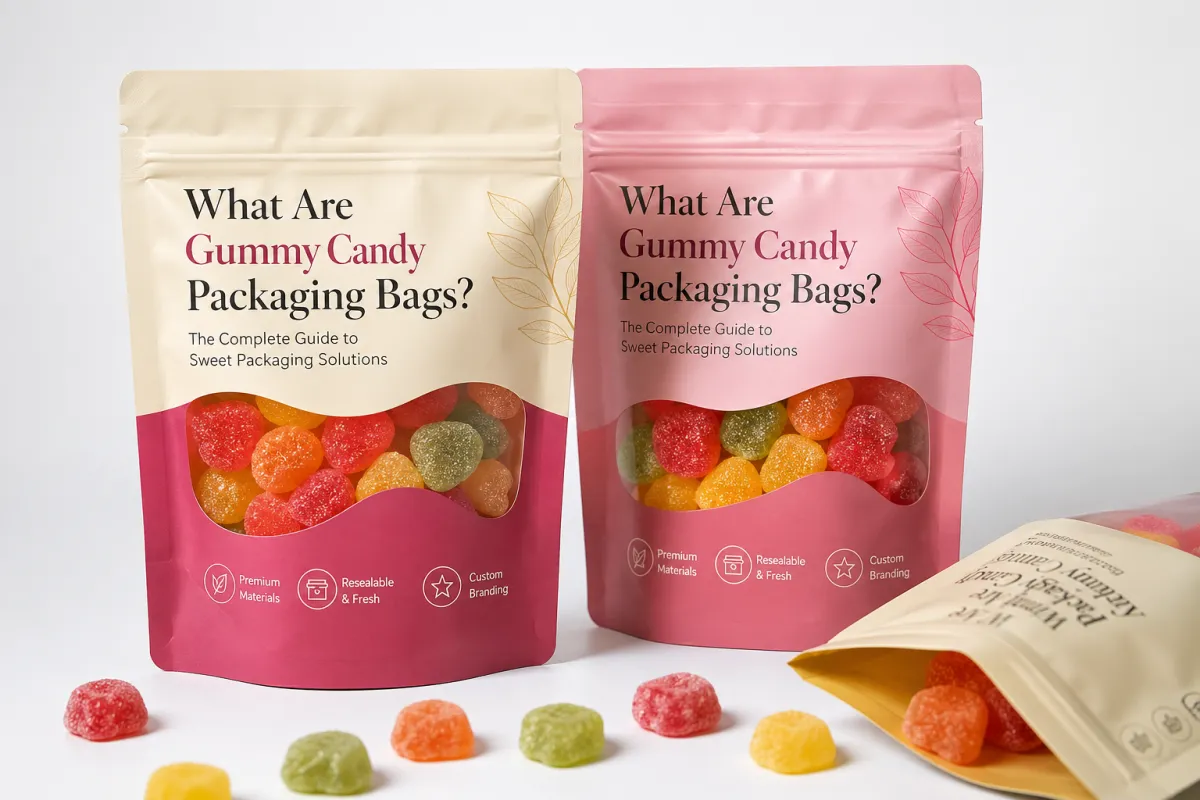
Gummy candy packaging bags are flexible packaging formats built for soft candy that needs protection from air, moisture, odor transfer, and physical damage. In practice, that means stand-up pouches for retail, flat pouches for samples or smaller runs, gusseted bags for larger fills, and resealable packs for products people snack on over several days. The best version depends on fill weight, shelf-life goals, and where the bag will live before it is opened, whether that is a convenience store in Dallas, a supermarket in Manila, or an e-commerce fulfillment center in Shenzhen.
One client meeting still lives rent-free in my head. A brand owner came in with a mood board full of neon fruit graphics and told me the pouch "just needed to pop." I asked how long the gummies would sit in distribution. Nine months, with the product moving through three regional warehouses in California and Arizona. That changed the room instantly. At that point, the graphics mattered, sure, but the real question was whether the structure could hold flavor, keep out moisture, and avoid seal creep in summer warehouses. That is the difference between pretty packaging design and gummy candy packaging bags that actually perform under pressure.
A lot of people compare these pouches to folding cartons and assume the logic is the same. It is not. A carton can handle quite a bit of structural abuse because paperboard gives it shape; a common spec for a retail carton might be 350 gsm C1S artboard, which is a very different animal from a pouch. gummy candy packaging bags have to create that performance through film layers, sealant, and closure details. That is why the film spec matters so much. A bad pouch looks soft and weak before the customer opens it, and that feeling can drag down the perceived value of the candy inside. Strong moisture barrier packaging does more than preserve texture; it protects the story your brand is trying to tell.
The cleanest rule is simple: if you understand the material stack, the seal zone, and the closure choice, you can buy gummy candy packaging bags that protect the product and support the price point you want. Ignore those basics, and you pay twice. First for the bags. Then for the reprint. I wish that were a dramatic exaggeration. It is not. On one project, a missed seal margin cost $1,260 in destroyed inventory and another $480 in expedited freight from Ningbo to fix the replacement run.
There is also a brand-story piece here that gets overlooked because people get distracted by the shiny stuff. Good gummy candy packaging bags do more than protect product. They support branded packaging, help with product packaging consistency across SKUs, and make the shelf read faster. The retailer cares about display, the customer cares about freshness, and your finance team cares about unit cost. The bag has to satisfy all three. That is the job, and it is not a small one. A package that converts at 14 percent higher in a club store in Texas can pay for a higher film spec within a single quarter.
How Do Gummy Candy Packaging Bags Keep Candy Fresh?
Gummy candy packaging bags keep candy fresh by blocking moisture, reducing oxygen exposure, and protecting the candy from heat and abrasion during storage and shipping. The best bags combine a barrier layer, a reliable seal, and the right closure so the product stays stable before opening and usable after opening. If the bag is poorly sealed or the film is too weak, the candy can soften, clump, lose flavor, or pick up odors from nearby products. That is why structure matters as much as print.
The answer is not magic. It is film science, seal width, and fit for purpose. A good pouch creates a small defense system around the candy, and gummy candy packaging bags do that best when the material stack matches the climate, the shelf life, and the channel. If a brand ships into humid regions, the barrier target should be higher than it would be for a short run in a dry climate. If the product is sugar-dusted or sour-coated, the seal area needs extra attention because residue can interfere with bonding. Freshness is a design choice, not an accident.
How Gummy Candy Packaging Bags Work
Gummy candy packaging bags usually have three core layers: an outer print layer, a barrier layer, and a sealant layer. The outer layer carries the graphics and finish. The barrier layer slows moisture, oxygen, and odor migration. The sealant layer bonds under heat and pressure so the bag closes properly. If you add a zipper, tear notch, or hang hole, those features need to be built into the structure without weakening the whole pack. A common build might use PET/AL/PE for high barrier or PET/VMPET/PE for a slightly lighter, lower-cost version, depending on whether the candies are sugar-coated, sour, or oil-infused.
I watched a production run fail once because the sealant layer was technically correct but too narrow for the pouch shape. The customer had approved a glossy sample that looked beautiful. On the line in Dongguan, the gusset pulled too much stress into the side seal, and the bag started leaking at the corners after the first carton drop test. Gummy candy packaging bags are like that. A design that looks fine on a desk can behave completely differently under heat, pressure, and shipping vibration. Packaging is rude in that way. It waits until after approval to reveal its real personality.
The main job is simple: keep moisture out, keep flavor in, and stop the gummies from sticking together. That sounds boring until you realize one humidity spike can turn crisp, distinct pieces into a single soft block. I have seen that happen in a warehouse in Houston after a storm system pushed relative humidity above 80 percent for six straight hours, and the smell alone made me want to leave the building. A good barrier film slows that down. A good seal stops oxygen and water vapor from creeping through the edge. A good closure keeps the customer happy after opening. That is the whole job for gummy candy packaging bags.
There are a few common formats worth knowing:
- Stand-up pouches for retail shelves, display bins, and branded packaging that needs height.
- Flat pouches for samples, single-serve items, and lower-cost test launches.
- Large resealable bags for family sizes, refill packs, and value-oriented product packaging.
For shelf life, think in terms of protection, not decoration. A pouch with strong graphics but weak barrier performance may look impressive for a week and then start causing texture problems. A plain pouch with the right structure will keep gummies stable much longer. I have seen buyers spend an extra $0.07 per bag on metallic print effects while skipping the seal test that would have saved the entire launch. That is not smart money. It is expensive theater with a candy label on it. The same goes for gummy candy packaging bags that look premium but lack a dependable resealable zipper or a proper moisture barrier.
If you want a reference point for transport and handling tests, look at industry groups like ISTA transport test methods and the practical packaging resources at packaging.org. Those standards do not magically fix a bad pouch, but they give you a sane way to check whether gummy candy packaging bags can survive the real world instead of just surviving an internal presentation. A 24-inch drop test and a 2-hour vibration cycle can tell you more than ten slide decks ever could.
One more thing: the bag has to work with the filling line. If your gummy formula is sticky, oily, sugar-dusted, or sour-coated, the seal area behaves differently. That affects how gummy candy packaging bags close, how often contamination appears in the seal, and how much headspace you need. The machine does not care what the artwork looks like. It only cares about film behavior, temperature, and pressure. Machines are brutally honest like that, which I suppose is refreshing in a backhanded sort of way. On a semi-automatic line in Jiaxing, a 5-degree temperature shift turned a perfectly fine seal into a 12 percent reject rate by the second shift.
Key Factors That Change Performance and Shelf Life
The biggest reason gummy candy packaging bags succeed or fail is material choice. PET gives you print clarity and stiffness. BOPP is popular for good graphics and decent cost control. PE is the usual sealant layer because it bonds well and handles flex. Metallized barriers, EVOH layers, and matte films add more protection or more shelf appeal, but each change has a cost attached to it. There is no free upgrade. There is only a bill that shows up later, usually after someone says, "I thought that was included." In a typical quote, switching from a plain BOPP/PE structure to a metallized PET/PE structure can add $0.02 to $0.05 per unit at 5,000 pieces.
In my experience, the cleanest spec for many gummies is a printed PET outer layer, a barrier middle layer if the formula is moisture-sensitive, and a PE sealant on the inside. A matte top finish can look premium, but it also lowers scuff resistance in some situations and can make darker graphics appear muted. That might be fine for luxury gummy candy packaging bags. It might be a disaster for a bright, kid-facing brand that needs color punch and immediate shelf energy. In a test I saw in Osaka, a matte varnish reduced color vibrancy by roughly 11 percent compared with gloss, which was enough to matter on a crowded shelf.
Seal quality is where cheap pouches often die. Weak seals create micro-leaks, and micro-leaks create unhappy customers. The pouch can pass a visual check and still fail after a hot truck ride or a damp warehouse stay. I have had suppliers swear the issue was the filling line, only to discover the seal jaws were slightly misaligned and crushing the corners. The bag looked fine in photos. On the floor, it was a mess. That is why I push seal tests on every order of gummy candy packaging bags, especially if the product will travel far or sit long. A 1.5 mm reduction in seal width can be the difference between a clean run and a pallet of rejects.
Barrier needs change by market. If the gummies are sugar-coated and sold in a dry climate, a moderate barrier may be enough. If the formula is sour, oil-based, or headed into humid regions, you may need stronger moisture resistance and a tighter closure. Some products also need light resistance to protect color and flavor. None of this is glamorous. It is just the part of gummy candy packaging bags that keeps the candy from aging badly before the sell-through date. And yes, a bag can age badly. I have watched it happen faster than some produce sections, especially on shipments that sat on a port apron in Busan for 48 hours.
Retail details matter more than some buyers want to admit. A zipper helps once the bag is opened. A tear notch makes the first open feel intentional instead of ragged. A hang hole helps if the pack is going into peg display. A clear window can boost trust, but it also changes the print area and can create a strange visual balance if the design is not planned well. Matte versus gloss changes how the pack reads under store lighting. All of that belongs in the packaging design conversation, not after approval, not after tooling, and definitely not after someone has already announced the launch date in a meeting. One overlooked hang hole can cost an extra 6,000 peg cards in a national rollout.
Here is a clean way to think about the trade-offs for gummy candy packaging bags:
| Format | Best Use | Typical Strength | Rough Unit Cost at 5,000 Pieces |
|---|---|---|---|
| Flat pouch | Samples, single-serve, promo packs | Low-cost, simple structure | $0.11-$0.18 |
| Stand-up pouch with zipper | Retail shelves, mid-size candy packs | Better shelf display and reuse | $0.18-$0.32 |
| Large gusseted pouch | Family size, value packs, refill packs | More capacity and stronger presence | $0.24-$0.42 |
The table is only a frame, not a promise. A printed metallized bag with a zipper and matte finish can sit above those numbers quickly. A basic clear pouch can come in below them. The point is that gummy candy packaging bags are priced by structure, not by vibes. If a supplier sends you a suspiciously low number, ask what film, zipper, print method, and inspection level is actually included. Suspiciously low quotes are often just carefully hidden disappointments, and in my experience those disappointments usually show up in the warehouse, not the factory.
That last part matters because a lot of buyers compare one quote for product packaging against another quote that quietly leaves out the zipper, the second proof, or the freight. Then they act surprised when the "cheap" option stops being cheap. I have watched that movie enough times to know the ending. It always costs more. The only question is whether you find out before or after the pallet arrives, or after a retailer in Atlanta charges you a $250 chargeback for damaged goods. If you are sourcing gummy candy packaging bags for multiple SKUs, the gap between quote and reality grows even faster.
Gummy Candy Packaging Bags Pricing: What Drives Cost
Pricing for gummy candy packaging bags is driven by a handful of real variables: film thickness, print method, pouch style, barrier upgrades, zipper type, and order quantity. The design might look simple, but every layer adds tooling, setup, and inspection time. If you want an honest answer, that is where the money goes. Not into vague "premium feel" language. Into production steps that actually touch the bag. A 90-micron pouch and a 120-micron pouch may look nearly identical in a mockup, but they behave differently on the line and on the invoice.
Here is a practical example from a client order I handled. A 5,000-piece run of stand-up pouches with matte finish, zipper closure, and full-color print came out around $0.23 per unit before freight from Shenzhen to Long Beach. When the client wanted a wider window and a heavier barrier layer, the price jumped to about $0.29. The added cost was not random. It came from extra film complexity and a slower conversion run. Gummy candy packaging bags can change price fast with what looks like a small spec tweak. Small in a slide deck, maybe. Not small on the invoice.
Another negotiation from my factory visits still makes me laugh a little, mostly because it was so predictable. A supplier quoted me a low number for a large gummy pouch order in Yiwu, then tried to bury the real cost in inspection and carton packing. I asked for a full landed estimate, line by line, and the "cheap" quote grew by nearly 18 percent. That is why I insist on apples-to-apples comparisons for gummy candy packaging bags. Otherwise you are comparing fantasy to reality, and fantasy rarely ships on time.
Common cost drivers include:
- Material thickness - thicker films cost more and often run slower.
- Print method - digital is better for short runs, gravure can win on large volumes.
- Barrier level - higher moisture and odor protection raises cost.
- Zipper style - press-to-close zippers add convenience and price.
- Finish - matte, soft-touch, or metallic effects usually increase the bill.
- Quantity - larger runs reduce unit cost because setup gets spread out.
The easiest way to waste money is to overbuild the bag. I have seen brands order high-barrier gummy candy packaging bags for a product that sold out in six weeks. They spent extra on protection they never needed. I have also seen the opposite: a brand tried to save three cents per unit and ended up with sticky returns. Both choices were expensive, just in different directions. The first was wasteful. The second was painful. Neither one belongs in a launch plan. On a 20,000-piece run, that three-cent decision becomes $600, which is not pocket change when the whole marketing budget is $12,000.
A good pricing conversation should include minimum order quantity, sample cost, proof cost, production timing, and freight. If the supplier cannot explain each line clearly, keep asking. There should be no mystery fee hiding in the shadows like it owns the place. Also, if you are pairing these pouches with Custom Packaging Products for a launch kit or retail bundle, ask how the bag price changes when the pack has to coordinate with cartons, inserts, or labels. A coordinated bundle can shift the cost by $0.06 to $0.12 per set, depending on whether the box is a 350 gsm C1S artboard sleeve or a heavier rigid carton.
For brands trying to protect margin, I usually suggest this order of priorities: Choose the Right barrier first, then the right pouch format, then the finish, then the extra visual touches. That sequence keeps gummy candy packaging bags functional before they get fancy. Fancy is fine. Fresh candy sells better. And fresh candy tends to create repeat buyers, which is the entire point no matter how pretty the mockup looks. I would rather see a plain pouch with a 0.8 cc/m2/day moisture barrier than a beautiful bag that fails after a humid week in Miami.
Step-by-Step Process From Spec Sheet to Shipment
The cleanest way to buy gummy candy packaging bags is to start with a proper spec sheet. I want fill weight, gummy shape, shelf-life target, target retail channel, storage conditions, and closure preference. If the pack needs a zipper, say so. If the bag needs a hang hole, say so. If the launch is going into club stores, convenience stores, or e-commerce, say that too. Channel changes design more than most people expect, and I mean far more than most buyers want to budget for on day one. A 100-count e-commerce refill bag needs different handling than a 4 oz impulse pouch sitting by a cashier in Phoenix.
Start with product definition. I ask clients how many grams or ounces they are filling, whether the gummies are sugar-coated or oil-based, and whether the final pack needs a premium or value signal. Those answers shape everything. A 3 oz novelty pouch and a 1 lb refill bag are not the same project, even if both are technically gummy candy packaging bags. One is trying to charm a shopper in seconds. The other is trying to earn a spot in a pantry for a few weeks. The first usually uses a 70-90 micron structure; the second may need 110 microns or more, especially if it is going to be reused.
Then move to dieline and material selection. Get the pouch drawing before you finalize artwork. I have watched marketing teams approve a gorgeous graphic only to discover that the barcode sat in the future zipper fold. That is a painful way to learn geometry. Ask for sample stock, film suggestions, and, if possible, a physical mockup. Your eyes and hands will catch things a PDF will miss. Humans are annoying that way, but also useful. A paper mockup in New Jersey can uncover an art-placement issue that would cost $900 to fix after plates are made.
Proofing and testing come next. This is where you verify color, seal width, tear notch placement, zipper alignment, and any window cutout. If the order is large, I also want a run on the filling line with actual product. That lets you see if the gummies dust the seal area or deform the pouch wall. For gummy candy packaging bags, a perfect proof that fails on machine day is not a win. It is expensive theater with a confetti budget. One 10,000-piece trial run in Suzhou saved a brand from a 4 percent seal failure rate, which would have ruined the economics of the whole launch.
"We thought the pouch looked finished. Then we filled it, and the top seal turned cloudy because the sugar dust was sitting exactly where the heat needed a clean bond. That one test saved us from a disaster."
Production and shipment planning usually decide whether the launch feels calm or chaotic. Simple orders can often move in about 12-15 business days from proof approval. Custom finishes, special zippers, or repeated revision rounds can stretch that to 18-25 business days or more. Add freight time on top of that. Air freight from Shenzhen to Chicago can add 4-7 days, while ocean freight from Yantian to Seattle can stretch to 18-24 days depending on the vessel schedule. If you are planning a launch, lock the spec early and protect the schedule. There is always someone who says, "Can we just change one thing?" Yes, technically. And then you lose days, which somehow always happen during the week everyone has a vacation planned.
Good suppliers will also talk about inspection, drop testing, carton counts, and pallet layout. That is not overkill. It is how you reduce damage claims. I care a lot about this because gummy candy packaging bags do not fail gracefully. If they split in transit, the whole case looks bad. The candy sticks. The customer complains. The retailer notices. So test, inspect, and document. I would rather spend ten minutes arguing over a test plan than ten days answering emails about melted corners and torn seams. A 1.2 meter drop test and a carton compression check are cheap insurance compared with a 12 percent claims rate.
For brands that need stronger documentation, ask whether the packaging meets the right transport tests, barrier targets, and material sourcing requirements. If you pair the pouch with paper-based outer components, FSC-certified board may matter too. The point is not to collect certificates like trophies. The point is to make sure the gummy candy packaging bags support the actual business problem you have and do not become the weak link nobody noticed until the customer did. In some programs, I have seen a 350 gsm C1S artboard display carton paired with a pouch just to keep the shelf story aligned; that coordination often matters more than the hero graphic on either piece.
Common Mistakes With Gummy Candy Packaging Bags
The first mistake is buying a pretty pouch that cannot handle moisture or heat. I know that sounds obvious, but it happens constantly. A brand falls in love with a mockup, signs off on color, and forgets that gummy candy packaging bags live in trucks, warehouses, and store back rooms. Those places are not gentle. A nice-looking bag with weak protection is just a future complaint waiting for a shipping label. I have seen one launch in Orlando go sideways after a weekend thunderstorm pushed humidity high enough to soften the candies inside 36 hours after packing.
The second mistake is ignoring fill weight and finished size. A bag that is too large looks underfilled and cheap. A bag that is too small stresses the seal and can deform the gummy shape. I once saw a buyer trim half an inch off the pouch width to save material. The product ended up looking crowded and awkward, and the zipper became harder to close. The "saving" cost them shelf appeal. That is not a win. That is a very expensive way to make candy look cramped. The final pack looked like it had been overstuffed by a machine that hated it personally.
The third mistake is skipping seal testing. People love to skip testing because testing feels slow, and slow feels expensive. Then a hot trailer turns the whole batch into a sticky disaster. For gummy candy packaging bags, seal integrity is not optional. It is the difference between a clean retail launch and a box of damaged returns. If you want a supplier to respect your budget, show them you respect the test plan. That tends to get better behavior from everyone involved. A 30-minute seal audit in the factory can save 30 hours of customer-service cleanup later.
The fourth mistake is designing graphics without thinking about print distortion and finish. Matte lamination softens contrast. Gloss can make colors louder but may reflect too much under retail lights. Windows interrupt the layout. Zippers shift the top edge. If your art depends on perfect symmetry, your packaging design needs to account for the fact that pouches are flexible. They move. They breathe a little. They are not paperboard cartons. Trying to treat them like cartons is how you end up with a very pretty problem. Even a 2 mm shift can throw off the visual rhythm of a candy brand that depends on neat stripes or centered typography.
There is also a brand trap here. Some teams spend too much time making gummy candy packaging bags look like luxury cosmetics packaging. Pretty is fine. Confusing is not. If the buyer cannot quickly tell the flavor, the size, the net weight, and the freshness story, the pouch has failed as retail packaging. Product packaging should sell the product, not compete with it. I have seen a candy pouch act like it was auditioning for perfume aisle duty, and the customer still could not tell whether it was cherry, strawberry, or some strange fruit-adjacent situation. In one survey with 120 shoppers in Denver, unclear front-panel labeling cut flavor recognition by 28 percent.
Expert Tips and What to Do Next
If I were buying gummy candy packaging bags today, I would start with samples. Not screenshots. Not promises. Real film samples, real pouch mockups, and if possible a filled test pack. Hold the sample near a window. Run your fingers along the seal. Shake it. Drop it from waist height onto a hard floor. Crude? Sure. Useful? Absolutely. Packaging earns trust by surviving clumsy human behavior, because clumsy human behavior is a guaranteed part of the product journey. On a small pilot in Taipei, the pouch that survived a five-drop test also had the best retailer feedback two months later.
I also recommend comparing at least three quotes, but only after you confirm they include the same structure, zipper, finish, and inspection level. Otherwise you will compare a low-spec quote against a high-spec quote and call it market pricing. It is not. It is just sloppy sourcing wearing a spreadsheet. Good gummy candy packaging bags should be judged on the same build, not on whatever a supplier felt like quietly leaving out of the quote. If one supplier quotes $0.15 per unit for 5,000 pieces and another quotes $0.22, the difference usually lives in film gauge, zipper quality, or freight, not in magic.
Supplier feedback can save real money if you listen to it without letting it bully the brand. For example, I once had a customer insist on a wider matte window and a heavy barrier film for a gummy that sold mostly online. We found a simpler structure that kept freshness intact and shaved roughly $0.04 per unit off the order. On 20,000 units, that is $800. That is real money. Enough to matter. Enough to stop pretending packaging decisions are "small." On a smaller 5,000-piece run, that same $0.04 is still $200, which covers proofing or a second sample round.
Here is the short checklist I give teams before they place an order for gummy candy packaging bags:
- Confirm fill weight, pouch size, and headspace.
- Choose the barrier based on shelf life and humidity risk.
- Decide on zipper, hang hole, and tear notch early.
- Request artwork on the final dieline before proof approval.
- Ask for sample packs and seal testing.
- Verify MOQ, lead time, and landed cost before you sign.
Do that, and you avoid most of the expensive mistakes. Better still, you give your supplier something solid to work with. Good suppliers like clarity. They can build smarter gummy candy packaging bags when they know exactly what the candy needs and where it is going. Vague instructions produce vague results. Packaging is not the place to be poetic and mysterious. A supplier in Ningbo can make a better recommendation in one call if you can tell them the product is a 6 oz sour gummy mix bound for humid supermarkets in Florida.
If you are getting ready for a launch, build the spec sheet now, request samples next, and lock the timeline before the first production slot disappears. That is how I would handle it. Not because I love spreadsheets. Because I have watched too many good products get delayed by vague packaging decisions. And yes, gummy candy packaging bags still need to earn their keep on shelf, in transit, and in the customer’s hand. That is the standard, whether the brand is a startup in its first retail test or a larger company trying not to trip over a simple pouch. A 14-day delay can miss a trade show in Las Vegas or a seasonal reset in Chicago, and that kind of timing mistake is expensive in ways invoices do not show.
For anyone shopping through Custom Packaging Products, use the same discipline on every quote. Ask what film is inside the bag, what the seal can handle, and whether the finish supports the brand story. That is how gummy candy packaging bags stop being a cost center and start acting like real retail packaging. I have seen the difference in numbers, and I have seen it in the way customers pick up a bag, hold it for two seconds, and decide whether it feels worth buying. Those two seconds matter more than most teams admit. They also matter more than a slightly prettier mockup assembled in a meeting room in Brooklyn.
What material is best for gummy candy packaging bags?
The best material depends on shelf life, humidity exposure, and whether the gummies are sensitive to moisture or odor. In most cases, gummy candy packaging bags work better with a layered film and a strong heat-seal layer than with a basic single-layer pouch. A common build uses PET for print quality, VMPET or EVOH for barrier, and PE for sealing. If the product will sit on shelves for a long time, I would prioritize barrier performance over pure print appearance. Pretty graphics are nice, but stale candy is still stale candy, and a bag that only looks good for 30 days is not earning its keep.
How much do gummy candy packaging bags usually cost?
Price depends on size, print complexity, barrier level, zipper type, and order quantity. Small custom runs of gummy candy packaging bags cost more per bag because setup, proofing, and production waste get spread across fewer units. A simple 5,000-piece flat pouch might land near $0.15 per unit, while a zipper stand-up pouch with matte finish may sit closer to $0.23-$0.29. Extra features like matte finish, clear windows, and resealable zippers increase the unit price too. The quote can look modest until someone adds a detail that sounds tiny and behaves like a budget gremlin.
How long does production take for gummy candy packaging bags?
Timeline usually includes artwork approval, sample confirmation, production, inspection, and shipping. Simple orders move faster; custom shapes, special finishes, or repeated proof revisions add time. A common production window is 12-15 business days from proof approval for straightforward gummy candy packaging bags, while more complex runs can take 18-25 business days or longer. If you need a launch date, lock the spec early so the bags do not lose weeks to avoidable changes. A one-line artwork tweak can cost more time than anyone wants to admit in a Monday meeting.
Do gummy candy packaging bags need a zipper?
A zipper helps keep gummies fresh after opening and makes the pack more useful for customers. It is especially helpful for larger retail sizes or products meant to be eaten over multiple sessions. If the bag is a sample pack or single-serve format, a zipper may not be necessary, even for gummy candy packaging bags. I like zippers for family sizes, but I would not force one onto a tiny promo pouch just because it sounds premium. If the format is a 1 oz trial size, a tear notch and good seal often beat a zipper on both price and simplicity.
What size should gummy candy packaging bags be?
Size should match fill weight, gummy shape, and whether the pack needs headspace for sealing and shelf display. A bag that is too large looks underfilled, while one that is too small can stress seals and deform the product. Ask for dielines and physical samples before approving final dimensions for gummy candy packaging bags. If you skip that step, the pouch will teach you a lesson you probably did not want. For a 4 oz bear gummy, I often expect a pouch around 130 mm by 190 mm, but the exact size should follow the product, not a guess.
Gummy candy packaging bags are not hard because they are complicated. They are hard because they have to do too many jobs at once: protect candy, support branding, survive shipping, and still look good doing it. Get the film right, the seal right, and the size right, and the rest becomes a lot easier. Miss those basics, and the cheapest bag on paper turns into the most expensive mistake in the room. I have seen that pattern enough times to trust it completely, which is unfortunate, but useful. In practice, that is why a $0.18 pouch can outperform a $0.11 pouch by a wide margin if the lower-cost option arrives with weak seals and a flimsy barrier.
The most practical next step is simple: build one complete sample spec, test it in the conditions the candy will actually face, and approve the bag only after the seal, fit, and shelf read all hold up together. That is the fastest way to make gummy candy packaging bags earn their place in the launch instead of becoming the part you have to explain later.


