Buying Heat Transfer Neck labels wholesale is usually a comfort decision first and a branding decision second. Scratchy sewn tags still create returns, complaints, and the familiar “I love the shirt, hate the label” reaction. Heat-applied neck branding removes the fabric itch, cleans up the inside finish, and gives a basic tee or hoodie a more finished feel without adding another sewn component.
For apparel buyers, that matters because the inside of a garment changes how the whole piece is judged. A small, well-placed neck print can make a $9 blank feel closer to a private-label product. The economics are simple: fewer parts, fewer sewing steps, fewer chances to misalign branding, and less bulk at the collar. That is why Heat Transfer Neck Labels wholesale keeps showing up in DTC basics, athleisure, and private label programs that need a cleaner interior presentation.
The category is not one-size-fits-all, though. A transfer that looks sharp on a cotton jersey tee may fail on a brushed fleece hoodie if the adhesive, dwell time, or fabric finish is wrong. Buyers who get the best results treat neck labels as a production spec, not a decoration order. That distinction is where most of the cost savings and quality gains show up.
Why heat transfer neck labels outperform sewn tags in apparel sales
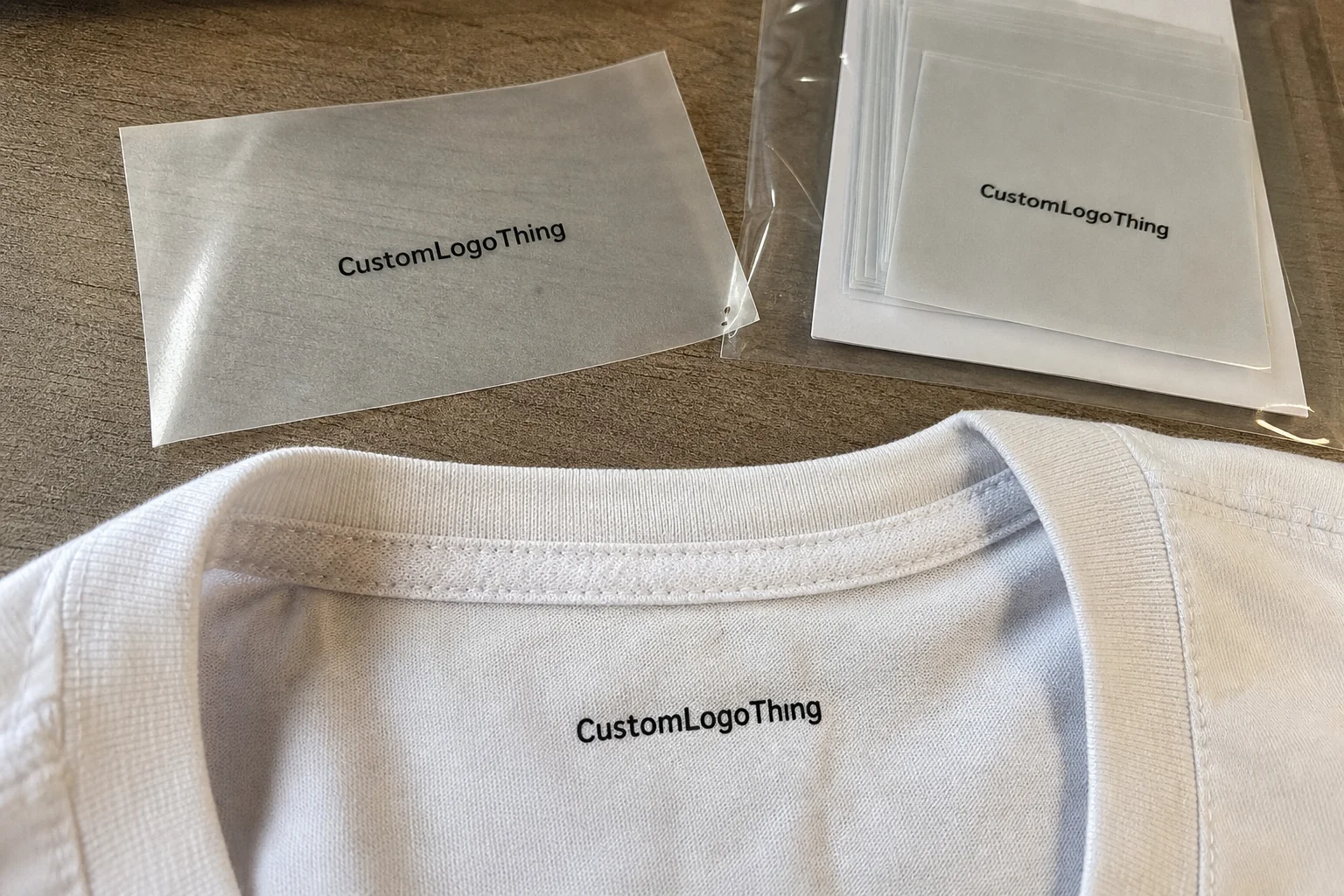
From a packaging and apparel buyer’s point of view, the inside of the garment is part of the product experience. A sewn woven label can work, but it also introduces friction: the tag rubs, it folds, it can be stitched slightly off-center, and it adds another production step. A printed neck transfer avoids those problems. The result feels simpler, and simplicity usually reads as quality when customers inspect a garment closely.
There is also a practical production angle. If a brand is running tees, hoodies, and joggers across multiple SKUs, one internal label spec can standardize the line. That reduces labor variation and limits the number of components that need to be tracked. In wholesale apparel, that is not a minor benefit. It can reduce rework risk and make reorder planning easier, especially when the label needs to be applied across several factories or fulfillment programs.
Another reason buyers move to heat-applied branding is perception. A small inside mark can change how customers judge the whole garment. The same cotton jersey tee may feel more premium if the neck area is clean and tag-free. That difference is subtle, but it shows up in customer reviews, return rates, and repeat purchase behavior. Many brands underestimate how much the interior finish influences the “this feels expensive” response.
“If customers notice the neck label, it should be because it looks clean—not because it itches.”
This format makes the most sense for:
- Direct-to-consumer basics where comfort is part of the brand promise
- Private label programs that want a consistent interior finish
- Athleisure and performance wear that avoids bulky seams at the neck
- Fashion basics with low tolerance for visible internal branding
For brands comparing options, Heat Transfer Neck Labels wholesale often wins on perceived value, reduced labor, and fewer defect opportunities. If you are already buying trims or packaging through an organized program, it can also fit into broader sourcing through Wholesale Programs and the broader trim mix inside Custom Labels & Tags.
Material options, finish types, and placement details
Not every heat transfer behaves the same way. Buyers usually encounter a few main systems: standard heat transfer, matte transfers, soft-hand finishes, and stretch-friendly options. The right choice depends on the garment fabric and the level of feel the brand wants inside the collar. A basic transfer can work well on cotton tees, while stretch fabrics usually need a formulation that tolerates movement without cracking.
Surface finish matters too. Glossy marks can stand out more, which helps with bold branding but can feel less premium on minimalist garments. Matte and soft-hand finishes usually blend better with the garment interior. On performance wear, low-profile finishes are often preferred because they avoid extra stiffness at the neck opening. For brands selling entry-level basics, the choice is often a trade-off between cost and tactility.
Placement is just as important as material. Some brands want the neck mark centered. Others prefer an offset placement to avoid collar seam interference or to fit alongside size information and care details. If the label includes a logo plus compliance text, the layout must be planned with actual neck real estate in mind. A too-large label looks crowded. A too-small one becomes illegible after washing.
What to specify before production
Before ordering Heat Transfer Neck Labels wholesale, buyers should confirm the following details in writing:
- Label size and final print area
- Shape: rectangular, rounded, or custom contour
- Color count and Pantone reference if color accuracy matters
- Placement: centered, offset, or lower-neck positioning
- Content: logo only, size, care symbols, origin, or fiber content
Garment compatibility matters too. Cotton usually accepts a wider range of application settings. Polyester and poly blends demand more care because heat can affect fabric sheen or dye migration. Performance fabrics and lightweight synthetics often require lower heat, shorter dwell time, or a different adhesive profile. That is why a sample on the actual fabric is better than a generic test sheet.
For compliance labeling, the inside print may need to include size, fiber blend, country of origin, and care instructions. Buyers should also check internal requirements against market rules before approving artwork. If the label must carry both branding and mandatory information, the typography hierarchy has to be legible at small scale. Fine type, tiny icons, and narrow letter spacing are common failure points.
Proofing deserves more attention than many teams give it. Small artwork can break down fast when reduced to neck-label size. Thin strokes disappear. Icons merge. Serif fonts get muddy. A good production proof should show the label at actual scale, not just as a generic logo mockup. If the art includes compliance text, the proof should show enough contrast to judge readability after transfer and after laundering.
Heat transfer neck labels wholesale specifications to confirm before ordering
The cleanest wholesale orders start with precise specs. If the supplier has to guess on font size, print area, or placement, the job gets slower and the risk of rework climbs. For heat transfer neck labels wholesale, the core specs to confirm are simple, but they matter a lot: print dimensions, minimum line thickness, Pantone matching, placement offset from the collar seam, and whether the design includes text beyond the logo.
Ask for a sample that reflects the real garment, not just a white cotton test shirt. A white sample tells you very little about how the transfer will behave on black polyester, heather gray blends, or textured fleece. If the target product is a stretch tee or brushed hoodie, the sample should match that fabric class as closely as possible. Color look, adhesion behavior, and edge definition can all shift when the substrate changes.
Durability is another point buyers should clarify before money changes hands. A properly applied transfer should hold up through repeated laundering without obvious cracking, peeling, or excessive color loss. That said, durability depends on the garment and the application settings. A transfer that works on heavyweight cotton may not behave the same way on ultralight performance knit. If the supplier can provide wash-test data or an internally validated test method, that is a better sign than a vague promise.
Application method should also be confirmed. Some programs use a standard heat press, while others rely on lower-temperature application because of fabric sensitivity. If the final user is applying labels in-house, the supplier should supply a clear temperature, pressure, and dwell-time window. A missing application spec is one of the easiest ways to create a bad batch, especially with mixed fabric orders.
For buyers managing compliance, confirm the exact text requirements early. Some programs need only a logo. Others need size, fiber content, care icons, and country-of-origin details. The difference affects layout, print area, and unit cost. If you add compliance text after artwork approval, expect delays. Production files should ideally be vector-based, with fonts outlined, a transparent background, and a clearly defined text hierarchy. That keeps the proof process tighter and reduces file cleanup charges.
One practical detail that gets overlooked: ask whether the transfer is designed for cut pieces, finished garments, or both. Some labels are more forgiving when applied before assembly; others are meant for finished neck openings only. That matters because collar stretch, seam thickness, and press access all change the result. A good supplier will ask about the garment stage instead of assuming the transfer can be applied anywhere.
| Spec item | What to confirm | Why it matters |
|---|---|---|
| Print area | Exact width and height in inches or mm | Prevents oversized labels that crowd the collar |
| Artwork format | Vector file, outlined fonts, transparent background | Improves proof accuracy and print clarity |
| Placement | Distance from collar seam and centerline | Reduces misalignment during application |
| Durability target | Wash, stretch, and rub expectations | Helps match transfer type to garment use |
| Compliance text | Size, fiber blend, origin, care symbols | Affects layout and regulatory accuracy |
One more detail saves money: confirm collar-to-print start measurement before the run begins. Even a few millimeters can change the look once the shirt is folded, packed, and worn. Small labels are unforgiving. A disciplined spec sheet is the easiest way to avoid rework.
Cost, pricing, and MOQ factors that change your quote
Pricing for heat transfer neck labels wholesale usually comes down to five variables: quantity, color count, label size, material grade, and any special finish. A plain single-color logo transfer in volume can be efficient. Add multiple inks, compliance text, or a specialty soft-hand finish, and the unit price climbs. That is normal. The question is not whether the quote changes. It is whether the added cost produces a better garment experience or a lower total production cost.
Small runs almost always carry a higher unit price because setup costs are spread across fewer pieces. Larger wholesale orders reduce the per-piece cost, sometimes sharply. That is why buyers should think in terms of total cost per labeled garment, not just the sticker price of the transfer. A transfer that costs a bit more can still be the better buy if it reduces sewing labor, shortens production steps, and lowers the risk of a crooked sewn-in label.
MOQ logic is usually straightforward. If the artwork is simple and the production method is standard, lower minimums may be available. If the design has multiple colors, fine type, or compliance text in several sizes, the MOQ may rise because setup and inspection time increase. If you need multiple garment colors or multiple placement versions, ask whether MOQ applies per design version or across the combined order. That distinction can change the quote materially.
Buyers also need to watch for hidden costs. Artwork cleanup, proof revisions, rush production, split shipping, and multiple warehouse drops can all add expense. Even packaging format can matter if the transfers need to be packed by SKU or bundled with garments for a fulfillment program. None of these costs is unusual, but they should be visible before approval.
Price ranges vary widely by order structure, but the pattern is consistent. Simpler orders tend to sit at the low end because setup is easier and inspection time is short. Orders with multiple print colors, smaller print areas, or precise compliance text move higher. Buyers who want a realistic quote should give the supplier the actual garment type, the expected annual volume, and whether the order is a one-time launch or a recurring restock.
A simple comparison helps:
| Order profile | Typical unit cost behavior | Best for |
|---|---|---|
| Low quantity, simple logo | Higher due to setup spread | Test runs and new product launches |
| Mid-volume, one-color branding | Moderate and predictable | Core basics and repeat styles |
| High-volume, compliance text included | Lower per unit, but more proof control | Private label programs and scale orders |
From a buyer’s perspective, the best quote is not always the lowest unit number. If a slightly higher-priced transfer saves labor at the sewing stage or cuts defects on the line, the total landed cost can improve. That is the comparison that matters.
Production steps, lead time, and delivery milestones
A clean production schedule usually starts with artwork review, then a digital proof, then sample approval, then full production, then inspection, and finally shipping. Each step can move quickly if the buyer is prepared. Each step can slow down if the garment specs keep changing. Simple repeat orders often move faster than first-time custom projects because the files, placement, and application settings are already known.
Typical lead time depends on order size, artwork complexity, and how fast approvals come back. If the design is simple and the files are production-ready, some orders can move on a tight schedule. If the artwork needs cleanup, or if the label includes compliance text and multiple size versions, expect more time. Seasonal pressure also matters. Peak apparel calendars can slow every supplier, even the good ones.
There are a few ways buyers can shorten turnaround. Send vector files. Keep the specs fixed after proof sign-off. Approve samples quickly. Provide garment color and fabric details up front. Those steps sound basic, but they often decide whether an order ships on time. Fast timelines are possible, but only when the project is disciplined from the start.
Quality control should not be an afterthought. Color matching, cut alignment, and adhesive consistency are the points that usually deserve inspection. If a label is slightly off-center, the garment looks less polished. If the adhesive performs unevenly, the brand inherits a customer problem. For buyers selling across retail channels, it can be smart to align testing with recognized standards such as ISTA for distribution handling and EPA guidance when evaluating material and process impacts across the supply chain.
Inspection reports are worth requesting on larger orders. Even a basic check list—print clarity, placement tolerance, color consistency, and adhesion appearance—can catch issues before cartons leave the line. On repeat programs, the comparison sample from the prior run is often more useful than a fresh mockup because it shows whether the new batch still matches what was previously approved.
Shipping deserves its own planning note. Domestic fulfillment can be simpler, but freight may be better for larger runs or multi-warehouse programs. If the transfers need to be split across several programs, confirm carton labeling and delivery windows before production begins. That avoids the common problem where the product is ready, but the receiving schedule is not.
Why wholesale buyers choose heat-pressed neck branding
Wholesale buyers are not shopping for slogans. They are comparing vendors on consistency, proof clarity, repeatability, and how well the supplier handles reorder changes. That is especially true for heat-pressed neck branding, where small errors become visible quickly. A label that is a few millimeters off or a shade too light can affect the perceived finish of an entire garment.
The practical advantages buyers care about are clear: flexible minimums, readable proofs, dependable color control, and support for multiple SKUs. If the order spans tees, hoodies, and joggers, the supplier needs to keep the inside branding consistent while adjusting placement and material settings for each fabric class. That is production support, not decoration.
Another point worth separating: decorative branding versus production-ready labeling. Decorative transfers can look good in a mockup. Production-ready labels need to survive handling, application, washing, and reorder cycles. Brands scaling beyond one-off launches usually discover that difference quickly. A supplier that understands the full apparel workflow saves time later, not just at order entry.
Cost control also matters at scale. The cheapest unit price can become expensive if the order produces rework, delayed shipments, or inconsistent garment presentation. Buyers who manage multiple SKUs usually care as much about repeatability as they do about price. A label system that behaves the same across seasons makes forecasting easier, which is a real advantage when inventory windows are narrow.
If neck labels are only one part of the program, packaging coordination matters too. Labels may need to ship with garments, be packed by colorway, or move through a retail-ready inventory flow. That is where reliable trim management helps. The fewer moving parts, the lower the chance of mismatch between the label, the garment, and the final carton contents.
Inspection standards also matter. Buyers should ask what happens if an approved proof does not match the finished output. Reprint policy, documentation, and traceability are trust signals. They do not need to be dramatic. They do need to be clear. The best wholesale partners make that information easy to understand before the first order ships.
“The best supplier is the one that makes reorder day boring.”
Next steps to place a wholesale order without delays
If you want a faster quote, gather the essentials before you request pricing: garment type, target quantity, label dimensions, artwork files, and whether the order needs branding only or full compliance information. That one decision changes the layout, the proof, and sometimes the minimum order. It also saves the back-and-forth that slows most first-time requests.
For stretch or performance fabrics, request a sample or at least a digital proof that reflects the actual textile. Do not assume a standard application will behave the same way on every fabric. If the garment has a brushed surface, moisture-wicking finish, or high stretch, the transfer spec should be chosen with that in mind. That is where experienced suppliers earn their keep.
Also prepare a reorder plan. If the style is likely to repeat, tell the supplier the likely volume range. That helps with current pricing and makes future restocks easier to quote. Brands that buy intelligently tend to think in seasons, not just single purchase orders. A clean repeat path matters almost as much as the first run.
Here is the short buying checklist:
- Send garment specs and artwork files.
- Confirm label size, placement, and content.
- Decide whether compliance text is required.
- Approve proof and sample before mass production.
- Lock MOQ, timeline, and shipping destination.
Use that sequence and the process stays manageable. Skip it, and the order tends to drift. If you are ready to move forward with heat transfer neck labels wholesale, keep the brief tight, the art file clean, and the production expectations specific. That is how you get a better label, fewer surprises, and a stronger garment finish.
For buyers comparing options across a wider trim program, the right next step is often to review Custom Labels & Tags alongside broader Wholesale Programs. The goal is not just buying a label. It is buying the right interior branding system for the garment, the budget, and the production schedule.
FAQ
What is the minimum order for heat transfer neck labels wholesale?
MOQ depends on transfer size, artwork complexity, and whether the design includes multiple colors or compliance text. Larger runs usually unlock better unit pricing, while smaller runs may still be available with a higher setup cost per piece. Ask for MOQ by size and by artwork version if you need multiple garments or colorways.
How durable are wholesale heat transfer neck labels after washing?
Durability depends on the transfer system, fabric type, and whether application settings match the garment specification. Well-applied transfers should resist cracking, peeling, and major color loss through repeated wash cycles. Request wash-test details or sample testing before approving a full production run.
Can heat transfer neck labels include size and care instructions?
Yes, most designs can include size, fiber content, care symbols, and country-of-origin details. The available space is limited, so typography must stay legible and the information hierarchy should be planned early. If compliance text is required, confirm regional labeling rules before artwork approval.
How long does production usually take for wholesale neck labels?
Lead time depends on proof approval speed, order quantity, and whether the artwork needs cleanup or revisions. Simple repeat orders can move faster than first-time custom projects with compliance text or multiple placement versions. Ask for both production time and shipping time so you can plan inventory accurately.
What files do I need to order custom heat transfer neck labels wholesale?
Vector artwork is preferred, along with outlined fonts and a transparent background when possible. Provide exact dimensions, placement instructions, logo color references, and all required text before proofing. If you do not have production-ready files, ask for artwork cleanup before the quote is finalized.