The inside neck is a small space with an outsized effect. If it looks unfinished, the garment feels cheaper; if it is clean and legible, the piece reads like a finished product. That is the practical appeal of Heat Transfer Neck Labels low MOQ: they give brands a retail-ready interior without the cost and commitment of sewn-in tags.
For small runs, the economics matter as much as the appearance. A startup testing its first drop, a boutique brand splitting a design across several colors, or a private label line trying a new body can use transfer neck labels to avoid overbuying inventory while still keeping the product polished.
Why low-MOQ neck labels make small apparel runs look finished
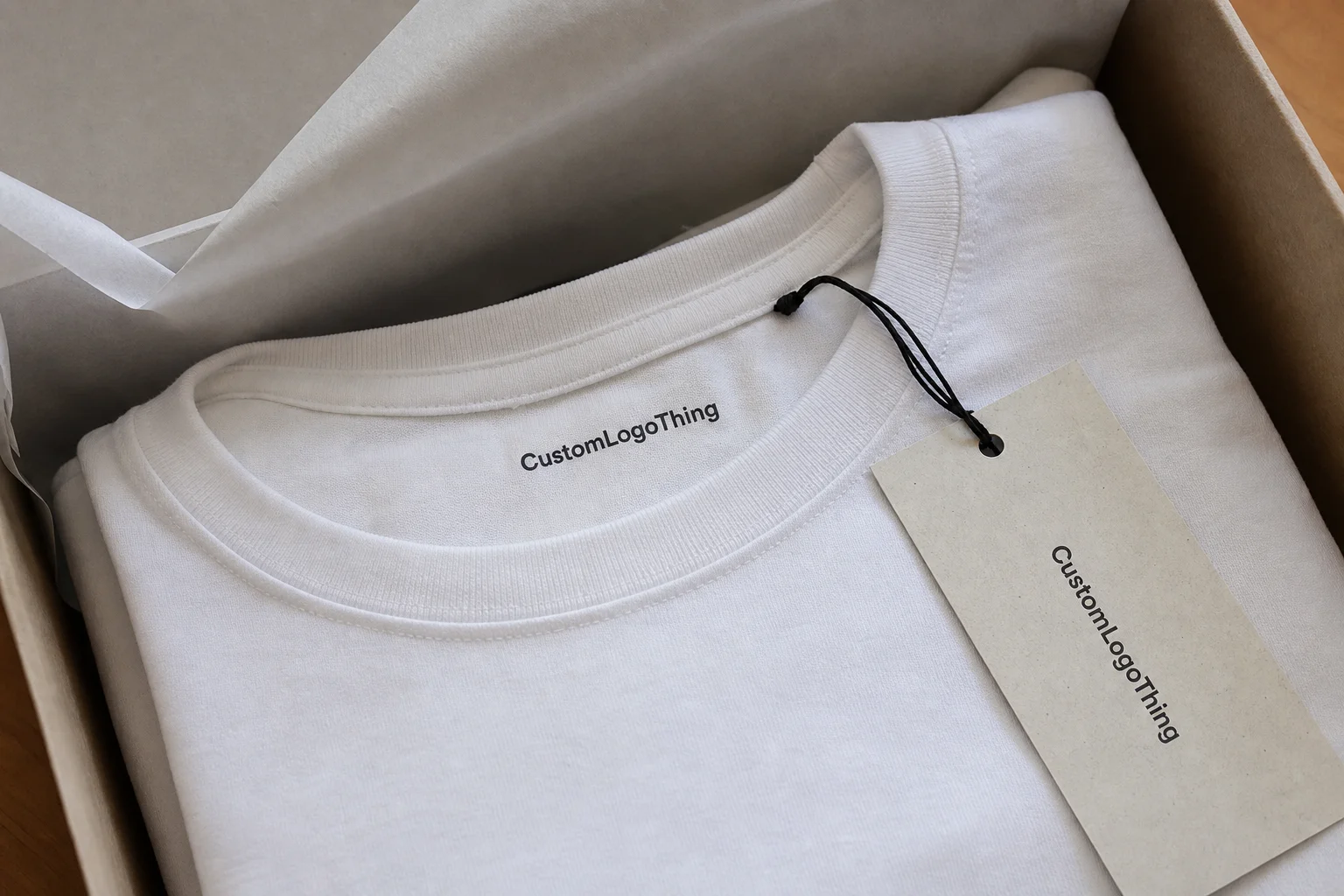
Small apparel programs often fail in the details buyers notice after the main design is approved. Neck labeling is one of them. A garment with a blank inside neck can feel like a sample, even if the cut, stitching, and print quality are strong. A transfer label closes that gap quickly.
That matters most during launch phases. Brands may only need a few hundred pieces to test fit, demand, or color response, and committing to thousands of woven labels is hard to justify. Low-MOQ heat transfers let the product look finished without locking the buyer into excess stock.
The value is not only visual. A sewn-in label adds a seam, a folded edge, and sometimes a stiff hand feel right at the neckline. Some customers barely notice it. Others cut labels out immediately. A transfer avoids that friction and keeps the inside of the garment softer.
“A good neck label does two jobs at once: it identifies the garment and disappears into the wearing experience.”
That is the standard buyers should use. The label should be visible enough to do its job, but not so heavy that it alters the neckline or creates a distraction. The most reliable short-run programs stay simple: one clean mark, one approved size, one correct placement.
What these transfer labels are made to do on apparel
A heat-applied neck label sits directly on fabric instead of being stitched into the seam. It can replace a traditional neck tag or work alongside a separate care label if the garment needs additional compliance information. The result is a tagless interior that fits modern basics, athletic wear, loungewear, and private-label fashion.
Most buyers use this format for logos, brand names, size marks, care symbols, or country-of-origin text. Some want the neck mark to be almost invisible, with only a small logo or size indicator. Others want it to reinforce brand identity as soon as the garment is unfolded. Both approaches work if the size, placement, and material spec are aligned with the fabric.
The strongest applications are usually cotton, cotton-poly blends, and many performance knits. Heavier fleece can work too, but the application settings and press pressure need to match the surface. Stretch fabrics need more attention because a label that bonds well on a static tee may crack or distort if the neckline moves aggressively.
There is also a practical production advantage. A transfer label often ships flatter, packs more efficiently, and can be easier to handle than sewn labels or folded inserts. For brands still refining pack-out or fulfillment, that simpler handling reduces the chance of mix-ups.
For buyers comparing brand-marking options, related product pages can help frame the decision. A good place to start is the broader category for Custom Labels & Tags, especially if the neck label has to fit into a larger package of woven labels, care labels, or hang tags.
Packaging standards matter too, even for something as small as a label order. If you care about transit damage or carton handling, the guidance from ISTA is relevant. If your packaging uses paperboard inserts or carton stock and sustainability claims are part of the brand story, FSC certification may also be worth checking.
Print, size, and durability specifications buyers should confirm
Artwork quality is one of the fastest ways to improve or ruin a neck transfer. Vector files are the safest format because they preserve sharp edges, thin type, and precise spacing. Raster artwork can still work, but soft edges or compression artifacts quickly become visible on a label that may be only a few inches wide.
The other constraint is space. Buyers often overestimate how much room exists inside a neckline. Once you account for the curve of the collar and the area that flexes when the garment is worn, the usable print window is smaller than it seems. If a design includes a logo, size line, and care text, the layout has to stay compact without becoming cramped.
That is why the quote should spell out more than just the price. Buyers should confirm the finished dimensions, fabric compatibility, application temperature, press time, and expected wash performance. A real spec should also say whether the finish is flat, soft-touch, or lightly raised, because tactile feel affects how premium the garment reads.
Durability is not uniform across fabrics. A label that stays put on a midweight cotton tee may behave differently on brushed fleece or a very stretchy poly blend. Wash cycles, detergent type, and tumble-dry habits all influence the final result, but the main issue is bond quality at the fabric level.
- Best artwork format: vector PDF, AI, or EPS
- Small text rule: keep type large enough to stay legible after pressing and washing
- Fabric check: confirm cotton, blend, or performance fabric compatibility
- Finish choice: flat, soft-touch, or lightly raised depending on the brand feel
- Performance target: match the label to the garment’s expected wash and wear cycle
Heat transfer neck labels low MOQ: pricing, setup, and minimums
Pricing for Heat Transfer Neck Labels low MOQ usually comes from a few inputs: artwork handling, setup, label size, color count, quantity tier, and any proofing or sample step. Standard digital neck transfers are often priced more by art setup and production efficiency than by hard tooling, so a quote that looks cheap at first can become expensive if revisions or samples are added later.
Low minimums are a risk-control tool. A buyer can test a style without sitting on thousands of labels, and the first production run can move faster because the brand does not need to wait for a large inventory commitment. The tradeoff is a higher unit cost than a bulk order, which is normal.
The best quotes separate the real drivers instead of collapsing everything into one total. Ask whether proofing is included, whether reorders reuse the same setup, and whether revisions after approval trigger a new charge. If the order includes multiple sizes, more than one artwork version, or different garment families, the price should reflect those differences plainly.
| Order type | Typical MOQ | Typical unit cost | Setup charges | Best use |
|---|---|---|---|---|
| Sample or test run | 50-100 pieces | $0.45-$0.90 per piece | Usually highest relative setup | Artwork validation, fit testing, first approval |
| Small launch run | 250-500 pieces | $0.22-$0.45 per piece | Moderate setup, sometimes no tooling fees | Capsule drops, boutique private label, colorway testing |
| Repeat production | 1,000+ pieces | $0.10-$0.25 per piece | Lower setup on repeat artwork | Core styles, replenishment, better bulk pricing |
Those numbers are directional. A simple single-color mark on a standard tee is one thing; a label with multiple lines of type or a stretch-sensitive substrate is another. The material spec and the garment structure will move the price more than most buyers expect.
Minimum order logic matters almost as much as the price itself. Some vendors quote by piece, others by sheet, design set, or layout. That can change how you plan colorways and size runs, and a low headline MOQ can still create waste if the order structure does not fit the assortment.
Production steps, proofing, and turnaround from approval to ship
The production workflow usually starts with file review. The supplier checks the artwork, size, placement, and fabric compatibility before anything is printed. That first pass should catch obvious issues such as too-small text, missing outlines, or a label size that will not fit the neckline cleanly. After that comes the proof, and for neck labels, the proof should be precise.
Why so much attention to detail for a small label? Because the neck area sits in a highly visible and tactile part of the garment. A logo that is slightly off-center, too large, or too close to the seam can become obvious once the shirt is worn and the collar flexes.
Turnaround should be discussed in two parts: prepress and production. A supplier may print fast once the file is approved, but that does not mean the whole order is fast. Revision cycles, sample requests, and clarifying questions all happen before the press starts.
A realistic low-MOQ timeline often looks like this:
- File review and quote: 1-2 business days if the artwork is clean.
- Proofing: 1-3 business days, longer if layout or color changes are needed.
- Production: commonly 5-10 business days after approval for short runs.
- Shipping: depends on the carrier, packing method, and destination.
The schedule gets longer if the buyer needs a sample, a color match review, or a custom build that falls outside the supplier’s normal flow. It gets shorter when the artwork is clean, the size is known, and the buyer can answer questions quickly.
Why brands choose a supplier built for short-run apparel orders
Short-run apparel work exposes weak process fast. If the supplier is disorganized, the mistakes show up in proofing, the quote, the label count, or the final pack-out. A brand does not need a vendor who sounds polished; it needs one who can keep the spec stable from file review to finished shipment.
Consistency matters more than sales language. The first piece has to match the last piece. That sounds basic, but it is where low-MOQ programs can drift if the supplier is not used to apparel decoration at this scale.
Good suppliers also explain the tradeoffs plainly. If a design is too detailed for the available print area, they say so. If a thin font is likely to disappear after washing, they say that too. If a certain fabric needs a different application setting, they flag it before production.
There is a fulfillment side as well. Low-MOQ orders often need to be packed cleanly, counted accurately, and delivered in a format that is easy for a decorator or warehouse team to use. A small mistake in counts or carton labeling can slow a launch just as much as a print defect.
The best short-run vendors do not inflate the complexity of the job. They explain the spec, flag the risk, and move the order forward. That is what buyers need from a low-MOQ neck label program.
What to send now to get an accurate quote and next steps
For a usable quote on Heat Transfer Neck Labels Low MOQ, send five things first: the artwork file, the garment type, the label dimensions, the quantity by size or color, and the target ship date. Those are the fields that determine whether the quote reflects the real job or just a rough estimate.
Then add the details that change the build. If Pantone matching matters, say so. If the label is replacing a sewn-in tag, say that too. If the fabric is unusually stretchy, brushed, or delicate, the supplier Should Know Before the proof is created.
Buyers should also compare quotes on the same basis. Check whether proofing is included, whether samples are extra, whether the first run carries a setup charge, and whether repeat pricing changes if the artwork stays unchanged. The more clearly those are defined at the start, the less the order depends on guesswork later.
Are heat transfer neck labels low MOQ suitable for cotton and blend garments?
Yes. They are commonly used on cotton, cotton-poly blends, and many light to midweight apparel fabrics. The key is matching the transfer system to the fabric surface and expected wash cycle.
How durable are low MOQ heat transfer neck labels after washing?
Durability depends on the transfer material, the press settings, and the garment fabric. A properly specified label should remain legible and attached through normal wear and wash cycles.
Can Pantone colors be matched on small neck label orders?
Often yes, but the achievable match depends on the print system and the artwork setup. If exact color matters, ask how the supplier handles match approval and whether a sample is available.
Do I need a sample before ordering heat transfer neck labels low MOQ?
A sample or proof is strongly recommended for new garments, small text, or unusual fabrics. It helps verify placement, size, readability, and feel before the full order is produced.
What details speed up a quote for low MOQ neck labels?
Send the artwork file, garment type, dimensions, quantity, color target, and delivery deadline. Include whether the label is a full tag replacement, a size mark, a care label, or a logo-only placement.


