Buyer Fit Snapshot
| Best fit | holiday resistant corrugated gift shippers explained for packaging buyers comparing material specs, print proof, MOQ, unit cost, freight, and repeat-order risk where brand print, material, artwork control, and repeat-order consistency matter. |
|---|---|
| Quote inputs | Share finished size, material target, print colors, finish, packing count, annual reorder estimate, and delivery region. |
| Proofing check | Approve dieline scale, logo placement, barcode or warning zones, color tolerance, and any recyclable or compostable wording before bulk production. |
| Main risk | Vague material claims, crowded artwork, or missing packing details can create delays even when the unit price looks attractive. |
Fast answer: Holiday Resistant Corrugated Gift Shippers Explained should be specified like a repeatable production item. The safest quote includes material, print method, finish, artwork proof, carton packing, and reorder notes in one written spec.
What to confirm before approving the packaging proof
Check the product dimensions against the actual filled item, not only the sales mockup. Ask for tolerance on folds, seals, hang holes, label areas, and retail display edges. If the package carries a logo, QR code, warning copy, or legal claim, reserve that space before decorative graphics fill the panel.
How to compare quotes without losing quality
Compare board or film grade, print process, finish, sampling route, tooling charges, carton quantity, and freight assumptions side by side. A lower quote is only useful if the supplier can repeat the same color, closure quality, and packing count on the next order.
Custom Logo Things
Holiday Resistant Corrugated Gift Shippers Explained
Learn how holiday resistant corrugated gift shippers built with 32 ECT, 350gsm C1S artboard inserts, and 12-15 business day production windows protect fragile goods, control costs, and keep peak-season packing from turning into a mess.
I still remember a December shift in a Milwaukee packing plant where a pallet of 18,000 Candle Gift Sets looked flawless at 7:15 a.m., then failed at the first conveyor transfer and left 240 broken jars, dented lids, and a service team staring down a three-day callback backlog. The supervisor stood there with that flat, exhausted look people get when a problem becomes expensive before breakfast. That was the day the lesson got crystal clear: holiday resistant corrugated gift shippers are not decorative extras. They are the line between a controlled Q4 and a warehouse full of damage claims.
In plain terms, holiday resistant corrugated gift shippers are custom corrugated packages built to handle stacking, vibration, temperature swings, and the general chaos that comes with seasonal shipping. I have seen them used for 8-ounce candles, glass ornaments, four-piece cosmetics kits, gourmet gift assortments, insulated tumblers, folded apparel, and promotional items that still need to arrive looking polished after two to five carrier handoffs. The best versions protect the product, keep the unboxing clean, and cut down on repacking labor that can add 20 to 30 seconds per unit during peak season. They also use edge crush test performance, die-cut inserts, and right-sized board far better than generic gift packaging ever can.
Here is the part many brands miss: a decorative box that looks festive in a catalog can still fail once it is stacked five high in a trailer or shoved across a sorter in Dallas, Atlanta, or Columbus. Holiday resistant corrugated gift shippers solve that by combining presentation and protection in one structure, so you do not have to choose between a box that looks good and one that survives a 600-mile lane. For a seasonal program, that matters just as much as a PMS color match or a foil-stamp registration tolerance of 0.5 mm. I have seen beautiful packaging collapse under 44 ECT load testing, and there is nothing elegant about a crushed corner and a 6 p.m. apology email.
On a client visit to a cosmetic co-packer in New Jersey, I watched a supervisor compare two nearly identical gift kits, and the cheaper one ended up costing more because it needed hand-repacking after nearly every tenth carton on a 4,800-unit run. That is why I look at holiday resistant corrugated gift shippers not only as packaging, but as a small production system that affects damage rates, labor, and customer satisfaction all at once. Packaging folks talk about board calipers and flute profiles; operators talk about minutes per case and whether the glue line holds at 58 degrees Fahrenheit. I try to listen to both.
What Are Holiday Resistant Corrugated Gift Shippers?
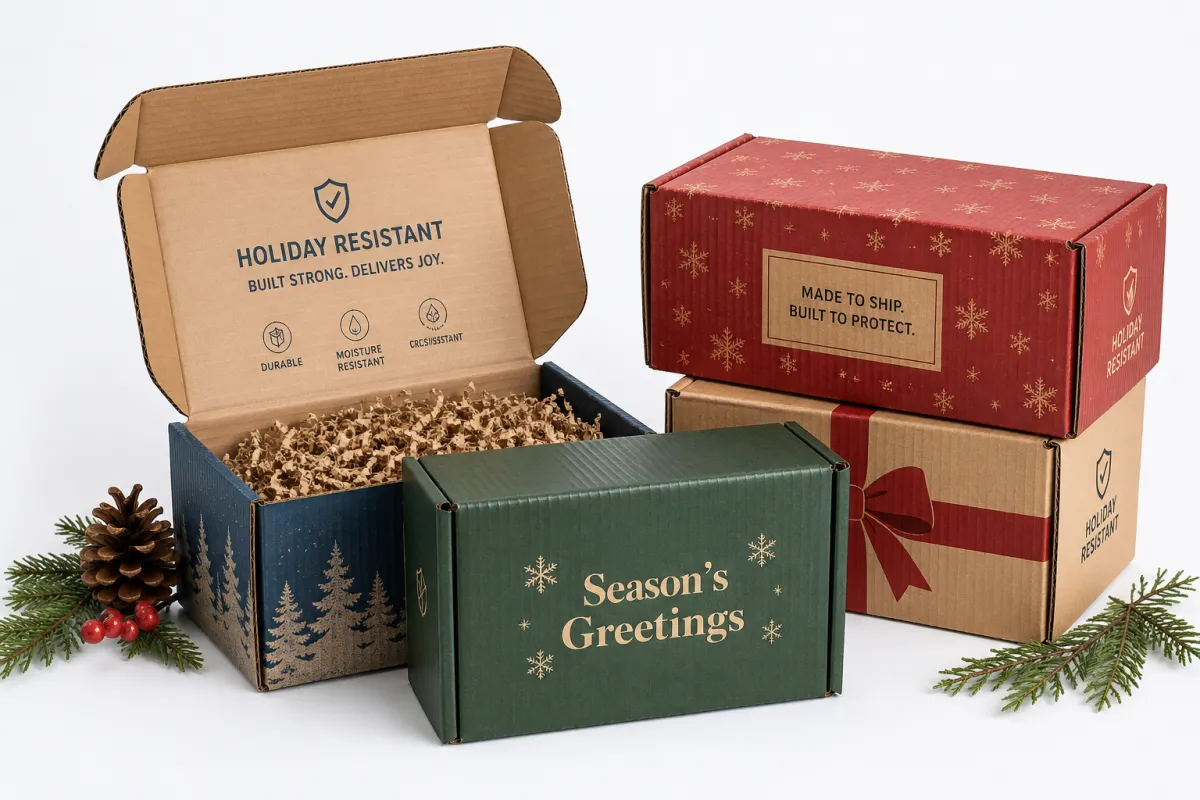
Holiday resistant corrugated gift shippers are corrugated cartons engineered for seasonal products that need to look gift-ready and still hold up under real transit abuse. They are not simple decorated mailers, and they are not display boxes pretending to be shipping containers. The structure usually begins with a corrugated board grade chosen for the weight and fragility of the product, then adds inserts, tight dimensions, and closure features that keep items from floating around inside the pack. In my experience, a 32 ECT single-wall shipper with a well-cut insert often performs better than a prettier box built on a loose 24 ECT spec, especially when the route runs from Chicago to Phoenix in January.
The difference shows up fast in the warehouse. A standard gift box may look perfect on a table, but holiday resistant corrugated gift shippers are built for the actual chain of events: packout, carton sealing, palletization, carrier sortation, truck vibration, delivery, and the inevitable rough drop onto a porch or loading dock. I have watched a candle assortment survive a 48-hour route because the inserts locked the jars in place, while a nearby unreinforced box failed after one corner impact at just 18 inches of drop height. Same product, very different outcome. Packaging is strange that way. Half an inch of restraint can save 100 percent of the contents.
These shippers are common for products that need both gifting value and transit protection. Think candle sets with glass jars, ornaments wrapped in tissue, prestige cosmetics, gourmet food bundles, insulated drinkware, folded apparel, and small promotional kits that cannot arrive scuffed or crushed. Holiday resistant corrugated gift shippers are also useful for subscription-style seasonal drops, where the presentation has to feel intentional even though the package is moving through a high-speed fulfillment line in Nashville or Reno. That combination of gift and machine-fed is where many brands get tripped up. A box has to do both jobs, and frankly, boxes are rarely praised enough for that kind of work.
The real value is simple. Fewer returns. Fewer crush claims. Less void fill. Less rework at the pack table. Holiday resistant corrugated gift shippers also help protect retail relationships, because a distributor or store team is far more forgiving of a clean shipper that arrives ready to shelf or gift than of a fancy carton that arrives dented and split. I have seen buyers overlook that and then act surprised when a 2,000-unit holiday launch in Toronto comes back with chargebacks tied to corner damage. Retailers have seen everything. They are not charmed by excuses.
When I talk with brands about seasonal packaging, I usually ask one question first: do you want the package to survive the holidays, or just look good in the mockup? The answer decides whether the box is a marketing prop or one of your most practical holiday resistant corrugated gift shippers, whether it is built in Shenzhen, Monterrey, or a domestic plant in Indianapolis.
How Holiday Resistant Corrugated Gift Shippers Work
At the core, corrugated board works because its fluted medium creates a set of tiny arches that spread load across the liners. That geometry matters more than most people realize. Edges and corners carry compression better than flat faces, so a well-designed carton uses the board structure to move force away from the product instead of directly into it. Holiday resistant corrugated gift shippers rely on that basic strength, then layer in inserts and dimensions that stop the contents from shifting during movement. It is a lot like a suspension bridge, except with more tape, more folding, and a board thickness measured in millimeters instead of steel.
Compression resistance is a big deal in holiday lanes. During peak season, cartons may be stacked on pallets longer than planned, sorted repeatedly, or left in a warm trailer during a warehouse backup. I have seen 32 ECT specifications that looked fine on paper fail once the boxes sat under a 1,200-pound pallet load for 36 hours and picked up moisture in a 72 percent humidity dock. That is why holiday resistant corrugated gift shippers are designed with the real shipping route in mind, not just the product weight sitting on a bench. Paper and reality do not always agree, which is annoying, but useful to remember.
Good design usually includes snug internal restraint, which can come from paperboard inserts, die-cut partitions, friction locks, or a carton shape that captures the item before tape is even applied. Tight-fitting inserts reduce abrasion and keep glass, caps, jars, and molded parts from rubbing against each other. Dust flaps can help too, especially when the package needs a cleaner closure and more consistent top compression. A 350gsm C1S artboard insert can work well for lighter cosmetics, while a 24pt SBS partition may be better for a heavier gourmet set. When the box is built right, the product stops moving and the shipping stress gets absorbed by the carton instead of the contents. That is the whole trick, though it is never as glamorous as the mockup board with ribbon, matte varnish, and all the other things that make designers smile.
Print and finishes still matter, but they should support the structure rather than weaken it. I like a crisp one- or two-color print on the exterior when the box needs to stay efficient, though soft-touch coating, spot varnish, or a carefully placed window can add premium value if they do not interfere with glue zones or panel strength. The most successful holiday resistant corrugated gift shippers I have seen balance both goals: the carton feels giftable, and the structure behaves like a shipping tool. That balance is not exciting until you compare damage claims before and after a 90-day holiday run. Then it gets very exciting.
The process is straightforward. Product goes into the insert. The insert locks into the shipper. The shipper closes with enough panel pressure to resist flexing. The sealed carton travels through the carrier network with less shifting, less crushing, and less scuffing. That is the point of holiday resistant corrugated gift shippers, and it is why a good spec often saves more than it costs, even when the unit price rises by $0.12 to $0.18.
For brands comparing shipping formats, I often point them toward Custom Shipping Boxes when they need a carton built around exact product dimensions rather than a generic stock size.
For practical testing and transport standards, I also recommend reviewing the resources at ISTA and the material guidance from FSC, especially if your seasonal program includes certified board or formal distribution testing.
Key Factors That Affect Holiday Resistant Corrugated Gift Shippers
Board grade is usually the first conversation, and it should be. Single-wall construction may be enough for lighter gift kits, while heavier assortments or long-haul parcel routes often need stronger board or even double-wall construction. Flute type matters too, because a finer flute can improve print appearance and reduce caliper, while a larger flute can improve cushioning and stacking behavior. Holiday resistant corrugated gift shippers are rarely one-size-fits-all, and I have seen that lesson play out in real factories from Juarez to southern Wisconsin more than once.
Product weight and fragility change everything. A 14-ounce candle in glass may need very different restraint than a folded apparel bundle, and a three-bottle gourmet set has its own failure points because liquid weight shifts during handling. Orientation matters as well. If a product must ship upright, the insert should hold that position without relying on the outer carton alone. Holiday resistant corrugated gift shippers perform best when the design matches the product's natural center of gravity, whether that is 9 ounces of fragrance oil or a 3.2-pound gift set with ceramic components.
Packout method is another variable people underestimate. If your team packs at a small warehouse with trained staff, you can often use a tighter, more precise design. If a third-party fulfillment center is handling the order, the shipper needs to be more forgiving, faster to assemble, and less sensitive to operator variation. I have sat with fulfillment managers who told me bluntly that a 20-second increase in packout time becomes a labor problem by the end of a 10,000-unit run, especially when wages are $18 to $22 per hour and overtime starts at 40 hours. They were not being dramatic. They were doing math. That is why holiday resistant corrugated gift shippers should be built around the actual packing workflow, not a theoretical one with perfect humans and unlimited patience.
Environmental conditions are not trivial either. Cold-weather transit can make some coatings brittle. Humidity can reduce compression performance. Peak-season congestion creates longer dwell times on docks and in trailers. If the carton is designed only for ideal storage, it may not hold up during a week of delayed freight and wet weather. Holiday resistant corrugated gift shippers need enough tolerance for the messiness of seasonal logistics. Weather, freight, and a full dock schedule are not exactly known for their kindness, especially in places like Portland, Maine or Minneapolis in late November.
Branding adds another layer. High-quality print, window cutouts, custom inserts, and specialty finishes all need to fit inside structural limits. A beautiful shipper that loses 15 percent of its compression strength because of bad die-cut placement is not a win. The best holiday resistant corrugated gift shippers respect both the creative brief and the physics of the box, whether the graphics are a two-color kraft print or a full CMYK wrap with a 1.5 mm score tolerance.
| Option | Typical Use | Sample Price | Notes |
|---|---|---|---|
| Single-wall mailer style shipper | Light apparel sets, small accessories | $0.62/unit at 5,000 pieces | Best when presentation matters more than stack load |
| Custom insert shipper | Candles, cosmetics, glassware | $0.88/unit at 5,000 pieces | Stronger product restraint and cleaner unboxing |
| Double-wall holiday shipper | Heavy gourmet kits, premium bundles | $1.34/unit at 3,000 pieces | Useful for higher compression and longer transit lanes |
| Premium printed gift shipper | High-end seasonal promotions | $1.78/unit at 1,000 pieces | Higher setup cost, stronger presentation value |
Holiday Resistant Corrugated Gift Shippers Cost and Pricing
Pricing usually starts with board caliper, print complexity, custom tooling, insert count, order quantity, and finishing. If a shipper uses a simple one-color print and a single die-cut insert, costs stay much lower than a multi-panel display carton with coated graphics and multiple internal components. Holiday resistant corrugated gift shippers can be surprisingly economical when the design is clean, but once you start adding specialty finishes, the tooling and labor stack up fast. Packaging budgets tend to look calm right up until someone adds a window, a second insert, and a foil stamp. Then everyone suddenly remembers that materials are not free, especially at 500, 2,500, or 10,000 units.
Prototype pricing and production pricing are not the same thing, and that is where some buyers get caught. A one-off sample might cost $150 to $400 because the tooling, setup, and hand labor are spread across just a few units. Short-run production might land near $1.20 to $2.10 per unit for a custom printed shipper with inserts, while a larger run can push that down substantially. I have seen a 5,000-piece seasonal program move from $1.42 per unit to $0.84 per unit simply because the order volume allowed the setup to be absorbed more efficiently. Holiday resistant corrugated gift shippers reward planning. They are basically the packaging version of buying plane tickets early instead of two days before Thanksgiving in Atlanta.
There is also a bigger cost picture than the unit price. A better shipper can reduce total landed cost by lowering damage, repack labor, void fill usage, and retailer chargebacks. One beverage client I worked with had a beautiful but underbuilt shipper that created a 6 percent damage rate in transit. After redesigning the insert geometry and moving to a stronger board grade, the damage rate dropped under 1 percent, and the packaging cost increase was more than offset by the savings in replacements and labor. That is a very common story with holiday resistant corrugated gift shippers. The unit price goes up a little, and the total mess goes down a lot, which is usually the better trade.
If you are budgeting a seasonal launch, ask for pricing in tiers so you can compare prototype, short-run, and full-run economics side by side. I like to ask suppliers for the following: board grade, flute type, ECT or burst spec, print process, insert material, tooling cost, and estimated packout time. Those details reveal where the money is really going. A low unit price with high waste is not cheap, especially if the carton requires 45 seconds of hand assembly and a 2-inch void-fill strip in every case.
Spend first on structure and fit, then spend on decorative touches that do not weaken the package. Save by simplifying print colors, reducing the number of unique components, and right-sizing the carton so you are not paying to ship empty space. Holiday resistant corrugated gift shippers should earn their keep before they win a design award, whether the converter is in Dongguan, Monterrey, or a plant outside Cleveland.
Honestly, I think too many seasonal buyers start with sparkle and work backward. That is backwards. The money should go into the parts that keep holiday resistant corrugated gift shippers intact through the lane, because a damaged premium box is just expensive disappointment, often at $3 to $7 per replacement once freight, handling, and customer service time are counted.
Holiday Resistant Corrugated Gift Shippers Process and Timeline
The best programs start with measurements, not artwork. I want the product dimensions, weight, fragility points, surface finish, and shipping method before I ever talk about graphics. Once that information is on the table, the designer can build holiday resistant corrugated gift shippers around real constraints rather than guesses. If a glass bottle ships in a sleeve, or a candle jar needs 0.25 inches of headspace for a lid, that detail should shape the insert and outer carton from the start. Otherwise you end up designing a box around a hope, and hope is not a spec.
From there, the process usually moves into CAD design, mockups, prototyping, and sample testing. Typical timeline stages look like this: discovery in 1 to 3 business days, structural design in about 3 to 5 business days, samples in 5 to 10 business days, approval after one or two revision rounds, then production and finishing. For a standard seasonal program, I would plan 12 to 15 business days from proof approval to finished goods, and longer if the design includes specialty coatings, multiple SKU versions, or custom insert combinations. Holiday resistant corrugated gift shippers are easier to approve when the calendar has room for real testing. Seasonal schedules do not reward optimism. They reward lead time and a little humility.
Testing should not be a formality. I want packout trials with actual staff, because the fastest way to discover a bad insert is to watch someone assemble it ten times in a row. I also want drop checks, compression checks, and a quick vibration review if the product is fragile or expensive. ASTM-style compression data and ISTA-style transit thinking are useful here, but I always remind buyers that lab success has to translate to warehouse reality. Holiday resistant corrugated gift shippers may pass on paper and still create labor headaches if the fit is too tight or the closure is awkward, especially on a Tuesday at 4:30 p.m. when the line is short-staffed.
I remember a promotional kit project where the box passed drop testing but failed packout because the insert required a two-handed fold that slowed the line to a crawl. We fixed the geometry, trimmed the number of folds, and the same holiday resistant corrugated gift shippers went from a frustrating packout to a clean 14-second assembly. That kind of change matters when you are shipping 8,000 seasonal kits. Fourteen seconds sounds small until you multiply it by 8,000 units and realize somebody has spent the morning wrestling cardboard.
Start early. Specialty board, printed inserts, and multi-SKU runs can bottleneck quickly, especially when everyone else is trying to launch at the same time. Seasonal planning gives you room for iteration, freight booking, and contingency samples. If you are trying to develop holiday resistant corrugated gift shippers two weeks before the first ship date, you are already in a tight spot. That is not a strategy; that is a fire drill with a logo.
A good timeline also gives you time to document the final spec. Keep the carton dieline, board spec, print notes, insert measurements, approved sample photo, and packout steps in one place. That file becomes the shortcut for every future holiday resistant corrugated gift shipper order, whether the next run is 1,000 units in September or 25,000 units in November.
Common Mistakes with Holiday Resistant Corrugated Gift Shippers
The first mistake is choosing a decorative carton that looks strong but fails under stack load or carrier handling. I have opened too many pretty sample boxes that collapsed the moment they were placed under a modest 35-pound load. Holiday resistant corrugated gift shippers need structural honesty; a festive exterior means very little if the carton cannot survive real distribution. A box can wear glitter and still be a disaster. Packaging, like people, sometimes overpromises.
Oversizing is another problem. Too much empty space lets products move, while too little space crushes corners, scrapes labels, and damages closures. I have seen brands lose more money from bad internal fit than from the board grade itself. Holiday resistant corrugated gift shippers should cradle the product without requiring a heroic amount of void fill. If the item slides more than 0.125 inches in any direction, the design is not finished.
Skipping sample testing is a mistake that shows up later as claims, returns, and angry emails. This is especially true if you are using a new insert material, a new coating, or a new fulfillment center. I once worked with a giftware brand that approved a lovely sample without a live packout trial, then discovered that the insert interfered with the sealing machine at a facility in Savannah. That one oversight slowed the line by half a shift. Holiday resistant corrugated gift shippers should always be tested in the actual workflow. Otherwise you are just paying for expensive surprises.
Overdesign is the opposite trap. Some teams add heavy board, oversized inserts, and unnecessary layers because they assume stronger is always better. Not always. Extra material can raise freight cost, make the box awkward to open, and create a bulky Unboxing Experience That feels more like industrial packaging than a gift. The right holiday resistant corrugated gift shippers are strong enough, not oversized to the point of waste, and often a 44 ECT double-wall spec is overkill for a 12-ounce apparel kit.
The last mistake is focusing on the pretty rendering and ignoring peak-season handling. A carton that works in a quiet office may behave very differently in a crowded warehouse with cold floors, tired staff, and stacked pallets waiting for carrier pickup. Holiday resistant corrugated gift shippers have to survive that environment, because that is the environment they will actually live in. I have seen a pristine mockup become a battered reality in less than a week on a line outside Detroit. The box did not change; the world around it did.
"We thought the fancy printed mailer was enough until the first holiday wave came back with crushed lids. After we switched to a real corrugated shipper with a tighter insert, the damage rate dropped almost overnight, from 4.8 percent to under 1 percent."
Expert Tips for Better Holiday Resistant Corrugated Gift Shippers
Test with real weight and real packout time. A cardboard mockup tells you almost nothing about how the line will behave once a bottle, jar, or boxed set is actually inside it. I want the exact product weight, the exact insert material, and the exact assembly sequence before I trust a design. Holiday resistant corrugated gift shippers are only as good as the conditions they are built to handle, and that includes a 6 a.m. packout on a cold dock in Ohio.
Build the carton to lock the product in place before you add foam or extra void fill. The best package design often uses the shipper itself as the first restraint, then lets a simple insert do the fine positioning. That approach usually gives cleaner presentation and lower material usage. Holiday resistant corrugated gift shippers tend to perform best when the board, the insert, and the product all work together instead of fighting each other, especially when the insert is cut from 350gsm C1S artboard or a comparable SBS component.
Coordinate closely on glue zones, print-safe areas, and die-cut tolerances. I cannot stress this enough. A gorgeous logo can be ruined by a glue flap running through the artwork, and a strong design can be weakened if a score line lands where it should not. I have watched factories in Shenzhen and Ohio both fight the same problem: somebody treated the print file like a poster instead of a production document. Holiday resistant corrugated gift shippers need both discipline and creativity, and that balance is easier when the dieline notes include 2 mm glue allowances and 1 mm score shifts.
Make the package easy to assemble. Stackable carton footprints, quick-close features, and well-designed inserts save minutes at scale, and minutes matter when you are shipping thousands of seasonal units. If a shipper needs too much hand manipulation, it will slow the line and invite operator shortcuts. The smartest holiday resistant corrugated gift shippers are built for speed without giving up quality. No one on the floor is thrilled to wrestle a fussy insert at 6:45 a.m. in December, especially when the first truck leaves at 8:00.
Keep a reusable seasonal spec. Save the dieline, board spec, closure notes, approved sample, and any test results from the current run. Next season, that package file can shorten approvals dramatically. I have seen teams cut two to three weeks from development simply because they had a clean record of what worked the year before. Holiday resistant corrugated gift shippers get easier and cheaper to reproduce when the documentation is solid, whether the next production run is in Monterrey or a plant in northern Illinois.
One more practical note: if the product is expensive enough to trigger customer anxiety, spend the extra money on better restraint, not on a fancier print effect. Customers forgive simple. They do not forgive broken. That is the truth behind most successful holiday resistant corrugated gift shippers, including the 5,000-piece programs that save $0.15 per unit by keeping the structure plain and the insert accurate.
Next Steps for Specifying Holiday Resistant Corrugated Gift Shippers
Start with a short checklist. Measure the product, note the shipping method, identify the fragility risks, estimate annual volume, and gather brand requirements before requesting quotes. If you know the product weight to the ounce, the maximum outer dimensions, and whether the box ships parcel or pallet, your supplier can recommend holiday resistant corrugated gift shippers that make sense much faster. That kind of clarity saves everyone from guessing, which is good because guessing gets expensive very quickly, especially when freight to the Northeast is already running 8 to 12 percent higher than last quarter.
Then order a prototype and test it in the real packout sequence. Watch how long it takes to assemble. Check whether the product shifts. Drop it. Stack it. Move it through the same path it will take during season. That kind of testing often exposes the small problems that cause the biggest headaches later. Holiday resistant corrugated gift shippers should be proven before they are printed in volume, not after 10,000 units are sitting in a warehouse in Newark.
Compare suppliers on structure, print capability, lead time, and total landed cost, not unit price alone. A converter that understands board performance, insert design, and seasonal scheduling is often worth more than the lowest quote on paper. If one supplier can deliver a better-designed shipper in 12 business days and another needs 17 business days plus more labor on your side, the cheaper unit price may not be cheaper at all. Holiday resistant corrugated gift shippers reward the buyer who looks past the first line of the quote and asks what happens at carton 500.
Document what worked. Keep notes on board grade, compression results, packout time, carrier damage, and customer feedback. Those notes become your roadmap for future seasonal replenishment, and they make next year’s approval much easier. I have helped clients move from a full redesign to a simple reprint because the original holiday resistant corrugated gift shippers were well documented and already proven in the field. That is the kind of boring file that quietly saves the whole program.
If you are building a seasonal program now, the goal is not just to ship a box. The goal is to protect the product, preserve the presentation, and keep the schedule intact through the busiest weeks of the year. That is the real promise of holiday resistant corrugated gift shippers, and it is why a well-specified shipper can save time, reduce damage, and make the whole season feel a lot less chaotic.
How do holiday resistant corrugated gift shippers differ from standard gift boxes?
They are engineered for transit strength, not just shelf appeal. Holiday resistant corrugated gift shippers usually use stronger corrugated board, tighter sizing, and better internal restraint so the product moves less and the carton resists crush damage better than a decorative gift box, especially on parcel routes that include two to four transfers.
What board strength should I use for holiday resistant corrugated gift shippers?
It depends on product weight, stacking load, and shipping distance. Ask for guidance on flute type, edge crush test, and burst strength based on the actual item and carrier path, because holiday resistant corrugated gift shippers for candles are not the same as shippers for apparel or glassware. A 32 ECT spec may be enough for a 1.2-pound set, while heavier kits often need 44 ECT or double-wall.
Can holiday resistant corrugated gift shippers be printed with premium branding?
Yes, most can be custom printed and finished while still keeping strong structure. The key is balancing decoration with glue zones, structural panels, and insert placement so holiday resistant corrugated gift shippers stay durable while still feeling premium. Foil, spot UV, and matte varnish can work well if they do not interfere with the die-cut or closure.
How long does it take to develop a custom holiday shipper?
Timeline varies by complexity, but it typically includes design, sampling, approval, and production. Start early so there is time to test fit and shipping performance before the seasonal rush, especially if your holiday resistant corrugated gift shippers need multiple SKU versions or specialty inserts. A realistic plan is 12 to 15 business days from proof approval to finished goods, with samples often taking 5 to 10 business days.
What is the best way to reduce cost on holiday resistant corrugated gift shippers?
Use the lightest structure that still passes testing and right-size the carton to the product. Reduce unnecessary inserts, simplify print processes, and plan quantities so setup costs are spread efficiently across your holiday resistant corrugated gift shippers order. A clean 5,000-piece order can sometimes save $0.10 to $0.20 per unit versus a fragmented 1,000-piece reprint schedule.
Holiday resistant corrugated gift shippers work best when they are designed from the product outward: measure the item, test the fit, check the lane, then build the carton to survive the exact abuse it will face. That is the practical takeaway. Get the structure right first, and the holidays stop feeling like a gamble.


