Buyer Fit Snapshot
| Best fit | To Holiday Packaging Planning for Seasonal Sales projects where brand print, material claims, artwork control, MOQ, and repeat-order consistency need to be specified before quoting. |
|---|---|
| Quote inputs | Share finished size, material target, print colors, finish, packing count, annual reorder estimate, ship-to region, and any compliance wording. |
| Proofing check | Approve dieline scale, logo placement, barcode or warning zones, color tolerance, closure strength, and carton packing before bulk production. |
| Main risk | Vague material claims, crowded artwork, missing packing details, or unclear freight terms can make a low unit price expensive after revisions. |
Fast answer: To Holiday Packaging Planning for Seasonal Sales: Material, Print, Proofing, and Reorder Risk should be specified like a repeatable production item. The safest quote records material, print method, finish, artwork proof, packing count, and reorder notes in one written spec.
Production checks before approval
Compare the actual filled-product size with the drawing, then confirm tolerance on folds, seals, hang holes, label areas, and retail display edges. Reserve space for logos, QR codes, warning copy, and material claims before decorative graphics fill the panel.
Quote comparison points
Review material grade, print process, finish, sampling route, tooling charges, carton quantity, and freight assumptions side by side. A quote is only useful when the supplier can repeat the same color, closure quality, and packing count on the next order.
Guide to Holiday Packaging Planning for Seasonal Sales
Guide to holiday packaging planning starts long before design files get pretty. I still remember sitting in a Toronto conference room where a brand team approved a foil-stamp flourish with confidence, then 72 hours later realized the stamp could not sit beside the logo because the live area was 2.5 mm too tight. Someone asked where the insert spec was hiding, and the silence that followed was the quietest sound in the room. Rush freight eventually came back at $1,840 for a 48-carton pallet, which made the room do arithmetic in panic mode. That is the chain reaction: design gets delayed, operations gets squeezed, finance gets blamed, and suddenly December feels less like a season and more like a stress test with glitter.
What changed in that meeting was not taste. It was the lack of a shared plan. A guide to holiday packaging planning only works when it treats every creative choice as a production variable that influences timing, cash flow, and shipping risk. If that sounds intense, good, because seasonal programs are not impressed by intentions. They are impressed by sequence, accountability, and dates that actually match reality.
Guide to Holiday Packaging Planning: Why It Fails Fast
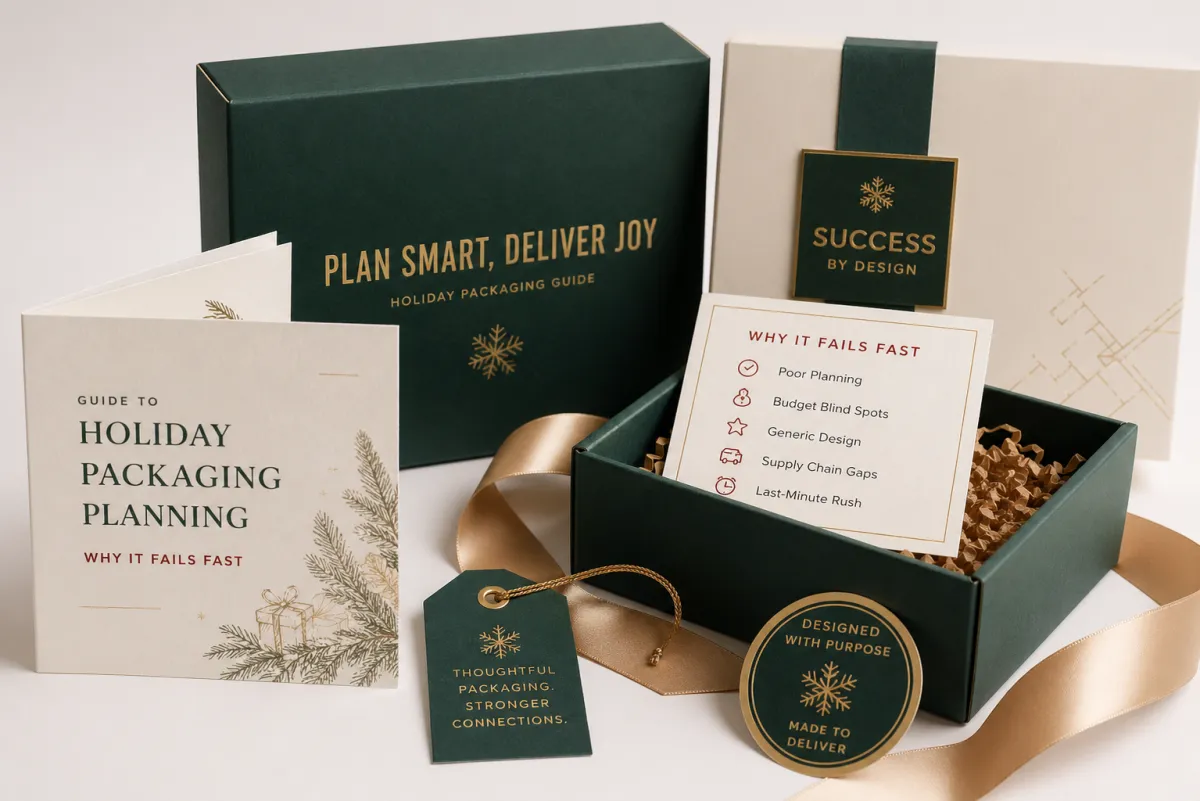
The first failure in this context is almost never the look. It is timing, and timing can punish complacency mercilessly. A marketing lead may say, “We can finish the box later,” and three teams interpret that as permission to postpone coordination. Meanwhile, mills and converters in Dongguan, Wenzhou, and Foshan are not waiting for your mood board cycle. In my notes, that sentence has repeatedly added 14 calendar days to at least one launch, and that is a real-world delay, not a theoretical one.
Holiday planning fails fast because dependencies are spread across too many people with too few hard dates. Creative direction, quantity planning, production lead time, and distribution all need to move as one sequence. If one link is soft, the whole chain starts borrowing time from the margin. During a Shenzhen facility visit, a buyer changed carton height by 3 mm after sample approval. The change looked tiny, yet it required a new die and broke palletization for 4,800 units. That one decision turned a manageable issue into a full-scale recovery exercise.
There is also a market effect in November and December that is easy to underestimate: upstream constraints synchronize. Paper supply tightens, plate makers run extended shifts, freight lanes get unpredictable, and everyone starts asking for one extra revision at once. I have seen a 12-business-day job in October become 18 business days in mid-November because a single proof tweak triggered a domino chain across proofing, tooling, and booking. You are no longer deciding between “better” and “best”; you are choosing where to pay the surcharge for uncertainty.
Another recurring blind spot is mistaking festive style for structural simplicity. A package can be festive and still simple, but it can never be simple if it must protect glass, sustain e-commerce handling, and survive retail shelf pressure at the same time. A client once showed me a gorgeous carton that behaved like a cracker under a 9 kg compression test, and the damage was almost immediate: product complaints, replacement orders, and a brand story that looked thinner than the board. Packaging is a control system disguised as paper, not a mood piece.
“We thought the box was the easy part. It turned into the hardest part of the launch.” A client in Los Angeles said this after we reworked a 6,000-unit run that missed the retail ship window by 9 days and added $1,260 in rebooking fees.
The practical guide to holiday packaging planning lives in ownership, stage timing, and the hidden costs people ignore until the last minute. That is where teams either stay calm or lose the entire launch rhythm.
How Do You Build a Guide to Holiday Packaging Planning from Brief to Delivery?
A sound guide to holiday packaging planning is sequence-first, not pretty-first. Miss one stage and the delay usually grows louder with every handoff. In my work, teams that document dependencies early spend less money and fight fewer midnight calls in December.
- Brief: Capture product type, campaign goal, target quantity, ship destination, and deadline. If you do not include both a target and fallback delivery date, the plan has no recovery path.
- Structural specs: Confirm dimensions, board grade, insert type, and closure method before artwork goes final. A 1 mm mismatch can invalidate packaging fit and cascade through shipping and assembly.
- Artwork: Build against dieline limits, color constraints, and brand standards. Seasonal text and messaging should be modular because retailer substitutions happen more often than brands want to admit in the last 10 to 14 days.
- Samples: Run a white sample, printed proof, and pre-production sample when possible. Physical samples reveal edge behavior, bending, and gloss changes that 2D previews often hide.
- Approval: Secure color, material, and quantity sign-off before final file transfer. One missing approval can stop an entire order, regardless of how good the layout looks.
- Production: Move through printing, die-cutting, assembly, finishing, and insert build in order, with confirmed run settings.
- Packing: Perform sorting, labelling, palletization, and pre-freight staging before booking.
- Delivery: Confirm receipt logistics and merchandising timing with enough buffer to absorb a missed dock schedule.
This sequence looks clean on paper, then a delayed dieline review adds three days, freight booking shifts five days, and what used to be an ocean option becomes an air-rate decision. A custom candle carton project I worked on followed that exact pattern after foil position and carton depth were approved in the wrong order. One extra tooling pass put the schedule back by a week and added $420 in unplanned cost.
Responsibilities matter more than talent, which sounds blunt but is usually true. If you do not assign who decides what, everyone will infer they own a part of the same decision and nothing moves. I have watched capable teams lose time simply because they were polite about ownership boundaries.
For folding cartons, a realistic rhythm after dimensions, color, and count is often 10 to 15 business days in many markets. Rigid boxes with magnetic hardware or specialty inserts can stretch to 18 to 30 days before freight is safe to schedule. Those windows are not guesses; they are where supplier capacity, setup complexity, and inspection cycles intersect.
For teams with strict quality expectations, I still point to established references like ISTA test methods and FSC-certified paper guidance as part of the planning baseline. Standards stop arguments early when decisions are emotional and expensive.
Simple folding cartons are usually faster than rigid formats because they pass through fewer manufacturing stages and fewer inspection points. A rigid format might win shelf impact, but it adds labor, handling, and risk. A 12,000-unit rigid run can save five minutes in a meeting and cost five full days on the floor if sequencing is not protected.
Key Cost Factors in Holiday Packaging Planning
Budget mistakes happen when teams compare only unit price and ignore logistics, tooling, and correction cycles. A carton that looks like $0.34 can become $0.61 landed if you include freight, handling, and late-stage changes. That is why this guide to holiday packaging planning should force people to review landed cost from start to finish.
Material choice drives the largest early swings. An 18pt folding carton and a 1200gsm rigid grayboard package cannot be treated with the same financial model. Inserts create additional variation: a plain paper insert might add $0.06 to $0.14 per unit, while molded pulp can push much higher depending on tooling depth and texture. I once had a “thirty-cent package” request that quickly became a lesson in sticker-shock when texture, foil, and multi-piece insert requirements came in the same meeting.
Quantity changes the denominator, not the physics. At 1,000 units, fixed costs dominate. At 10,000 units those same costs spread out and per-unit pricing becomes more forgiving. Samples, tooling, and freight have a gravity of their own, and they still show up whether your run is 800 or 8,000.
| Packaging Option | Typical Spec | Estimated Unit Cost at 5,000 | Setup / Tooling | Lead Time | Best Fit |
|---|---|---|---|---|---|
| Folding carton | 18pt SBS, 4/0 CMYK, aqueous coating | $0.22-$0.38 | $180-$450 | 10-15 business days | Light retail packaging, cosmetics, accessories |
| Mailer box | E-flute, 1-2 color print, matte finish | $0.68-$1.10 | $260-$700 | 12-18 business days | E-commerce product packaging, subscription kits |
| Rigid gift box | 1200gsm greyboard, wrap paper, foil detail | $1.45-$2.80 | $450-$1,200 | 18-30 business days | Premium branded packaging, gift sets |
| Custom insert | Paperboard, molded pulp, or EVA foam | $0.25-$1.40 | $150-$650 | 10-25 business days | Protection, display fit, multi-item kits |
The table is a planning benchmark, not a binding quote. Final pricing still varies by print coverage, region, vendor, and fulfillment model, plus whether cartons move from one warehouse or a split network. I usually remind teams that landed cost can rise 8% to 15% if shipments are fragmented, because the material and pallet logic lose efficiency. This often flips a “cheap” offer into a tight margin by launch week.
Hidden costs are where plans usually crack first. Revisions can run $35 to $120 each. Color adjustments can trigger extra proofs, and line changes after booking can trigger rush fees that feel optional until the invoice lands. In my experience, adding 5% to 10% as a risk buffer is not caution for caution’s sake; it is insurance against the season’s tendency to invent one more issue exactly when everyone is tired.
Most teams should prioritize where perception starts: structure, legibility, and handling behavior. Foil and soft-touch can support that, but they only work if the package stays stable and readable. I have learned to defend an extra $0.12 insert upgrade over a $0.12 finish upgrade when the choice is about real-world use, and this is not about being cheap. It is about not creating weak moments in a warehouse you cannot control. Costs in these cases are often a New Jersey-level lesson: a tiny structural weakness can erase a premium concept fast.
Trust note: Pricing and lead times depend on supplier network, commodity trends, and seasonal capacity, so confirm all estimates with your chosen converter before you sign the PO.
Step-by-Step Guide to Holiday Packaging Planning
Now the process gets tactical. A great plan for holiday packaging sounds dull until it saves your team from a three-time revision spiral at 9:00 p.m. on a Friday, and then it feels essential.
Step 1: Define the campaign goal
The right question is never “what looks good?” first; it is “what must this package do?” Decide if this is premium shelf display, direct-to-consumer transit, or a gift-ready retail format before artwork expands. That decision drives material, finish, and the internal review order. A chocolate sleeve usually needs different handling logic than a multi-item skincare set.
A luxury skincare client once wanted “premium” without defining hand-feel, shelf signal, or shipping stress. Instead of a full effects build, we ended with one metallic accent, a 14pt rigid wall, and matte wrap. The result stayed elevated without breaking budget because the package performed according to function first.
Step 2: Lock product dimensions and protection needs
Measure the product. Then measure it again with the insert. A 78 mm product in a 79 mm cavity sounds close until humidity and manual assembly enter the conversation. I have seen a 2 mm wiggle become a return-heavy season and a warranty headache in transit.
For e-commerce, define drop and compression performance standards from the start, not after shipping starts. ASTM D4169 and ISTA sequences are practical tools because they force teams to quantify risk instead of arguing aesthetics. Brand confidence comes from repeatability, not from the nicest render.
Step 3: Choose structure and material with purpose
Structure is a function decision. Folding cartons move quickly and serve light SKUs. Mailer boxes are better when handling and display matter at home and on truck docks. Rigid boxes raise perceived quality but cost more labor and lead time because every finish and insert line adds dependency.
Paperboard grade, flute type, lamination, and wall thickness should match product weight, handling path, and storage conditions. In Ho Chi Minh City, a 2-piece candle box looked fine in CAD yet buckled at sample; switching to an E-flute shipper with wrap solved the performance issue without killing the design intent. That is where material and method beat “looks” as the deciding principle.
If your brand includes sustainability claims, ask for documented evidence, such as FSC or recycled-content verification, instead of fuzzy language. Customers cross-check claims against physical behavior, and they notice inconsistencies. A guide to holiday packaging planning has to protect trust and margin at the same time.
If you want to sanity-check options before lock-in, Custom Packaging Products can help compare structures fast, but only as a starting point; final specs still need supplier confirmation.
Step 4: Build artwork around production reality
Production speaks in tolerances, and design has to learn that language early. Keep content inside the dieline, confirm bleed and safe zones, and pin Pantone or brand colors with actual intent where spot color matters. Seasonal copy should be modular enough to swap local legal or promotional text without rewriting the whole file.
One team in Denver lost four days because “Happy Holidays” became “Season’s Greetings” for a chain-specific print. Because the change was late, every stage carried extra cost. You can avoid this by preparing approved copy variants before finalization.
Push for physical checks before final approval. A physical sample catches texture mismatch, color drift, curl behavior, and edge profile before these issues scale. I still remember approving a rushed sample at 11:40 p.m. and spotting a corner crack that prevented about $1,100 in replacement costs. The coffee was cold, but the project was saved.
Step 5: Sample, revise, approve, and place the order
Sampling is where planning proves its credibility to both finance and operations. A white sample checks structure and fit. A printed proof checks color and communication. A pre-production sample checks build quality. Skipping the last one is how rework multiplies.
A brand once debated a $280 rush plate charge versus approving a sample revision. They reviewed, corrected early, and later avoided a reprint near $1,900. The room was tense, yes, but the schedule stayed alive. That is a real-world trade no spreadsheet can hide.
Once approved, place the order with buffer, not bravado. For straightforward carton runs, I recommend 10 to 15 business days of working slack; for premium builds, 20 to 30 is safer. If there are retail appointment dates, cutoffs, or legal approvals, extend that buffer.
- Brief the vendor with full dimensions, quantity, and realistic delivery window.
- Approve the dieline before file handoff and design freeze.
- Review samples with operations and sourcing, not marketing alone.
- Freeze revisions after sign-off unless schedule can absorb the change.
- Book freight when production dates are fixed, not when someone happens to ask.
This sequence is not complicated. Its reliability comes from discipline, the same thing that keeps most teams from being trapped by a 4:00 p.m. “just one more change” request.
Common Holiday Packaging Planning Mistakes Brands Keep Making
Some errors are so common they look normal, and that is exactly why they still hurt. A campaign can look polished in September and still fail in November when teams assume flexibility remains. Freight windows, supplier queues, and warehousing do not move because your creative schedule feels urgent.
Late artwork approvals are one of the most expensive mistakes because they seem harmless. If artwork crosses fold lines, legibility collapses at the crease. If dimensions change after design lock, inserts need re-cutting and you lose that “ready” status. A Chicago project lost almost a week after bundle height increased by 4 mm after approval, proving that a physical dimension change can make your timeline rude very quickly.
Freight and warehouse planning get treated as downstream tasks, then become upstream emergencies. A shipment can arrive on time and still miss launch if dock staging is wrong, labels mismatch, or ASN details are inconsistent. I have stood in a New Jersey dock with 6,000 units and no clear receiving plan because pallet tags carried the wrong SKU code. That is not “small admin.” That is an operational stop sign.
Visual effects can be overused as a substitute for strategy. Foil, embossing, soft-touch, and inserts all have their place, but each adds setup and inspection burden. A strong package can carry one visual anchor and still feel premium. If that is the strategy, you reduce risk and protect lead time.
Under-ordering is another quiet killer. Last year’s sell-through is a starting point, not an authority. If demand accelerates and the program is under-sized, you force a second run under worse terms. In many cases, low-volume execution can cost more than the first production cycle.
“We thought 3,000 units was safe. We sold through in 11 days and had to airfreight a second batch.” The same consumer brand later reported $2,400 in last-minute freight and six extra days in transit.
One practical fix is a single source of truth. Teams get better results when everyone uses one master spec sheet and one decision ledger. In one project, 12 minutes of aligned review replaced three days of confusion created by parallel versions and old email threads.
There is a trust piece too: if your planning docs rely on old versions and verbal agreements, you are depending on memory. Memory is useful for birthdays; it is not a production system for 9,500 seasonal units.
Expert Tips to Sharpen Guide to Holiday Packaging Planning
Start with the hard constraint first: launch or warehouse arrival date. Design deadlines are downstream of that boundary, not the other way around. In this business, a two-day delay in a QC loop can erase an entire week of reserve time.
Use one master spec sheet across design, sourcing, and production and keep it current at each milestone. Include dimensions, board grade, print colors, finish notes, carton count, destination, and named contacts. That one document prevents expensive version drift.
Build a late-change variant before the campaign is final. This is not a weak design strategy. It is a practical backup for retailer copy swaps and legal edits. A placeholder panel for campaign windows can prevent full file rebuilds and keep a program on schedule.
Collect photos and physical sample updates before full production, not after approval fatigue sets in. Score lines, corner folds, and registration drift are defects you want to catch early. I still remember a late check that caught a corner crack in Guangdong and prevented about $1,100 in replacement work while preserving launch timing.
Build approval buffers into calendar planning. Human workflows are not machine-perfect; vacations, trade shows, and legal reviews happen, no matter how many reminders are sent. A practical guide to holiday packaging planning adds 2 to 3 business days at each approval gate, and that often prevents the all-night fire drill cycle.
Protect performance before style: the outer carton, secure insert, and clear brand mark matter more to returns than one extra decorative layer. I have seen beautiful premium effects fail because structural integrity did not match product mass and handling. If you want a quick structure comparison, review categories on our custom printed boxes and packaging options page before final lock-in.
Procurement teams often approve the lowest unit quote and only later face color matching, insert rework, and fragmented freight. If a bid is $0.10 to $0.22 cheaper per unit but implies frequent change orders, you may be choosing a discount with a delayed charge tag attached. Total cost of ownership is the only number that keeps giving the real answer.
For teams that are new to seasonal surges, this is the honest bit: vendors are not evil and calendars are not cruel; they are both deterministic systems. If you feed them unclear inputs, they return uncertainty quickly.
What to Do Next in Guide to Holiday Packaging Planning
After the plan exists, turn it into a working file with owners, dates, and recurring check-ins. If a team lead still relies on memory, you already lost one layer of control. Share it with design, sourcing, production, and logistics from day one.
Validate supplier capacity before payment is released. Ask for available press time, sample-to-production throughput, and confirmed shipment mode (ocean, air, or mixed). I have seen factories hit every technical requirement while still missing launch because their schedule was already full for six consecutive days.
Run weekly reviews until shipment is out. Thirty minutes to check sample outcomes, counts, and freight status can prevent a late budget emergency. Ask the same three questions: Did the sample pass? Is carton count accurate? Is freight actually booked? If any answer is “not sure,” hold the line until it is resolved.
Plans should stay editable without becoming chaotic. In seasonal programs, market demand, warehousing, and even logo requirements can all shift within a week of launch. A document that supports controlled change is not weak; it is alive, and it works.
Lock specs, protect timeline, and keep accountability explicit. A disciplined guide to holiday packaging planning is how teams avoid six-figure season losses tied to one missing approval or late revision. I have watched brands recover lost performance with good cadence, and I have watched equal-size brands miss margins because they trusted a “tight but fine” assumption.
Clear next move: before you touch final artwork, write your backward timeline from the target delivery date, then assign three owners: structure, approval, and freight. That is the first practical step that upgrades any plan from pretty to dependable.
FAQ
How early should I start holiday packaging planning for custom boxes?
Start as soon as campaign dates are stable. A folding carton run usually needs 3 to 5 weeks for a practical full cycle, and rigid or specialty insert programs are usually safer at 6 to 8 weeks. Add time for proofs, revisions, compliance checks, and freight coordination. This is typically the window teams underestimate in any guide to holiday packaging planning.
What is the biggest cost driver in holiday packaging planning?
Material and print complexity are usually the strongest cost drivers. Foil, embossing, extra coatings, and custom inserts can move costs quickly. Order size lowers unit cost, but setup, tooling, and freight still shape final economics. The least expensive base quote can become the most expensive landed cost if it triggers revisions and delays.
How do I keep holiday packaging planning on schedule?
Work backward from the warehouse or retail arrival date, then map each internal sign-off against supplier deadlines. Freeze dimensions early, and assign one accountable decision owner for final approvals. Multiple parallel approvers may feel inclusive, but it usually adds avoidable drift and downstream risk.
What should I include in a holiday packaging planning brief?
Include exact dimensions, target quantity, shipment model, brand standards, print method, finish details, and launch date with fallback options. Add handling context: e-commerce handling, retail shelving, or hybrid channel needs. A complete brief reduces confusion and improves quote quality, which is exactly what a good guide to holiday packaging planning should support.
How do I reduce risk in holiday packaging planning without overspending?
Prioritize structural correctness before design accents. Ask for early samples, hold an approval buffer, and keep a contingency reserve for freight and late revisions. That balance may sound unexciting, but in seasonal programs it is what keeps launches from becoming expensive afterthoughts.


