Buyer Fit Snapshot
| Best fit | Corrugated Shipping Cartons The Way projects where brand print, material claims, artwork control, MOQ, and repeat-order consistency need to be specified before quoting. |
|---|---|
| Quote inputs | Share finished size, material target, print colors, finish, packing count, annual reorder estimate, ship-to region, and any compliance wording. |
| Proofing check | Approve dieline scale, logo placement, barcode or warning zones, color tolerance, closure strength, and carton packing before bulk production. |
| Main risk | Vague material claims, crowded artwork, missing packing details, or unclear freight terms can make a low unit price expensive after revisions. |
Fast answer: Corrugated Shipping Cartons The Way: Board, Finish, Dieline, and Unit Cost should be specified like a repeatable production item. The safest quote records material, print method, finish, artwork proof, packing count, and reorder notes in one written spec.
Production checks before approval
Compare the actual filled-product size with the drawing, then confirm tolerance on folds, seals, hang holes, label areas, and retail display edges. Reserve space for logos, QR codes, warning copy, and material claims before decorative graphics fill the panel.
Quote comparison points
Review material grade, print process, finish, sampling route, tooling charges, carton quantity, and freight assumptions side by side. A quote is only useful when the supplier can repeat the same color, closure quality, and packing count on the next order.
How to choose corrugated shipping cartons the smart way
Packaging mistakes do not usually announce themselves with sirens. They just chew through margin in quiet chunks. A carton that is oversized can quietly trigger a dimensional weight penalty. A carton that is underbuilt can split at a seam, crush a corner, or cave in under stacked weight. A box that looks perfect on a sample table can still fail in fulfillment, where speed is always tight and handling is anything but careful. If you are trying to figure out how to choose corrugated shipping cartons, the task is not choosing a “nice-looking” container. It is choosing package protection that can survive ecommerce and B2B distribution, pallet loads, and the kind of transit vibration nobody labels properly until returns start piling up.
In my years with packaging suppliers and fulfillment teams, the best solution is almost never the fanciest carton. It is the one that fits the product, the lane, the pallet layout, and the budget without causing another issue somewhere else. That is the practical heart of how to choose corrugated shipping cartons: reduce damage, control total landed cost, and keep the packing floor from becoming a daily firefight.
What is the best way to choose corrugated shipping cartons?
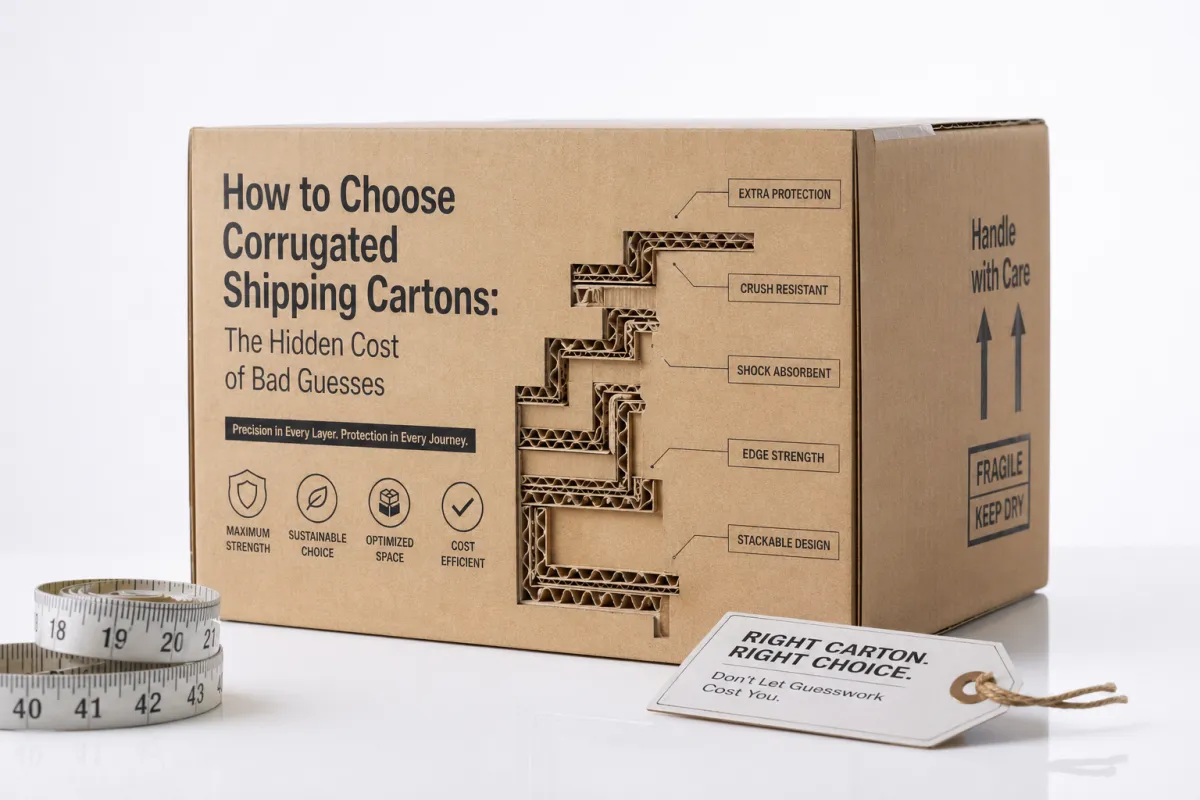
The short version is simple: match board strength, carton size, and route risk to the product, then validate with real-scenario testing. The best carton lowers damage, limits dimensional waste, and keeps packing speed stable. If you do that in order, you can avoid getting lost in procurement language and still make decisions that feel defensible to operations and finance.
There is also a bit of hard truth in this title-level question. A lot of teams choose carton structure to satisfy internal preferences first and only later ask, “Will it survive the truck?” That usually costs more than a heavier wall or prettier print ever saves.
How to choose corrugated shipping cartons: the hidden cost of bad guesses
A carton that is even one size too large does more than waste board. It can increase freight tiers, slow packout, and force more void-fill into the box, which can create a loose, sloppy unboxing feel. A carton too light in structure can fail at corners, tear at glue seams, or collapse under stack pressure. That is why how to choose corrugated shipping cartons has to begin with product behavior, not with visual appeal.
Most people describe this as “choosing a box.” In practice, it is an engineering decision chain: single-Wall vs Double-wall, flute profile, liner grade, closure style, and print method. Each choice affects performance. Each choice affects cost. Each choice can be right on one lane and expensive on another. If teams treat how to choose corrugated shipping cartons like a one-line purchase order, finance gets a clean invoice and operations pays the hidden cost later.
A simple split is helpful. If SKUs are light, stable, and low-risk, structure can stay simple. If they are fragile, expensive, heavy, odd-shaped, or mixed across loads, carton selection quickly becomes a distribution engineering decision with real consequences. The difference is more expensive than many teams expect.
Think through three common cases:
- Fragile SKUs like glassware, candles, electronics, and cosmetic sets with rigid components usually need stronger crush resistance and tighter internal fit.
- Heavy product categories such as industrial parts, pharmaceuticals in bulk bottles, books, and tools often need stronger board and seam integrity because bottom failure is common, not theoretical.
- Long-haul or high-return shipping increases weakness visibility, especially in ecommerce, where parcel handlers are rougher than most teams assume.
Same product, different carton, different outcome. I have personally seen a shipment that looked excellent in a warehouse pass, then fail after one rough route segment because the carton had too much void space and insufficient edge crush resistance. The destination did not change. The product did not change. The carton choice did.
A carton can look fine on a table and still fail in a trailer. Transit packaging does not reward good intentions.
That is why the process in this article runs in sequence: understand structure, map product risk, validate the build, compare total cost, avoid common errors, and lock approval before the next reorder is placed. Follow that path and how to choose corrugated shipping cartons becomes much less like guessing and much more like disciplined operations.
For broader packaging categories beyond cartons, you can also review Custom Packaging Products if your SKU mix needs mailers, inserts, or retail-ready packaging in one program.
How corrugated shipping cartons work: structure, load, and protection
Corrugated board is not just folded paperboard. It is a layered system of linerboard and fluted medium bonded to create stiffness, cushioning, and stacking strength. The flute profile is the engineered geometry doing the work: it determines how load moves across the panel, where compression lands, and how the box behaves during impacts.
In practical terms, the board must handle three jobs simultaneously: crush resistance, impact protection, and load retention under weight stacking. This is the technical core of how to choose corrugated shipping cartons without being dragged into marketing language.
Different flute profiles produce different outcomes:
- E flute is thinner, prints cleanly, and suits lighter products where clean graphics and compact volume matter.
- B flute gives a useful balance of puncture resistance, shape support, and printability for many standard shipping SKUs.
- C flute usually adds more cushioning and better stacking behavior, which is useful for heavier or more delicate shipments.
- Double-wall combinations increase compression strength for demanding loads, awkward geometries, and longer transit conditions.
Performance is not one number. Edge crush resistance, burst resistance, puncture resistance, and shock absorption do different things at different points in the trip. A thick wall can still fail if edge crush is weak or geometry is poor. That is a technical point teams underestimate because every spec seems “strong” at first glance.
Test language matters. You need to ask suppliers: which standard are you using, and what does it actually measure? ISTA is relevant because the protocols connect packaging behavior to actual distribution risks instead of sample-room aesthetics. For sourcing and sustainability claims, FSC certification can matter too, especially for customers asking for fiber traceability.
Now the less glamorous part: environment. Cartons might sit under pallet stacks, bounce on conveyors, lean in trailers, and absorb humidity at warehouse docks. Moisture and temperature change stiffness and seam behavior. If your route includes damp docks, monsoon-season transits, or international moves, then how to choose corrugated shipping cartons has to include environmental risk, not just product dimensions.
A useful perspective is this: the carton needs to survive the boring moments, not the dramatic ones. Most returns are triggered by subtle fatigue—repeated vibration, compression, minor impacts—not by one dramatic fall event. Success is a box that keeps shape through ordinary abuse.
How to choose corrugated shipping cartons by product risk and fit
Start with the product, then widen the lens outward. This sounds basic. It is still missed constantly. In practice, I score each SKU across five factors: weight, geometry, fragility, movement sensitivity, and value at risk. Those five factors usually decide more than any catalog quote.
- Weight determines required bottom support and seam integrity.
- Shape irregularity determines whether fit margins and internal supports are needed.
- Shock sensitivity determines cushioning and insert depth.
- Vibration sensitivity matters for any item that chips, scuffs, or shifts in transit.
- Value at risk determines how much cost you can accept per defect event.
Fit is where teams quietly leak margin. They often pick a carton from outside measurements, add filler, then question freight spikes later. Better is a tighter equation: product dimensions plus movement allowance plus cushioning allowance gives carton footprint. Then test fill ratio with an actual packed sample under realistic conditions. One sample round here beats three spreadsheets later.
Internal protection changes structural requirements more than people realize. Foam corners, molded pulp, paper wrap, honeycomb inserts, and die-cut supports each change stress distribution. A rigid insert can reduce in-box movement and let you downsize void-fill. Loose fill may increase carton volume and require a stronger shell because shift tolerance rises. These are the interactions that make carton design feel like packaging architecture.
Orientation is also a decision, not a detail. Some items must remain upright, others tolerate flat shipping, and some fail if pressure changes airflow direction or liquid orientation. These use-case factors are part of how to choose corrugated shipping cartons if you care about real handling performance.
Route behavior then shifts the target again. Parcel networks punish dimensional weight. Palletized loads punish stack design. Mixed loads punish weak cartouches in the middle layers. Long routes punish vibration and humidity. If you pool SKUs, the weakest carton in your pallet often dictates the acceptable spec for all.
| Carton option | Best for | Typical strength profile | Tradeoff |
|---|---|---|---|
| Single-wall E flute | Light, compact SKUs with clean presentation | Good print quality, moderate crush resistance | Less forgiving for heavy or sharp products |
| Single-wall B or C flute | Most standard ecommerce shipping cartons | Balanced cushioning and stacking strength | May increase carton size slightly |
| Double-wall | Heavy, fragile, or long-haul shipments | High compression strength and stronger edge support | Higher material usage and freight bulk |
| Custom die-cut with insert | Irregular shapes, premium unboxing, sensitive SKUs | High fit accuracy and controlled movement | Higher tooling, setup, and sample iteration time |
Some product categories bring additional rules, and these are not optional details. Food and consumables can add restrictions on materials, inks, and storage compatibility. Medical and chemical SKUs can introduce labeling or performance standards. If you ignore these before quoting, how to choose corrugated shipping cartons turns into a late-stage compliance scramble. Compliance costs are real and usually painful.
If lighter items can survive without corrugated build, compare alternatives like Custom Poly Mailers. They are not universal substitutes, but for the right families they can cut waste and dimensional overhead. The point is to match structure to the risk, not to force every SKU into the same language.
How the process works: step-by-step timeline to final carton approval
Most programs stall because teams want a final spec before validating assumptions. The middle stage is exactly where how to choose corrugated shipping cartons gets won or lost. The timeline below is realistic for small teams and scalable for bigger ones.
Days 1 to 3: collect the right inputs
Start with hard data: SKU dimensions, packed weight, return reasons, breakage history, and route mix. Track shipping modes too: parcel, LTL, air, and full truckload should be separated. If one SKU ships multiple ways, document each lane because the load risk changes. If the design changes by season, capture that in the spec too. A carton spec built from stale numbers is not a spec. It is a guess with clean formatting.
In these first days, packaging, logistics, and finance need to align. Box strategy is operational strategy. A polished render cannot correct an expensive mismatch in carton engineering. This is when how to choose corrugated shipping cartons transitions from packaging vanity to shared business decision-making.
Days 4 to 7: shortlist build options
Pick three candidates, not ten. Keep selection intentional: one conservative, one cost-driven, one balanced. Ask suppliers to standardize closure method, tape width, and glue specification so comparisons remain valid. Once you mix closure types, closure performance no longer sits in the same lane as structure performance.
For many lines, standard sizes are fine for stable SKUs. But if fit, brand integrity, or shelf-ready handling matters, custom die-line architecture often becomes the better path. In those cases, how to choose corrugated shipping cartons becomes a decision about controlled fit, not just catalog availability.
Week 2: run practical validation
Use actual packed product in testing. Do not use empty cartons or substitute loads. The sample has to mirror actual shipping stress. Run drop tests, compression checks, vibration checks, and stacking simulations at relevant heights. ISTA-style protocols are useful because they make results defensible and easier to compare between teams and suppliers.
Be brutally specific about routes. A box that passes local ground can fail on mixed-load, long-haul operations. A pallet test that looks fine in-house can fall apart in parcel handling. That is why how to choose corrugated shipping cartons must be tied to route profile, not generic strength claims.
Approval should mean more than “the sample looks good.” It should mean fit, handling behavior, lead-time reliability, and test pass criteria all land together.
Week 3: compare and refine
Evaluate four things together: damage, pack speed, material use, and appearance integrity. If a carton protects but increases void-fill so much that freight balloons, that is still a bad option. If it looks premium but collapses in stack tests, that is not acceptable either. We are scoring transit packaging, not catalog aesthetics.
Most teams can narrow to one or two finalists at this point. If still unclear, alter only one variable at a time—board grade, flute, insert, or closure. Change everything at once and you lose the signal. That is the packaging equivalent of changing tire pressure, brakes, and engine at the same time and then expecting a clean root-cause read.
Week 4: approve pilot quantity and reorder rules
Then lock pilot quantity, define measurable pass/fail thresholds, and document trigger rules for reorder. Typical custom lead times often sit around 12 to 15 business days after proof approval, but tooling, production load, and print complexity can shift that. If a supplier claims extremely short lead time with no production evidence, ask direct questions and get proof. Polite pressure is healthy here.
Always prepare a backup path. If preferred tooling slips, what is the backup carton size? What board grade is your acceptable fallback? Which alternate supplier can carry overflow volume? You ask these questions before final approval so how to choose corrugated shipping cartons does not become a one-point failure.
How to choose corrugated shipping cartons on a budget: total cost breakdown
The lowest unit price is rarely the lowest-cost solution. That line is obvious and still true. If a “cheap” box increases damage, void-fill, freight, or packing time, savings disappear fast. So how to choose corrugated shipping cartons on a budget means comparing total cost of usable shipment, not just piece price.
Think in buckets:
- Raw board price by liner grade, flute, and construction.
- Printing and finishing for one-color, two-color, and premium branded work.
- Tooling or die costs for custom sizes and non-standard geometries.
- Conversion cost for die-cutting, folding, gluing, and quality checks.
- Freight for inbound freight and outbound carrier billing.
- Handling cost from storage density, packing speed, and labor.
- Returns handling from damage claims, repacks, and support tickets.
Volume changes the formula dramatically. Low-volume custom runs spread setup costs over fewer units. High-volume runs often lower per-unit cost, but only if inventory turns fast enough to avoid dead stock. I have seen teams spend on idealized cartons that sat in reserve while sales lagged; that is capital that is no longer working for the business.
There is a real tradeoff between structural strength and shipping efficiency. A stronger carton can cost more up front. It can still win if damage rates fall meaningfully. In ecommerce, one failed shipment can trigger return shipping, handling labor, and customer service touchpoints all at once. The hidden cost stack gets ugly quickly.
MOQ planning matters. Grouping compatible SKUs into one carton family can cut cost and simplify operations. Some teams save by running two similar sizes through one print setup. Others use one base carton and customize only high-risk SKUs. How to choose corrugated shipping cartons usually gets cheaper as the program becomes less fragmented and less exception-heavy.
Below is a practical budget lens:
| Budget choice | What you save | What you risk | Best use case |
|---|---|---|---|
| Stock carton | Lower tooling and quick start | More void space and potentially weaker fit | Stable, predictable products |
| Custom size, simple print | Better fit and moderate branding control | Higher setup versus stock | Core ecommerce shipping SKUs |
| Custom die-cut with premium print | Reduced movement and stronger brand control | Higher tooling and longer lead time | High-value or gift-ready products |
| Double-wall build | Lower failure risk on difficult lanes | More material, weight, and freight impact | Heavy, fragile, or long-haul shipments |
Negotiation usually comes down to practical levers: confirm freight terms, volume breaks, and any bundled conversion costs. Ask how reruns are handled if proof is out of tolerance. Ask whether inspection or kitting can be included in pricing. Ask if a shorter lead-time option changes quality control assumptions. You are not being difficult—you are avoiding hidden surprises.
If you are comparing packaging families, Custom Shipping Boxes can help you align structure and branding without forcing every SKU into a unique design loop.
One useful benchmark: if a stronger carton reduces damage by even 1 to 2 percent on a high-volume line, that can offset a modest per-unit price increase quickly. This is why how to choose corrugated shipping cartons should stay tied to cost per successful delivery, not cost per blank.
Common mistakes when choosing corrugated shipping cartons
Most carton failures are boring, repetitive, and avoidable. That is the annoying part. They are not mysterious. If you want cleaner results, start by avoiding these recurring traps in how to choose corrugated shipping cartons.
Mistake one: choosing by weight only. Weight is a factor, not a full model. A light item with hard edges can puncture a carton. A mid-weight item can fail from vibration if internal movement is high. Repeated shake loads often matter more than gross weight alone.
Mistake two: ignoring pallet-level behavior. A carton that looks fine in single-box handling can collapse under stack loading in the middle of a mixed pallet. If top layers crush lower layers, the board spec is weak or the pack pattern is wrong, usually both. One lane rarely gives you forgiveness.
Mistake three: treating print as a structural requirement. Nice graphics matter, but fancy registration, complex inks, and tight windows are often cost accelerators with low shipping value. A simple print architecture is often faster, more stable, and harder to break in production.
Mistake four: skipping hands-on validation. Supplier claims are useful; real samples are decisive. If a carton passes CAD but fails under actual packing and handling, trust physical performance. That is where how to choose corrugated shipping cartons becomes factual.
Mistake five: rewarding the lowest immediate unit price. Low-cost boxes look efficient until damage spikes, return rates rise, and support teams absorb the cost. One failed shipment can erase the “savings” from hundreds of boxes, quickly and quietly.
Use this quick diagnostic:
- Does the product move inside the box?
- Can the carton hold safely on a pallet stack?
- Does closure stay intact after normal handling?
- Are you paying too much dimensional weight for this family?
- Does the print spec add function, or just cost?
If any answer is “maybe,” pause before placing a full order. It is usually better to rework one spec cycle than to explain 500 bad deliveries.
Expert tips for how to choose corrugated shipping cartons with confidence
These habits make carton programs easier to manage, especially once volume grows. They are not glamorous. They are operationally boring in the best way.
Demand test documentation with method context. A supplier might claim strength. You need to see which test and which route profile. If the program is parcel-heavy, require test evidence tied to parcel abuse patterns. If it is pallet-heavy, include stack and compression data that match actual stacking heights.
Test by SKU family, not by SKU isolation. If products share weight, dimensions, and movement risk, test together. That keeps the process efficient and improves signal quality. It also lowers sample cost, which everyone likes until results demand a tougher decision.
Keep a supplier scorecard. Price matters, but so do lead-time adherence, proof accuracy, complaint response quality, and problem-resolution transparency. A lower quote with weak execution becomes a future cost center, not a win.
Match closure to the user journey. Openability and resealability are part of the product experience. Hard-to-open cartons create frustration, and torn seams create returns. The box seam, tape pattern, and flap depth should match the real use case, not only brand direction.
Use one living spec sheet. Keep one controlled document with carton style, board grade, flute profile, target compression, approved alternates, closure method, and approved file versions. That file kills the “I thought we agreed” chaos and helps cross-team handoffs.
Align design, logistics, and finance. If one team picks packaging while another pays the freight bill, the process is weak by design. Good carton selection is cross-functional by nature, and teams that work this way tend to beat teams that stay in silos.
Practical rule from the field: optimize by product family, not by ego. You are not expected to invent a custom carton for every SKU if a disciplined family strategy solves 80 percent of failures. The goal is a robust packaging system that protects product, supports order fulfillment, and does it at a predictable cost.
I should add a caveat here: these choices are context-dependent. Carrier behavior, regional handling standards, and insurance requirements can change recommended specs. If your SKU has hazardous classification or strict regulatory handling constraints, loop in your compliance and carrier teams before final freeze. That saves reputational and financial risk later.
How to choose corrugated shipping cartons: your actionable 14-day action plan
If all of this still feels abstract, execute it. A compressed two-week loop is often enough to break the guesswork cycle and get a practical spec in motion. The sequence below works when teams stick to evidence, not opinions.
Day 1: Pull the top five SKUs by volume or damage rate. Gather dimensions, packed weight, carton dimensions, current return reasons, and current pain points. Keep notes tied to shipment lane.
Day 2: Group the SKUs into product families by size, fragility, and route behavior. If one SKU is materially different, isolate it early instead of forcing a poor shared box.
Day 3: Request three sample concepts per family with standardized closure style. This keeps comparisons clean and avoids confounding variables.
Day 4: Map route profile in detail: parcel, LTL, air, or full truckload. Capture humidity and stacking concerns. A carton for cold-dock distribution can fail differently than one that only moves on ambient lanes.
Day 5: Build a test matrix with explicit pass, rework, and reject criteria. Define acceptable movement, crush tolerance, and closure performance thresholds before samples arrive.
Days 6 to 7: Receive samples and run real packing tests with product in-customer ready state. Verify fit, movement, tape usage, and opening behavior. Photograph failures. Memory is unreliable around sample fatigue.
Days 8 to 9: Run practical durability checks: drop, stack, and shake. Compare against real route stress, not an idealized benchmark you created for a presentation slide.
Day 10: Compare total cost side by side using unit price, freight, handling, and likely dimensional weight impact. Include the cost of expected returns in a simple sensitivity estimate.
Day 11: Review branding and print requirements with production owners. Confirm the design supports recognition without creating unnecessary press on the print workflow.
Day 12: Select finalist one or two. If no clear winner, document tradeoffs and keep a fallback option active to preserve agility.
Day 13: Confirm Supplier Lead Times, pilot quantity, and reorder triggers in writing. Ask for assumptions: tooling load, approved alternates, and reproof process.
Day 14: Lock the spec sheet and define your first formal review after one full shipment cycle. Measure damage and freight changes before scaling volume.
If this still feels too much, use a three-bin model in your review meetings: Pass, Rework, and Reject. A carton that cannot land in one of those bins usually means your criteria are still fuzzy.
The practical finish line is simple and operational: pick five meaningful SKUs, test real alternatives, compare damage and freight outcomes after one full shipment cycle, then standardize only the best performers. That is the answer to how to choose corrugated shipping cartons without turning the next season into a rework campaign.
For teams managing broader packaging ecosystems, bringing shipping cartons, branded mailers, and protective inserts into one planning cycle can reduce emergency substitutions and keep quality consistent across channels.
If this process is done right, how to choose corrugated shipping cartons stops being a guess and becomes a repeatable supply chain method: fewer returns, fewer breaks, steadier pack speed, and lower freight waste. That is the real operational upside.
FAQ
How to choose corrugated shipping cartons for heavy but fragile items?
Use a stronger flute profile or a double-wall build when load and fragility indicate, then add corner support or blocking so shocks do not transfer directly to product edges. Edge crush resistance is often the first real failure point for these SKUs. In most operations, heavy and fragile items fail from corner compression more than panel puncture. Validate with drop and vibration scenarios that reflect your route and adjust inserts before full-scale procurement. That is the safer way to choose corrugated shipping cartons for this class of product.
Do I need customized corrugated shipping cartons, or are stock sizes usually enough?
Stock cartons are often fine for stable, regular shapes with predictable dimensions. Once a product becomes odd-shaped, high-value, or movement-sensitive, custom options often justify their cost sooner than expected. Run a short pilot and measure void-fill waste, pack time, and damage before deciding. If those indicators stay low and stable, stock can remain your default. If not, customization tends to improve total economics. That is the practical core of how to choose corrugated shipping cartons without overspending.
What is a realistic timeline for how to choose corrugated shipping cartons before launch?
For most operations, plan on 2 to 4 weeks for spec definition, sampling, testing, and revision. Validation normally takes longer than quoting, especially if multiple lanes are involved. If timing is tight, prequalify a backup supplier and keep alternate sizes approved so production can continue if one lot slips. Tight schedules are survivable, but only when fallback paths are written in advance.
How much do corrugated shipping cartons usually cost when I choose based on strength and branding?
Costs vary by board grade, flute profile, print coverage, conversion complexity, carton form, and quantity. A stronger branded carton usually costs more at the start, but the right build can reduce failures and returns enough to improve total landed cost. Budget also for tooling and sample cycles, which only become cheap at volume. If product value is high, the lowest unit quote is often not the smartest business answer.
How to choose corrugated shipping cartons without overspending on tests and samples?
Keep testing narrow, relevant, and ranked by risk. Start with your top 10 SKUs and test two to three variants per family under one route profile each. Shared sample batches reduce cost if your test design stays strict and repeatable. Then scale only after the first shipping cycle confirms that the winner performs in actual operations. This is how you maintain a sane test budget and still make a confident decision on how to choose corrugated shipping cartons.