Buyer Fit Snapshot
| Best fit | Packaging Budget for Ecommerce projects where brand print, material claims, artwork control, MOQ, and repeat-order consistency need to be specified before quoting. |
|---|---|
| Quote inputs | Share finished size, material target, print colors, finish, packing count, annual reorder estimate, ship-to region, and any compliance wording. |
| Proofing check | Approve dieline scale, logo placement, barcode or warning zones, color tolerance, closure strength, and carton packing before bulk production. |
| Main risk | Vague material claims, crowded artwork, missing packing details, or unclear freight terms can make a low unit price expensive after revisions. |
Fast answer: Packaging Budget for Ecommerce: Quote Scope should be specified like a repeatable production item. The safest quote records material, print method, finish, artwork proof, packing count, and reorder notes in one written spec.
Production checks before approval
Compare the actual filled-product size with the drawing, then confirm tolerance on folds, seals, hang holes, label areas, and retail display edges. Reserve space for logos, QR codes, warning copy, and material claims before decorative graphics fill the panel.
Quote comparison points
Review material grade, print process, finish, sampling route, tooling charges, carton quantity, and freight assumptions side by side. A quote is only useful when the supplier can repeat the same color, closure quality, and packing count on the next order.
The packaging budget for ecommerce gets treated like a tiny line item until the freight quote lands and everybody starts staring at the table. I remember one brand owner leaning back and saying, "It is just boxes," and then a $0.14 insert, a $0.09 sticker, a $0.18 paper wrap, and a $0.62 dimensional-weight penalty turned that sentence into a $28,000 problem before the first 4,000 units shipped from a facility outside Dongguan. I still think about that meeting whenever someone waves away packaging like it is decorative confetti in a Q4 launch deck.
That is why I never describe the packaging budget for ecommerce as if it only covers the outer carton. It includes the full cost stack: mailers, inserts, tape, labels, void fill, printing, freight, storage, spoilage allowance, and the labor it takes to pack the order without turning the line into a bottleneck at 40 units an hour. A typical sample cycle can take 3 to 5 business days in Guangzhou, while a production run in Mexico often lands in 12 to 15 business days from proof approval if the material is already in stock. Honestly, I think the word "packaging" is misleading here. It sounds small. The actual bill is not small.
My experience says the fastest way to create ugly surprises is to underbudget the brand side and overtrust the operations side. Strong packaging design protects margin, keeps breakage down, and still gives you branded packaging that feels deliberate instead of bargain-bin. A 350gsm C1S artboard sleeve with a single PMS spot color can look more premium than a flimsy 24pt carton covered in four-color ink, and it may cost less to pack if it folds in 14 seconds instead of 29. That balance matters more than shaving $0.03 off a box that arrives crushed, because a crushed box has a way of making the whole brand look tired.
If you need a practical starting point, look at your current Custom Packaging Products options and stop pretending every SKU belongs in the same structure. A subscription kit, a fragile skincare set, and a wholesale shipper do not belong in the same budget conversation, even if the sales team insists they do. I have had teams argue for hours over this in Chicago, Toronto, and Shenzhen, usually with a lot of hand-waving, one red marker, and a spreadsheet that had 18 tabs by lunch. That kind of mess is why budgets drift.
What Does a Packaging Budget for Ecommerce Actually Cover?
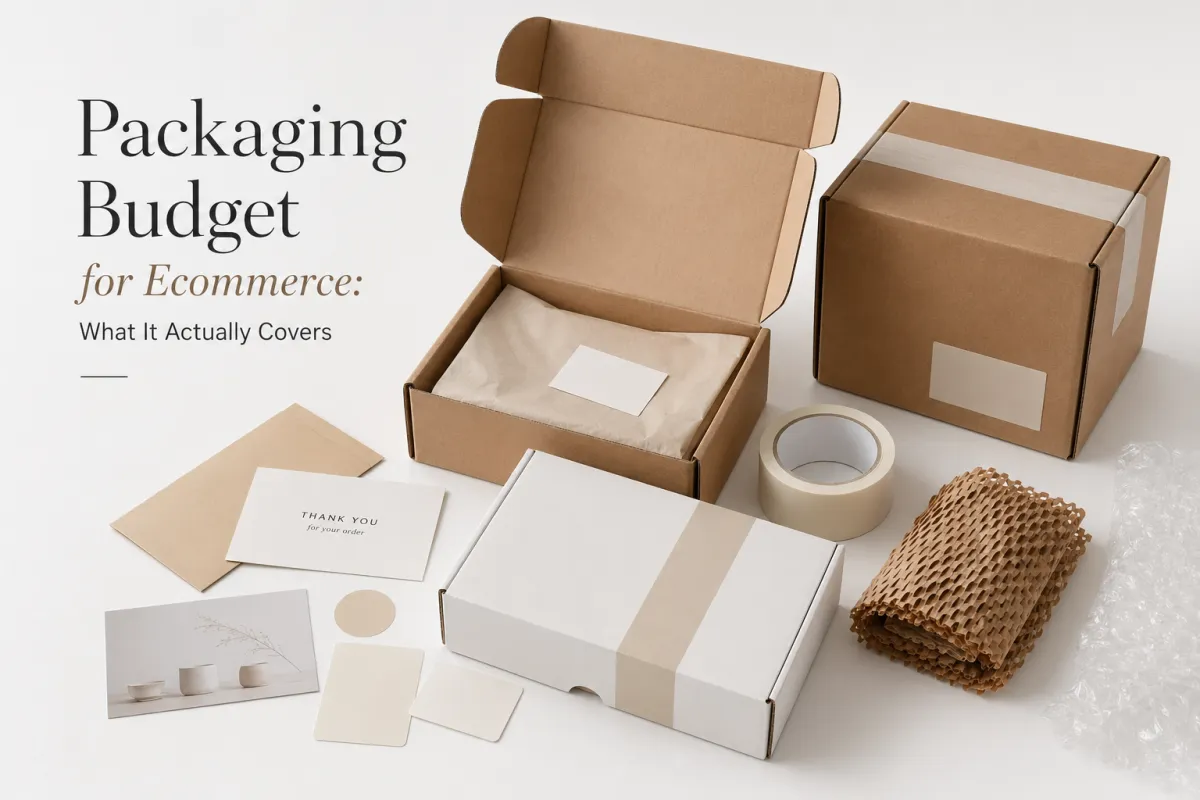
The packaging budget for ecommerce is the full cost of getting a product from your shelf to a customer's doorstep in one piece, with the brand looking like it knew what it was doing. I once saw a founder in a Shenzhen facility argue over a $0.05 change in board weight, then discover the thinner board doubled the damage rate on a 14-inch ceramic item shipped to Austin. That is not savings. That is a bill with better PR. I have also seen the reverse: a slightly heavier board, 32ECT with a kraft liner and water-based ink, looked expensive on paper and saved a fortune by not exploding in transit.
A clean definition helps. The packaging budget for ecommerce should include the outer shipper, any inner tray or insert, printed tissue, tape, labels, dunnage, anti-scratch protection, retail packaging if the product moves through stores later, freight to your warehouse, warehousing fees, and a small allowance for spoilage or rework. I usually tell clients to add a 5% to 8% cushion for the mess nobody wants to discuss until it is already on the invoice. If the product is fragile, weirdly shaped, or sold in a holiday rush, I have pushed that cushion to 10% because reality likes to show up uninvited at 7:45 a.m. with a pallet jack.
Packaging sits in two columns at once: brand expense and operations expense. That is the part people miss. When the unboxing feels polished, it can support repeat purchase behavior and make product packaging feel more expensive than it is. When the structure is wrong, it creates labor drag, damaged goods, and returns that chew through margin from both sides. A pretty box that wrecks fulfillment is not a win. It is a slow leak, and a leak of $0.21 per order across 18,000 orders is not a rounding error. It is a line item finance will notice three months later.
"I thought we were buying boxes, not freight, not inserts, not tape, and definitely not a headache." That was a direct quote from a client during a budget review in Dallas, and I still hear it whenever someone treats the packaging budget for ecommerce like a one-line expense.
My view is blunt: the packaging budget for ecommerce should be built around the customer journey, not around a single carton quote. If the box opens badly, if the insert is loose, or if label placement slows the packout team, the budget is already wrong. I would rather see a brand spend $0.11 more on a better fit than pay $0.40 in labor and damage later, especially when a 2 mm tolerance change can save 7 seconds per pack. That is not me being dramatic; that is me having seen the same mistake enough times to be mildly irritated on your behalf.
How a Packaging Budget for Ecommerce Works
The packaging budget for ecommerce works like a chain reaction, which is why one small decision can change five numbers at once. Start with SKU count, then product dimensions, then box size, then assembly method, then shipping lane. If a brand sells six sizes of candles and insists on six unique boxes, the budget gets heavier fast. Standardizing one or two structures usually cuts setup chaos and gives the supplier a cleaner quote, especially if the factory is in Foshan or Monterrey and wants to run 5,000 pieces per SKU instead of 1,000-piece fragments. I know that sounds boring. It is boring. It also saves money.
I like to map the sequence in the same order the work happens. First comes the dieline, often reviewed in Adobe Illustrator or ArtiosCAD. Then come sample rounds, usually one physical sample and one revision sample if the artwork or fit is tight. After that, the factory books production. Then transit starts, which can be 7 to 12 business days domestically or 25 to 40 days by ocean if the order crosses borders. The packaging budget for ecommerce should reflect all of that, not just the final carton price, because a proof approved on Monday in Los Angeles can still become a truckload problem by the second Friday.
Custom packaging behaves like a staged project. Design costs show up early, usually before you have a final unit price. Production costs show up later, often tied to minimum order quantities and print runs. Timing costs show up when someone drags their feet on approvals. I have seen a brand lose a prime production slot because the CEO wanted one more tiny logo tweak on a 1-color kraft mailer, which sounds harmless until the supplier slides you two weeks and the truck booking shifts too. Tiny tweaks have a knack for becoming very expensive hobbies.
The cheapest unit price is often a lie. I do not mean "slightly optimistic." I mean flat-out misleading. A $0.32 box that requires a $0.19 insert, a $0.06 sticker, a $0.10 labor step, and a freight penalty is not cheaper than a $0.58 mailer that packs in 18 seconds and fits the parcel rate better. That is why the packaging budget for ecommerce should always be measured as landed cost per order. If your budget is built on unit price alone, you are basically budgeting with one eye shut.
For brands sourcing Custom Printed Boxes, the best budget math starts with the actual order profile. Weight, fragility, average items per order, and return rate all matter. If your team ships one item most days but occasionally ships a three-piece bundle, the budget needs a case for both scenarios or you will undercount the assembly labor on busy weeks. A beauty brand shipping 3.2 oz jars needs a different budget than a 1.4 lb candle kit, and the difference can be $0.27 per order before freight even enters the room. Packaging is not impressed by marketing language.
Key Cost Factors in a Packaging Budget for Ecommerce
The biggest drivers in a packaging budget for ecommerce are usually material choice, quantity, labor, freight, and consistency. I have watched a 32ECT corrugated shipper price at $0.41 in one quote and $0.57 in another simply because one spec sheet said "brown box" and the other said "B-flute, 32ECT, kraft liner, 2-color print, water-based ink." Vague specs are expensive. They invite assumptions, and assumptions cost money. They also make suppliers look psychic, which is an unfair job description for anybody in Ohio, Guangdong, or Nuevo Leon.
Material sits first in line. A basic kraft mailer is not the same thing as a 24pt SBS carton with matte aqueous coating and a soft-touch laminate. Recycled content can move pricing too, especially if you ask for FSC chain-of-custody documentation. A 350gsm C1S artboard insert with a die-cut lock tab might cost $0.15 per unit at 5,000 pieces in Dongguan, while the same structure can jump by 20% if you want metallic foil or a full-bleed flood varnish. If the product is fragile, I like to compare board grades against a known test plan, and I usually point clients to ISTA testing standards so they stop guessing about drop resistance like it is a personality trait.
Volume tiers and MOQ math matter more than most founders expect. A 500-unit run can look expensive per box, but the total spend may still be lower than ordering 5,000 units you cannot store. I have seen a startup spend $6,200 on a big run of retail packaging in Ho Chi Minh City only to discover they needed a dieline change after the second product revision. That is how storage and write-off costs sneak into the packaging budget for ecommerce. The box itself was fine. The timing was the disaster, and the warehouse in New Jersey had no room left for 1,800 obsolete sleeves.
Labor is another quiet killer. Hand-packed inserts can add $0.08 to $0.22 per order depending on how fussy the assembly is. Sticker placement, tissue folding, ribbon tying, and kit assembly all eat time. If your warehouse team packs 1,000 orders a day, a slow structure can cost real money in overtime. I once watched a team in Phoenix spend more time folding tissue than actually packing orders, and by Friday the supervisor was quoting packing rates in seconds instead of units because the pain had become measurable.
Freight and dimensional weight are where the budget often gets dragged across the floor. A box that is two inches too tall can bump you into a higher rate tier on parcel carriers. That extra volume can cost more than the print upgrade you spent three meetings approving. In the packaging budget for ecommerce, shipping efficiency is not a side note. It belongs in the spec. If the carton shape makes your carrier bill sulk, the design is costing you twice, once at procurement and again at checkout.
Supplier geography matters too. A quote from Dongguan, a quote from Ohio, and a quote from northern Mexico will not behave the same once you add transit, customs, pallets, and the cost of one more proof. In one negotiation, a paper mill adjustment moved linerboard pricing by roughly $38 per metric ton during the quote window. The supplier did not "forget" to mention it. Paper prices moved, and the budget had to move with them. Packaging procurement is basically a very organized conversation with a market that refuses to stay still.
| Packaging Option | Typical Unit Cost at 5,000 Units | Best Use Case | Budget Impact |
|---|---|---|---|
| Kraft mailer, one-color print | $0.42 to $0.68 | Light apparel, accessories, low-breakage goods | Lower print cost, good freight efficiency |
| E-flute custom printed box | $0.78 to $1.25 | Beauty, candles, small electronics, giftable product packaging | Balanced branding and protection |
| Rigid setup box with insert | $1.80 to $3.50 | Premium launches, jewelry, high-margin kits | High visual impact, higher storage and freight costs |
| Mailer plus die-cut insert | $0.55 to $0.95 | Mixed-SKU orders, subscription kits, branded packaging | Good fit control, moderate labor requirement |
The table above is not a promise. It is a working range, and real quotes shift with paper grade, print coverage, and supplier location. Still, it gives you a better floor for the packaging budget for ecommerce than the usual "I saw a box online for 29 cents" conversation, which is about as useful as a cardboard umbrella in a rainstorm. I have had people present those bargain screenshots with a straight face, as if a single internet price settled the whole question. It never does.
Another cost factor people ignore is consistency. A supplier that misses caliper by 10% can create an endless stream of tiny problems: jammed automation, loose product fit, shifted inserts, and more customer complaints than your service team wants to read on Monday morning. The cheapest quote is not cheap if lot-to-lot variation wrecks the plan. In my opinion, consistency is one of the most underrated line items in the whole budget, because it does not shout until something goes wrong.
Step-by-Step: Build Your Packaging Budget for Ecommerce
The simplest packaging budget for ecommerce starts with a clean list and a ruthless pencil. Not glamorous. Useful. I have built enough budgets on factory floors in Shenzhen and San Diego to know that guessing from memory is how people miss the extra sleeve, the second label, or the $0.07 foam corner that never made it into the original spreadsheet. Memory is a terrible accountant. It means well, but it lies under pressure.
- List every package type by channel. Direct-to-consumer, wholesale, and subscription packs should not share assumptions. A wholesale shipper may need more protection, while a DTC pack may need stronger presentation. One spec rarely fits all three, and a 10-count wholesale carton can cost $0.33 more to pack than a single-unit mailer. I have seen brands try to force it, and the result is usually a compromise nobody loves.
- Measure the order profile. Record average item count, weight, fragility, return rate, and seasonal spikes. If 70% of your orders are under 1.5 lb and the rest are bundled kits, the packaging budget for ecommerce should separate those cases instead of blending them into a fake average. The fake average looks tidy. Tidy is not the same as true, especially when 2,000 Q4 orders hit in 6 business days.
- Request apples-to-apples quotes. Send the same spec sheet to at least two suppliers. Use board grade, print method, dimensions, finish, and quantity. Vague requests create vague quotes, and vague quotes are how people compare apples to expensive mystery fruit. I have never once seen a "close enough" spec save a budget, whether the factory was in Ohio or Dongguan.
- Add sample and revision costs. Physical samples might run $35 to $120 each, depending on complexity. If the artwork changes twice, the dieline changes once, and the fit is tight, you need a budget line for rework. That is not waste. It is part of the process. A supplier in Mexico City may quote 2 samples for free on a 10,000-unit run, but the third revision still costs time, and time is where the hidden money lives.
- Calculate landed cost per order. This is the number that matters. Include box cost, inserts, freight, labor, spoilage allowance, and storage. If the landed cost still leaves your target margin intact, the packaging budget for ecommerce is probably healthy. If not, the budget is telling you something useful, even if that something is annoying and arrives in an invoice PDF.
Do not skip the sample round. I can still picture a client in a Guangdong plant who approved a gorgeous printed sleeve from a PDF mockup, then realized the real bottle had a 2 mm shoulder that tore the top flap. One sample would have saved three weeks and a reprint fee. That was a $1,900 mistake caused by optimism and a laptop screen. I have made peace with the fact that screens are liars when packaging is involved, especially when the ink density looks different under warehouse LEDs than it does on a MacBook.
When I build the budget, I also add a contingency bucket for the ugly stuff: rush production, material substitutions, freight swings, or a last-minute SKU change. A 7% reserve is common for a first run. If the program is larger or the launch date is fixed, I have seen people go to 10% just to avoid panic pricing. The packaging budget for ecommerce should make room for reality, because reality always shows up. Usually with a deadline, a bad mood, and a request for a revised proof by 4:00 p.m.
If you are sourcing from a supplier that also handles Custom Packaging Products, ask them to quote the packaging, assembly, and freight separately. That split matters. A total program quote can hide whether you are paying too much for materials or too much for the labor to pack them. Separating those pieces is how you keep the packaging budget for ecommerce honest. I am a big fan of uncomfortable clarity; it saves everyone from the "wait, what is this charge?" email later.
Common Packaging Budget Mistakes Ecommerce Brands Make
The most common mistake in a packaging budget for ecommerce is budgeting for the outer box and forgetting the rest of the stack. Inserts, void fill, tape, labels, tissue, desiccant, packing labor, and freight all take a bite. I see this every quarter. Someone gets a unit price on a box and acts like the project is done. It is not even close. That feeling of "we are almost there" is usually how a budget goes to hide behind a plant and smoke a cigarette.
Mistake number two is choosing a box size that looks efficient on paper but triggers higher parcel charges. Dimensional weight can make a "smaller" package more expensive if it is tall, airy, or awkward. I once reviewed a launch where the team saved $0.04 on corrugated board and lost $0.36 per shipment in carrier fees across 12,000 orders. That is the sort of math that should offend your common sense immediately. The packaging budget for ecommerce has to account for shipping math, not just purchase price. If you ignore that, your carrier will happily remind you.
Mistake number three is approving a design without packing the actual product inside it. A flat render is not a fit test. A nice mockup is not a drop test. When you skip the real sample, you risk crushed corners, crooked inserts, and an unboxing that looks like the package got into a fight and lost. If the product is delicate, use a real sample and, if needed, a proper EPA sustainable materials management resource review so waste, recyclability, and material choice are part of the decision instead of an afterthought. I have learned the hard way that "looks right" and "survives transit" are very different species.
Mistake number four is assuming lead times are fixed. They are not. Dieline approval, sample revisions, press scheduling, transit, and inbound receiving all move the finish line. If a proof comes back late by three days, the launch can slip, and once the launch slips, rush freight and overtime can get ugly. I have seen a 12-business-day plan turn into 21 because a logo file arrived with the wrong color profile from a team in Brooklyn that swore the file was final. The file was technically "fine," which is corporate for "this will now be a problem."
Mistake number five is chasing the lowest quote without checking whether the supplier can actually hold spec. A factory can quote beautiful numbers and still miss on glue strength, board consistency, or print accuracy. One supplier in a negotiation offered a very low price on a run of 20,000 Custom Printed Boxes, then admitted they could not guarantee the same liner on the full lot. That is not a deal. That is a future complaint log. I would rather pay a little more and sleep than save a few cents and spend my week chasing defects.
Frankly, the packaging budget for ecommerce breaks most often because people confuse unit cost with program cost. Those are not the same thing. A penny saved on paper can vanish in freight, labor, or damage before the first customer opens the box. The only budget that matters is the one that survives a real shipment and a real warehouse shift, ideally on 1,500 orders in one week, not a spreadsheet projected from optimism. Everything else is a fantasy with decent typography.
Expert Tips to Lower Costs Without Weakening the Brand
The best way to improve a packaging budget for ecommerce is not to make the packaging sad. It is to make it smarter. I have spent enough time on factory floors to know that savings often come from fit, standardization, and print restraint, not from stripping away every detail until the package looks like office supplies. Nobody wants a premium product arriving in packaging that says, "We gave up halfway through," especially when the item itself cost $42 and the box cost $0.68.
Start by standardizing box sizes across compatible SKUs. If four products can live in one internal size with only a small insert change, do that. Fewer structures usually mean better pricing, simpler forecasting, and less warehouse confusion. I have seen a brand cut three SKUs of packaging down to one base mailer and save $0.12 to $0.18 per order in both procurement and handling. That is the kind of move that respects the packaging budget for ecommerce and the fulfillment team at the same time. And the fulfillment team, frankly, is usually the one doing the real hero work at 6:30 p.m.
Use print strategically. A one-color exterior on kraft stock can look sharp if the typography is deliberate and the layout is clean. Put the money where people actually notice it: the first reveal, the insert card, the inner flap, the tissue, or the thank-you note. That is smarter package branding than covering every surface with ink just because the press can do it. I have seen brands spend an extra $0.21 on all-over print when a stronger logo placement and better structure would have done more for the customer experience. Pretty is not the same thing as effective.
Negotiate on the total program, not one lonely line item. A supplier may not move much on board price, but they might soften freight, absorb one revision, or adjust the packing labor rate if the overall volume is attractive. In one factory meeting in Monterrey, I traded a 10,000-unit commitment for a lower setup fee and saved a client $860 on the first run alone. That was not magic. It was just a better conversation around the packaging budget for ecommerce. Suppliers are people too; they respond to clarity, volume, and the occasional reasonable favor.
Tighten the fit. A package that reduces void fill by 30% can lower material cost, labor time, and damage rates in the same stroke. That is rare. Usually one lever helps while another hurts. Fit is one of those annoying exceptions where better design actually makes the budget healthier. If you need help specifying the right structure, browse the Custom Packaging Products line and compare mailers, inserts, and printed cartons against your actual order profile. I know that sounds practical because it is practical, and practical wins a lot of arguments.
My favorite factory-floor tip is simple: ask for a physical sample packed with the real product before you lock the budget. Not the prototype. The real thing. A 2.1 oz serum bottle, a 7.8-inch candle, a 1.4 lb supplement jar, whatever the actual item is. I have seen more bad assumptions collapse in one afternoon with a sample box than in six weeks of email threads. The packaging budget for ecommerce gets better the moment real product meets real packaging. That moment is often humbling, which is another way of saying useful.
Do not ignore sustainability if your customers care about it. FSC-certified board, recycled content, and better pack size control can all reduce waste in a way that helps both brand and operations. That does not mean every package has to become a manifesto. It means the packaging should earn its keep. If it protects the product, looks good, and avoids unnecessary material, the budget usually gets healthier too. I think that is a fair trade, and frankly, consumers can spot fake eco-posturing from a mile away.
Next Steps to Tighten Your Packaging Budget for Ecommerce
If you want a stronger packaging budget for ecommerce this week, start with an audit. Pull the last three packaging invoices, the freight charges, the damage claims, and the labor notes from your warehouse team. Put them on one page. I do this with clients because a clean one-page view beats a 47-tab spreadsheet every single time. People relax when the picture gets simple, which is convenient because packaging already creates enough stress without extra tabs and four color-coded workbooks.
Rank your top three waste drivers after that. Maybe it is oversized boxes. Maybe it is rework. Maybe it is the extra insert that nobody actually reads. Once you know the biggest leak, you can fix the right thing first. That is the boring answer, but boring saves money. I have never met a founder who regretted finding a $0.09 problem before it became a $9,000 problem. I have met plenty who regretted ignoring it, though, usually right after the first bad quarter.
Ask for one revised quote and one physical sample next. Just one. Not twelve. Change the thing that looks most expensive in your real shipment flow and test the result. If the packaging gets cheaper, lighter, or faster to pack without hurting presentation, you are moving in the right direction. That is how the packaging budget for ecommerce gets tighter without becoming miserable. There is no prize for suffering through avoidable complexity, especially when a revised die-cut can save 5 seconds per unit.
If you are comparing suppliers right now, ask them to quote the same spec, the same quantity, and the same freight terms. Then compare landed cost, not just unit cost. The difference between those two numbers is usually where the budget truth lives. It is also where people discover that the "cheap" option was never cheap at all. I have seen this revelation more times than I can count, from Seattle to Singapore, and it never gets less satisfying.
My blunt advice: stop guessing and start measuring every layer of the packaging budget for ecommerce. That means box cost, insert cost, freight, labor, storage, and damage rate. Once you see those numbers side by side, the decision gets easier. The brand gets stronger. The warehouse stops cursing. And your margin finally has a chance to breathe, even if you are shipping 8,000 units a month from two different facilities. I wish more budgets were built this way from the start, but if they were, I would have fewer war stories and maybe a less dramatic coffee habit.
How do I estimate a packaging budget for ecommerce before launch?
Start with every component, not just the outer carton: box, insert, tape, labels, void fill, printing, and freight. Then multiply by your expected order volume and average parcel weight so the packaging budget for ecommerce reflects landed cost per order. Add a 5% to 10% contingency for sampling, reprints, and freight swings so launch does not blow up on day one. If your product is fragile or your launch date is locked, I would lean toward the higher end, because launch week has a talent for chaos and a 14-business-day timeline can turn into 19 quickly.
What percentage of revenue should packaging take in ecommerce?
There is no magic percentage, because product value, margin, and shipping method change the math. A low-margin item needs stricter control than a premium product with a higher average order value. The better question is whether the packaging budget for ecommerce still leaves enough margin after freight, fulfillment, and expected damage replacements. For a brand selling $48 candles, a packaging spend of $1.10 may be fine; for a $14 accessory, it could be too high. In my opinion, a good budget is one that protects profit without making the customer experience feel cheap.
What are the biggest hidden costs in ecommerce packaging?
Freight, dimensional weight, and packing labor usually surprise people first. Sampling, design revisions, and rush production can also add costs before the first order ships. Damage rates matter too, because cheap packaging that fails creates replacement shipments and customer service costs that swell the packaging budget for ecommerce fast. I have watched one weak structure create more cost in replacements than the original packaging ever saved, especially on a 6,000-unit run out of a plant in Guangdong. That stings.
How long does it take to build a custom packaging budget for ecommerce?
A basic draft can be built in a day if the product specs are clear. Custom packaging usually takes longer because you need sampling, revisions, and supplier quoting time. If you want numbers you can trust, leave enough room to test a sample before you lock the final packaging budget for ecommerce. A realistic timeline is 12 to 15 business days from proof approval for production on many standard runs, plus shipping time if the factory is in southern China or northern Mexico. Rushing this part is how people end up paying twice and pretending it was just a timing issue.
Should I choose the cheapest packaging supplier?
Not automatically. The cheapest quote can hide weak materials, higher freight, or inconsistent production. Compare landed cost, sample quality, and reliability, not just the unit price on paper. The best supplier is the one that protects margin, presentation, and delivery performance together, which is exactly how a smart packaging budget for ecommerce should work. If a supplier sounds too good to be true, I usually assume the missing cost is waiting somewhere else in the spec sheet or the freight bill.

